towing CHEVROLET S10 1994 2.G Owners Manual
[x] Cancel search | Manufacturer: CHEVROLET, Model Year: 1994, Model line: S10, Model: CHEVROLET S10 1994 2.GPages: 340, PDF Size: 18.45 MB
Page 59 of 340
Downloaded from www.Manualslib.com manuals search engine NOTICE:
Your engine is designed to work with the electronics in your
vehicle.
If you add electrical parts or accessories, you could
change the way the fuel injection system operates. Before adding
electrical equipment, check
with your dealer. If you don’t, your
engine might not perform properly.
If you ever have to have your vehicle towed, see the part of this
manual that tells how to do it without damaging your vehicle.
See “Towing Your Vehicle” in the Index.
To start your 4.3 Liter engine:
1. Without pushing the accelerator pedal, turn your ignition key t\
o “Start.”
When the engine starts, let go of the key. The idle speed will go down
as your engine gets warm.
NOTICE:
Holding your key in “Start” for longer than 15 seconds at a time
will cause your battery to be drained much sooner.
And the
excessive heat can damage your starter motor.
2. If it doesn’t start right away, hold your key in “Start.” If
it doesn’t start
in three seconds, push the accelerator pedal about one-quarter
of the
way down for 12 more seconds, or until
it starts.
flooded with too much gasoline.
Try this:
3. If your engine still won’t start (or starts but then stops), it could be
Wait 15 seconds to let the starter motor cool down. Then push\
your accelerator pedal all the way to the floor.
Hold it there. Then, hold the
key in “Start” for no more than ten seconds. This clears the extra
gasoline from the engine.
If the engine still doesn’t start, wait another 15 seconds and do it all
again.
When the engine starts, let go of the key and the accelerator pedal.
2-13
Page 60 of 340
Downloaded from www.Manualslib.com manuals search engine NOTICE:
Your engine is designed to work with the electronics in your
vehicle.
If you add electrical parts or accessories, you could
change the
way the fuel injection system operates. Before adding
electrical equipment, check with your dealer.
If you don’t, your
engine might not perform properly.
If you ever have to have your vehicle towed, see the part of this
manual that tells how to do it without damaging your vehicle.
See “Towing Your Vehicle” in the Index.
Driving Through Deep Standing Water
NOTICE:
If you drive too quickly through deep puddles or standing water,
water can come in through your engine’s air intake and badly
damage your engine.
If you can’t avoid deep puddles or standing
water, drive through them very slowly.
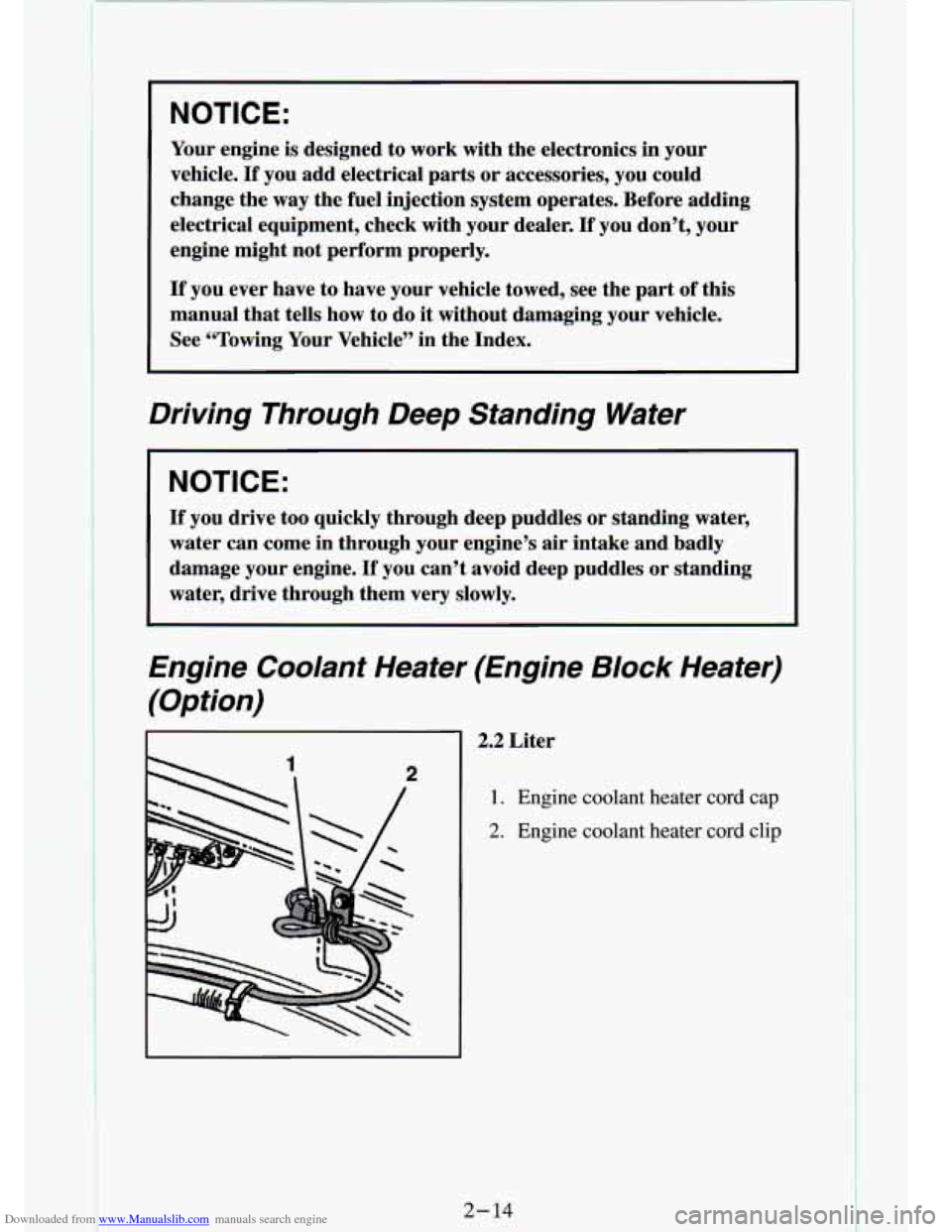
Engine Coolant Heater (Engine Block Heater)
(Option)
2.2 Liter
1. Engine coolant heater cord cap
2. Engine coolant heater cord clip
i
2- 14
Page 64 of 340
Downloaded from www.Manualslib.com manuals search engine NOTICE:
Damage to your transmission caused by shifting out of “P”
(Park) or “N” (Neutral) with the engine racing isn’t covered by
your warranty.
@ (Overdrive)
This position is for normal driving. If you need more p . rer f_ r
passing, and you’re:
- Going less than about 35 mph (56 ludh), push your accelerator
- Going about 35 mph (56 km/h) or more, push the accelerator all
pedal about halfway down.
the
way down.
You’ll shift down to the next gear and have more power.
@ should not be used when towing a trailer, carrying a heavy
load, driving on steep hills, or for off-road driving. Select
“D”
(Third Gear) when operating the vehicle under any of these
conditions.
D (Third Gear)
This is like @, but you never go into Overdrive. You should use “D”
(Third Gear) when towing a trailer, carrying a heavy load, driving on
steep hills, or for off-road driving.
2 (Second Gear)
This position gives you more power but lower fuel economy. You can
use
“2” (Second Gear) on hills. It can help control your speed as y\
ou go
down steep mountain roads, but then you would also want to use your
brakes
off and on.
If you manually select “2” (Second Gear), the transmission will drive
in second gear. You may use this feature for reducing torque to the rear
wheels when you are trying to start your vehicle from a stop on
slippery road surfaces.
1 (First Gear)
This position gives you even more power (but lower fuel economy)
than
“2” (Second Gear). You can use it on very steep hills, or in deep
snow or mud. If the selector lever is put in
“1” (First Gear), the
transmission won’t shift into
“1” (First Gear) until the vehicle is going
slowly enough.
2- 18
Page 68 of 340

Downloaded from www.Manualslib.com manuals search engine ..
NOTICE:
Driving with the parking brake on can cause your rear brakes \
to overheat. You may have to replace them, and you could also
damage other parts
of your vehicle.
If you are on a hill: See “Parking on Hills” in the Index. That section
shows how
to turn your front wheels.
If you are towing a trailer and are parking on any hill: See “Towing a
Trailer” in the Index. That section shows what to
do first to keep the trailer
from moving.
Shifting Into ‘6P’’ (Park)
(A utomaticTransmission Models Only)
1. Hold the brake pedal down with your right foot and set the parking
brake.
2-22
I I
Page 70 of 340
Downloaded from www.Manualslib.com manuals search engine Torque Lock (Automatic Transmission)
If you are parking on a hill and you don’t shift your transmission into “P’
(Park) properly, the weight of the vehicle may put too much force on the
parking pawl in the transmission. You may find it difficult to pull the shift
lever out of
“P” (Park). This is called “torque lock.” To prevent torque lock,
set the parking brake and
then shift into “P” (Park) properly before you
leave the driver’s seat.
To find out how, see “Shifting Into ‘P’ (Park)” in the
Index.
When you are ready to drive, move the shift lever out of
“P” (Park)
BEFORE you release the parking brake.
If “torque lock” does occur, you may need to have another vehicle push
yours a little uphill
to take some of the pressure from the transmission, so
you can pull the shift lever out of “P’ (Park).
Parking Your Vehicle (Manual Transmission
Models Only)
Before you get out of your vehicle, turn off your engine, put your manual
transmission in
“R’ (Reverse) and firmly apply the parking brake.
lr you have four-wheel drive with a manual transfer case shift lever, be sure
your transfer case is
in a drive gear. Your vehicle could roll if it isn’t.
If you are parking on
a hill, or if your vehicle is equipped to tow a trailer,
see “Parking on Hills” or “Towing
a Trailer” in the Index.
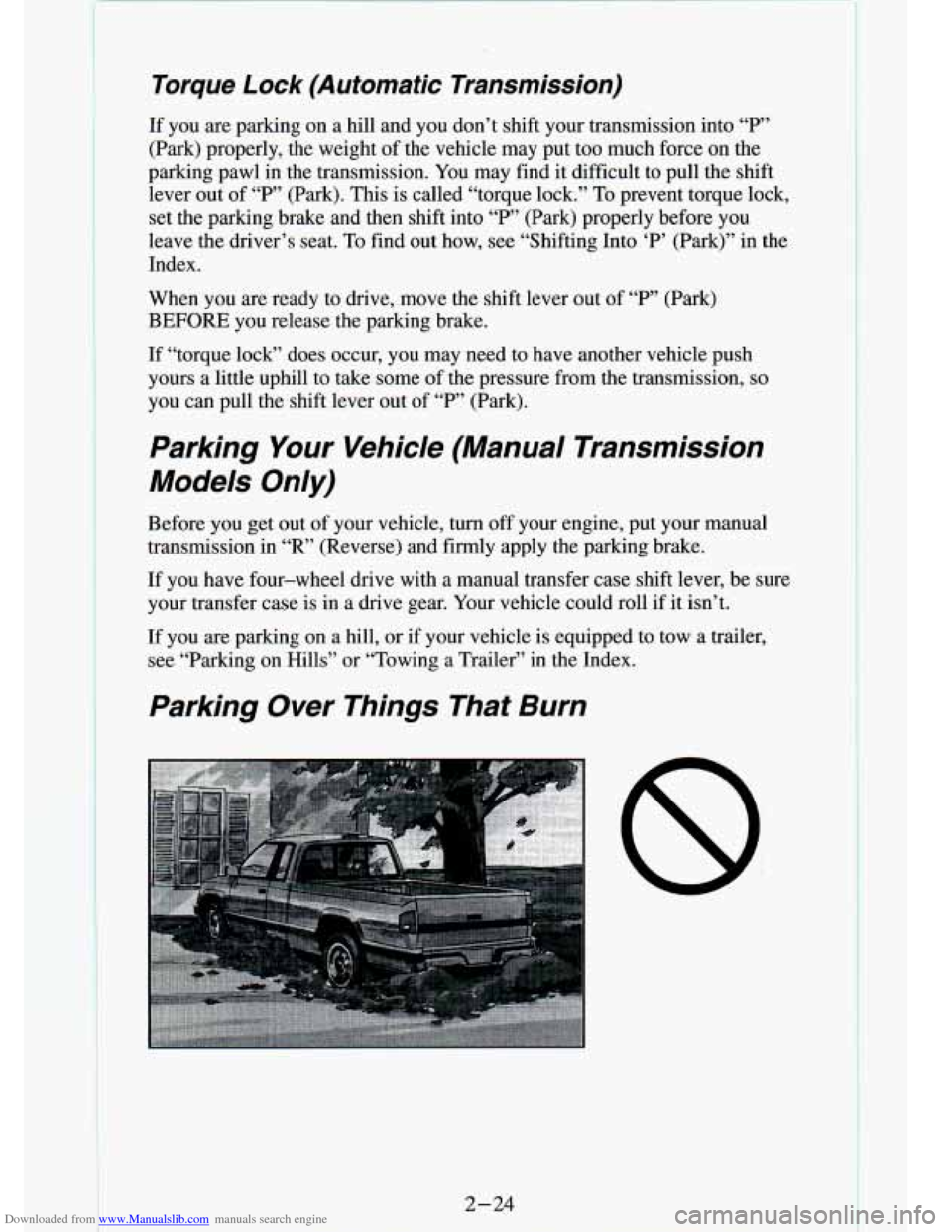
Parking Over Things That Burn
8
2- 24
Page 72 of 340
Downloaded from www.Manualslib.com manuals search engine Running Your Engine While You’re Parked
(Automatic Transmission)
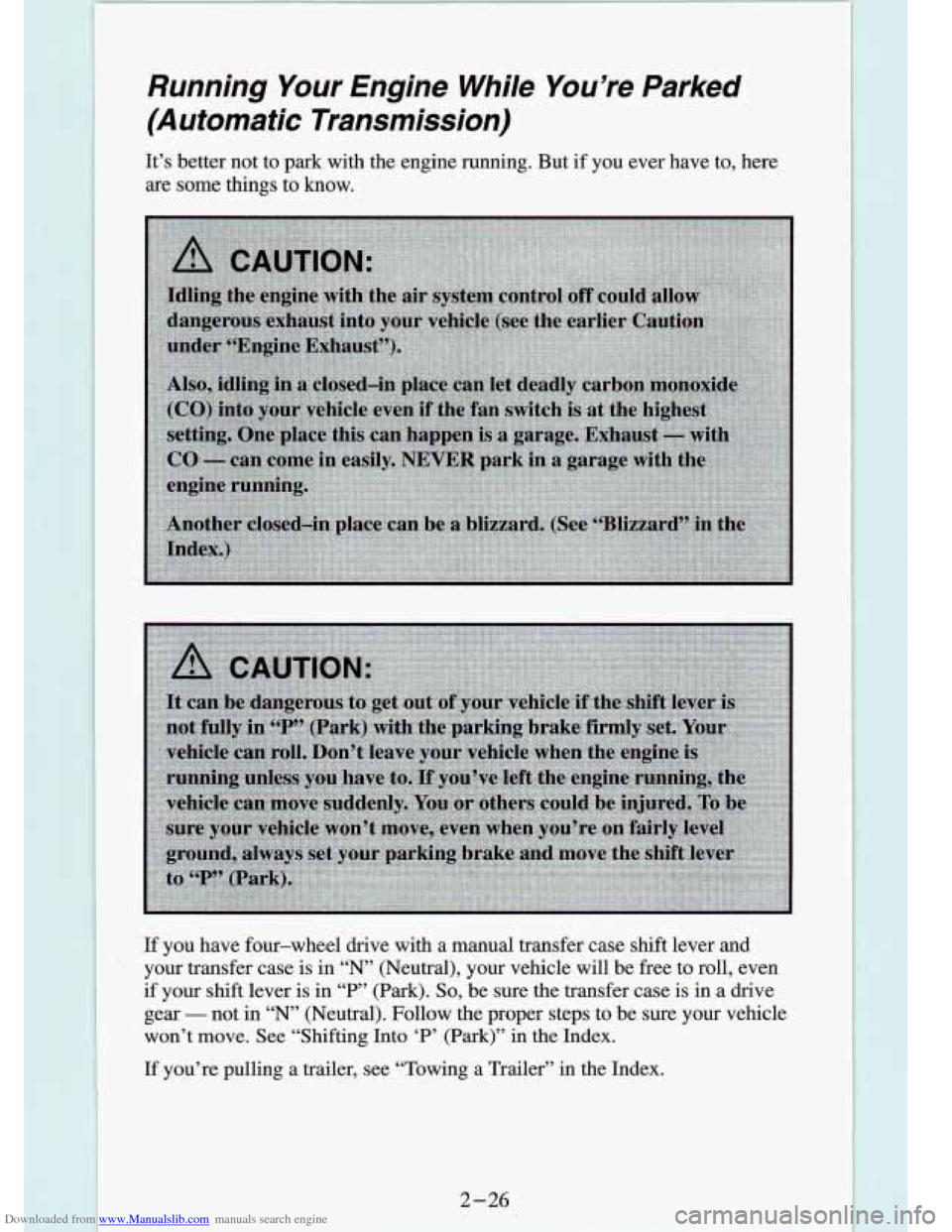
It’s better not to park with the engine running. But if you ever have to, here
are some things
to know.
If you have four-wheel drive with a manual transfer case shift lever and
your transfer case is in “N” (Neutral), your vehicle wi\
ll be free to roll, even
if your shift lever is in “P’ (Park). So, be sure the transfer case is in a drive
gear
- not in “N’ (Neutral). Follow the proper steps to be sure your vehicle
won’t move. See
“Shifting Into ‘P’ (Park)” in the Index.
If you’re pulling a trailer, see “Towing a Trailer’’ in\
the Index.
2-26
Page 81 of 340
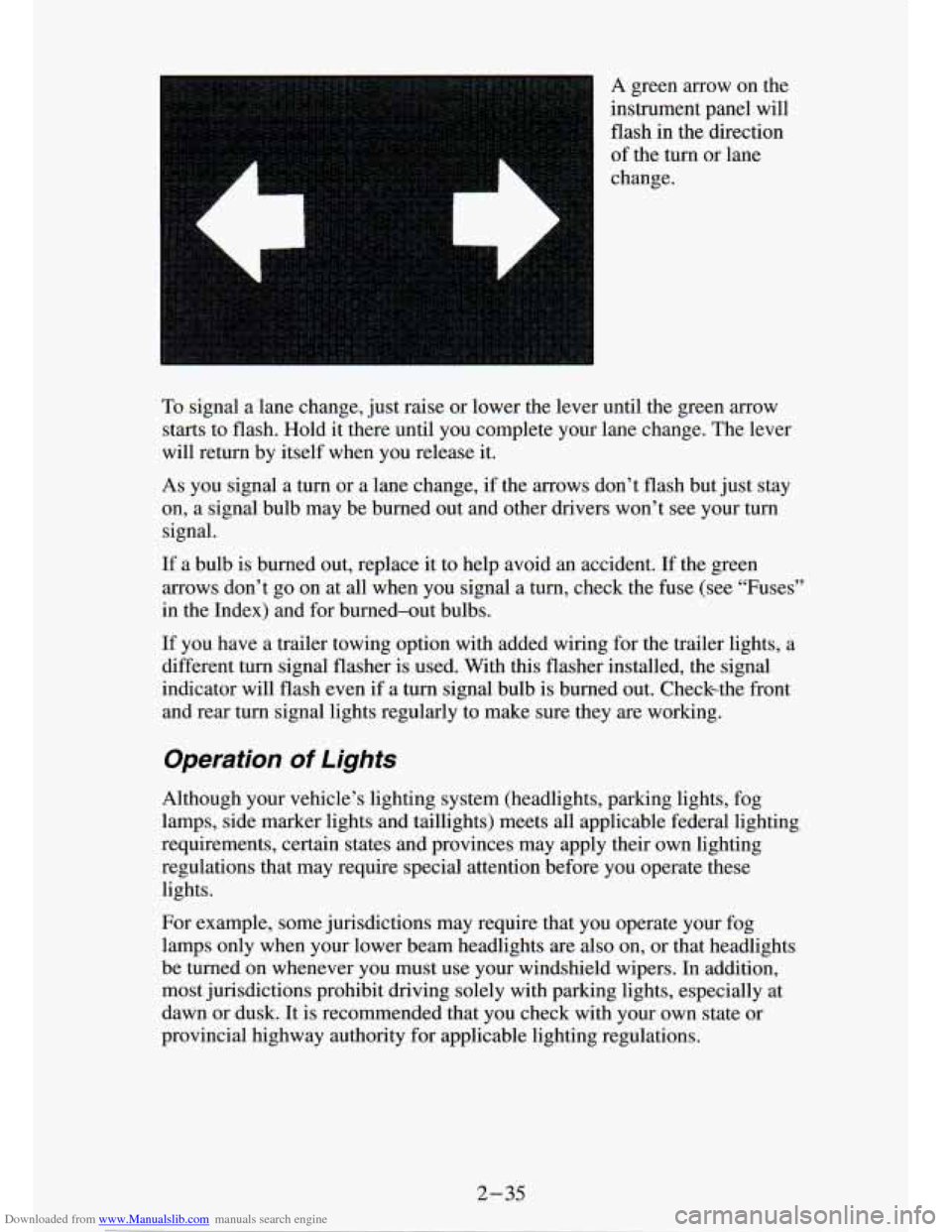
Downloaded from www.Manualslib.com manuals search engine A green arrow on the
instrument panel will
flash in the direction
of the turn
or lane
change.
To signal a lane change, just raise or lower the lever until the green arrow
starts to flash. Hold it there until you complete your lane change. The lever
will return by itself when you release it.
As you signal a turn or a lane change, if the arrows don’t f\
lash but just stay
on, a signal bulb may be burned out and other drivers won’t see your turn
signal.
If a bulb is burned out, replace it to help avoid an accident. If the green
arrows don’t go
on at all when you signal a turn, check the fuse (see “Fuses”
in the Index) and for burned-out bulbs.
If you have a trailer towing option with added wiring for
the trailer lights, a
different turn signal flasher is used. With this flasher installed, the signal
indicator will flash even if a turn signal bulb is burned out. Checkthe front
and rear turn signal lights regularly to make sure they
are working.
Operation Of Lights
Although your vehicle’s lighting system (headlights, parking \
lights, fog
lamps, side marker lights and taillights) meets all applicable federal ligh\
ting
requirements, certain states and provinces may apply their own lighting
regulations that may require special attention before you operat\
e these
lights.
For example, some jurisdictions may require that you operate your f\
og
lamps only when your lower beam headlights
are also on, or that headlights
be turned on whenever you must use your windshield wipers. In add\
ition,
most jurisdictions prohibit driving solely with parking lights, \
especially at
dawn or dusk. It is recommended that you check with your own state or
provincial highway authority for applicable lighting regulations.
2 -35
Page 105 of 340
Downloaded from www.Manualslib.com manuals search engine Brake System Warning Light
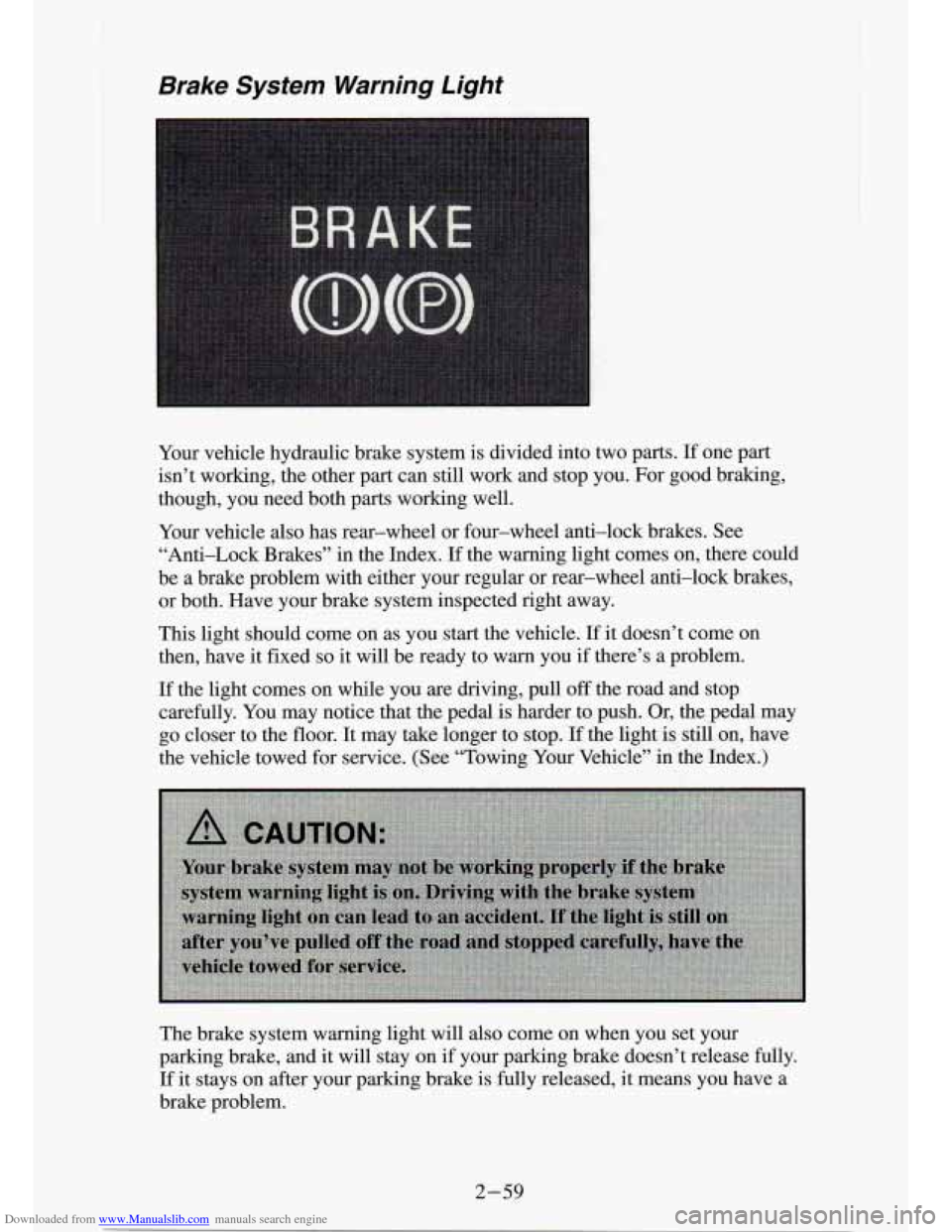
Your vehicle hydraulic brake system is divided into two parts. If one part
isn’t working, the other part can still work and stop you. For good braking,
though, you need both parts working well.
Your vehicle also has rear-wheel or four-wheel anti-lock brakes. See \
“Anti-Lock Brakes” in the Index.
If the warning light comes on, there could
be a brake problem with either your regular or rear-wheel anti\
-lock brakes, or both. Have your brake system inspected right away.
This light should come on as you start the vehicle.
If it doesn’t come on
then, have it fixed
so it will be ready to warn you if there’s a problem.
If the light comes on while you are driving, pull off the road and stop
carefully. You may notice that the pedal
is harder to push. Or, the pedal may
go closer to the floor. It may take longer to stop.
If the light is still on, have
the vehicle towed for service. (See “Towing Your Vehicle” in the Index.)
The brake system warning light
will also come on when you set your
parking brake, and it will stay on
if your parking brake doesn’t release fully.
If it stays on after your parking brake is fully released, it means you have a
brake problem.
2-59
Page 137 of 340

Downloaded from www.Manualslib.com manuals search engine Your Driving and the Road
Section
.
Here you’ll find information about driving on different kinds\
of roads and in
varying weather conditions
. We’ve also included many other useful tips on
driving
.
Defensive Driving .......................................... 4-2
Drunken Driving
........................... : ............... 4-2
Control of a Vehicle
Braking
................................................ 4-5
Steering ................................................ 4-8
Steering Tips
............................................ 4-8
Passing
............................................... 4-11
Loss of Control ......................................... 4-12
Driving Guidelines
......................................... 4-13
Off-Road Driving With Your Four-wheel Drive Vehicle
.......... 4-13
DrivingatNight
........................................... 4-25
Driving in the Rain
........................................ 4-26
Freeway Driving
.......................................... 4-29
CityDriving
.............................................. 4-28
Hill and Mountain Roads
.................................... 4-31
WinterDriving
............................................ 4-33
Recreational Vehicle Towing (Four-wheel Drive Only)
........... 4-36
TowingaTrailer
........................................... 4-38
4-1
Page 172 of 340
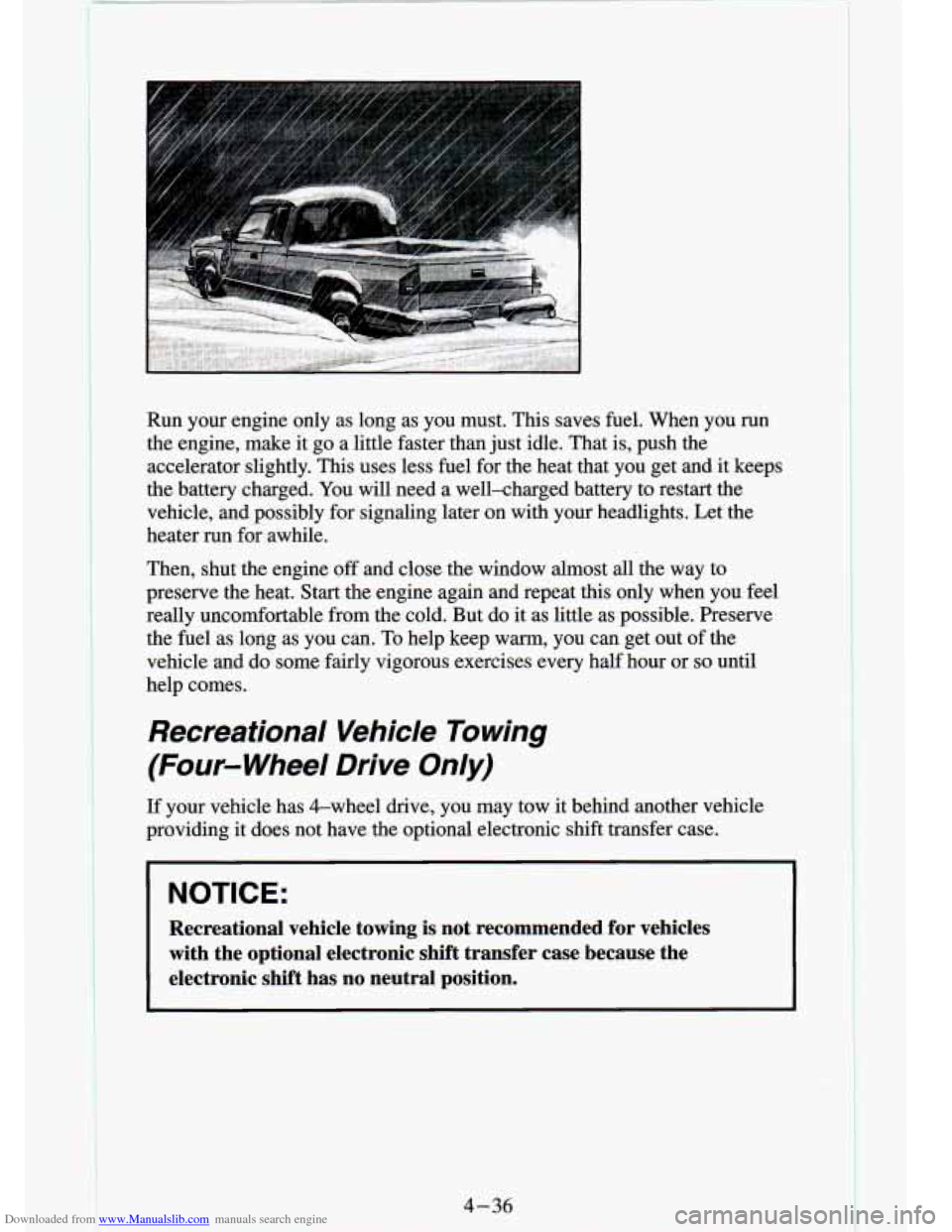
Downloaded from www.Manualslib.com manuals search engine Run your engine only as long as you must. This saves fuel. When you run
the engine, make it go a little faster than just idle. That is, push the
accelerator slightly. This uses less fuel for the heat that you get and it keeps
the battery charged. You will need a well-charged battery to restart the
vehicle, and possibly for signaling later on with your headlights. Let the
heater run for awhile.
Then, shut the engine off and close the window almost all the way to
preserve the heat. Start the engine again and repeat this only\
when you feel
really uncomfortable from the cold. But do it as little as possible. Preserve
the fuel as long as you can. To help keep warm, you can get out of the
vehicle and do some fairly vigorous exercises every half hour \
or
so until
help comes.
Recreational Vehicle Towing
(Four- Wheel Drive Only)
If your vehicle has &wheel drive, you may tow it behind another vehicle
providing it does not have the optional electronic shift transfer case.
NOTICE:
Recreational vehicle towing is not recommended for vehicles
with the optional electronic shift transfer case because the
electronic shift has no neutral position.
4-36