ESP CHEVROLET S10 1995 2.G Owner's Manual
[x] Cancel search | Manufacturer: CHEVROLET, Model Year: 1995, Model line: S10, Model: CHEVROLET S10 1995 2.GPages: 354, PDF Size: 18.92 MB
Page 233 of 354
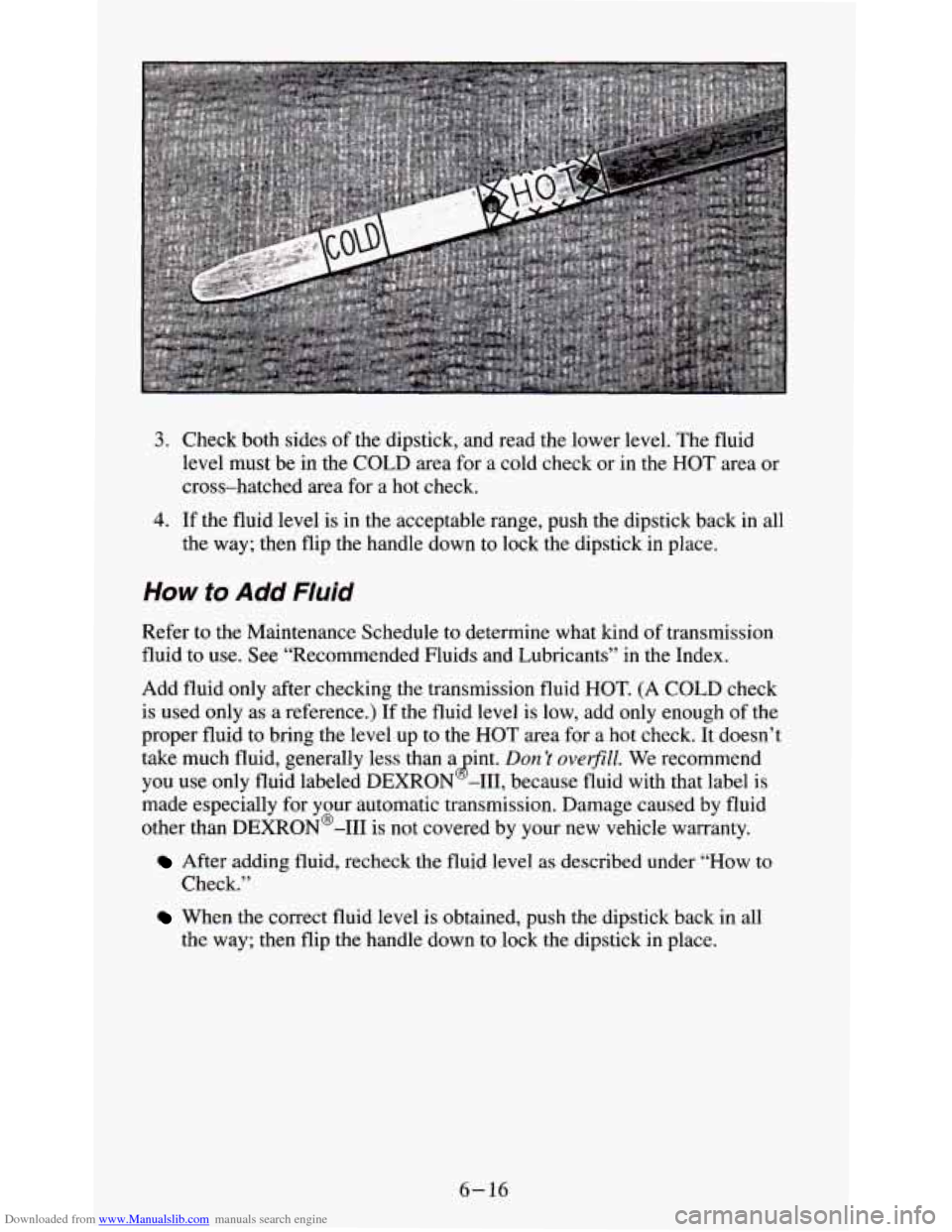
Downloaded from www.Manualslib.com manuals search engine 3. Check both sides of the dipstick, and read the lower level. The fluid
level must be
in the COLD area for a cold check or in the HOT area or
cross-hatched area for a hot check.
4. If the fluid level is in the acceptable range, push the dipstick back in all
the way; then flip the handle down to lock the dipstick
in place.
How to Add Fluid
Refer to the Maintenance Schedule to determine what kind of transmission
fluid to use.
See “Recommended Fluids and Lubricants” in the Index.
Add fluid only after checking the transmission fluid HOT.
(A COLD check
is used only as
a reference.) If the fluid level is low, add only enough of the
proper fluid to bring the level up to the
HOT area for a hot check. It doesn’t
take much fluid, generally less than a int.
Don ’I overjill. We recommend
you use only fluid labeled DEXRON -111, because fluid with that label is
made especially for your automatic transmission. Damage caused by fluid
other than DEXRON@-I11 is not covered by your new vehicle warranty.
After adding fluid, recheck the fluid level as described under “How to
8
Check.”
When the correct fluid level is obtained, push the dipstick back in all
the wav: then flip the handle down to lock the dipstick in place.
6- 16
Page 258 of 354
Downloaded from www.Manualslib.com manuals search engine NOTICE:
~~
Don’t let anyone tell you that underinflation or overinflation is
all right. It’s not. If your tires don’t have enough air
(underinflation) you can get:
Too much flexing
Too much heat
Tire overloading
Bad wear
Bad handling
Bad fuel economy.
If your tires have too much air (overinflati
Unusual wear
Bad handling
Rough ride
Needless damage from road hazards. can
get
‘e re
When to Check
Check your tires once a month or more. Also, check the tire pressure of the
spare tire.
How to Check
Use a good quality pocket-type gage to check tire pressure. Simply looking
at the tires will not tell you the pressure, especially if you have radial tires
- which may look properly inflated even if they’re underinflated.
If your tires have valve caps, be sure to put them back on. They help prevent
leaks by keeping out dirt and moisture.
Tire Inspection and Rotation
Tires should be inspected every 6,000 to 8,000 miles (10 000 to 13 000 km)
for any signs of unusual wear. If unusual wear is present, rotate your tires as
soon
as possible and check wheel alignment. Also check for damaged tires
or wheels. See “When it’s Time for New Tires” and “Wheel Replacement”
later in
this section for more information.
6-41
Page 261 of 354
Downloaded from www.Manualslib.com manuals search engine Uniform Tire Quality Grading
The following information relates to the system developed by the United
States National Highway Traffic Safety Administration which grades tires
by treadwear, traction and temperature performance. (This applies only to
vehicles sold in the United States.)
Treadwear
The treadwear grade is a comparative rating based on the wear rate of the
tire when tested under controlled conditions on a specified government test
course. For example, a tire graded
150 would wear one and a half (1 112)
times as well on the government course as a tire graded 100. The relative
performance
of tires depends upon the actual conditions of their use,
however, and may depart significantly from the norm due to variations in
driving habits, service practices and differences in road characteristics and
climate.
Traction -A, By C
The traction grades, from highest to lowest are: A, B, and C. They represent
the tire’s ability to stop on wet pavement as measured under controlled
conditions on specified government test surfaces of asphalt and concrete.
A
tire marked C may have poor traction performance.
Warning: The traction grade assigned to this tire is based on braking
(straight-ahead) traction tests and does not include cornering (turning)
traction.
Temperature - A, 9, C
The temperature grades are A (the highest), B, and C, representing the tire’s
resistance to the generation of heat and its ability to dissipate heat when
tested under controlled conditions on a specified indoor laboratory test
wheel. Sustained high temperature can cause the material
of the tire to
degenerate and reduce tire life, and excessive temperature can lead to
sudden tire failure. The grade
C corresponds to a level of performance
which all passenger car tires must meet under the Federal Motor Vehicle
Safety Standard
No. 109. Grades B and A represent higher levels of
performance on the laboratory test wheel than the minimum required by
law.
6-44
Page 262 of 354
Downloaded from www.Manualslib.com manuals search engine Warning: The temperature grade for this tire is established for a tire that is
properly inflated and not overloaded. Excessive speed, underinflation, or
excessive loading, either separately or in combination, can cause heat
buildup and possible tire failure.
These grades are molded on the sidewalls of passenger
car tires.
While the tires available as standard or optional equipment on General
Motors vehicles may vary with respect to these grades, all such tires meet
General Motors performance standards and have been approved for use on
General Motors vehicles. All passenger type
(P Metric) tires must conform
to Federal safety requirements in addition to these grades.
Wheel Alignment and Tire Balance
The wheels on your vehicle were aligned and balanced carefully at the
factory to give you the longest tire life and best overall performance.
In most cases, you will not need to have your wheels aligned again.
However, if you notice unusual tire wear or your vehicle pulling one way or
the other, the alignment may need to be reset. If you notice your vehicle
vibrating when driving on a smooth road, your wheels may need to be
rebalanced.
Wheel Replacement
Replace any wheel that is bent, cracked, or badly rusted or corroded. If
wheel nuts keep coming loose, the wheel, wheel bolts, and wheel nuts
should be replaced. If the wheel leaks air, replace it (except some aluminum
wheels, which can sometimes be repaired). See your GM dealer if any of
these conditions exist.
Your dealer will know the kind of wheel you need.
Each new wheel should have the same load carrying capacity, diameter,
width, offset, and be mounted the same way as the one it replaces.
If you need to replace any of your wheels, wheel bolts, or wheel nuts,
replace them only with new GM original equipment parts. This way, you
will be sure to have the right wheel, wheel bolts, and wheel nuts for your
vehicle.
6-45
Page 332 of 354
Downloaded from www.Manualslib.com manuals search engine Customer Assistance Information
Section
Here you will find out how to contact Chevrolet if you need assistance. This
section also tells you how
to obtain service publications and how to report
any safety defects.
This section includes information
on: The Customer Satisfaction Procedure,
Customer Assistance for Hearing or Speech Impaired,
BBB Auto Line -
Alternative Dispute Resolution Program, Reporting Safety Defects,
Roadside Assistance, and Service Publications.
Customer Satisfaction Procedure
Your satisfaction and goodwill are important to your dealer and Chevrolet.
Normally, any concern with the sales transaction or
the operation of your
vehicle will be resolved by your dealer’s Sales or Service Departments.
Sometimes, however, despite the best intentions
of all concerned,
misunderstandings can occur.
If your concern has not been resolved to your
satisfaction, the following steps should be taken:
STEP ONE - Discuss your concern with a member of dealership
management. Normally, concerns can be quickly resolved at that level.
If
the matter has already been reviewed with the Sales, Service, or Parts
Manager, contact the owner
of the dealership or the General Manager.
8-1
Page 345 of 354
Downloaded from www.Manualslib.com manuals search engine Break.1n. New Vehicle ............................................ 2-9
Bulb Replacement
............................................... 6-30
Composite Headlamps
......................................... 6-32
Halogen Bulb
................................................ 6-31
Replacement Chart ............................................ 6-63
Sealed Beam Headlamps
........................................ 6-30
Center
High Mounted Stop Lamp (CHMSL)
........................ 6-35
Front Park Turn Signal Lamps
................................... 6-33
RearLamps .................................................. 6-34
Capacities and Specification
............ ....................... 6-61
CarbonMonoxide
.......................................... 2-26, 4-34
Care of Your Cassette Tape Player (See “Audio Systems”)
Cassette Tape Player System (See “Audio Systems”)
Catalytic Converter
.............................................. 6-39
CertificatiodTire Label
........................................... 4-36
Changing
a Flat Tire .............................................. 5-19
Chemical Paint Spotting
........................................... 6-55
Cigarette LightedAshtrays
......................................... 2-49
Child
Restraints (See “Safety Belts”)
Center High Mounted Stop Lamp (CHMSL) (See “Lamps“)
Circuit Breakers (See “Fuses and Circuit Breakers”)
Cleaning Fabric Protection
.............................................. 6-50
Finishcare
.................................................. 6-53
Glass ....................................................... 6-52
InsideofVehicle
.............................................. 6-48
Instrumentpanel, Top .......................................... 6-51
Outsideofvehicle
............................................. 6-52
Tires
....................................................... 6-54
VinylorLeather
.............................................. 6-51
Wheels
........................................ ........ 6-53
Special
Problems
.............................................. 6-50
Weatherstrips ................................................. 6-52
Audio System with Compact Disc (CD)
............................. 3-5
Clock, Setting
the
Audio System without
a Compact Disc (CD) ......................... 3-5
Comfort Controls
................................................. 3-1
Compact Disc (CD) System (See “Audio Systems”)
Control
of a Vehicle ........................................... 4-4
Coolant (See “Engine”)
Cooling System Capacity
.......................................... 6-62
Courtesy Transportation
............................................ 8-7
Crankcase Capacity .............................................. 6-62
Cruise Control (Option)
........................................... 2-38
Passing Another Vehicle
........................................ 2-41
To Erase Speed Memory
........................................ 2-42
To Increase Speed
............................................. 2-40
OnHills
..................................................... 2-42
ToGetOutOf
................................................ 2-42
ToReduceSpeed
.............................................. 2-41
ToResume .................................................. 2-40
ToSet ...................................................... 2-39
2