section 6 CHEVROLET S10 1995 2.G Owner's Manual
[x] Cancel search | Manufacturer: CHEVROLET, Model Year: 1995, Model line: S10, Model: CHEVROLET S10 1995 2.GPages: 354, PDF Size: 18.92 MB
Page 218 of 354
Downloaded from www.Manualslib.com manuals search engine Service & Appearance Care
Section
Here you will find information about the care of your vehicle. This section
begins with service and fuel information, and then it shows how to check
important fluid and lubricant levels. There is also technical information
about your vehicle, and a part devoted to its appearance care.
Service
Your GM dealer knows your vehicle best and wants you to be happy with it.
We hope you’ll go to your dealer for all your service needs. You’ll get
genuine GM
parts and GM-trained and supported service people.
We hope you’ll want to keep your GM vehicle all GM. Genuine GM parts
have one
of these marks:
Doing Your Own Service Work
If you want to do some of your own service work, you’ll want to get the
proper
GM Service Manual. It tells you much more about how to service
your vehicle than this manual can.
To order the proper service manual, see
“Service Publications” in the Index.
6-1
Page 236 of 354
Downloaded from www.Manualslib.com manuals search engine Rear Axle
When to Check and Change Lubricant
Refer to the Maintenance Schedule to determine how often to check the
lubricant and when to change it. See “Scheduled Maintenance Services” in
the Index.
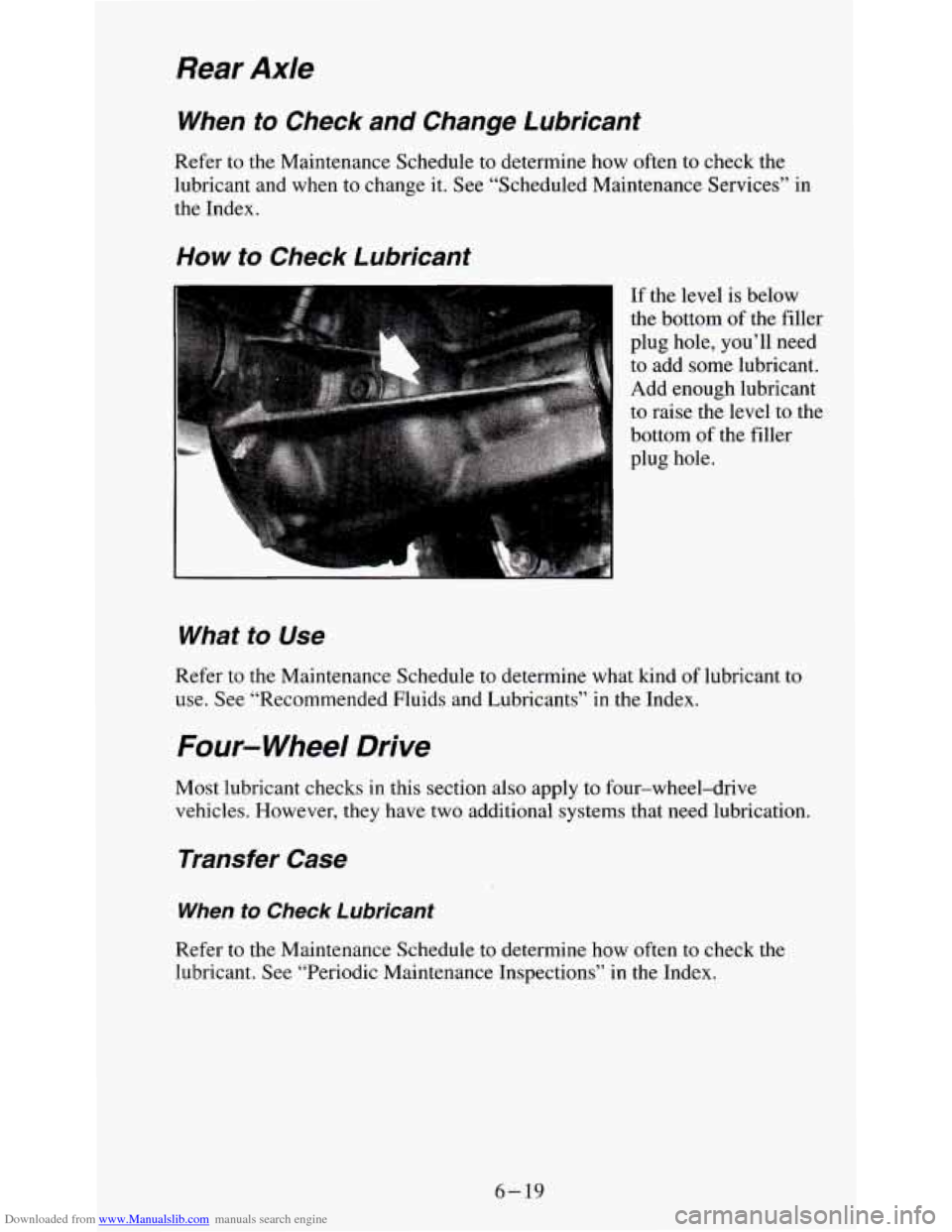
How to Check Lubricant
I 1
If the level is below
the bottom
of the filler
plug hole, you’ll need
to add some lubricant.
Add enough lubricant
to raise the level to the
bottom
of the filler
plug hole.
What to Use
Refer to the Maintenance Schedule to determine what kind of lubricant to
use. See “Recommended Fluids and Lubricants” in the Index.
Four- Wheel Drive
Most lubricant checks in this section also apply to four-wheel-drive
vehicles. However, they have two additional systems that need lubrication.
Transfer Case
When to Check Lubricant
Refer to the Maintenance Schedule to determine how often to check the
lubricant. See “Periodic Maintenance Inspections”
in the Index.
6-19
Page 258 of 354
Downloaded from www.Manualslib.com manuals search engine NOTICE:
~~
Don’t let anyone tell you that underinflation or overinflation is
all right. It’s not. If your tires don’t have enough air
(underinflation) you can get:
Too much flexing
Too much heat
Tire overloading
Bad wear
Bad handling
Bad fuel economy.
If your tires have too much air (overinflati
Unusual wear
Bad handling
Rough ride
Needless damage from road hazards. can
get
‘e re
When to Check
Check your tires once a month or more. Also, check the tire pressure of the
spare tire.
How to Check
Use a good quality pocket-type gage to check tire pressure. Simply looking
at the tires will not tell you the pressure, especially if you have radial tires
- which may look properly inflated even if they’re underinflated.
If your tires have valve caps, be sure to put them back on. They help prevent
leaks by keeping out dirt and moisture.
Tire Inspection and Rotation
Tires should be inspected every 6,000 to 8,000 miles (10 000 to 13 000 km)
for any signs of unusual wear. If unusual wear is present, rotate your tires as
soon
as possible and check wheel alignment. Also check for damaged tires
or wheels. See “When it’s Time for New Tires” and “Wheel Replacement”
later in
this section for more information.
6-41
Page 266 of 354
Downloaded from www.Manualslib.com manuals search engine Using Foam-Type Cleaner on Fabric
Vacuum and brush the area to remove any loose dirt.
Always clean a whole trim panel or section. Mask surrounding trim
0 Mix Multi-Purpose Powdered Cleaner following the directions on the
along
stitch or welt lines.
container label.
Use suds only and apply with a clean sponge.
Don’t saturate the material.
Don’t rub it roughly.
As soon as you’ve cleaned the section, use a sponge to remove the
suds.
0 Rinse the section with a clean, wet sponge.
0 Wipe off what’s left with a slightly damp paper towel or cloth.
Then dry it immediately with a blow dryer or a heat lamp.
I NOTICE:
Be careful. A blow dryer may scorch the fabric.
0 Wipe with a clean cloth.
Using Solvent-Type Cleaner on Fabric
First, see if you have to use solvent-type cleaner at all. Some spots and
stains will clean off better with just water and mild soap.
If you need to use a solvent:
Gently scrape excess soil from the trim material with a clean, dull knife
or scraper. Use very little cleaner, light pressure and clean cloths
(preferably cheesecloth). Cleaning should start at the outside
of the
stain, “feathering” toward the center. Keep changing to a clean section
of the cloth.
0 When you clean a stain from fabric, immediately dry the area with a
blow dryer to help prevent a cleaning ring. (See the previous NOTICE.)
6-49
Page 277 of 354
Downloaded from www.Manualslib.com manuals search engine Headlamps
The headlamp wiring is protected by a circuit breaker in the light switch. An
electrical overload will cause the lights to go on and
off, or in some cases to
remain off. If this happens, have your headlamp wiring checked right away.
Windshield Wipers
The windshield wiper motor is protected by a circuit breaker and a fuse. If
the motor overheats due to heavy snow, etc., the wiper will stop until the
motor cools. If the overload is caused by some electrical problem and not
snow, etc., be sure to get it fixed.
Power Windows and Other Power Options
Circuit breakers in the fuse panel protect the power windows and other
power accessories. When the current load is too heavy, the circuit breaker
opens and closes, protecting the circuit until the problem is fixed.
Trailer Wiring Harness
The optional seven-wire trailer wiring harness is protected by an in-line
fuse in the battery feed wire. This fuse is near the junction block in the
front, driver’s side fender. See “Trailer Wiring Harness”
in the Features &
Controls section.
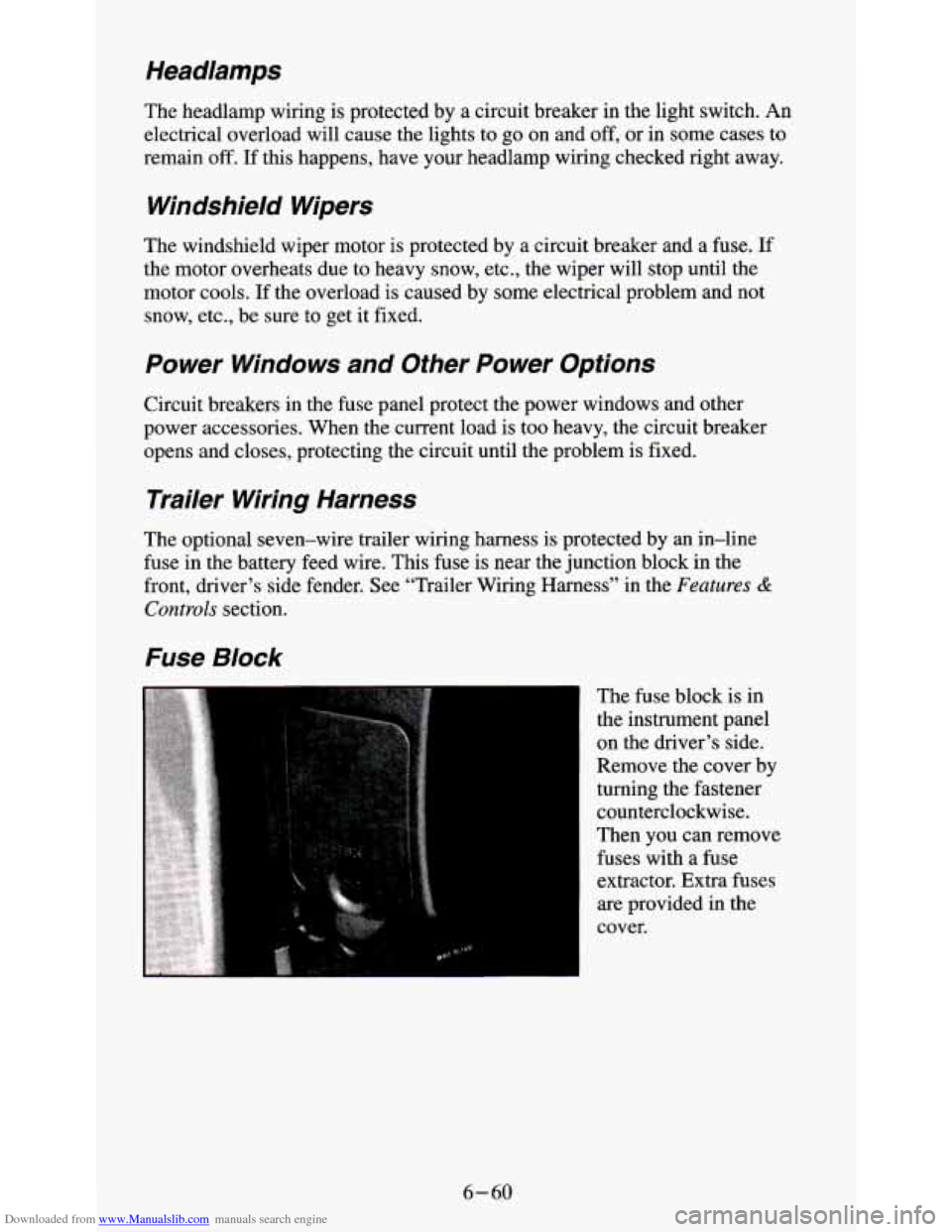
Fuse Block
. .. . .,
The fuse block is in
the instrument panel
on the driver’s side.
Remove the cover by
turning the fastener
counterclockwise.
Then you can remove
fuses with a fuse
extractor. Extra fuses
are provided in the
cover.
6-60
Page 278 of 354
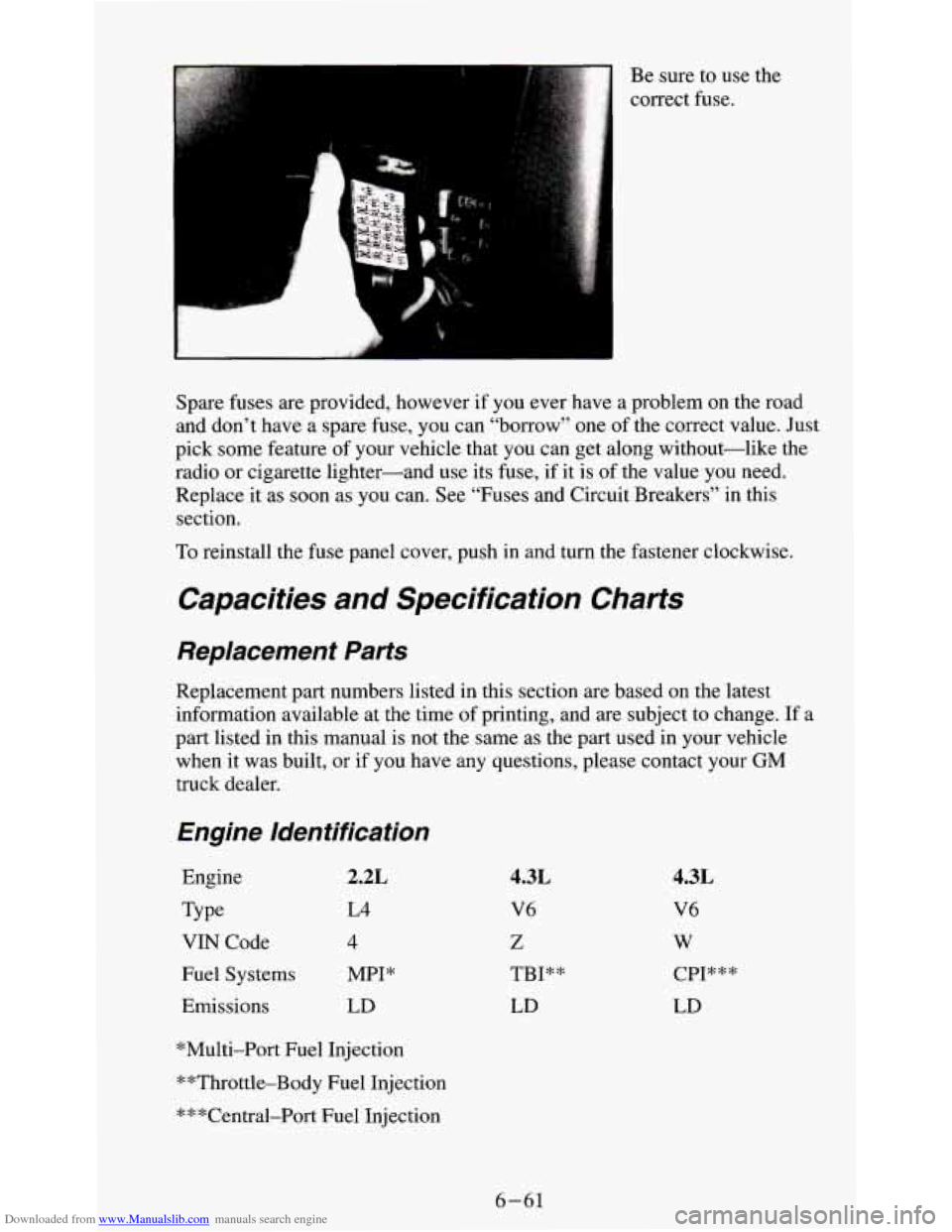
Downloaded from www.Manualslib.com manuals search engine Be sure to use the
correct fuse.
Spare fuses are provided, however if you ever have a problem on the road
and don’t have a spare fuse, you
can “borrow” one of the correct value. Just
pick some feature of your vehicle that you can get along without-like the
radio or cigarette lighter-and use its fuse, if it is of the value you need.
Replace it as soon as you
can. See “Fuses and Circuit Breakers” in this
section.
To reinstall the fuse panel cover, push in and turn the fastener clockwise.
Capacities and Specification Charts
Replacement Parts
Replacement part numbers listed in this section are based on the latest
information available at the time of printing, and are subject to change. If a
part listed in this manual is not the same as the part used in your vehicle
when
it was built, or if you have any questions, please contact your GM
truck dealer.
Engine Ideniificafion
Engine
Type VIN Code
Fuel Systems Emissions 2.2L
L4
4
MPI*
LD
4.3L
V6
Z
m1* *
LD
4.3L
V6
W
CPI* * *
LD
*Multi-Port Fuel Injection
**Throttle-Body Fuel Injection
***Central-Port Fuel Injection
6-61
Page 288 of 354
Downloaded from www.Manualslib.com manuals search engine Maintenance Schedule
IMPORTANT:
KEEP ENGINE OIL
AT THE PROPER
LEVEL AND CHANGE
AS RECOMMENDED
Section
7
This section covers the maintenance required for your vehicle. Your vehicle
needs these services
to retain its safety, dependability and emission control
performance.
Have you purchased the GM Protection Plan.? The Plan sctpplem.ent,s yo~~r
new vehicle warranties. See your GM dealerafor detuils.
Introduction
Your Vehicle and the ~ vironment
Proper vehicle maintenance not only helps to keep your vehicle in good
working condition, but
also helps the environment. All recommended
maintenance procedures are important. Improper vehicle maintenance or the
removal
of important components can significantly affect the quality of the
air we breathe. Improper fluid levels or even
the wrong tire inflation can
increase the level
of emissions from your vehicle. To help protect our
environment, and
to help keep your vehicle in good condition, please
maintain your vehicle properly.
7-1
Page 289 of 354
Downloaded from www.Manualslib.com manuals search engine How This Section is Organized
The remainder of this section is divided into five parts:
“Part A: Scheduled Maintenance Services” shows what to have done and
how often.
Some of these services can be complex, so unless you are
technically qualified and have the necessary equipment, you should let your
dealer’s service department or another qualified service center do these jobs.
If you are skilled enough to do some work on your vehicle, you will
probably want to get the service information GM publishes. See “Service
Publications” in the Index.
“Part B: Owner Checks and Services” tells you what should be checked
whenever
you stop for fuel. It also explains what you can easily do to help
keep your vehicle in good condition.
“Part C: Periodic Maintenance Inspections” explains important
inspections that your GM dealer’s service department or another qualified
service center should perform.
“Part D: Recommended Fluids and Lubricants” lists some products GM
recommends to help keep your vehicle properly maintained. These products,
or their equivalents, should be used whether you
do the work yourself or
have it done.
“Part E: Maintenance Record” provides a place for you to record the
maintenance performed
on your vehicle. Whenever any maintenance is
performed, be sure to write it down in this part. This will help you
determine when your next maintenance should be done. In addition, it is a
good idea to keep your maintenance receipts. They may be needed to
qualify your vehicle for warranty repairs.
7-2
Page 290 of 354
Downloaded from www.Manualslib.com manuals search engine Part A: Scheduled Maintenance Services
Using Your Maintenance Schedule
We at General Motors want to help you keep your vehicle in good working
condition. But we don’t know exactly how you’ll drive it. You may drive
very short distances only a few times a week. Or you may drive long
distances all the time in very hot, dusty weather. You may use your vehicle
in making deliveries. Or
you may drive it to work, to do errands or in many
other ways.
Because of all
the different ways people use their GM vehicles, maintenance
needs vary. You may even need more frequent checks and replacements than
you’ll find
in the schedules in this section. So please read this section and
note how you drive.
If you have any questions on how to keep your vehicle
in good condition, see your GM dealer.
This part tells
you the maintenance services you should have done and when
you should schedule them. If you
go to your dealer for your service needs,
you’ll know that GM-trained and supported service people will perform the
work using genuine GM parts.
The proper fluids and lubricants
to use are listed in Part D. Make sure
whoever services your vehicle uses these. All parts should be replaced and
all necessary repairs done before
you or anyone else drives the vehicle.
These schedules are for vehicles that:
a
0
a
a
carry passengers and cargo within recommended limits. You will find
these limits
on your vehicle’s CertificatiodTire label. See “Loading
Your Vehicle”
in the Index.
are driven on reasonable road surfaces within legal driving limits.
are driven off-road
in the recommended manner. See “Off Road
Driving With Your Four-wheel Drive Vehicle”
in the Index.
use the recommended unleaded fuel. See
“Fuel” in the Index.
7-3
Page 332 of 354
Downloaded from www.Manualslib.com manuals search engine Customer Assistance Information
Section
Here you will find out how to contact Chevrolet if you need assistance. This
section also tells you how
to obtain service publications and how to report
any safety defects.
This section includes information
on: The Customer Satisfaction Procedure,
Customer Assistance for Hearing or Speech Impaired,
BBB Auto Line -
Alternative Dispute Resolution Program, Reporting Safety Defects,
Roadside Assistance, and Service Publications.
Customer Satisfaction Procedure
Your satisfaction and goodwill are important to your dealer and Chevrolet.
Normally, any concern with the sales transaction or
the operation of your
vehicle will be resolved by your dealer’s Sales or Service Departments.
Sometimes, however, despite the best intentions
of all concerned,
misunderstandings can occur.
If your concern has not been resolved to your
satisfaction, the following steps should be taken:
STEP ONE - Discuss your concern with a member of dealership
management. Normally, concerns can be quickly resolved at that level.
If
the matter has already been reviewed with the Sales, Service, or Parts
Manager, contact the owner
of the dealership or the General Manager.
8-1