light CHEVROLET S10 1995 2.G Workshop Manual
[x] Cancel search | Manufacturer: CHEVROLET, Model Year: 1995, Model line: S10, Model: CHEVROLET S10 1995 2.GPages: 354, PDF Size: 18.92 MB
Page 161 of 354
Downloaded from www.Manualslib.com manuals search engine Freeway Driving
Mile for mile, freeways (also called thruways, parkways, expressways,
turnpikes, or superhighways)
are the safest of all roads. But they have their
own special rules.
The most important advice on freeway driving is: Keep up with traffic and
keep to the right. Drive at the same speed most of the other drivers are
driving. Too-fast or too-slow driving breaks a smooth traffic flow. Treat
the
left lane on a freeway as a passing lane.
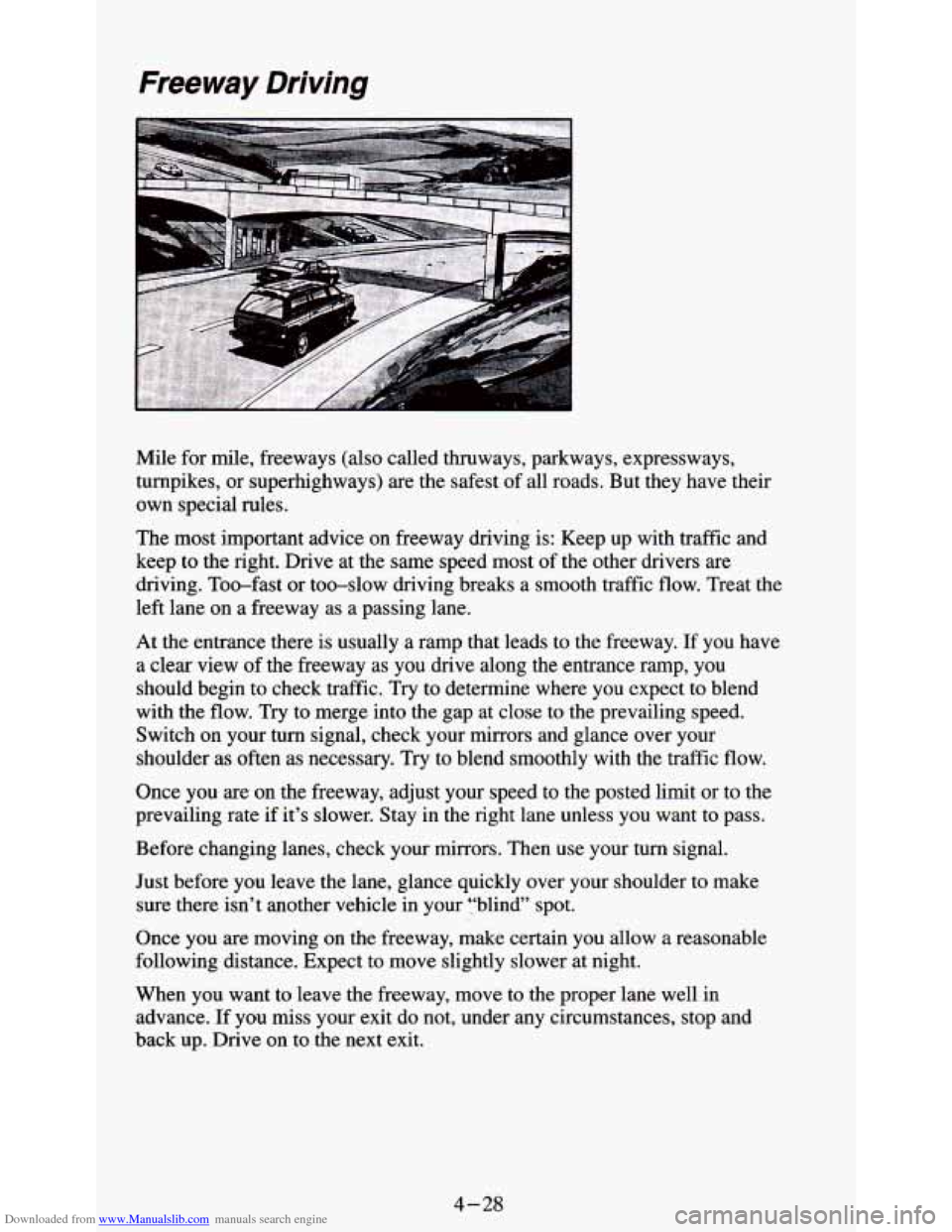
At the entrance there is usually a ramp that leads to the freeway. If you have
a clear view of the freeway as you drive along the entrance ramp, you
should begin to check traffic. Try to determine where you expect to blend
with the
flow. Try to merge into the gap at close to the prevailing speed.
Switch on your turn signal, check your mirrors and glance over your
shoulder as often as necessary.
Try to blend smoothly with the traffic flow.
Once you are on the freeway, adjust your speed to the posted limit or to the
prevailing rate if it’s slower. Stay in the right lane unless you want to pass.
Before changing lanes, check your mirrors. Then use your turn signal.
Just before you leave the lane, glance quickly over your shoulder to make
sure there
isn’t another vehicle in your ‘.‘blind” spot.
Once you are moving on the freeway, make certain you allow a reasonable
following distance. Expect to move slightly slower at night.
When you want to leave the freeway, move to the proper lane well in
advance. If you miss your exit
do not, under any circumstances, stop and
back up. Drive on to the next exit.
4-28
Page 162 of 354
Downloaded from www.Manualslib.com manuals search engine The exit ramp can be curved, sometimes quite sharply.
The
exit speed is usually posted.
Reduce your speed according to your speedometer, not
to your sense of
motion. After driving for any distance at higher speeds, you may tend to
think you are going slower than you actually are.
Before Leaving on a Long Trip
Make sure you’re ready. Try to be well rested. If you must start when you’re
not fresh
- such as after a day’s work - don’t plan to make too many
miles that first part of the journey. Wear comfortable clothing and shoes you
can easily drive
in.
Is your vehicle ready for a long trip? If you keep it serviced and maintained,
it’s ready to
go. If it needs service, have it done before starting out. Of
course, you’ll find experienced and able service experts in GM dealerships
all across North America. They’ll be ready and willing to help if you need
it.
Here are some things you can check before a trip:
Windshield Washer Fluid: Is the reservoir full? Are all windows clean
inside and outside?
Wiper Blades: Are they in good shape?
Fuel, Engine Oil, Other Fluids: Have you checked all levels?
Lights: Are they all working? Are the lenses clean?
0 Tires: They are vitally important to a safe, trouble-free trip. Is the tread
good enough for long-distance driving? Are the tires all inflated to the
recommended pressure?
Weather Forecasts: What’s the weather outlook along your route?
Maps: Do you have up-to-date maps?
Should
you delay your trip a short time to avoid a major storm system?
Highway Hypnosis
Is there actually such a condition as “highway hypnosis”? Or is it just plain
falling asleep at the wheel? Call it highway hypnosis, lack of awareness, or
whatever.
There
is something about an easy stretch of road with the same scenery,
along with the hum of the tires on the road,
the drone of the engine, and the
rush of the wind against the vehicle that can make you sleepy. Don’t let it
happen to you! If it does, your vehicle can leave the road in
less than a
second,
and you could crash and be injured.
What can you
do about highway hypnosis? First, be aware that it can
happen.
4-29
Page 165 of 354
Downloaded from www.Manualslib.com manuals search engine Include an ice scraper, a small brush or broom, a supply of windshield
washer fluid, a rag, some winter outer clothing, a small shovel, a flashlight,
a red cloth, and a couple
of reflective warning triangles. And, if you will be
driving under severe conditions, include a small bag of sand, a piece of old
carpet
or a couple of burlap bags to help provide traction. Be sure you
properly secure these items in your vehicle.
Driving on Snow or Ice
Most of the time, those places where your tires meet the road probably have
good traction.
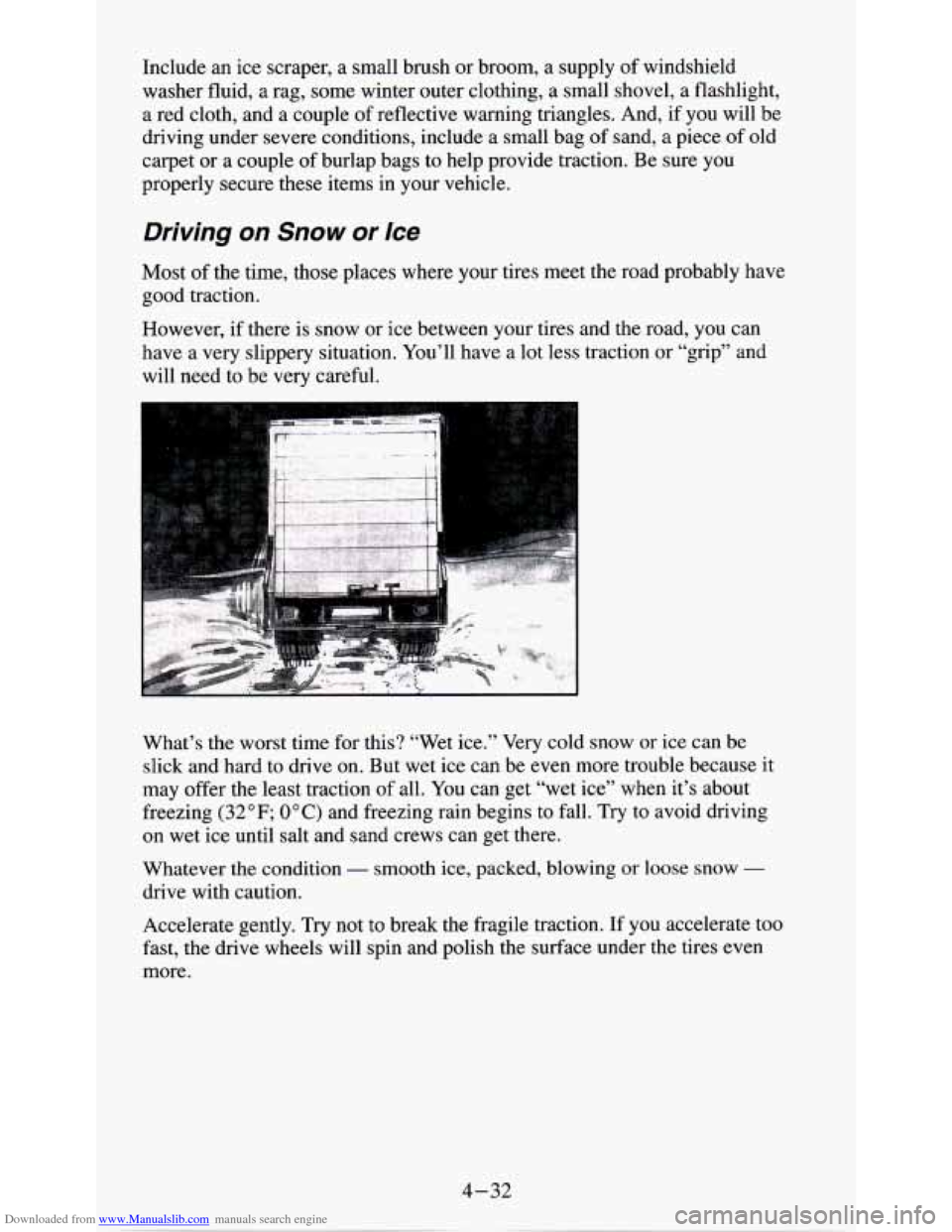
However, if there is snow
or ice between your tires and the road, you can
have a very slippery situation. You’ll have a lot less traction or “grip” and
will need to be very careful.
What’s the worst time for this? “Wet ice.” Very cold snow or ice can
be
slick and hard to drive on. But wet ice can be even more trouble because it
may offer the least traction
of all. You can get “wet ice” when it’s about
freezing
(32 OF; OOC) and freezing rain begins to fall. Try to avoid driving
on wet ice until salt and sand crews can get there.
Whatever the condition
- smooth ice, packed, blowing or loose snow -
drive with caution.
Accelerate gently. Try not to break the fragile traction.
If you accelerate too
fast,
the drive wheels will spin and polish the surface under the tires even
more.
4-32
Page 167 of 354
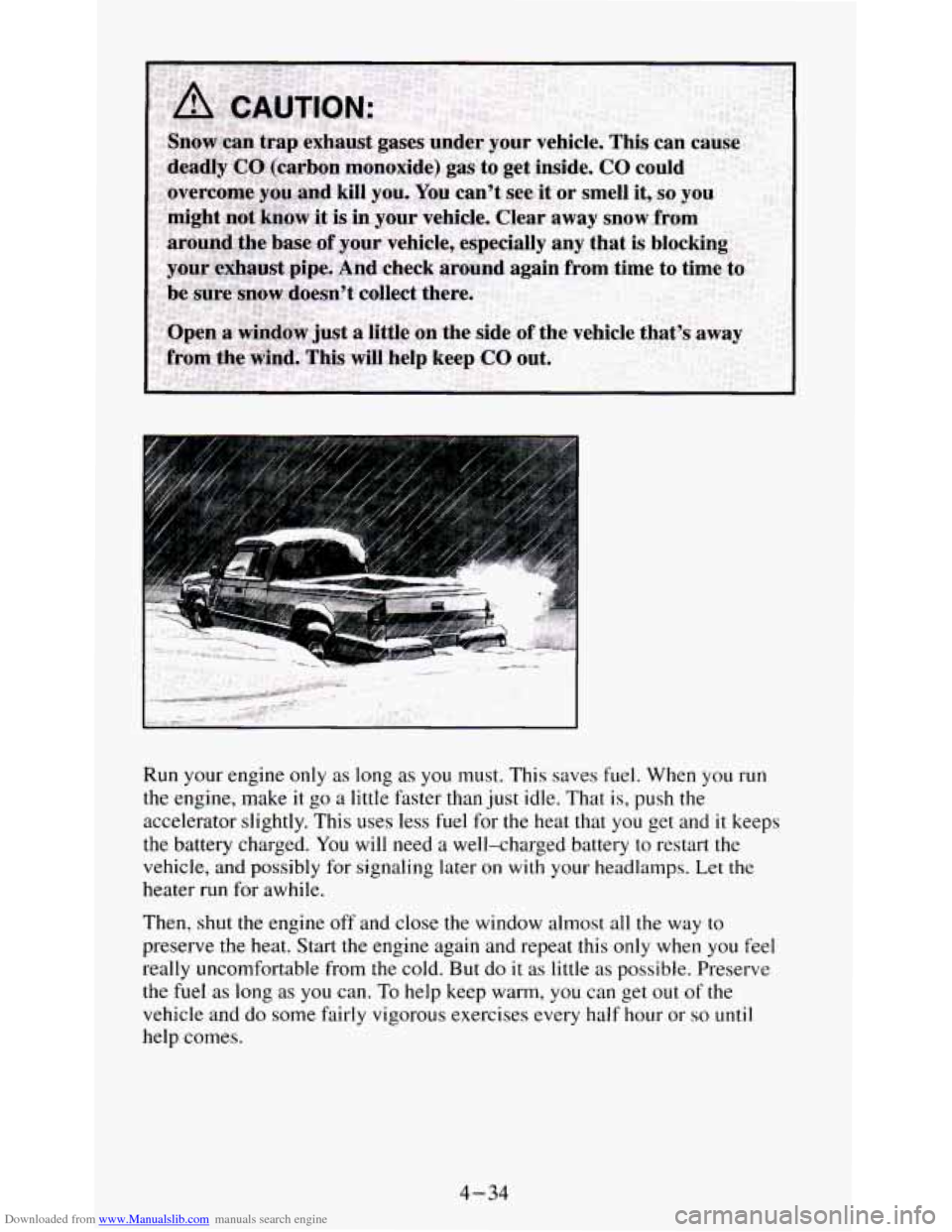
Downloaded from www.Manualslib.com manuals search engine Run your engine only as long as you must. This saves fuel. When you run
the engine, make it go
a little faster than just idle. That is, push the
accelerator slightly. This uses less fuel for the heat that you get and
it keeps
the battery charged. You will need
a well-charged battery to restart the
vehicle, and possibly
for signaling later on with your headlamps. Let the
heater run
for awhile.
Then, shut the engine off and close the window almost all the way to
preserve the heat. Start the engine again and repeat this only when you feel
really uncomfortable from the cold. But do
it as little as possible. Preserve
the fuel
as long as you can. To help keep warm, you can get out of the
vehicle and
do some fairly vigorous exercises every half hour or so until
help comes.
4-34
Page 179 of 354
Downloaded from www.Manualslib.com manuals search engine Safety Chains
You should always attach chains between your vehicle and your trailer.
Cross the safety chains under the tongue of the trailer
so that the tongue will
not drop to the road if it becomes separated from the hitch. Instructions
about safety chains may be provided by the hitch manufacturer or by the
trailer manufacturer. Follow the manufacturer’s recommendation for
attaching safety chains and do not attach them to the bumper. Always leave
just enough slack
so you can turn with your rig. And, never allow safety
chains to drag on the ground.
Trailer Brakes
If your trailer weighs more than 1,000 pounds (450 kg) loaded, then it needs
its own brakes
- and they must be adequate. Be sure to read and follow the
instructions for the trailer brakes
so you’ll be able to install, adjust and
maintain them properly.
Your trailer brakes system can tap into vehicle’s hydraulic brake system
except:
Don’t tap into your vehicle’s brake system if the trailer’s brake system will
use more than 0.02 cubic inch (0.3~~) of fluid from your vehicle’s master
cylinder. If it does, both braking systems won’t work well. You could even
lose your brakes.
Will the trailer parts take 3,000 psi (20 650 kPa)
of pressure? If not, the
trailer brake system must not be used with your vehicle.
If everything checks out this far, then make the brake fluid tap at
the port on
the master cylinder that sends fluid to the rear brakes. But don’t use copper
tubing for this. If you do, it will bend and finally break off. Use steel brake
tubing.
Driving with a Trailer
Towing a trailer requires a certain amount of experience. Before setting out
for the open road, you’ll want to get
to know your rig. Acquaint yourself
with the feel
of handling and braking with the added weight of the trailer.
And always keep
in mind that the vehicle you are driving is now a good
deal longer and not nearly as responsive as your vehicle
is by itself.
Before
you start, check the trailer hitch and platform (and attachments),
safety chains, electrical connector, lights, tires and mirror adjustment. If the
trailer has electric brakes, start your vehicle and trailer moving and then
apply the trailer brake controller by hand to be sure
the brakes are working.
This lets you check your electrical connection at
the same time.
During your trip, check occasionally
to be sure that the load is secure, and
that the lights and any trailer brakes are still working.
4-46
Page 182 of 354
Downloaded from www.Manualslib.com manuals search engine When You Are Ready to Leave After Parking on a Hill
1. Apply your regular brakes and hold the pedal down while you:
Start your engine;
Shift into a gear; and
Release the parking brake.
2. Let up on the brake pedal.
3. Drive slowly until the trailer is clear of the chocks.
4. Stop and have someone pick up and store the chocks.
Maintenance When Trailer Towing
Your vehicle will need service more often when you’re pulling a trailer. See
the Maintenance Schedule for more on this. Things that are especially
important in trailer operation are automatic transmission fluid (don’t
overfill), engine oil, axle lubricant, belt, cooling system, and brake
adjustment. Each of these is covered in this manual, and the Index will help
you find them quickly. If you’re trailering, it’s a
good idea to review these
sections before you start your trip.
Check periodically to
see that all hitch nuts and bolts are tight.
Trailer Lighting Systems Wiring
See “Trailer Wiring Harness” in the Index.
4-49
Page 185 of 354
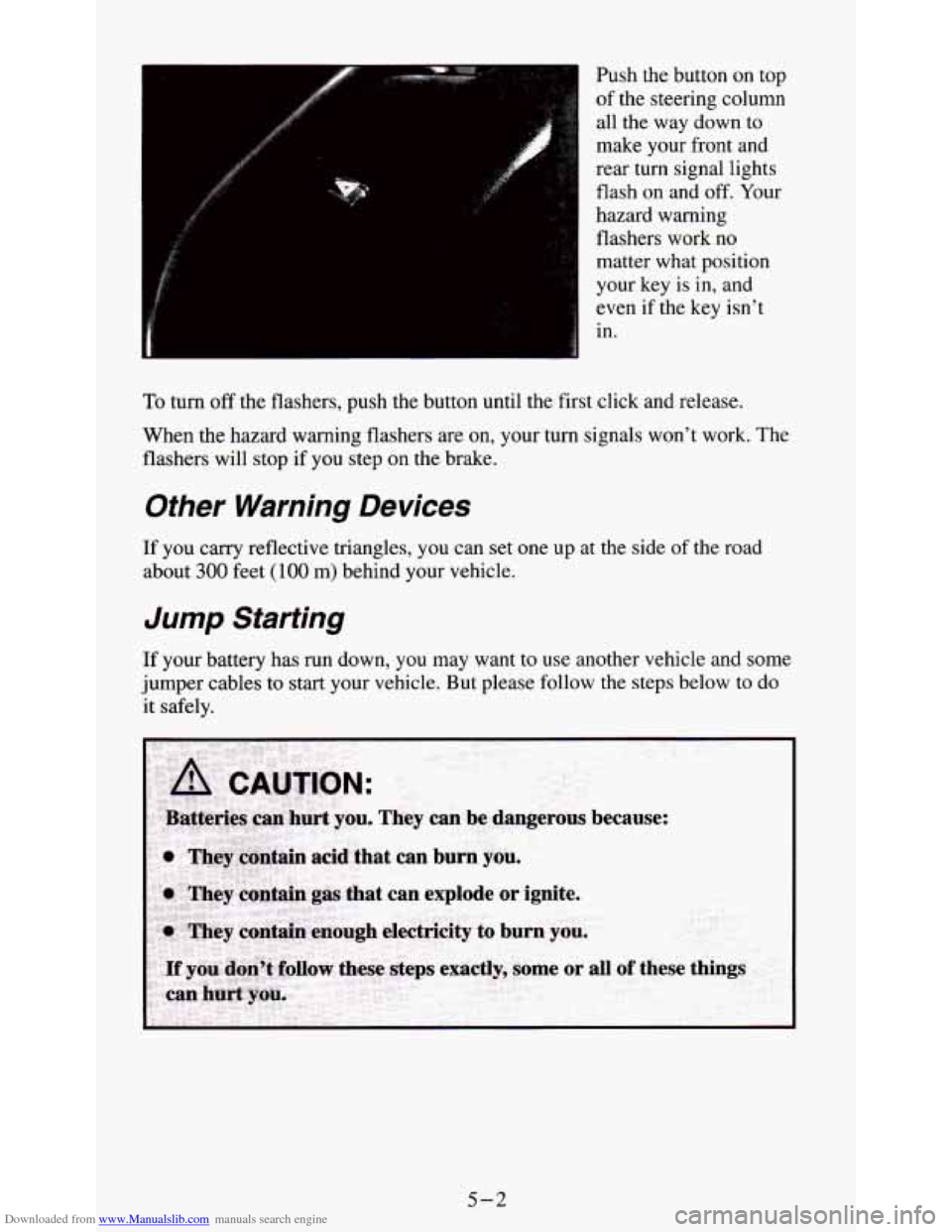
Downloaded from www.Manualslib.com manuals search engine Push the button on top
of the steering column
all the way down
to
make your front and
rear turn signal lights
flash on and
off. Your
hazard warning
flashers work
no
matter what position
your key is
in, and
even if the key isn’t
in.
To turn off the flashers, push the button until the first click and release.
When the hazard warning flashers are on, your turn signals won’t work. The
flashers will stop if you step on the brake.
Other Warning Devices
If you carry reflective triangles, you can set one up at the side of the road
about
300 feet (100 m) behind your vehicle.
Jump Starting
If your battery has run down, you may want to use another vehicle and some
jumper cables to start your vehicle. But please follow the steps below to do
it safely.
5-2
Page 186 of 354
Downloaded from www.Manualslib.com manuals search engine NOTICE:
Ignoring these steps could result in costly damage to your
vehicle that wouldn’t be covered by your warranty.
Trying to start your vehicle by pushing or pulling
it could
damage your vehicle, even if you have a manual transmission.
And if you have an automatic transmission, it won’t
start that
way.
To Jump Start Your Vehicle;
1. Check the other vehicle. It must have a 12-volt battery with a negative
ground system.
NOTICE:
If the other system isn’t a 12-volt system with a negative
ground, both vehicles can be damaged.
2. Get the vehicles close enough so the jumper cables can reach, but be
sure the vehicles aren’t touching each other. If they are, it could cause
a
ground connection you don’t want. You wouldn’t be able to start your
vehicle, and the bad grounding could damage the electrical systems.
You could be injured if the vehicles roll. Set the parking brake firmly
on each vehicle. Put an automatic transmission in
PARK (P) or a
manual transmission in NEUTRAL (N). If you have
a
four-wheel-drive vehicle with a manual transfer case shift lever, be
sure the transfer case is not in NEUTRAL
(N).
3. Turn off the ignition on both vehicles. Turn off all lights that aren’t
needed, and radios. This will avoid sparks and help save both batteries.
And it could save your radio!
NOTICE:
If you leave your radio on, it could be badly damaged. The
repair wouldn’t be covered by your warranty.
4. Open the hoods and locate the batteries. Find the positive (+) and
negative
(-) terminals on each battery.
5-3
Page 216 of 354

Downloaded from www.Manualslib.com manuals search engine NOTICE:
Spinning your wheels can destroy parts of your vehicle as well\
as
the tires. If you spin the wheels too fast while shifting you\
r
transmission back and forth, you can destroy your transmission. \
For information about using tire chains on your vehicle, see “Tire Chains”
in the Index.
Rocking your vehicle to get it out:
First, turn your steering wheel left and right. That will clear the area around
your front wheels. Then shift back and forth between REVERSE (R) and a
forward gear (or with a manual transmission, between FIRST
(1) or
SECOND
(2) gear and REVERSE), spinning the wheels as little as possible.
Release the accelerator pedal while you shift, and press lightly
on the
accelerator pedal when the transmission
is in gear. If that doesn’t get you
out after a few tries, you may need to be towed out. Or, you can use your
recovery hooks, if your vehicle has them.
If you do need to be towed out,
see “Towing Your Vehicle” in the Index.
Using the Recovery Hooks
Your vehicle may be equipped with recovery hooks. The recovery hooks are
provided at the front of your vehicle. You may need to use them
if you’re
stuck off-road and need to be pulled to some place where you can continue
driving.
5-33
Page 219 of 354
Downloaded from www.Manualslib.com manuals search engine You should keep a record with all parts receipts and list the mileage and the
date
of any service work you perform. See “Maintenance Record” in the
Index.
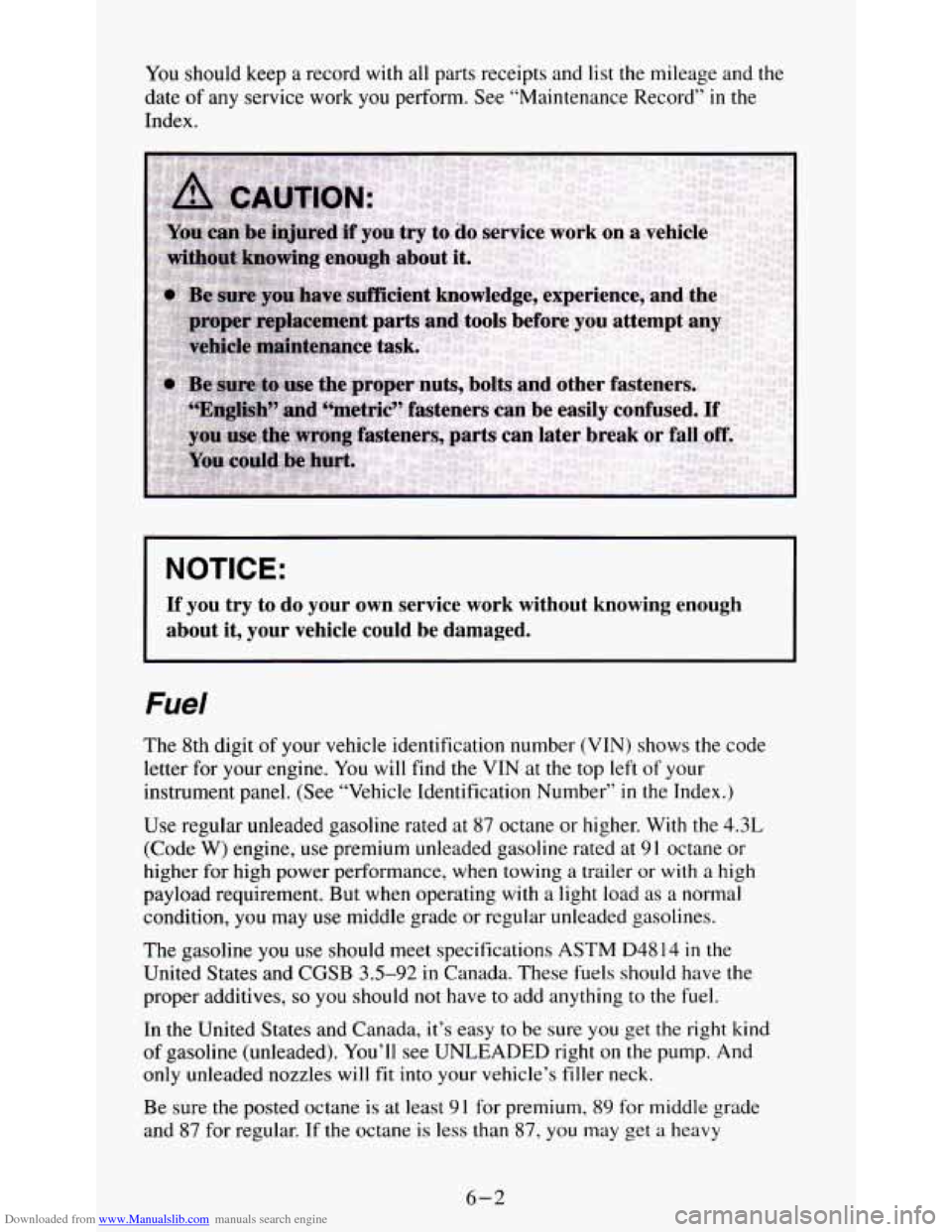
NOTICE:
If you try to do your own service work without knowing enough
about it, your vehicle could be damaged.
Fuel
The 8th digit of your vehicle identification number (VIN) shows the code
letter for your engine. You will find the VIN at the top left
of your
instrument panel. (See “Vehicle Identification Number”
in the Index.)
Use regular unleaded gasoline rated at 87 octane or higher. With the
4.3L
(Code W) engine, use premium unleaded gasoline rated at 9 1 octane or
higher for high power performance, when towing
a trailer or with a high
payload requirement. But when operating with a light load
as a normal
condition, you may use middle grade or regular unleaded gasolines.
The gasoline you use should meet specifications
ASTM D48 14 in the
United States and CGSB
3.5-92 in Canada. These fuels should have the
proper additives,
so you should not have to add anything to the fuel.
In the United States and Canada, it’s easy to be sure you get the right kind
of gasoline (unleaded). You’ll see UNLEADED right on the pump. And
only unleaded nozzles will fit into your vehicle’s filler neck.
Be sure the posted octane
is at least 91 for premium, 89 for middle grade
and 87 for regular. If the octane
is less than 87, you may get a heavy
6-2