light CHEVROLET S10 1995 2.G Repair Manual
[x] Cancel search | Manufacturer: CHEVROLET, Model Year: 1995, Model line: S10, Model: CHEVROLET S10 1995 2.GPages: 354, PDF Size: 18.92 MB
Page 223 of 354
Downloaded from www.Manualslib.com manuals search engine Checking Things Under the Hood
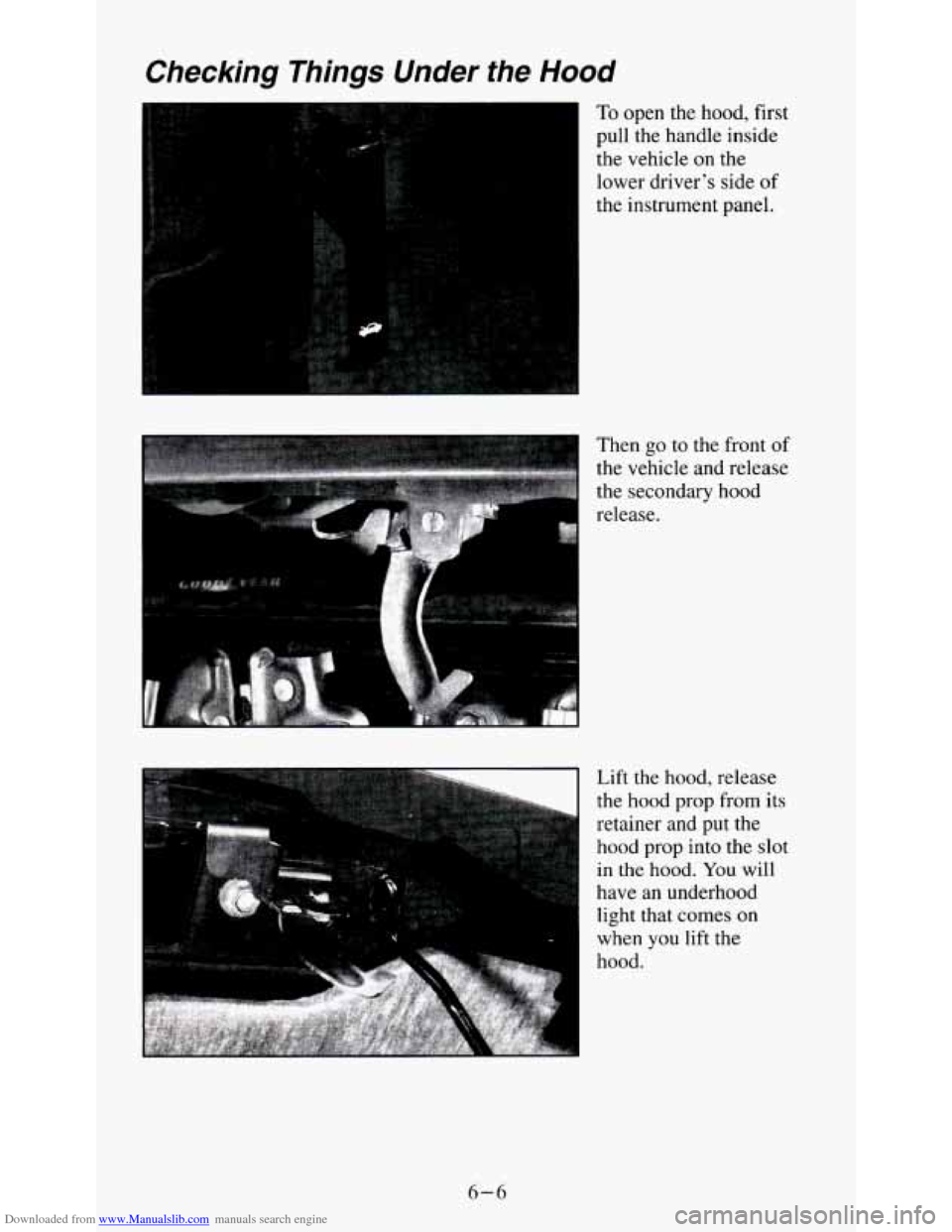
To open the hood, first
pull the handle inside
the vehicle on the
lower driver’s side
of
the instrument panel.
Then
go to the front of
the vehicle and release
the secondary hood
release.
Lift the hood, release
the hood prop from its
retainer and put the
hood prop into the slot
in the hood. You will
have
an underhood
light that comes
on
when you lift the
hood.
6-6
Page 235 of 354
Downloaded from www.Manualslib.com manuals search engine How to Add Fluid
Here’s how to add fluid. Refer to the Maintenance Schedule to determine
what kind of fluid to
use. See “Recommended Fluids and Lubricants” in the
Index.
1. Remove the filler plug.
2. Add fluid at the filler plug hole. Add only enough fluid to bring the
fluid level up to the bottom of the filler plug hole.
3. Install the filler plug. Be sure the plug is fully seated.
Hydraulic Clutch
The hydraulic clutch linkage in your vehicle is self-adjusting. A slight
amount of play
(1/4 inch to 1/2 inch) in the pedal is normal.
When to Check and What to Use
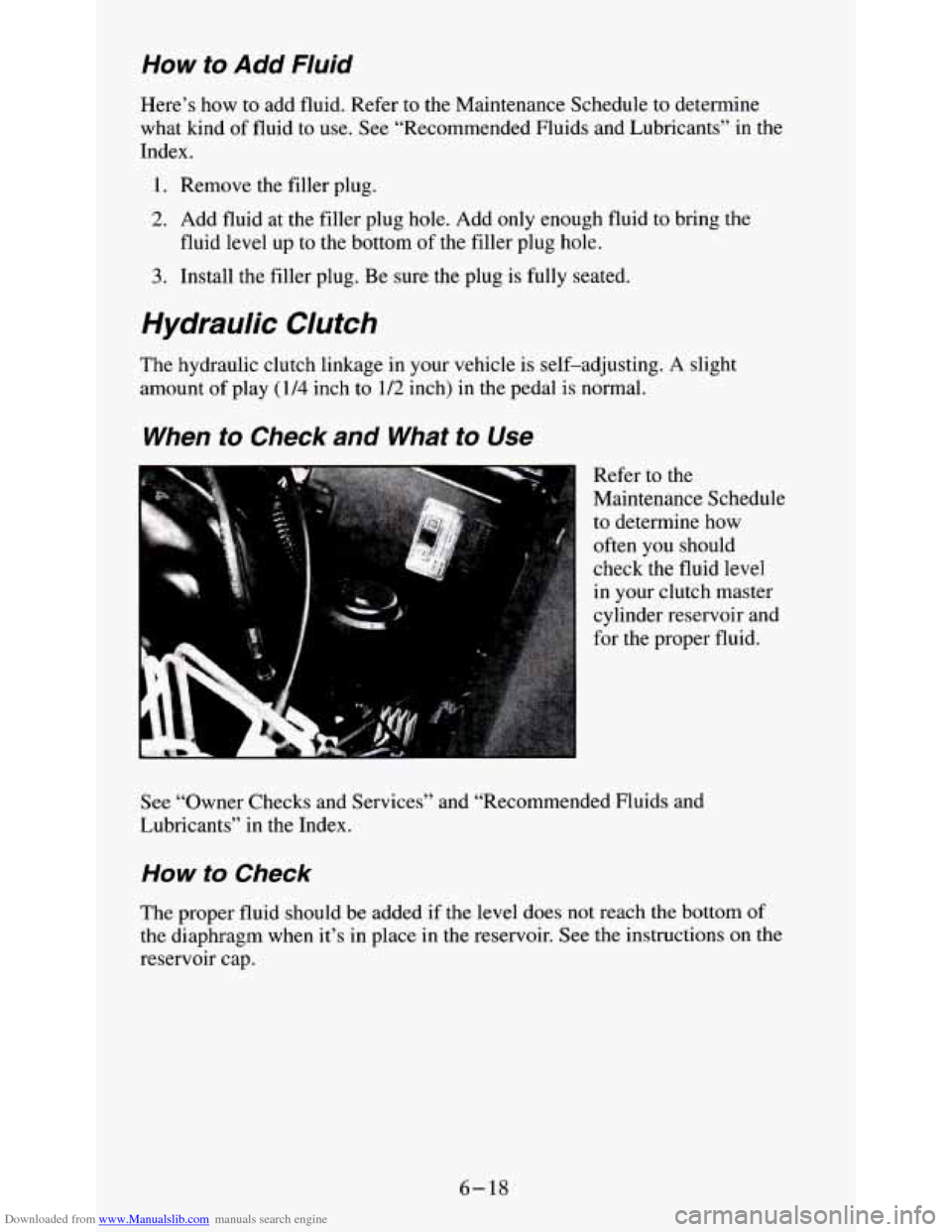
Refer to the
Maintenance Schedule
to determine how
often
you should
check the fluid level
in your clutch master
cylinder reservoir and
for the proper fluid.
See “Owner Checks and Services” and “Recommended Fluids and
Lubricants” in the Index.
How to Check
The proper fluid should be added if the level does not reach the bottom of
the diaphragm when it’s in place in the reservoir. See the instructions on the
reservoir cap.
6-18
Page 238 of 354
Downloaded from www.Manualslib.com manuals search engine What to Use
Refer to the Maintenance Schedule to determine what kind of lubricant to
use. See “Recommended Fluids and Lubricants” in the Index.
Engine Coolant
The following explains your cooling system and how to add coolant when it
is low. If you have a problem with engine overheating, see “Engine
Overheating” in the Index.
The proper coolant for your vehicle will:
Give freezing protection down to -34°F (-37 “C).
Give boiling protection up to 262°F (128 “C).
Protect against rust and corrosion.
Help keep the proper engine temperature.
Let the warning lights and gages work as they should.
What to Use
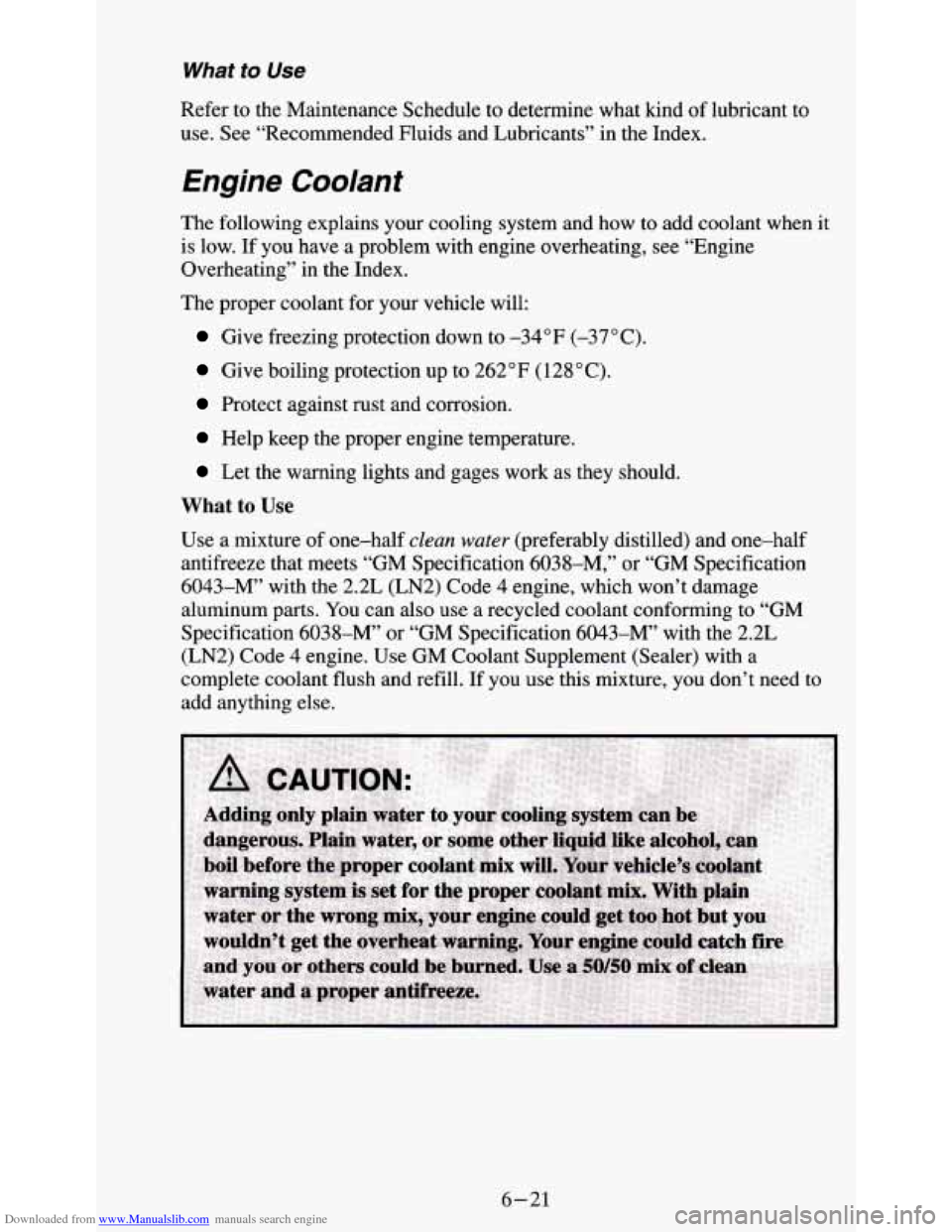
Use a mixture of one-half clean water (preferably distilled) and one-half
antifreeze that meets “GM Specification 6038-M,” or “GM Specification
6043-M’ with the 2.2L (LN2) Code 4 engine, which won’t damage
aluminum parts.
You can also use a recycled coolant conforming to “GM
Specification 603%”’ or “GM Specification 6043-M” with the 2.2L
(LN2) Code 4 engine. Use GM Coolant Supplement (Sealer) with a
complete coolant flush and refill. If you use this mixture, you don’t need to
add anything else.
6-21
Page 245 of 354
Downloaded from www.Manualslib.com manuals search engine NOTICE:
Don’t let someone put in the wrong kind of fluid. For
example, just a few drops
of mineral-based oil, such as engine
oil, in your brake system can damage brake system parts
so
badly that they’ll have to be replaced.
Brake fluid can damage paint, so be careful not to spill brake
fluid on your vehicle.
If you do, wash it off immediately. See
“Appearance Care” in the Index.
Brake Wear
Your vehicle has front disc brakes and rear drum brakes.
Disc brake pads have built-in wear indicators that make a high-pitched
warning sound when the brake pads are
worn and new pads are needed. The
sound may come and go or be heard all the time your vehicle
is moving
(except when you are pushing
on the brake pedal firmly).
I NOTICE:
Continuing to drive with worn-out brake pads could result in
costly brake repair.
Some driving conditions or climates may Cause a brake squeal when the
brakes are
first applied or lightly applied. This does not mean something is
wrong with your brakes.
Your rear drum brakes don’t have wear indicators, but if you ever hear a
rear brake rubbing noise, have the rear brake linings inspected. Also, the
rear brake drums should be removed and inspected each time the tires are
removed for rotation or changing. When you have the front brakes replaced,
have
the rear brakes inspected, too.
Brake linings should always be replaced as complete axle sets.
6-28
Page 256 of 354
Downloaded from www.Manualslib.com manuals search engine Lock Cylinders
To be sure your locks operate properly, they must be lubricated.
Refer
to the Maintenance Schedule to determine how often to lubricate them
and what type of lubricant to use.
You should not
use penetrating oils because they could wash out the factory
installed lubricant and cause the lock to bind. De-icers which contain
alcohol could also wash away the lubricant,
so be sure to lubricate the lock
after using a de-icer of this type.
Exhaust System
To help prevent damage to your exhaust system, do not continue to drive
your vehicle if you notice:
Engine misfiring
Loss of performance
Exhaust system components hanging lower than normal.
Loud exhaust system noises.
Other unusual operating conditions
Have your engine and exhaust system serviced regularly.
Three-way Catalytic Converter
Your vehicle’s three-way catalytic converter is designed to reduce the
pollutants in your vehicle’s exhaust. Use only unleaded fuel in your vehicle.
If you use leaded fuel, you could damage your three-way catalytic converter
and other engine components.
Engine Control Module System
This system has an oxygen (02) sensor that helps keep your engine’s
air-fuel mixture at a proper level. Use only unleaded fuel in your vehicle. If
you use leaded fuel, you could damage your oxygen
(02) sensor and affect
your vehicle’s emissions.
Malfunction Indicator Lamp (SERVICE ENGINE
SOON)
This light on your instrument panel lets you know when your emission
system needs service. See “Malfunction Indicator Lamp” in the Index.
6-39
Page 266 of 354
Downloaded from www.Manualslib.com manuals search engine Using Foam-Type Cleaner on Fabric
Vacuum and brush the area to remove any loose dirt.
Always clean a whole trim panel or section. Mask surrounding trim
0 Mix Multi-Purpose Powdered Cleaner following the directions on the
along
stitch or welt lines.
container label.
Use suds only and apply with a clean sponge.
Don’t saturate the material.
Don’t rub it roughly.
As soon as you’ve cleaned the section, use a sponge to remove the
suds.
0 Rinse the section with a clean, wet sponge.
0 Wipe off what’s left with a slightly damp paper towel or cloth.
Then dry it immediately with a blow dryer or a heat lamp.
I NOTICE:
Be careful. A blow dryer may scorch the fabric.
0 Wipe with a clean cloth.
Using Solvent-Type Cleaner on Fabric
First, see if you have to use solvent-type cleaner at all. Some spots and
stains will clean off better with just water and mild soap.
If you need to use a solvent:
Gently scrape excess soil from the trim material with a clean, dull knife
or scraper. Use very little cleaner, light pressure and clean cloths
(preferably cheesecloth). Cleaning should start at the outside
of the
stain, “feathering” toward the center. Keep changing to a clean section
of the cloth.
0 When you clean a stain from fabric, immediately dry the area with a
blow dryer to help prevent a cleaning ring. (See the previous NOTICE.)
6-49
Page 267 of 354
Downloaded from www.Manualslib.com manuals search engine Fabric Protection
Your vehicle has upholstery and carpet that has been treated with
Scotchgard" Fabric Protector, a 3M product. Scotchgard" protects fabrics
by repelling oil and water, which are the carriers
of most stains. Even with
this protection, you still need
to clean your upholstery and carpet often to
keep
it looking new.
Further information on cleaning is available by calline 1-800433-3296 (in
Minnesota, 1-800-642-6 167).
Special Cleaning Problems
Greasy or Oily Stains
Stains caused by grease, oil, butter, margarine, shoe polish, coffee with
cream, chewing gum, cosmetic creams, vegetable oils, wax crayon, tar and
asphalt can be removed
as follows:
Carefully scrape off excess stain.
Follow the solvent-type instructions described earlier.
Shoe polish, wax crayon, tar and asphalt will stain if left on a vehicle
seat fabric. They should be removed as soon as possible.
Be careful,
because the cleaner
will dissolve them and may cause them to spread.
Non-Greasy Stains
Stains caused by catsup, coffee (black), egg, fruit, fruit juice, milk, soft
drinks, wine, vomit, urine and blood can be removed as follows:
Carefully scrape off excess stain, then sponge the soiled area with cool
water.
If a stain remains, follow the foam-type instructions described earlier.
If an odor lingers after cleaning vomit or urine, treat the area with a
waterhaking soda solution:
I teaspoon (5 ml) of baking soda to 1 cup
(250 ml) of lukewarm water.
If needed, clean lightly with solvent-type cleaner.
Combination Stains
Stains caused by candy, ice cream, mayonnaise, chili sauce and unknown
stains can be removed as follows:
Carefully scrape off excess stain, then clean with cool water and allow
to dry.
If a stain remains, clean it with solvent-type cleaner.
6-50
Page 277 of 354
Downloaded from www.Manualslib.com manuals search engine Headlamps
The headlamp wiring is protected by a circuit breaker in the light switch. An
electrical overload will cause the lights to go on and
off, or in some cases to
remain off. If this happens, have your headlamp wiring checked right away.
Windshield Wipers
The windshield wiper motor is protected by a circuit breaker and a fuse. If
the motor overheats due to heavy snow, etc., the wiper will stop until the
motor cools. If the overload is caused by some electrical problem and not
snow, etc., be sure to get it fixed.
Power Windows and Other Power Options
Circuit breakers in the fuse panel protect the power windows and other
power accessories. When the current load is too heavy, the circuit breaker
opens and closes, protecting the circuit until the problem is fixed.
Trailer Wiring Harness
The optional seven-wire trailer wiring harness is protected by an in-line
fuse in the battery feed wire. This fuse is near the junction block in the
front, driver’s side fender. See “Trailer Wiring Harness”
in the Features &
Controls section.
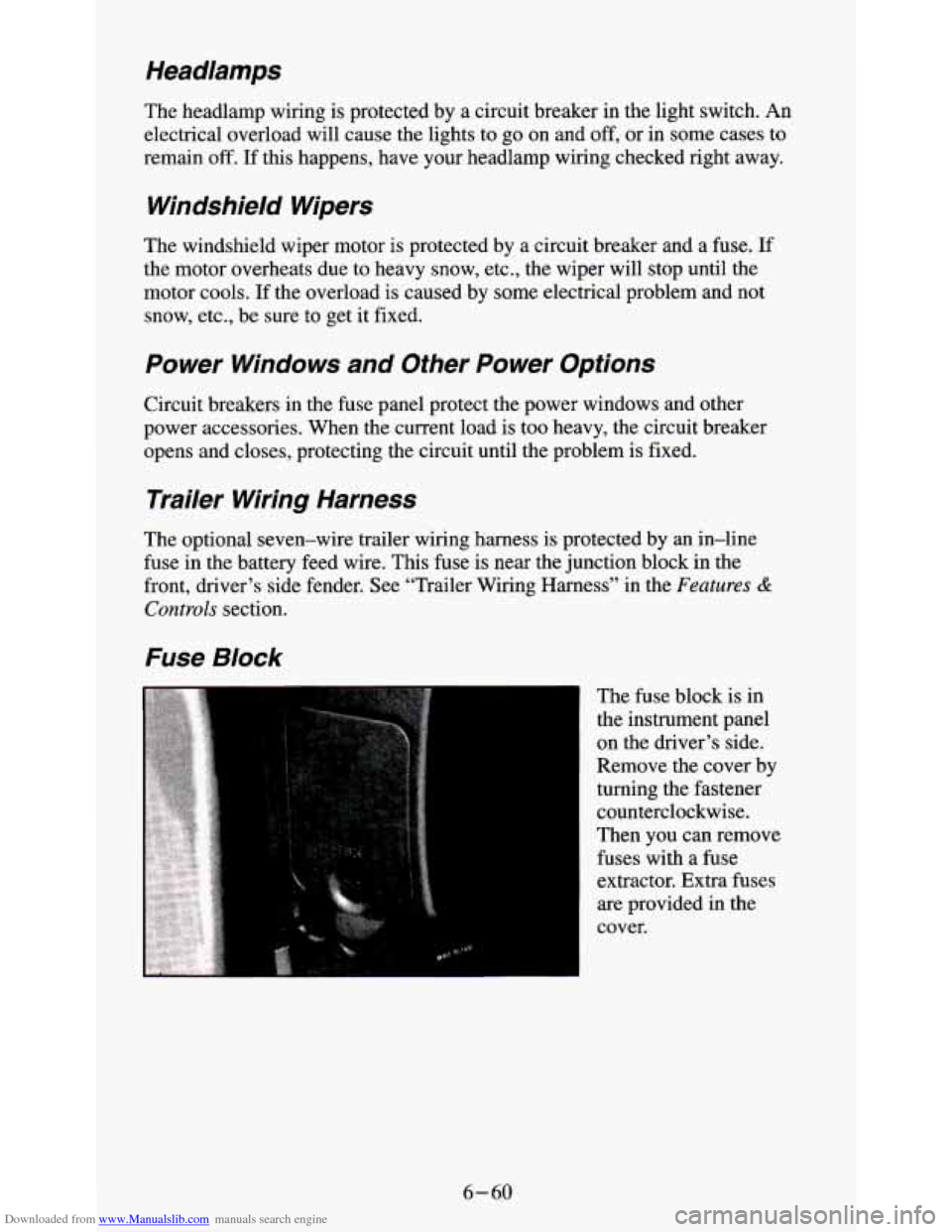
Fuse Block
. .. . .,
The fuse block is in
the instrument panel
on the driver’s side.
Remove the cover by
turning the fastener
counterclockwise.
Then you can remove
fuses with a fuse
extractor. Extra fuses
are provided in the
cover.
6-60
Page 278 of 354
Downloaded from www.Manualslib.com manuals search engine Be sure to use the
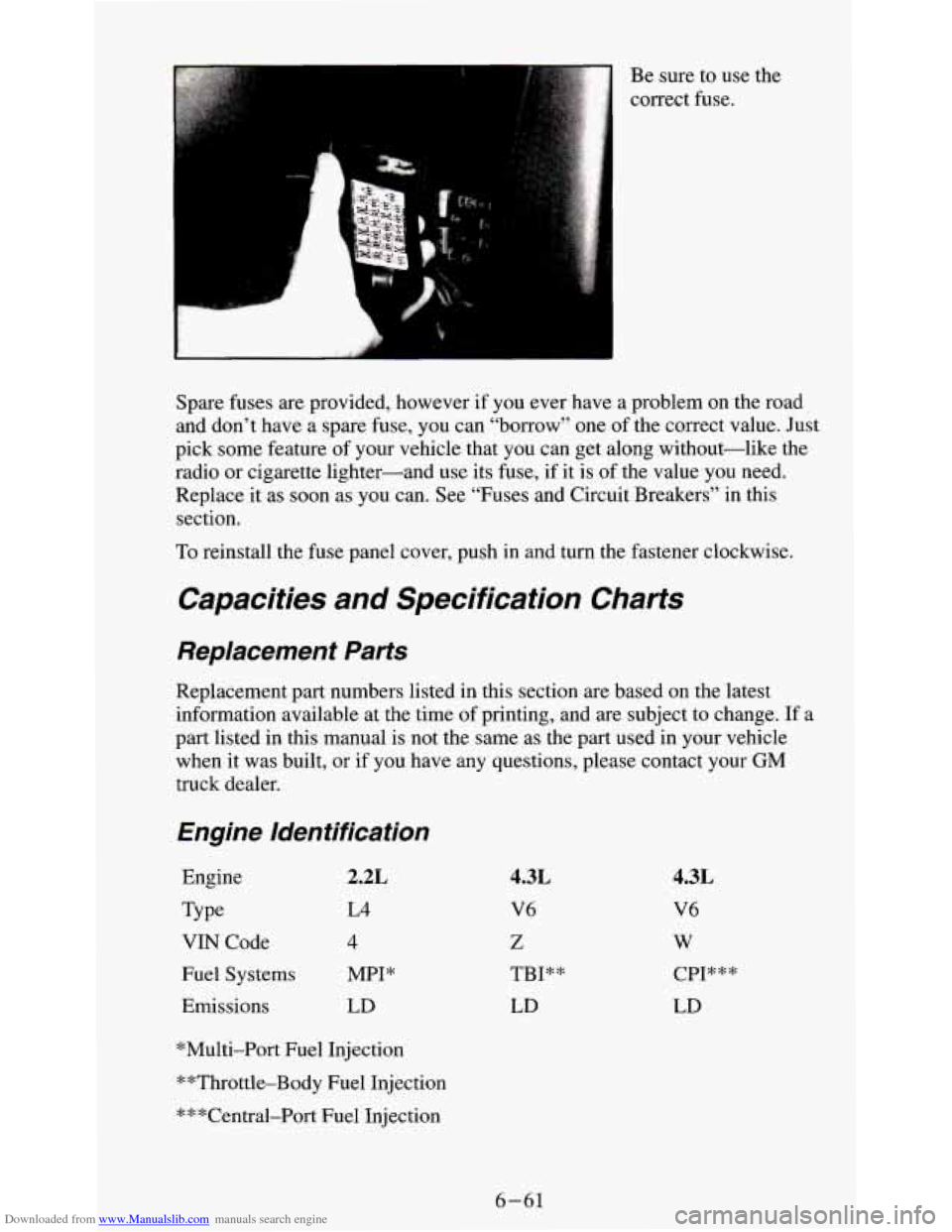
correct fuse.
Spare fuses are provided, however if you ever have a problem on the road
and don’t have a spare fuse, you
can “borrow” one of the correct value. Just
pick some feature of your vehicle that you can get along without-like the
radio or cigarette lighter-and use its fuse, if it is of the value you need.
Replace it as soon as you
can. See “Fuses and Circuit Breakers” in this
section.
To reinstall the fuse panel cover, push in and turn the fastener clockwise.
Capacities and Specification Charts
Replacement Parts
Replacement part numbers listed in this section are based on the latest
information available at the time of printing, and are subject to change. If a
part listed in this manual is not the same as the part used in your vehicle
when
it was built, or if you have any questions, please contact your GM
truck dealer.
Engine Ideniificafion
Engine
Type VIN Code
Fuel Systems Emissions 2.2L
L4
4
MPI*
LD
4.3L
V6
Z
m1* *
LD
4.3L
V6
W
CPI* * *
LD
*Multi-Port Fuel Injection
**Throttle-Body Fuel Injection
***Central-Port Fuel Injection
6-61
Page 283 of 354
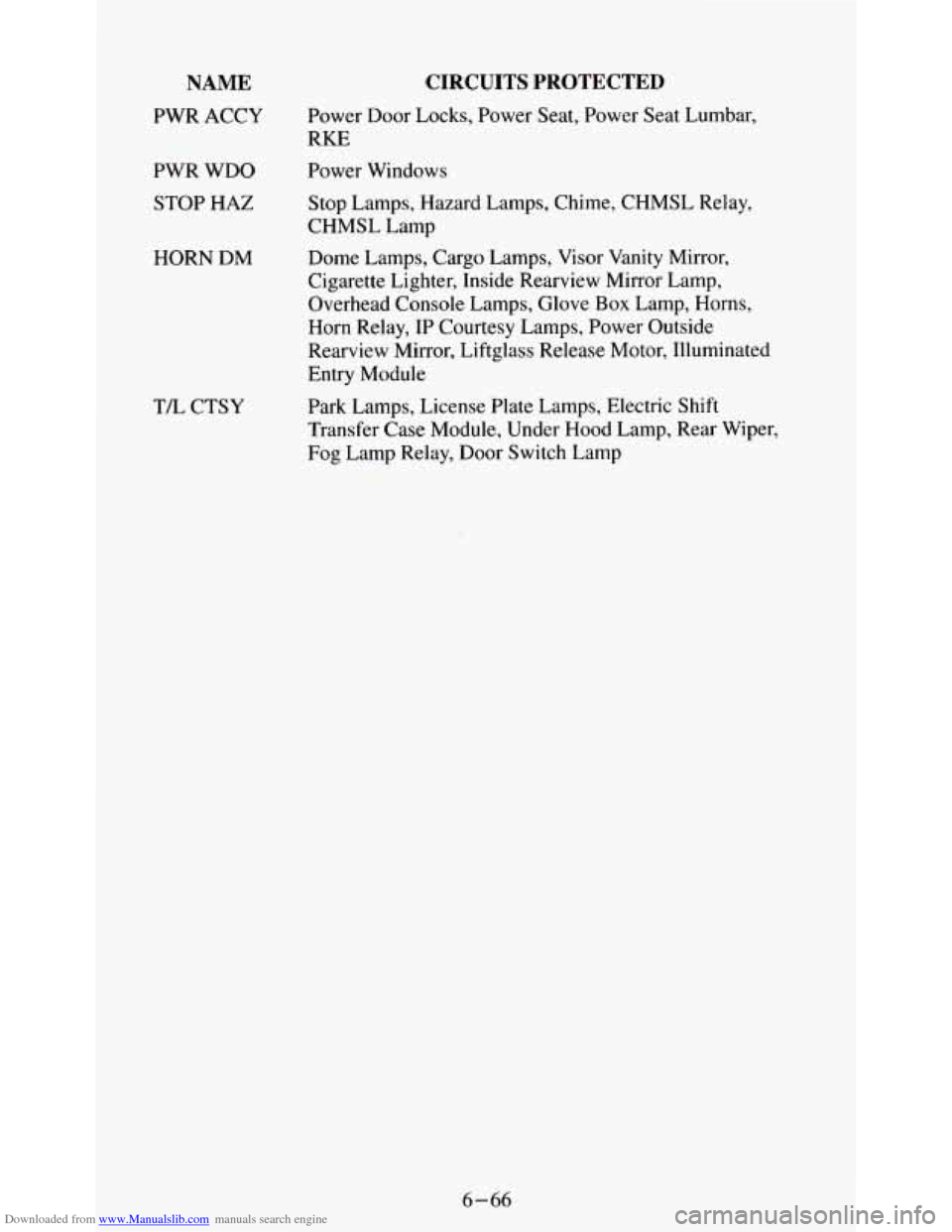
Downloaded from www.Manualslib.com manuals search engine NAME
PWR ACCY
PWR WDO
STOP
HA2
HORN DM
T/L CTSY
CIRCUITS PROTECTED
Power Door Locks, Power Seat, Power Seat Lumbar,
RKE
Power Windows
Stop Lamps, Hazard Lamps, Chime, CHMSL Relay,
CHMSL Lamp
Dome Lamps, Cargo Lamps, Visor Vanity Mirror,
Cigarette Lighter, Inside Rearview Mirror Lamp,
Overhead Console Lamps, Glove
Box Lamp, Horns,
Horn Relay, IP Courtesy Lamps, Power Outside
Rearview Mirror, Liftglass Release Motor, Illuminated
Entry Module
Park Lamps, License Plate Lamps, Electric Shift
Transfer Case Module, Under Hood Lamp, Rear Wiper,
Fog Lamp Relay, Door Switch Lamp
6-66