load capacity CHEVROLET S10 1995 2.G Owners Manual
[x] Cancel search | Manufacturer: CHEVROLET, Model Year: 1995, Model line: S10, Model: CHEVROLET S10 1995 2.GPages: 354, PDF Size: 18.92 MB
Page 111 of 354
Downloaded from www.Manualslib.com manuals search engine A CAUTION:
Don’t keep driving if the oil pressure is low. If you do, your
engine can become
so hot that it catches fire. You or others could
be burned. Check your oil
as soon as possible and have your
vehicle serviced.
NOTICE:
Damage to your engine from neglected oil problems can be
costly and is not covered
by your warranty.
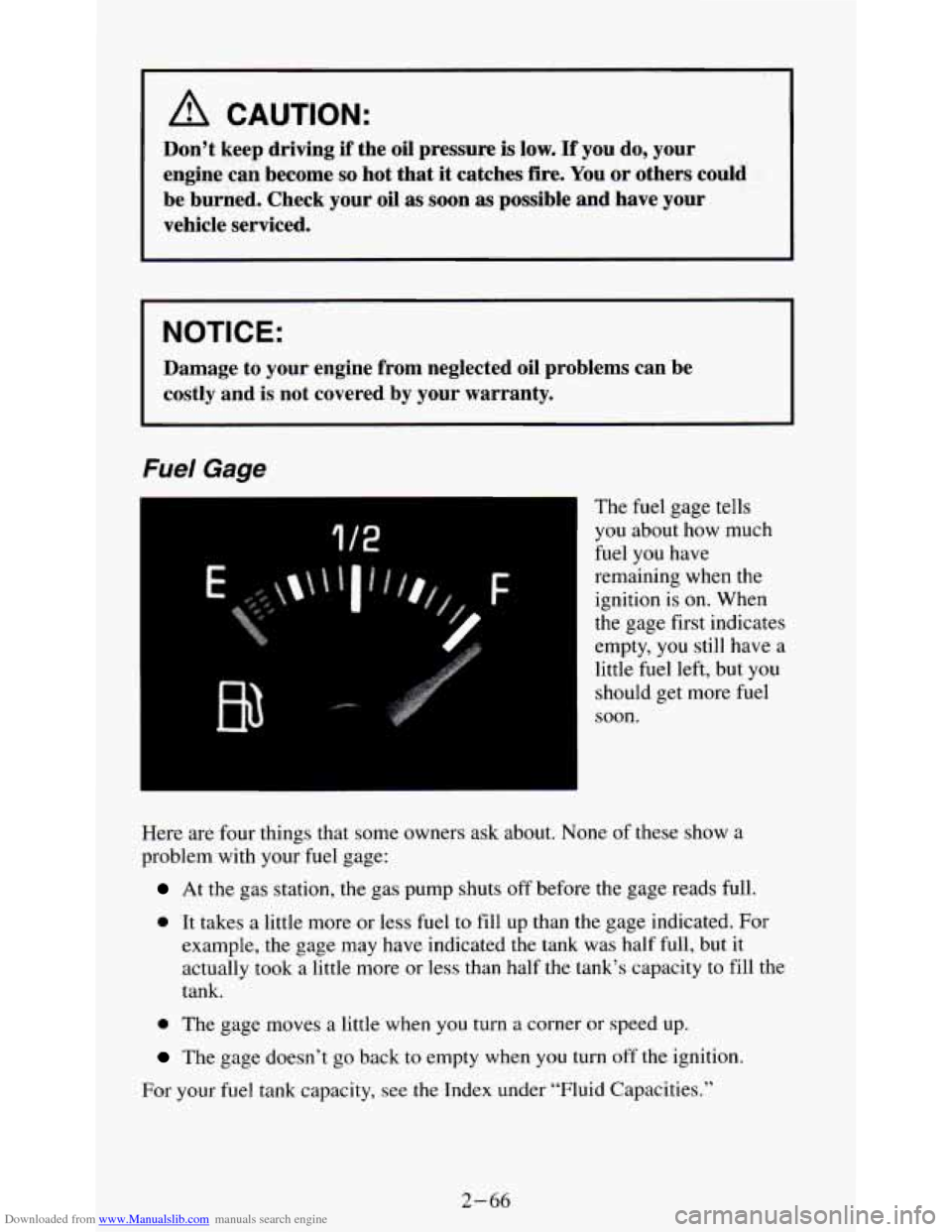
Fuel Gage
The fuel gage tells
you about how much
fuel you have
remaining when the
ignition
is on. When
the gage first indicates
empty, you still have a
little fuel left, but you
should get more fuel
soon.
Here are four things that some owners ask about. None of these show a
problem with your fuel gage:
At the gas station, the gas pump shuts off before the gage reads full.
0 It takes a little more or less fuel to fill up than the gage indicated. For
example, the gage may have indicated the tank was half full, but it
actually took a little more or less than half the tank’s capacity to fill the
tank.
0 The gage moves a little when you turn a corner or speed up.
The gage doesn’t go back to empty when you turn off the ignition.
For your fuel tank capacity, see the Index under “Fluid Capacities.”
2-66
Page 169 of 354
Downloaded from www.Manualslib.com manuals search engine 5. Release the parking brake only after the vehicle being towed is firmly
attached to the tow vehicle.
6. Insert the ignition key into the ignition switch and turn it one notch
forward of the
LOCK position. This places the key into the OFF
position, which unlocks the steering column while preventing battery
drain. Unlocking the steering column will allow for proper movement
of the front wheelshires during towing.
NOTICE:
You should exercise extra care whenever towing another vehicle.
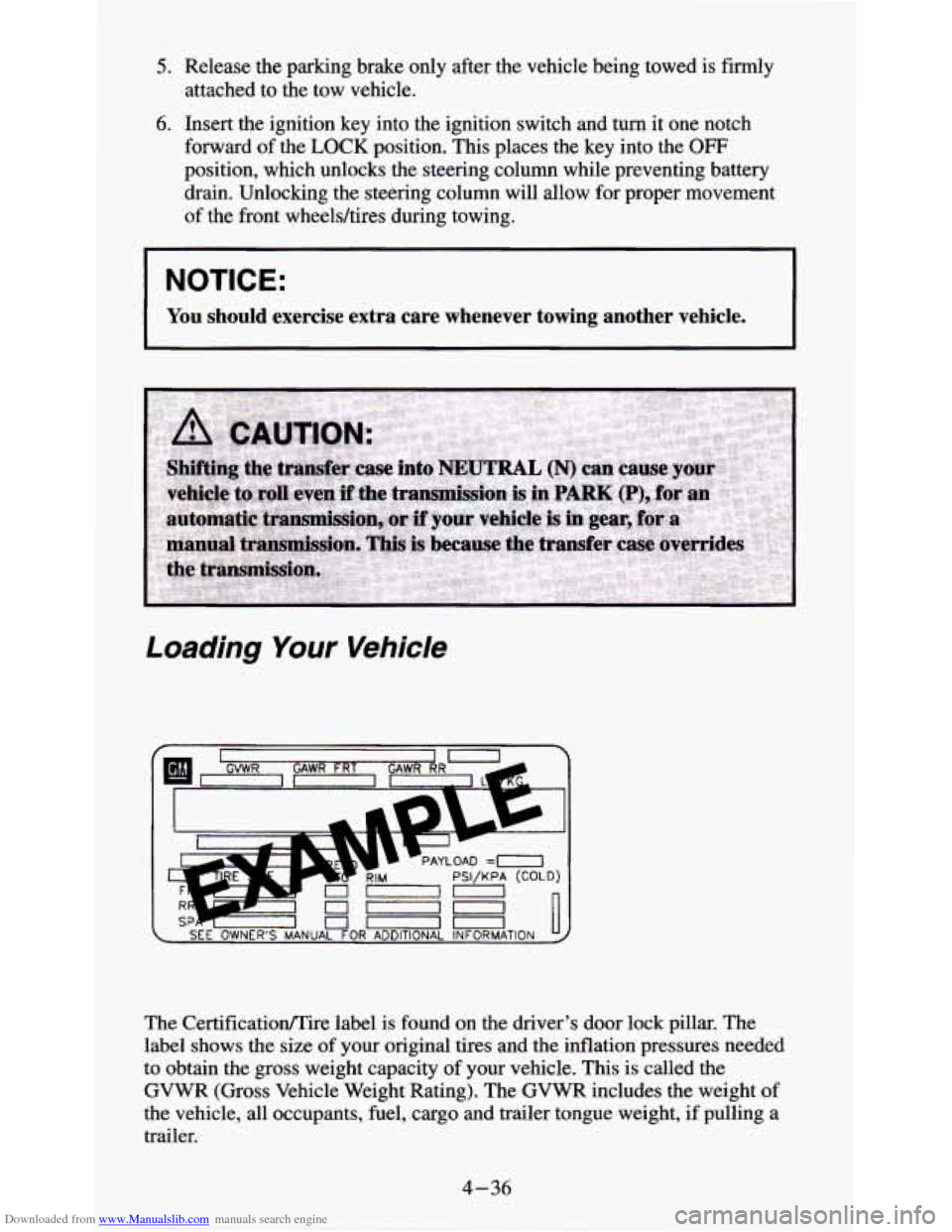
Loading Your Vehicle
PAYLOAD =I-1
The Certificatioflire label is found on the driver’s door lock pillar. The
label shows the size of your original tires and the inflation pressures needed
to obtain the gross weight capacity of your vehicle. This is called the
GVWR (Gross Vehicle Weight Rating). The GVWR includes the weight of
the vehicle, all occupants, fuel, cargo and trailer tongue weight, if pulling a
trailer.
4-36
Page 171 of 354
Downloaded from www.Manualslib.com manuals search engine There’s also important loading information for off-road driving in this
manual. See “Loading Your Vehicle”
in the Index.
Two-Tiered Loading
By positioning four 2” x 6” wooden planks across the width of the pickup
box,
you can create an upper load platform. The planks must be inserted in
the pickup box depressions. The length
of the planks must allow for at least
3/4“ bearing surface on each end of the plank.
When using this upper load platform, be sure the load
is securely tied down
to prevent it from shifting. The load’s center of gravity should be positioned
in a zone over the rear axle. The zone is located in the area between the
front
of each fenderwell and the rear of each fenderwell. The center of
gravity height must
not extend above the top of the pickup box flareboard.
Any load that extends beyond the vehicle’s taillamp area must be properly
marked according to local laws and regulations.
Remember
not to exceed the Gross Axle Weight Rating (GAWR) of the rear
axle. See “Loading Your Vehicle”
in the Index.
Payload
The Payload Capacity is shown on the CertificatiodTire label. This is the
maximum load capacity that your vehicle can carry. Be sure to include
the
weight of the people inside as part of your load. If you added any
accessories or equipment after your vehicle
left the factory, remember to
subtract the weight
of these things from the payload. Your dealer can help
you with
this.
4-38
Page 177 of 354
Downloaded from www.Manualslib.com manuals search engine Don’t tow a trailer at all during the first 500 miles (800 km) your new
vehicle is driven. Your engine, axle or other parts could be damaged.
Then, during the first 500 miles (800 km) that you tow a trailer, don’t
drive over
50 mph (80 km/h) and don’t make starts at full throttle. This
helps your engine and other parts of your vehicle wear in at the heavier
loads.
If you have an automatic transmission, you should use DRIVE (D) (or,
as you need to, a lower gear) when towing a trailer. Operating your
vehicle
in DRIVE (D) when towing a trailer will minimize heat
build-up and extend the life of your transmission. If you have a manual
transmission and you are towing a trailer, it’s better not to use
FIFTH
(5) gear. Just drive in FOURTH (4) gear (or, as you need to, a lower
gear)-
Three important considerations have to do with weight:
Weight of the Trailer
How heavy can a trailer safely be?
It depends on how you plan to use your rig. For example, speed, altitude,
road grades, outside temperature and how much your vehicle is used to pull
a trailer are all important. And, it can also depend on any special equipment
that you have on your vehicle.
You can ask your dealer for our trailering information
or advice, or you can
write us at the address listed in your Warranty and Owner Assistance
Information Booklet.
In Canada, write to:
General Motors of Canada Limited
Customer Assistance Center
1908 Colonel Sam Drive
Oshawa, Ontario L1H
8P7
Weight of the Trailer Tongue
The tongue load (A) of any trailer is an important weight to measure
because it affects the total or gross weight of your vehicle. The gross vehicle
weight (GVW) includes the curb weight of the vehicle, any cargo you may
carry in it, and the people who will be riding in the vehicle. And if you will
tow a trailer, you must add the tongue load to the GVW because your
vehicle will be carrying that weight, too. See “Loading Your Vehicle” in the
Index for more information about your vehicle’s maximum load capacity.
4-44
Page 226 of 354
Downloaded from www.Manualslib.com manuals search engine When to Add Oil
If the oil is at or below the ADD line, then you’ll need to add some oil. But
you must
use the right kind. This part explains what kind of oil to use. For
crankcase capacity, see “Capacities and Specifications” in the Index.
I NOTICE:
Don’t add too much oil. If your engine has so much oil that the
oil level gets above the cross-hatched area that shows the pro\
per
operating range, your engine could be damaged.
The engine oil filler cap is located on the driver’s side engine valve cover.
Just fill
it enough to put the level somewhere in the proper operating range.
Push the dipstick all the way back in when you’re through.
What Kind of Oil to Use
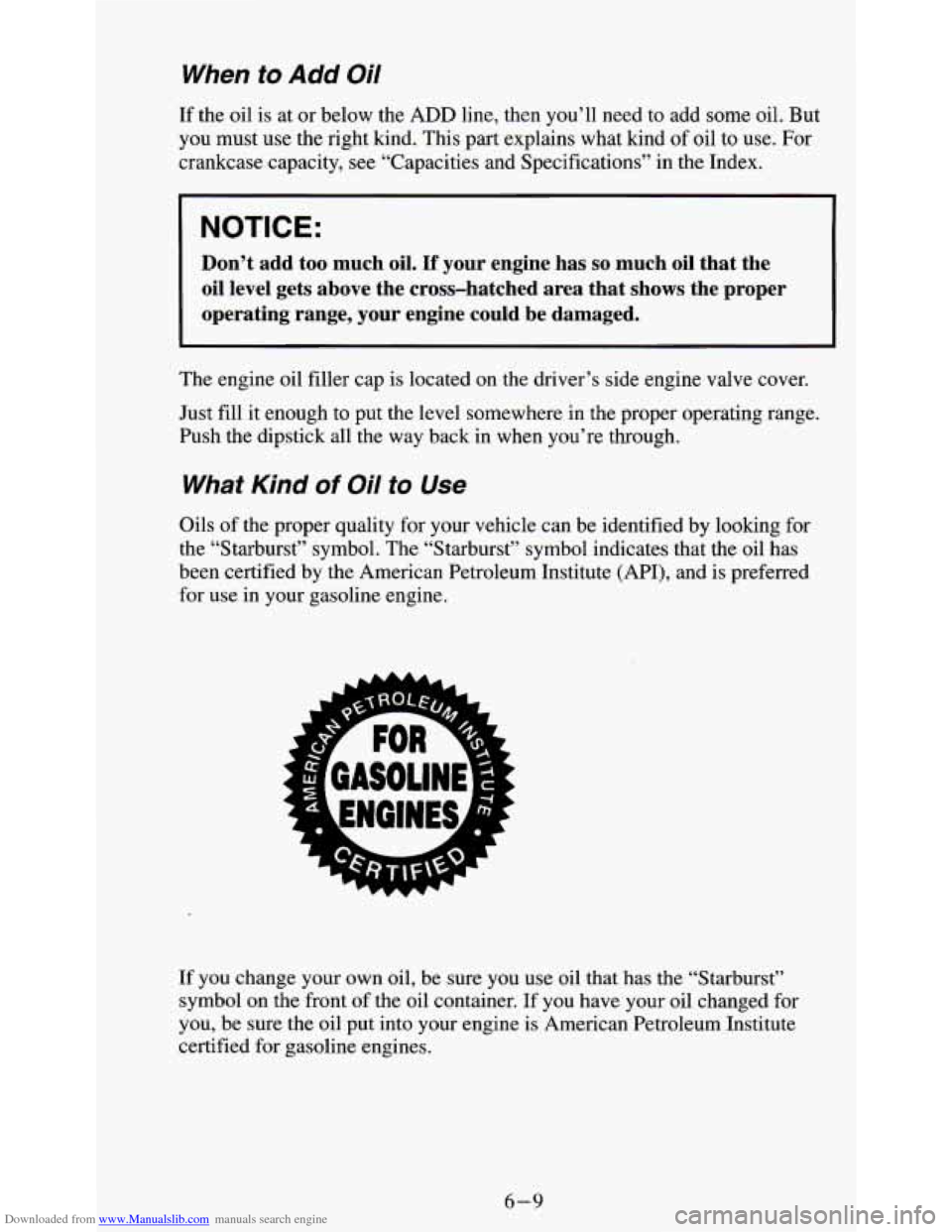
Oils of the proper quality for your vehicle can be identified by looking for
the “Starburst” symbol. The “Starburst” symbol indicates that the oil has
been certified by the American Petroleum Institute (API), and is preferred
for use in your gasoline engine.
If you change your own oil, be sure you use oil that has the “Starburst”
symbol on the front
of the oil container. If you have your oil changed for
you, be sure the oil put into your engine is American Petroleum Institute
certified for gasoline engines.
6-9
Page 262 of 354
Downloaded from www.Manualslib.com manuals search engine Warning: The temperature grade for this tire is established for a tire that is
properly inflated and not overloaded. Excessive speed, underinflation, or
excessive loading, either separately or in combination, can cause heat
buildup and possible tire failure.
These grades are molded on the sidewalls of passenger
car tires.
While the tires available as standard or optional equipment on General
Motors vehicles may vary with respect to these grades, all such tires meet
General Motors performance standards and have been approved for use on
General Motors vehicles. All passenger type
(P Metric) tires must conform
to Federal safety requirements in addition to these grades.
Wheel Alignment and Tire Balance
The wheels on your vehicle were aligned and balanced carefully at the
factory to give you the longest tire life and best overall performance.
In most cases, you will not need to have your wheels aligned again.
However, if you notice unusual tire wear or your vehicle pulling one way or
the other, the alignment may need to be reset. If you notice your vehicle
vibrating when driving on a smooth road, your wheels may need to be
rebalanced.
Wheel Replacement
Replace any wheel that is bent, cracked, or badly rusted or corroded. If
wheel nuts keep coming loose, the wheel, wheel bolts, and wheel nuts
should be replaced. If the wheel leaks air, replace it (except some aluminum
wheels, which can sometimes be repaired). See your GM dealer if any of
these conditions exist.
Your dealer will know the kind of wheel you need.
Each new wheel should have the same load carrying capacity, diameter,
width, offset, and be mounted the same way as the one it replaces.
If you need to replace any of your wheels, wheel bolts, or wheel nuts,
replace them only with new GM original equipment parts. This way, you
will be sure to have the right wheel, wheel bolts, and wheel nuts for your
vehicle.
6-45
Page 279 of 354
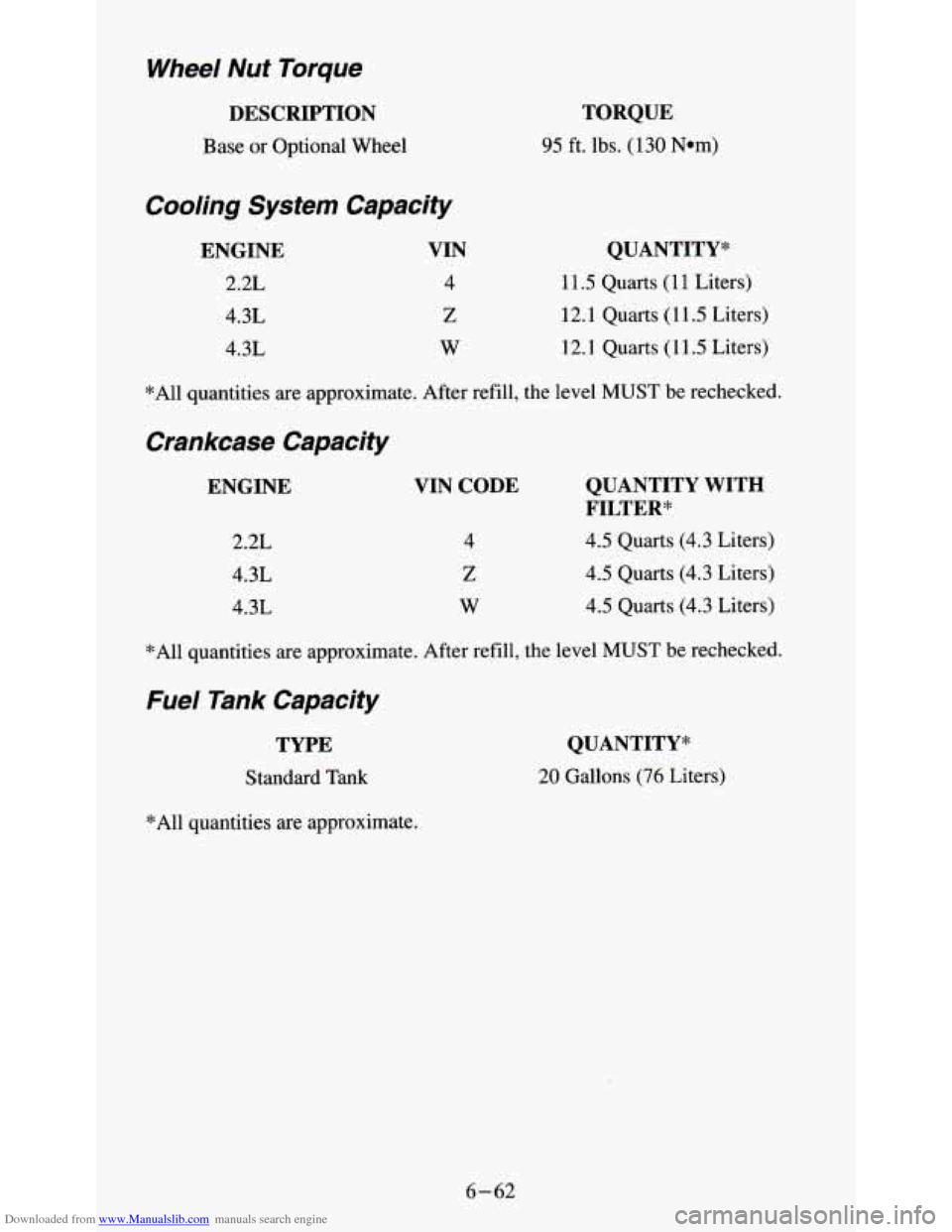
Downloaded from www.Manualslib.com manuals search engine Wheel Nut Torque
DESCRIPTION
Base or Optional Wheel
Cooling System Capacity
ENGINE
2.2L
4.3L
4.3L
VIN
4
Z
w
TORQUE
95 ft. lbs. (130 Nom)
QUANTITY*
11.5 Quarts (1 1 Liters)
12.1 Quarts (1 1.5 Liters)
12.1 Quarts
(1 1.5 Liters)
*All quantities are approximate. After refill, the level
MUST be rechecked.
Crankcase Capacity
ENGINE
2.2L
4.3L
4.3L
VIN CODE
4
z
W
QUANTITY WITH
FILTER*
4.5 Quarts (4.3 Liters)
4.5 Quarts (4.3 Liters)
4.5 Quarts (4.3 Liters)
*All quantities are approximate. After refill, the level
MUST be rechecked.
Fuel Tank Capacity
TYPE
Standard Tank
QUANTITY*
20 Gallons (76 Liters)
*All quantities are approximate.
6-62
Page 287 of 354
Downloaded from www.Manualslib.com manuals search engine Air Conditioning Refrigerants
Not all air conditioning refrigerants are the same. If the air conditioning
system in your vehicle needs refrigerant, be sure the proper refrigerant is
used. If you’re not sure, ask your
GM dealer. For additional information, see
your “Warranty and Owner Assistance Information” booklet.
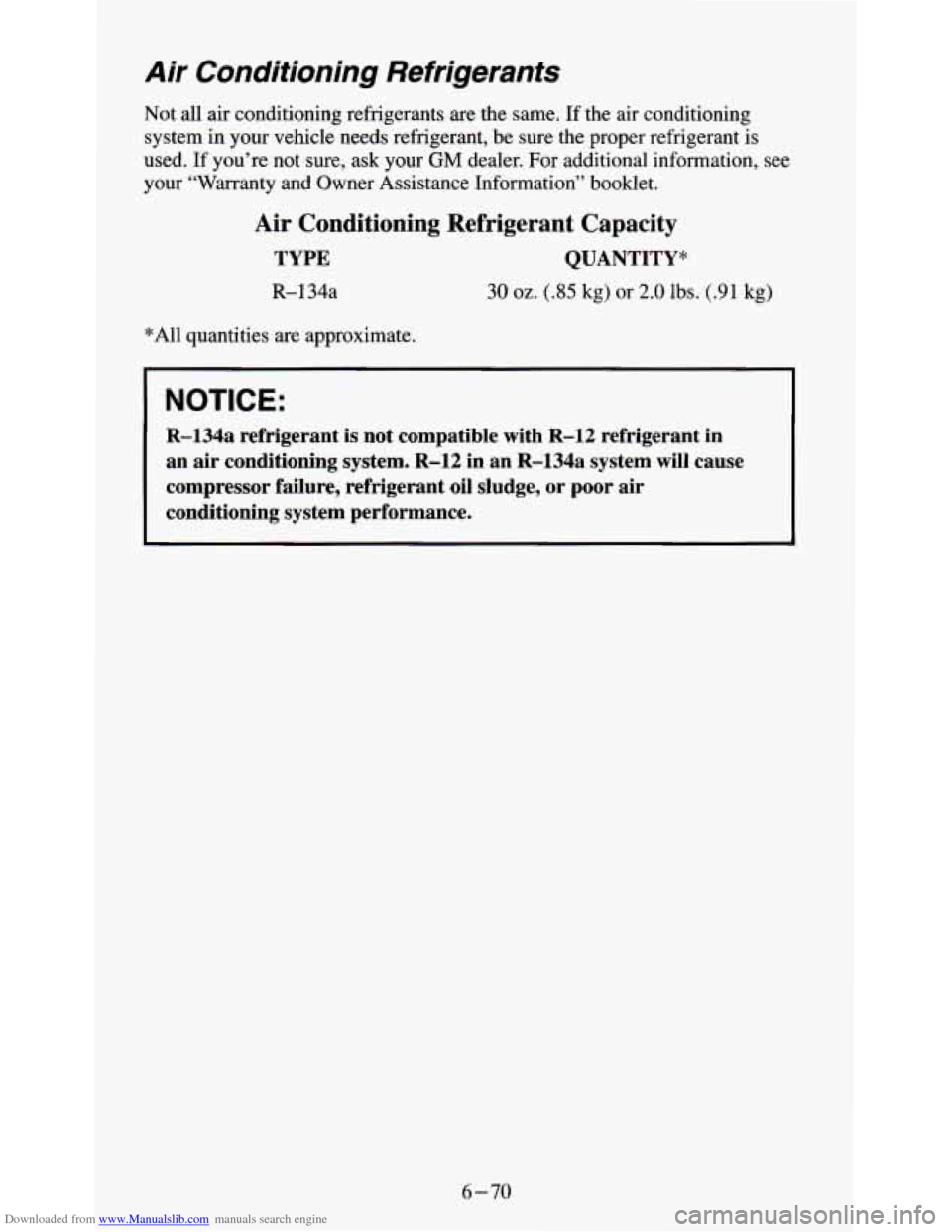
Air Conditioning Refrigerant Capacity
TYPE QUANTITY*
R-134a
*All quantities are approximate.
30 oz. (35 kg) or 2.0 lbs. (.91 kg)
NOTICE:
R-134a refrigerant is not compatible with R-12 refrigerant in
an air conditioning system. R-12 in an R-134a system will caus\
e
compressor failure, refrigerant oil sludge, or poor air
conditioning system performance.
6-70
Page 345 of 354
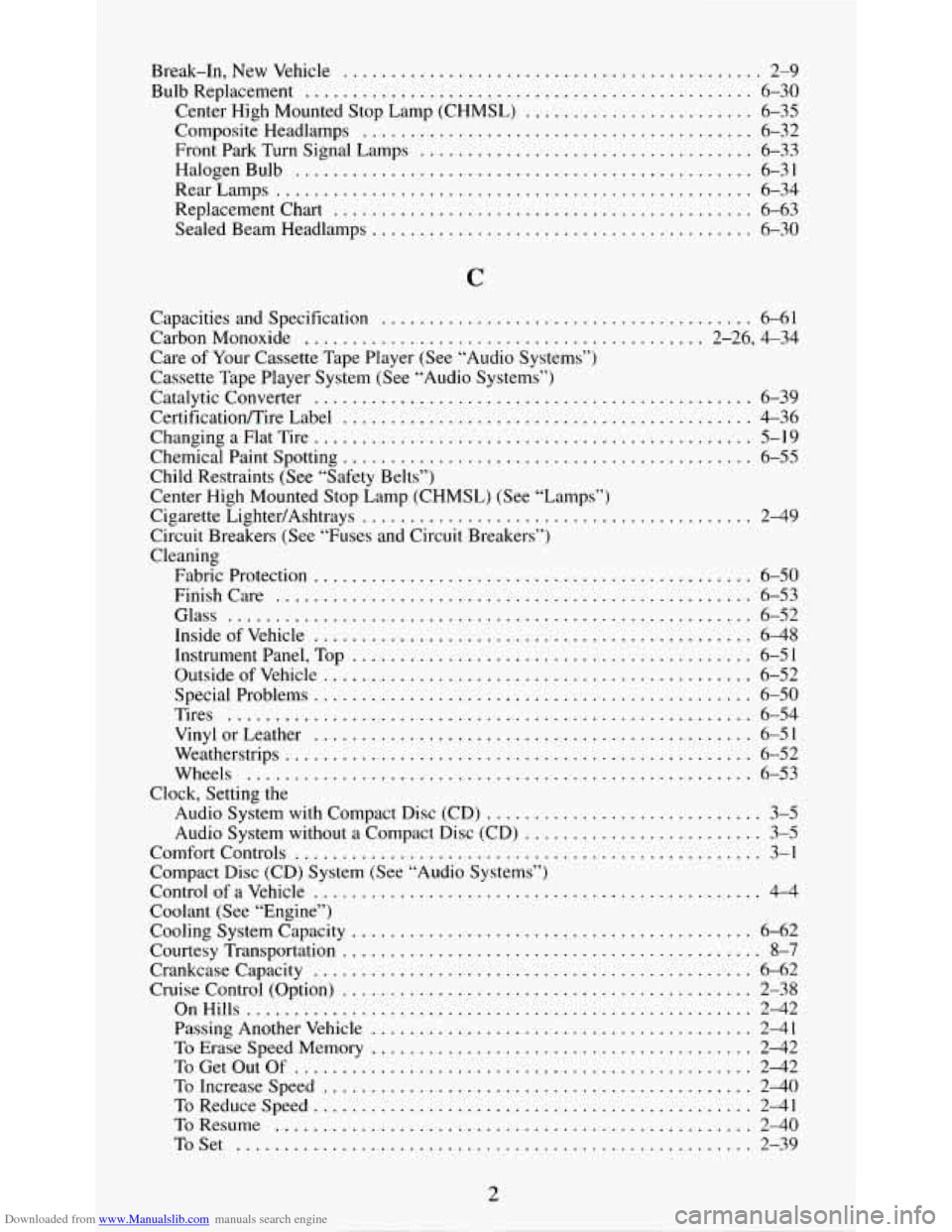
Downloaded from www.Manualslib.com manuals search engine Break.1n. New Vehicle ............................................ 2-9
Bulb Replacement
............................................... 6-30
Composite Headlamps
......................................... 6-32
Halogen Bulb
................................................ 6-31
Replacement Chart ............................................ 6-63
Sealed Beam Headlamps
........................................ 6-30
Center
High Mounted Stop Lamp (CHMSL)
........................ 6-35
Front Park Turn Signal Lamps
................................... 6-33
RearLamps .................................................. 6-34
Capacities and Specification
............ ....................... 6-61
CarbonMonoxide
.......................................... 2-26, 4-34
Care of Your Cassette Tape Player (See “Audio Systems”)
Cassette Tape Player System (See “Audio Systems”)
Catalytic Converter
.............................................. 6-39
CertificatiodTire Label
........................................... 4-36
Changing
a Flat Tire .............................................. 5-19
Chemical Paint Spotting
........................................... 6-55
Cigarette LightedAshtrays
......................................... 2-49
Child
Restraints (See “Safety Belts”)
Center High Mounted Stop Lamp (CHMSL) (See “Lamps“)
Circuit Breakers (See “Fuses and Circuit Breakers”)
Cleaning Fabric Protection
.............................................. 6-50
Finishcare
.................................................. 6-53
Glass ....................................................... 6-52
InsideofVehicle
.............................................. 6-48
Instrumentpanel, Top .......................................... 6-51
Outsideofvehicle
............................................. 6-52
Tires
....................................................... 6-54
VinylorLeather
.............................................. 6-51
Wheels
........................................ ........ 6-53
Special
Problems
.............................................. 6-50
Weatherstrips ................................................. 6-52
Audio System with Compact Disc (CD)
............................. 3-5
Clock, Setting
the
Audio System without
a Compact Disc (CD) ......................... 3-5
Comfort Controls
................................................. 3-1
Compact Disc (CD) System (See “Audio Systems”)
Control
of a Vehicle ........................................... 4-4
Coolant (See “Engine”)
Cooling System Capacity
.......................................... 6-62
Courtesy Transportation
............................................ 8-7
Crankcase Capacity .............................................. 6-62
Cruise Control (Option)
........................................... 2-38
Passing Another Vehicle
........................................ 2-41
To Erase Speed Memory
........................................ 2-42
To Increase Speed
............................................. 2-40
OnHills
..................................................... 2-42
ToGetOutOf
................................................ 2-42
ToReduceSpeed
.............................................. 2-41
ToResume .................................................. 2-40
ToSet ...................................................... 2-39
2
Page 347 of 354
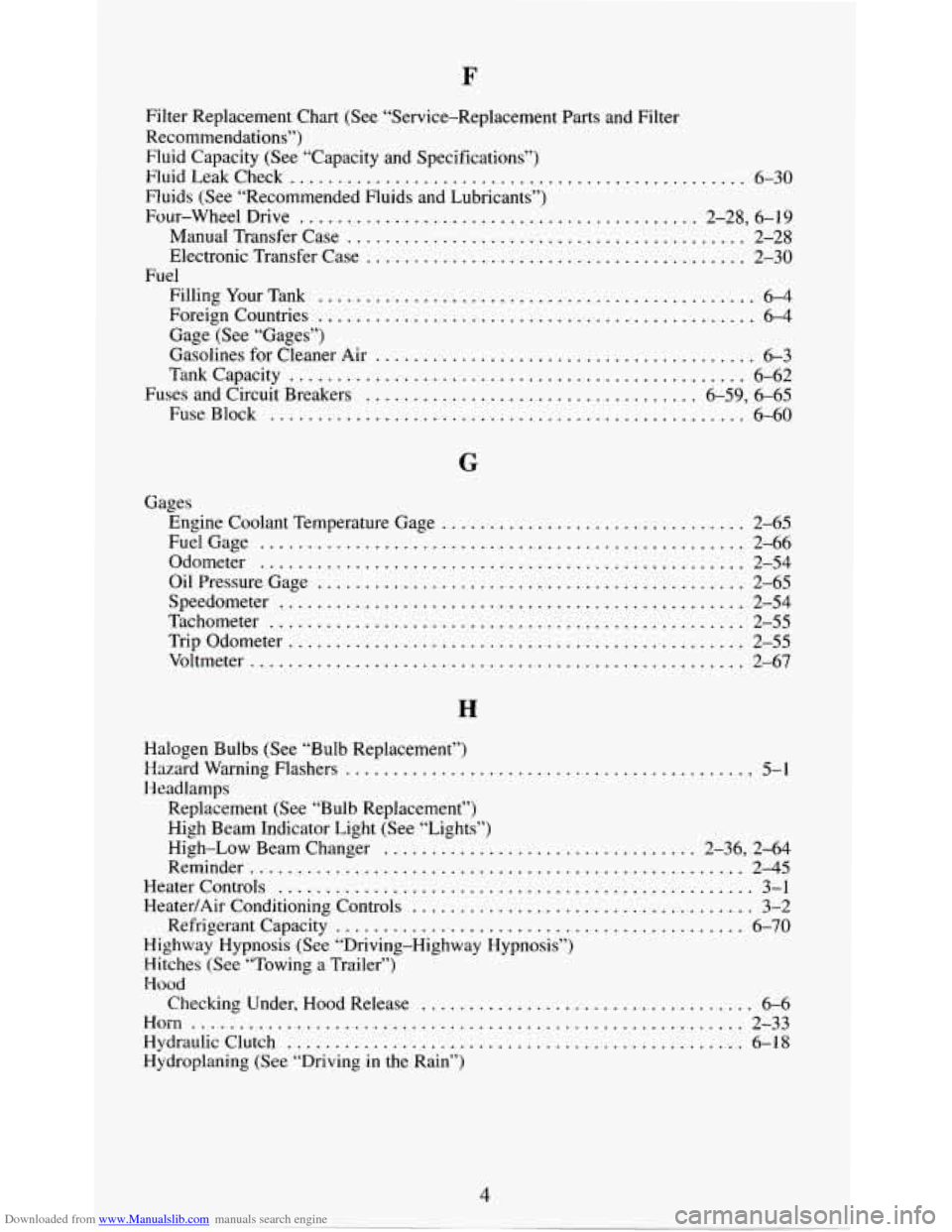
Downloaded from www.Manualslib.com manuals search engine F
Filter Replacement Chart (See “Service-Replacement Parts and Filter
Recommendations”)
Fluid Capacity (See “Capacity and Specifications”)
l;luidLeakCheck
................................................ 6-30
Fluids (See “Recommended Fluids and Lubricants”)
Four-wheel Drive
.......................................... 2-28. 6-19
Manual Transfer Case
.......................................... 2-28
Electronic Transfer Case
........................................ 2-30
FillingYourTank
.............................................. 6-4
Foreign Countries .............................................. 6-4
Gage (See “Gages”)
Gasolines for Cleaner Air
.................................... 6-3
Tankcapacity
................................................ 6-62
Fuses and Circuit Breakers
................................... 6-59, 6-65
Fuel
FuseBlock .................................................. 6-60
G
Gages
Engine Coolant Temperature Gage
................................ 2-65
FuelGage
................................................... 2-66
Odometer
................................................... 2-54
OilPressureGage
............................................. 2-65
Tachometer
.................................................. 2-55
Voltmeter
.................................................... 2-67
Speedometer
................................................. 2-54
Trip Odometer
................................................ 2-55
.............. 5-1
Halogen Bulbs (See “Bulb Replacement”)
Headlamps Hazard Warning Flashers
...........................
Replacement (See “Bulb Replacement”)
High Beam
Indicator Light (See “Lights”)
High-Low Beam Changer
................................. 2.36, 2.64
Reminder
.................................................... 2-45
Heater Controls
.................................................. 3-1
Heater/Air Conditioning Controls
.................................... 3-2
Refrigerant Capacity
........................................... 6-70
Highway Hypnosis (See “Driving-Highway Hypnosis”)
Hitches (See “Towing a Trailer”)
Wood
Horn ......................................... ............. 2-33
HydraulicClutch
................................................ 6-18
Hydroplaning (See “Driving in the Rain”)
Checking
Under, Hood Release
................................... 6-6
4