power steering CHEVROLET S10 1995 2.G Owners Manual
[x] Cancel search | Manufacturer: CHEVROLET, Model Year: 1995, Model line: S10, Model: CHEVROLET S10 1995 2.GPages: 354, PDF Size: 18.92 MB
Page 140 of 354
Downloaded from www.Manualslib.com manuals search engine To Use Four-wheel Anii-Lock
Don’t pump the brakes. Just hold the brake pedal down and let anti-lock
work for
you. You may feel the brakes vibrate, or you may notice some
noise, but
this is normal.
On vehicles with four-wheel drive, your anti-lock brakes work at all
times
- whether you are in two-wheel drive or four-wheel drive.
To Use Rear- Wheel Anii-Lock
Use rear-wheel anti-lock like regular brakes. You may feel the brakes
vibrate, or
you may notice some noise outside your vehicle, but this is
normal. Let anti-lock work for you, but remember: Your front wheels can
still stop rolling. If that happens, release enough pressure
on the brakes to
get the wheels rolling again
so that you can steer.
Braking in Emergencies
At some time, nearly every driver gets into a situation that requires hard braking.
The four-wheel anti-lock system
lets you steer and brake at the same time.
If you have the rear-wheel anti-lock braking system, your front wheels can
stop rolling when you brake very hard. Once they do, the vehicle can’t
respond to your steering. Momentum will carry
it in whatever direction it
was headed when the front wheels stopped rolling. That could be off the
road, into the very thing you were trying
to avoid, or into traffic.
So, unless you have four-wheel anti-lock, use a “squeeze” braking
technique. This will give
you maximum braking while maintaining steering
control. You do this by pushing on the brake pedal with steadily increasing
pressure. When you do, it
will help maintain steering control. In many
emergencies, steering can help
you more than even the very best braking.
Steering
Power Steering
If you lose power steering assist because the engine stops or the system is
not functioning,
you can steer but it will take much more effort.
Steering Tips
Driving on Curves
It’s important to take curves at a reasonable speed.
A lot of the “driver lost control” accidents mentioned on the news happen
on curves. Here’s why:
Experienced driver
or beginner, each of us is subject to the same laws of
physics when driving on curves. The traction of the tires against the road
4-7
Page 149 of 354
Downloaded from www.Manualslib.com manuals search engine Approaching a Hill
When you approach a hill, you need to decide if it’s one of those hills that’s
just too steep to climb, descend, or cross. Steepness can be hard to judge.
On a very small hill, for example, there may be a smooth, constant incline
with only a small change in elevation where you can easily see all the way
to the top. On a large hill, the incline may get steeper as you near the top,
but you may not see this because the crest of the hill is hidden by bushes,
grass, or shrubs.
Here are some other things to consider as you approach a hill.
Is there a constant incline, or does the hill get sharply steeper in places?
Is there good traction on the hillside, or will the surface cause tire
slipping?
Is there a straight path up or down the hill so you won’t have to make
turning maneuvers?
Are there obstructions on the hill that can block your path (boulders,
trees, logs or ruts)?
What’s beyond the hill? Is there a cliff, an embankment, a drop-off, a
fence? Get out and walk the hill if you don’t know. It’s the smart way
to
find out.
Is the hill simply too rough? Steep hills often have ruts, gullies, troughs
and exposed rocks because they are more susceptible to the effects
of
erosion.
Driving Uphill
Once you decide you can safely drive up the hill, you need to take some
special steps.
Use a low gear and get a firm grip on the steering wheel.
Get a smooth start up the hill and try to maintain your speed. Don’t use
more power than you need, because you don’t want your wheels to start
spinning or sliding.
turns, you might want to find another route.
0 Try to drive straight up the hill if at all possible. If the path twists and
4- 16
Page 241 of 354
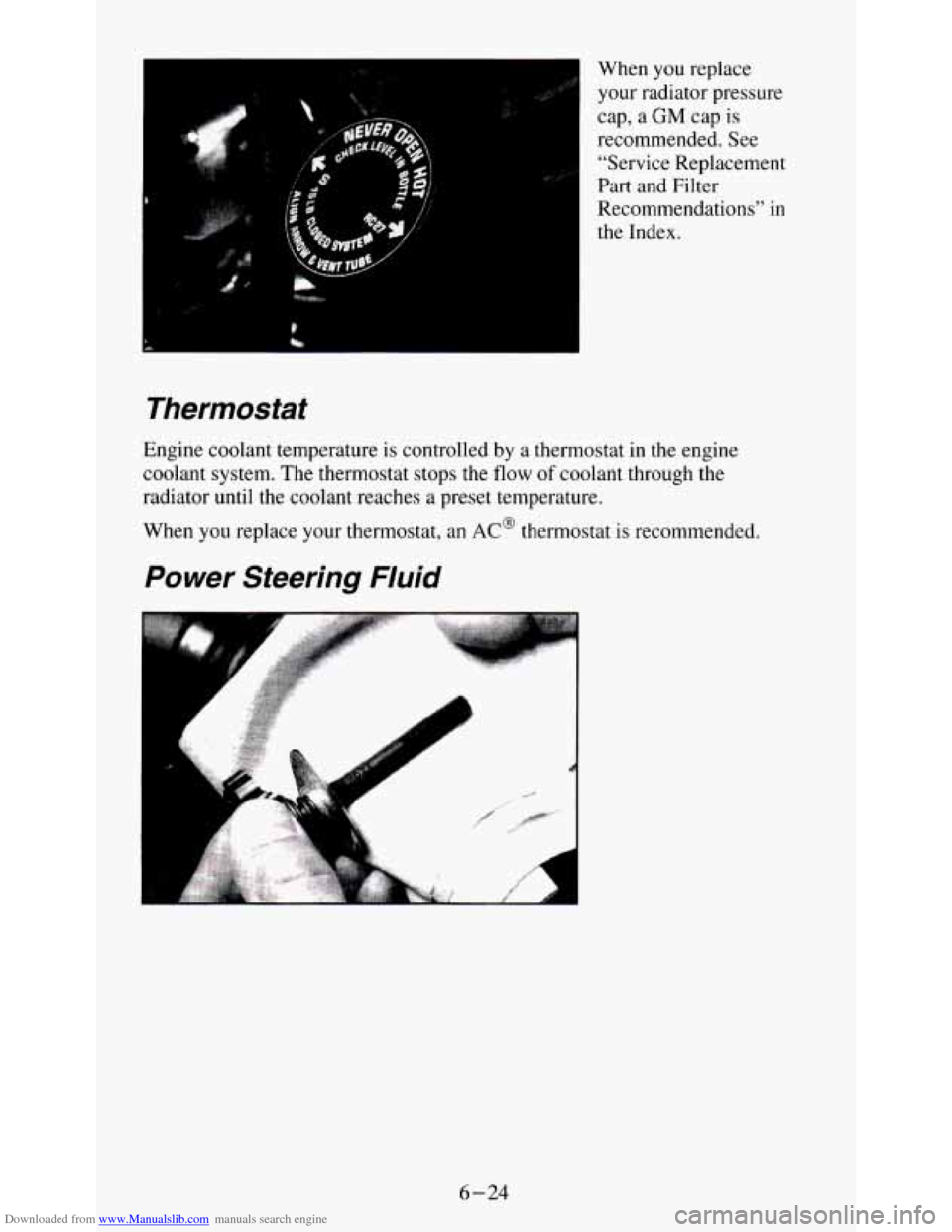
Downloaded from www.Manualslib.com manuals search engine When you replace
your radiator pressure
cap, a
GM cap is
recommended. See
"Service Replacement
Part and Filter
Recommendations"
in
the Index.
Thermostat
Engine coolant temperature is controlled by a thermostat in the engine
coolant system. The thermostat stops the
flow of coolant through the
radiator until the coolant reaches
a preset temperature.
When
you replace your thermostat, an AC@ thermostat is recommended.
Power Steering Fluid
il
A
6-24
Page 242 of 354
Downloaded from www.Manualslib.com manuals search engine How To Check Power Steering Fluid
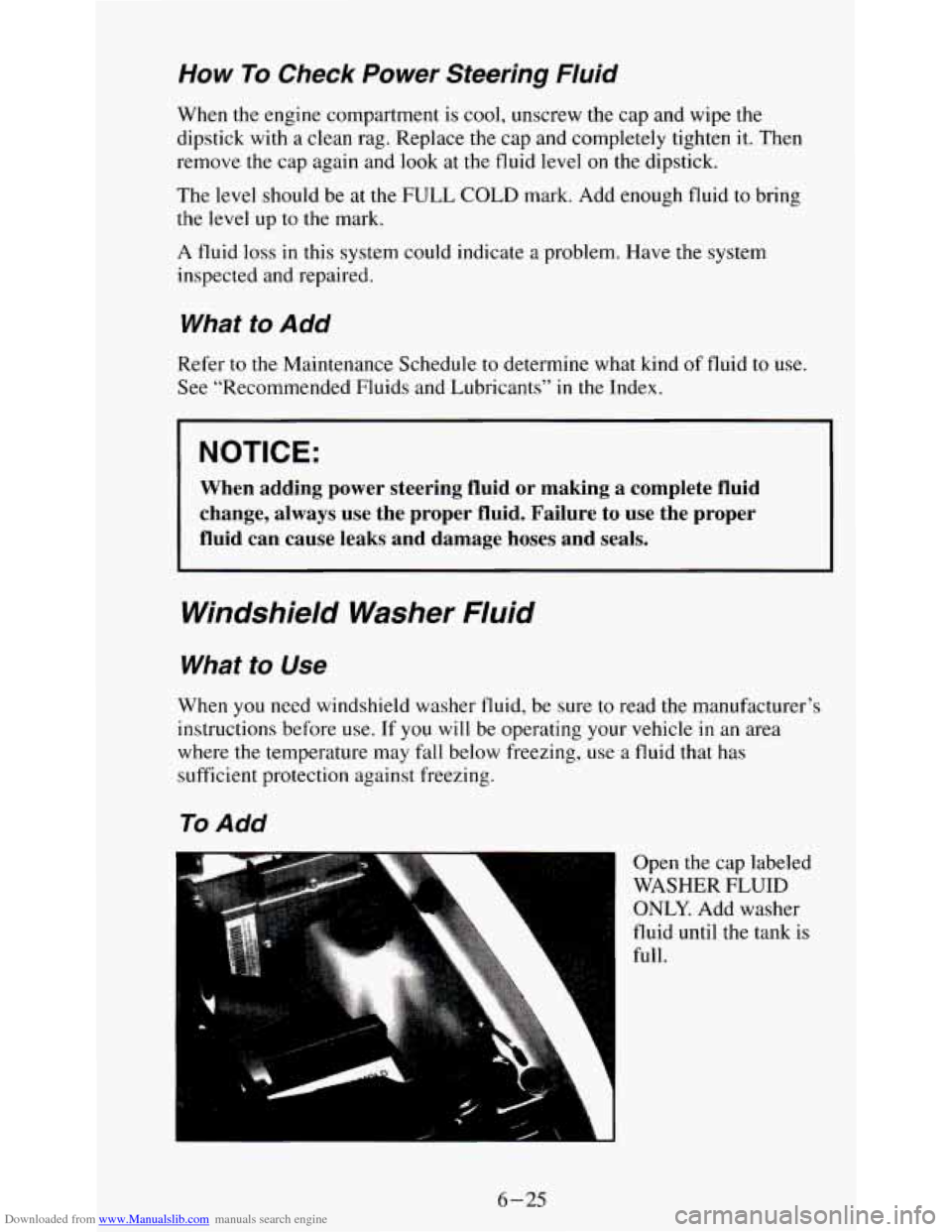
When the engine compartment is cool, unscrew the cap and wipe the
dipstick with a clean rag. Replace
the cap and completely tighten it. Then
remove the cap again and look at the fluid level
on the dipstick.
The
level should be at the FULL COLD mark. Add enough fluid to bring
the level up to the mark.
A fluid loss
in this system could indicate a problem. Have the system
inspected and repaired.
What to Add
Refer to the Maintenance Schedule to determine what kind of fluid to use.
See "Recommended Fluids and Lubricants"
in the Index.
NOTICE:
When adding power steering fluid or making a complete fluid
change, always use the proper fluid. Failure to use the proper
fluid can cause leaks and damage hoses and seals.
Windshield Washer Fluid
What to Use
When you need windshield washer fluid, be sure to read the manufacturer's
instructions before use. If you will be operating your vehicle in an area
where
the temperature may fall below freezing, use a fluid that has
sufficient protection against freezing.
t
L
To Add
Open the cap labeled
WASHER
FLUID
ONLY. Add washer
fluid until
the tank is
full.
L
L
t
6-25
Page 326 of 354
Downloaded from www.Manualslib.com manuals search engine Steering and Suspension Inspection
Inspect the front and rear suspension and steering system for damaged,
loose or missing parts, signs of wear, or lack of lubrication. Inspect power
steering
lines and hoses for proper hookup, binding, leaks, cracks,
chafing, etc.
Exhaust System Inspection
Inspect the complete exhaust system. Inspect the body near the exhaust
system. Look for broken, damaged, missing or out-of-position parts as well
as open seams, holes, loose connections, or other conditions which could
cause a heat build-up in the floor pan or could let exhaust fumes into the
vehicle. See “Engine Exhaust” in the Index.
Accelerator Control System
Lubricate all pivot points with engine oil, except the TBI throttle shaft. Do
not lubricate the cam pulley. Remove all external deposits from pulley. Do
not oil any accelerator or cruise control cables. Replace any cables that have
high effort or excessive wear.
Drive Axle Service
Check readfront axle fluid level and add as needed. Check constant velocity
joints and axle seals for leaking.
Transfer Case (Four- Wheel Drive) Inspection
Every 12 months or at oil change intervals, check front axle and transfer
case and add lubricant when necessary. Oil the control lever pivot point and
all exposed control linkage. Check vent hose
at transfer case for kinks and
proper installation. More frequent lubrication may be required on off-road
use.
7-39
Page 327 of 354
Downloaded from www.Manualslib.com manuals search engine Part D: Recommended Fluids and Lubricants
NOTE: Fluids and lubricants identified below by name, part number or
specification may be obtained from your GM dealer.
USAGE
Engine Oil
Engine Coolant
Coolant Supplement
Hydraulic Brake System
Hydraulic Clutch System
Power Steering System
FLUID/LUBRICANT
Engine oil with the American Pe-
troleum Institute Certified For Gas-
oline Engines “Starburst” symbol
of
the proper viscosity. To determine
the preferred viscosity for your ve-
hicle’s engine, see “Engine
Oil” in
the Index.
Mixture of water and
a good quality
ethylene glycol base antifreeze con-
forming to GM Specification
6038-M (4.3L)
or GM Specifica-
tion 6043-M (2.2L).
GM Part
No. 3634621 or equivalent
with a complete flush and refill.
Delco Supreme
1 1 @ Brake Fluid
(GM Part
No. 1052535 or equiva-
lent DOT-3 brake fluid).
Hydraulic Clutch Fluid (GM Part
No. 12345347 or equivalent).
GM Power Steering Fluid (GM Part
No.
10500 1 7 or equivalent) con-
forming
to GM Specification
99850
IO.
Manual Transmission (2.2L Engine) DEXRON@-I11 Automatic Trans-
mission Fluid.
Manual Transmission
(4.3L Engine) Synchromesh Transmission Fluid
(GM Part
No. I2345349 or equiva-
lent).
Automatic Transmission
Key Lock Cylinders DEXRON@-TI1
Automatic Trans-
mission Fluid.
Lubricate with Multi-Purpose Lu-
bricant (GM Part
No. 12345 120) or
synthetic SAE SW-30 engine
oil.
7-40
Page 349 of 354
Downloaded from www.Manualslib.com manuals search engine M
Malfunction Indicator Lamp (See “Lights”)
Maintenance (See “Scheduled Maintenance Services’’)
Maintenance Record (See “Scheduled Maintenance Services”)
Master Cylinder (See “Brakes”)
Mirrors
Convexoutside
............................................... 2-48
Inside
....................................................... 2-46
Outside
..................................................... 2-47
Vanity ...................................................... 2-48
Multifunction Lever
.............................................. 2-34
OBDII ........................................................ 2-60
Odometer (See “Gages”)
Off-Road Driving (See “Driving”)
Oil
............................................................ 6-8
Additives
.................................................... 6-11
Pressure Gage (See “Gages”)
ToCheck
..................................................... 6-8
WhatKindtoUse .............................................. 6-9
WhentoAdd .................................................. 6-9
Whentochange .............................................. 6-11
What to Do with Used
.......................................... 6-12
Owner Checks and Services
........................................ 7-35
Off-Road Recovery ............................................... 4-9
P
Parking
Brake
( See “Brakes-Parking”)
On Hills
( See “Towing-Parking On Hills”)
Over Things That
Burn ......................................... 2-25
Your Vehicle (Manual Transmission)
............................ 2-25
Passing (See “Driving-Passing”)
Payload (See “Loading
Your Vehicle”)
Periodic Maintenance Inspections (See “Scheduled Maintenance Services”)
Power
Door Locks
( See “Doors”)
Steering
...................................................... 4-7
SteeringFluid ................................................ 6-24
Winches (See “Winches”)
Radiator Pressure Cap
............................................ 6-23
Radio (See “Audio Systems”)
Rear Axle (See “Axle”)
Rear Safety Belt Comfort Guides (See “Safety Belts”)
Recommended Fluids and Lubricants (See “Scheduled Maintenance Services”)