low beam CHEVROLET S10 1995 2.G Owners Manual
[x] Cancel search | Manufacturer: CHEVROLET, Model Year: 1995, Model line: S10, Model: CHEVROLET S10 1995 2.GPages: 354, PDF Size: 18.92 MB
Page 7 of 354
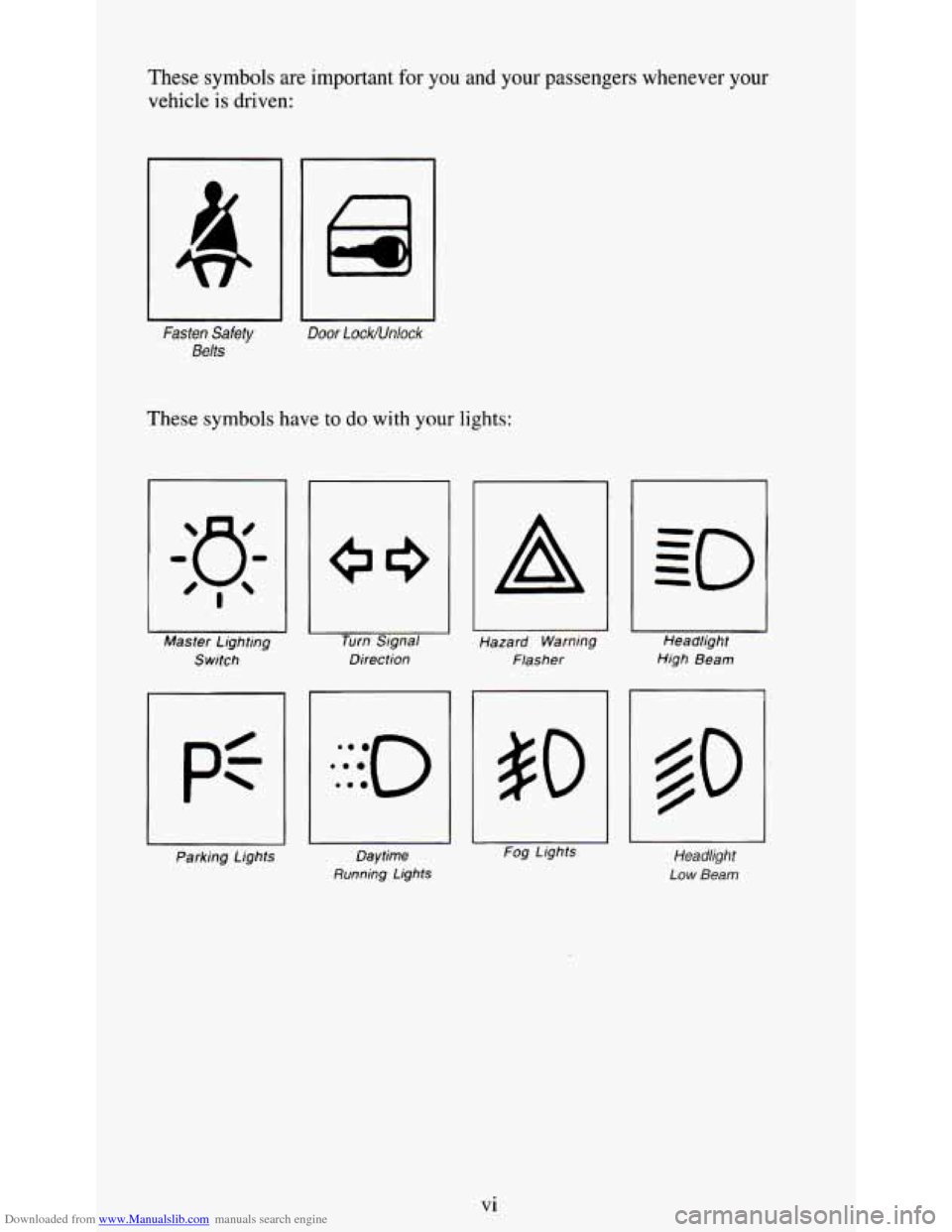
Downloaded from www.Manualslib.com manuals search engine These symbols are important for you and your passengers whenever your
vehicle
is driven:
Fasten Safety
Belts
Door LockNnlock
These symbols have to do with your lights:
I Master Lighting
Switch Turn
Signal
Direction
A
Hazard Warning
Flasher Headlight
High Beam
Parking Lights Daytime
Running Lights
- Fog Lights Headlight
Low Beam
Vi
Page 79 of 354
Downloaded from www.Manualslib.com manuals search engine Tilt Wheel (Option)
I
I
If you have the tilt
steering wheel,
you
should adjust the
steering wheel before
you drive.
You can raise it
to the highest level to give your legs more room when you
enter and exit the vehicle.
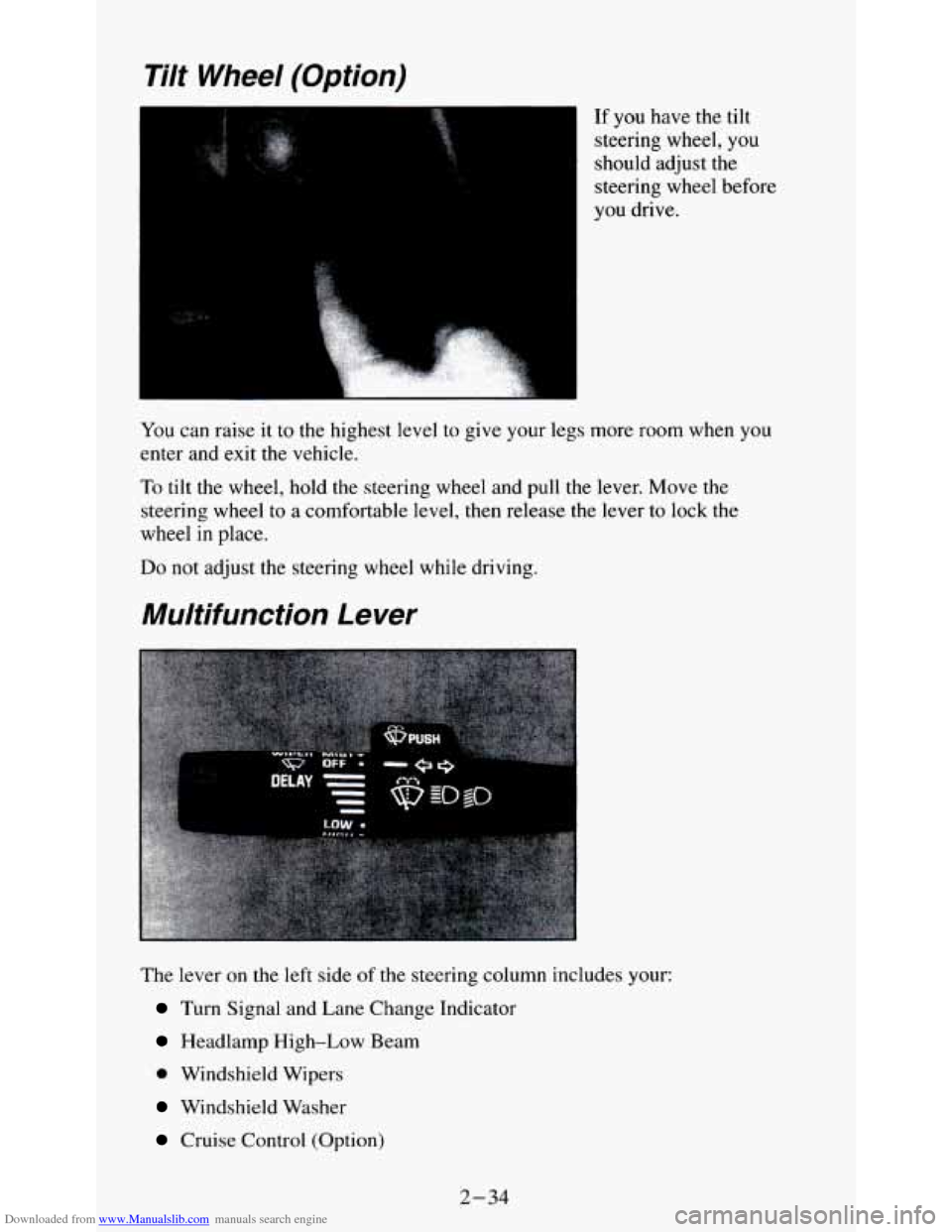
To tilt the wheel, hold the steering wheel and pull the lever. Move the
steering wheel to a comfortable level, then release the lever to lock the
wheel in place.
Do not adjust the steering wheel while driving.
Multifunction Lever
The lever on the left side of the steering column includes your:
Turn Signal and Lane Change Indicator
Headlamp High-Low Beam
0 Windshield Wipers
Windshield Washer
Cruise Control (Option)
2-34
Page 81 of 354
Downloaded from www.Manualslib.com manuals search engine Headlamp High-Low Beam
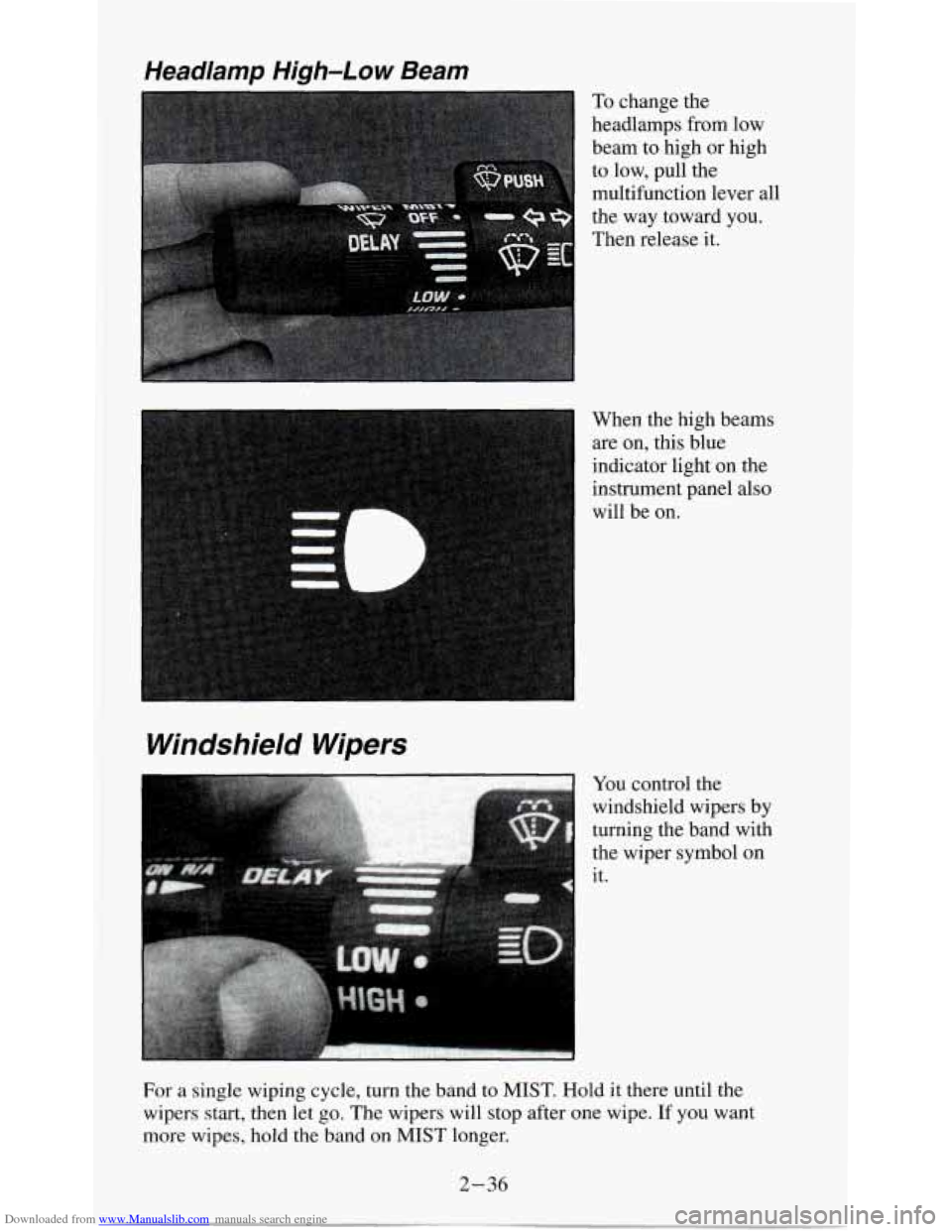
To change the
headlamps from low
beam to high or high
to low, pull the
multifunction lever all
the way toward you.
Then release it.
When the high beams
are on, this blue
Windshield Wipers
indicator light on the
instrument panel also
will be on.
You control the
windshield wipers by
turning the band with
the wiper symbol on
it.
For a single wiping cycle, turn the band to MIST. Hold it there until the
wipers start, then let
go. The wipers will stop after one wipe. If you want
more wipes, hold the band
on MIST longer.
2-36
Page 88 of 354
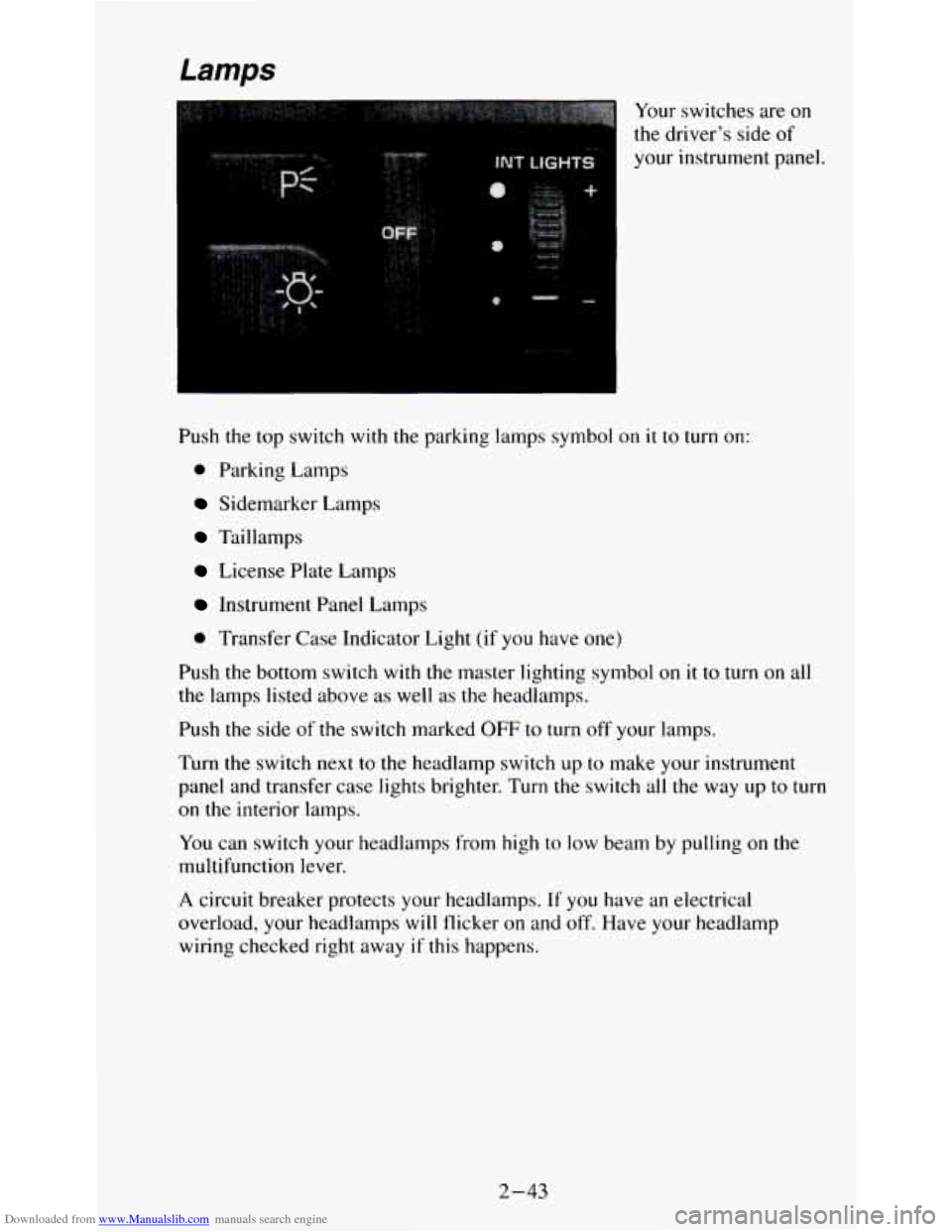
Downloaded from www.Manualslib.com manuals search engine Your switches are on
the driver’s side of
your instrument panel.
Push the top switch with the parking lamps symbol on
it to turn on:
0 Parking Lamps
Sidemarker Lamps
Taillamps
License Plate Lamps
Instrument Panel Lamps
0 Transfer Case Indicator Light (if you have one)
Push the bottom switch with the master lighting symbol on it to turn on all
the lamps listed above as well as the headlamps.
Push
the side of the switch marked OFF to turn off your lamps.
Turn the switch next to the headlamp switch up to make your instrument
panel and transfer case lights brighter. Turn the switch all the way up
to turn
on the interior lamps.
You can switch your headlamps from high to low beam by pulling on the
multifunction lever.
A circuit breaker protects your headlamps. If you have an electrical
overload, your headlamps
will flicker on and off. Have your headlamp
wiring checked right away
if this happens.
2-43
Page 89 of 354
Downloaded from www.Manualslib.com manuals search engine Fog Lamps (Option)
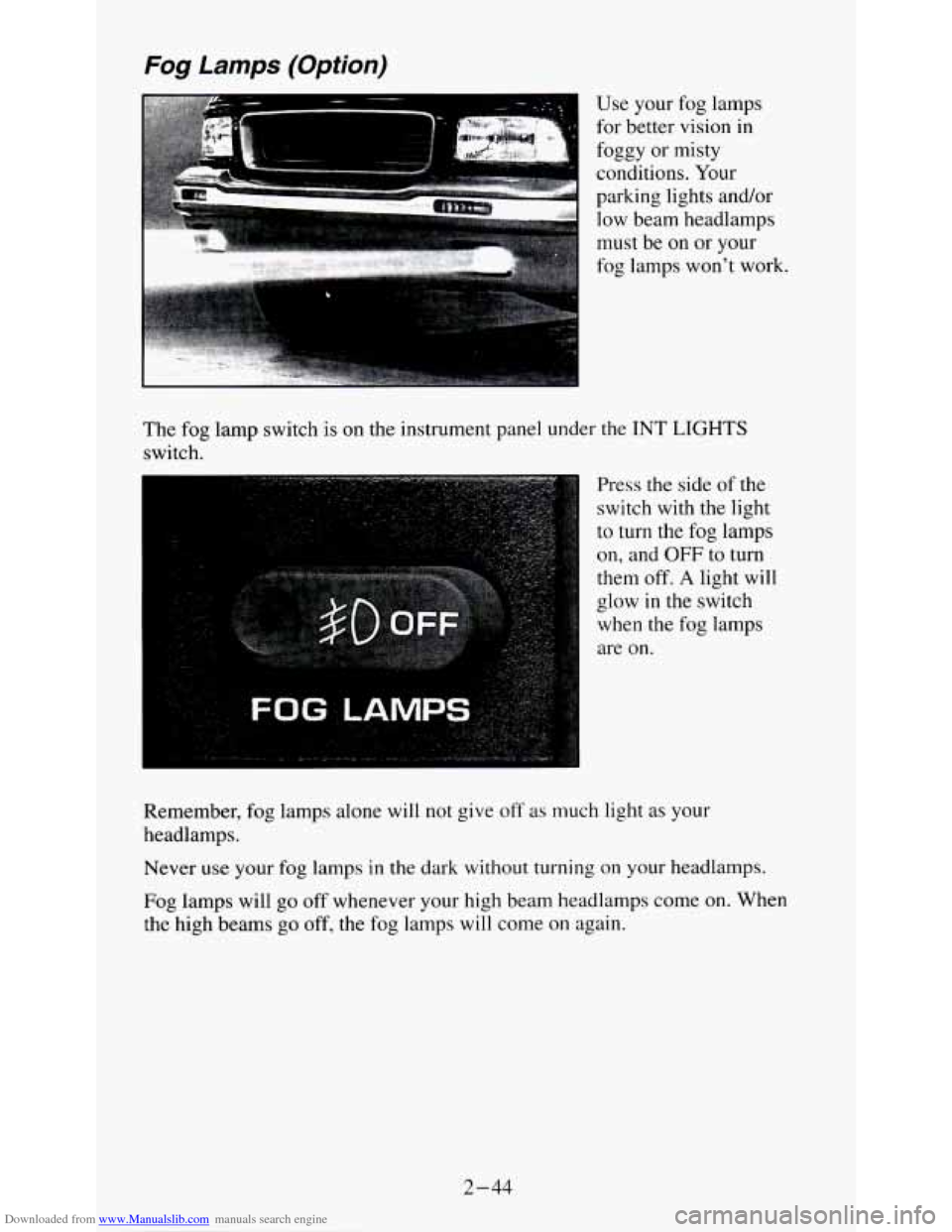
Use your fog lamps
for better vision in
foggy
or misty
conditions. Your
parking lights and/or low beam headlamps
must be
on or your
.. : L .ii$..I.'.%$:~>:. -,.-.:* . ',I.?: ,: ,, '*$+A& ., . ,, .. , ', . .. fog lamps won't work.
The fog lamp switch is on the instrument panel under
the INT LIGHTS
switch.
Press the side
of the
switch with the light
to turn the fog lamps
on, and OFF to turn
them off.
A light will
glow in the switch
when the fog lamps
are on.
Remember, fog lamps alone will not give off as
much light as your
headlamps.
Never use your
fog lamps in the dark without turning on your headlamps.
Fog lamps will go off whenever your high beam headlamps come on. When
the high beams
go off, the fog lamps will come on again.
2-44
Page 105 of 354
Downloaded from www.Manualslib.com manuals search engine Indicator Lights
Indicator lights go on when you use your turn signals, change from low
beam headlights
to high beams, or when you use your hazard flashers. The
next few pages will also tell you about the indicator lights on your vehicle
and help
you locate them.
Malfunction Indicator Lamp (SERVICE ENGINE SOON
Light)
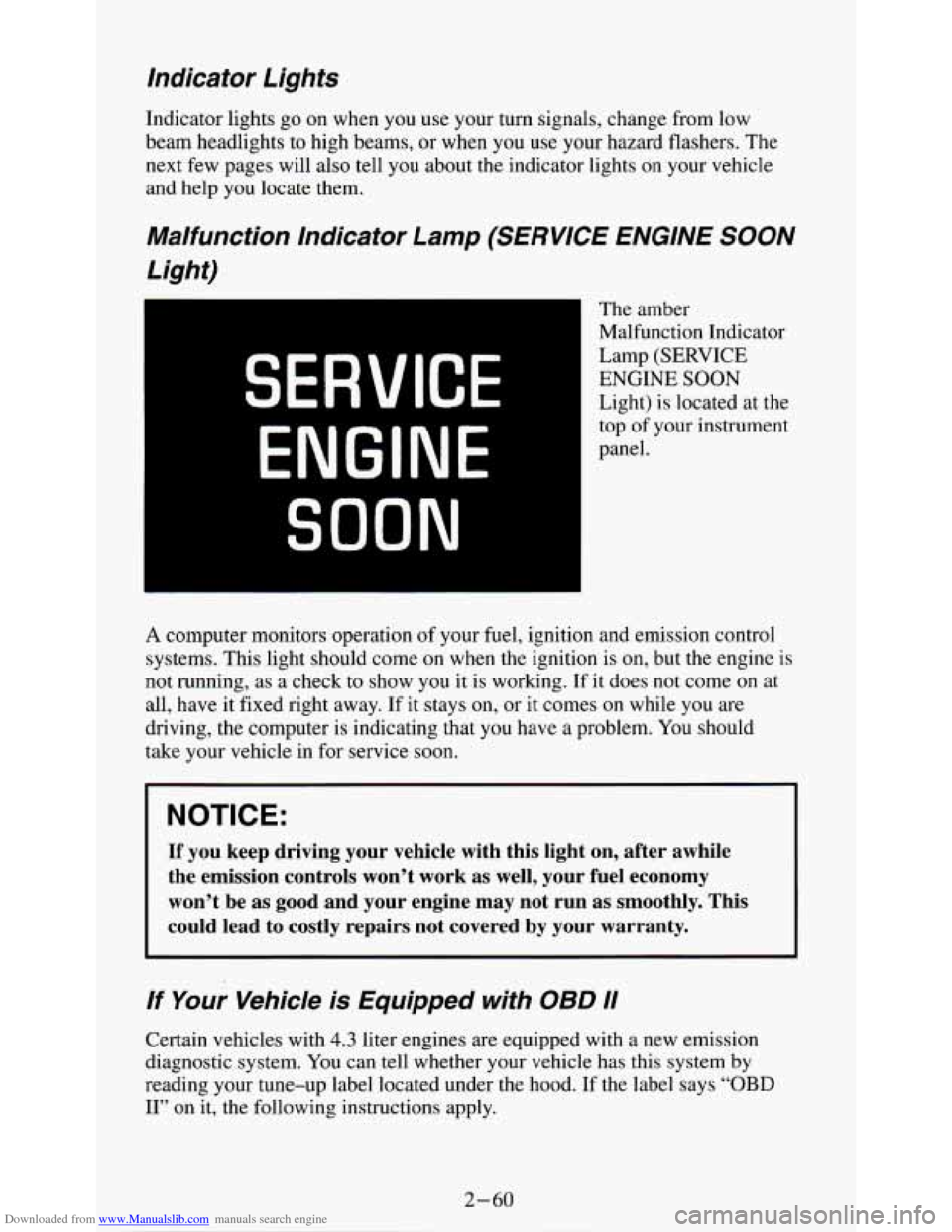
The amber
Malfunction Indicator
Lamp (SERVICE
ENGINE SOON
Light) is located at the
top of your instrument
panel.
SERVICE
ENGINE
SOON
A computer monitors operation of your fuel, ignition and emission control
systems. This light should come
on when the ignition is on, but the engine is
not running, as a check to show you it is working. If it does not come
on at
all, have it fixed right away.
If it stays on, or it comes on while you are
driving, the computer is indicating that
you have a problem. You should
take your vehicle in for service
soon.
NOTICE:
If you keep driving your vehicle with this light on, after awhile
the emission controls won’t work as well, your fuel economy
won’t be as good and your engine may not run as smoothly. This
could lead
to costly repairs not covered by your warranty.
If Your Vehicle is Equipped with OBD I1
Certain vehicles with 4.3 liter engines are equipped with a new emission
diagnostic system. You can tell whether your vehicle has this system
by
reading your tune-up label located under the hood. If the label says “OBD
11” on it, the following instructions apply.
Page 109 of 354
Downloaded from www.Manualslib.com manuals search engine Headlamp High-Beam Indicator Light
A
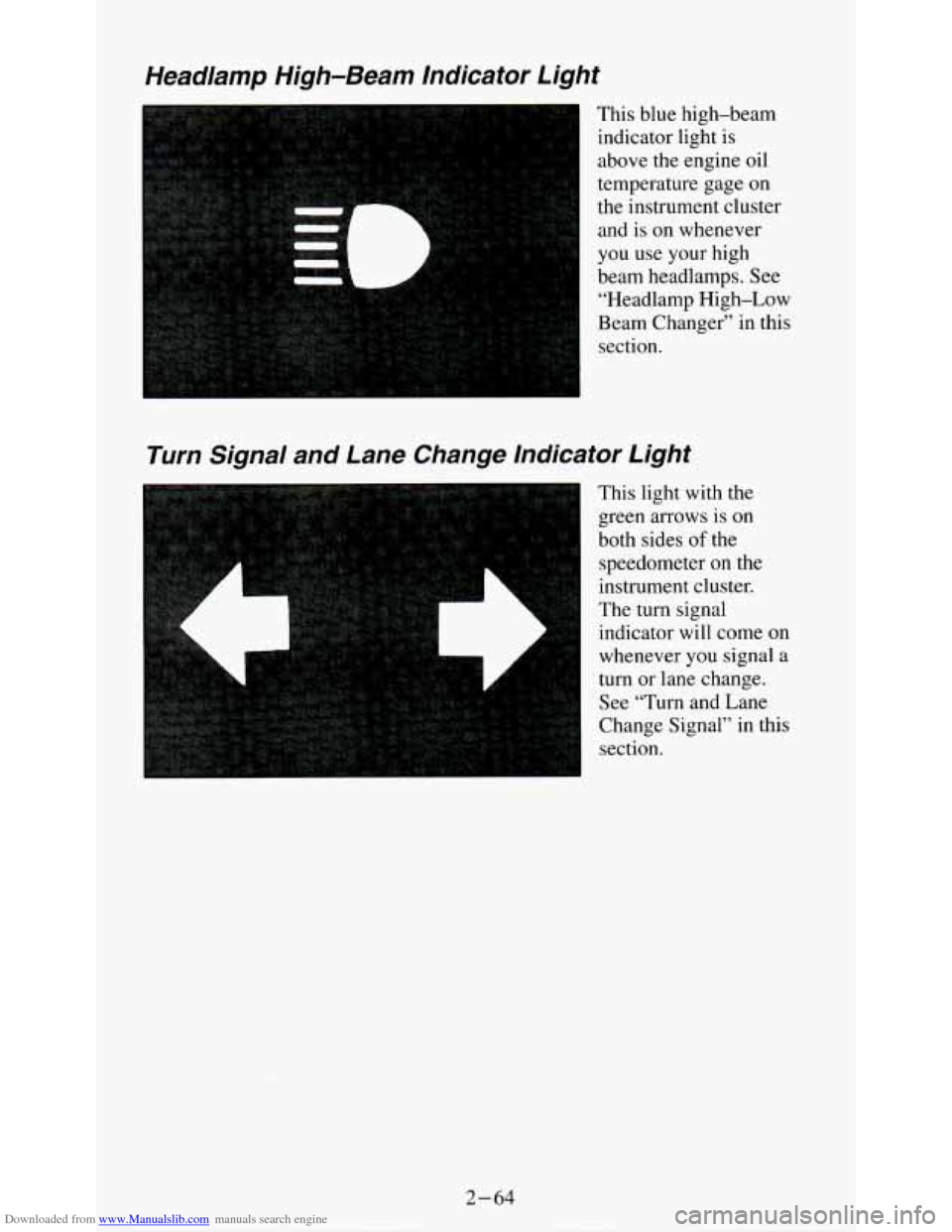
This blue high-beam
indicator light is
above the engine oil
temperature gage
on
the instrument cluster
and is on whenever
you use your high
beam headlamps. See
“Headlamp High-Low
Beam Changer” in this section.
Turn Signal and Lane Change Indicator Light
This light with the
green arrows is
on
both sides of the
speedometer on the
instrument cluster.
The turn signal
indicator will come on
whenever
you signal a
turn or lane change.
See “Turn and Lane
Change Signal” in this
section.
2-64
Page 157 of 354
Downloaded from www.Manualslib.com manuals search engine Here are some tips on night driving.
Drive defensively.
0 Don’t drink and drive.
Adjust your inside rearview mirror to reduce the glare from headlights
Since you can’t see as well, you may need to slow down and keep more
behind you.
space
between you and other vehicles.
Slow down, especially on higher speed roads. Your headlights can light
up
only so much road ahead.
In remote areas, watch for animals.
0 If you’re tired, pull off the road in a safe place and rest.
Night Vision
No one can see as well at night as in the daytime. But as we get older these
differences increase. A 50-year-old driver may require at least twice as
much light to see the same thing at night as a 20-year-old.
What you do in the daytime can also affect your night vision.
For example,
if you spend the day in bright sunshine you
are wise to wear sunglasses.
Your eyes will have less trouble adjusting to night. But
if you’re driving,
don’t wear sunglasses at night. They may cut down on glare from
headlights, but they also make a lot of things invisible.
You can be temporarily blinded by approaching lights. It can take a second
or
two, or even several seconds, for your eyes to readjust to the dark. When
you
are faced with severe glare (as from a driver who doesn’t lower the high
beams, or a vehicle with misaimed headlights), slow down a little. Avoid
staring directly into the approaching lights.
Keep your windshield and all the glass on your vehicle clean
- inside and
out. Glare at night is made much worse by dirt on the glass. Even the inside
of the glass can build up a film caused by dust. Dirty glass makes lights
dazzle and flash more than clean glass would, making
the pupils of your
eyes contract repeatedly.
Remember that your headlights light up far less of a roadway when you
are
in a turn or curve. Keep your eyes moving; that way, it’s easier to pick out
dimly lighted objects. Just as your headlights should be checked regularly
for proper aim,
so should your eyes be examined regularly. Some drivers
suffer from night blindness
- the inability to see in dim light - and aren’t
even aware
of it,
4-24
Page 159 of 354
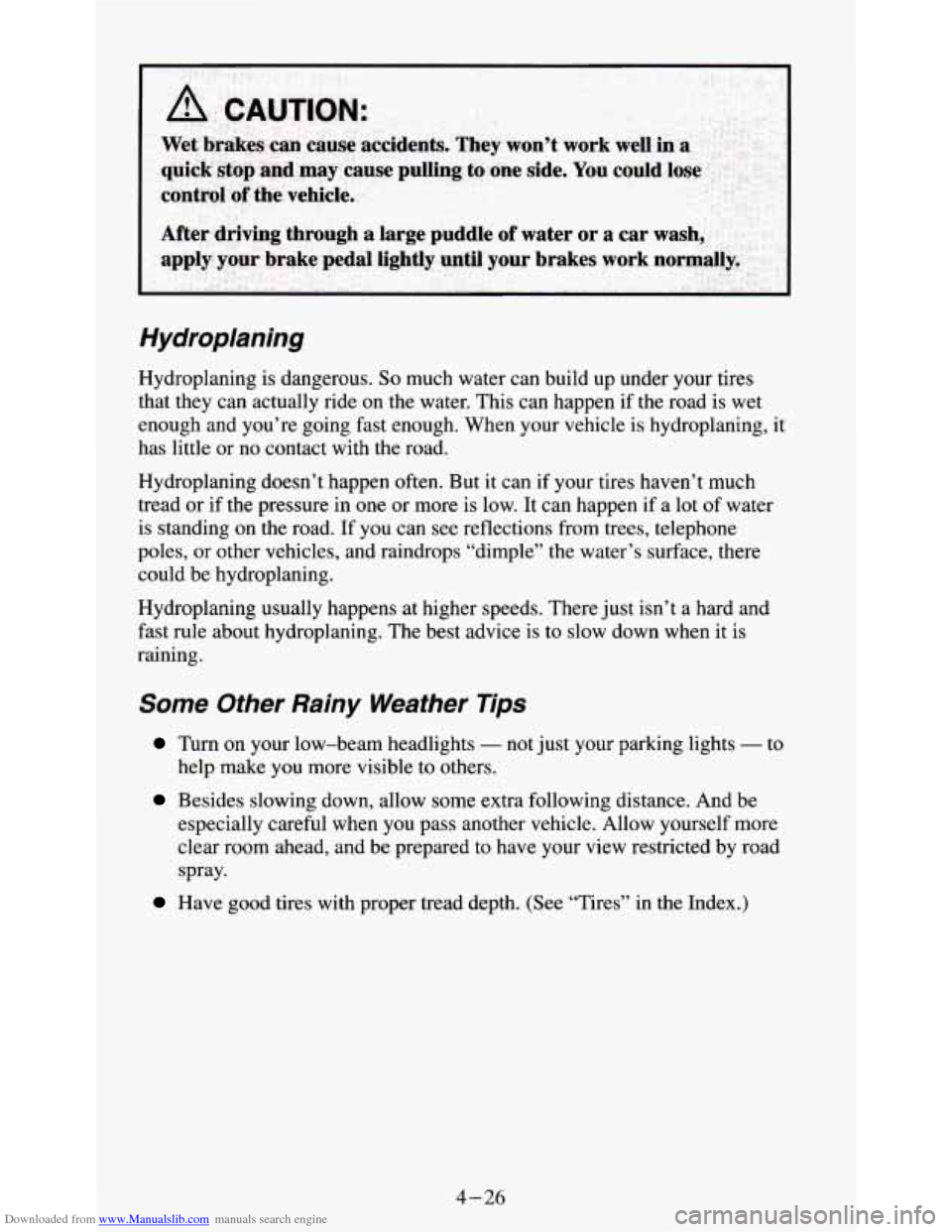
Downloaded from www.Manualslib.com manuals search engine Hydroplaning
Hydroplaning is dangerous. So much water can build up under your tires
that they can actually ride on the water. This can happen if the road
is wet
enough and you’re going fast enough. When your vehicle is hydroplaning, it
has little or
no contact with the road.
Hydroplaning doesn’t happen often. But it can if your tires haven’t much
tread or if the pressure in one or more is low. It can happen if a lot
of water
is standing on the road. If
you can see reflections from trees, telephone
poles,
or other vehicles, and raindrops “dimple” the water’s surface, th\
ere
could be hydroplaning.
Hydroplaning usually happens at higher speeds. There just isn’t
a hard and
fast rule about hydroplaning.
The best advice is to slow down when it is
raining.
Some Other Rainy Weather Tips
Turn on your low-beam headlights - not just your parking lights - to
help make you more visible to others.
Besides slowing down, allow some extra following distance. And be
especially careful when you pass another vehicle. Allow yourself more
clear room ahead, and be prepared
to have your view restricted by road
spray.
Have good tires with proper tread depth. (See “Tires” in the Index.)
4-26
Page 280 of 354
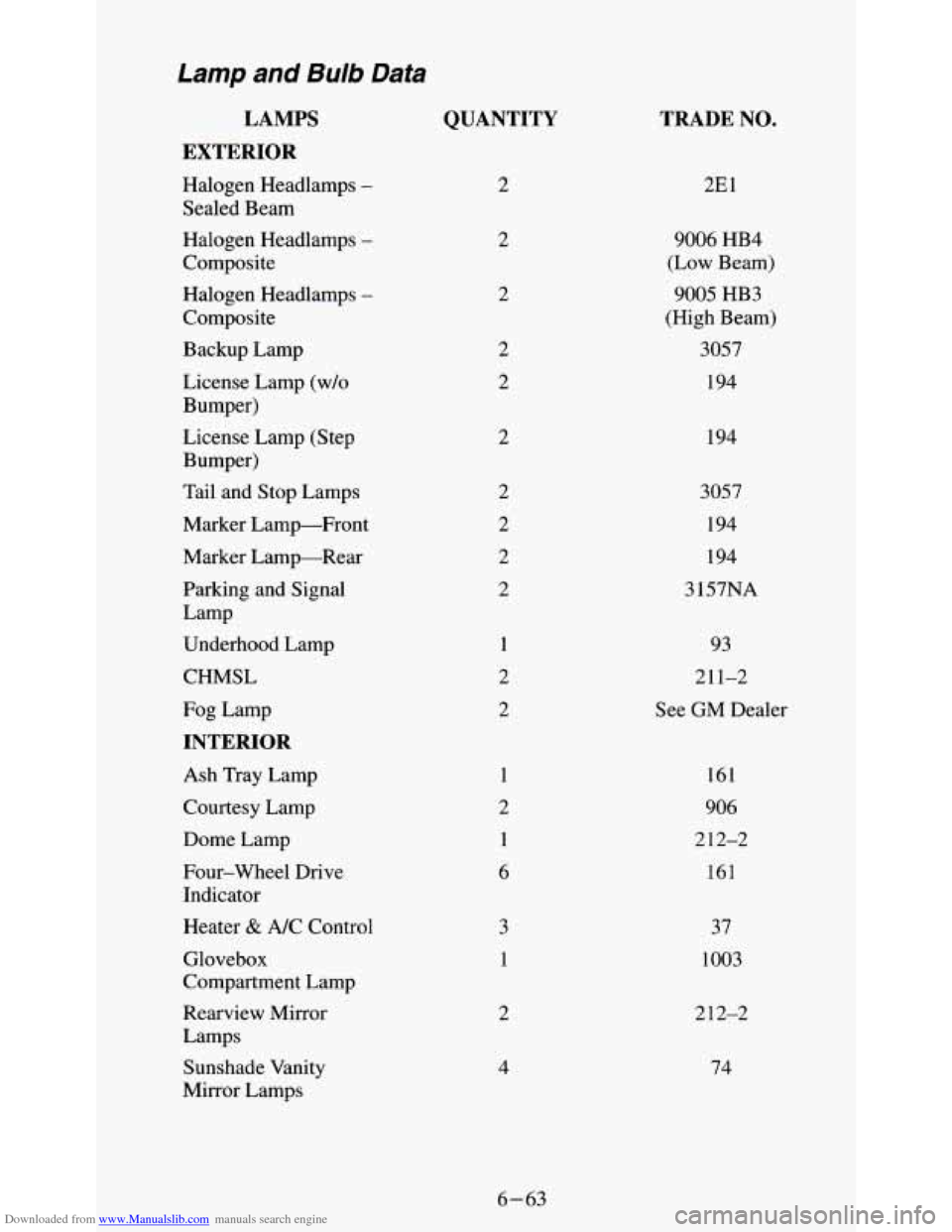
Downloaded from www.Manualslib.com manuals search engine Lamp and Bulb Data
LAMPS
EXTERIOR
QUANTITY TRADE NO.
2 2El
Halogen Headlamps -
Sealed Beam
Halogen Headlamps
-
Composite 2
9006 HB4 (Low Beam)
2
Halogen Headlamps
-
Composite
Backup Lamp
License Lamp
(w/o
Bumper) 9005
HB3
(High Beam)
3057 2
2 194
2 194
License Lamp (Step
Bumper)
Tail and Stop Lamps
Marker Lamp-Front
Marker Lamp-Rear
3057
194
194
3 157NA
2
Parking and Signal
Lamp
93
211-2
See GM Dealer
Underhood
Lamp
CHMSL
Fog Lamp
INTERIOR
Ash Tray Lamp
Courtesy Lamp
Dome Lamp 1
2 161
906
1 2 12-2
Four-wheel Drive Indicator
6 161
3
1
37
1003
Heater & A/C Control
Glovebox
Compartment Lamp
2 2 12-2
Rearview Mirror
Lamps
Sunshade Vanity
Mirror Lamps 4
74
6-63