steering CHEVROLET S10 1995 2.G Owners Manual
[x] Cancel search | Manufacturer: CHEVROLET, Model Year: 1995, Model line: S10, Model: CHEVROLET S10 1995 2.GPages: 354, PDF Size: 18.92 MB
Page 26 of 354
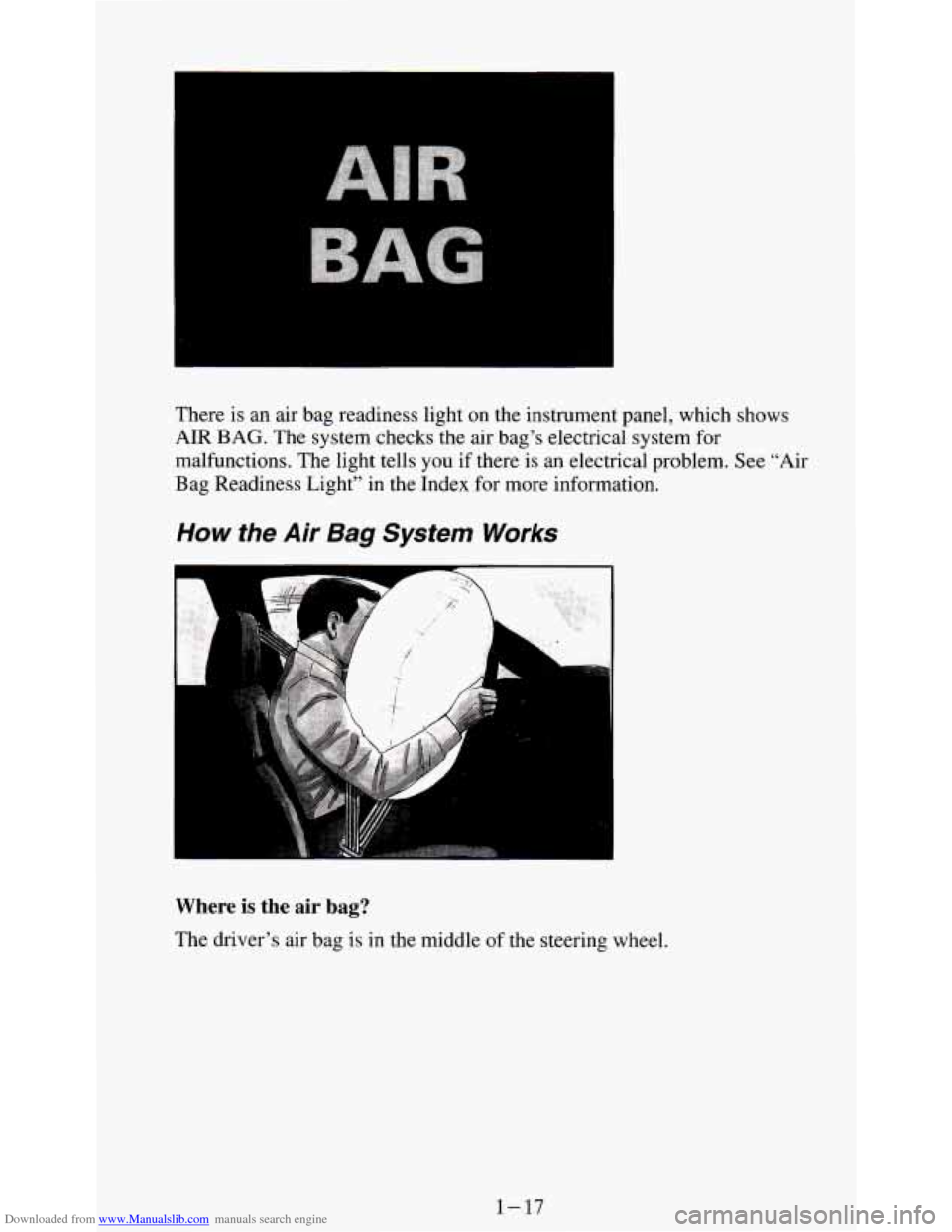
Downloaded from www.Manualslib.com manuals search engine There is an air bag readiness light on the instrument panel, which shows
AIR BAG. The system checks the air bag’s electrical system for
malfunctions. The light tells
you if there is an electrical problem. See “Air
Bag Readiness Light” in the Index for more information.
How the Air Bag System Works
Where is the air bag?
The driver’s air bag is in the middle of the steering wheel.
1-17
Page 27 of 354
Downloaded from www.Manualslib.com manuals search engine When should an air bag inflate?
The air bag is designed to inflate in moderate to severe frontal or
near-frontal crashes. The air bag will inflate only if the impact speed is
above the system’s designed “threshold level.” If your vehicle\
goes straight
into a wall that doesn’t move or deform, the threshold level is about 14 to
18
mph (23 to 29 kdh). The threshold level can vary, however, with specific
vehicle design,
so that it can be somewhat above or below this range. If your
vehicle strikes something that will move or deform, such
as a parked car, the
threshold level will be higher. The air bag is not designed to inflate in
rollovers, side impacts, or rear impacts, because inflation would not help the
occupant.
In any particular crash, no one can say whether an air bag should have
inflated simply because
of the damage to a vehicle or because of what the
repair costs were. Inflation is determined by the angle of the impact and the
vehicle’s deceleration. Vehicle damage is only one indication of this.
The air bag system is designed to work properly under a wide range of
conditions, including off-road usage. Observe safe driving speeds,
especially on rough terrain.
As always, wear your safety belt. See
“Off-Road Driving” in the Index for more tips on off-road driving.
What makes an air bag inflate?
In a frontal or near-frontal impact of sufficient severity, the air bag sensing
system detects that the vehicle is suddenly stopping as a result of a crash.
The sensing system triggers a chemical reaction
of the sodium azide sealed
in the inflator. The reaction produces nitrogen gas, which inflates the air
bag. The inflator, air bag, and related hardware are all part
of the air bag
module packed inside the steering wheel.
1-18
Page 28 of 354
Downloaded from www.Manualslib.com manuals search engine How does an air bag restrain?
In moderate to severe frontal or near-frontal collisions, even belted
occupants can contact the steering wheel. The air bag supplements the
protection provided by safety belts. Air bags distribute the force of the
impact more evenly over the occupant’s upper body, stopping the occupant
more gradually. But air bags would
not help you in many types of collisions,
including rollovers and rear and side impacts, primarily because an
occupant’s motion is not toward the air bag. Air bags should never be
regarded as anything more than a supplement
to safety belts, and then only
in moderate to severe frontal or near-frontal collisions.
What will you see after an air bag inflates?
After the air bag inflates, it quickly deflates. This occurs so quickly that
some people may not even realize the air bag inflated. Some components
of
the air bag module in the steering wheel hub will be hot for a short time, but
the part
of the bag that comes into contact with you will not be hot to the
touch. There will be some smoke and dust coming from vents in the deflated
air bag. Air bag inflation will not prevent
the driver from seeing or from
being able
to steer the vehicle, nor will it stop people from leaving the
vehicle.
A CAUTION:
When an air bag inflates, there is dust in the air. This dust could
cause breathing problems for people with a history
of asthma or
other breathing trouble. To avoid this, everyone in the vehicle
should get out as soon as it is safe to do
so. If you have breathing
problems but can’t get out
of the vehicle after an air bag inflates,
then get fresh air by opening a window or door.
The air bag is designed to inflate only once. After it inflates, you’ll
need some new parts for your air bag system. If you don’t get them, the
air bag system won’t be there to help protect you in another crash. A
new system will include the air bag module and possibly other parts.
The service manual for your vehicle covers the need to replace other
parts.
1-19
Page 53 of 354
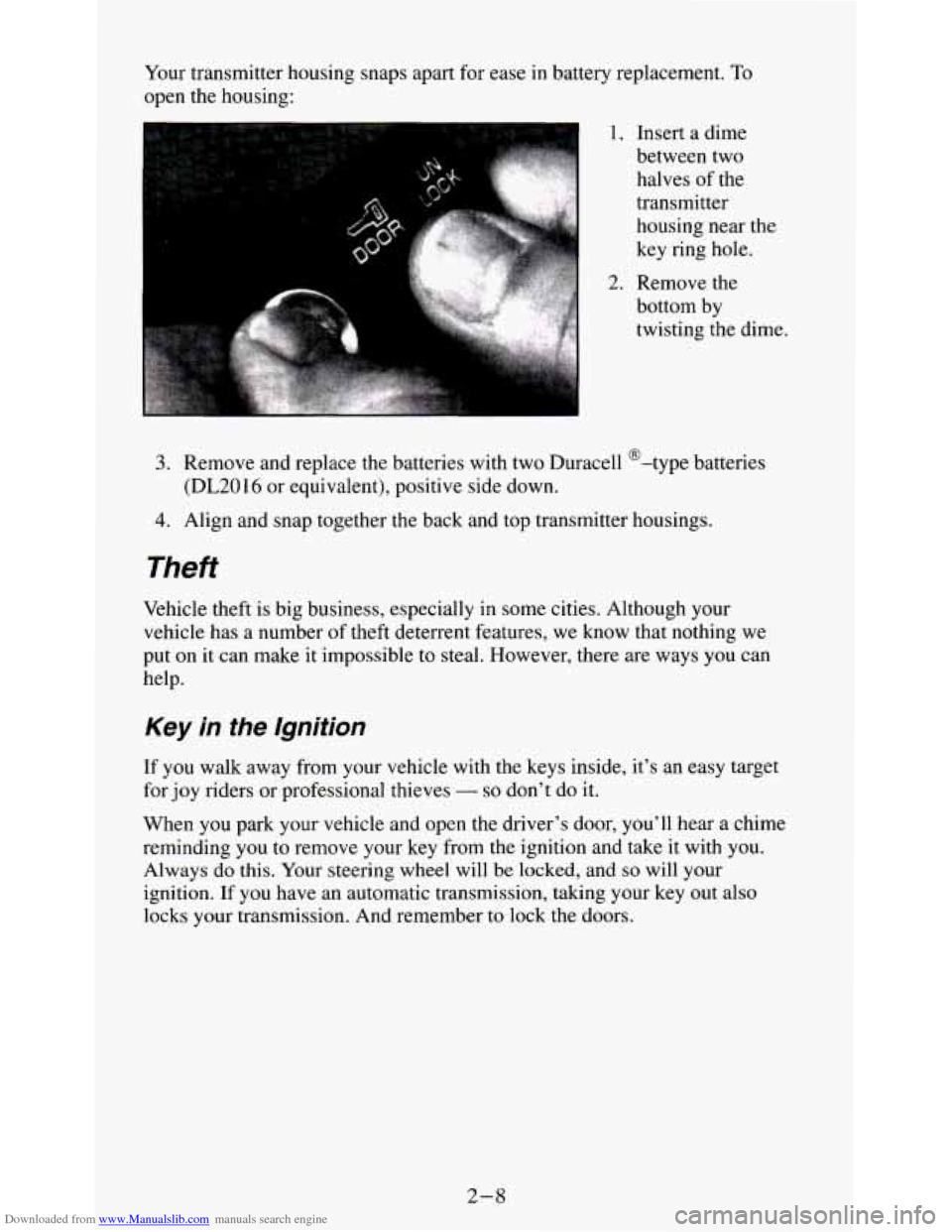
Downloaded from www.Manualslib.com manuals search engine Your transmitter housing snaps apart for ease in battery replacement. To
open the housing:
1. Insert a dime
between two
halves
of the
transmitter
housing near the
key ring hole.
2. Remove the
bottom by
twisting the dime.
3. Remove and replace the batteries with two Duracell @-type batteries
4. Align and snap together the back and top transmitter housings.
(DL2016
or equivalent), positive side down.
Theft
Vehicle theft is big business, especially in some cities. Although your
vehicle has a number
of theft deterrent features, we know that nothing we
put
on it can make it impossible to steal. However, there are ways you can
help.
Key in the lgnition
If you walk away from your vehicle with the keys inside, it’s an easy target
for joy riders or professional thieves
- so don’t do it.
When
you park your vehicle and open the driver’s door, you’ll hear a chime
reminding you
to remove your key from the ignition and take it with you.
Always do this. Your steering wheel will be locked, and so will your
ignition.
If you have an automatic transmission, taking your key out also
locks your transmission. And remember
to lock the doors.
2-8
Page 55 of 354
Downloaded from www.Manualslib.com manuals search engine Ignition Switch
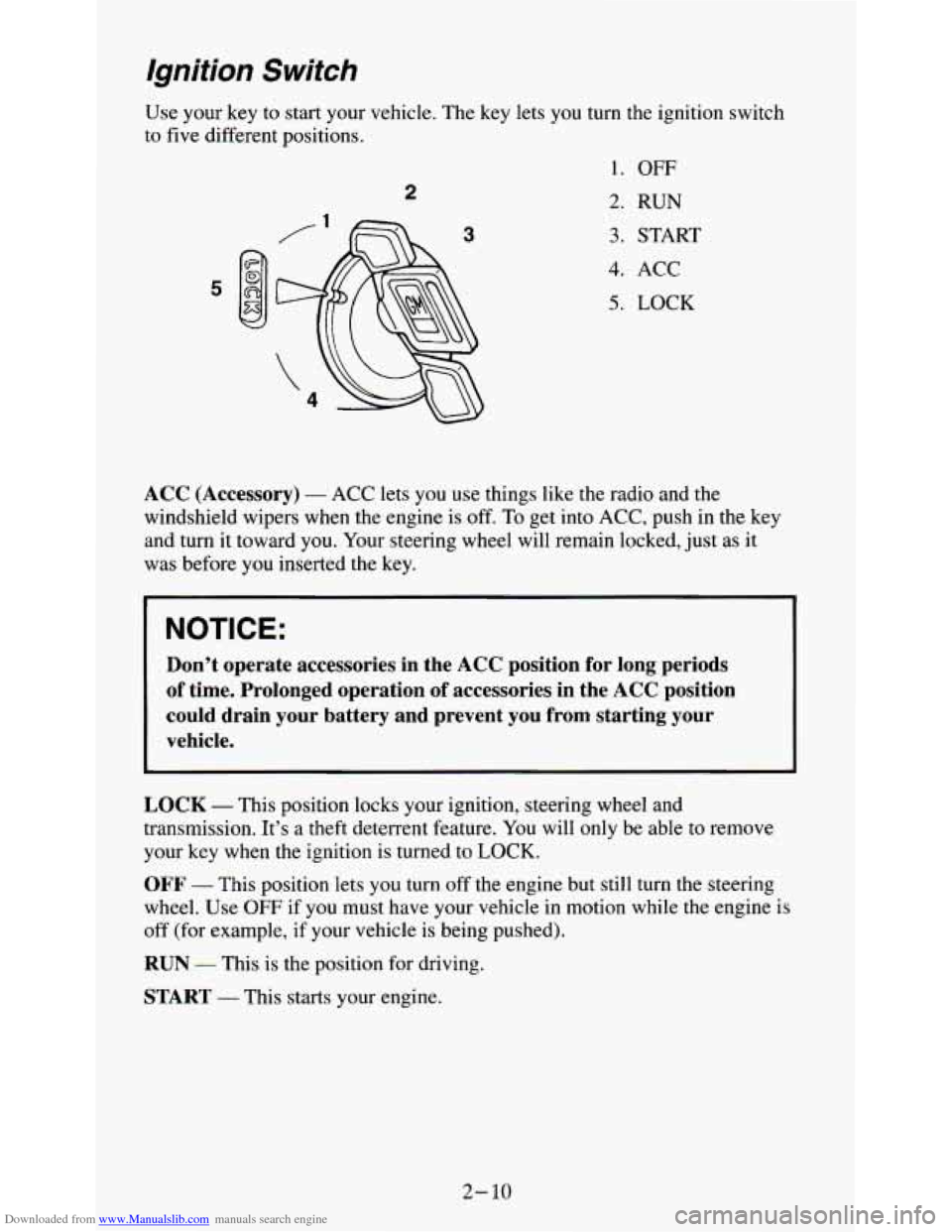
2
Use your key to start your vehicle. The key lets you turn the ignition switch
to five different positions.
1.
OFF
2. RUN
3. START
4. ACC
5. LOCK 5
ACC (Accessory) - ACC lets you use things like the radio and the
windshield wipers when the engine is off. To get into ACC, push in the key
and turn it toward
you. Your steering wheel will remain locked, just as it
was before you inserted the key.
Don’t operate accessories in the ACC position for long periods
of time. Prolonged operation
of accessories in the ACC position
could drain your battery and prevent you from starting your
vehicle.
LOCK - This position locks your ignition, steering wheel and
transmission. It’s a theft deterrent feature. You will only
be able to remove
your key when
the ignition is turned to LOCK.
OFF - This position lets you turn off the engine but still turn the steering
wheel. Use
OFF if you must have your vehicle in motion while the engine is
off (for example, if your vehicle
is being pushed).
RUN - This is the position for driving.
START - This starts your engine.
2- 10
Page 56 of 354
Downloaded from www.Manualslib.com manuals search engine I NOTICE:
If your key seems stuck in LOCK and you can’t turn it, be sure
it is all the way in. If it is, then turn the steering wheel left and
right while you turn the key hard. But turn the key only with
your hand. Using a tool to force it could break the key or the
ignition switch.
If none of this works, then your vehicle needs
service.
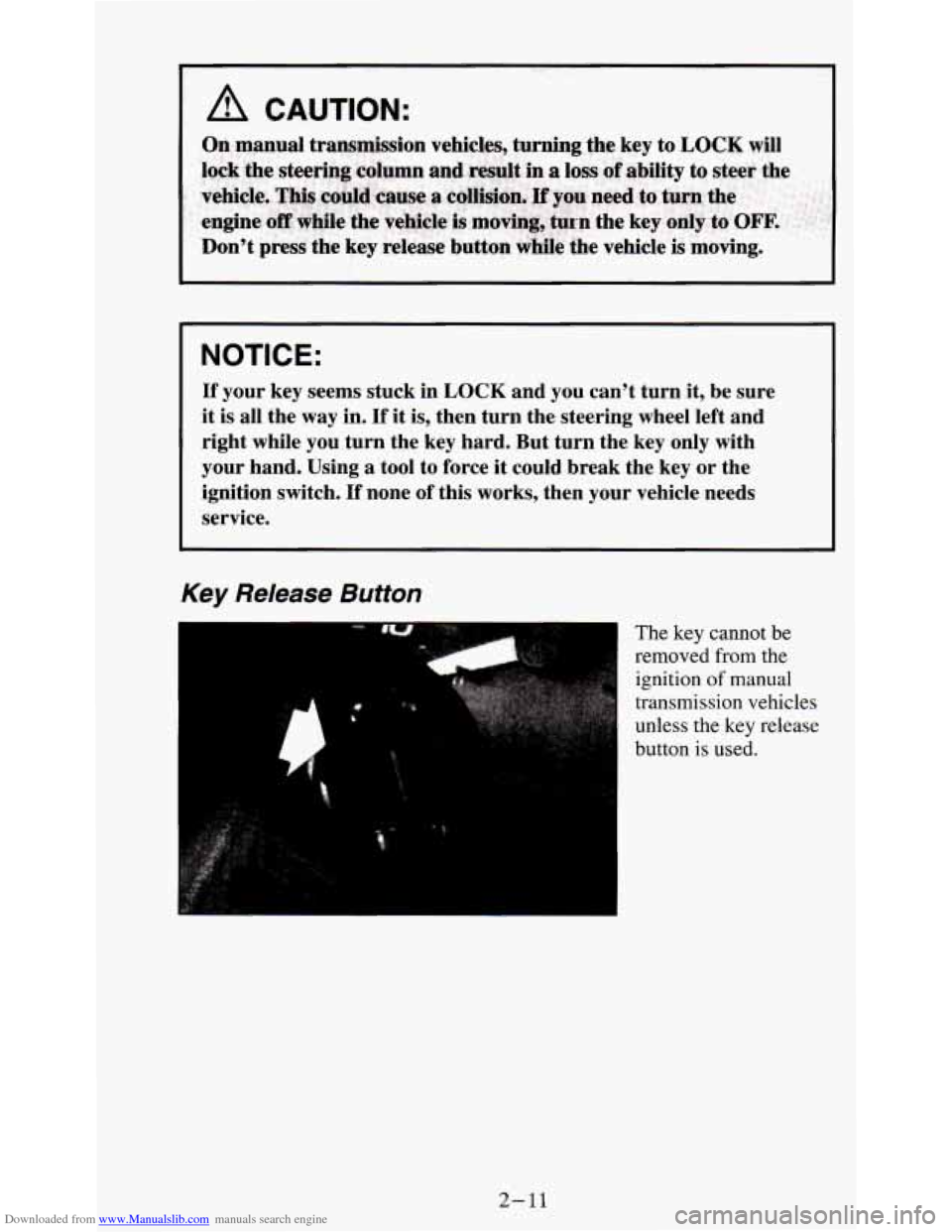
Key Release Button
The key cannot be
removed
from the
ignition
of manual
transmission vehicles
unless the
key release
button
is used.
2-11
Page 78 of 354
Downloaded from www.Manualslib.com manuals search engine Sliding Rear Window
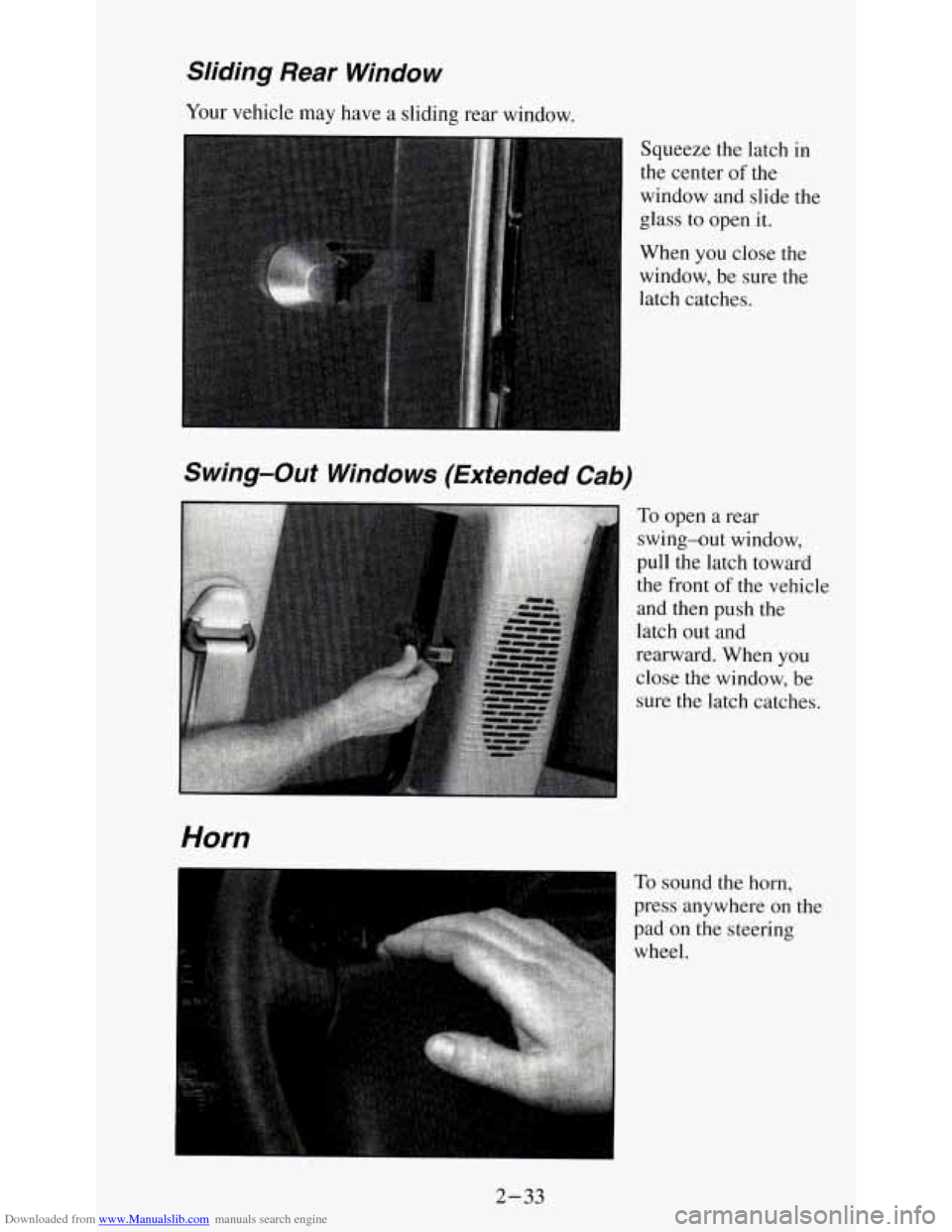
Your vehicle may have a sliding rear window.
Squeeze the latch in
the center
of the
window and slide the
glass
to open it.
When you close the
window,
be sure the
latch catches.
Swing-Out Windows (Extended Cab)
To open a rear
swing-out window,
pull the latch toward
the front
of the vehicle
and then push the
latch out and
rearward. When you close the window, be
sure the latch catches.
Horn
' To sound the horn,
press anywhere on the
pad
on the steering
wheel.
2-33
Page 79 of 354
Downloaded from www.Manualslib.com manuals search engine Tilt Wheel (Option)
I
I
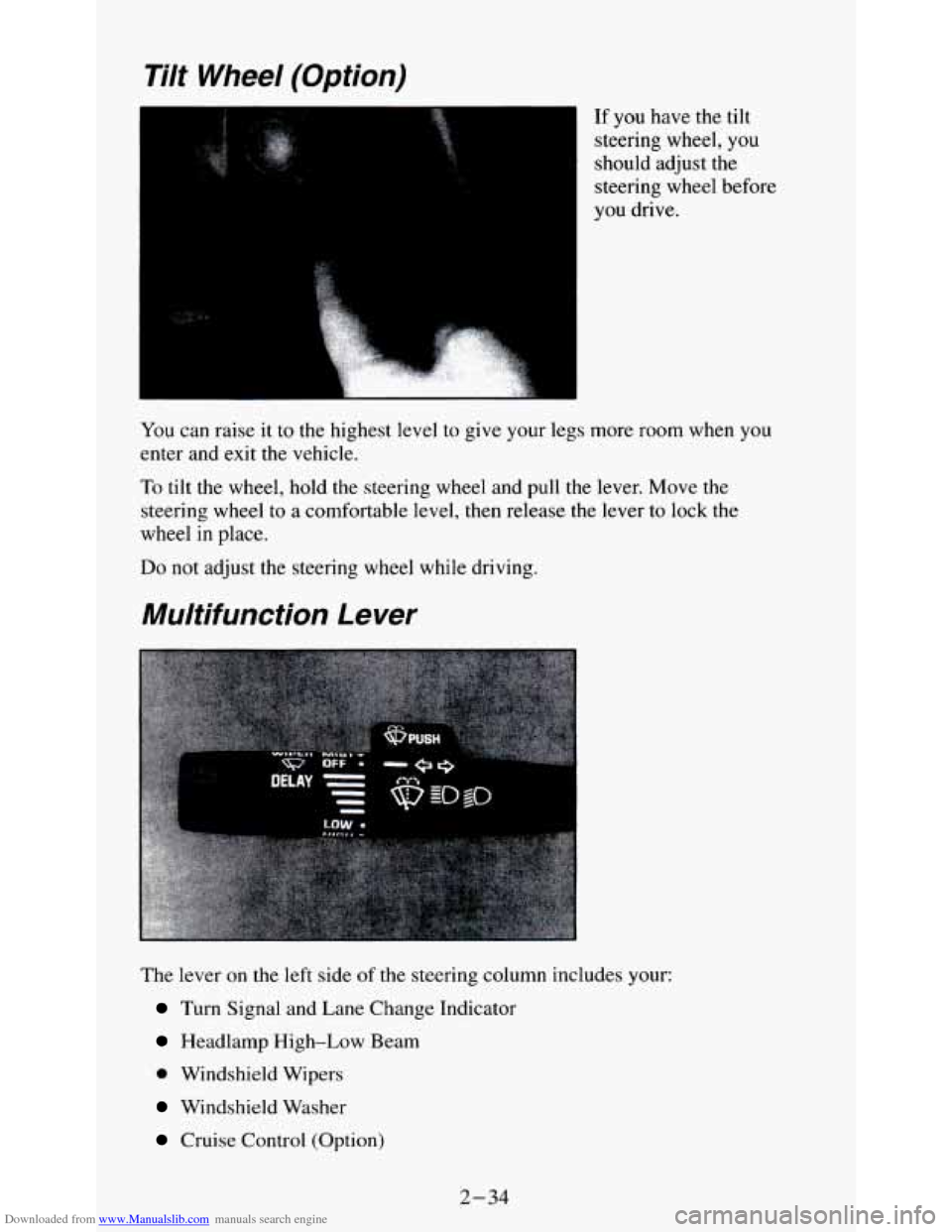
If you have the tilt
steering wheel,
you
should adjust the
steering wheel before
you drive.
You can raise it
to the highest level to give your legs more room when you
enter and exit the vehicle.
To tilt the wheel, hold the steering wheel and pull the lever. Move the
steering wheel to a comfortable level, then release the lever to lock the
wheel in place.
Do not adjust the steering wheel while driving.
Multifunction Lever
The lever on the left side of the steering column includes your:
Turn Signal and Lane Change Indicator
Headlamp High-Low Beam
0 Windshield Wipers
Windshield Washer
Cruise Control (Option)
2-34
Page 137 of 354
Downloaded from www.Manualslib.com manuals search engine The body takes about an hour to rid itself of the alcohol in one drink. No
amount of coffee or number of cold showers will speed that up. “I’ll be
careful” isn’t the right answer. What if there’s an emergency, a need to take
sudden action, as when a child darts into the street?
A person with even a
moderate
BAC might not be able to react quickly enough to avoid the
collision.
There’s something else about drinking and driving that many people don’t
know. Medical research shows that alcohol
in a person’s system can make
crash injuries worse, especially injuries
to the brain, spinal cord or heart.
This means that when anyone who has been drinking
- driver or passenger
- is in a crash, that person’s chance of being killed or permanently disabled
is higher than if the person had not been drinking.
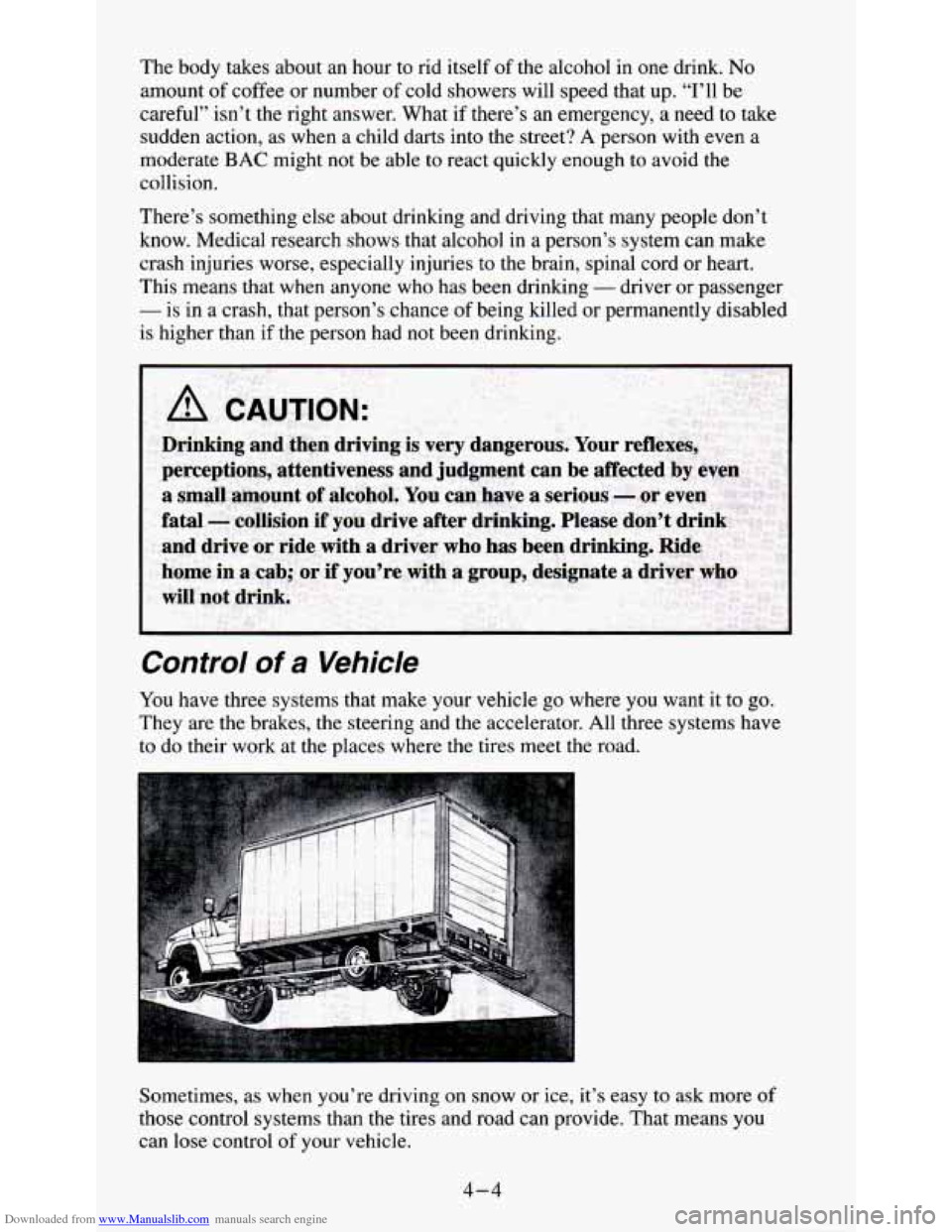
Control of a Vehicle
You have three systems that make your vehicle go where you want it to go.
They are the brakes, the steering and the accelerator. All three systems have
to do their work at the places where the tires meet the road.
Sometimes, as when you’re driving on snow or ice, it’s easy to ask more
of
those control systems than the tires and road can provide. That means you
can lose control of your vehicle.
4-4
Page 140 of 354
Downloaded from www.Manualslib.com manuals search engine To Use Four-wheel Anii-Lock
Don’t pump the brakes. Just hold the brake pedal down and let anti-lock
work for
you. You may feel the brakes vibrate, or you may notice some
noise, but
this is normal.
On vehicles with four-wheel drive, your anti-lock brakes work at all
times
- whether you are in two-wheel drive or four-wheel drive.
To Use Rear- Wheel Anii-Lock
Use rear-wheel anti-lock like regular brakes. You may feel the brakes
vibrate, or
you may notice some noise outside your vehicle, but this is
normal. Let anti-lock work for you, but remember: Your front wheels can
still stop rolling. If that happens, release enough pressure
on the brakes to
get the wheels rolling again
so that you can steer.
Braking in Emergencies
At some time, nearly every driver gets into a situation that requires hard braking.
The four-wheel anti-lock system
lets you steer and brake at the same time.
If you have the rear-wheel anti-lock braking system, your front wheels can
stop rolling when you brake very hard. Once they do, the vehicle can’t
respond to your steering. Momentum will carry
it in whatever direction it
was headed when the front wheels stopped rolling. That could be off the
road, into the very thing you were trying
to avoid, or into traffic.
So, unless you have four-wheel anti-lock, use a “squeeze” braking
technique. This will give
you maximum braking while maintaining steering
control. You do this by pushing on the brake pedal with steadily increasing
pressure. When you do, it
will help maintain steering control. In many
emergencies, steering can help
you more than even the very best braking.
Steering
Power Steering
If you lose power steering assist because the engine stops or the system is
not functioning,
you can steer but it will take much more effort.
Steering Tips
Driving on Curves
It’s important to take curves at a reasonable speed.
A lot of the “driver lost control” accidents mentioned on the news happen
on curves. Here’s why:
Experienced driver
or beginner, each of us is subject to the same laws of
physics when driving on curves. The traction of the tires against the road
4-7