brakes CHEVROLET S10 1995 2.G Owners Manual
[x] Cancel search | Manufacturer: CHEVROLET, Model Year: 1995, Model line: S10, Model: CHEVROLET S10 1995 2.GPages: 354, PDF Size: 18.92 MB
Page 64 of 354
Downloaded from www.Manualslib.com manuals search engine NOTICE:
Damage to your transmission caused by shifting out of PARK
(P) or NEUTRAL (N) with the engine racing isn’t covered by
your warranty.
0 OVERDRIVE (@) - This position is for normal driving. If you need
more power for passing, and you’re:
- Going less than about 35 mph (56 kdh), push your accelerator
pedal about halfway down.
- Going about 35 mph (56 kdh) or more, push the accelerator all
the way down.
You’ll shift down to the next gear and have more power.
OVERDRIVE
(a) should not be used when towing a trailer,
carrying
a heavy load, driving on steep hills, or for off-road
driving. Select DRIVE
(D) when operating the vehicle under any
of these conditions.
DRIVE (D) - This is like @, but you never go into Overdrive. You
should use DRIVE
(D) when towing a trailer, carrying a heavy load,
driving on steep hills, or for off-road driving.
0 SECOND GEAR (2) - This position gives you more power but lower
fuel economy. You can use SECOND GEAR (2) on hills. It can help
control your speed
as you go down steep mountain roads, but then you
would
also want to use your brakes off and on.
If you manually select SECOND GEAR (2), the transmission will drive
in second gear. You may use this feature for reducing torque to the rear
wheels when
you are trying to start your vehicle from a stop on
slippery road surfaces.
2- 19
Page 65 of 354
Downloaded from www.Manualslib.com manuals search engine 0 FIR$T GEAR (1) - This position gives you even more power (but
lower fuel economy) than
SECOND GEAR (2). You can use it on very
steep hills, or in deep snow or mud. If the selector lever is put in
FIRST
GEAR (1) while the vehicle is moving forward, the transmission won’t
shift into FIRST
GEAR (1) until the vehicle is going slowly enough.
NOTICE:
If your rear wheels can’t rotate, don’t try to drive. This might
happen
if you were stuck in very deep sand or mud or were up
against a solid object.
You could damage your transmission.
Also, if you stop when going uphill, don’t hold your vehicle there
with only the accelerator pedal. This could overheat and damage
the transmission. Use your brakes or shift into PARK
(P) to hold
your vehicle in position on a hill.
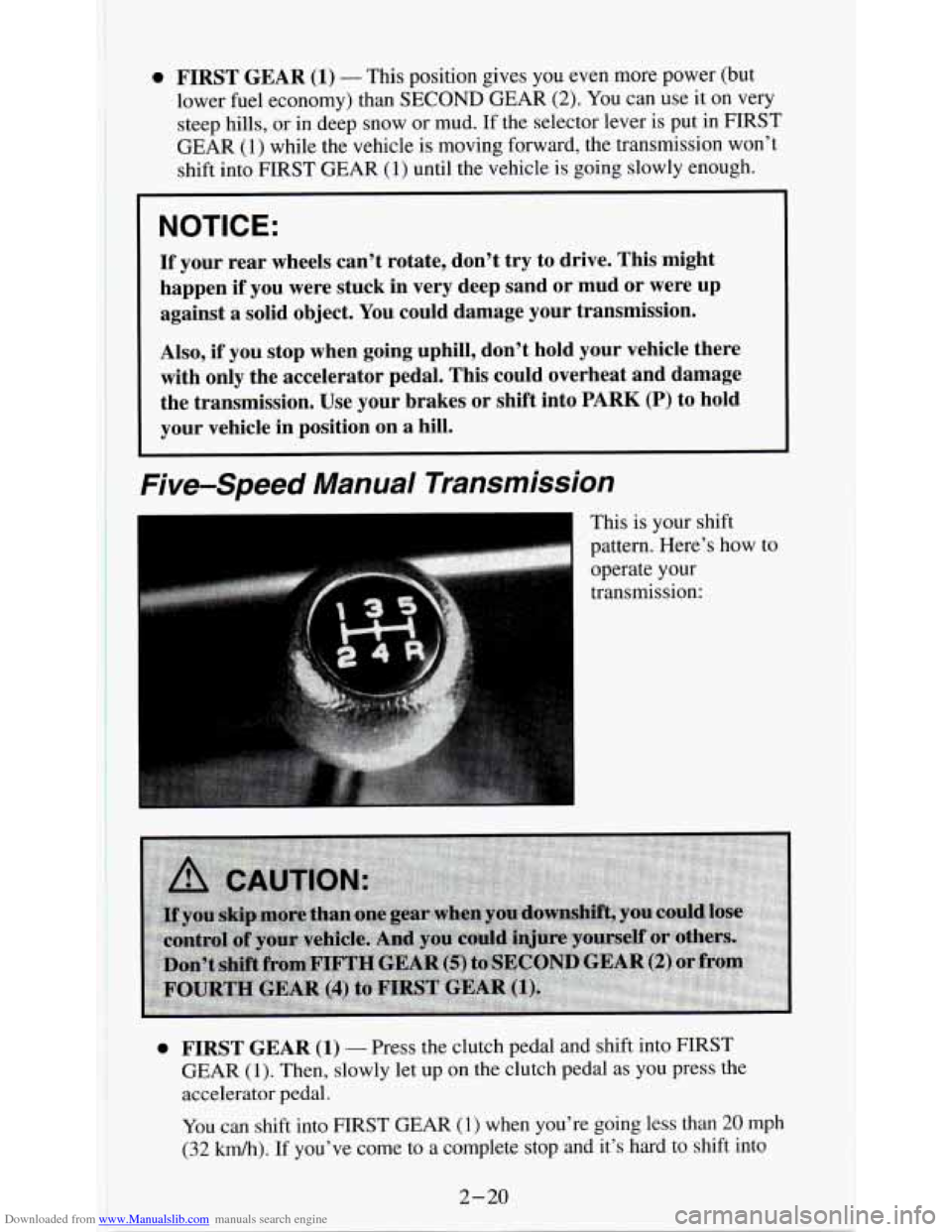
Five-Speed Manual Transmission
This is your shift
pattern. Here’s how to
operate your
transmission:
0 FIRST GEAR (1) - Press the clutch pedal and shift into FIRST
GEAR (1). Then, slowly let up on the clutch pedal as you press the
accelerator pedal.
You can shift into FIRST GEAR (1) when you’re going less than\
20 mph
(32 km/h). If you’ve come to a complete stop and it’s hard to shift into
1 2-20
I
Page 68 of 354
Downloaded from www.Manualslib.com manuals search engine NOTICE:
Driving with the parking brake on can cause your rear brakes to
overheat. You may have to replace them, and you could also
damage other parts
of your vehicle.
If you are on a hill: See “Parking on Hills” in the Index. That section
shows how to
turn your front wheels.
If you are towing a trailer and are parking on any hill: See “Towing a
Trailer” in the Index. That section shows what to do first to keep the trailer
from moving.
Shifting Into PARK (P)
(Automatic Transmission Models Only)
1. Hold the brake pedal down with your right foot and set the parking
brake.
2-23
Page 74 of 354
Downloaded from www.Manualslib.com manuals search engine The front axle portion of the diagram on the indicator will light up when
you shift into four-wheel drive. A slight delay between shifting and the
pattern’s lighting is normal. If the pattern does not light up, or
if the front
axle lights do not go out after you shift out of four-wheel drive, have your
dealer check your system. Turn the INT LIGHTS switch located to the right
of your headlight switch
to dim your transfer case indicator light when your
headlights or parking lights are
on. This will also cause your instrument
panel lights to dim.
2HI - This setting is for driving in most street and highway situations.
Your front axle is not engaged in two-wheel drive.
4HI - This setting engages your front axle to help drive your vehicle. Use
4HI when you need extra traction, such as on snowy or icy roads, or in most
off-road situations.
N SET PARK BRAKE - Shift to this neutral setting only when your
vehicle needs to be towed.
4LO - This setting also efigziges your front axle to give you extra traction
and provides extra gear reduction. You may never need 4LO. It
sends the
maximum power to all four wheels. You might choose 4LO if you were
driving off-road in sand, mud, or deep snow and climbing or descending
steep hills.
You can shift from 2HI to 4HI
or from 4HI to 2HI while the vehicle is
moving.
Do not press the transfer case shift lever button when shifting from
2HI to
4HI or from 4HI to 2HT. Your front axle will engage faster if you
take your foot off of the accelerator for a few seconds after you shift.
To shift your transfer case into N SET PARK BRAKE:
1. Stop the vehicle and shift your transmission into NEUTRAL
(N).
2. Set the parking brake. Your vehicle can roll unless the brakes are
applied.
3. Pull the transfer case shift lever into N SET PARK BRAKE.
To shift into or out of 4LO:
1. The vehicle must be stopped or moving less than 3 mph (4.8 km/h)
with the transmission in NEUTRAL
(N) for an automatic transmission
or the clutch pedal depressed with a manual transmission.
2. Press the transfer case shift button and shift in one continuous motion.
Don’t pause in
N SET PARK BRAKE as you shift into or out of 4L0, or
your gears could clash.
Remember that driving in 4HI or 4LO may reduce fuel economy. Also,
driving in four-wheel drive
on dry pavement could cause your tires to wear
faster and make your transfer case harder to shift and reduce powertrain
longevity.
2-29
Page 84 of 354
Downloaded from www.Manualslib.com manuals search engine If you have an automatic transmission and you apply your brakes, the
Cruise Control will shut
off.
If you have a manual transmission and you apply your brakes or push the
clutch pedal, the
Cruise Control will shut off.
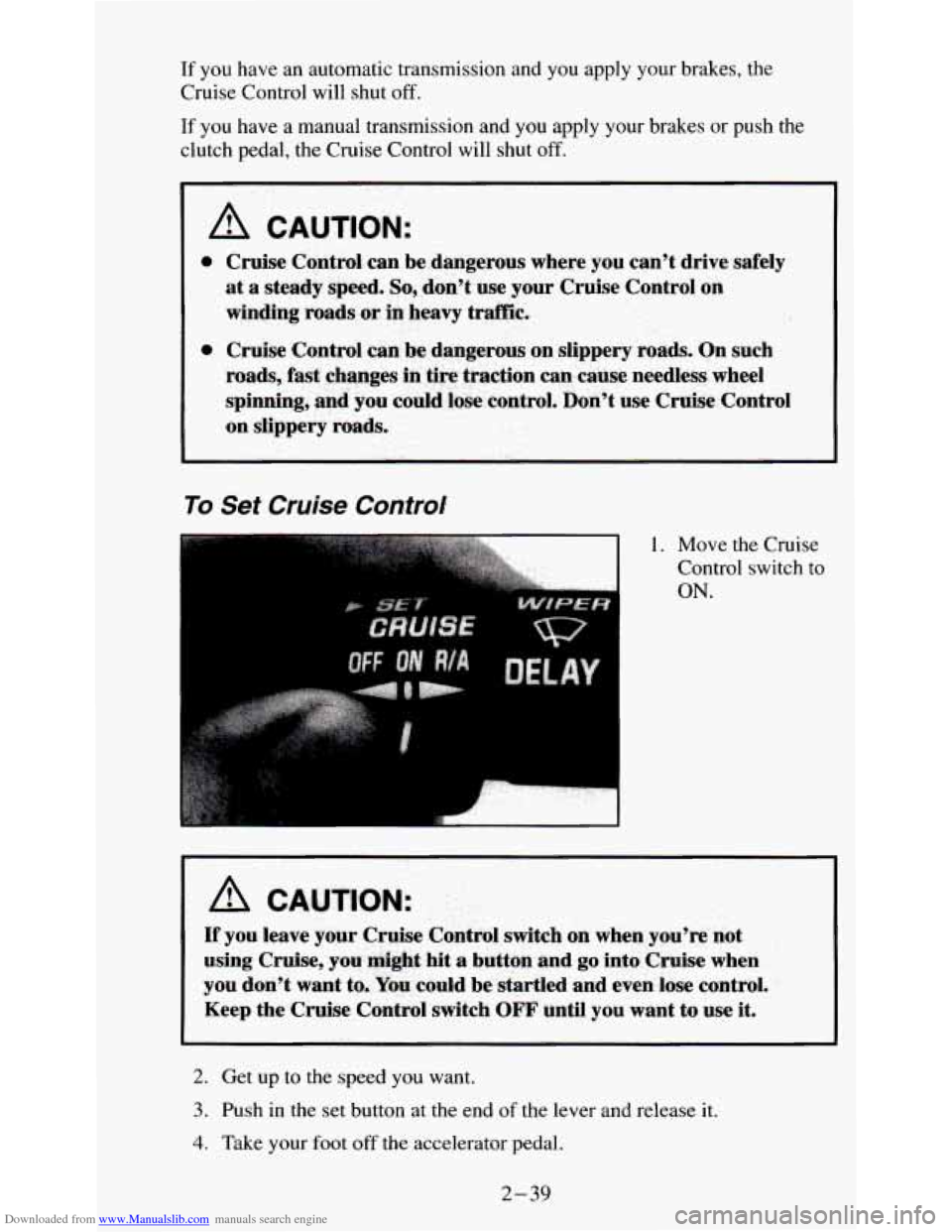
To Set Cruise Control
1. Move the Cruise
Control switch
to
ON.
A CAUTION:
If you leave your Cruise Control switch on when you're not
using Cruise, you
mi&€ hit a button and go into Cruise when
you don't want to- Yaw could be startled and even lose control.
Keep the Cruise Control switch OFF until you want to use it.
2. Get up to the speed you want.
3. Push in the set button at the end of the lever and release it.
4. Take your foot off the accelerator pedal.
2-39
Page 103 of 354
Downloaded from www.Manualslib.com manuals search engine You will see this light flash for a few seconds when you turn your ignition
to RUN or START. Then the light should go out. This means the system is
ready.
If the air bag readiness light doesn’t come
on when you start your vehicle,
or stays on, or comes
on when you are driving, your air bag system may not
work properly. Have your vehicle serviced right away.
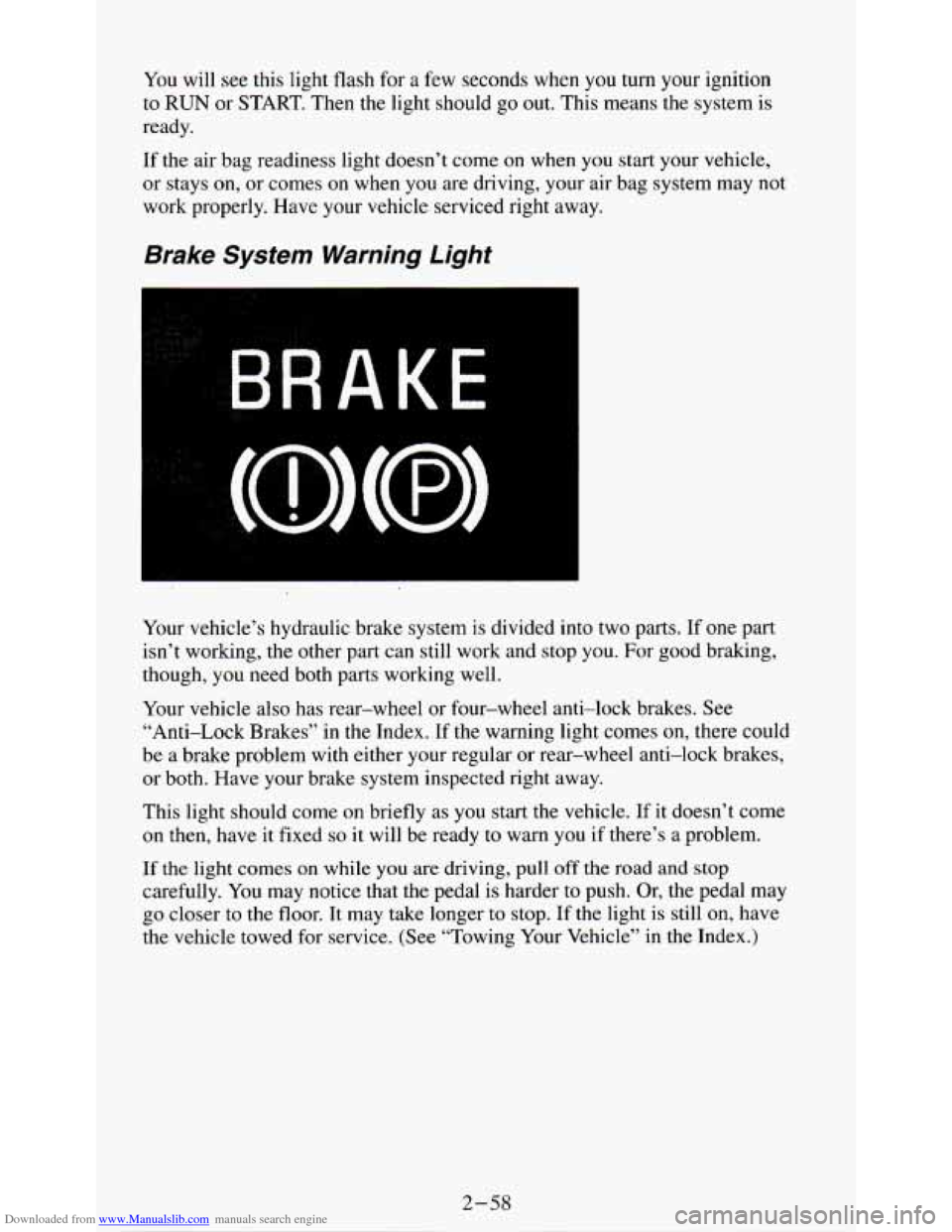
Brake System Warning Light
-1
BRAKE
Your vehicle’s hydraulic brake system is divided into two parts. If one part
isn’t working, the other part can still work and stop you. For good braking,
though, you need both parts working well.
Your vehicle also has rear-wheel or four-wheel anti-lock brakes. See
“Anti-Lock Brakes” in the Index. If the warning light comes on, there could
be a brake problem with either your regular or rear-wheel anti-lock brakes,
or both. Have your brake system inspected right away.
This light should come
on briefly as you start the vehicle. If it doesn’t come
on then, have it fixed
so it will be ready to warn you if there’s a problem.
If the light comes on while you are driving, pull off the road and stop
carefully. You may notice that the pedal is harder
to push. Or, the pedal may
go closer to the floor. It may take longer to stop. If the light
is still on, have
the vehicle towed for service. (See “Towing Your Vehicle” in the Index.)
2-58
Page 104 of 354
Downloaded from www.Manualslib.com manuals search engine The brake system warning light will also come on when you set your
parking brake, and it will stay on if your parking brake doesn’t release fully.
If it stays on after your parking brake is fully released, it means you have a
brake problem.
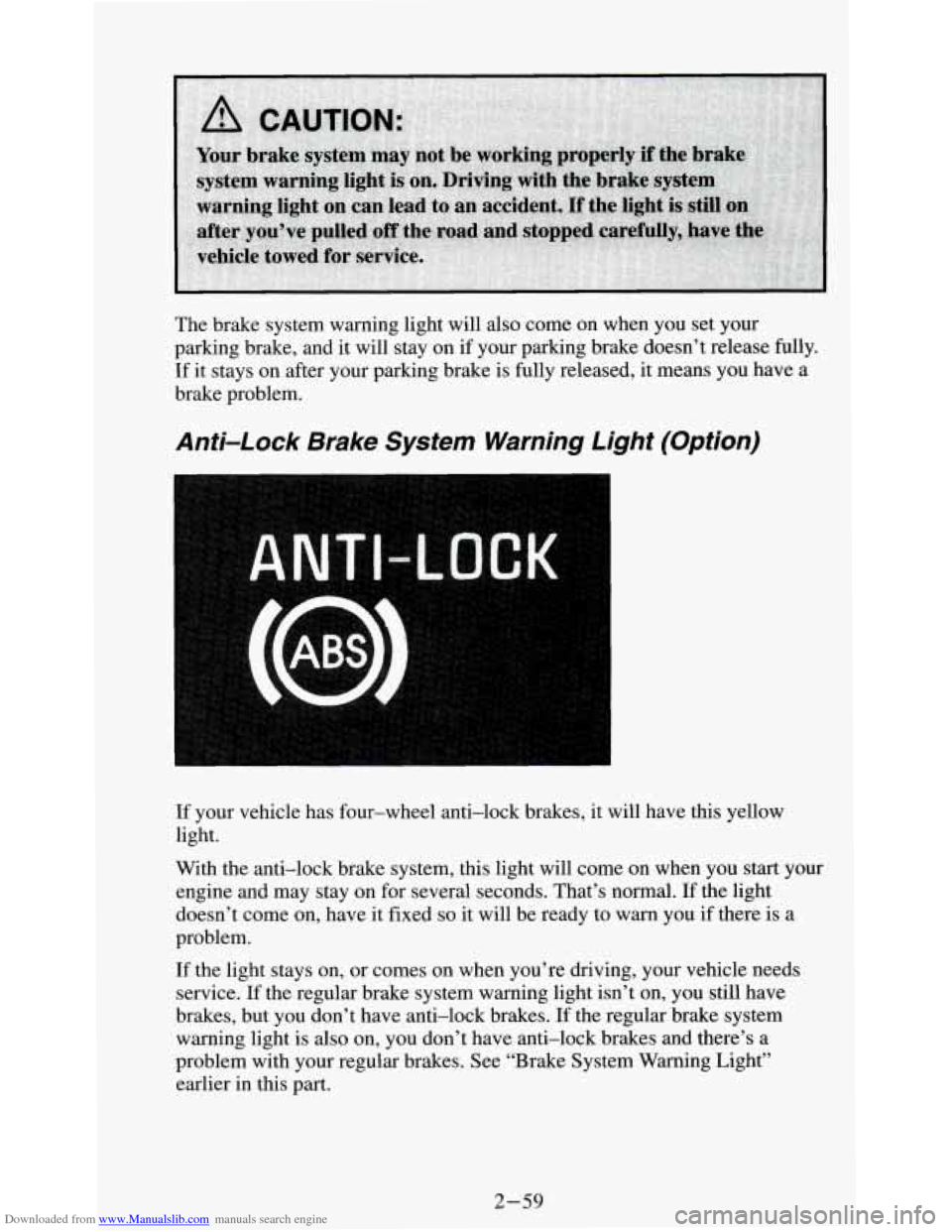
Anti-Lock Brake System Warning Light (Option)
If your vehicle has four-wheel anti-lock brakes, it will have this yellow
light.
With the anti-lock brake system, this light will come on when you
start your
engine and may stay on for several seconds. That’s normal. If the light
doesn’t come
on, have it fixed so it will be ready to warn you if there is a
problem.
If the light stays on, or comes on when you’re driving, your vehicle needs
service. If the regular brake system warning light isn’t on, you still have
brakes, but you don’t have anti-lock brakes. If the regular brake system
warning light is also
on, you don’t have anti-lock brakes and there’s a
problem with your regular brakes. See “Brake System Warning Light”
earlier in this part.
2-59
Page 137 of 354
Downloaded from www.Manualslib.com manuals search engine The body takes about an hour to rid itself of the alcohol in one drink. No
amount of coffee or number of cold showers will speed that up. “I’ll be
careful” isn’t the right answer. What if there’s an emergency, a need to take
sudden action, as when a child darts into the street?
A person with even a
moderate
BAC might not be able to react quickly enough to avoid the
collision.
There’s something else about drinking and driving that many people don’t
know. Medical research shows that alcohol
in a person’s system can make
crash injuries worse, especially injuries
to the brain, spinal cord or heart.
This means that when anyone who has been drinking
- driver or passenger
- is in a crash, that person’s chance of being killed or permanently disabled
is higher than if the person had not been drinking.
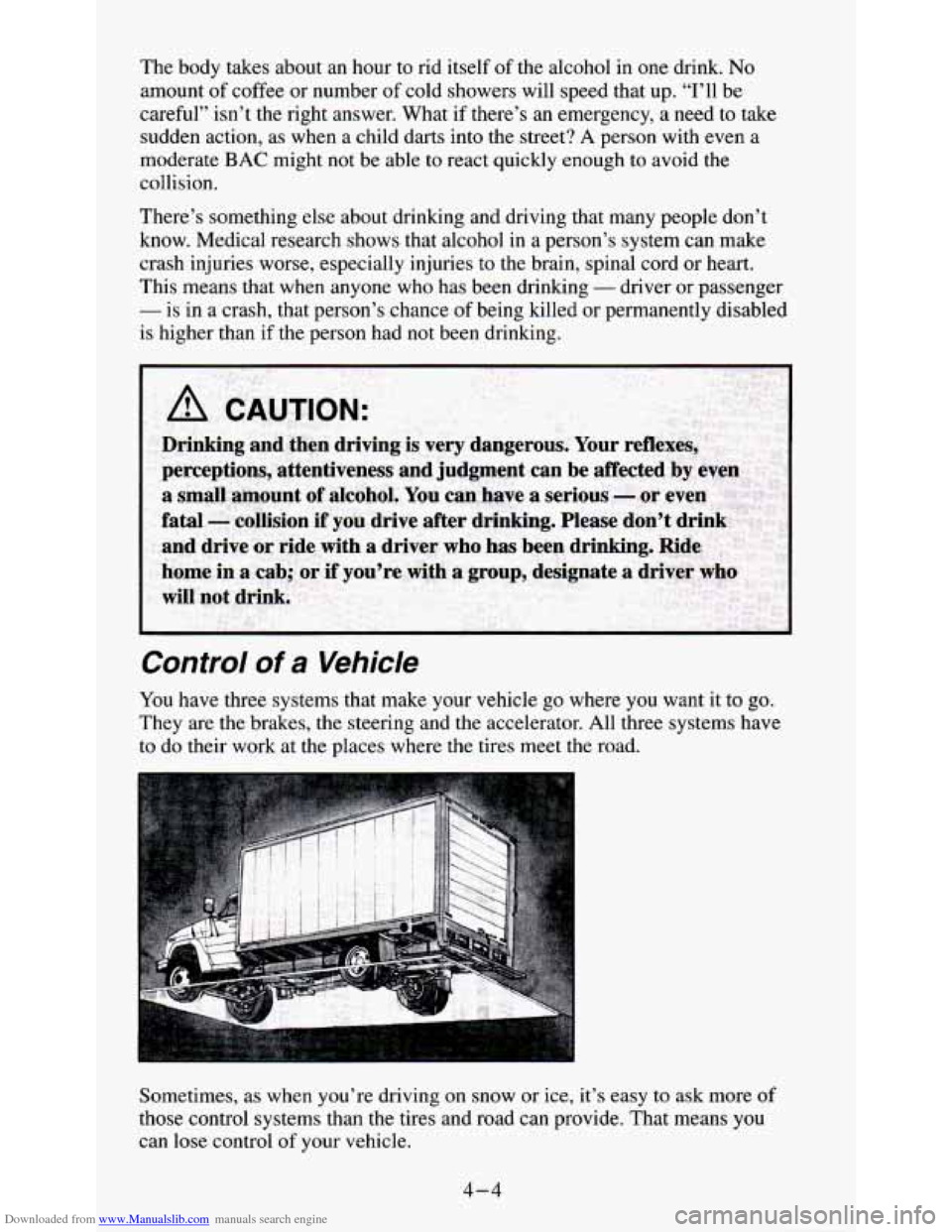
Control of a Vehicle
You have three systems that make your vehicle go where you want it to go.
They are the brakes, the steering and the accelerator. All three systems have
to do their work at the places where the tires meet the road.
Sometimes, as when you’re driving on snow or ice, it’s easy to ask more
of
those control systems than the tires and road can provide. That means you
can lose control of your vehicle.
4-4
Page 138 of 354
Downloaded from www.Manualslib.com manuals search engine Braking
Braking action involves perception time and reaction time.
First, you have to decide to push on the brake pedal. That’s perception time.
Then you have to bring up your foot and do it. That’s reaction time.
Average reaction time is about 3/4 of a second. But that’s only an average. It
might be less with one driver and as long as two or three seconds or more
with another. Age, physical condition, alertness, coordination, and eyesight
all play a part.
So do alcohol, drugs and frustration. But even in 3/4 of a
second, a vehicle moving at
60 mph (100 km/h) travels 66 feet (20 m). That
could be a lot of distance in an emergency,
so keeping enough space
between your vehicle and others is important.
And, of course, actual stopping distances vary greatly with the surface of the
road (whether it’s pavement or gravel); the condition of the road (wet, dry,
icy); tire tread; and the condition of your brakes.
Avoid needless heavy braking. Some people drive in spurts
- heavy
acceleration followed by heavy braking
- rather than keeping pace with
traffic. This is a mistake. Your brakes may not have time to cool between
hard stops. Your brakes will wear out much faster if you do a lot of heavy
braking. If you keep pace with the traffic and allow realistic following
distances, you will eliminate a lot
of unnecessary braking. That means better
braking and longer brake
life.
If your engine ever stops while you’re driving, brake normally but don’t
pump your brakes. If you do, the pedal may get harder to push down. If
your engine stops, you will still have some power brake assist. But you will
use it when you brake. Once the power assist is used up, it may take longer
to stop and the brake pedal will be harder to push.
Anti-Lock Brakes (ABS)
Your vehicle has an advanced electronic braking system that can help you
keep it under control.
If your vehicle has an anti-lock brake system warning light on the
instrument panel, it has four-wheel anti-lock brakes. Otherwise, it has
rear-wheel anti-lock brakes. When you start a vehicle that has four-wheel
anti-lock brakes and begin to drive away, you may hear a momentary motor
or clicking noise. This is the
ABS system testing itself.
4-5
Page 139 of 354
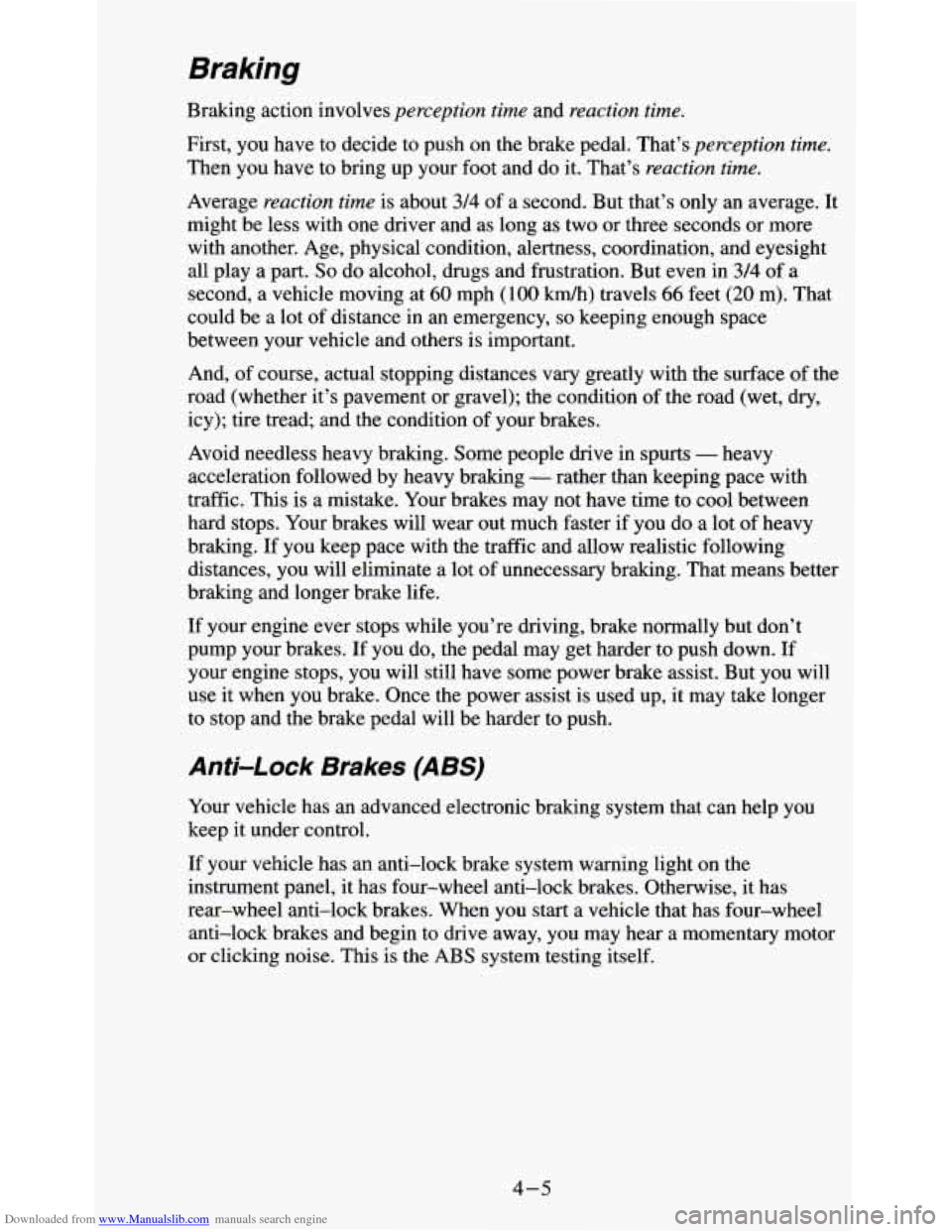
Downloaded from www.Manualslib.com manuals search engine Here's how anti-lock works. Let's say the road is wet. You're driving safely.
Suddenly an animal jumps out
in front of you.
You slam on the brakes. Here's what happens with ABS.
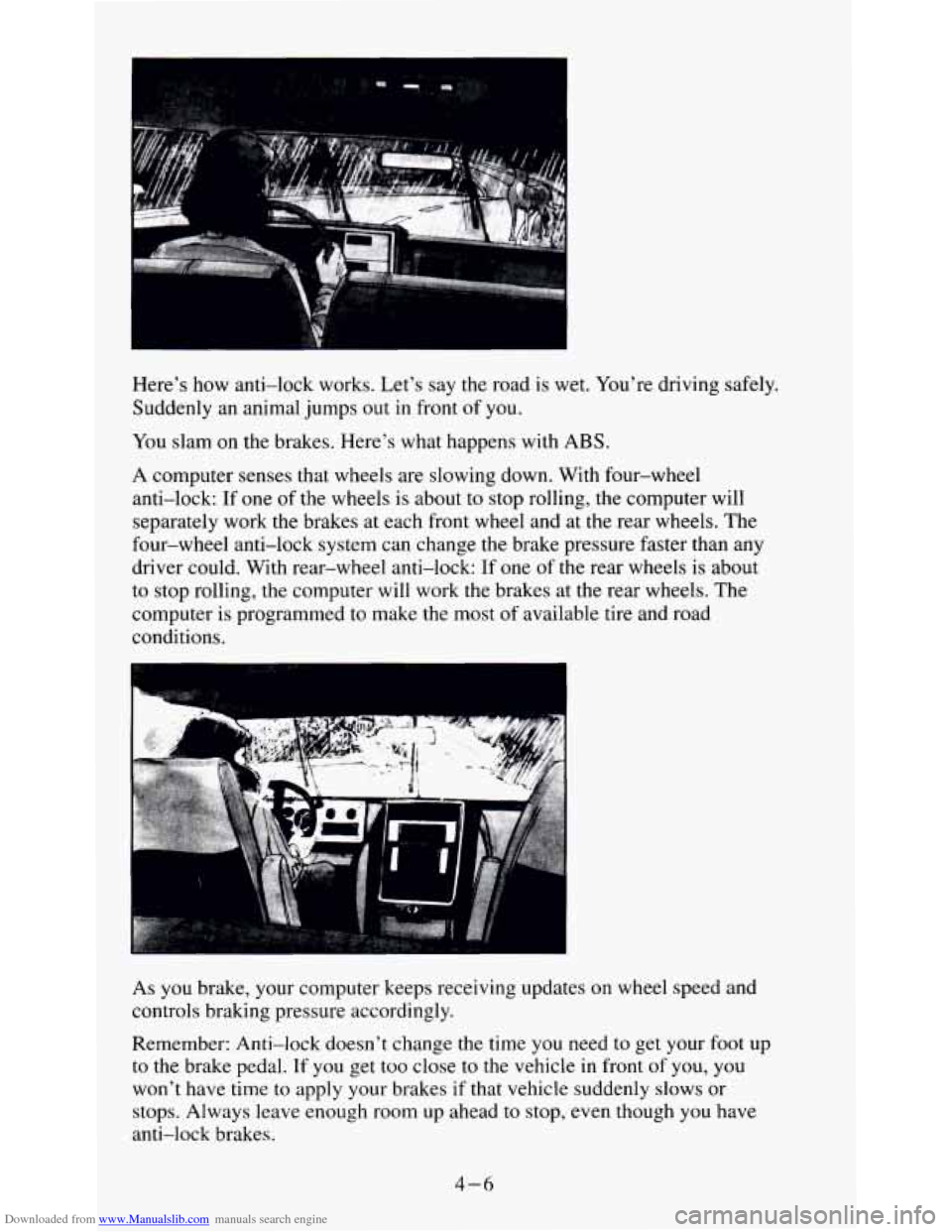
A computer senses that wheels are slowing down. With four-wheel
anti-lock: If one of the wheels
is about to stop rolling, the computer will
separately work the brakes at each front wheel and at the rear wheels. The
four-wheel anti-lock system can change the brake pressure faster than any
driver could. With rear-wheel anti-lock: If one
of the rear wheels is about
to stop rolling, the computer will work the brakes at the rear wheels. The
computer
is programmed to make the most of available tire and road
conditions.
As
you brake, your computer keeps receiving updates on wheel speed and
controls braking pressure accordingly.
Remember: Anti-lock doesn't change the time you need to get your foot up
to the brake pedal. If you get too close
to the vehicle in front of you, you
won't have time to apply your brakes if that vehicle suddenly slows or
stops. Always leave enough room up ahead
to stop, even though you have
anti-lock brakes.
4-6