automatic transmission CHEVROLET S10 1996 2.G User Guide
[x] Cancel search | Manufacturer: CHEVROLET, Model Year: 1996, Model line: S10, Model: CHEVROLET S10 1996 2.GPages: 375, PDF Size: 20.73 MB
Page 103 of 375
Downloaded from www.Manualslib.com manuals search engine Speedometer and Odometer
Your speedometer lets you see your speed in both miles
per hour (mph) and kilometers per hour (km/h).
Your odometer shows how far your vehicle has been
driven, in either miles (used in the United States) or
kilometers (used in Canada).
Your odometer is tamper resistant. It will show
silver lines between the numbers if someone tries to
turn it back.
‘You may wonder what happens if your vehicle needs a
new odometer installed. If the new one can be set to the
mileage total of the old odometer, then it
must be. But if
it can’t, then it’s set at zero, and a label must be put on
the driver’s door
to show the old mileage reading when
the new odometer was installed.
Trip Odometer
The trip odometer can tell you how far your vehicle has
been driven since you last set the trip odometer to zero.
To set the trip odometer to zero, press the button near
the readout.
Tachometer (Option)
The tachometer displays the engine speed in revolutions
per minute
(rpm).
Each tachometer has a dlrrerent limit depending on the
powertrain
in your vehicle. The tachometer has three
areas: normal operating range, red warning range and
red danger range.
Normal operating range shows your engine speed during
normal driving conditions. For example, when
the
needle points to 2, it means the engine is running at
2,000 revolutions per minute (rpm). The tachometer
needle will vary all the time that the engine is running.
The red warning range tells you that your engine speed
is reaching its upper limits. Don’t drive very long with
the tachometer
in the red warning range. If you have a
manual transmission, shift to a higher gear as soon as
possible.
If. you have an automatic transmission, lift
your foot off of
the accelerator pedal.
The red danger range tells you that your engine speed is
at its upper limits.
You should immediately shift to a
higher gear, or lift your foot off of the accelerator pedal.
NOTICE:
Do not operate the engine with the tachometer in
the red range,
or engine damage will occur. I
2-52
Page 172 of 375
Downloaded from www.Manualslib.com manuals search engine Recreational Vehicle Towing
(Four-wheel Drive Oniy)
1.
2.
3.
4.
Set the parking brake firmly.
Place
an automatic transmission in PARK (P) or a
manual transmission in FIRST (1).
Firmly attach the vehicle being towed to the tow
vehicle.
Do not tow the vehicle by the rear bumper
bar. Refer to
the hitch manufacturer’s instructions.
Place the transfer case shift lever in NEUTRAL (N).
Recreational vehicle towing is not recommended for
vehicles
with the optional electronic shift transfer case
because the transfer case has
no neutral position.
Shifting the transfer case into NEUTRAL (N) can
cause your vehicle to roll even if the transmission
is in
PARK (P), for an automatic transmission,
or if your vehicle is in gear, for a manual
transmission. This is because the transfer case
overrides the transmission.
5. Release the parking brake only after the vehicle
being towed is firmly attached to the tow vehicle.
6. Insert the ignition key into the ignition switch and
turn it one notch forward of the LOCK position. This
places the key
in the OFF position, which unlocks
the steering column while preventing battery drain.
Unlocking the steering
column will allow for proper
movement
of the front wheelshires during towing.
4-41
Page 180 of 375
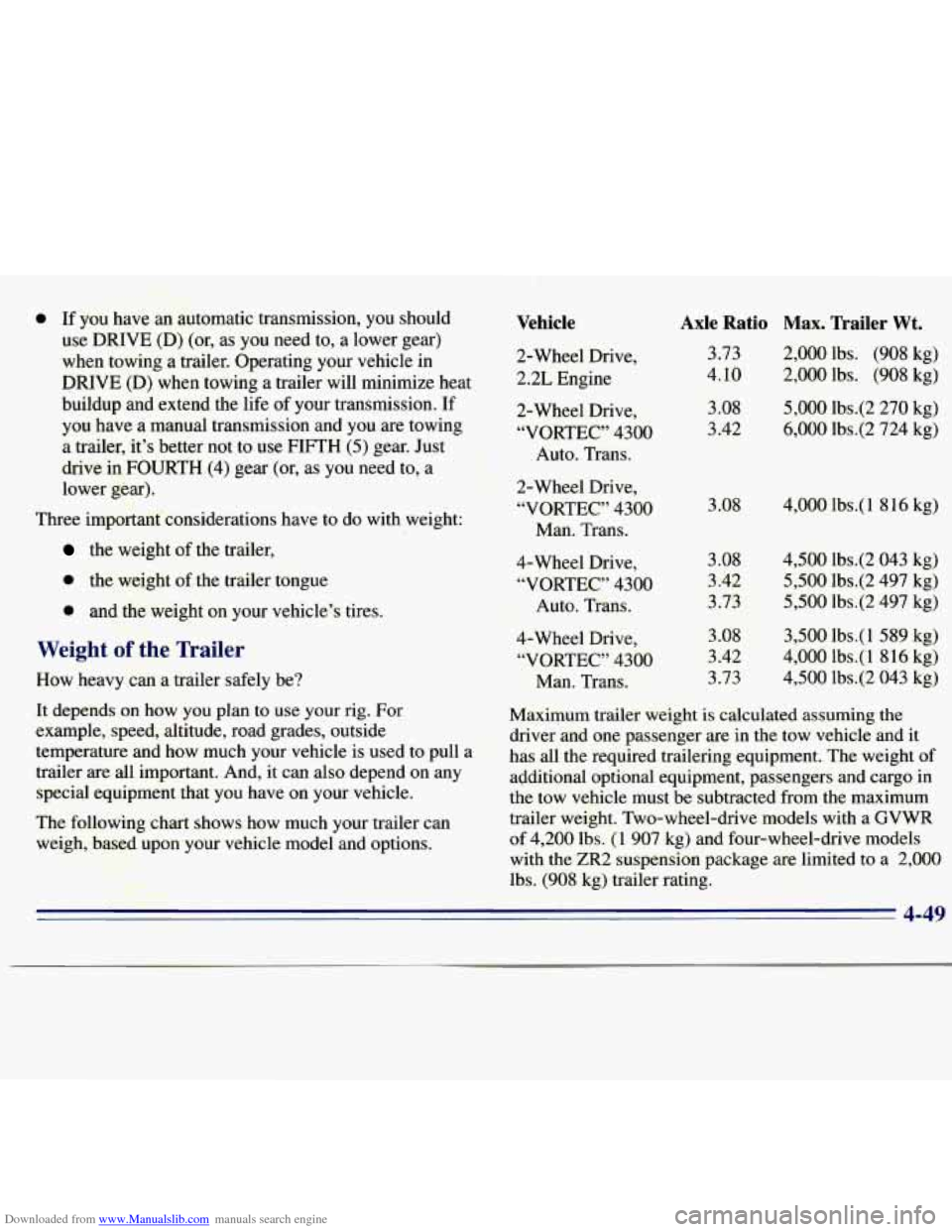
Downloaded from www.Manualslib.com manuals search engine 0 If you haw a11 automatic transmission, you should Vehicle Axle Ratio Max. Trailer Wt.
use DRIVE (D) (or, as you need to, a lower gear)
when towing a trailer. Operating your vehicle in 2-Wheel Drive,
DRIVE (D) when towing a trailer will minimize heat 2.Z Engine 3.73 2,000
lbs. (908 kg)
4.10 2,000 lbs. (908 kg)
buildup and extend the life
of your transpission. If 2-Wheel Drive, 3.08 5,000 lbs.(2 270 kg)
you have a manual transmission and you are towing
“VORTEC” 4300 3.42 6,000 lbs.(2 724 kg)
a trailer, it’s better not to use
FIFTH (5) gear. Just Auto. Trans.
drive in
FOURTH (4) gear (or, as you need to, a -
lower gear). pi,. 2-Wheel Drive,
“-“‘VORTEC” 4300 3.08 4,000 lbs.( 1 816 kg)
Three important considerations have to do with weight:
Man. Trans. ,I+, : = . -
the weight of the trailer,
0 the weight of the trailer tongue
0 and the weight on your vehicle’s tires.
Weight of the Trailer
How heavy can a trailer safely be? 4-Wheel Drive,
3.08 4,500
lbs.(2 043
kg)
“VORTEC” 4300 3.42
5,500 lbs.(2 497 kg)
Auto. Trans. 3.73
5,500 lbs.(2
497 kg)
4-Wheel Drive, 3.08 3,500
lbs.( 1 589 kg)
“VORTEC” 4300 3.42
4,000 lbs.( 1 816
kg)
Man. Trans. 3.73
4,500 lbs.(2 043 kg)
It depends
on how you plan to use your rig. For
Maximum trailer weight is calculated assuming the
example, speed, altitude, road grades, outside
driver and one passenger are in the tow vehicle and it
temperature and how Your vehicle is used to Pull a
’ has all the required trailering equipment. The weight of
trailer are all important. And, it can also depend on any
agditional optional equipment, passengers and cargo in
special equipment that you have on your vehicle.
the tow vehicle must be subtracted from the maximum
The following chart shows how much your trailer can trailer weight. Two-wheel-drive models
with a GVWR
weigh, based upon your vehicle model and options. of
4,200 lbs.
(1 907 kg) and four-wheel-drive models
JT”;’ ,-p?? , ,- -&-I:. , * with the ZR2 suspension package are limited to a 2,000
’ , :-qqg$+. r *? *. F:. rr I‘
ty+ : ‘ -.. 4 I lbs. (908 kg) trailer rating.
4-49
Page 185 of 375
Downloaded from www.Manualslib.com manuals search engine Turn Signals When Towing a Trailer
When you tow a trailer, your vehicle has to have extra
wiring and a heavy-duty turn signal flasher (included
in
the optional trailering package).
The green arrows on your instrument panel will flash
whenever you signal a turn or lane change. Properly
hooked up, the trailer lamps will also flash, telling other
drivers you’re about to turn, change lanes or stop.
When towing a trailer, the green arrows on your
instrument panel will flash for turns even if the bulbs on
the trailer are burned out. Thus, you may think drivers
behind
you are seeing your signal when they are not. It’s
important
to check occasionally to be sure the trailer
bulbs are still working.
Driving On Grades
Reduce speed and shift to a lower gear before you start
down a long or steep downgrade. If you don’t shift
down,
you might have to use your brakes so much that
they would get hot and no longer work well, On
a long uphill grade, shift down and reduce your
speed to around
45 mph (70 kdh) to reduce the
possibility of engine
and transmission overheating.
If you have an automatic transmission, you should use
DRIVE (D) when towing a trailer. Operating your
vehicle in DRIVE (D) when towing a trailer will
minimize heat buildup and extend the life of your
transmission. Or, if you have a manual transmission, it’s
better not to use FIFTH
(5), just drive in FOURTH (4)
(or, as you need to, a lower gear).
When towing at high altitude on steep uphill grades,
consider the following: Engine coolant will boil
at a
lower temperature than at normal altitudes. If you turn
your engine off immediately after towing at high altitude
on steep
uphill grades, your vehicle may show signs
similar to engine overheating. To avoid this, let the
engine run while parked (preferably on level ground)
with the automatic transmission in PARK
(P) (or the
manual transmission out of gear and the parking brake
applied) for
a few minutes before turning the engine off.
If you do get the overheat warning, see “Engine
Overheating’’
in the Index.
4-54
Page 187 of 375
Downloaded from www.Manualslib.com manuals search engine When You Are Ready to Leave After
Parking on a Hill
1. Apply your regular brakes and hold the pedal down
while
you:
Start your engine;
0 Shift into a gear; and
0 Release the parking brake.
2. Let up on the brake pedal.
3. Drive slowly until the trailer is clear of the chocks.
4. Stop and have someone pick up and store the chocks.
Maintenance When Trailer Towing
Your vehicle will need service more often when you’re
pulling a trailer. See the Maintenance Schedule for more
on this. Things that are especially important in trailer
operation are automatic transmission fluid (don’t
overfill), engine oil, axle lubricant, belt, cooling system
and brake adjustment. Each
of these is covered in this
manual, and the Index will help
you find them quickly.
If you’re trailering, it’s
a good idea to review these
sections before you start your trip.
Check periodically to see that all hitch nuts and bolts
are tight.
Trailer Wiring Harness
The eight-wire harness is stored under your vehicle
along
the rear frame crossmember. This harness has a
30-amp feed wire with an inline fuse located in the
instrument panel fuse block and no connector. It should
be wired by a qualified electrical technician. The
technician can use
the following color code chart when
connecting the wiring harness to your trailer.
0 DARK BLUE: Use for electric trailer brakes or
0 RED: Use for battery charging; it connects to the
LIGHT GREEN: Back-up lamps.
0 BROWN: Taillamps and parking lamps.
0 YELLOW Left stoplamp and turn signal.
0 DARK GREEN: Right stoplamp and turn signal.
0 WHITE (Heavy Gage): Ground wire.
0 WHITE (Light Gage): Auxiliary stoplamp.
Securely attach the harness to the trailer, then tape or
strap it to your vehicle’s frame rail. Be sure
you leave
it loose enough
so the wiring doesn’t bend or break,
but not so
loose that it drags on the ground. Store the
harness in its original place. Wrap the harness together
and tie
it neatly so it won’t be damaged.
auxiliary wiring.
starter solenoid.
4-56
Page 191 of 375
Downloaded from www.Manualslib.com manuals search engine When the hazard warning flashers are on, your turn
signals won't work. The flashers will stop
if you 'step on.
the brake.
,Other Warning Devices
If you carry reflective triangles, you can set one up at
the side
of the road about 300 feet (100 m) behind
your vehicle.
Jump Starting
'If your battery has run down, you may want to
use another vehicle and some jumper cables to
start
your vehicle. But please use the following steps to
do it safely.
NOTICE:
Ignoring these steps could result in costly damage
to your vehicle that wouldn't be 'covered by
your warranty.
.
DO not try to start your' vehicle by pushing or
pulling
it. This could damage'your vehicle, even if'
you have a manual transmission. And if you have
an automatic transmission, it won't
start thqt way.
b
Batteries can hurt you. They can be
dangerous because:
They contain acid that can burn you.
They contain gas that can explode or ignite.
They contain enough electricity to burn you.
If you don't follow these steps exactly, some or all
of these things can hurt you.
1. Check the other vehicle.
It must have a 12-volt
battery with a negative ground system.
NOTICE:
If the other system isn't a 12-volt system with a
negative ground, both vehicles can be damaged.
5-2
Page 192 of 375
Downloaded from www.Manualslib.com manuals search engine 2. Get the vehicles close enough so the jumper cables
can reach, but be sure the vehicles aren’t touching
each other.
If they are, it could cause a ground
connection you don’t want. You wouldn’t be able
to
start your vehicle, and the bad grounding could
damage the electrical systems.
You could be injured
if the vehicles roll. Set the
parking brake firmly on each vehicle. Put an
automatic transmission
in PARK (P) or a manual
transmission in NEUTRAL
(N). If you have a
four-wheel-drive vehicle with a manual transfer case
shift lever, be sure the transfer case is not
in
NEUTRAL (N).
3. Turn off the ignition on both vehicles. Unplug
unnecessary accessories plugged into the cigarette
lighter, or accessory power outlets,
if you have this
option. Turn off all lamps that aren’t needed as well
as radios. This will avoid sparks and help save both
batteries.
In addition, it could save your radio!
NOTICE:
If you leave your radio on, it could be badly
damaged. The repair wouldn’t be covered by
your warranty.
If your vehicle has air conditioning, the auxiliary
electric fan under the hood can start up even
when the engine is not running and can injure
you. Keep hands, clothing and tools away from
-7 any underhood electric fan.
5-3
Page 202 of 375
Downloaded from www.Manualslib.com manuals search engine If No Steam Is Coming From Your Engine
If you get the overheat warning but see or hear no
steam, the problem may not be too serious. Sometimes
the engine can get a little too hot when you:
Climb a long hill on a hot day.
Stop after high-speed driving.
Idle for long periods in traffic.
Tow a trailer. See “Driving on Grades” in the Index
If
you get the overheat warning with no sign of steam,
try this for a minute or
so:
1. If you have an air conditioner, turn it off.
2. Turn on your heater to full hot at the highest fan
speed
and open the window as necessary.
3. If you’re in a traffic jam, shift to NEUTRAL (N);
otherwise, shift to the highest gear while
driving
-- AUTOMATIC OVERDRIVE (,@)
or DRIVE (D) for automatic transmissions.
If you no longer have the overheat warning, you can
drive. Just to be safe, drive slower for about
10 minutes.
If the warning doesn’t come back on, you can
drive normally.
If the warning continues, pull over, stop, and park your
vehicle right away.
If there’s still no sign of steam, push the accelerator until
the engine speed is about twice
as fast as normal idle
speed. Bring the engine speed back to normal idle speed
after two or three minutes. Now see
if the warning stops.
But then, if you still have the .warning, turn ofthe
engine
and get everyone out of the vehicle until it
cools down.
You may decide not to lift the hood but to get service
help right
away.
5-12
Page 212 of 375
Downloaded from www.Manualslib.com manuals search engine Changing a Flat Tire
If a tire goes flat, avoid further tire and wheel damage
by driving slowly to a level place. Turn on your hazard
warning flashers.
-
6% CAUTION:
Changing a tire can cause an injury. The vehicle
can slip
off the jack and roll over you or other
people. You and they could be badly injured.
Find a level place to change your tire.
To help
prevent the vehicle from moving:
1. Set the parking brake firmly.
2. Put an automatic transmission shift
lever in
PARK (P) or shift a manual
transmission to FIRST
(1) or
REVERSE (R).
3. If you have a four-wheel-drive vehicle
with
a manual transfer case shift lever,
be sure the transfer case
is in a drive
gear
-0 not in NEUTRAL (N).
CAUTION: (Continued)
4. Turn off the engine.
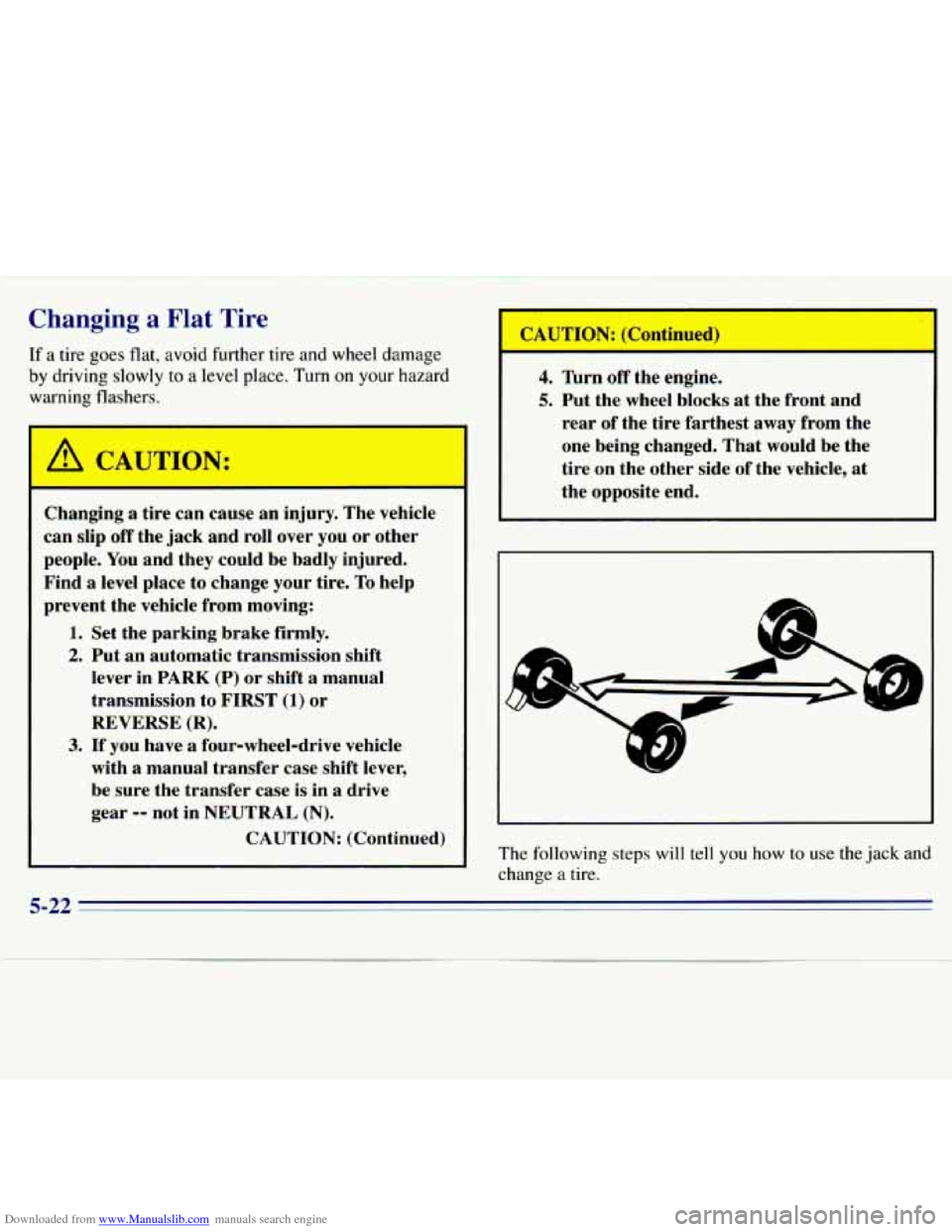
5. Put the wheel blocks at the front and
rear of the tire farthest away from the
one being changed. That would be the
tire on the other side of the vehicle, at
the opposite end.
The following
steps will tell you how to use the jack and
change a tire.
5-22
Page 242 of 375
Downloaded from www.Manualslib.com manuals search engine Automatic Transmission Fluid
When to Check and Change
A good time to check your automatic transmission fluid
level is
when the engine oil is changed.
Change both the fluid and filter every
50,000 miles
(83
000 km) if the vehicle is mainly driven under one or
more
of these conditions:
In heavy city traffic where the outside temperature
regularly reaches 90°F (32°C) or higher.
0 In hilly or mountainous terrain.
0 When doing frequent trailer towing.
0 Uses such as found in taxi, police or delivery service.
If you do not use your vehicle under any of these
conditions, the fluid and filter do not require changing.
See “Scheduled Maintenance Services” in the Index.
How to Check
Because this operation can be a little difficult, you may
choose to have this done at your
GM dealer’s Service
Department. If you do it yourself, be sure to follow all the instructions\
here, or
you could get a false reading on the dipstick.
NOTICE:
Too much or too little fluid can damage your
transmission.
Too much can mean that some of
the fluid could come out and fall on hot engine
parts or exhaust system parts, starting a fire. Be
sure to get an accurate reading if you check your
transmission fluid.
Wait at least 30 minutes before checking the
transmission fluid level if
you have been driving:
When outside temperatures are above 90°F (32°C).
0 At high speed for quite a while.
0 In heavy traffic -- especially in hot weather.
0 While pulling a trailer.
To get the right reading, the fluid should be at normal
operating temperature, which is 180°F to
200°F
(82°C to 93°C).
6-16