fuel CHEVROLET S10 1996 2.G User Guide
[x] Cancel search | Manufacturer: CHEVROLET, Model Year: 1996, Model line: S10, Model: CHEVROLET S10 1996 2.GPages: 375, PDF Size: 20.73 MB
Page 112 of 375
Downloaded from www.Manualslib.com manuals search engine Shift Light
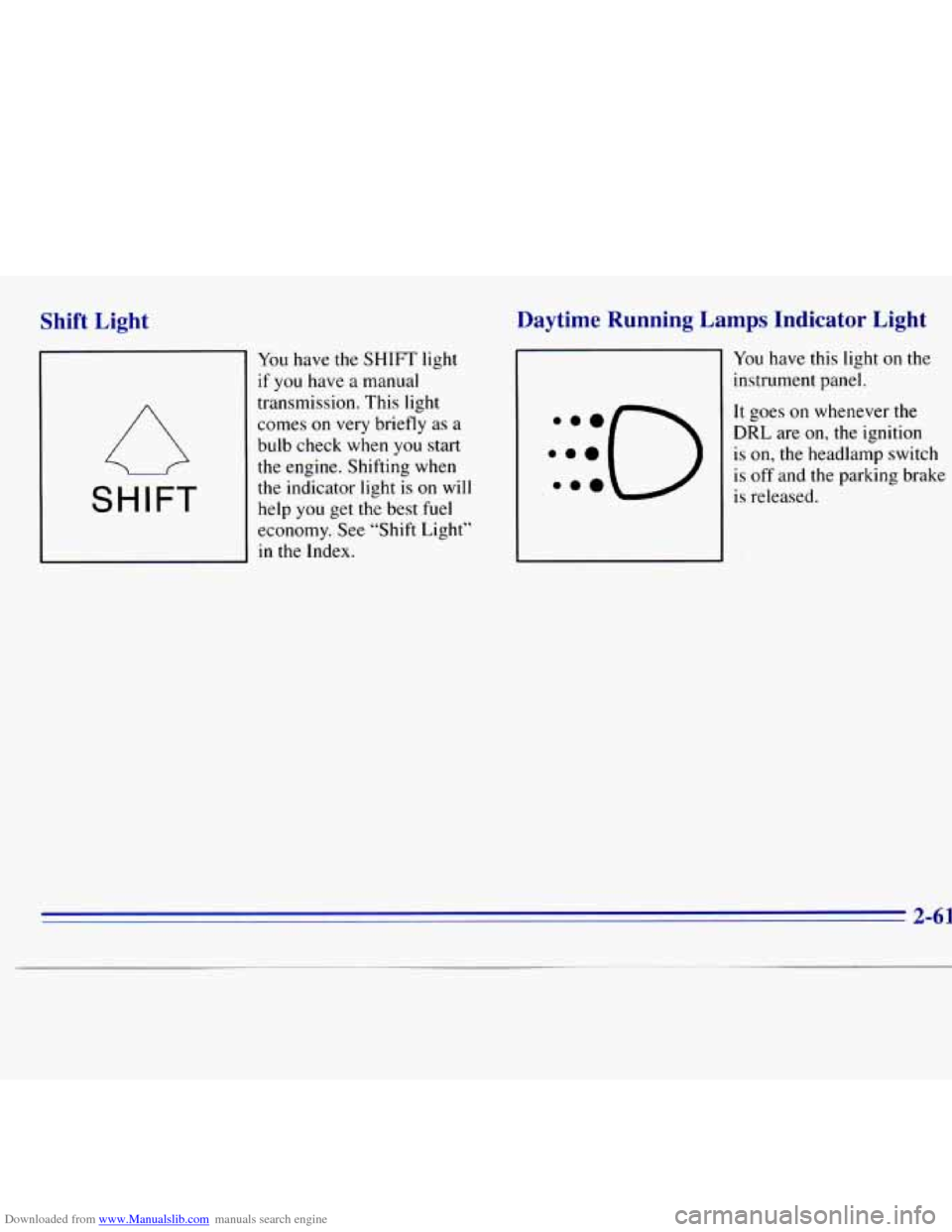
A
SHIFT
You have the
if you have a
transmission.
SHIFT light
manual This light
comes
on very briefly as a
bulb check when you start
the engine. Shifting when
the indicator light is on will
help you get
the best fuel
economy. See “Shift Light”
in the Index.
Daytime Running Lamps Indicator Light
:::O 0.0
You have this light on the
instrument panel.
It goes on whenever the
DRL are on, the ignition
is on, the headlamp switch
is off and the parking brake
is released.
2-61
Page 113 of 375
Downloaded from www.Manualslib.com manuals search engine Check Gages Light
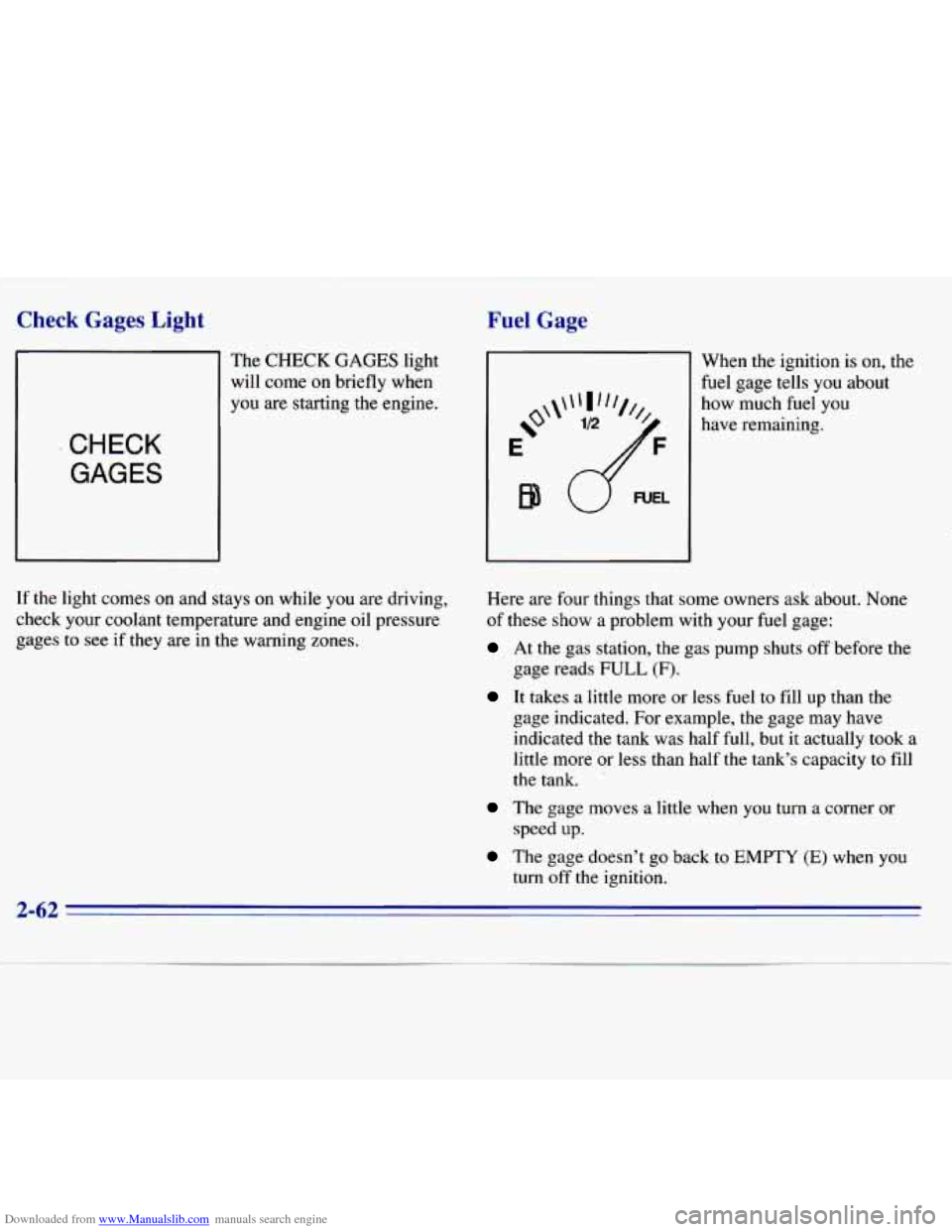
The CHECK GAGES light
will come on briefly when
you are starting the engine.
CHECK
GAGES
If the light comes on and stays on while you are driving,
check your coolant temperature and engine oil pressure
gages to see if they are
in the warning zones.
Fuel Gage
When the ignition is on, the
fuel gage tells
you about
how much fuel
you
have remaining.
Here are four things that some owners ask about. None
of these show a problem with your fuel gage:
At the gas station, the gas pump shuts off before the
It takes a little more or less fuel to fill up than the
gage reads
FULL (F).
gage indicated. For example, the gage may have
indicated the tank was half full, but it actually took a
little more or less than half the tank’s capacity to fill
the tank.
The gage moves a little when you turn a corner or
speed up.
The gage doesn’t go back to EMPTY (E) when you
turn off the ignition.
2-62
Page 145 of 375
Downloaded from www.Manualslib.com manuals search engine ~ ~~ . ~ ~~
Before You GO Off-Roading
There are some things to do before
you go out. For
. example, be sure to have all necessary maintenance and
service work done. Check to make sure all underbody
shields (if
so equipped) are properly attached. Be sure
you read all the information about your four-wheel-drive
, ‘ vehicle in this manual. Is there enough fuel? Is the spare
tire fully inflated? Are the fluid levels up where they should be? What are the local laws that apply to
off-roading where you’ll be driving?
If you don’t know,
- you should check with law enforcement people in the
area. Will you be
on someone’s private land? If so, be
sure to get the necessary permission.
Loading Your Vehicle for Off-Road Driving
There are some important things to remember about
how to load your vehicle.
The heaviest things should be on the load floor and
, forward of your rear axle. Put heavier items as far
forward as you can.’
Be’ sure the load is secured properly, so driving on
’ the off-road ten@ doesn’t toss things around. Cargo on the load floor
piled higher than
the seatbacks can be thrown forward
during
a sudden stop. You or your
passengers could be injured. Keep cargo
below the top of the seatbacks.
Unsecured cargo on the load floor can be
tossed about when driving over rough
terrain. You or your passengers can be
struck by flying objects. Secure the
cargo properly.
Heavy loads on the roof raise the vehicle’s
center of gravity, making it more likely to
roll over.
You can be seriously or fatally
injured if the vehicle rolls over. Put heavy
loads inside the cargo area, not on the roof. Keep cargo in the cargo area
as far forward
and low
as possible.
You’ll find other important information
in this manual.
See “Vehicle Loading,” “Luggage Carrier” and “Tires”
in the Index.
4-14
Page 158 of 375
Downloaded from www.Manualslib.com manuals search engine If the water isn’t too deep, then drive through it slowly.
At fast speeds, water splashes
on your ignition system
and your vehicle can stall. Stalling can also occur if you
get your tailpipe under water. And, as long as your
tailpipe is under water, you’ll never be able to start your
engine. When
you go through water, remember that
when your brakes get wet, it may take you longer
to stop.
Driving through rushing water can be dangerous.
Deep water can sweep your vehicle downstream
and you and your passengers could drown.
If it’s
only shallow water, it can still wash away the
ground from under your tires, and you could lose
traction and roll the vehicle over. Don’t drive
through rushing water.
See “Driving Through Water” in the Index for more
information on driving through water.
After Off-Road Driving
Remove any brush or debris that has collected on the
underbody, chassis or under the hood. These
accumulations
can be a fire hazard.
After operation in mud
or sand, have the brake linings
cleaned and checked. These substances can cause
glazing and uneven bralung. Check the body structure,
steering, suspension, wheels, tires and exhaust system
for damage. Also, check the fuel lines and cooling
system for any leakage.
Your vehicle will require more frequent service due to
off-road use. Refer to the Maintenance Schedule for
additional information.
4-27
Page 165 of 375
Downloaded from www.Manualslib.com manuals search engine Once you are moving on the freeway, make certain you
allow
a reasonable following distance. Expect to move
slightly slower
at night.
When you want to leave the freeway, move to the proper
lane well in advance.
If you miss your exit, do not,
under any circumstances, stop and back
up. Drive on to
the
next exit.
The exit ramp can be curved, sometimes quite sharply.
The exit speed is usually posted.
Reduce your speed according to your speedometer, ‘not
to your sense of motion. After driving for
any distance
at higher speeds, you may tend to think you are going
slower than
you actually are.
Before Leaving on a Long Trip
Make sure you’re ready. Try to be well rested. If you
must start when you’re not fresh
-- such as after a day’s
work
-- don’t plan to make too many miles that first part
of the journey. Wear comfortable clothing and shoes you
can easily drive in.
Is your vehicle ready for a long trip? If you keep it
serviced and maintained,
it’s ready to go. If it needs
service, have it done before starting out. Of course,
you’ll find experienced and able service experts in
GM
dealers all across North America. They’ll be ready and
willing to help
if you need it.
Here are some things you can check before
a trip:
0
0
0
0
0
0
0
Windshield Washer Fluid: Is the reservoir full?
Are all windows clean inside and outside?
Wiper Blades: Are they in good shape?
Fuel, Engine Oil, Other Fluids: Have you checked
all levels?
Lamps: Are they all working? Are the lenses clean?
Tires: They are vitally important to a safe,
trouble-free trip.
Is the tread good enough for
long-distance driving? Are the tires all inflated to the
recommended pressure?
Weather Forecasts: What’s the weather outlook
along your route? Should you delay your trip a short
time to avoid a major storm system?
Maps: Do you have up-to-date maps?
4-34
Page 171 of 375
Downloaded from www.Manualslib.com manuals search engine -
Snow can trap exhaust gases under your vehicle.
This can cause deadly
CO (carbon monoxide) gas
to get inside.
CO could overcome you and kill
you. You can’t see it
or smell it, so you might not
know it is in your vehicle. Clear away snow from
around the base of your vehicle, especially any
that
is blocking your exhaust pipe. And check
around again from time to time to be sure snow
doesn’t collect there.
Open a window just a little on the side
of the
vehicle that’s away from the wind. This will help
keep
CO out.
Run your engine only as long as you must. This saves
fuel. When you
run the engine, make it go a little faster
than just idle. That
is, push the accelerator slightly. This
uses less fuel for the heat that you get and
it keeps the
battery charged.
You will need a well-charged battery to
restart the vehicle, and possibly for signaling later
on
with your headlamps. Let the heater run for awhile.
Then, shut the engine off and close the window almost
all the way
to preserve the heat. Start the engine again
and repeat this only when you feel really uncomfortable
from the cold.
But do it as little as possible. Preserve the
fuel as long as you can.
To help keep warm, you can get
out of the vehicle and
do some fairly vigorous exercises
every
half hour or so until help comes.
4-40
Page 173 of 375
Downloaded from www.Manualslib.com manuals search engine Loading Your Vehicle
< SEE OWNER'S MANUAL FOR ADDITIONAL INFORMATION uu-
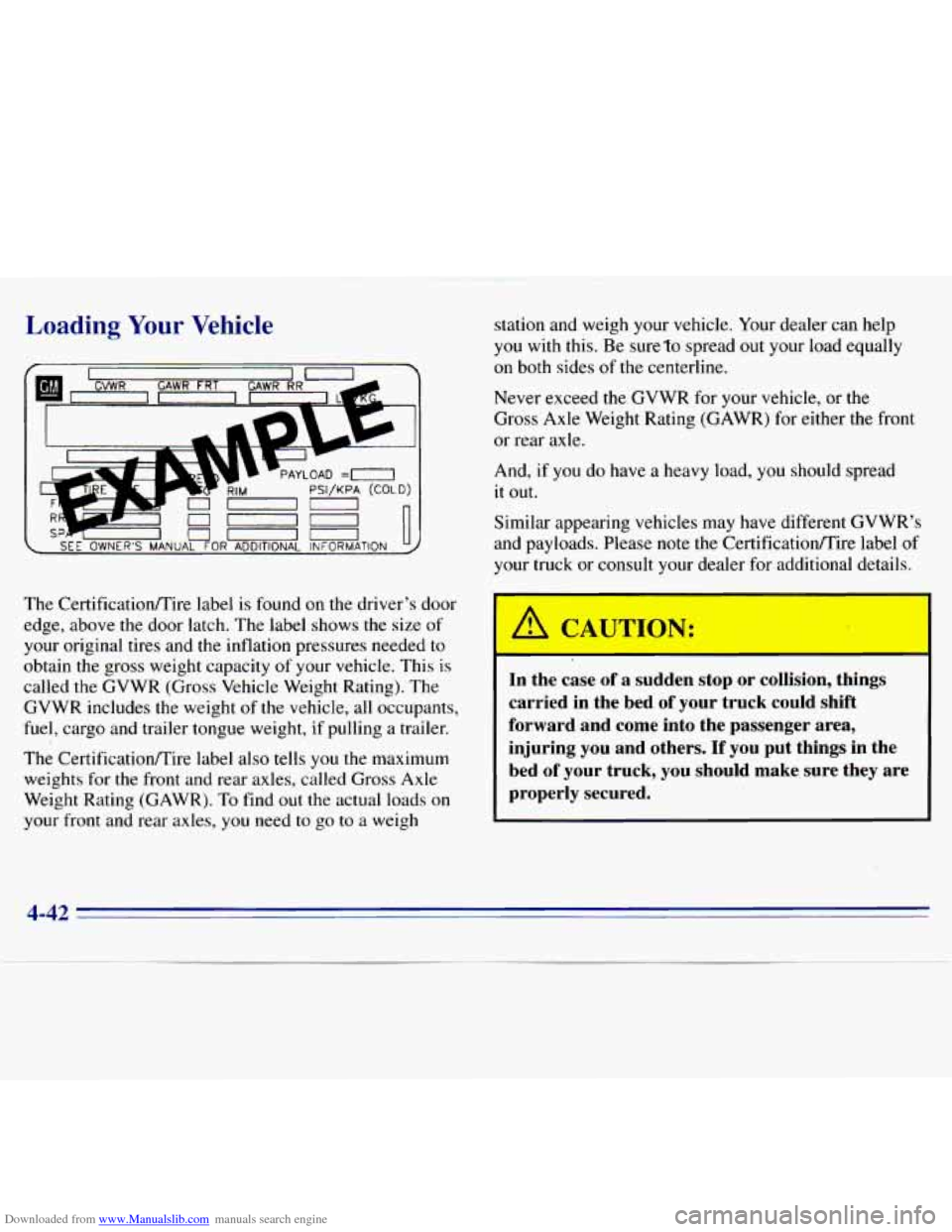
The CertificatiodTire label is found on the driver's door
edge, above
the door latch. The label shows the size of
your original tires and the inflation pressures needed to
obtain the gross weight capacity of your vehicle. This is
called the GVWR (Gross Vehicle Weight Rating). The
GVWR includes the weight
of the vehicle, all occupants,
fuel, cargo and trailer tongue weight, if pulling a trailer.
The Certificationmire label also
tells you the maximum
weights for the front and rear axles, called Gross Axle
Weight Rating (GAWR). To find out the actual loads
on
your front and rear axles, you need to go to a weigh station and weigh your vehicle.
Your dealer can help
you with this. Be sure'to spread out your load equally
on both sides of the centerline.
Never exceed the GVWR for your vehicle, or
the
Gross Axle Weight Rating (GAWR) for either the front
or rear axle.
And, if you do have a heavy load, you should spread
it out.
Similar appearing vehicles may have different GVWR's
and payloads. Please note the Certificationire label
of
your truck or consult your dealer for additional details.
I
. A CAUTION:
I
In the case of a sudden stop or collision, things
carried in the bed of your truck could shift
forward and come into the passenger area,
injuring you and others.
If you put things in the
bed of your truck, you should make, sure they are
properly secured.
4-42
Page 179 of 375
Downloaded from www.Manualslib.com manuals search engine NOTICE:
Pulling a trailer improperly can damage your vehicle and result in costly repairs not covered by
your warranty.
To pull a trailer correctly, follow
the advice in this part, and see your
GM dealer
for important information about towing a trailer
with your vehicle.
Every vehicle is ready for some trailer towing. If yours
was
built with trailering options, as many are, it’s ready
for heavier trailers.
But trailering is different than just
driving your vehicle by itself. Trailering means changes
in handling, durability and fuel economy. Successful,
safe trailering takes correct equipment, and
it has to be
used properly.
That’s the reason for this part.
In it are many
time-tested, important trailering tips and safety rules.
Many of these are important for your safety and that
of
your passengers. So please read this section carefully
before you pull a trailer.
If Ydu Do Decide To Pull A Trailer
If you do, here are some important points:
0
0
0
0
There are many different laws, including speed limit
restrictions, having to do with trailering. Make sure
your rig
will be legal, not only where you live but
also where
you’ll be driving. A good source for this
information can be state or provincial police.
Consider using a sway control if your trailer will
weigh
2,000 lbs. (900 kg) or less. You should always
use a sway control
if your trailer will weigh more
than
2,000 lbs. (900 kg). You can ask a hitch dealer
about sway controls.
Don’t tow
a trailer at all during the first 500 miles
(800 km) your new vehicle is driven. Your engine,
axle or other parts could be damaged.
Then, during the first
500 miles (800 km) that you
tow
a trailer, don’t drive over 50 mph (80 kmh) and
don’t make starts at full throttle. This helps your
engine and other
parts of your vehicle wear in at the
heavier loads.
4-48
Page 211 of 375
Downloaded from www.Manualslib.com manuals search engine Engine Fan Noise
This vehicle has a clutched engine cooling fan. When
the clutch is engaged, the fan spins faster to provide
more air
to cool the engine. In most every day driving
conditions the clutch is not engaged. This improves fuel
economy and reduces fan noise. Under heavy vehicle
loading, trailer towing and/or high outside temperatures,
the fan speed increases when the clutch engages.
So
you may hear an increase in fan noise. This is normal
and should not be mistaken as
the transmission
slipping or making extra shifts. It is merely the
cooling system functioning properly. The fan will slow
down when additional cooling
is not required and the
clutch disengages.
You may also hear this fan noise when you start the
engine. It will go away as the fan clutch disengages.
If a Tire Goes Flat
It’s unusual for a tire to “blow out” while you’re driving,
especially if
you maintain your tires properly. If air goes
out of a tire, it’s much more likely to leak out slowly.
But if
you should ever have a “blowout,” here are a few
tips about what
to expect and what to do:
If a front tire fails,
the flat tire will create a drag that
pulls
the vehicle toward that side. Take your foot off the
accelerator pedal and grip the steering wheel firmly.
Steer
to maintain lane position, and then gently brake to
a stop well out of the traffic lane.
A rear blowout, particularly on a curve, acts much like a
skid and may require the same correction you’d
use in a
skid.
In any rear blowout, remove your foot from the
accelerator pedal. Get the vehicle under control by
steering the way you want the vehicle to
go. It may be
very bumpy and noisy, but
you can still steer. Gently
brake to a stop
-- well off the road if possible.
If a tire goes flat, the next part shows how to use your
jacking equipment
to change a flat tire safely.
5-21
Page 227 of 375
Downloaded from www.Manualslib.com manuals search engine Section 6 Service and Appearance Care
Here you will find information about the care of your
vehicle. This section begins with service and fuel
information, and then it shows how
to check important
fluid and lubricant levels. There is also technical
information about your vehicle, and a part devoted to its
appearance care.
Service
Your GM dealer knows your vehicle best and wants you
to be happy with it. We hope you’ll
go to your dealer for
all your service needs. You’ll get genuine GM parts and
GM-trained and supported service people. We
hope you’ll want to keep your GM vehicle all GM.
Genuine GM parts have one of these marks:
n
Delco
6-1