fuel CHEVROLET S10 1996 2.G Owners Manual
[x] Cancel search | Manufacturer: CHEVROLET, Model Year: 1996, Model line: S10, Model: CHEVROLET S10 1996 2.GPages: 375, PDF Size: 20.73 MB
Page 10 of 375
Downloaded from www.Manualslib.com manuals search engine 1
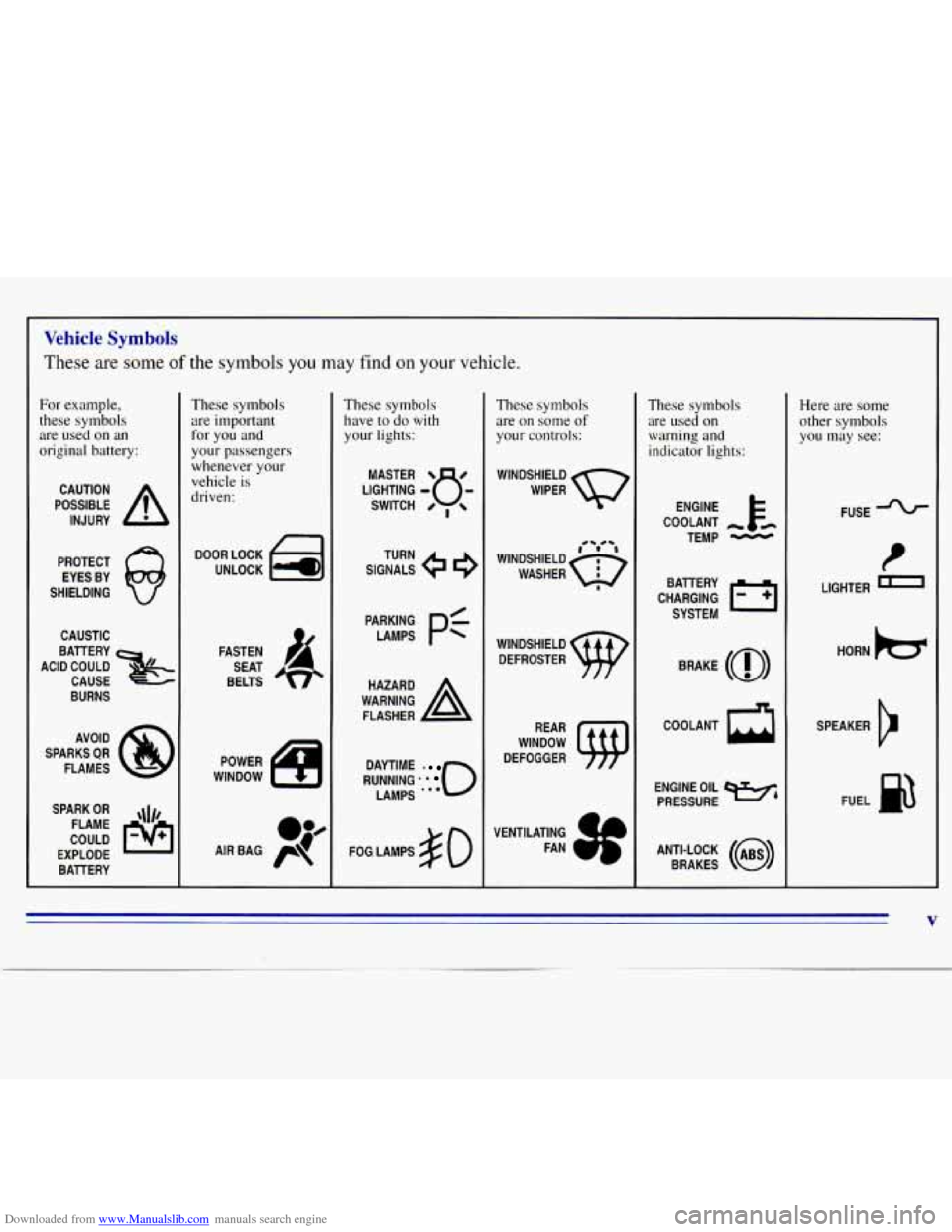
Vehicle Symbols
These are some of the symbols you may find on your vehicle.
For example,
these symbols
are used on an
original battery:
POSSIBLE A
CAUTION
INJURY
PROTECT EYES BY
SHIELDING
CAUSTIC
BURNS
SPARK
OR ,111,
COULD FLAME
EXPLODE BATTERY
These symbols are important
for you and
your passengers
whenever your vehicle
is
driven:
DOOR LOCK
UNLOCK
FASTEN SEAT
BELTS
POWER
WINDOW
These symbols have
to do with
your lights:
SIGNALS e
TURN
RUNNING
* 0
DAYTIME -
LAMPS '.*
FOG LAMPS $0
These symbols
are on some
of
your controls:
WINDSHIELD
WIPER
WINDSHIELD DEFROSTER
VENTILATING FAN
These symbols are used on
warning and
indicator lights:
COOLANT -
TEMP -
CHARGING I-1
BATTERY
SYSTEM
BRAKE
(0)
COOLANT a
ENGINE PRESSURE OIL e,
ANTI-LOCK (@)
BRAKES
Here are some
other symbols
you may see:
FUSE
LIGHTER
m
HORN k3
SPEAKER
b
FUEL B3
V
Page 64 of 375
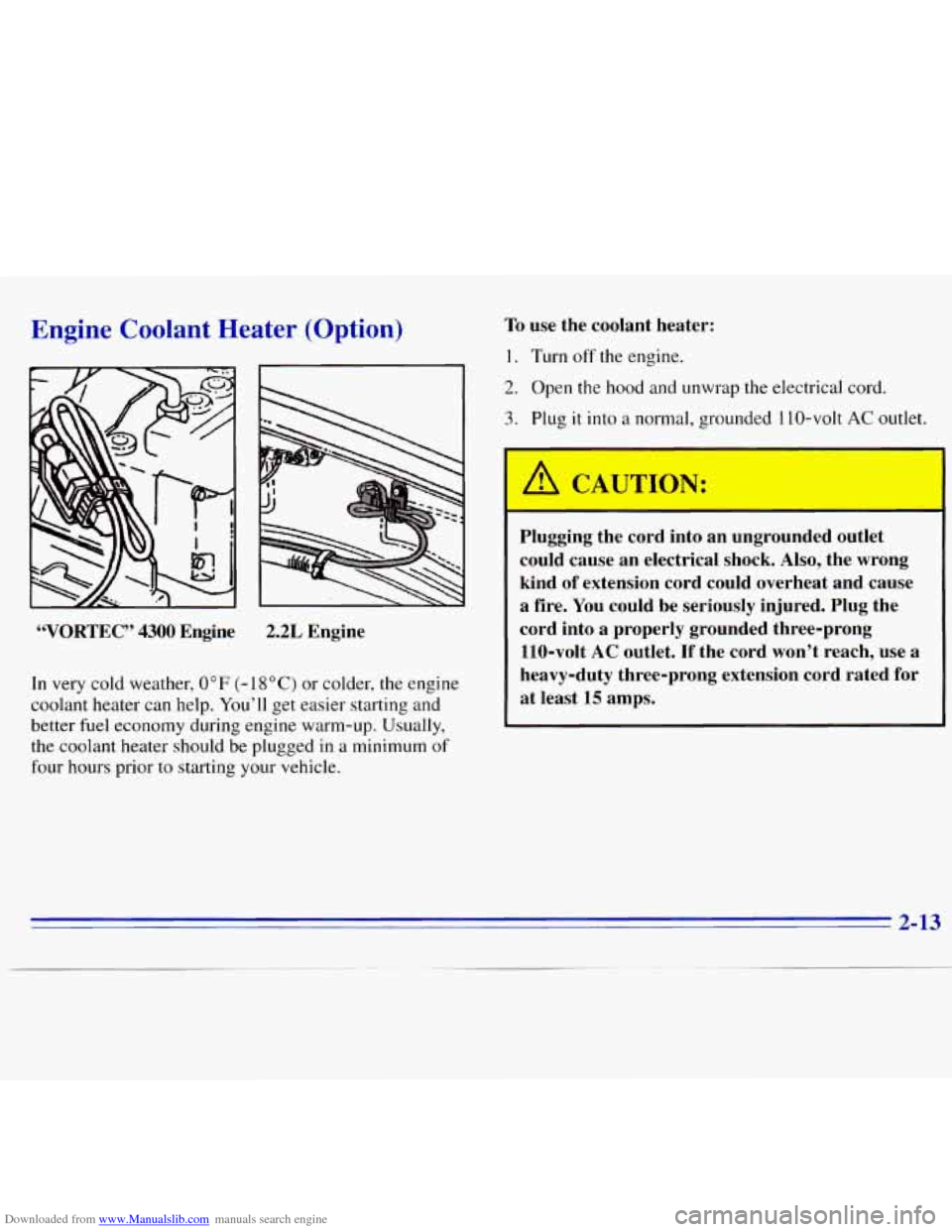
Downloaded from www.Manualslib.com manuals search engine Engine Coolant Heater (Option)
“VORTEC” 4300 Engine 2.2L Engine
In very cold weather,
0°F (- 18°C) or colder, the engine
coolant heater can help. You’ll get easier starting and
better fuel economy during engine warm-up. Usually,
the coolant heater should be plugged
in a minimum of
four hours prior to starting your vehicle.
To use the coolant heater:
1. Turn off the engine.
2. Open the hood and unwrap the electrical cord.
3. Plug it into a normal, grounded 110-volt AC outlet.
1
Plugging the cord into an ungrounded outlet
could cause an electrical shock. Also, the wrong
kind
of extension cord could.overheat and cause
a fire.
You could be seriously injured. Plug the
cord into
a properly grounded three-prong
110-volt
AC outlet. If the cord won’t reach, use a
heavy-duty three-prong extension cord rated for
at least
15 amps.
2-13
Page 68 of 375
Downloaded from www.Manualslib.com manuals search engine FIRST (1): This position gives you even more power
(but lower fuel economy) than
SECOND (2). You can
use it on very steep hills, or in deep snow or mud. If the
selector lever
is put in FIRST (1) while the vehicle is
moving forward, the transmission won’t shift into
FIRST (1) until the vehicle is going slowly enough.
1 NOTICE:
If your rear wheels can’t rotate, don’t try to
drive. This might happen if you were stuck in
very deep sand or mud or were up against
a solid
object.
You could damage your transmission.
Also, if you stop when going uphill, don’t hold
your vehicle there with only the accelerator pedal.
This could overheat and damage the transmission.
Use your brakes or shift into
PARK (P) to hold
your vehicle in position on a hill.
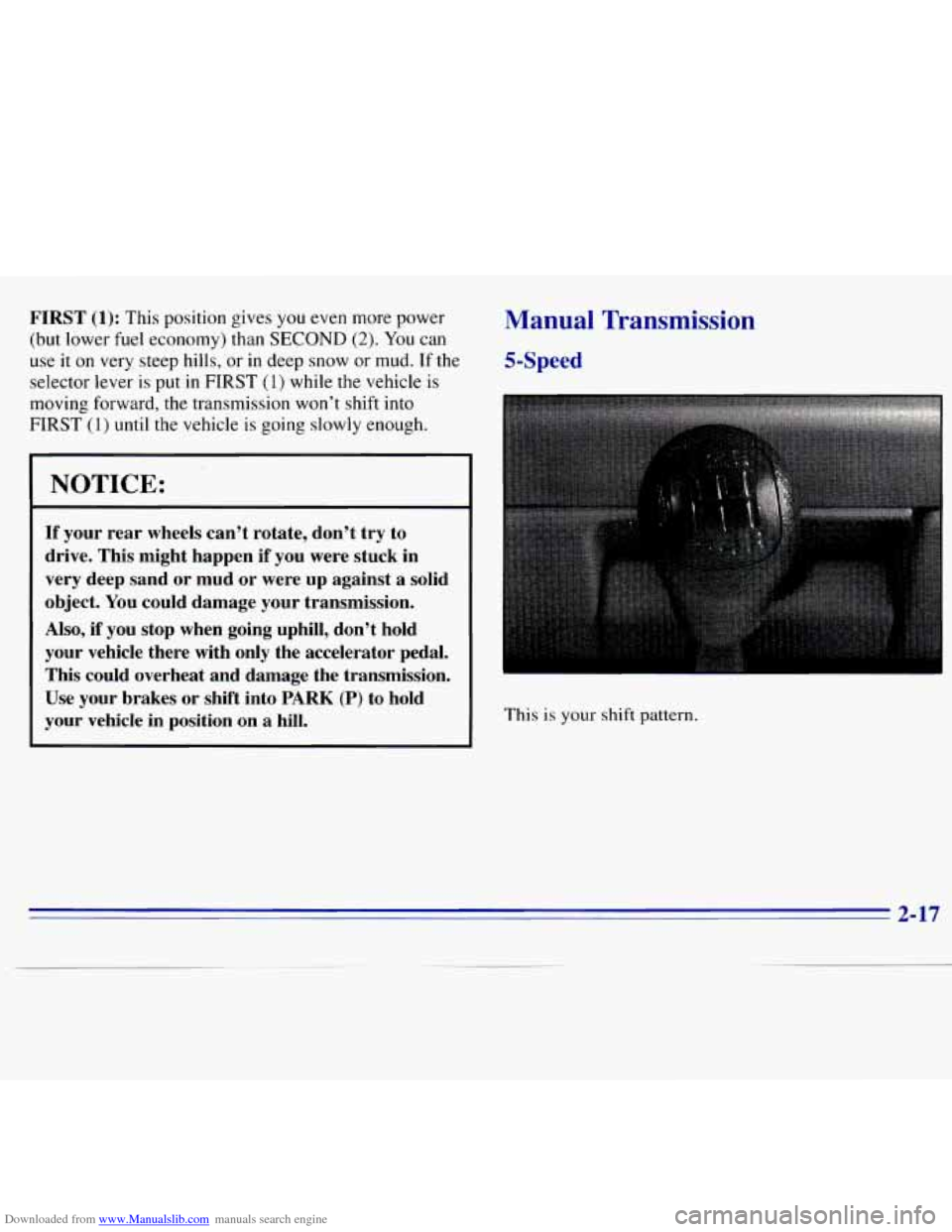
Manual Transmission
5-Speed
This is your shift pattern.
2-17
Page 70 of 375
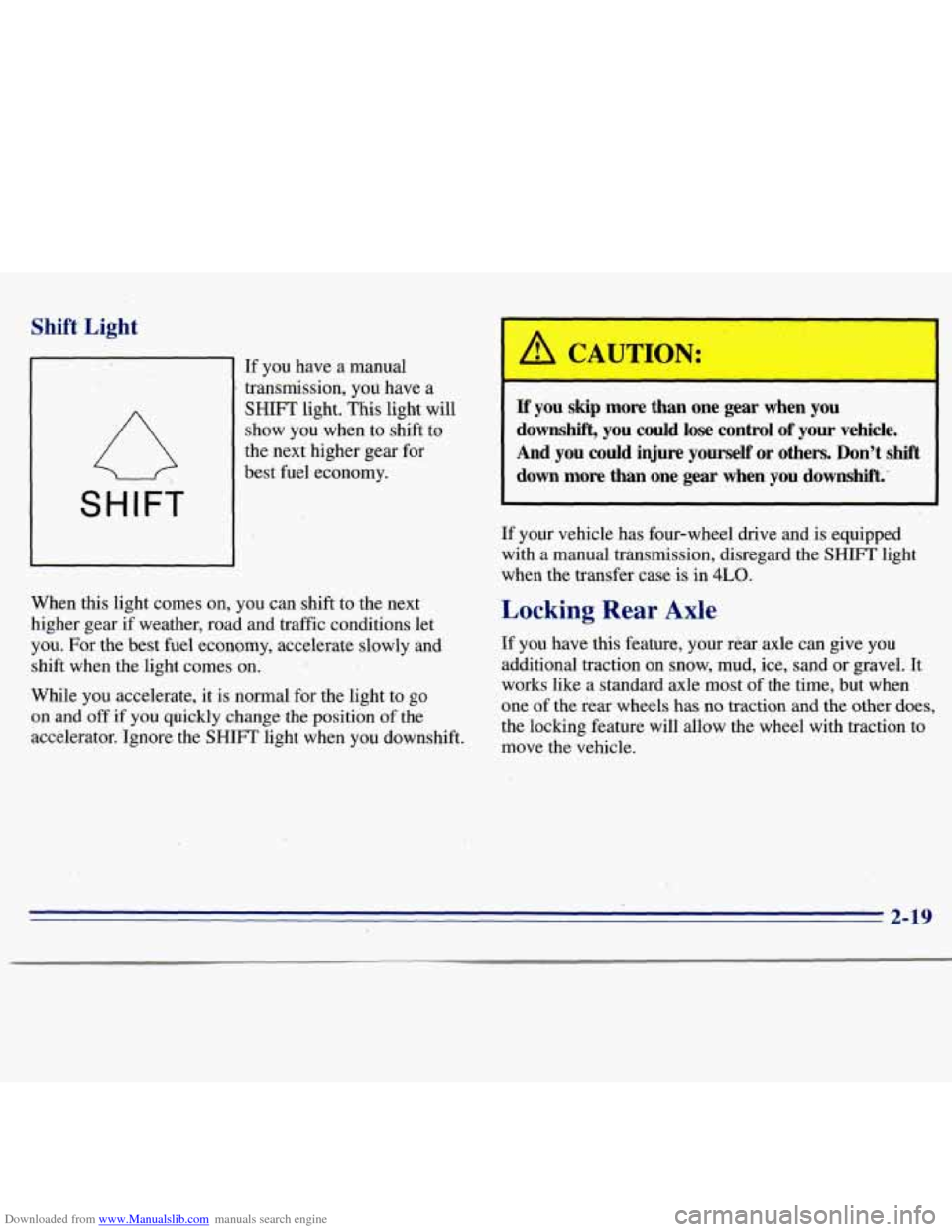
Downloaded from www.Manualslib.com manuals search engine Shift Light
SHIFT
If you have a manual
transmission, you have a
SHIFT light. This light will
show you when to shift
to
the next higher gear for
best fuel economy.
When this light comes on,
you can shift to the next
higher gear
if weather, road and traffic conditions let
you.
For the best fuel economy, accelerate slowly and
shift when
the light comes on.
While you accelerate, it is normal for the light to go
on
and off if you quickly change the position of the
accelerator. 'Ignore the SHIFT light when you downshift.
a CAUTION:
If you skip more than one gear when you
downshift, you could lose' control of your vehicle.
And
you could injure yourself' or others. Don't shift
down more than one gear when you downshift.'
If your vehicle has four-wheel drive and is equipped
with a manual transmission, disregard the
SHIFT light
when the transfer case
is in 4LO.
Locking Rear Axle
If you have this feature, your rear axle can give you
additional traction on snow, mud, ice, sad or gravel. It
works like a standard axle most of the time, but when
one
of the rear wheels has no traction and the other does,
the locking feature will allow the wheel with traction to
move the vehicle.
Page 73 of 375
Downloaded from www.Manualslib.com manuals search engine 4LO: This setting also engages your front axle to give
you extra traction and provides extra gear reduction.
You may never need 4LO. It sends the maximum power
to all four wheels. You might choose 4LO
if you were
driving off-road in sand, mud, or deep snow and
climbing or descending steep hills.
You can shift from 2HI to 4HI or from 4HI to 2HI while
the vehicle is moving.
Do not press the transfer case
shift lever button when shifting from 2HI to 4HI
or from
4HI to 2HI. Your front axle will engage faster
if you
take your foot
off of the accelerator for a few seconds
after you shift.
To shift your transfer case into
N SET PARK BRAKE:
1. Stop the vehicle and shift your transmission into
2. Set the parking brake. Your vehicle can roll unless
NEUTRAL
(N).
the brakes
are applied.
3. Pull the transfer case shift lever into N SET
PARK BRAKE.
To shift into or out of 4LO:
1. The vehicle must be moving less than 3 mph
(4.8
km) with the transmission in NEUTRAL (N)
for an automatic transmission. For a ,manual
transmission, the clutch pedal must be engaged. The
preferred method for shifting into 4LO is to have
your vehicle moving 1 to 2 mph (1.6 to 3.2 km/h).
2. Press the transfer case shift button and shift in one
continuous motion.
Don’t pause in
N SET PARK BRAKE as you shift into
or out
of 4L0, or your gears could clash.
Remember that driving in 4HI or
4LO may reduce
fuel economy. Also, driving in four-wheel drive
on
dry pavement could cause your tires to wear faster and
make your transfer case harder to shift and reduce
powertrain longevity.
2-22
Page 101 of 375
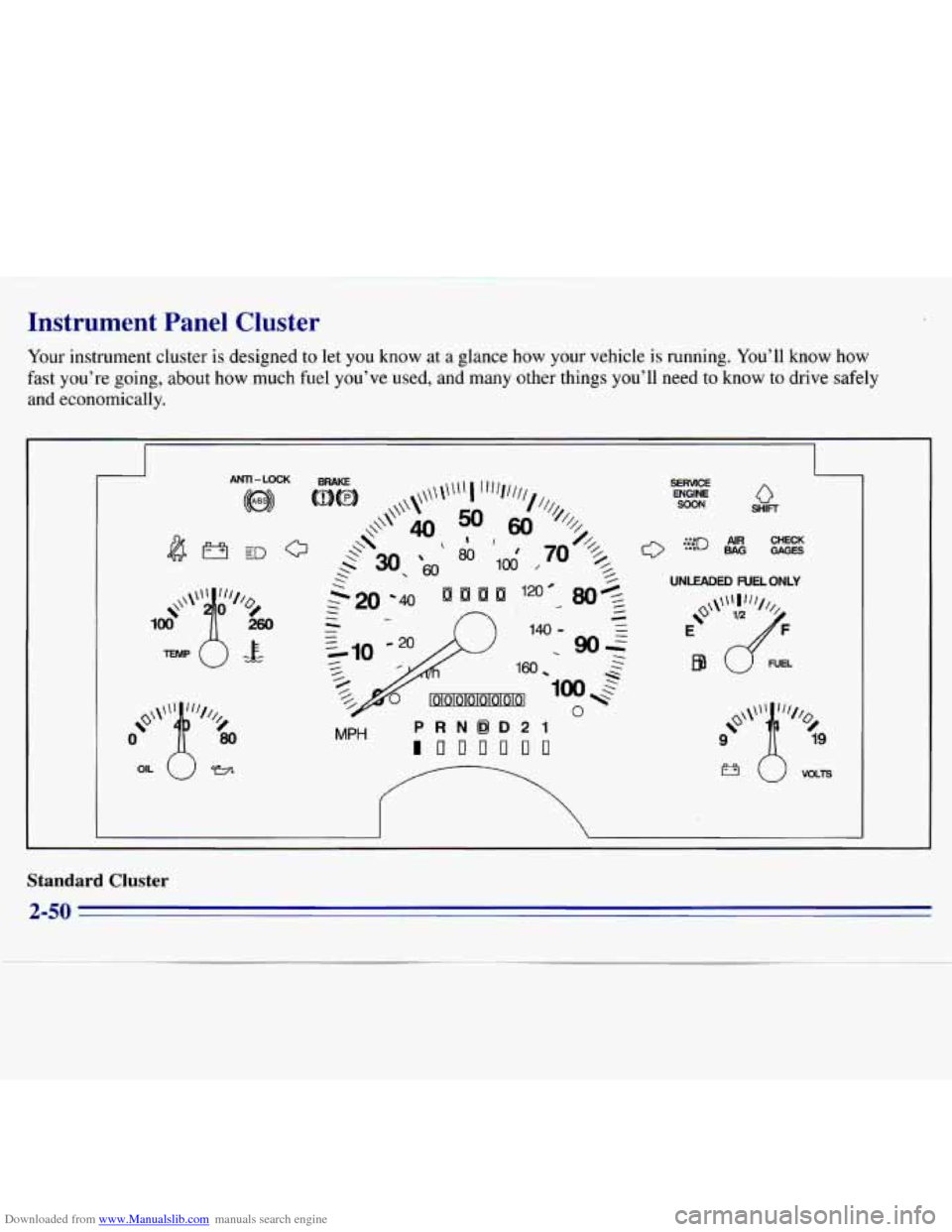
Downloaded from www.Manualslib.com manuals search engine Instrument Panel Cluster
Your instrument cluster is designed to let you know at a glance how your vehicle is running. You'll know how
fast you're going, about how much fuel you've used, and many other things you'll need
to know to drive safely
and economically.
I SERVlCE ENGINE SOON Q SHIFT
UNLEADED FUEL ONLY
Standard Cluster
2-50
Page 102 of 375
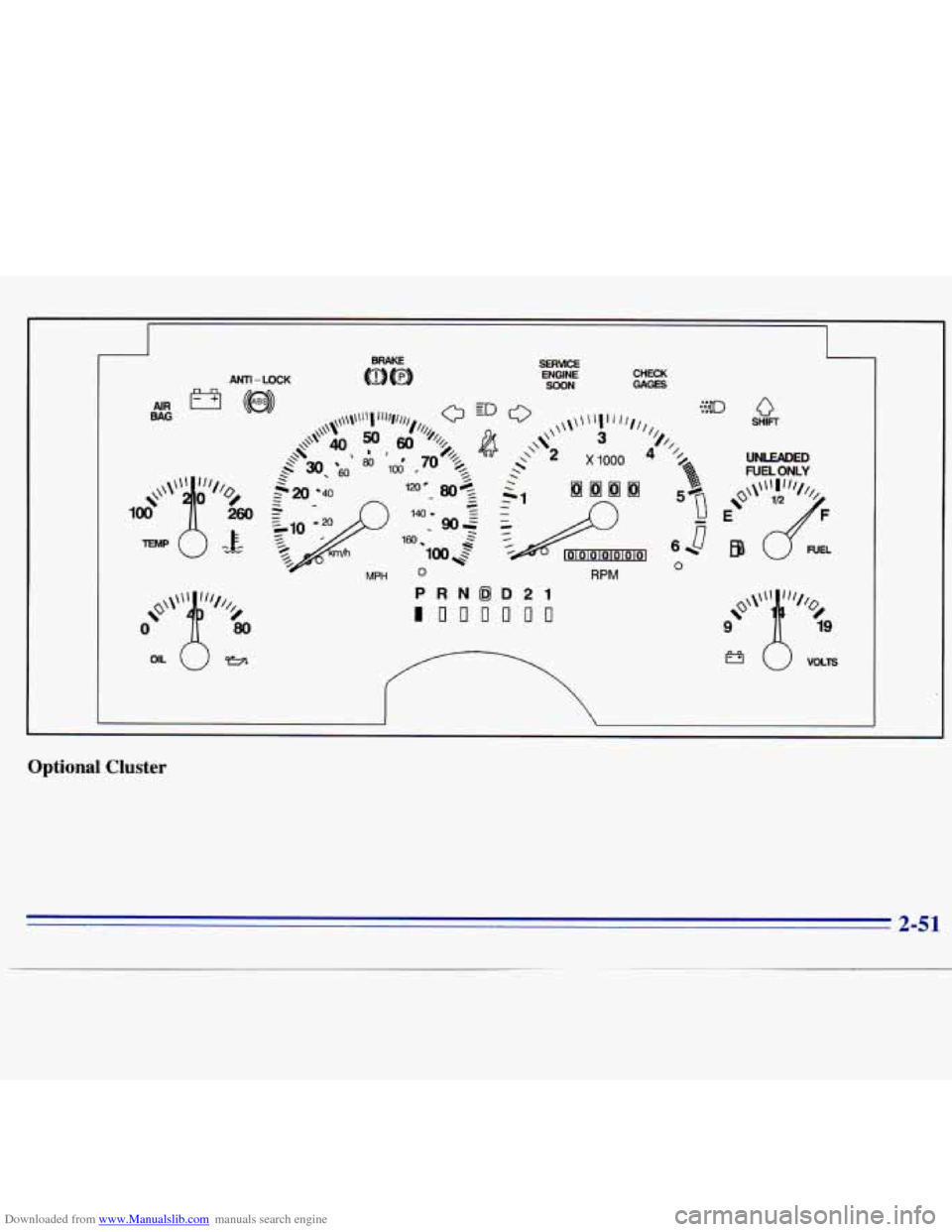
Downloaded from www.Manualslib.com manuals search engine ANTl- LOCK ENGINE SOON CHECK GAGES
RPM
Q SHIFT
'/ UNLEADED
FUEL ONLY
0
Optional Cluster
2-51
Page 108 of 375
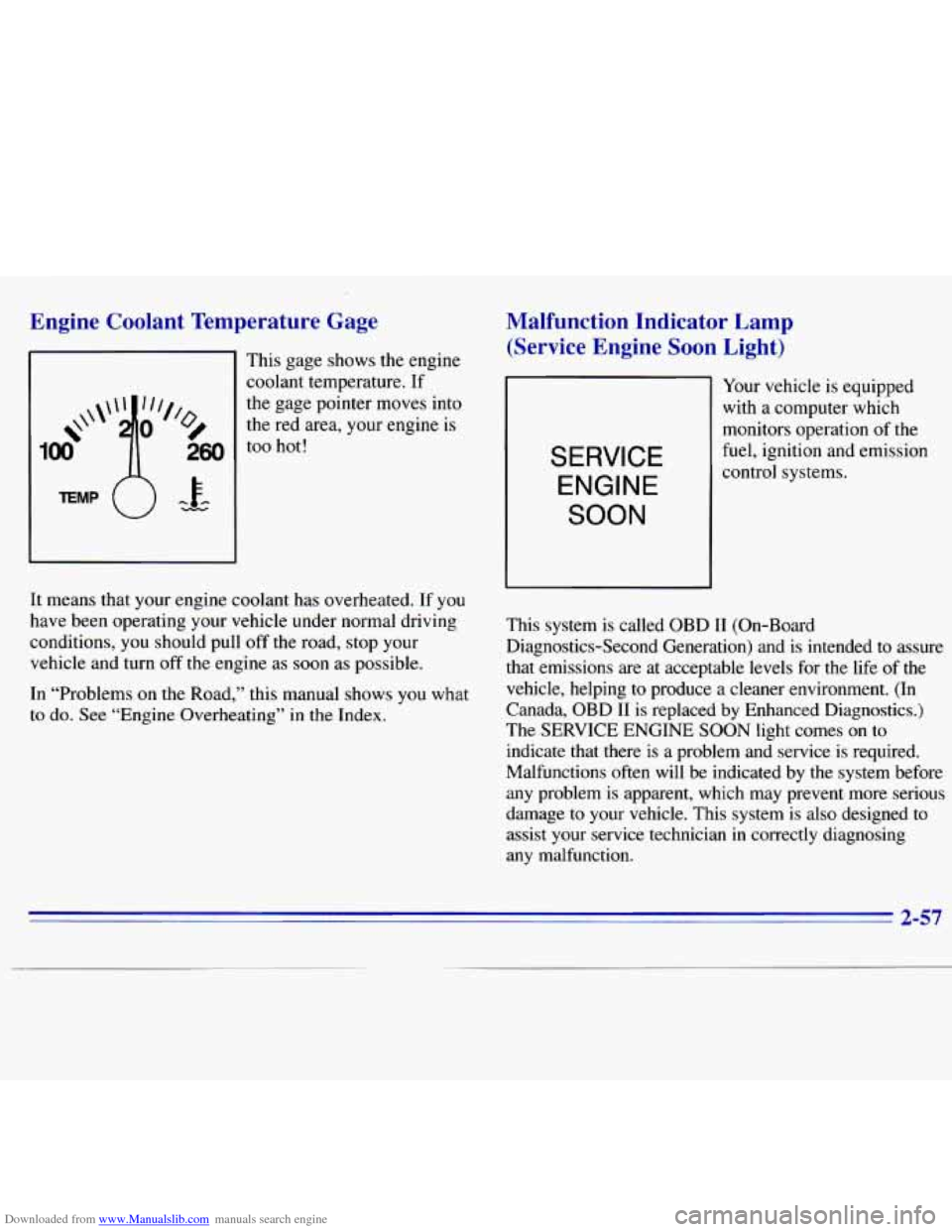
Downloaded from www.Manualslib.com manuals search engine Engine Coolant Temperature Gage
This gage shows the engine
coolant temperature.
If
the gage pointer moves into
the red area, your engine is
260 too hot!
TEMP
Malfunction Indicator Lamp
(Service Engine Soon Light)
Your vehicle is equipped
with a computer which
monitors operation of the
fuel, ignition and emission
SERVICE
ENGINE
SOON
control systems.
It means that your engine coolant has overheated. If you
have been operating your vehicle under normal driving
conditions, you should pull off the road, stop your
vehicle and turn off
the engine as soon as possible.
In “Problems on the Road,” this manual shows you
what
to do. See “Engine Overheating” in the Index. This
system is called
OBD I1 (On-Board
Diagnostics-Second Generation) and is intended
to assure
that emissions are at acceptable levels for the life of the
vehicle, helping to produce a cleaner environment.
(In
Canada, OBD I1 is replaced by Enhanced Diagnostics.)
The SERVICE ENGINE SOON light comes on to
indicate that there is a problem and service
is required.
Malfunctions often will be indicated by the system before
any problem is apparent, which may prevent more serious
damage to your vehicle. This system
is also designed to
assist your service technician
in correctly diagnosing
any malfunction.
2-57
Page 109 of 375
Downloaded from www.Manualslib.com manuals search engine NOTICE:
~~
If you keep driving your vehicle with this light
on, after a while, your emission controls may not work as well, your fuel economy may not be as
good and your engine may not run as smoothly.
This could lead to costly repairs that may not be
covered by your warranty.
This light should come on, as a check to show you it is
working, when the ignition is on and the engine is not
running. If the light doesn’t come on, have
it repaired.
This light will also come
on during a malfunction in one
of two ways:
Light Flashing -- A misfire condition has been
detected. A misfire increases vehicle emissions and
may damage the emission control system on your
vehicle. Dealer or qualified service center diagnosis
and service is required.
Light On Steady -- An emission control system
malfunction has been detected on your vehicle.
Dealer or qualified service center diagnosis and
service may be required.
If the Light Is Flashing
The following may prevent more serious damage to
your vehicle:
Reduce vehicle speed.
0 Avoid hard accelerations.
Avoid steep uphill grades.
0 If towing a trailer, reduce the amount of cargo being
hauled as soon as
it is possible.
If the light
stops flashing and remains on steady, see “If
the Light
Is On Steady” following.
If
the light continues to flash, when it is safe to do so,
stop the vehicle. Put your vehicle in PARK (P). Turn the
key off, wait at least
10 seconds and restart the engine.
If the light remains on steady, see “If the Light
Is On
Steady” following. If
the light is still flashing follow the
previous steps, and drive the vehicle to your dealer or
qualified service center for service.
2-58
Page 110 of 375
Downloaded from www.Manualslib.com manuals search engine If the Light Is On Steady
You may be able to correct the emission system
malfunction by considering the following:
Did you just put fuel into your vehicle?
If
so, reinstall the fuel cap, making sure to fully install
the cap. The diagnostic system can determine if the fuel
cap has been left off or improperly installed. This will
allow fuel to evaporate into the atmosphere.
A few
driving trips should turn the light off.
Did you just drive through a deep puddle of water?
If
so, your electrical system may be wet. The condition
will usually be corrected when the electrical system
dries out. A few driving trips should turn
the light off.
Are you low on fuel?
As your engine starts to run out of fuel, your engine may
not
run as efficiently as designed since small amounts of
air are sucked into the fuel line causing a misfire. The
system can detect this. Adding fuel should correct this
condition. Make sure
to install the fuel cap properly. It
will take a few driving trips to turn the light off. Have
you recently changed brands of fuel?
If
so, be sure to fuel your vehicle with quality fuel (see
“Fuel” in the Index). Poor
fuel quality will cause your
engine not to run as efficiently as designed. You may
notice this as stalling after start-up, stalling when you
put the vehicle into gear, misfiring, hesitation on
acceleration or stumbling on acceleration. (These
conditions may go away once the engine is warmed up.)
This will be detected by the system and cause the light
to turn on.
If you experience this condition, change the fuel brand
you use. It will require at least one full tank of the
proper
fuel to turn the light off.
If none of the above steps have made the light turn off,
have your dealer or qualified service center check the
vehicle. Your dealer has the proper test equipment and
diagnostic tools to
fix any mechanical or electrical
problems that may have developed.
2-59