lock CHEVROLET S10 1996 2.G User Guide
[x] Cancel search | Manufacturer: CHEVROLET, Model Year: 1996, Model line: S10, Model: CHEVROLET S10 1996 2.GPages: 375, PDF Size: 20.73 MB
Page 53 of 375
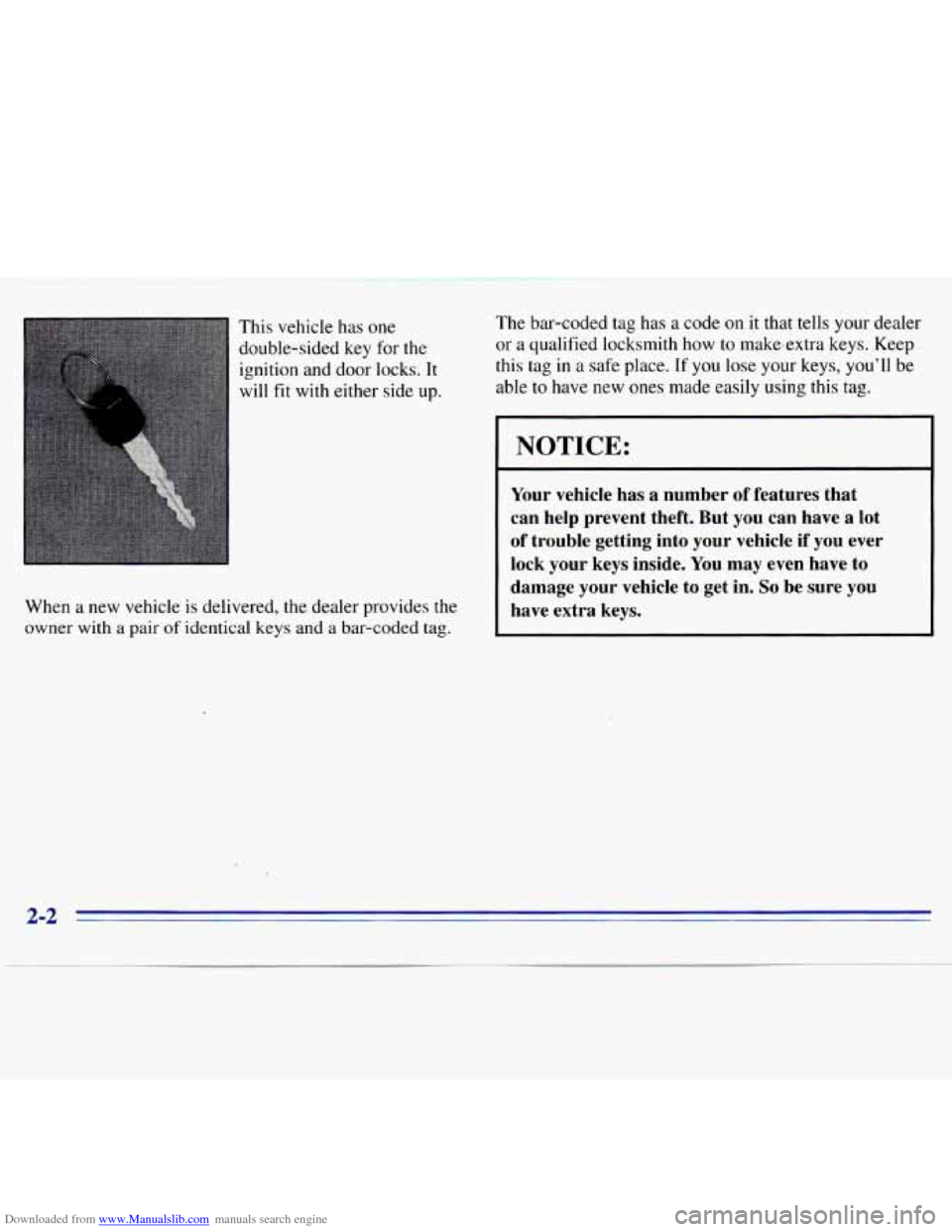
Downloaded from www.Manualslib.com manuals search engine This vehicle has one
double-sided key for the
ignition and door locks. It
will fit with either side up.
When
a new vehicle is delivered, the dealer provides the
owner
with a pair of identical keys and a bar-coded tag.
The bar-coded tag has a code on it that tells your dealer
or a qualified locksmith how to make,extra keys. Keep
this tag in
a safe place. If you lose your keys, you’ll be
able to have new ones made easily using this tag.
NOTICE:
Your vehicle has a number of features that
can help prevent theft. But you can have a lot
of trouble getting into your vehicle if you ever
lock your keys inside. You may even have
to
damage your vehicle to get in. So be sure you
have extra keys.
2-2
Page 54 of 375
Downloaded from www.Manualslib.com manuals search engine Door Locks
1 CAUTION:
Unlocked doors can be dangerous.
Passengers
-- especially children -- can easily
open the doors and fall out. When a door is
locked, the inside handle won't open
it.
Outsiders can easily enter through an unlocked
door when you slow down or stop your vehicle.
This may not be
so obvious: You increase the
chance of being thrown out of the vehicle in a
crash if the doors aren't locked. Wear safety belts
properly, lock your doors, and you will be far
better off whenever you drive your vehicle.
There are several ways
to lock and unlock your vehicle. You
can use the Keyless Entry System,
if you have
this option.
You can use your key to unlock your door from
the outside.
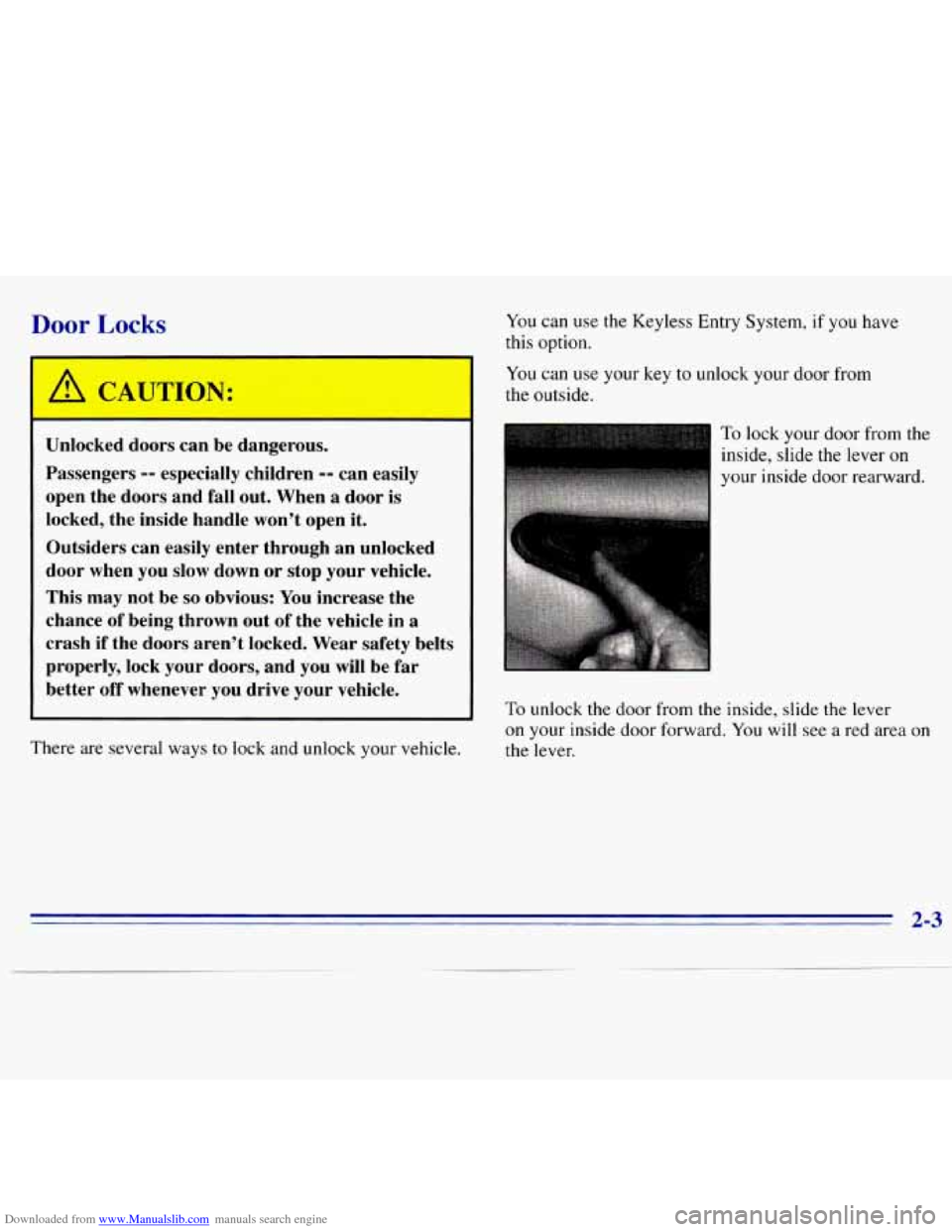
To lock your door from the
inside, slide the lever
on
your inside door rearward.
To unlock the door from the inside, slide the lever
on your inside door forward. You will see a red area on
the lever.
2-3
Page 55 of 375
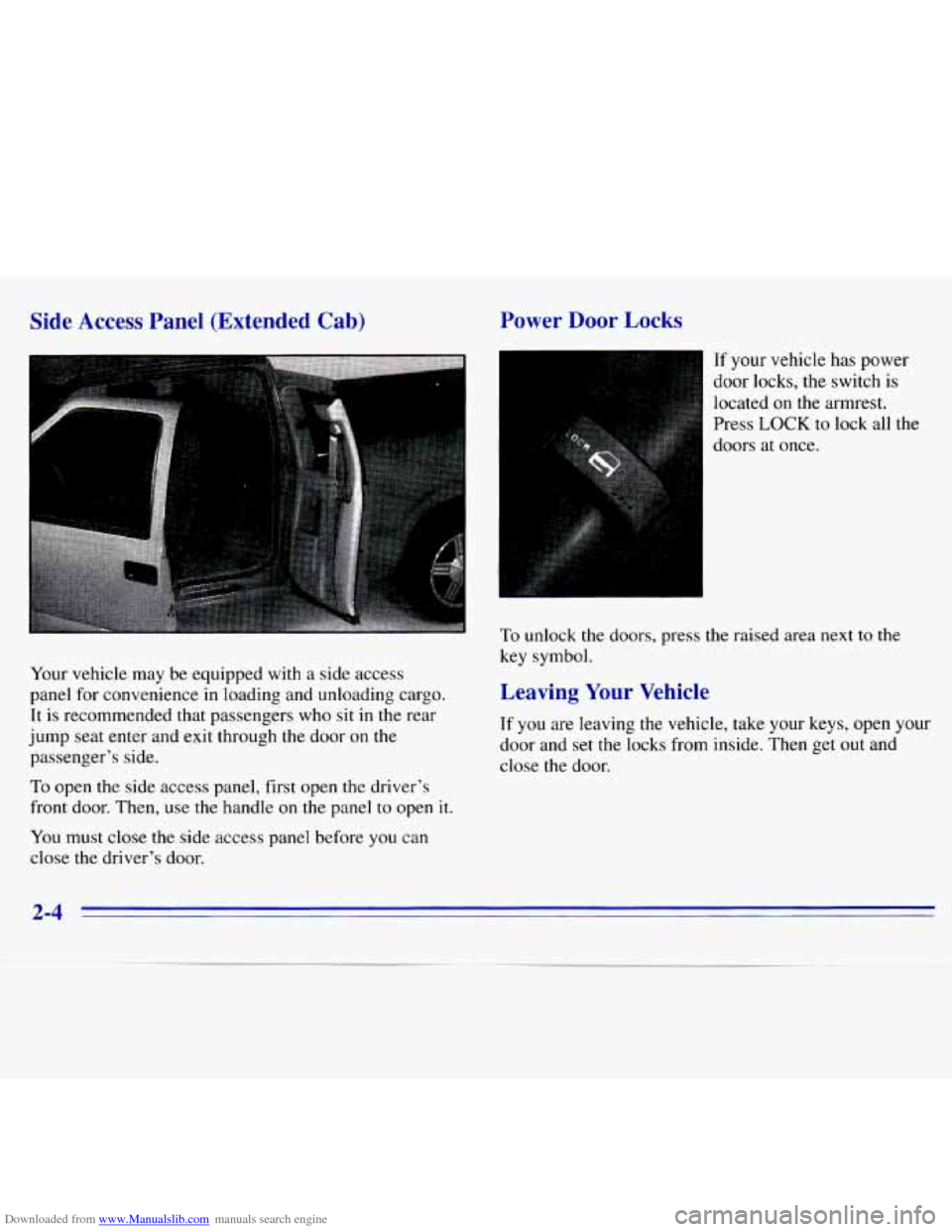
Downloaded from www.Manualslib.com manuals search engine Your vehicle may be equipped with a side access
panel for convenience in loading and unloading cargo.
It is recommended that passengers who sit in the rear
jump seat enter and exit through
the door on the
passenger's side.
To open the side access panel, first open the driver's
front door.
Then, use the handle on the panel to open it.
You must close the side access panel before you can
close the driver's door.
Power Door Locks
If your vehicle has power
door locks, the switch is
located
on the armrest.
Press
LOCK to lock all the
doors at once.
To unlock
the doors, press the raised area next to the
key symbol.
Leaving Your Vehicle
If you are leaving the vehicle, take your keys, open your
door and set
the locks from inside. Then get out and
close the door.
2-4
Page 56 of 375
Downloaded from www.Manualslib.com manuals search engine Keyless Entry System (Option)
If your vehicle has this option, you can lock and unlock
your doors from up to
30 feet (9 m) away using the key
chain transmitter supplied with your vehicle.
Your Keyless
Entry System operates on a radio
frequency subject
to Federal Communications
Commission
(FCC) Rules.
This device complies with Part 15 of the FCC Rules.
Operation is subject to the following two conditions:
(1) This device may not cause harmful interference, and
(2), This device must accept any interference received,
including interference that may cause undesired operation.
Should interference to this system occur, try this:
0
0
0
0
Check to determine if battery replacement is necessary.
See the instructiohs on battery replacement.
Check the distance.
You may be too far from your
vehicle.
This product has a maximum range.
Check the location. Other vehicles or objects may be
blocking the signal.
See your
GM dealer or a qualified technician
for service.
Changes or modifications to this system by other than an
authorized service facility could void authorization to
use this equipment.
Operation
When you press UNLOCK, the driver's door will
unlock 'automatically.
If you press UNLOCK again
within five seconds, all the doors will unlock. Press
LOCK to lock all the doors.
.Matching Transmitter(s) To Your Vehicle
Each key chain transmitter is coded to prevent another
transmitter
from unlocking. your vehicle. If a transmitter is
lost or stolen, a replacement can
be .purchased through
your dealer. Remember to bring any remaining transmitters
with you when you
go to your dealer. When the dealer
matches the replacement'transmitter to your vehicle, any
remaining transmitters must also be matched. Once the
new transmitter is coded, the lost transmitter will not
unlock your vehicle. Each vehicle can have only two
transmitters matched to it.
Battery Replacement
Under normal use, the batteries in your key chain
transmitter should last about two years.
You can tell the batteries are weak if the transmitter
won't work at the normal range in any location.
If you
have to get close to your vehicle before the transmitter
works, it's probably time to change the batteries.
2-5
,
Page 58 of 375
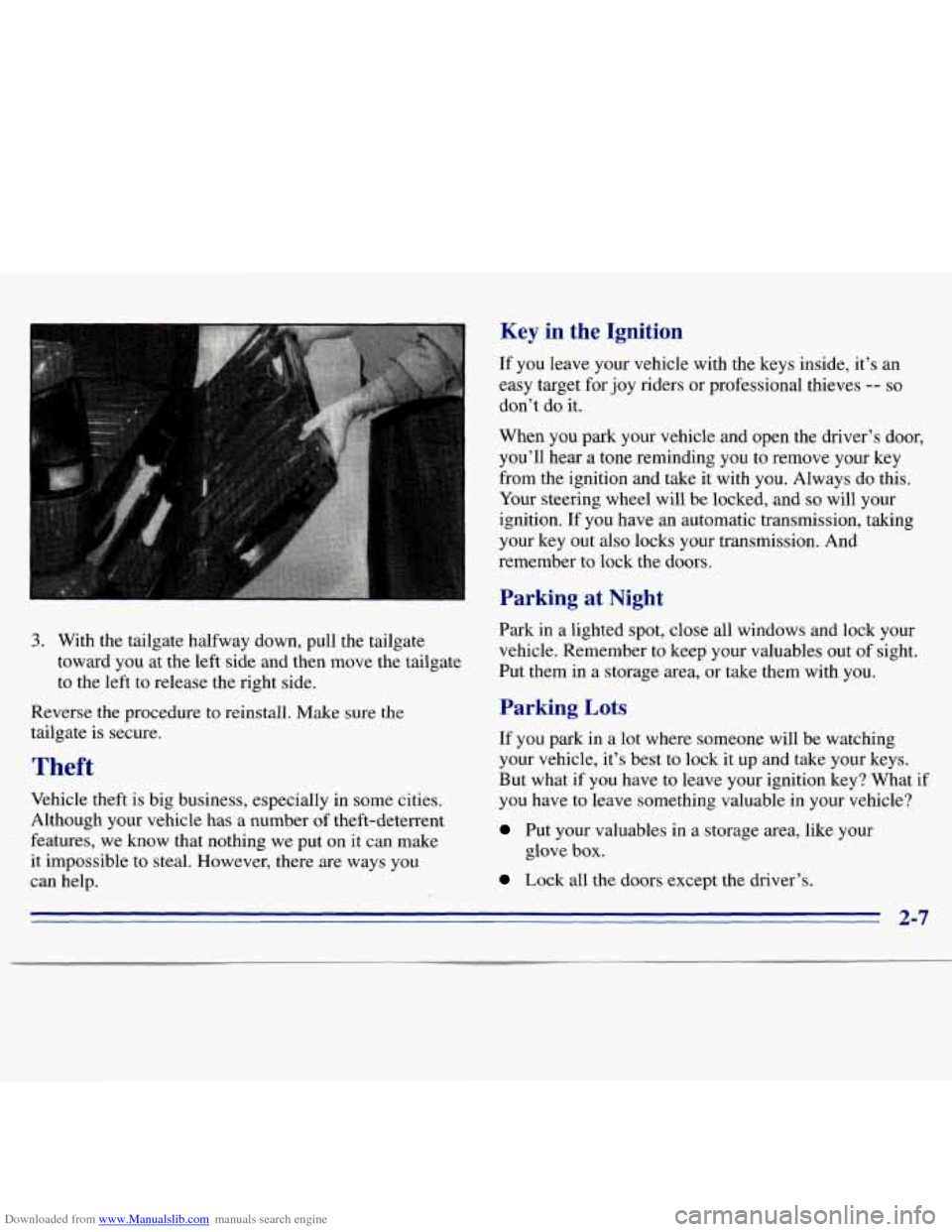
Downloaded from www.Manualslib.com manuals search engine 3. With the tailgate halfway down, pull the tailgate
toward you at the left side and then move the tailgate
to the left to release the right side.
Reverse the procedure to reinstall. Make sure the
tailgate is secure.
Theft
Vehicle theft is big business, especially in some cities.
Although your vehicle has a number
of theft-deterrent
features, we know that nothing we put on it can make
it impossible to steal. However, there are ways you
can help.
Key in the Ignition
If you leave your vehicle with the keys inside, it’s an
easy target for joy riders or professional thieves
-- so
don’t do it.
When you park your vehicle and open the driver’s door,
you’ll hear a tone reminding you to remove your key
from the ignition and take it with you. Always do this.
Your steering wheel will
be locked, and so will your
ignition. If you have
an automatic transmission, taking
your key out
also locks your transmission. And
remember to lock the doors.
Parking at Night
Park in a lighted spot, close all windows and lock your
vehicle. Remember to keep your valuables out of sight.
Put them in a storage area, or take them with you.
Parking Lots
If you park in a lot where someone will be watching
your vehicle, it’s best to lock it up
and take your keys.
But what if you have to leave your ignition key? What if
you have to leave something valuable in your vehicle?
Put your valuables in a storage area, like your
Lock all the doors except the driver’s. glove
box.
2-7
Page 59 of 375
Downloaded from www.Manualslib.com manuals search engine New Vehicle “Break-In”
NOTICE:
Your modern vehicle doesn’t need an elaborate
“break-in.” But it will perform better in the long
run if you follow these guidelines:
0
0
0
0
Keep your speed at 55 mph (88 km/h) or
less for the first
500 miles (804 km).
Don’t drive at any one speed
-- fast or
slow
-- for the first 500 miles (804 km).
Don’t make full-throttle starts.
Avoid making hard stops for the first
200 miles (322 km) or so. During this time
your new brake linings aren’t yet broken in.
Hard stops with new linings can mean
premature wear and earlier replacement.
Follow this breaking-in guideline every time
you get new brake linings.
Don’t tow
a trailer during break-in.
See “Towing a Trailer” in the Index for
more information.
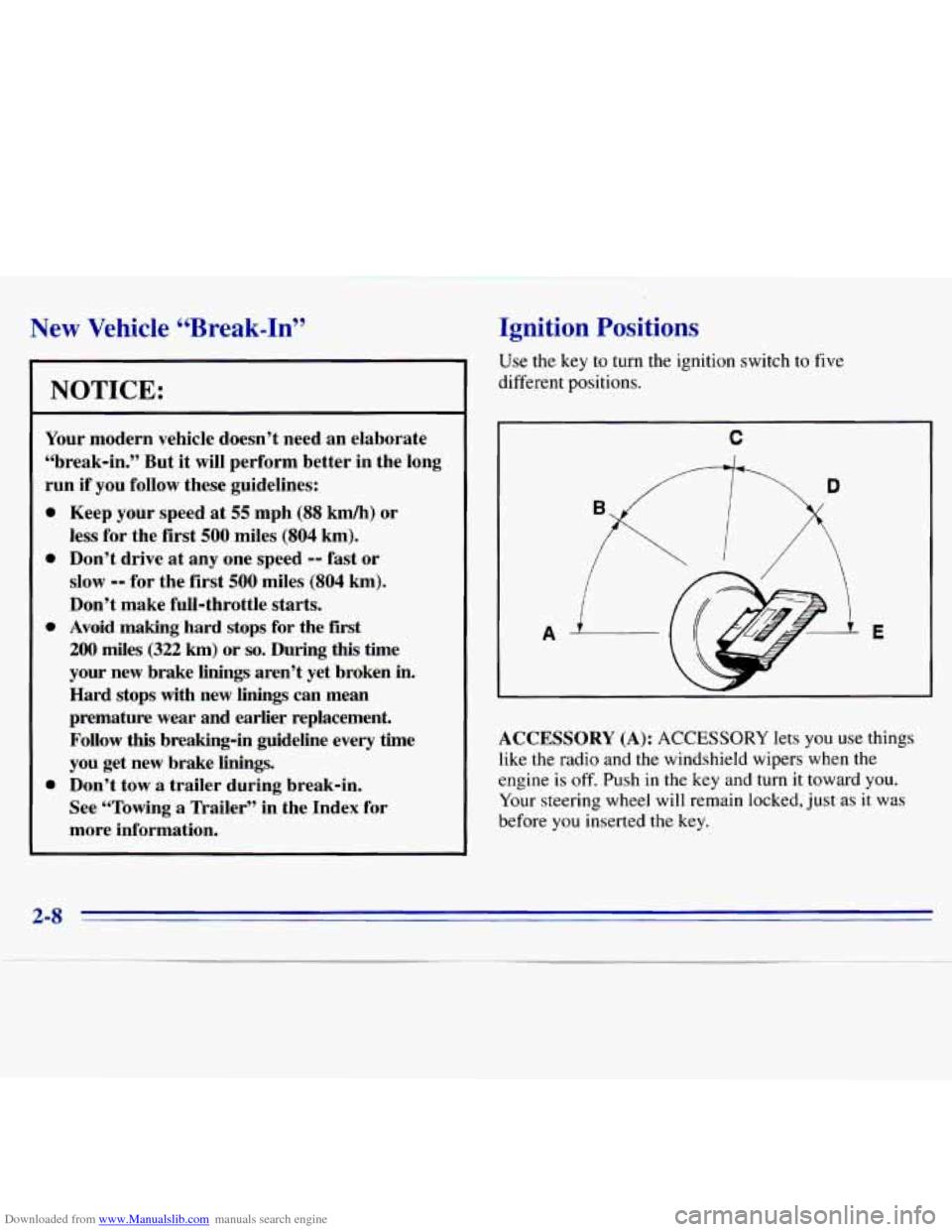
Ignition Positions
Use the key to turn the ignition switch to five
different positions.
A
C
E
ACCESSORY (A): ACCESSORY lets you use things
like the radio and the windshield wipers when the
engine is off. Push in
the key and turn it toward you.
Your steering wheel will remain locked, just as
it was
before you inserted the key.
2-8
Page 60 of 375
Downloaded from www.Manualslib.com manuals search engine NOTICE:
Don’t operate accessories in the ACCESSORY
position for long periods
of time. Prolonged
operation of accessories in the ACCESSORY
position could drain your battery and prevent
you from starting your vehicle.
LOCK (B): This position locks your ignition, steering
wheel and transmission. It’s a theft-deterrent feature.
You will only be able to remove your key when the
ignition is turned to
LOCK.
OFF (C): This position lets you turn off the engine but
still turn the steering wheel. Use
OFF if you must have
your vehicle in motion while the engine is
off (for
example, if your vehicle is being towed).
RUN (D): This is the position for driving.
START
(E): This starts your engine. On manual transmission
vehicles, turning the key
to LOCK will lock the steering column and result
in
a loss of ability to steer the vehicle. This could
cause a collision.
If you need to turn the engine
off while the vehicle
is moving, turn the key only
to
OFF. Don’t press the key release button while
the vehicle
is moving.
NOTICE:
~ ~ ~
If your key seems stuck in LOCK and you can’t
turn
it, be sure it is all the way in. If it is, then
turn the steering wheel left and right while you
turn the key hard. But turn the key only
with
your hand. Using a tool to force it could break
the key or the ignition switch.
If none of this
works, then your vehicle needs service.
2-9
Page 61 of 375
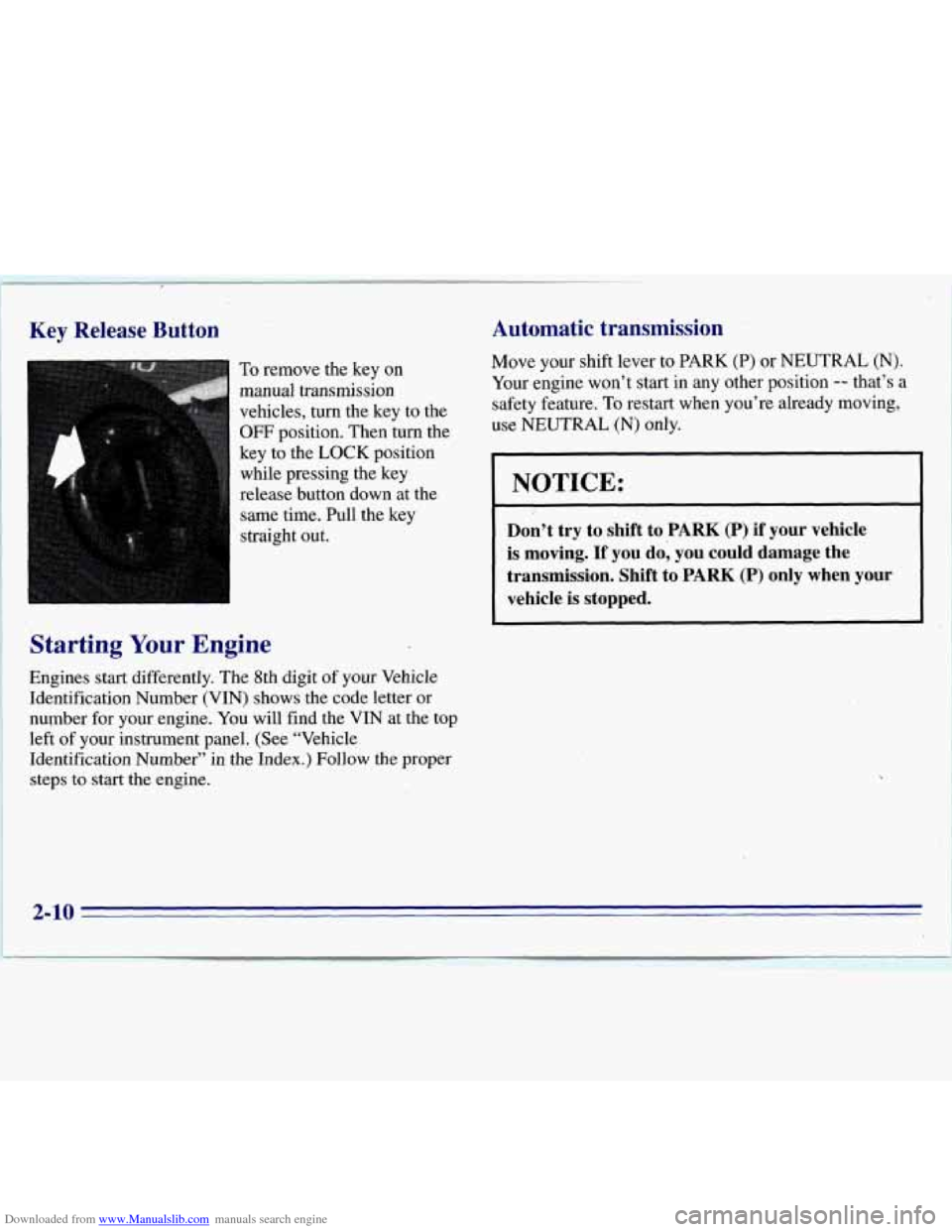
Downloaded from www.Manualslib.com manuals search engine Key Release Button
*A
To remove the key on
manual transmission
vehicles,
turn the key to the
OFF position. Then turn the
key to the
LOCK position
while pressing the key
release button down at the
same time. Pull the key
straight out.
Starting Your Engine
Engines start differently. The 8th digit of your Vehicle
1 Identification Number (VIN) shows the code letter or
number for your engine.
You will ‘find the VIN at the t OP
left of your instrum&t panel. (See “Vehicle
Identification Number” in the Index.) Follow the proper
steps
to start the engine.
1
2-10
Page 65 of 375
Downloaded from www.Manualslib.com manuals search engine 4. After you’ve used the coolant heater, be sure to
store the cord as it was before
to keep it away
from moving engine parts. If you don’t,
it could
be damaged.
How long should you keep the coolant heater plugged
in? The answer depends
on the outside temperature, the
kind
of oil you have, and so.me other things. Instead of
trying to list everything here, we ask that
you contact
your
GM dealer in the area where you’ll be parking your
vehicle. The dealer can give you the best advice for that
particular area.
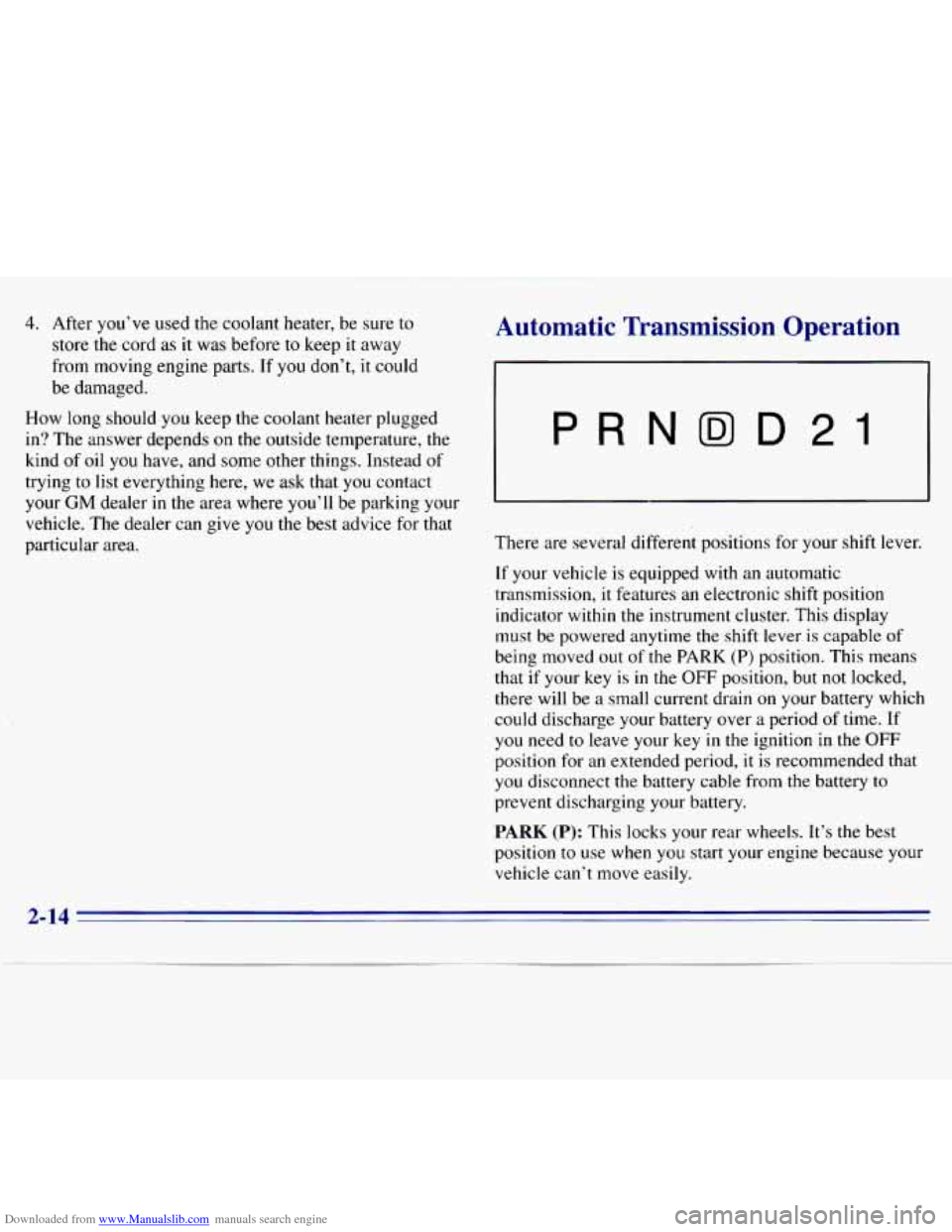
Automatic Transmission Operation
. --
P RNDD 21
There are several different positions for your shift lever.
If your vehicle is equipped with an automatic
transmission, it features an electronic shift position
indicator within the instrument cluster. This display
must be powered anytime
the shift lever is capable of
being moved out of the PARK (P) position. This means
that
if your key is in the OFF position, but not locked,
there will be a small current drain on your battery which
could discharge your battery over a period
of time. If
you need to leave your key in the ignition in the OFF
position for an extended period, it is recommended that
you disconnect the battery cable from the battery to
prevent discharging your battery.
PARK (P): This locks your rear wheels. It’s the best
position
to use when you start your engine because your
vehicle can’t move easily.
2-14
Page 66 of 375
Downloaded from www.Manualslib.com manuals search engine It is dangerous to get out of your vehicle if the
shift lever
is not fully in,PARK (P) with the ’
parking brake firmly set. Your vehicle can roll.
Don’t leave your vehicle when the engine is
running unless you have to.
If you have left the
engine running, the vehicle can move suddenly.
You or others could be injured. To be sure your
vehicle won’t move, even when you’re on fairly
level ground, always set your parking brake and
move the shift .lever to PARK
(P).
If you have four-wheel drive, your vehicle
will be free to roll
-- even .if your shift lever
is in PARK (P) -- if your transfer case is in
NEUTRAL (N). So, be sure the transfer case is in
a drive gear, two-wheel high (2HI) or four-wheel
high (4HI) or four-wheel low (4LO)
-- not in
NEUTRAL
(N). See “Shifting Into PARK (P)” in
the Index.
If you’re pulling a trailer, see “Towing
a Trailer” in the Index. Ensure’ the shift lever
is €ully in PARK (P) range
before starting the engine. Your vehicle has a
brake-transmission shift interlock. You have to fully
apply your regular brakes before you can shift from
PARK (P) when the ignition key is
ii.1 the RUN position.
If you cannot shift out of PARK (P), ease pressure on
the shift lever
-- push the shift lever all the way into
PARK (P) as you maintain brake application. Then
move the shift lever into the gear you wish. See
“Shifting Out of PARK (P)” in the Index.
REVERSE (R): Use this gear to back up.
NOTICE:
Shifting to REVERSE (R) while your vehicle is
moving forward could damage your transmission.
Shift to REVERSE (Rjonly after your vehicle
is stopped.
To rock your vehicle back and forth to get out of snow,
ice
or sand without damaging your transmission, see
“Stuck in Sand, Mud, Ice
or Snow” in the Index.
2-15