tow CHEVROLET S10 1996 2.G User Guide
[x] Cancel search | Manufacturer: CHEVROLET, Model Year: 1996, Model line: S10, Model: CHEVROLET S10 1996 2.GPages: 375, PDF Size: 20.73 MB
Page 66 of 375
Downloaded from www.Manualslib.com manuals search engine It is dangerous to get out of your vehicle if the
shift lever
is not fully in,PARK (P) with the ’
parking brake firmly set. Your vehicle can roll.
Don’t leave your vehicle when the engine is
running unless you have to.
If you have left the
engine running, the vehicle can move suddenly.
You or others could be injured. To be sure your
vehicle won’t move, even when you’re on fairly
level ground, always set your parking brake and
move the shift .lever to PARK
(P).
If you have four-wheel drive, your vehicle
will be free to roll
-- even .if your shift lever
is in PARK (P) -- if your transfer case is in
NEUTRAL (N). So, be sure the transfer case is in
a drive gear, two-wheel high (2HI) or four-wheel
high (4HI) or four-wheel low (4LO)
-- not in
NEUTRAL
(N). See “Shifting Into PARK (P)” in
the Index.
If you’re pulling a trailer, see “Towing
a Trailer” in the Index. Ensure’ the shift lever
is €ully in PARK (P) range
before starting the engine. Your vehicle has a
brake-transmission shift interlock. You have to fully
apply your regular brakes before you can shift from
PARK (P) when the ignition key is
ii.1 the RUN position.
If you cannot shift out of PARK (P), ease pressure on
the shift lever
-- push the shift lever all the way into
PARK (P) as you maintain brake application. Then
move the shift lever into the gear you wish. See
“Shifting Out of PARK (P)” in the Index.
REVERSE (R): Use this gear to back up.
NOTICE:
Shifting to REVERSE (R) while your vehicle is
moving forward could damage your transmission.
Shift to REVERSE (Rjonly after your vehicle
is stopped.
To rock your vehicle back and forth to get out of snow,
ice
or sand without damaging your transmission, see
“Stuck in Sand, Mud, Ice
or Snow” in the Index.
2-15
Page 72 of 375
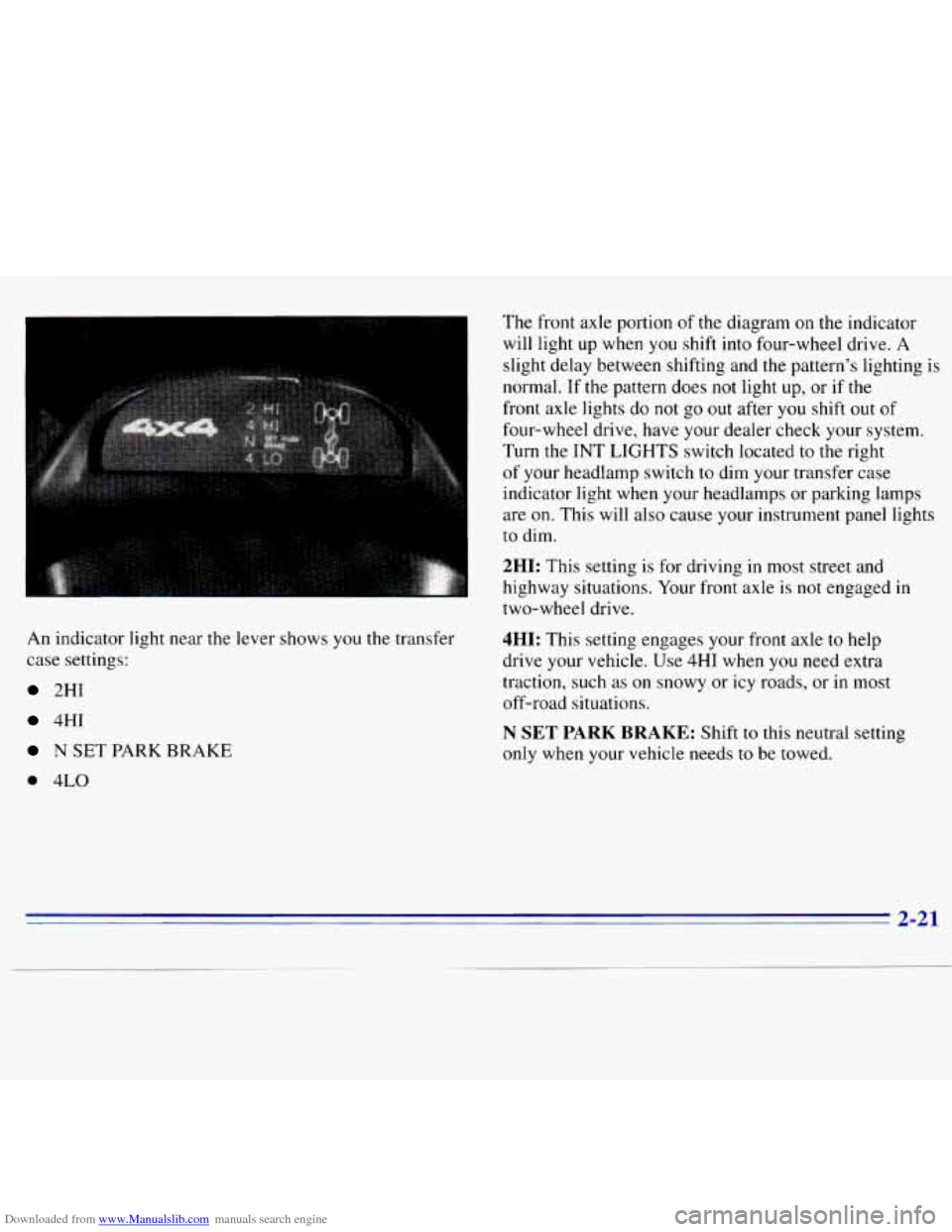
Downloaded from www.Manualslib.com manuals search engine An indicator light near the lever shows you the transfer
case settings:
2HI
4HI
N SET PARK BRAKE
0 4LO
The front axle portion of the diagram on the indicator
will light up when you shift into four-wheel drive.
A
slight delay between shifting and the pattern’s lighting is
normal. If the pattern does not light up, or if
the
front axle lights do not go out after you shift out of
four-wheel drive, have your dealer check your system.
Turn the INT
LIGHTS switch located to the right
of your headlamp switch to dim your transfer case
indicator light when your headlamps or parking lamps
are on. This will also cause your instrument panel lights
to dim.
2HI: This setting is for driving in most street and
highway situations. Your front axle is not engaged
in
two-wheel drive.
4HI: This setting engages your front axle to help
drive your vehicle. Use
4HI when you need extra
traction, such as
on snowy or icy roads, or in most
off-road situations.
N SET PARK BRAKE: Shift to this neutral setting
only when your vehicle needs to be towed.
2-21
Page 76 of 375
Downloaded from www.Manualslib.com manuals search engine Parking Brake
To set the parking brake, hold the regular brake pedal
down with your right foot. Push down the parking brake
pedal with your left foot. If the ignition is on, the brake
system warning light will come on.
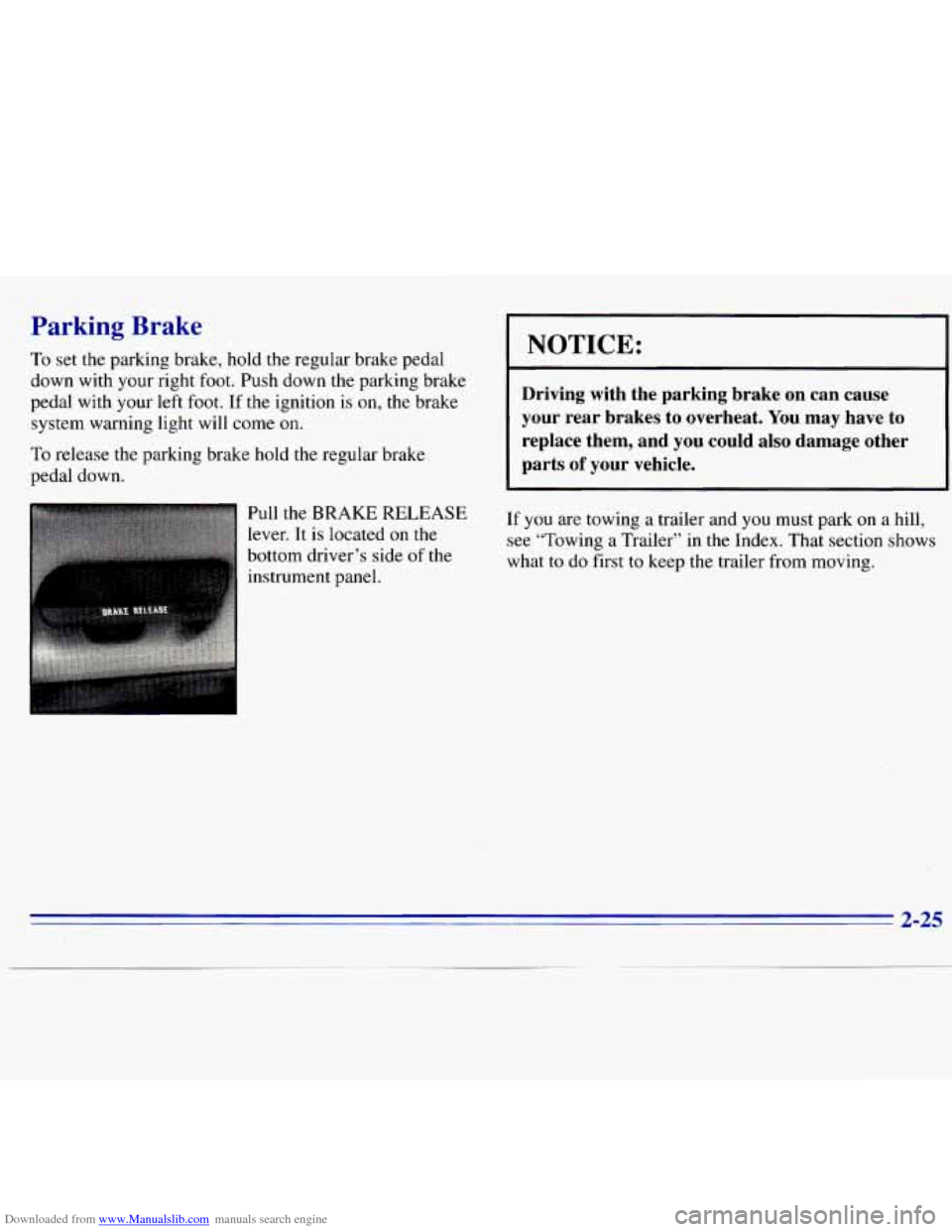
To release the parking brake hold the regular brake
pedal down.
lr Pull the BRAKE RELEASE
lever. It is located on the
bottom driver’s side of
the
instrument panel.
I NOTICE:
Driving with the parking brake on can cause
your rear brakes to overheat. You may have to
replace them, and you could also damage other
parts
of your vehicle.
If you are towing a trailer and you must park on a hill,
see “Towing a Trailer” in the Index. That section shows
what to do first
to keep the trailer from moving.
2-25
Page 77 of 375
Downloaded from www.Manualslib.com manuals search engine Shifting Into PARK (P)
(Automatic Tkansmission Models Only)
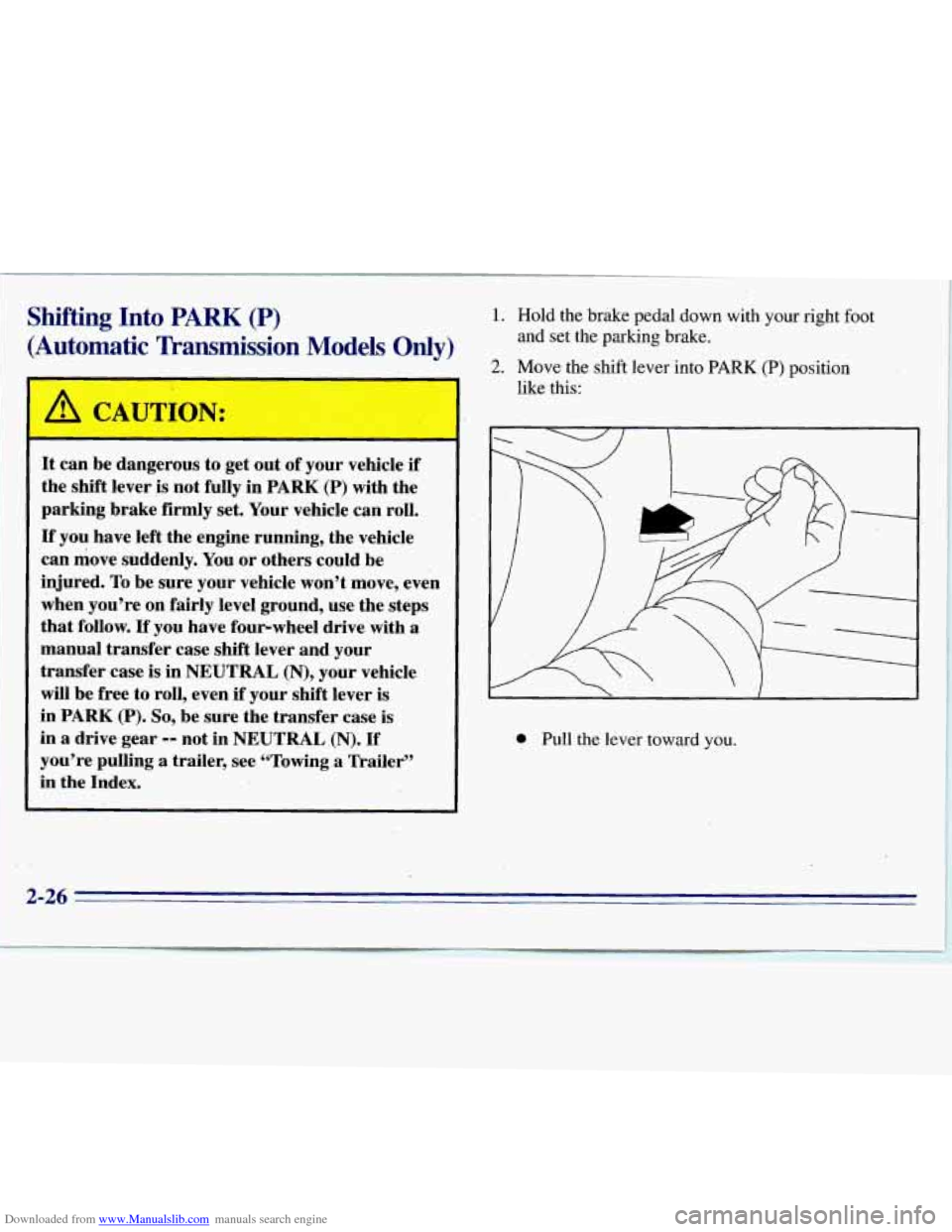
1. Hold the brake pedal down with your right foot
2. Move the shift lever into PARK (P) position
and set the parking brake.
..
It can be dangerous to get out of your vehicle if
the shift lever
is not fully in PARK (P) with the
parking. brake
firmly set. Your vehicle can roll.
If you have left the engine running, the vehicle
can move suddenly.
You or others could be
injured. To be sure your vehicle won’t move, even
when you’re on
fairly level ground, use the steps
that follow.
If you have four-wheel drive with a
manual transfer case shift lever and your
transfer case
is in NEUTRAL (N), your vehicle
will be free to roll, even
if your shift lever is
in
PARK (P). So, be sure the transfer case is
in
a drive gear -- not in NEUTRAL.(N). If
you’re pulling a trailer, see “Towing a Trailer”
in the Index. like this:
I
0 Pull the lever toward you.
2-26
!
Page 79 of 375
Downloaded from www.Manualslib.com manuals search engine If you have to leave your vehicle with the engine
running, be sure your vehicle
is in PARK (P) and your
parking brake is firmly set before you leave
it. After
you’ve moved the shift lever into the PARK (P)
position, hold the regular brake pedal down. Then, see if
you can move the shift lever away from PARK (P)
without first pulling it toward you. If
you can, it means
that the shift lever wasn’t fully locked into PARK (P).
Torque Lock (Automatic Transmission)
If you are parking on a hill and you don’t shift your
transmission into PARK (P) properly, the weight of the
vehicle may put too much force
on the parking pawl in
the transmission. You may find it difficult to pull the
shift lever out
of PARK (P). This is called “torque lock.”
To prevent torque lock, set the parking brake and then
shift into PARK (P) properly before you leave the
driver’s seat.
To find out how, see “Shifting Into
PARK (P)” in the Index.
When you are ready to drive, move the shift lever
out of
PARK (P)
before you release the parking brake.
If torque lock does occur, you may need to have another
vehicle push yours a little uphill
to take some of the
pressure from the transmission,
so you can pull the shift
lever
out of PARK (P).
Shifting Out of PARK (P)
(Automatic Transmission)
Your vehicle has a brake-transmission shift interlock.
You have to fully apply your regular brake before you
can shift from
PARK (P) when the ignition is in the
RUN position. See “Automatic Transmission Operation”
in the Index.
If
you cannot shift out of PARK (P), ease pressure
on the shift lever -- push the shift lever all the way
into PARK (P) as you maintain brake application. Then
move the shift lever into the gear you want.
If you ever hold the brake pedal down but still can’t
shift out
of PARK (P), try this:
1. Turn the key to OFF.
2. Apply and hold the brake until the end of Step 4.
3. Shift to NEUTRAL (N).
4. Start the vehicle and then shift to the drive gear
you want.
5. Have the vehicle fixed as soon as you can.
2-28
Page 80 of 375
Downloaded from www.Manualslib.com manuals search engine Parking Your Vehicle
(Manual Transmission Models
Only)
If you have four-wheel drive with a manual transfer case
shift lever, be sure your transfer case is in a drive gear.
Your vehicle could roll if it isn’t.
If you are parking
on a hill or pulling a trailer, see
“Towing a Trailer” in the Index.
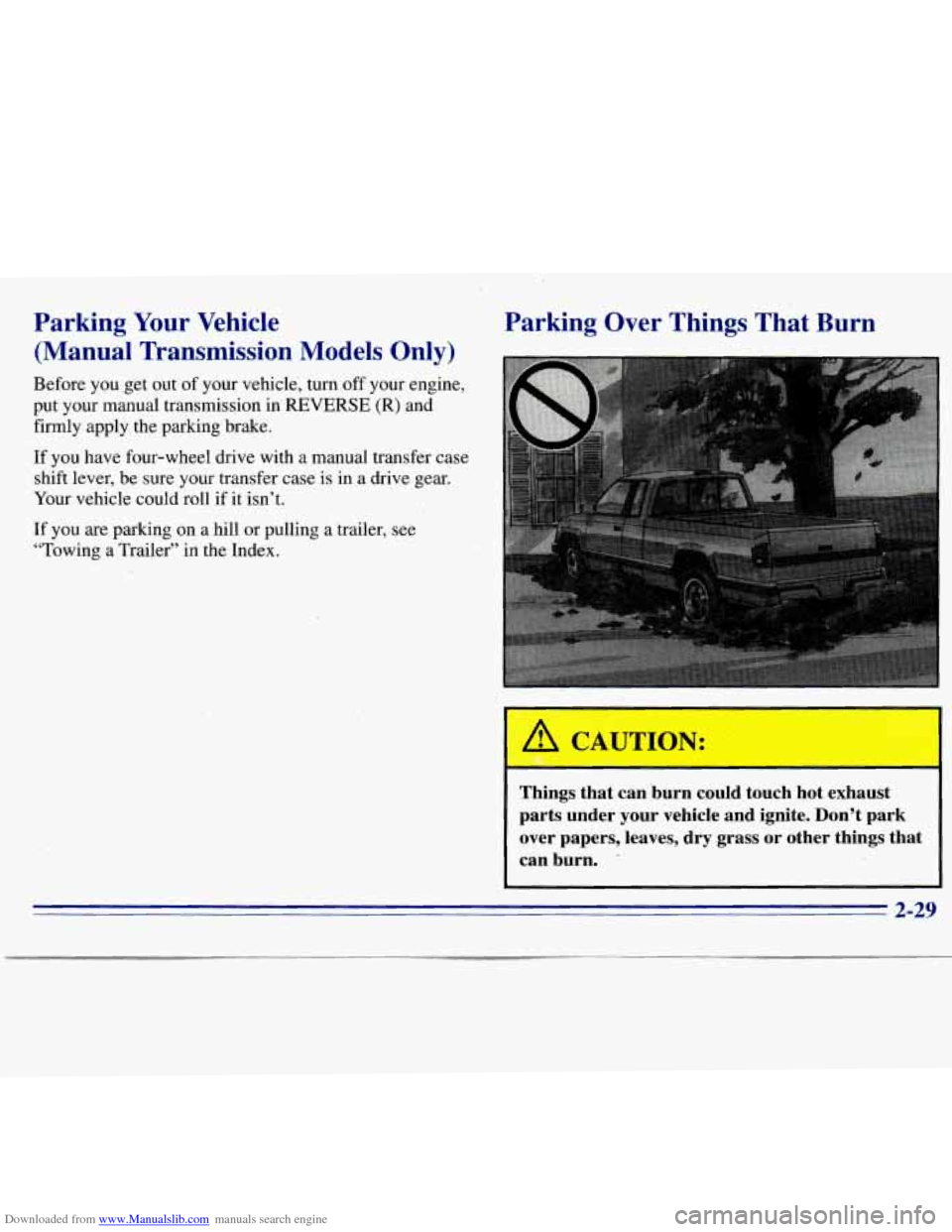
Parking Over Things That Burn
Before you get out of your vehicle’, turn off your engine,
put your manual transmission in
REVERSE (R) and
firmly apply the parking brake.
Things that can burn could touch hot exhaust
parts under your vehicle and ignite. Don’t park
over papers, leaves, dry grass or other things that
can burn.
-
2-29
Page 82 of 375
Downloaded from www.Manualslib.com manuals search engine I b CAUTION:
-
It can be dangerous to get out of your vehicle if
the shift lever
is not fully in PARK (P) with the
parking brake firmly set. Your vehicle can roll.
Don’t leave your vehicle when the engine
is
running unless you have to. If you’ve left the
engine running, the vehicle can move suddenly.
You or others could be injured.
To be sure your
vehicle won’t move, even when you’re on fairly
level ground, always set your parking brake and
move the shift lever
to PARK (P). !
If you have four-wheel drive with a manual transfer case
shift lever and your transfer case is in NEUTRAL (N),
your vehicle will be free to roll, even if your shift lever
is in PARK
(P). So, be sure the transfer case is in a drive
gear
-- not in NEUTRAL (N). Always set your parking
brake. Follow the proper steps to be sure your vehicle
won’t move. See “Shifting Into PARK
(P)” in the Index.
If you’re pulling a trailer, see “Towing a Trailer’’ in
the Index.
Windows
Manual Windows
Turn the hand crank on each door to raise or lower your
m&ual side door windows.
Power Windows (Option)
If you have the optional power windows, the controls
are on each of the side doors. Your power windows will
only work when the ignition has been turned to RUN.
The driver’s door has a switch for the passenger’s
window as well.
2-3 1
Page 83 of 375
Downloaded from www.Manualslib.com manuals search engine Express-Down Window
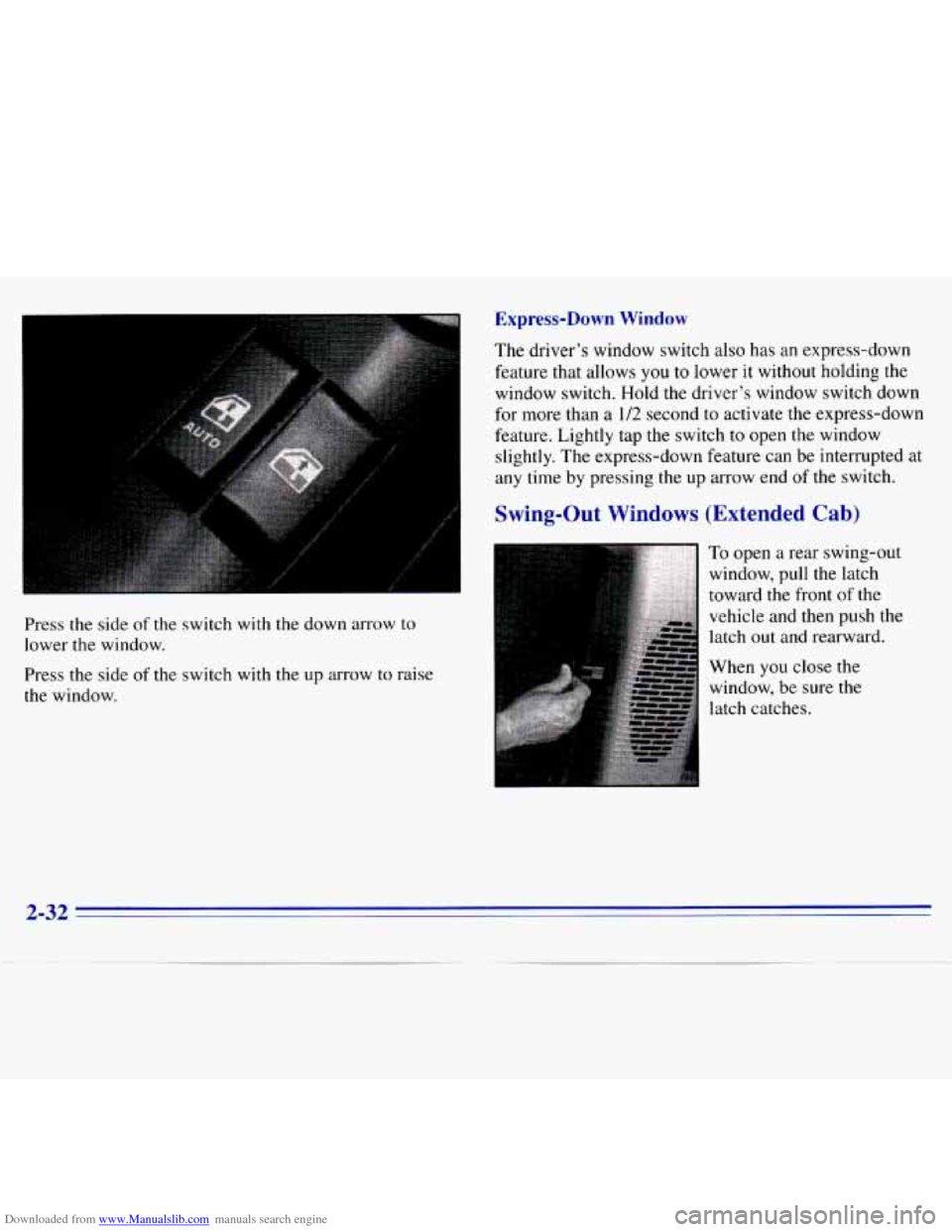
Press the side of the switch with the down arrow to
lower the window.
Press the side
of the switch with the up arrow to raise
the window. The driver’s
window switch also has an express-down
feature that
allows you to lower it without holding the
window switch. Hold the driver’s window switch down
for more than a 1/2 second to activate the express-down
feature. Lightly tap the switch
to open the window
slightly. The express-down feature can be interrupted at
any time by pressing the up arrow end of the switch.
Swing-Out Windows (Extended Cab)
To open a rear swing-out
window, pull the latch
toward the front
of the
vehicle and then push the
latch out and rearward.
When
you close the
window, be sure the
latch catches.
2-32
Page 84 of 375
Downloaded from www.Manualslib.com manuals search engine Sliding Rear Window (Option) Tilt Wheel (Option)
If you have the tilt steering
wheel, you should adjust
the steering wheel before you drive.
You can raise
it to the
highest level
to give your
legs more room when
you
enter and exit the vehicle.
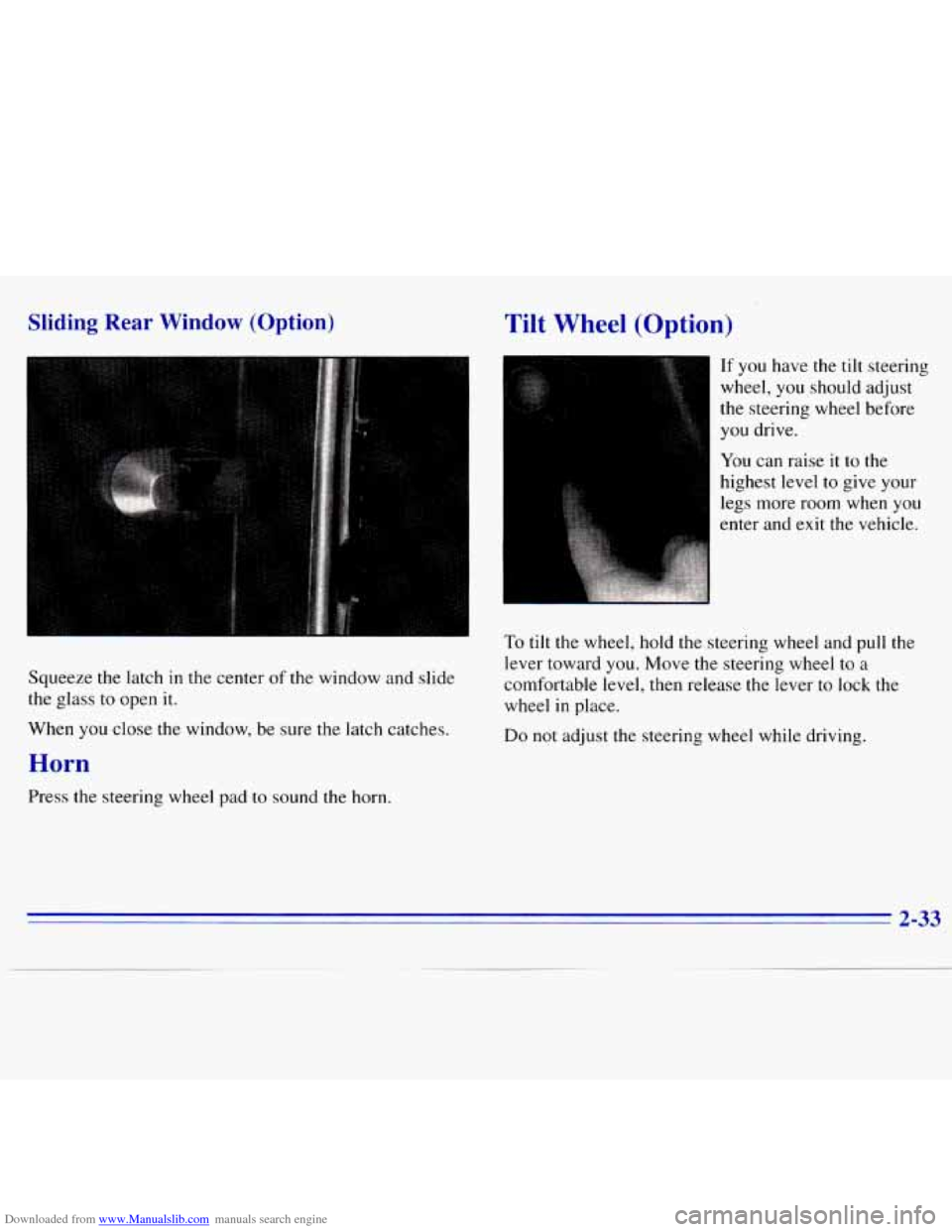
Squeeze
the latch in the center of the window and slide
the glass
to open it.
To tilt the wheel, hold the steering wheel and pull the
lever toward you. Move the steering wheel
to a
comfortable level, then release the lever to lock the
wheel
in place.
When
you close the window, be sure the latch catches.
Horn
Do not adjust the steering wheel while driving.
Press the steering wheel pad
to sound the horn.
Page 86 of 375
Downloaded from www.Manualslib.com manuals search engine If a bulb is burned out, replace it to help avoid an
accident. If the arrows don’t go
on at all when you
signal a turn, check the fuse (see “Fuses and Circuit
Breakers” in the Index) and for burned-out bulbs.
If
you have a trailer towing option with added wiring for
the trailer lamps,
a different turn signal flasher is used.
With this flasher installed, the signal indicator will flash
even if a turn signal bulb is burned out. Check the front
and rear turn signal lamps regularly to make sure they
are working.
Headlamp High/Low Beam Changer
To change the headlamps from low-beam to high or
high to low, pull the multifunction lever all the way
toward you. Then release it.
When the high-beam
headlamps are
on, this
indicator light
on the
instrument panel also
will be
on.
Windshield Wipers
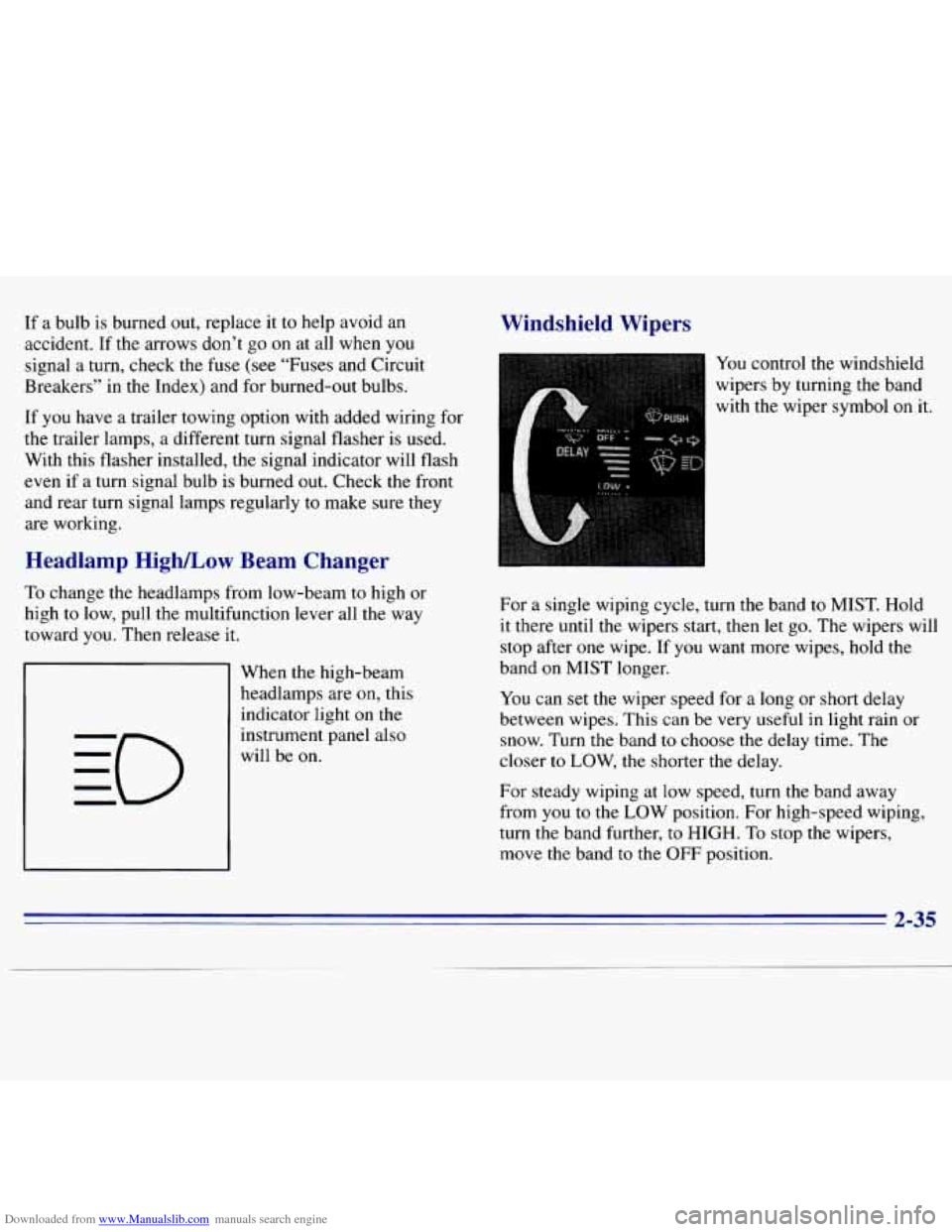
You control the windshield
wipers by turning the band
with the wiper symbol
on it.
For a single wiping cycle, turn the band
to MIST. Hold
it there until the wipers start, then let go. The wipers will
stop after one wipe. If you want more wipes, hold the
band
on MIST longer.
You can set the wiper speed for a long or short delay
between wipes. This can be very useful in light rain or
snow. Turn the band
to choose the delay time. The
closer
to LOW, the shorter the delay.
For steady wiping at
low speed, turn the band away
from
you to the LOW position. For high-speed wiping,
turn the band further,
to HIGH. To stop the wipers,
move the band
to the OFF position.
2-35