belt CHEVROLET S10 1996 2.G Service Manual
[x] Cancel search | Manufacturer: CHEVROLET, Model Year: 1996, Model line: S10, Model: CHEVROLET S10 1996 2.GPages: 375, PDF Size: 20.73 MB
Page 147 of 375
Downloaded from www.Manualslib.com manuals search engine Controlling your vehicle is the key to successful
off-road driving. One
of the best ways to control your
vehicle is to control your speed. Here are some things
to
keep in mind. At higher speeds:
you approach things faster and you have less time to
scan the terrain for obstacles.
0 you have less time to react.
you have more vehicle bounce when you drive
over obstacles.
0 you’ll need more distance for braking, especially
since you’re on an unpaved surface.
When you’re driving off-road, bouncing and
quick changes in direction can easily throw you
out of position. This could cause you to lose
control and crash.
So, whether you’re driving on
or
off the road, you and your passengers should
wear safety belts.
Scanning the Terrain
Off-road driving can take you over many different kinds
of terrain. You need to be familiar with
the terrain and its
many different features. Here are some things to consider.
Su$ace Conditions. Off-roading can take you over
hard-packed dirt, gravel, rocks, grass, sand, mud, snow or
ice. Each of these surfaces
affects the steering, acceleration
and braking
of your vehicle in different ways. Depending
upon the kind
of surface you are on, you may experience
slipping, sliding, wheel spinning, delayed acceleration,
poor traction and longer braking distances.
Surface Obstacles. Unseen or hidden obstacles can be
hazardous. A rock, log, hole, rut or bump can startle you
if you’re not prepared for them. Often these obstacles are
hidden by grass, bushes, snow or even the rise and fall
of
the terrain itself. Here are some things to consider:
Is the path ahead clear?
0 Will the surface texture change abruptly up ahead?
0 Does the travel take you uphill or downhill?
(There’s more discussion
of these subjects later.)
0 Will you have to stop suddenly or change direction
quickly?
4-16
Page 187 of 375
Downloaded from www.Manualslib.com manuals search engine When You Are Ready to Leave After
Parking on a Hill
1. Apply your regular brakes and hold the pedal down
while
you:
Start your engine;
0 Shift into a gear; and
0 Release the parking brake.
2. Let up on the brake pedal.
3. Drive slowly until the trailer is clear of the chocks.
4. Stop and have someone pick up and store the chocks.
Maintenance When Trailer Towing
Your vehicle will need service more often when you’re
pulling a trailer. See the Maintenance Schedule for more
on this. Things that are especially important in trailer
operation are automatic transmission fluid (don’t
overfill), engine oil, axle lubricant, belt, cooling system
and brake adjustment. Each
of these is covered in this
manual, and the Index will help
you find them quickly.
If you’re trailering, it’s
a good idea to review these
sections before you start your trip.
Check periodically to see that all hitch nuts and bolts
are tight.
Trailer Wiring Harness
The eight-wire harness is stored under your vehicle
along
the rear frame crossmember. This harness has a
30-amp feed wire with an inline fuse located in the
instrument panel fuse block and no connector. It should
be wired by a qualified electrical technician. The
technician can use
the following color code chart when
connecting the wiring harness to your trailer.
0 DARK BLUE: Use for electric trailer brakes or
0 RED: Use for battery charging; it connects to the
LIGHT GREEN: Back-up lamps.
0 BROWN: Taillamps and parking lamps.
0 YELLOW Left stoplamp and turn signal.
0 DARK GREEN: Right stoplamp and turn signal.
0 WHITE (Heavy Gage): Ground wire.
0 WHITE (Light Gage): Auxiliary stoplamp.
Securely attach the harness to the trailer, then tape or
strap it to your vehicle’s frame rail. Be sure
you leave
it loose enough
so the wiring doesn’t bend or break,
but not so
loose that it drags on the ground. Store the
harness in its original place. Wrap the harness together
and tie
it neatly so it won’t be damaged.
auxiliary wiring.
starter solenoid.
4-56
Page 274 of 375
Downloaded from www.Manualslib.com manuals search engine The tire has a panctufe, cut or other .damage that
can’t be repaired well because of the size or location
. of the damage.
Buying New Tires
To find out what kind and size of tires you need, look at
the Certificatioflire label.
The tires installed on your vehicle when it was new had
a Tire Performance Criteria Specification (TPC Spec)
number on each tire’s sidewall. When you get new tires,
get ones with that same TPC Spec number. That way
your vehicle will continue to have tires that are designed
to give proper endurance, handling, speed rating,
traction, ride and other things during normal service
on your vehicle.
If your tires have an all-season tread
design, the TPC number will be followed by an
“MS”
(for mud and snow).
If you ever replace your tires with those not having a
TPC Spec number, make sure they are the same size,
load range, speed rating and construction type (bias,
bias-belted or radial)
as your original tires. Mixing
tires could cause you to lose control while
driving.
If you mix tires of different sizes or ‘types
(radial and bias-belted tires), the vehicle may not
handle properly, and you could have
a crash.
Using tires of different sizes may also cause
damage to your vehicle. Be sure to use the same
size and type tires on all wheels.
It’s all ,right to drive with your compact spare
(if you have one).. It was developed for use on
your vehicle.
Page 282 of 375
Downloaded from www.Manualslib.com manuals search engine Care of Safety Belts
Keep belts clean and dry.
I A CAUTION:
Do not bleach or dye safety belts. If you do, it may
severely weaken them.
In a crash they might not be
able to provide adequate protection. Clean safety
belts only with mild soap and lukewarm water.
Glass
Glass should be cleaned often. GM Glass Cleaner (GM
Part
No. 1050427) or a liquid household glass cleaner
will remove normal tobacco smoke and dust films.
Don’t use abrasive cleaners on glass, because they may
cause scratches. Avoid placing decals on
the inside rear
window, since they may have
to be scraped off later.
Cleaning the Outside of the
Windshield and Wiper Blades
If the windshield is not clear after using the windshield
washer, or if the wiper blade chatters when running, wax
or other material may be on
the blade or windshield.
Clean the outside
of the windshield with GM
Windshield Cleaner, Bon-Ami Powder@
(GM Part
No. 105001 1). The windshield is clean if beads do not
form when you rinse it with water.
Clean the blade by wiping vigorously with a cloth soaked in full-strength windshield washer solvent. Then
rinse the blade with water.
Wiper blades should be checked on a regular basis and
replaced when worn.
Weatherstrips
Silicone grease on weatherstrips will make them last
longer, seal better, and
not stick or squeak. Apply
silicone grease with a clean cloth at least every six
months. During very cold, damp weather more frequent
application may be required. (See “Recommended
Fluids and Lubricants” in
the Index.)
Page 300 of 375
Downloaded from www.Manualslib.com manuals search engine Maintenance Schedule
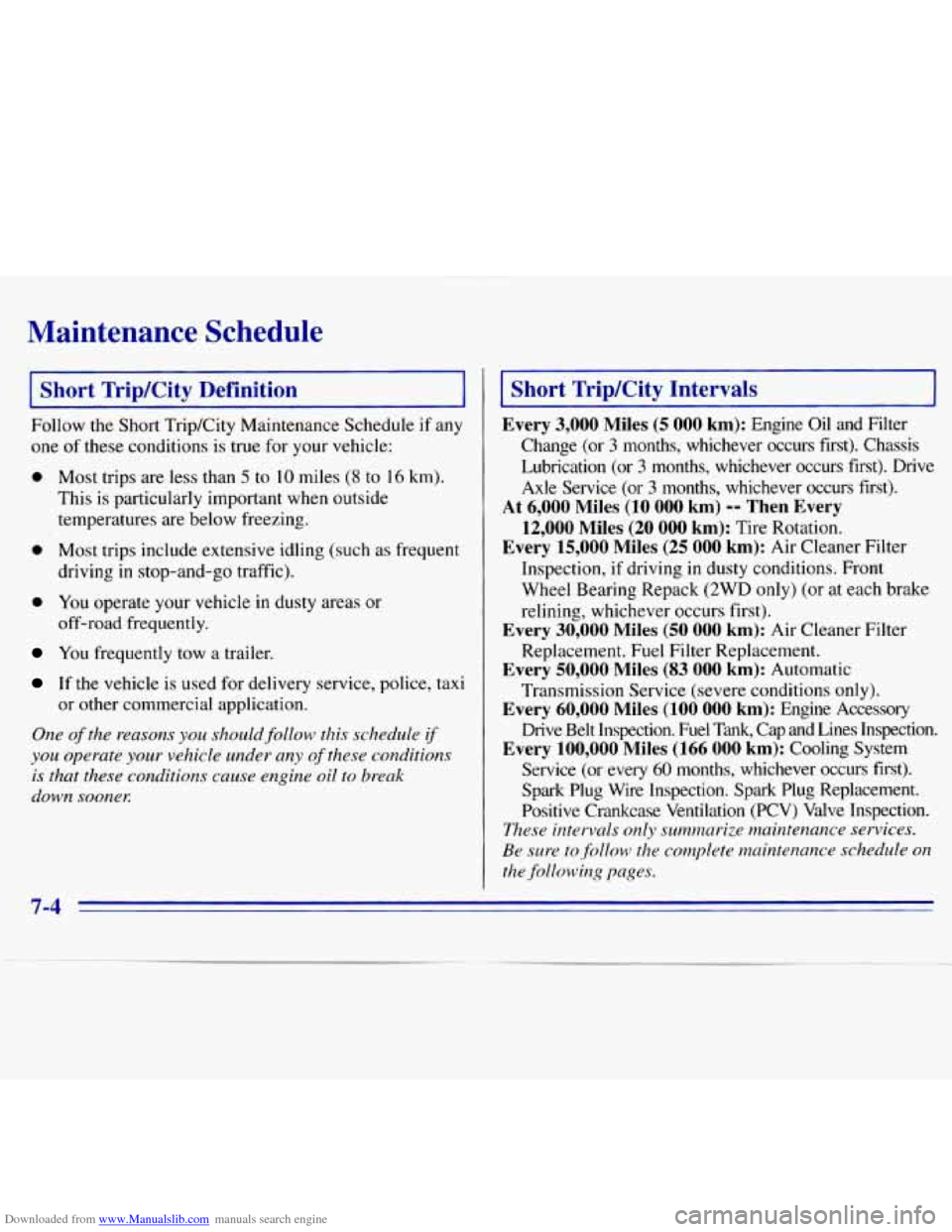
I Short TripKity Definition
__~
Follow the Short TripKity Maintenance Schedule if any
one
of these conditions is true for your vehicle:
0 Most trips are less than 5 to 10 miles (8 to 16 km).
This is particularly important when outside
temperatures are below freezing.
driving
in stop-and-go traffic).
0 Most trips include extensive idling (such as frequent
0 You operate your vehicle in dusty areas or
off-road frequently.
You frequently tow a trailer.
If the vehicle is used for delivery service, police, taxi
or other commercial application.
One of the reasons you should follow this sch.edule if
you operate your vehicle under any qf these conditions
is that these conditions
cause engine oil to break
down soone):
Short TripKity Intervals
Every 3,000 Miles (5 000 km): Engine Oil and Filter
Change (or
3 months, whichever occurs first). Chassis
Lubrication (or
3 months, whichever occurs first). Drive
Axle Service (or
3 months, whichever occurs first).
At 6,000 Miles (10 000 km) -- Then Every
12,000 Miles (20 000 km): Tire Rotation.
Every 15,000 Miles (25 000 km): Air Cleaner Filter
Inspection,
if driving in dusty conditions. Front
Wheel Bearing Repack
(2WD only) (or at each brake
relining, whichever occurs first).
Every 30,000 Miles (50 000 km): Air Cleaner Filter
Replacement.
Fuel Filter Replacement.
Every 50,000 Miles (83 000 km): Automatic
Transmission Service (severe conditions only).
Every 60,000 Miles (100 000 km): Engine Accessory
Drive Belt Inspection. Fuel
Tank, Cap and Lines Inspection.
Every 100,000 Miles (166 000 km): Cooling System
Service
(or every 60 months, whichever occurs first).
Spark Plug Wire Inspection.
Spark Plug Replacement.
Positive Crankcase Ventilation (PCV) Valve Inspection.
These intervals only sumrnurize maintenance services.
Be sure to.follow the complete maintenance schedule on
the%following pages.
7-4
Page 301 of 375
Downloaded from www.Manualslib.com manuals search engine Maintenance Schedule
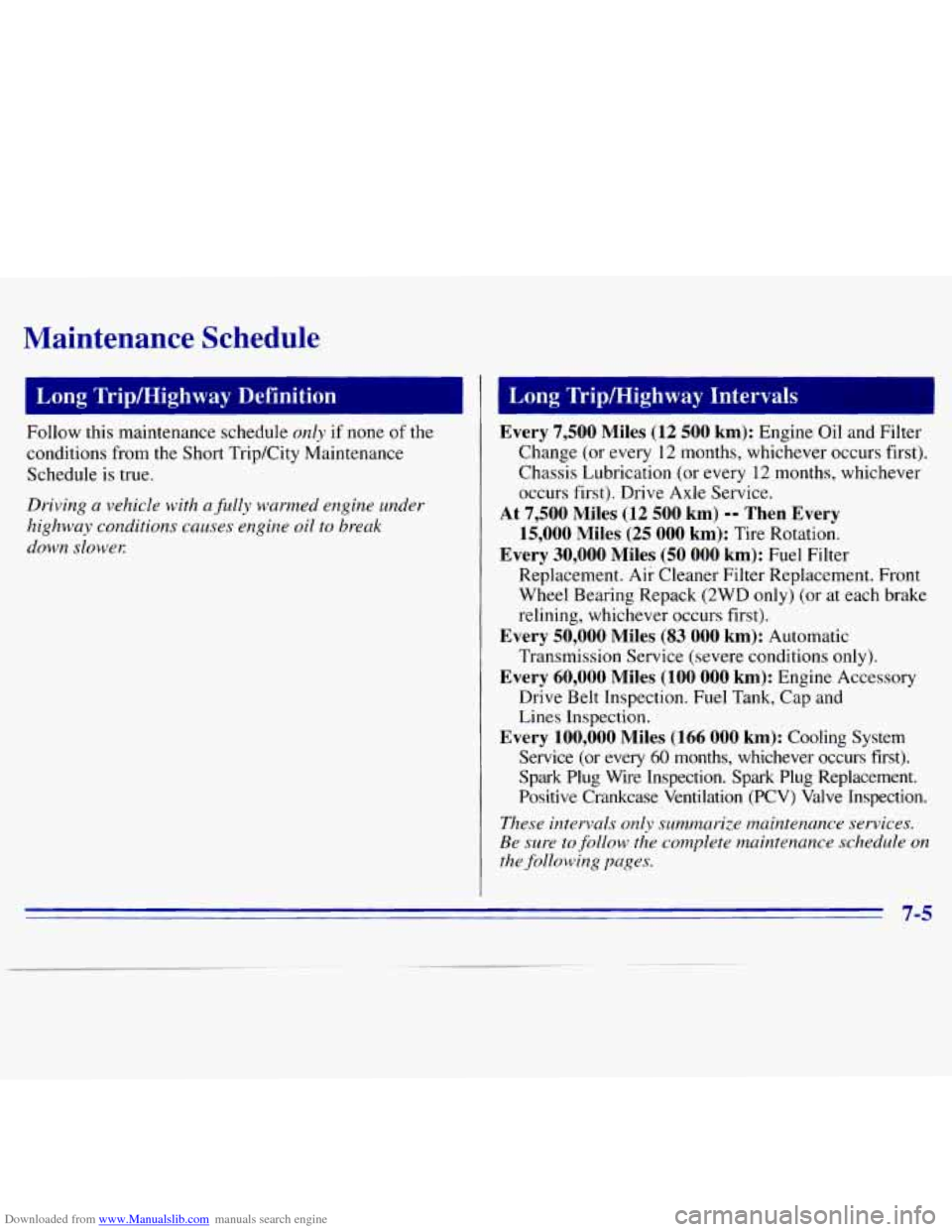
Follow this maintenance schedule only if none of the
conditions from the Short Trip/City Maintenance
Schedule
is true.
Driving a vehicle with a fully warmed engine under
highway conditions causes engine
oil to break
down slower:
Every 7,500 Miles (12 500 km): Engine Oil and Filter
Change (or every 12 months, whichever occurs first).
Chassis Lubrication (or every 12 months, whichever
occurs first). Drive Axle Service.
At 7,500 Miles (12 500 km) -- Then Every
15,000 Miles (25
000 km): Tire Rotation.
Every 30,000 Miles (50 000 km): Fuel Filter
Replacement. Air Cleaner Filter Replacement. Front
Wheel Bearing Repack (2WD only) (or at each brake
relining, whichever occurs first).
Transmission Service (severe conditions only).
Drive Belt Inspection.
Fuel Tank, Cap and
Lines Inspection.
Every 100,000 Miles (166 000 km): Cooling System
Service (or every
60 months, whichever occurs first).
Spark Plug Wire Inspection. Spark Plug Replacement.
Positive Crankcase Ventilation (PCV) Valve Inspection.
Every 50,000 Miles (83 000 km): Automatic
Every 60,000 Miles (100 000 km): Engine Accessory
These intervals only summarize maintenance services.
Be sure
to follow the complete maintenance schedule on
the following pages.
7-5
Page 317 of 375
Downloaded from www.Manualslib.com manuals search engine Short TripKity Maintenance Schedule
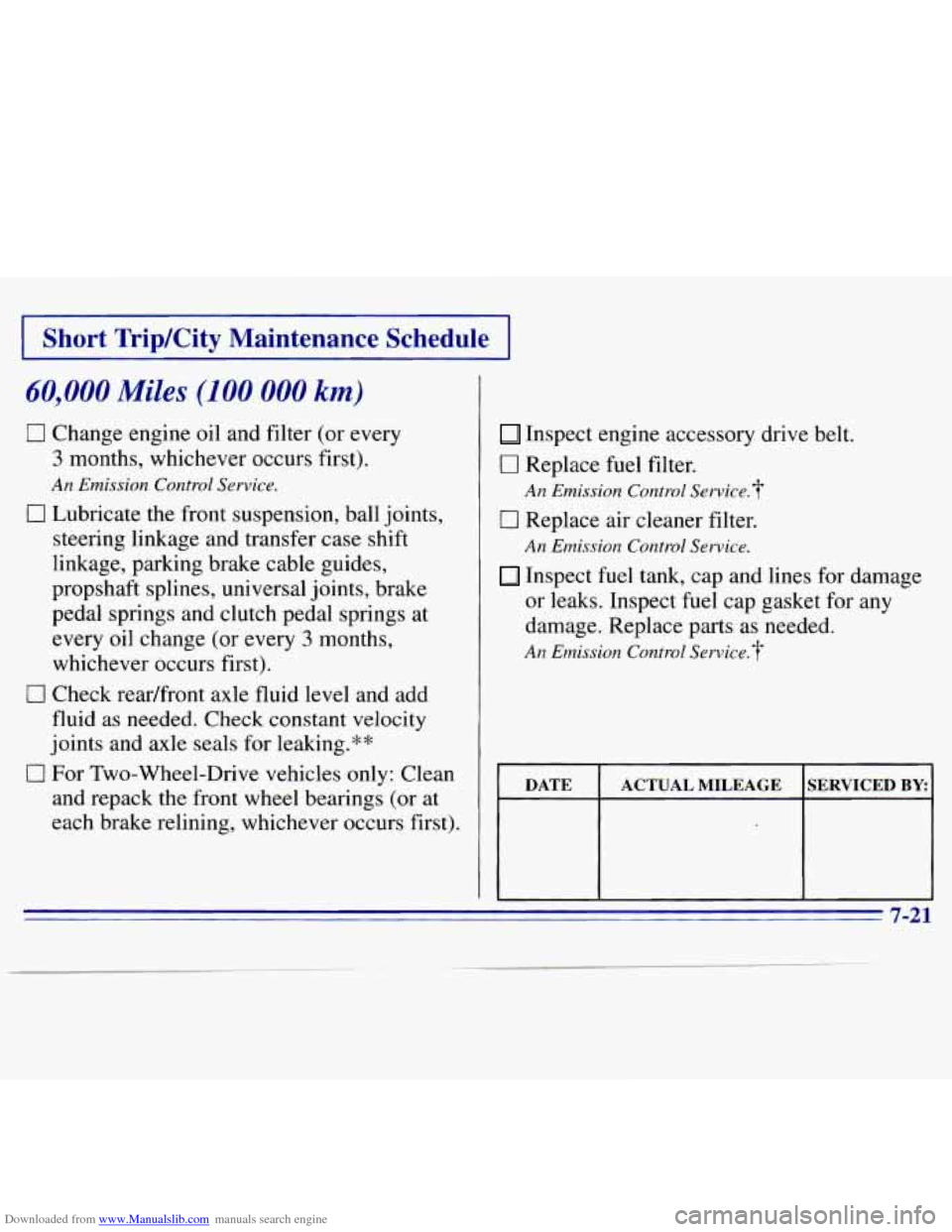
60,000 Miles (100 000 km)
I7 Change engine oil and filter (or every
3 months, whichever occurs first).
An Emission Control Service.
0 Lubricate the front suspension, ball joints,
steering linkage and transfer case shift
linkage, parking brake cable guides,
propshaft splines, universal joints, brake
pedal springs and clutch pedal springs at
every
oil change (or every 3 months,
whichever occurs first).
17 Check readfront axle fluid level and add
fluid as needed.
Check constant velocity
joints and axle seals for leaking.**
0 For Two-Wheel-Drive vehicles only: Clean
and repack the front wheel bearings (or at
each brake relining, whichever occurs first).
J dril Inspect engine accessoq
0 Replace fuel filter. de
belt.
An Emission Control Service.?
0 Replace air cleaner filter.
Inspect fuel tank, cap and lines for damage
or leaks. Inspect fuel cap gasket for any
damage. Replace parts as needed.
An Emission Control Service.
An Emission Control Service.?
I DATE ACTUAL MILEAGE SERVICED BY
7-21
Page 336 of 375
Downloaded from www.Manualslib.com manuals search engine I
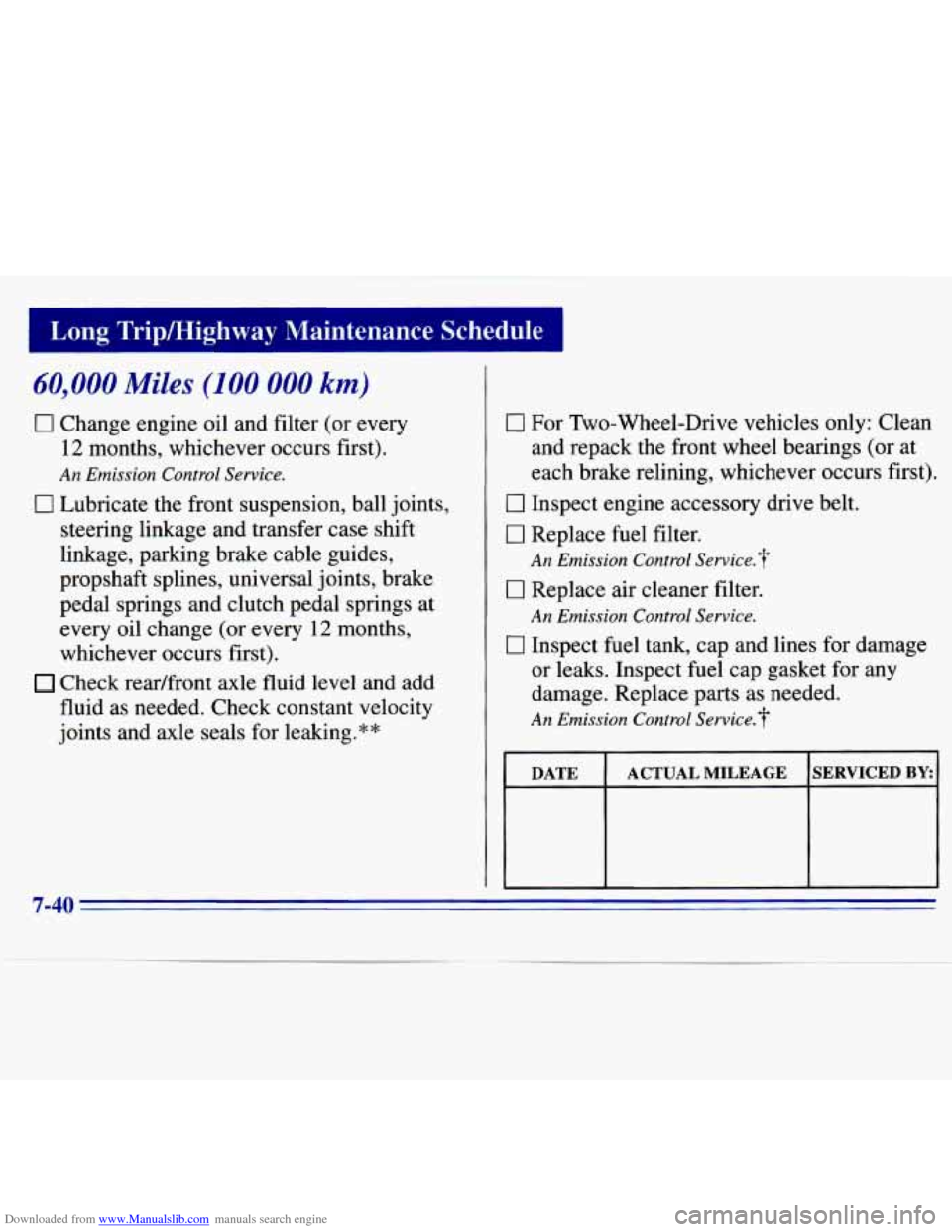
60,000 Miles (100 000 km)
0 Change engine oil and filter (or every
12 months, whichever occurs first).
An Emission Control Service.
0 Lubricate the front suspension, ball joints,
steering linkage and transfer case shift
linkage, parking brake cable guides,
propshaft splines, universal joints, brake
pedal springs and clutch pedal springs at
every oil change (or every
12 months,
whichever occurs first).
Check readfront axle fluid level and add
fluid as needed. Check constant velocity
joints and axle seals for leaking.**
0 For Two-Wheel-Drive vehicles only: Clean
and repack the front wheel bearings
(or at
each brake relining, whichever occurs first).
0 Inspect engine accessory drive belt.
0 Replace fuel filter.
0 Replace air cleaner filter.
0 Inspect fuel tank, cap and lines for damage
or leaks. Inspect fuel cap gasket for any
damage. Replace parts as needed.
An Emission Control Service.?
An Emission Control Service.
An Emission Control Service.'f
I DATE I ACTUAL MILEAGE JSERVICED BY:(
U
7-40
Page 344 of 375
Downloaded from www.Manualslib.com manuals search engine At Least Twice a Year
Restraint System Check
Make sure the safety belt reminder light and all your
belts, buckles, latch plates, retractors and anchorages are
working properly. Look for any other loose or damaged
safety belt system parts. If you see anything that might
keep a safety belt system from doing its job, have it
repaired. Have any torn or frayed safety belts replaced.
Also look for any opened or broken air bag covers, and
have them repaired
or replaced. (The air bag system
does not need regular maintenance.)
Manual Transmission Check
Check the transmission fluid level; add if needed. See
“Manual Transmission” in the Index. A fluid
loss may
indicate a problem. Check the system and repair if needed.
Automatic Transmission Check
Check the transmission fluid level; add if needed. See
“Automatic Transmission” in the Index.
A fluid loss may
indicate a problem. Check the system and repair if needed.
Hydraulic Clutch System Check
At Least Four Times a Year
Tailgate Lubrication Service
Lubricate tailgate latch bolt, handle assembly pivot
points, and hinges with lubricant recommended in
Part
D. Lubricate every 3,000 miles (5 000 km) if
following schedule I or every
7,500 miles (12 500 km)
if following schedule 11.
At Least Once a Year
Key Lock Cylinders Service
Lubricate the key lock cylinders with the lubricant
specified in Part
D.
Body Lubrication Service
Lubricate all body door and fuel door hinges, latches
and locks including the glove box, console doors and the
body hood, and any moving seat hardware. Lubricate
the hood safety lever pivot and prop rod pivot. Part
D
tells you what to use. More frequent lubrication may be
required when exposed to a corrosive environment.
Check the fluid level in the clutch reservoir. See
“Hydraulic Clutch Fluid” in the Index.
A fluid loss in
this system could indicate a problem. Have the system
inspected and repaired at once.
7-48
Page 366 of 375
Downloaded from www.Manualslib.com manuals search engine I
Brakes Adjustment ........... ....................... '6-34
qMager Cylinder ............................... 6-31 Anti-Lock .................................... 4-6
Pedal Travel- ................................. 6-34
Replading System Parts ......................... 6-34
Trailer 4-52
Wear ....................................... 6-33
Brake-Transmission' Shift Interlock Check ........... 7-49
Braking ......................................... 4-5
......................................
BTaking in Emergencies ........................... 4-8
Break-In, New Vehicle ............................ 2-8
BTSI Check .................................... 7-49
Bulb Replacement .......................... 6-35., 6-66
Brightness Control ............................. ; 2-42
Canadian Roadside Assistance .................... 8-6
Capacities and Specifications ................. 6-66. 6-68
Cassette Tape Player ......................... 3.7. 3.9
Center High-Mounted Stoplamp Bulb Replacement .... 6-39
Center Passenger Position ........................ 1-25
Certif?cation/Tire Label ............... , ........... 4-42
Chains
Carbon Manoxide .......................... 2.30. 4.40
Care ....................................... 3-18
Safety ...................................... 4-51
Tire ......................................... 6-52 Changing a Flat Tire ............................. 5-22
Charging System Light .......................... 2-54
Check Gages Light ' ' ... ' .. 2-62 ............... ..........
Checking Your Restraint Systems .................... 1-38 Chemical Paint Spotting .......................... 6-59
ChiSd-ReStraints ........................... 1 .... 1-30
Securing in the Center Seat Position (Except W40) . . 1-31
Securing in the Right FTont Seat Position .......... 1-33
Where Not to Put
Top
Strap
................................... : 1-30.
......................... 1-32. 1-33
Cleaner, Air .............................. 6-14, 6-67
Aluminum Wheels ............................ 6-58
Inside of Your Vehicle ......................... 6-53
.
Cigarette Lighter ................................ 2-46
Circuit Breakers and Fuses ......................... 6-63
Cleaning
Fabric
........................................ 6-53
Glass 6-56
Instrument Panel ................ .'. ....... 1 ... 6-55
Leather .................. : ..................... 6-55
Outside of Your Vehicle' ........................ 6-57
Safety Belts ................................... 6-56
Stains ...................................... 6-54
Tires 6-58
.Vinyl ....................................... 6-55
Weatherstrips .................... : ............ 6-56
.......................................
........................................
Wheels ...................................... 6-58
Windshield and Wiper Blades ................... 6-56
Climate Control System ........................... 3-1
Clock, Setting ................................... 3-5
Comfort Controls ................................ 3-1 Clutch, Hydraulic ................................ 6-20
Compact Disc Care ......... I. .................... 3-18
9-2