brake CHEVROLET S10 1996 2.G Owners Manual
[x] Cancel search | Manufacturer: CHEVROLET, Model Year: 1996, Model line: S10, Model: CHEVROLET S10 1996 2.GPages: 375, PDF Size: 20.73 MB
Page 5 of 375
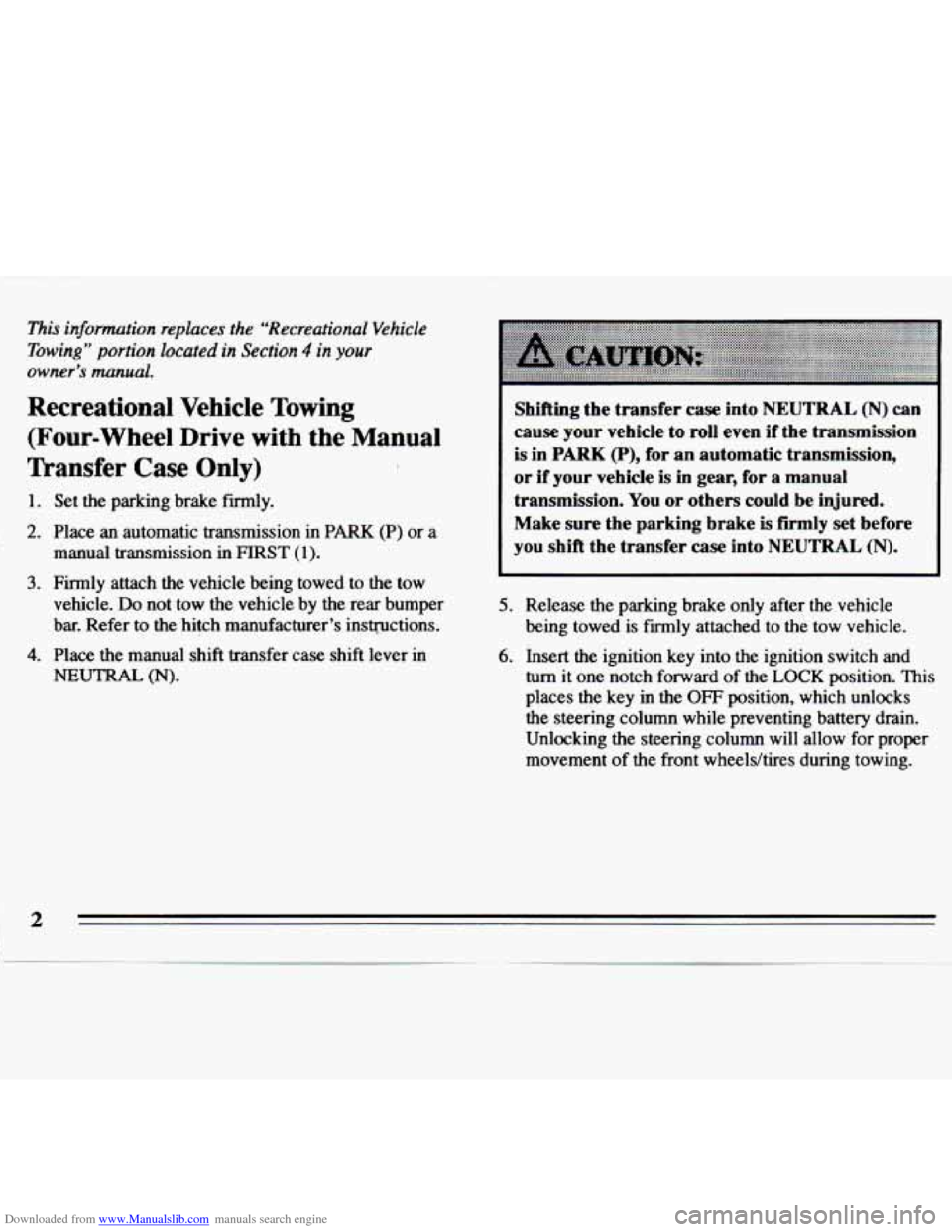
Downloaded from www.Manualslib.com manuals search engine This infurmation replaces the “Recreational Vehicle
Towing” portion located in Section 4 in your
owner’s manual.
Recreational Vehicle Towing
(Four-wheel Drive with the Manual
Transfer
Case Only)
1. Set the parking brake fmly.
2. Place an automatic transmission in PARK (P) or a
3. Firmly attach the vehicle being towed to the tow
manual transmission in FIRST (1).
vehicle. Do not tow the vehicle by the rear bumper
bar. Refer to the hitch manufacturer’s insmctions.
4. Place the manual shift transfer case shift lever in
NEUTRAL (N).
Shifting the transfer case into NEUTRAL (N) can
cause your vehicle to
roll even if the transmission
is in PARK (P), for an automatic transmission,
or if your vehicle is in gear, for a manual
transmission.
You or others could be injured.
Make sure the parking brake is firmly
set before
you
shift the transfer case into NEUTRAL (N).
5. Release the parking brake only after the vehicle
being towed is fiily attached to the tow vehicle.
6. Insert the ignition key into the ignition switch and
turn it one notch forward of the LOCK position. This
places the key
in the OFF position, which unlocks
the steering column while preventing battery drain.
Unlocking the steering column will allow for proper
movement
of the front wheelshires during towing.
I I
Page 10 of 375
Downloaded from www.Manualslib.com manuals search engine 1
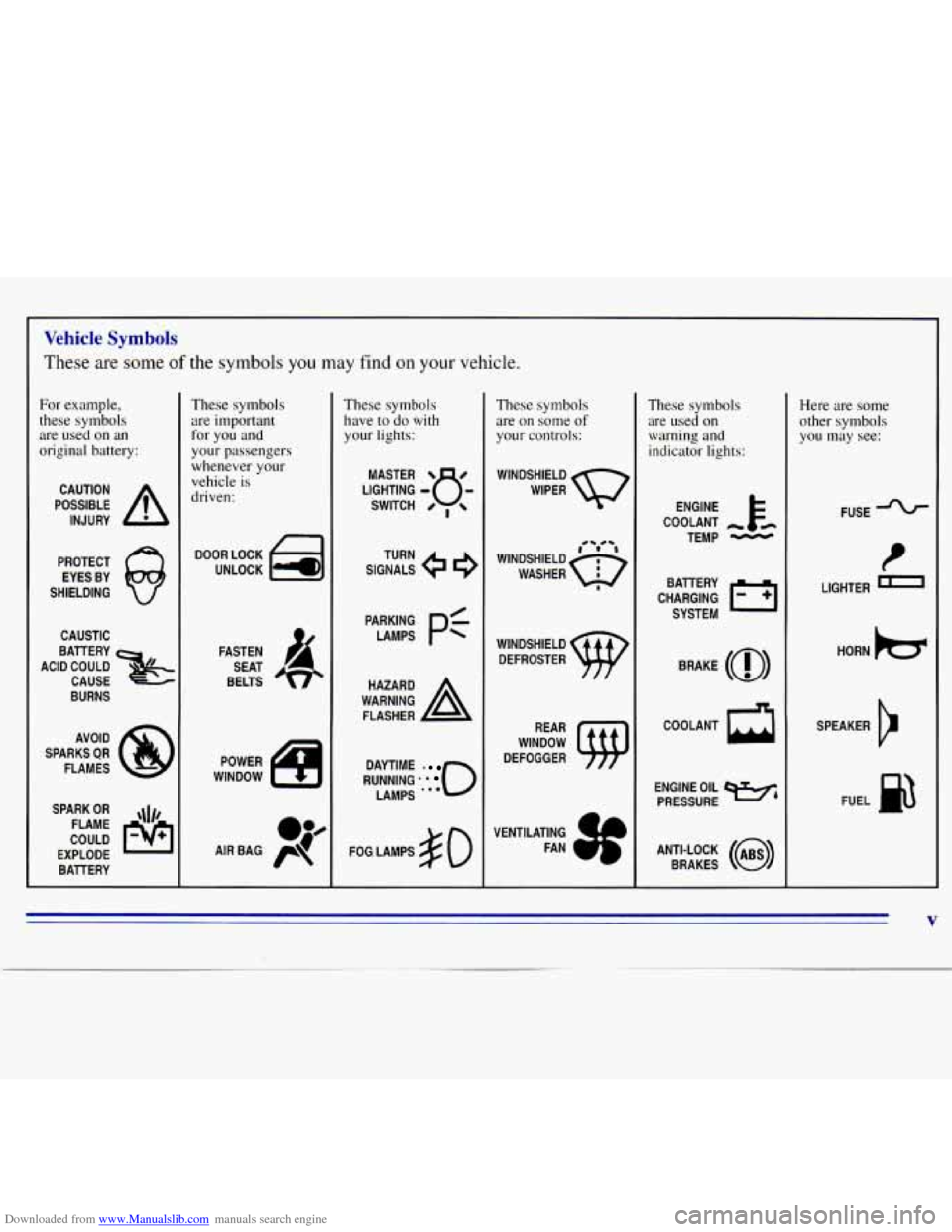
Vehicle Symbols
These are some of the symbols you may find on your vehicle.
For example,
these symbols
are used on an
original battery:
POSSIBLE A
CAUTION
INJURY
PROTECT EYES BY
SHIELDING
CAUSTIC
BURNS
SPARK
OR ,111,
COULD FLAME
EXPLODE BATTERY
These symbols are important
for you and
your passengers
whenever your vehicle
is
driven:
DOOR LOCK
UNLOCK
FASTEN SEAT
BELTS
POWER
WINDOW
These symbols have
to do with
your lights:
SIGNALS e
TURN
RUNNING
* 0
DAYTIME -
LAMPS '.*
FOG LAMPS $0
These symbols
are on some
of
your controls:
WINDSHIELD
WIPER
WINDSHIELD DEFROSTER
VENTILATING FAN
These symbols are used on
warning and
indicator lights:
COOLANT -
TEMP -
CHARGING I-1
BATTERY
SYSTEM
BRAKE
(0)
COOLANT a
ENGINE PRESSURE OIL e,
ANTI-LOCK (@)
BRAKES
Here are some
other symbols
you may see:
FUSE
LIGHTER
m
HORN k3
SPEAKER
b
FUEL B3
V
Page 59 of 375
Downloaded from www.Manualslib.com manuals search engine New Vehicle “Break-In”
NOTICE:
Your modern vehicle doesn’t need an elaborate
“break-in.” But it will perform better in the long
run if you follow these guidelines:
0
0
0
0
Keep your speed at 55 mph (88 km/h) or
less for the first
500 miles (804 km).
Don’t drive at any one speed
-- fast or
slow
-- for the first 500 miles (804 km).
Don’t make full-throttle starts.
Avoid making hard stops for the first
200 miles (322 km) or so. During this time
your new brake linings aren’t yet broken in.
Hard stops with new linings can mean
premature wear and earlier replacement.
Follow this breaking-in guideline every time
you get new brake linings.
Don’t tow
a trailer during break-in.
See “Towing a Trailer” in the Index for
more information.
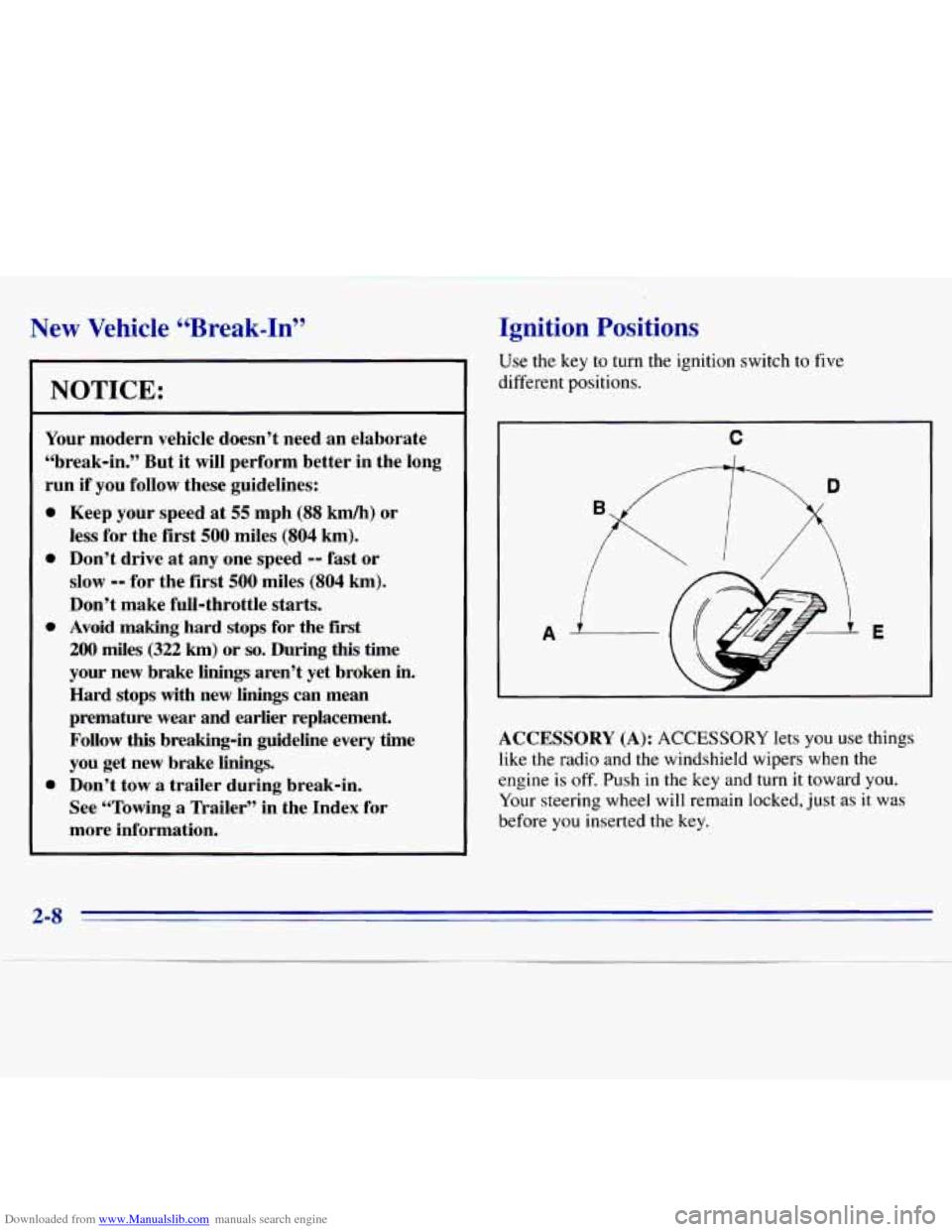
Ignition Positions
Use the key to turn the ignition switch to five
different positions.
A
C
E
ACCESSORY (A): ACCESSORY lets you use things
like the radio and the windshield wipers when the
engine is off. Push in
the key and turn it toward you.
Your steering wheel will remain locked, just as
it was
before you inserted the key.
2-8
Page 66 of 375
Downloaded from www.Manualslib.com manuals search engine It is dangerous to get out of your vehicle if the
shift lever
is not fully in,PARK (P) with the ’
parking brake firmly set. Your vehicle can roll.
Don’t leave your vehicle when the engine is
running unless you have to.
If you have left the
engine running, the vehicle can move suddenly.
You or others could be injured. To be sure your
vehicle won’t move, even when you’re on fairly
level ground, always set your parking brake and
move the shift .lever to PARK
(P).
If you have four-wheel drive, your vehicle
will be free to roll
-- even .if your shift lever
is in PARK (P) -- if your transfer case is in
NEUTRAL (N). So, be sure the transfer case is in
a drive gear, two-wheel high (2HI) or four-wheel
high (4HI) or four-wheel low (4LO)
-- not in
NEUTRAL
(N). See “Shifting Into PARK (P)” in
the Index.
If you’re pulling a trailer, see “Towing
a Trailer” in the Index. Ensure’ the shift lever
is €ully in PARK (P) range
before starting the engine. Your vehicle has a
brake-transmission shift interlock. You have to fully
apply your regular brakes before you can shift from
PARK (P) when the ignition key is
ii.1 the RUN position.
If you cannot shift out of PARK (P), ease pressure on
the shift lever
-- push the shift lever all the way into
PARK (P) as you maintain brake application. Then
move the shift lever into the gear you wish. See
“Shifting Out of PARK (P)” in the Index.
REVERSE (R): Use this gear to back up.
NOTICE:
Shifting to REVERSE (R) while your vehicle is
moving forward could damage your transmission.
Shift to REVERSE (Rjonly after your vehicle
is stopped.
To rock your vehicle back and forth to get out of snow,
ice
or sand without damaging your transmission, see
“Stuck in Sand, Mud, Ice
or Snow” in the Index.
2-15
Page 68 of 375
Downloaded from www.Manualslib.com manuals search engine FIRST (1): This position gives you even more power
(but lower fuel economy) than
SECOND (2). You can
use it on very steep hills, or in deep snow or mud. If the
selector lever
is put in FIRST (1) while the vehicle is
moving forward, the transmission won’t shift into
FIRST (1) until the vehicle is going slowly enough.
1 NOTICE:
If your rear wheels can’t rotate, don’t try to
drive. This might happen if you were stuck in
very deep sand or mud or were up against
a solid
object.
You could damage your transmission.
Also, if you stop when going uphill, don’t hold
your vehicle there with only the accelerator pedal.
This could overheat and damage the transmission.
Use your brakes or shift into
PARK (P) to hold
your vehicle in position on a hill.
Manual Transmission
5-Speed
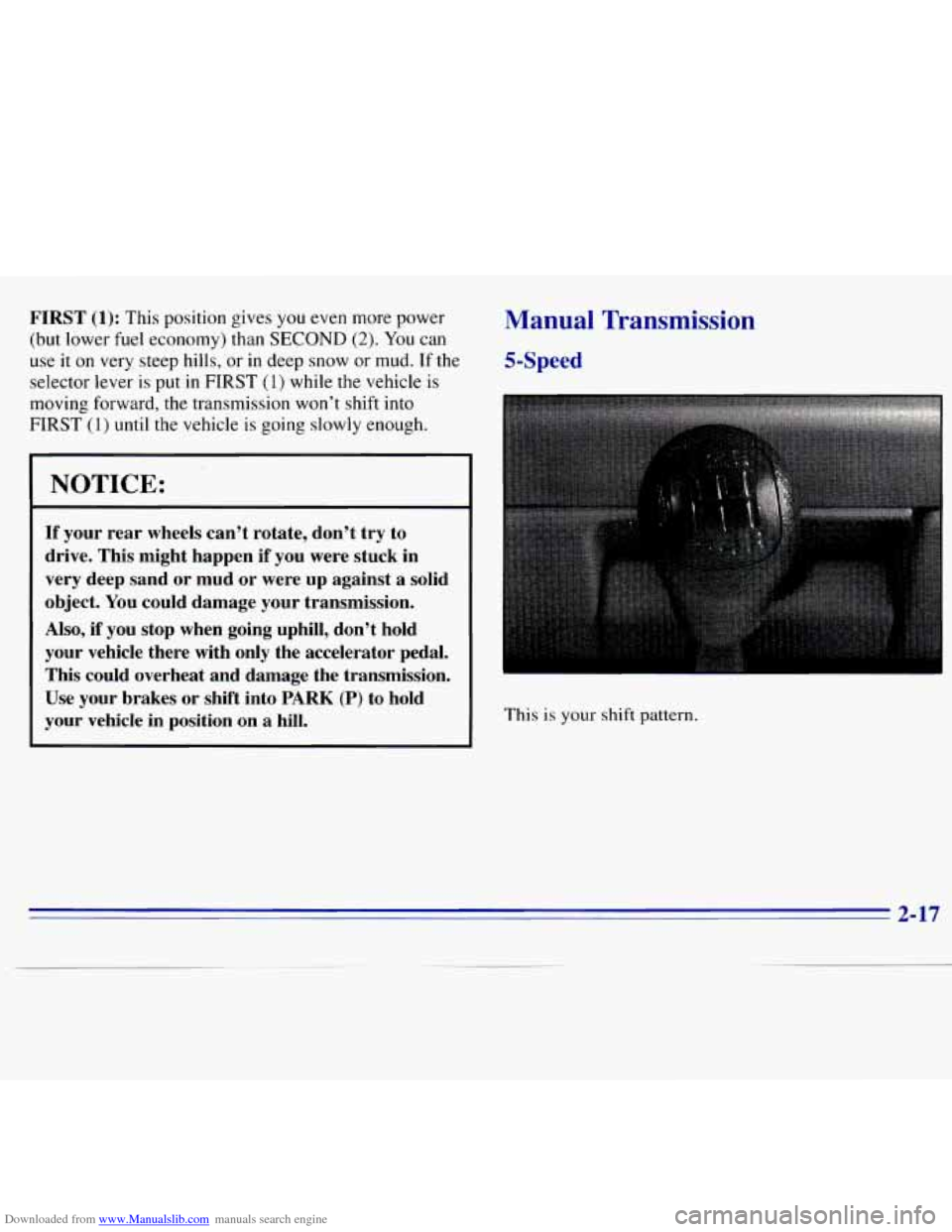
This is your shift pattern.
2-17
Page 69 of 375
Downloaded from www.Manualslib.com manuals search engine Here’s how to operate your transmission:
FIRST (1): Press the clutch pedal and shift into
FIRST
(1). Then, slowly let up on the clutch pedal
as you press the accelerator pedal.
You can shift into FIRST (1) when you’re going less
than
20 mph (32 km/h). If you’ve come to a complete
stop and it’s hard to shift into FIRST
(l), put the shift
lever
in NEUTRAL (N) and let up on the clutch. Press
the clutch pedal back down. Then shift into FIRST (1).
SECOND (2): Press the clutch pedal as you let up on
the accelerator pedal and shift into SECOND (2). Then,
slowly let up
on the clutch pedal as you press the
accelerator pedal.
THIRD, FOURTH AND FIFTH (3,4 and 5): Shift
into THIRD
(3), FOURTH (4) and FIFTH (5) the
same way
you do for SECOND (2). Slowly let up on
the clutch pedal as you press the accelerator pedal.
To stop, let up on the accelerator pedal and press the
brake pedal. Just before the vehicle stops, press the
clutch pedal and the brake pedal, and shift
to
NEUTRAL (N).
NEUTRAL (N): Use this position when you start or
idle your engine.
REVERSE (R): To back up, press the clutch pedal
down, wait about six seconds, then shift into
REVERSE (R). Then let up on the clutch pedal
slowly while pressing
the accelerator pedal.
riGCE:
Shift to REVERSE (R) only after your vehicle is
stopped. Shifting to
REVERSE (R) while your
vehicle is moving could damage your transmission.
Use REVER$E (R), along with the parking brake, for
parking your vehicle.
2-18
Page 72 of 375
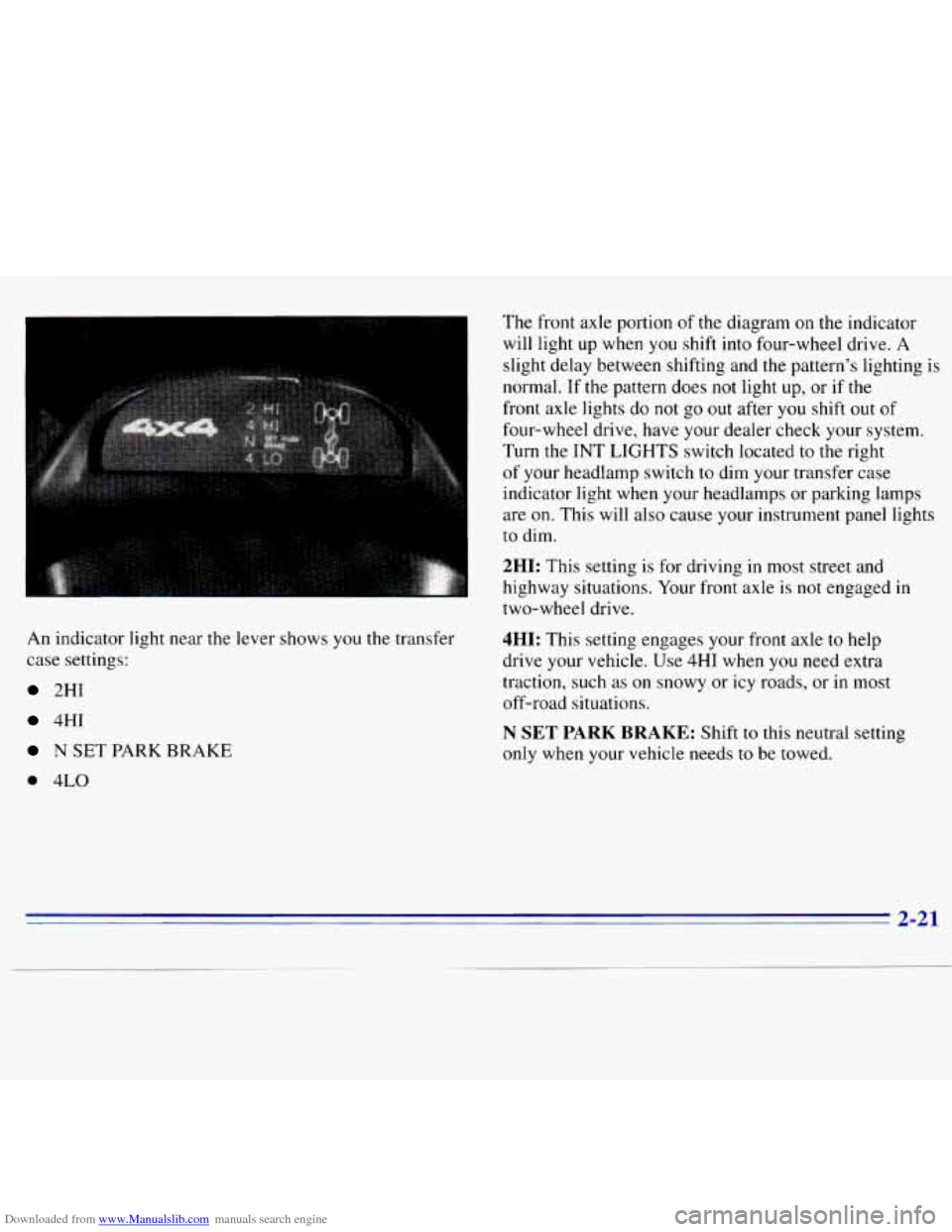
Downloaded from www.Manualslib.com manuals search engine An indicator light near the lever shows you the transfer
case settings:
2HI
4HI
N SET PARK BRAKE
0 4LO
The front axle portion of the diagram on the indicator
will light up when you shift into four-wheel drive.
A
slight delay between shifting and the pattern’s lighting is
normal. If the pattern does not light up, or if
the
front axle lights do not go out after you shift out of
four-wheel drive, have your dealer check your system.
Turn the INT
LIGHTS switch located to the right
of your headlamp switch to dim your transfer case
indicator light when your headlamps or parking lamps
are on. This will also cause your instrument panel lights
to dim.
2HI: This setting is for driving in most street and
highway situations. Your front axle is not engaged
in
two-wheel drive.
4HI: This setting engages your front axle to help
drive your vehicle. Use
4HI when you need extra
traction, such as
on snowy or icy roads, or in most
off-road situations.
N SET PARK BRAKE: Shift to this neutral setting
only when your vehicle needs to be towed.
2-21
Page 73 of 375
Downloaded from www.Manualslib.com manuals search engine 4LO: This setting also engages your front axle to give
you extra traction and provides extra gear reduction.
You may never need 4LO. It sends the maximum power
to all four wheels. You might choose 4LO
if you were
driving off-road in sand, mud, or deep snow and
climbing or descending steep hills.
You can shift from 2HI to 4HI or from 4HI to 2HI while
the vehicle is moving.
Do not press the transfer case
shift lever button when shifting from 2HI to 4HI
or from
4HI to 2HI. Your front axle will engage faster
if you
take your foot
off of the accelerator for a few seconds
after you shift.
To shift your transfer case into
N SET PARK BRAKE:
1. Stop the vehicle and shift your transmission into
2. Set the parking brake. Your vehicle can roll unless
NEUTRAL
(N).
the brakes
are applied.
3. Pull the transfer case shift lever into N SET
PARK BRAKE.
To shift into or out of 4LO:
1. The vehicle must be moving less than 3 mph
(4.8
km) with the transmission in NEUTRAL (N)
for an automatic transmission. For a ,manual
transmission, the clutch pedal must be engaged. The
preferred method for shifting into 4LO is to have
your vehicle moving 1 to 2 mph (1.6 to 3.2 km/h).
2. Press the transfer case shift button and shift in one
continuous motion.
Don’t pause in
N SET PARK BRAKE as you shift into
or out
of 4L0, or your gears could clash.
Remember that driving in 4HI or
4LO may reduce
fuel economy. Also, driving in four-wheel drive
on
dry pavement could cause your tires to wear faster and
make your transfer case harder to shift and reduce
powertrain longevity.
2-22
Page 76 of 375
Downloaded from www.Manualslib.com manuals search engine Parking Brake
To set the parking brake, hold the regular brake pedal
down with your right foot. Push down the parking brake
pedal with your left foot. If the ignition is on, the brake
system warning light will come on.
To release the parking brake hold the regular brake
pedal down.
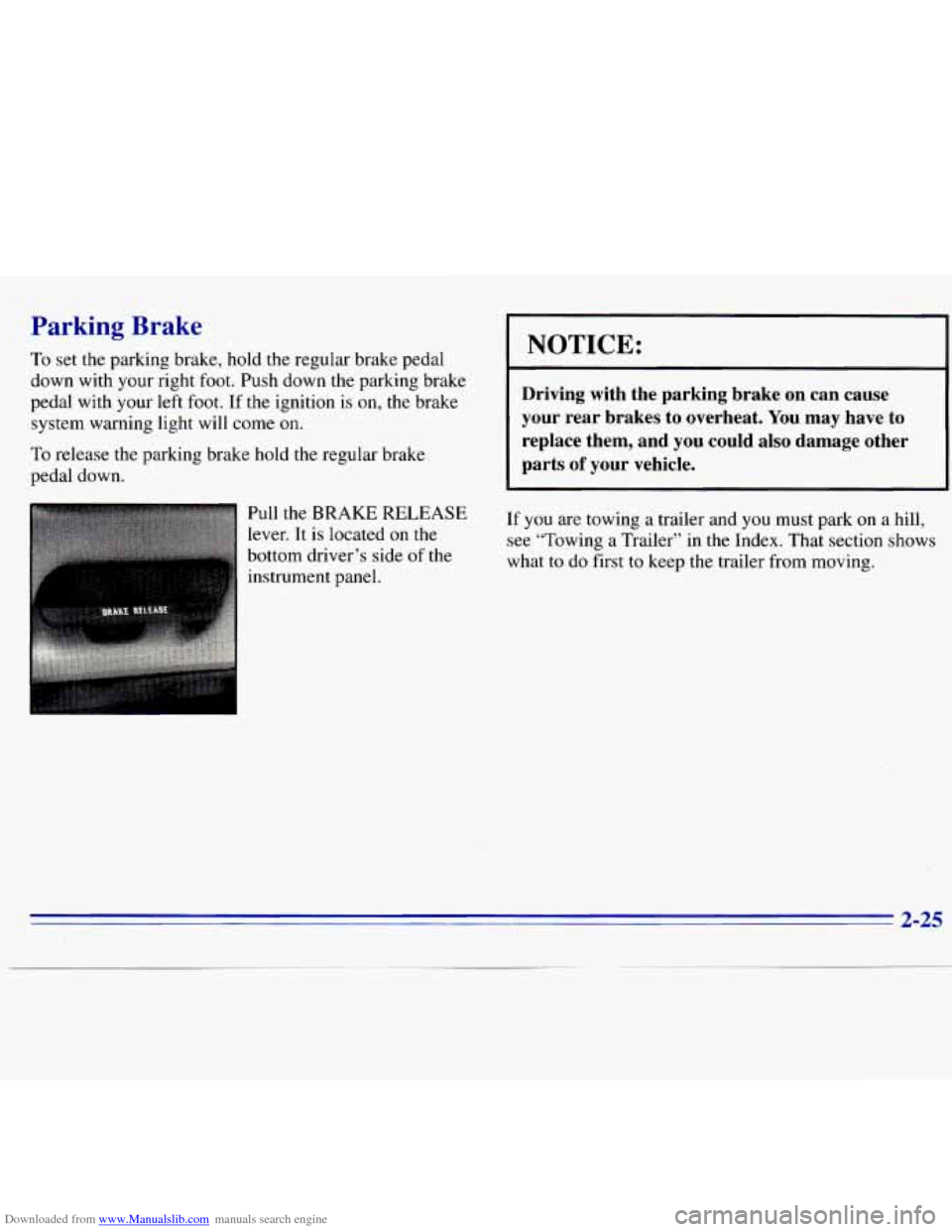
lr Pull the BRAKE RELEASE
lever. It is located on the
bottom driver’s side of
the
instrument panel.
I NOTICE:
Driving with the parking brake on can cause
your rear brakes to overheat. You may have to
replace them, and you could also damage other
parts
of your vehicle.
If you are towing a trailer and you must park on a hill,
see “Towing a Trailer” in the Index. That section shows
what to do first
to keep the trailer from moving.
2-25
Page 77 of 375
Downloaded from www.Manualslib.com manuals search engine Shifting Into PARK (P)
(Automatic Tkansmission Models Only)
1. Hold the brake pedal down with your right foot
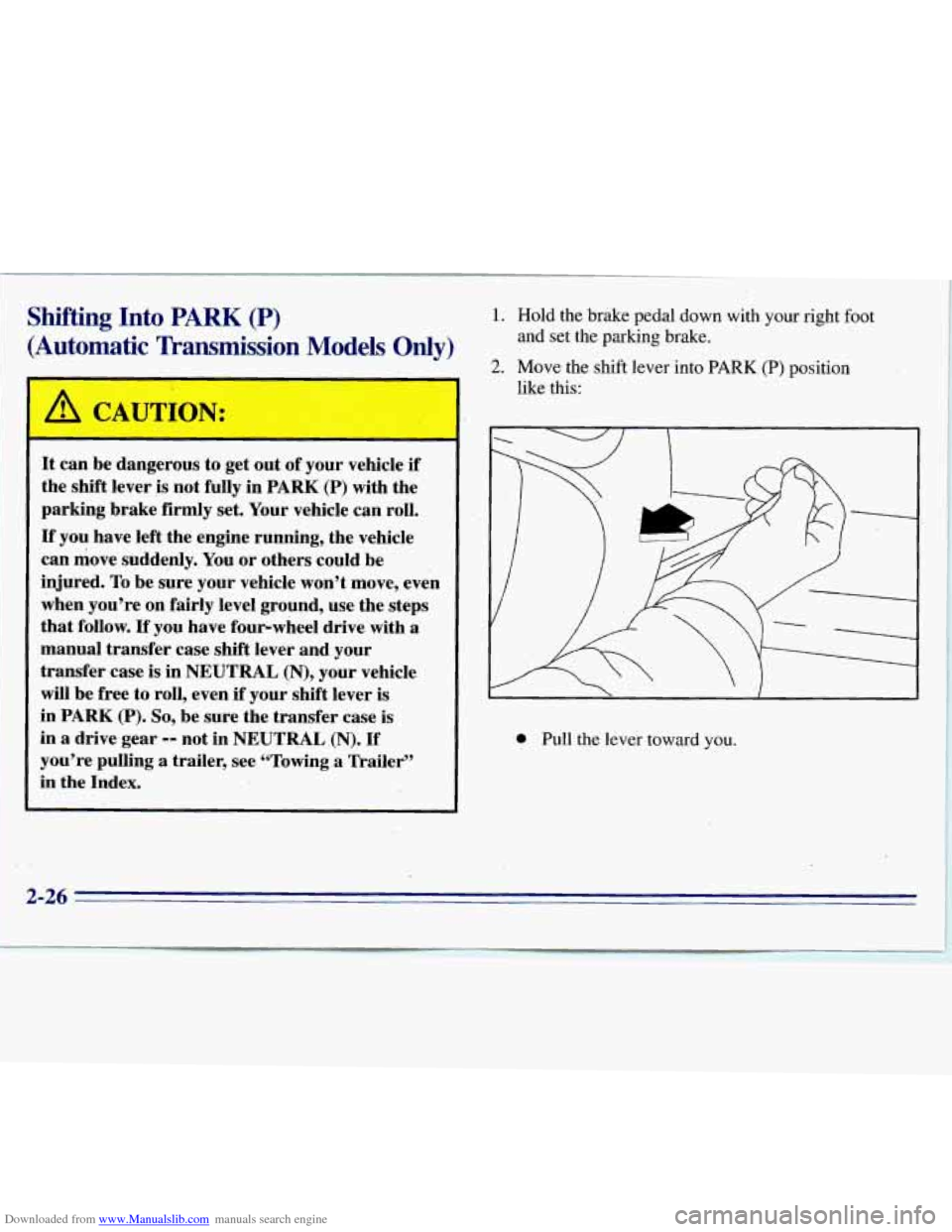
2. Move the shift lever into PARK (P) position
and set the parking brake.
..
It can be dangerous to get out of your vehicle if
the shift lever
is not fully in PARK (P) with the
parking. brake
firmly set. Your vehicle can roll.
If you have left the engine running, the vehicle
can move suddenly.
You or others could be
injured. To be sure your vehicle won’t move, even
when you’re on
fairly level ground, use the steps
that follow.
If you have four-wheel drive with a
manual transfer case shift lever and your
transfer case
is in NEUTRAL (N), your vehicle
will be free to roll, even
if your shift lever is
in
PARK (P). So, be sure the transfer case is
in
a drive gear -- not in NEUTRAL.(N). If
you’re pulling a trailer, see “Towing a Trailer”
in the Index. like this:
I
0 Pull the lever toward you.
2-26
!