trailer CHEVROLET S10 1996 2.G Owners Manual
[x] Cancel search | Manufacturer: CHEVROLET, Model Year: 1996, Model line: S10, Model: CHEVROLET S10 1996 2.GPages: 375, PDF Size: 20.73 MB
Page 59 of 375
Downloaded from www.Manualslib.com manuals search engine New Vehicle “Break-In”
NOTICE:
Your modern vehicle doesn’t need an elaborate
“break-in.” But it will perform better in the long
run if you follow these guidelines:
0
0
0
0
Keep your speed at 55 mph (88 km/h) or
less for the first
500 miles (804 km).
Don’t drive at any one speed
-- fast or
slow
-- for the first 500 miles (804 km).
Don’t make full-throttle starts.
Avoid making hard stops for the first
200 miles (322 km) or so. During this time
your new brake linings aren’t yet broken in.
Hard stops with new linings can mean
premature wear and earlier replacement.
Follow this breaking-in guideline every time
you get new brake linings.
Don’t tow
a trailer during break-in.
See “Towing a Trailer” in the Index for
more information.
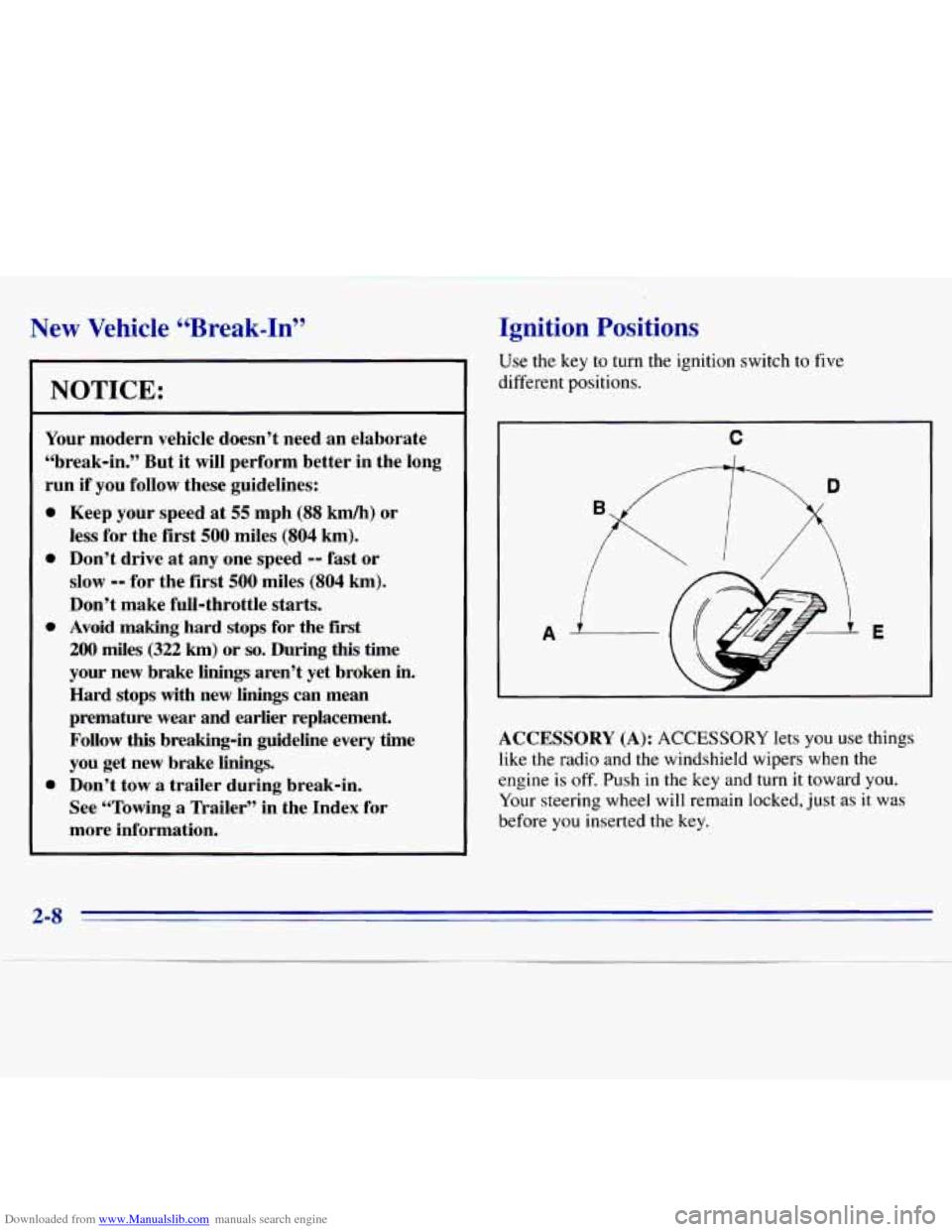
Ignition Positions
Use the key to turn the ignition switch to five
different positions.
A
C
E
ACCESSORY (A): ACCESSORY lets you use things
like the radio and the windshield wipers when the
engine is off. Push in
the key and turn it toward you.
Your steering wheel will remain locked, just as
it was
before you inserted the key.
2-8
Page 66 of 375
Downloaded from www.Manualslib.com manuals search engine It is dangerous to get out of your vehicle if the
shift lever
is not fully in,PARK (P) with the ’
parking brake firmly set. Your vehicle can roll.
Don’t leave your vehicle when the engine is
running unless you have to.
If you have left the
engine running, the vehicle can move suddenly.
You or others could be injured. To be sure your
vehicle won’t move, even when you’re on fairly
level ground, always set your parking brake and
move the shift .lever to PARK
(P).
If you have four-wheel drive, your vehicle
will be free to roll
-- even .if your shift lever
is in PARK (P) -- if your transfer case is in
NEUTRAL (N). So, be sure the transfer case is in
a drive gear, two-wheel high (2HI) or four-wheel
high (4HI) or four-wheel low (4LO)
-- not in
NEUTRAL
(N). See “Shifting Into PARK (P)” in
the Index.
If you’re pulling a trailer, see “Towing
a Trailer” in the Index. Ensure’ the shift lever
is €ully in PARK (P) range
before starting the engine. Your vehicle has a
brake-transmission shift interlock. You have to fully
apply your regular brakes before you can shift from
PARK (P) when the ignition key is
ii.1 the RUN position.
If you cannot shift out of PARK (P), ease pressure on
the shift lever
-- push the shift lever all the way into
PARK (P) as you maintain brake application. Then
move the shift lever into the gear you wish. See
“Shifting Out of PARK (P)” in the Index.
REVERSE (R): Use this gear to back up.
NOTICE:
Shifting to REVERSE (R) while your vehicle is
moving forward could damage your transmission.
Shift to REVERSE (Rjonly after your vehicle
is stopped.
To rock your vehicle back and forth to get out of snow,
ice
or sand without damaging your transmission, see
“Stuck in Sand, Mud, Ice
or Snow” in the Index.
2-15
Page 76 of 375
Downloaded from www.Manualslib.com manuals search engine Parking Brake
To set the parking brake, hold the regular brake pedal
down with your right foot. Push down the parking brake
pedal with your left foot. If the ignition is on, the brake
system warning light will come on.
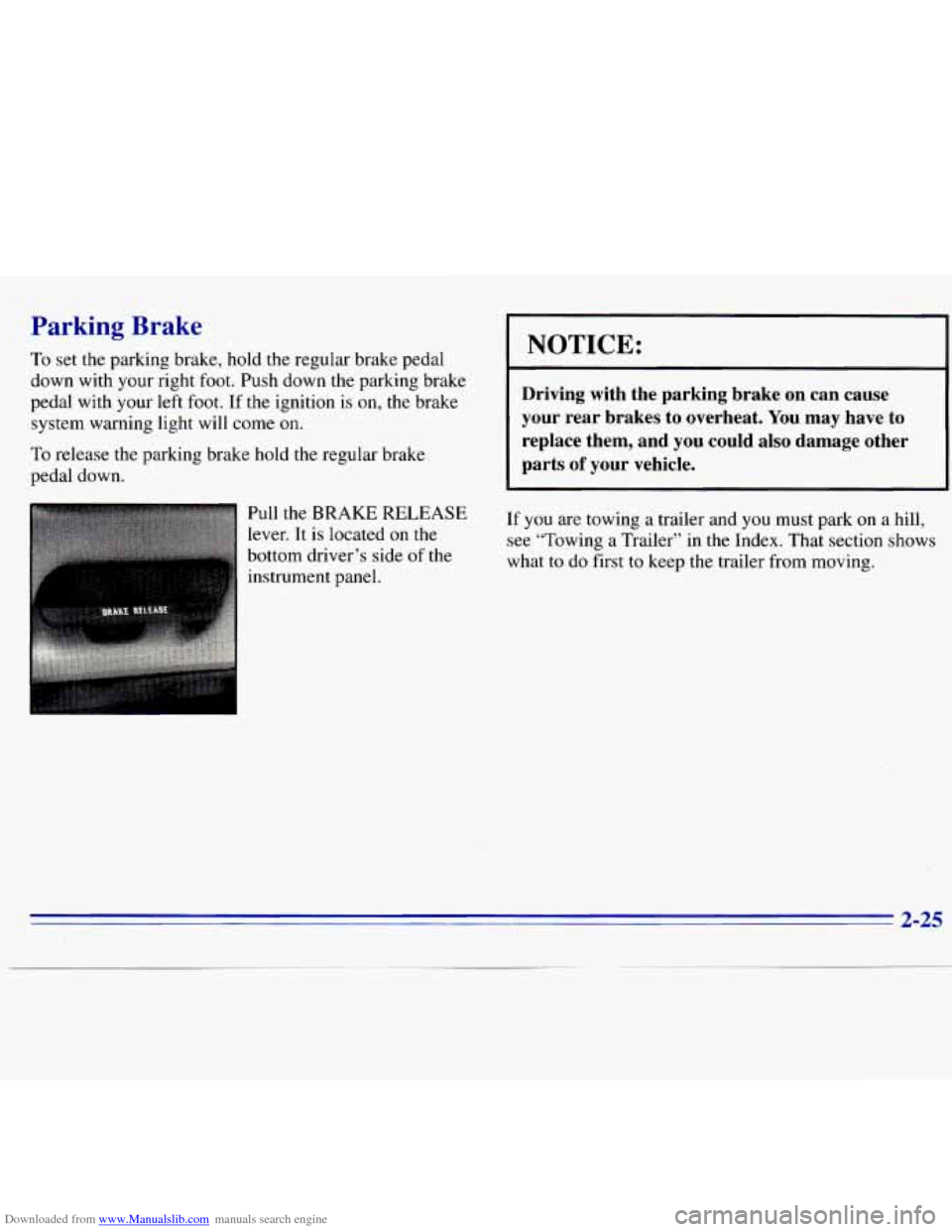
To release the parking brake hold the regular brake
pedal down.
lr Pull the BRAKE RELEASE
lever. It is located on the
bottom driver’s side of
the
instrument panel.
I NOTICE:
Driving with the parking brake on can cause
your rear brakes to overheat. You may have to
replace them, and you could also damage other
parts
of your vehicle.
If you are towing a trailer and you must park on a hill,
see “Towing a Trailer” in the Index. That section shows
what to do first
to keep the trailer from moving.
2-25
Page 77 of 375
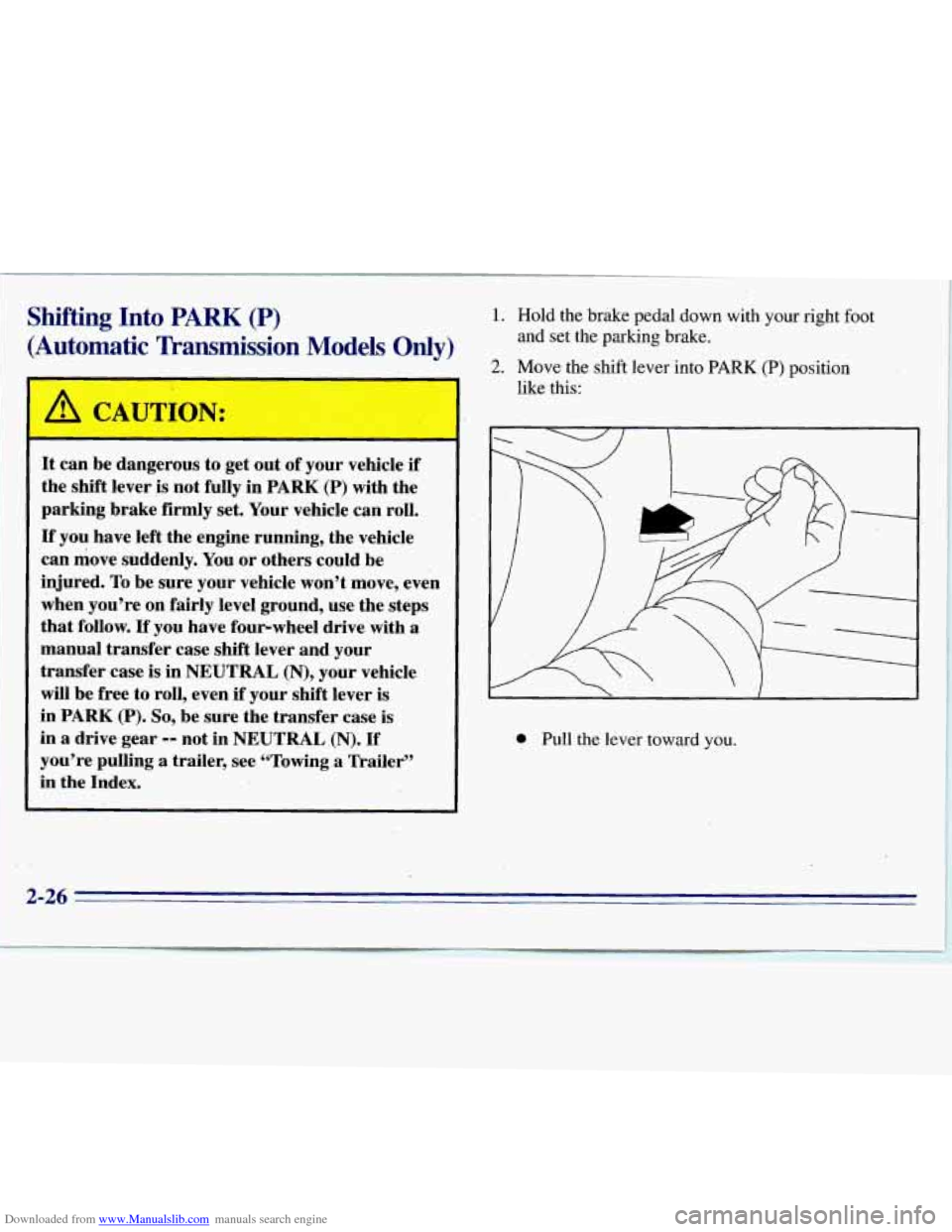
Downloaded from www.Manualslib.com manuals search engine Shifting Into PARK (P)
(Automatic Tkansmission Models Only)
1. Hold the brake pedal down with your right foot
2. Move the shift lever into PARK (P) position
and set the parking brake.
..
It can be dangerous to get out of your vehicle if
the shift lever
is not fully in PARK (P) with the
parking. brake
firmly set. Your vehicle can roll.
If you have left the engine running, the vehicle
can move suddenly.
You or others could be
injured. To be sure your vehicle won’t move, even
when you’re on
fairly level ground, use the steps
that follow.
If you have four-wheel drive with a
manual transfer case shift lever and your
transfer case
is in NEUTRAL (N), your vehicle
will be free to roll, even
if your shift lever is
in
PARK (P). So, be sure the transfer case is
in
a drive gear -- not in NEUTRAL.(N). If
you’re pulling a trailer, see “Towing a Trailer”
in the Index. like this:
I
0 Pull the lever toward you.
2-26
!
Page 80 of 375
Downloaded from www.Manualslib.com manuals search engine Parking Your Vehicle
(Manual Transmission Models
Only)
If you have four-wheel drive with a manual transfer case
shift lever, be sure your transfer case is in a drive gear.
Your vehicle could roll if it isn’t.
If you are parking
on a hill or pulling a trailer, see
“Towing a Trailer” in the Index.
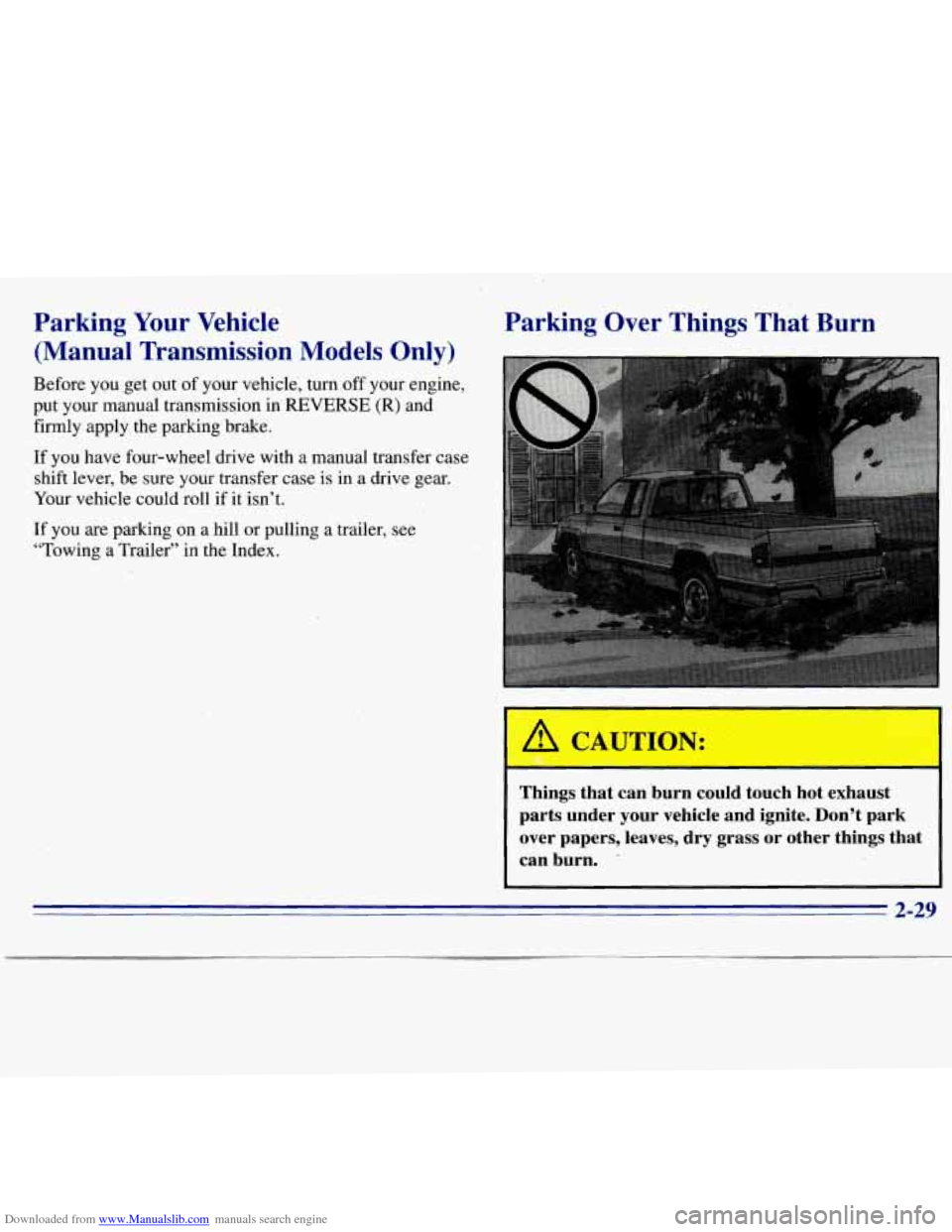
Parking Over Things That Burn
Before you get out of your vehicle’, turn off your engine,
put your manual transmission in
REVERSE (R) and
firmly apply the parking brake.
Things that can burn could touch hot exhaust
parts under your vehicle and ignite. Don’t park
over papers, leaves, dry grass or other things that
can burn.
-
2-29
Page 82 of 375
Downloaded from www.Manualslib.com manuals search engine I b CAUTION:
-
It can be dangerous to get out of your vehicle if
the shift lever
is not fully in PARK (P) with the
parking brake firmly set. Your vehicle can roll.
Don’t leave your vehicle when the engine
is
running unless you have to. If you’ve left the
engine running, the vehicle can move suddenly.
You or others could be injured.
To be sure your
vehicle won’t move, even when you’re on fairly
level ground, always set your parking brake and
move the shift lever
to PARK (P). !
If you have four-wheel drive with a manual transfer case
shift lever and your transfer case is in NEUTRAL (N),
your vehicle will be free to roll, even if your shift lever
is in PARK
(P). So, be sure the transfer case is in a drive
gear
-- not in NEUTRAL (N). Always set your parking
brake. Follow the proper steps to be sure your vehicle
won’t move. See “Shifting Into PARK
(P)” in the Index.
If you’re pulling a trailer, see “Towing a Trailer’’ in
the Index.
Windows
Manual Windows
Turn the hand crank on each door to raise or lower your
m&ual side door windows.
Power Windows (Option)
If you have the optional power windows, the controls
are on each of the side doors. Your power windows will
only work when the ignition has been turned to RUN.
The driver’s door has a switch for the passenger’s
window as well.
2-3 1
Page 86 of 375
Downloaded from www.Manualslib.com manuals search engine If a bulb is burned out, replace it to help avoid an
accident. If the arrows don’t go
on at all when you
signal a turn, check the fuse (see “Fuses and Circuit
Breakers” in the Index) and for burned-out bulbs.
If
you have a trailer towing option with added wiring for
the trailer lamps,
a different turn signal flasher is used.
With this flasher installed, the signal indicator will flash
even if a turn signal bulb is burned out. Check the front
and rear turn signal lamps regularly to make sure they
are working.
Headlamp High/Low Beam Changer
To change the headlamps from low-beam to high or
high to low, pull the multifunction lever all the way
toward you. Then release it.
When the high-beam
headlamps are
on, this
indicator light
on the
instrument panel also
will be
on.
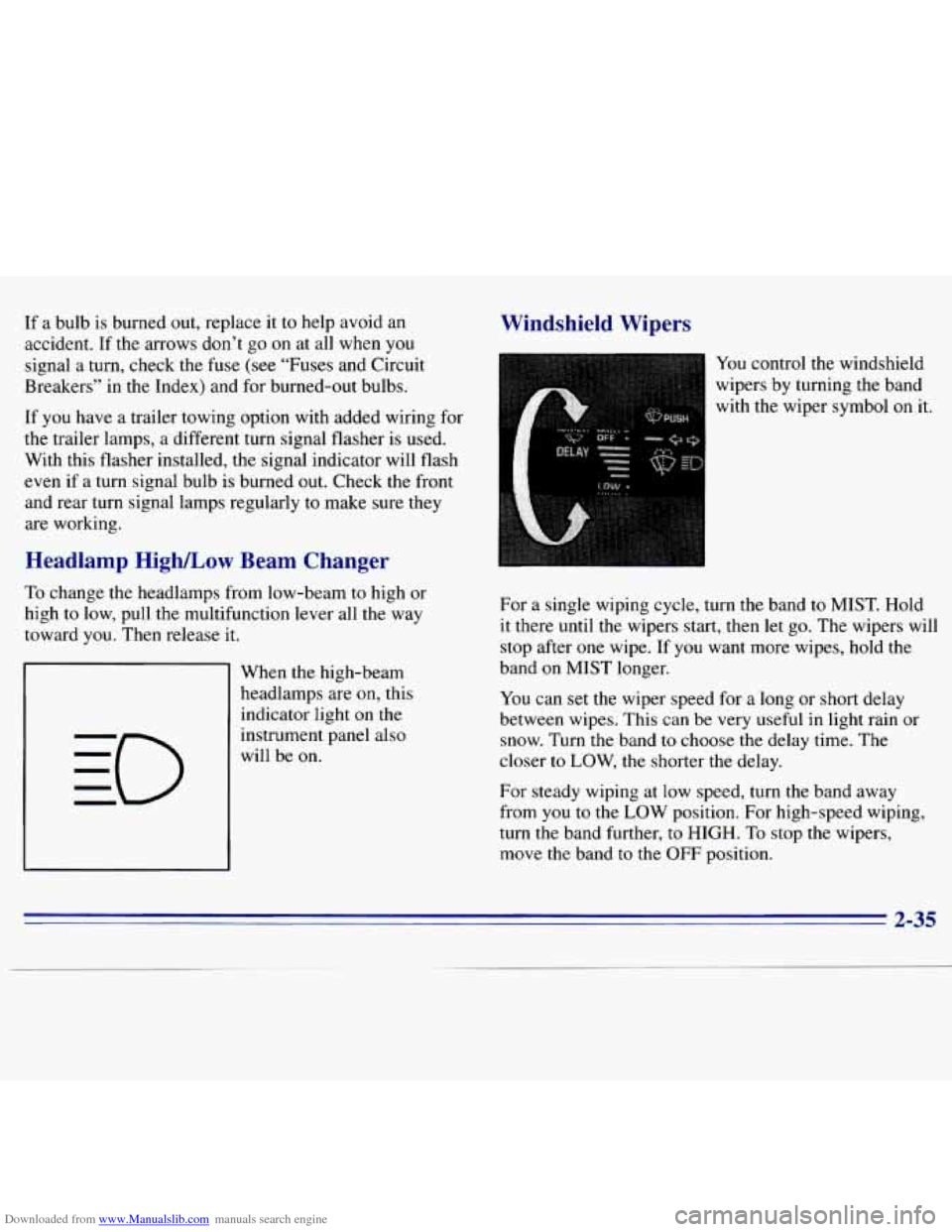
Windshield Wipers
You control the windshield
wipers by turning the band
with the wiper symbol
on it.
For a single wiping cycle, turn the band
to MIST. Hold
it there until the wipers start, then let go. The wipers will
stop after one wipe. If you want more wipes, hold the
band
on MIST longer.
You can set the wiper speed for a long or short delay
between wipes. This can be very useful in light rain or
snow. Turn the band
to choose the delay time. The
closer
to LOW, the shorter the delay.
For steady wiping at
low speed, turn the band away
from
you to the LOW position. For high-speed wiping,
turn the band further,
to HIGH. To stop the wipers,
move the band
to the OFF position.
2-35
Page 109 of 375
Downloaded from www.Manualslib.com manuals search engine NOTICE:
~~
If you keep driving your vehicle with this light
on, after a while, your emission controls may not work as well, your fuel economy may not be as
good and your engine may not run as smoothly.
This could lead to costly repairs that may not be
covered by your warranty.
This light should come on, as a check to show you it is
working, when the ignition is on and the engine is not
running. If the light doesn’t come on, have
it repaired.
This light will also come
on during a malfunction in one
of two ways:
Light Flashing -- A misfire condition has been
detected. A misfire increases vehicle emissions and
may damage the emission control system on your
vehicle. Dealer or qualified service center diagnosis
and service is required.
Light On Steady -- An emission control system
malfunction has been detected on your vehicle.
Dealer or qualified service center diagnosis and
service may be required.
If the Light Is Flashing
The following may prevent more serious damage to
your vehicle:
Reduce vehicle speed.
0 Avoid hard accelerations.
Avoid steep uphill grades.
0 If towing a trailer, reduce the amount of cargo being
hauled as soon as
it is possible.
If the light
stops flashing and remains on steady, see “If
the Light
Is On Steady” following.
If
the light continues to flash, when it is safe to do so,
stop the vehicle. Put your vehicle in PARK (P). Turn the
key off, wait at least
10 seconds and restart the engine.
If the light remains on steady, see “If the Light
Is On
Steady” following. If
the light is still flashing follow the
previous steps, and drive the vehicle to your dealer or
qualified service center for service.
2-58
Page 173 of 375
Downloaded from www.Manualslib.com manuals search engine Loading Your Vehicle
< SEE OWNER'S MANUAL FOR ADDITIONAL INFORMATION uu-
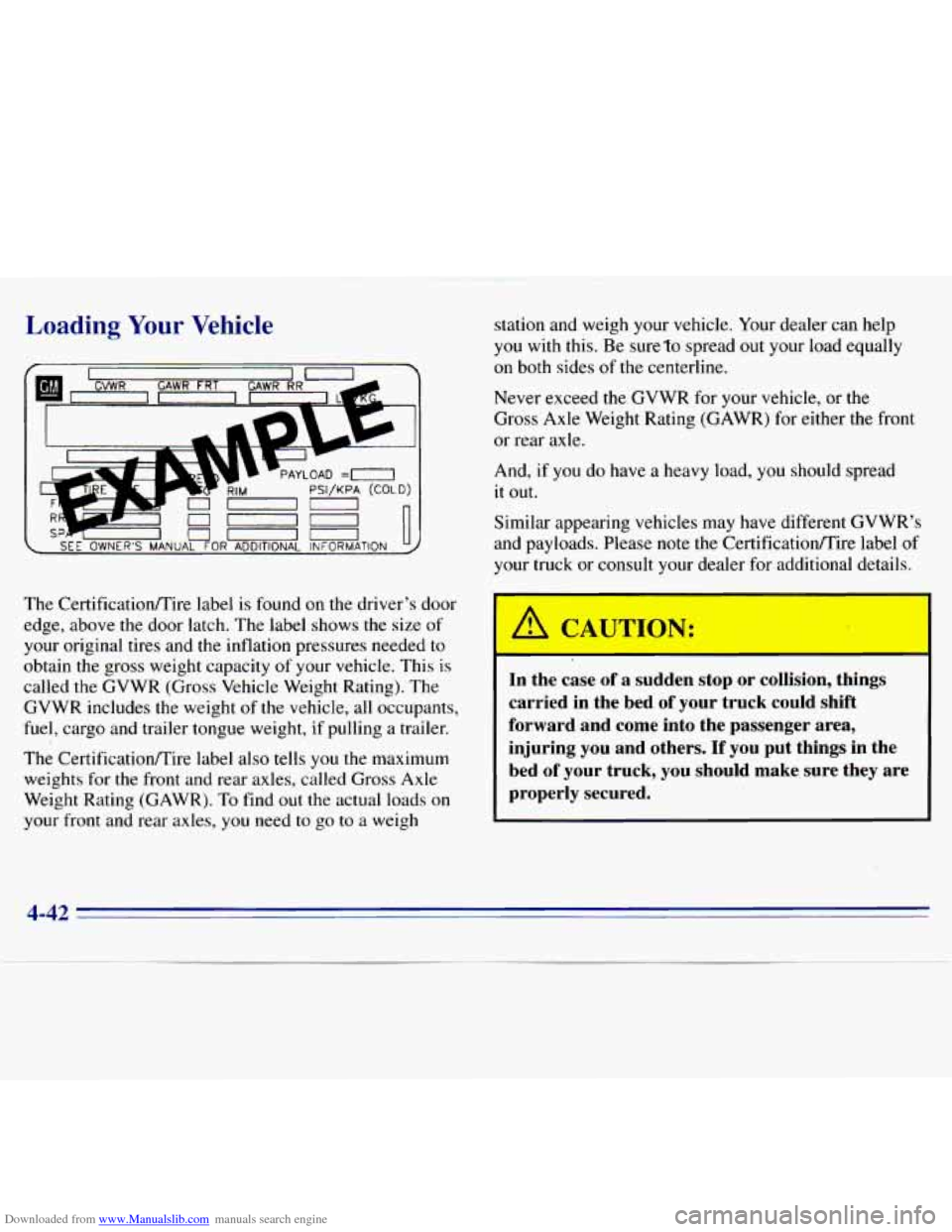
The CertificatiodTire label is found on the driver's door
edge, above
the door latch. The label shows the size of
your original tires and the inflation pressures needed to
obtain the gross weight capacity of your vehicle. This is
called the GVWR (Gross Vehicle Weight Rating). The
GVWR includes the weight
of the vehicle, all occupants,
fuel, cargo and trailer tongue weight, if pulling a trailer.
The Certificationmire label also
tells you the maximum
weights for the front and rear axles, called Gross Axle
Weight Rating (GAWR). To find out the actual loads
on
your front and rear axles, you need to go to a weigh station and weigh your vehicle.
Your dealer can help
you with this. Be sure'to spread out your load equally
on both sides of the centerline.
Never exceed the GVWR for your vehicle, or
the
Gross Axle Weight Rating (GAWR) for either the front
or rear axle.
And, if you do have a heavy load, you should spread
it out.
Similar appearing vehicles may have different GVWR's
and payloads. Please note the Certificationire label
of
your truck or consult your dealer for additional details.
I
. A CAUTION:
I
In the case of a sudden stop or collision, things
carried in the bed of your truck could shift
forward and come into the passenger area,
injuring you and others.
If you put things in the
bed of your truck, you should make, sure they are
properly secured.
4-42
Page 177 of 375
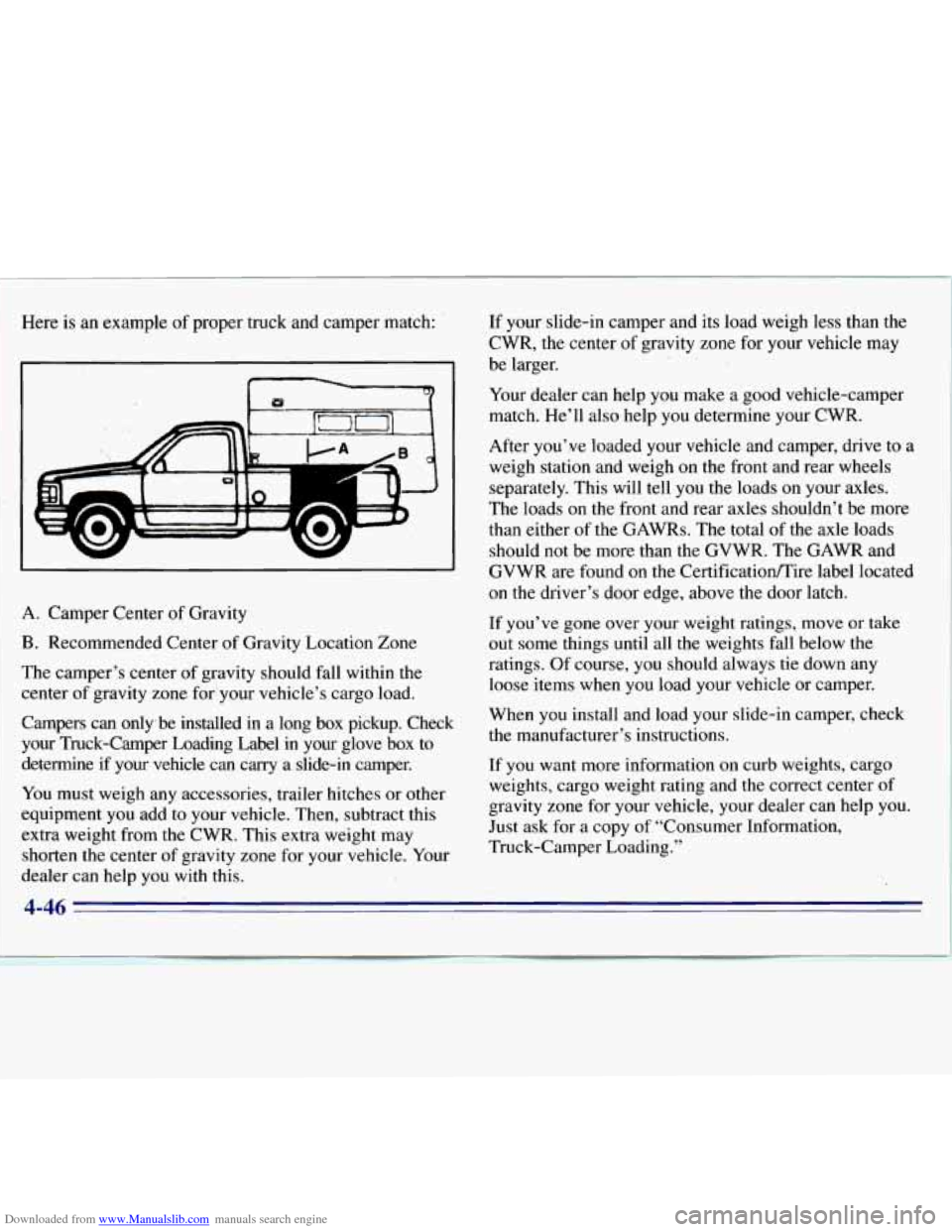
Downloaded from www.Manualslib.com manuals search engine Here is an example of proper truck and camper match:
I .c
J
A. Camper Center of Gravity
B. Recommended Center of Gravity Location Zone
The camper’s center of gravity should fall within the
center
of gravity zone for your vehicle’s cargo load.
Campers can only,be installed
in a long box pickup. Check
your Truck-Camper Loading Label
in your glove box to
determine if your vehicle can carry a slide-in camper.
You must weigh any accessories, trailer hitches or other
equipment
you add to your vehicle. Then, subtract this
extra weight from the CWR. This extra weight may
shorten the center of gravity zone for your vehicle. Your
dealer can help you with this.
I
I
~ - ~~~ - ~~
~~
If your slide-in camper and its load weigh less than the
CWR, the center of gravity zone for your vehicle may
be larger.
Your dealer can help you make a good vehicle-camper
match. He’ll also help you determine your CWR.
After you’ve loaded your vehicle and camper, drive
to a
weigh station and weigh on
the front and rear wheels
separately. This will tell you the loads on your axles.
The loads on the front and rear axles shouldn’t be more
than either of the GAWRs. The total of the axle loads
should
not be more than the GVWR. The GAWR and
GVWR are found on the Certification/Tire label located
on the driver’s door edge, above the door latch.
If you’ve gone over your weight ratings, move
or take
out some things until all the weights fall below the
ratings. Of course, you should always tie down any
loose items when you load your vehicle or camper.
When you install and load your slide-in camper, check
the manufacturer’s instructions.
If you want more information on curb weights, cargo
weights, cargo weight rating and the correct center
of
gravity zone for your vehicle, your dealer can help you.
Just ask for a copy of “Consumer Information,
Truck-Camper Loading.”