manual transmission CHEVROLET S10 1997 2.G User Guide
[x] Cancel search | Manufacturer: CHEVROLET, Model Year: 1997, Model line: S10, Model: CHEVROLET S10 1997 2.GPages: 402, PDF Size: 21.04 MB
Page 89 of 402
Downloaded from www.Manualslib.com manuals search engine Incrleasing Speed While Using Cruise Control
There are two ways to..go: to a hi.gher speed:
U.se the ac.cel:eratsr pedal to get to the higher speed.
press the :button at the md of the lever, then reIea.se
the button and the accelerator p.edal. You'll now
cruise-at the higher
speed.
0 'Move the cruise switch froin ON to R/A. Hold it
tlwe until
y0.u get up to the speed you want, and
then
release tkswitch. (To increase your speed in
very small amounts, move the switch to
WA. Each
time you dcj this, your vehicle will g.o about 1 mph
1.4 kdh) faster;)
Reducing Speed While Using- Cruise C-ontrol
Press in the. hutton- at the endof ,the lever until you reach
the lower s.peed you want, then release it.
To slaw down in very small amounts., press the button
for
.less than a half a second. Each time you do: this,
you'll go 1 mph (1.6 km/h) slower.
Passing Another Vehicle While Using. .Cruise Contml
Use the :accelerator pe.dal to increase pur speed. When
you take your foot off the pedal, yQur vehicle will slow
down to the cmise control -speed you
set earlier:
Using Cruise. Control an Hills
How well your cruise control will work an hills depeads
upon your spee"d, load .and the steepmss of the hills.
When going. up steep
hills, you may want to step on the
accelerator pedal to maintain'your speed. When
going
downhill, you may have to bcake o? shift tba lower gear
to keep your speed down. Of course, applying the brake-
takes you out of cruise control. Many-drivers find this to
b,e too much trouble and don't use cruise cc -01 on
steep. hills.
Ending Cruise Controf
Th.ere.are. two ways to.turn off the cruise control:
O Step lightly on the brake, pedal or push .the clutch
pedal, if you have a manual transmission.
0 Move the cruise switch to OFF.
Erasing Speed Memory
When you turn off the cruise control or the ignition,
your c.ruise control set speed mernmy is erased.
2-42
Page 110 of 402
Downloaded from www.Manualslib.com manuals search engine Shift Light Check Gages Light.
SHIFT
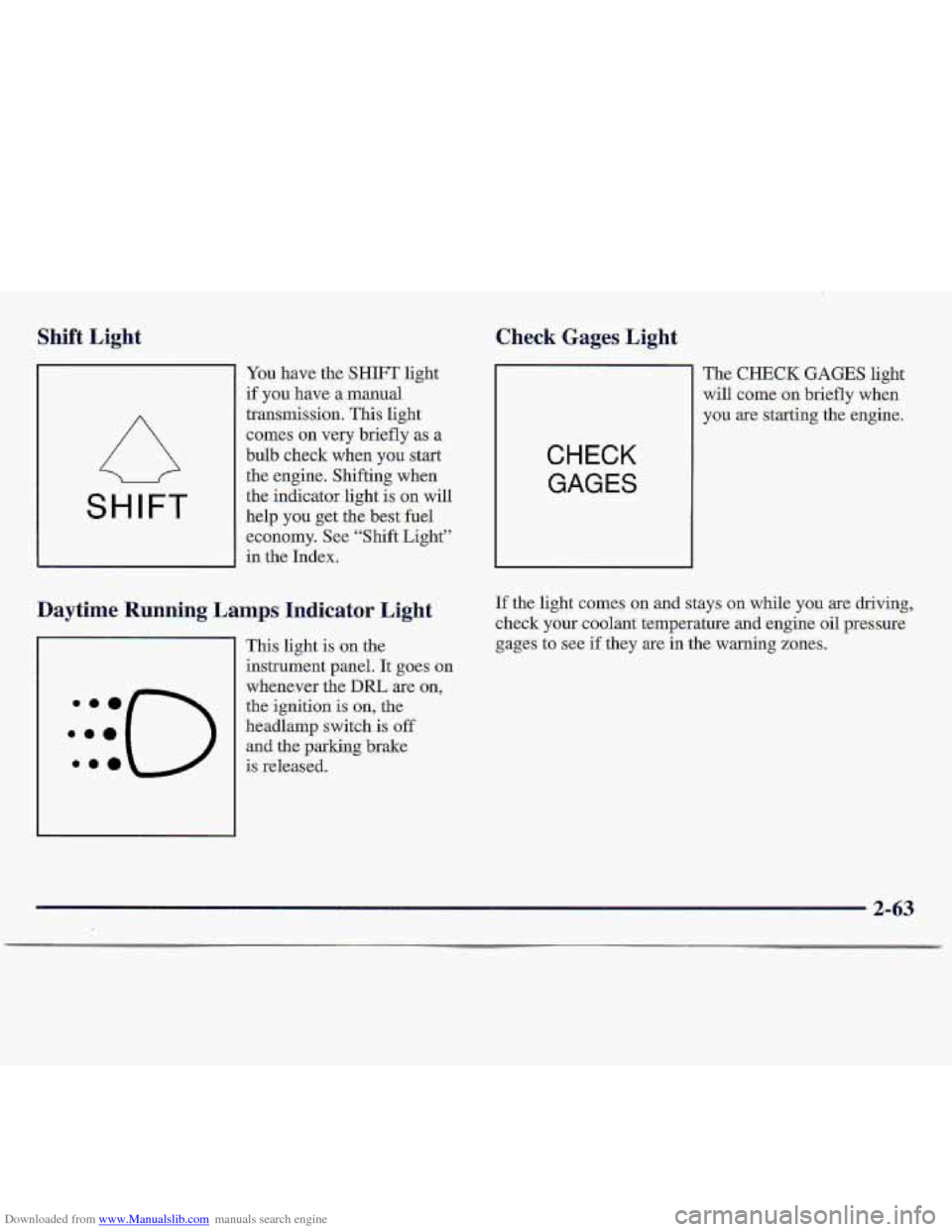
You have the SHIFT light
if you have a manual
transmission. This light
comes- on very briefly as a
bulb check wh-en
you start
the engine. Shifting when
the indicator light is on will
help
you get the best fuel
economy. See “Shift Light”
in the Index.
Daytime Running Lamps Indicator Light
This light is ,on the
instrument panel. It goes on
whenever the
DIU are on,
the ignition is on, the
headlamp switch
is off
and the parking brake-
:::(-)
.ma is released.
CHECK
GAGES
The CHECK GAGES light
will come
on briefly when
y9u
are starting the engine.
If the light comes on and stays on while you are driving,
check
your coolant temperature and engine oil pressure
gages
to see if they are in the warning zones.
2-63
Page 158 of 402
Downloaded from www.Manualslib.com manuals search engine QZ What.shou1.d I do if my vehicle stalls, or is about
to stall,
and I can’t make it up the hill?
A:- If this happens, .thexe are some things you should.
do, and there are some things
yo11 must not do.
First, here’s what you slzould do:
0 Push the brake pedal to stop the vehicle and
keep it from rollin-g backwards. Also,, qp:ly the
parking
brake.
2f your engine is still running, shift the transmission
to REVERS-E (R), release the parking brake, arid
slowly back down the hill in REVERSE (R).
If your engine’has stopped running, you’ll need to
restart it. With
the brake pedal depressed and the
parking brake still applied, shift
the transmission to
PARK (P) (or, shift to NEUTRAL (N) if your
vehi-cle has a manual h-ansmi.ssion) and restart the
engine. Then,
shift-to REVERSE (R), release the
parking
brake, and slowly back dow’n the hill as
straight as possible in REVERSE (R).
Insteixd, apply the regula- br.&e: to st-op the
vehicle.
Then apply the p.aTki-ng:brake. Shift to
REVERSE (R), release the parking -brake, and
slowly back straight down.
Never attempt to turn around if you are about to stall
when going up a hill. If the hill is steep eno.ugh to.
stall your vehicle; it:s steep enough to Game yon PO
1-011 over X you tuyn .aTaund. If-you c;an”t. make it up
the hill, you must back straight down the hill.
4-21
Page 159 of 402
Downloaded from www.Manualslib.com manuals search engine Q.' S.uppose, after.stalling, I try to back down the
hiIl and decide I just can't do it. What should
I do?
A: Set the. parking brake, put your trammission
in PAW (P) (or the manual transmission in
FIRST (1)) and turn-off the engine. Leave the
vehicle and
go get-.some help. Exit on the uphill
side.
md stay cl&xr of the path the vehicle would
take
if it rolled downhill. Do not shift.the transfer
case to NEUTRAL (N) when you leave the vehicle.
Leave it in some gear.
If you have- a manual transfer case shtft lever,
shifting the transfer case
to NEUTRAL (N) can
cause your vehicle to roll. even if the transmission
is
m PARK (P) (or, if you have the manual
transmission, even
if you're in gear). This is
~ because the NEUTRAL (N) position on the
transfer case overrides the transmission.
If you
are going
to leave your vehicle, set the parking
brake
and shift the transmission to- PARK (P)
(or, put your manual transmission in FIRST (1)).
But do not shift the transfer case to the
NEUTRAL (N) position. Leave the transfer
case in the
ZHI, 4HI DI" 4LO position.
4-22 i
Page 161 of 402
Downloaded from www.Manualslib.com manuals search engine Q.’ Are there some things-I should notdo when
A: Yes! These are important because if you
.driving ’down a hill?
ignore them you could lose control .and have a
serious accident,.
0 When driving downhill, avoid turns that take you
across the incline of the hill. A .hill that’s nut too
steep to drive down may be too steep tQ drive acro:ss.
You could roll over if you don’t drive straight down.
NEUTW (N),.or- with the clutch pedal dep&ssed
in a .manuai~ shift. This is called “free-wheeling.”
Your brakes will. have to do all the work and could
overhe’at and. fade.
0 Never go down-hill with the transmission in:
.Q: Am I likely to stall when going downhill?
A: It’s much more likely to happen ,going uphill. But if
it.happens
going downhill, here’s: what to do.
0 Stop your vehicle by applying the- regular brakes.
Apply the parking brake.
Shift to
PARK. (P) (.or to NEUTRAL (N) with the
manual transmission) and, while still
braking, restart
the engine. ..
S.hift back to a 1.0w gear, release the parking brake,
and drive straight down.
If the engine- won’t start, get out and get. help.
4-24
Page 175 of 402
Downloaded from www.Manualslib.com manuals search engine If you drive regularly in steep country, or if you're
planning to visit there, here are some tips that can make
your trips safer-and more enjoyable. (See "Off-Road
Driving" in the Index
for information ab.out driving
off-road.)
Keep your vehicle in good shape; Check all fluid
levels and
also the brakes, tires, cooling system and
transmission. These pqrts
@a work hard on
mountain roads.
Know how to go down hills. The most important
thing
to 'know is this: let: your engine do. some of the
slowing. down. Shift
-to a lower gear when you go
down
a steep or long hill.
If you .don't shift down, your brakes could get
so hot that,they wouldn't work well. You would
then have
po.or braking or even none going
down
a hill. You could crash. Shift down to let
your engine assist your brakes .on a steep
downhill
slope.
I
Coasting downhill in NEUTRAL (N) or WILII the
ignition
off is dangerous. Your brakes will have to
do all the work of slowing down. They could get so
hot that they wouldn't work wen. You would then
have poor braking
or even none going down a hill.
You could crash. Always have your enbe running
and your vehicle in gear when you go downhill.
Know how to go uphill. You may want to-shift down
to a lower gear. The lower gears help cool your engine
and transmission, and you can climb the hill better.
Stay in your own lane when driving on two-lane
roads
in hills- or mountains. Don't swing wide or cut I
across the center-of the road, Drive at speeds that let
-you stay in your own lane.
As YOU go over the top of--a hill, be alert. There could be
something in your lane, like a stalled car or an accident.
YQU may see highway signs an mountains that warn of
special problems. Examples are long grades, passing or
no-passing zones, a falling rocks area or winding
roads. Be alert to these and take appropriate action.
4-38
Page 180 of 402
Downloaded from www.Manualslib.com manuals search engine Recreational Vehicle Towing
(Four-wheel Drive With Manual
Shift Transfer Case Only)
1 * Set the 1 'king brake: firmly.
2. Place an auromatic transmission in PARR (P) qr a
-manual transmis'siori in FIRST (1).
3. Firmly attach the vehicle .being towed to the 'to,w
vehick. Do not tow the. v&icle by the rear bumper
bar. Refer to the hitch manufactu.rer's instructions.
4. Place the manual shift transfer case- shift lever in
'NEUTRAL (N).
Shifting the transfer case into NEUTRAL (N. an
cause your vehicle
to roll evenif the transmission
is in PARK (P), for an automatic transmission, or
if your vehicle is in gear, for a manual
transmissi6n.
You or othets could be injured.
Make sure the-parking brake is firmly .set befbre
you shift the transfer case into NEUTRAL (N).
5. Release the parking brake only after the -vehicle,
being
towed is firmly attache-d to the tow vehicie.
6; Ins-ert thei-gnitiaa key into the ignitim switch md
turn it one notch fixward of the LOCK position. This
places the key in the OFF po'sitiofi; which 'ufilocks
the steering column while preventing battexy draia.
Unlocking the
steering column will allow for proper
rnovemcnt of the:front w'beel.s/tirr;s during towing.
R-ecre.ationa1 Vehicle Towing
(Except Four-Wheel Drive With
Manual Shift Transfer Case)
4-43
Page 188 of 402
Downloaded from www.Manualslib.com manuals search engine '0 If you have- an automatic transsinission5. you can
use DRIVE (Dj (m,as you need to, a lower gear)
when -towing a.tr-ailer. Operating your vehickin
DRIVE (P) when towing a trail& will minimize. heat
buildup a-nd extend the life of your transmission. If
you have -a manual eansmission and YQU'W~ towing-
a trailer, it-'s :better not to 'use FIFTH (5) gear. Just
drive in FOURTH (4). gear (or, as y-ou necd to, a
1Qwer ge.a).
Three importmt considerations have to do. with weight:
the; weight Qf the- trailer,
0 the weight of the traiirer?tongne
and the weight on-your vehicle's tires.
Weight of the Trailer
How he-avy can - a trail& safely be?'
It depends on how yosll plan to use your rig. For
example, speed, altitude, mad grades, outside
-temp&ature and how much yaw vehicle is used to pull a
trailer are -all important. An,d~, it can also depend an any
.-special equipment that you have on your vehicle.
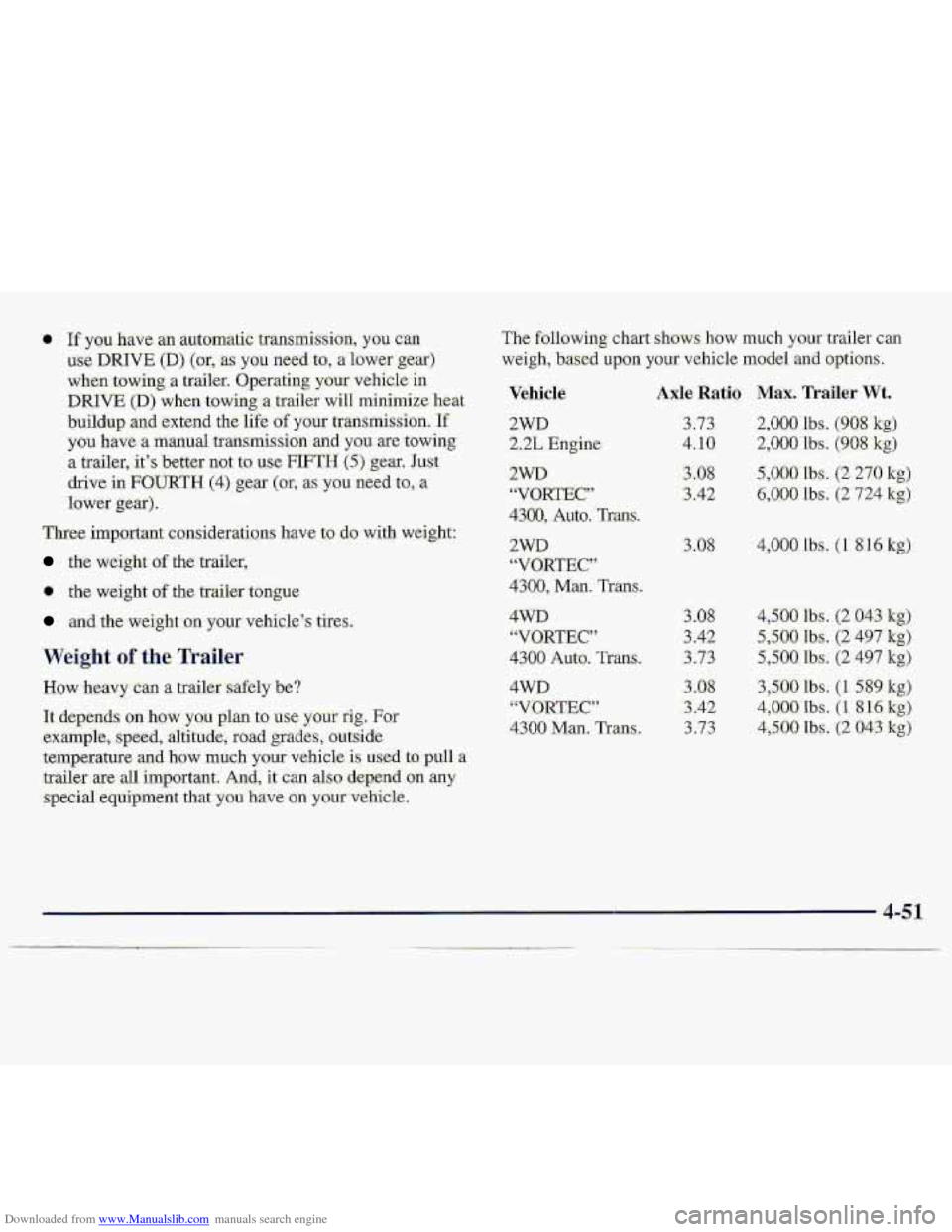
The follo-w%g chart shows haw much your trailer can
weigh, based upon your: vehicle rno.&l and. options.
Vehicle
2wD
2.2L Engine:
2wJ-J
'VOREC"'
4300, Auto. Trans.
Axle Ratio Max. Trailer Wt.
3.73
4.10
2,000.Il.?s. (90.8 kg)
2,000 lbs. (908 kg:)
3 .m
3.42
5,000.lbs. (2 270 kg)
6,O.OO lhs. (2 724 kg)
3.08 4,000 lbs. (1 g.16 kg)
4m 3.08
"VORTEC" 3 -42
4300 Auta:. Trans. 3.73
4.,500 hs. (2 043 kg)
5,500 1b.s. (2 497 kg)
$,5OOllbs.. (2 497 kg)
3,500 ibs. (I 589 kg,)
4,500 lbs. (2 043 .kg)
4,000, lbs. (1 8 1.6 kg)
Page 193 of 402
Downloaded from www.Manualslib.com manuals search engine When. you tow a tixiilkr, y-our vehicle ha.s to’have extra
wiring :and a- heavy-duty turn signal flasher. (included in
the- optional trailering package).
The arrows-on your instrument panel will flash
whenever.
you signal a turn 01- 1-me. change, Properly
hooked .up, the &&la lamps will also flash, telling other
drivers you’re
about to :turn, change lanes or stop.
When towing a:txailer,
the. arrows. on your hstrument
panel will flash for turm even if the bulbs on the trailer
are burned out. Thus, you may think drivers behind you
axe seeing your signal when they arenot. ICs important
to check. occasionally to.be sure- the trider bulbs are.
still working.
Driving On .Grades
Reduce speed and shiftlo dower. ge.ar. ,befure you start
dawn B long -or steep downgrade. If-you do-n’t shift
down,
you might have to use your brakes wmuch that
they would
get hot and no longer work weIl.
If you have an.aut~~atic-transm~ssion, you should use
DRIVE (D) when towing a trailer. Operating your
vehicle in DRIVE @) when towing a. trail& will
Mze: heat:buiidup and merid the life af y.our
transmissioil. Qr, if you have, a-manu-ai transmission,
it’s
better not to use FIFTH (S), just drive in FOURTH (4)
(or, as you need to, a lower gew).
4-56
Page 194 of 402
Downloaded from www.Manualslib.com manuals search engine Parking on Hills
You really should not park your vehicle, with a trailer
attached,
on a hll. If something goes wrong, your rig
could
start to move. People can be injured, and b.oth
your vehicle and the trailer can be damaged.
But
if you ever have to park your rig on a hill, here’s
how to do it:
1.
2.
3.
4.
5.
6.
Apply your regulafbrakes, but don’t shift into
PARK (P) yet, or into gear for a manual
transmission. When parking uphill, turn your wheels
away from the curb. When parking downhill,
turn
your wheels into the curb.
Have someone place chocks under the trailer wheels.
When the wheel chocks are in place, release the
regular brakes until the chocks absorb the load.
Reapply the regular brakes. Then apply your
parking brake, and then shift into PARK (P), or
REVERSE (R) for a manual transmission.
If.you have a four-wheel-drive vehicle with
a
manual transfer case shift lever, be sure the transfer
case
is in a drive gear -- not in NEUTRAL (N).
Release the regular brakes.
It can be dangerous to get out of pur vehicle if
the shift lever is not fully in PARK (P) with the
parking brake firmly set.
Your vehicle can roll.
If you have left the engine running, the vehicle
can move suddenly.
You or others could be
injured.
To be sure your vehicle won’t move, even
when yoa’re
on fairly level ground, use the steps
that follow.
If you have four-wheel drive with a manual
transfer case shift lever and your transfer case
is
in NEUTRAL (N), your vehicle will be free to
roll, even if your shift lever is in PARK (P). So, be
sure the transfer ca’se is in a drive gear
-- not in
NEUTRAL (N).
4-57