lock CHEVROLET S10 1997 2.G Workshop Manual
[x] Cancel search | Manufacturer: CHEVROLET, Model Year: 1997, Model line: S10, Model: CHEVROLET S10 1997 2.GPages: 402, PDF Size: 21.04 MB
Page 195 of 402
Downloaded from www.Manualslib.com manuals search engine When You Are Re.ady .to Leave After
Parking on a Hill
1. Apply your regular brakes and hold the pedal down
while you:
Start your engine;
s.hift; int,o a.gear; and
.i Release tfie parking brake.
2. Let up dn the brake pedal.
3. .Drive slowly until the trailer- is ele-ar of-the chocks.
4. .Stop. and have someone pick up and store the chocks,
Maintenance W-hen Trailer Towing
Your vehicle will need service more. often when you're
-pullilig'.a trailer. Swthe Maintenance Schedule 'for more
on this. Things. that ar.e e.specizrlly import,at in trailer
operation
-axe automatic trmsrnission.fluid (don't
overfill),
engjne oil, axle lubricant, belt, cooling system
and brake adjustment.
Each of these is covered in this
manual, and the
Tndex- will help you find them. quickly.
If you're traileriqg, i-t's a go0.d i,dea to review these
sections before you start ,your trip ...
Check periodicailp t6 see-.th-at all hitch nuts and bolts
are -tight.
Trailer Wiring Harness,
'The -eight-wire harness is: stored under ysur vehicle
along the
rear frame crossmember. This hamess has a
30-amp feed wire with an inline fuse located by the
.junction block. It has no.cmnecttor .and should he. wired
by a qualified electrical technician. T.he .technician can
use the fullowing c~lor:c.ode chart when connecting the
-wiring harness IO yow trailer:
0
a
a
0
0
0
a
a
Page 206 of 402
Downloaded from www.Manualslib.com manuals search engine When your vehicle is being towed,. h-ave the ignition key
. md.& ;the OFF- position.. The ite,erin,g wliegl sli~ultl
be. cla-mped in- a straightdahezd position witb a clamping
&vice desi:ped for towing-service. DO fiat ust the
vehicle's steering c.olumxz I-ock for this. The transmission
should be in
NEUTRAL (N) an-d the .transfer case, if you
'31ave one, ShQuLd. be in 2HI. The p&ing.bm.ke shguld-.-lje
seleased.
If your vehicle has. a flqor mounted shifter and no
.electrical power,
the electrical.So1enoi.d lock must be
.ovexKidd.m tu shi%t-.hm PARK (P> :to NEUTRAL (Nj.
Follow -:these. step.8:
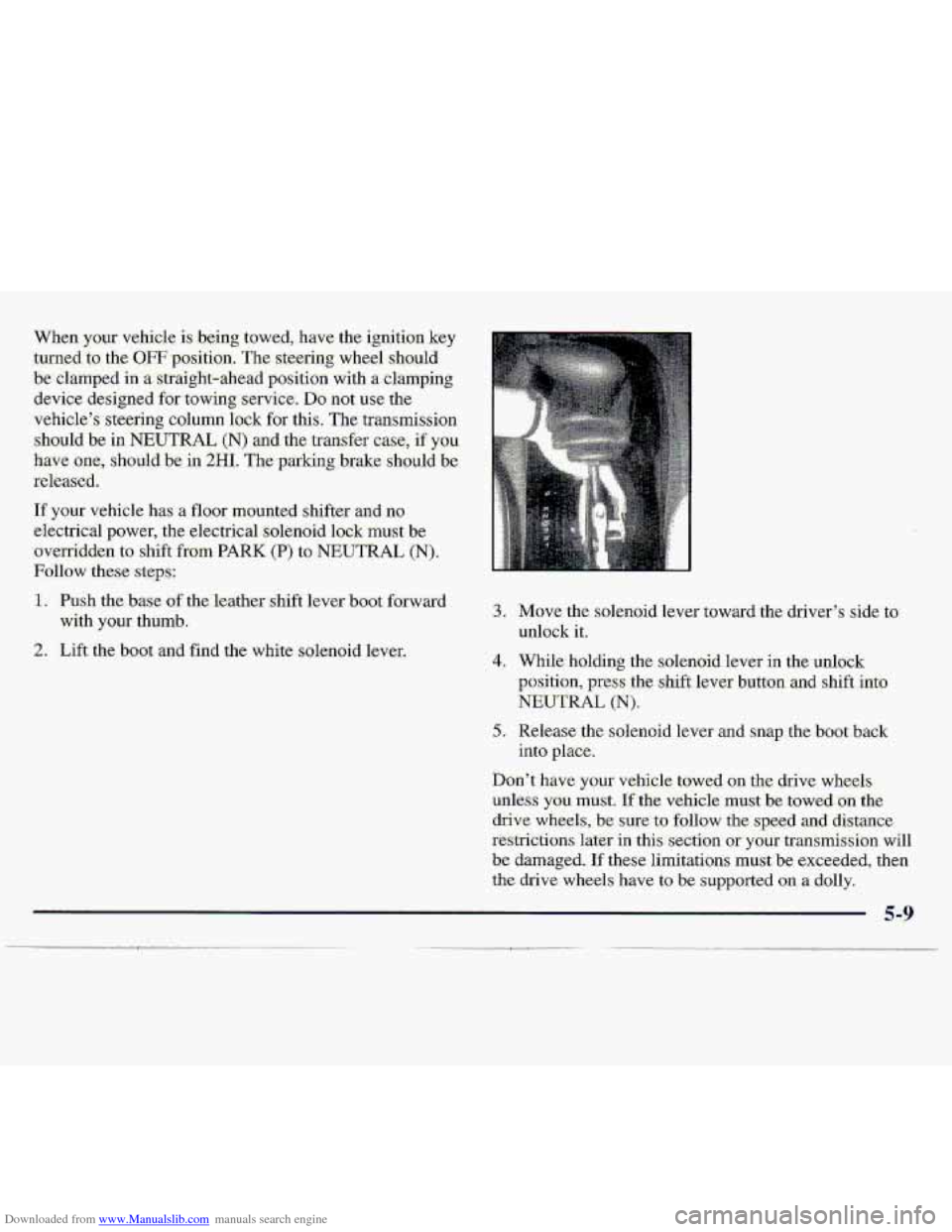
1. Push the'bme of the.'€e.ather shift leva boat forward
with
your thumb.
L
3.
4.
5'.
'Move the solenoid. lever toward the driver's side to.
m1oc.k it;
'While holding the solenoid lever in the unlock
gosition, press the shift lever button and shift into
NEUTRAL
(N).
Release the solenoid lever and snap the b.QgL.b.a&
into place.
,... . .
Don't have your vehi-cle towed on th-e drive wheels
unless you must. If -the Vehicle .must be towed--on. the
drive wheels, be sure to follow the. sp.e.ad and distance
restrictions
Mer in this section oryour transmission will
be damaged.. If these limitations must be exceeded, the0
the drive wheels have to b:e supported on .a dolly.
Page 216 of 402
Downloaded from www.Manualslib.com manuals search engine Wow .to Add Coolant to the Radiator
2. Then keep turning the pressur'e cap, but. now push
down
as you turn it. Remove the pressure cap.
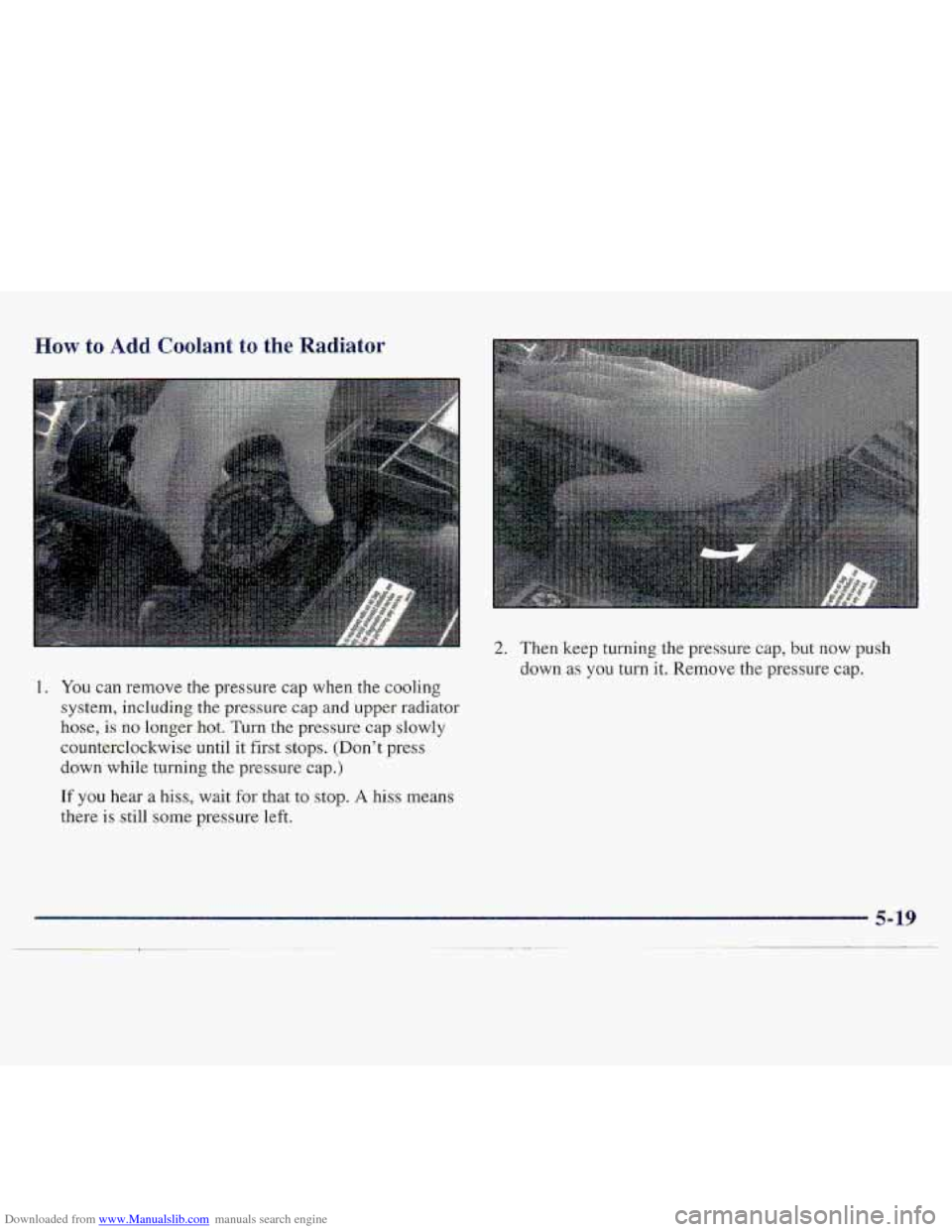
1. You can remove the pressure cap when the cooling
system, inchding the pressure cap and upper radiator
hose, is no longer hot. Turn the-pressure cap slowly
counterclockwise until'it first stops. (Don't press
down while turning the pressure cap.)
If you hear a hiss, wait for that to stop. A hiss means
there is still some
pressure left.
Page 220 of 402
Downloaded from www.Manualslib.com manuals search engine If a tire goes flat, avoid further tire and wheel damage
by driving slowly to a level place. Turn on your hazard
warning flashers.
Changing a tire can cause an injury. The vehicle
can slip off the jack and roll over
you or other
people.
You and they could be badly injured.
Find
a level place to change your tire. To help
prevent the vehicle from moving:
I. Set the parking brake firmly.
2. Put an automatic transmission shift
lever in
PARK (PI or shift a manual
transmission to FIRST (1) or
REVERSE (R).
CAUTION: (Continued)
3. If you have a four-wheel-drive vehicle
with
a manual transfer case shift lever,
be sure the transfer case is in
a drive
gear
-- not in NEUTRAL (N).
4. Turn off the engine.
5. Put the wheel blocks at the front and
rear
of the tire farthest away from the
one being changed. That would be the
tire on the other side
of the vehicle, at
the opposite end.
Page 222 of 402
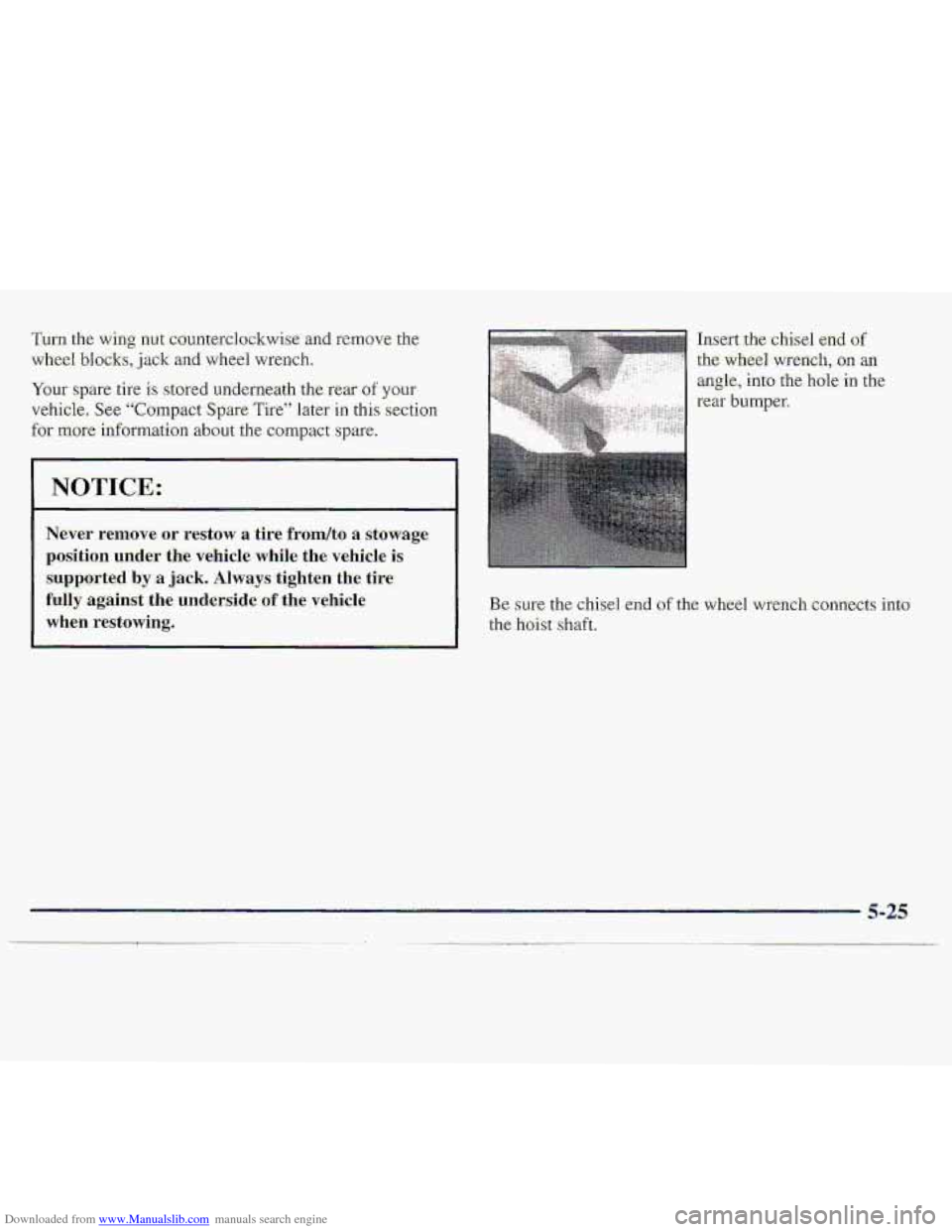
Downloaded from www.Manualslib.com manuals search engine Turn .the wi~%g imt. cwnterclockwise :and rem-ove the
wheel blocks., jack and wheel wrench.
Your spare tire is stored underneath the rear of your
vehicle; See “Compact S-pare Tire” later in this section
for more mformation- about the compact spare.
NOTICQ
Never remove or restow a tire frodto a stowage.
psition under the vehicle while the .vehicle is
suppiorted by .a jack+ Always tighten th.e tire
fully against the: underside- of the vehicle
when restowiqg.
$-E
. _.. - .
Page 225 of 402
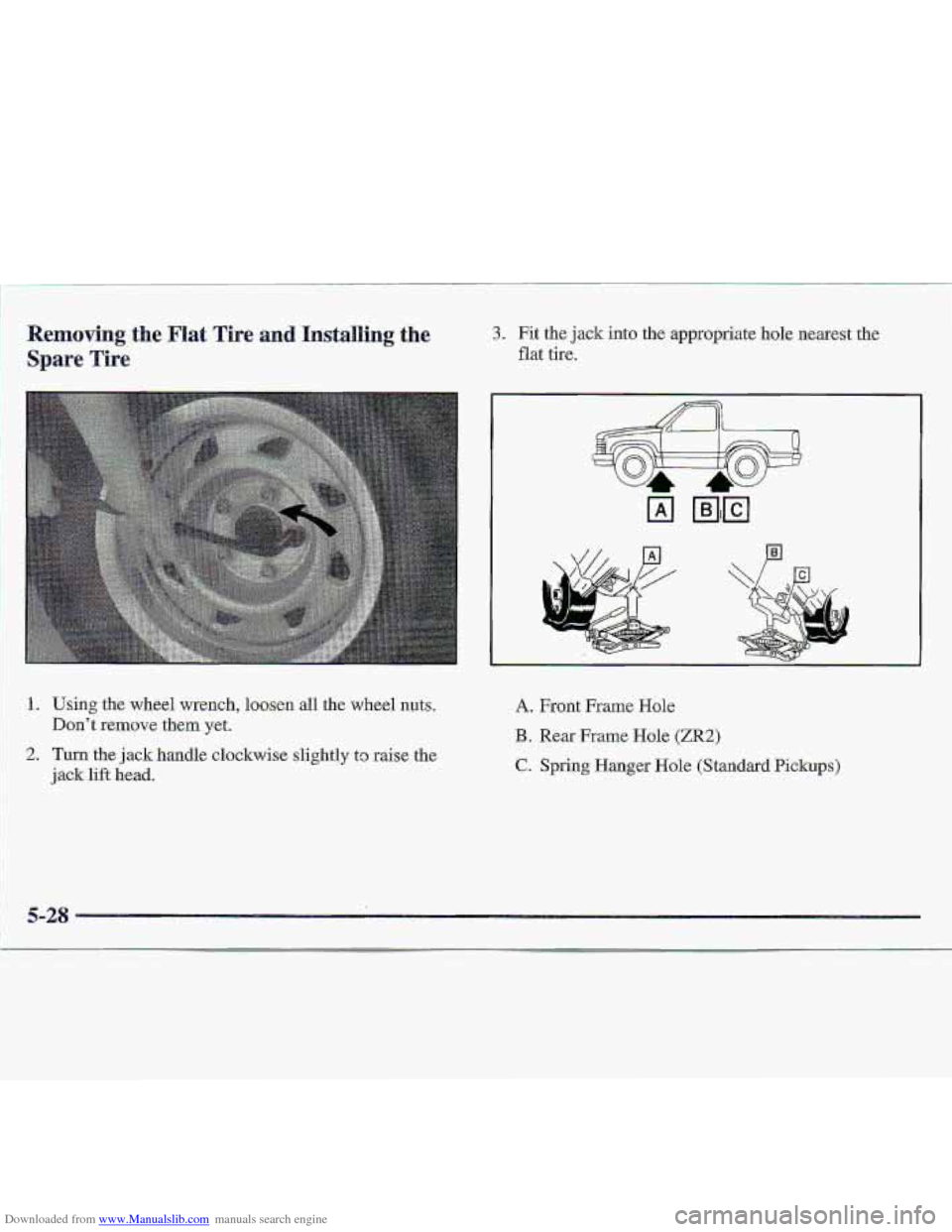
Downloaded from www.Manualslib.com manuals search engine 1. Using the wheel wrench, lomen all the wheel nuts.
Don't remove them yet.
2. Turn the jack handle clockwise slightly to raise the
jack lift head.
3. Fit the jack into the appropriate ho1.e nearest the
flat
tire.
A. Front Frame Hole.
B. Rear Frame Hole (ZR2)
C. Spring Hanger Hole (Standard Pickups)
5-28
Page 226 of 402

Downloaded from www.Manualslib.com manuals search engine Getting under a vehicle when it is jacked up is
dangerous. If the vehicle slips off the jack, you
could be badly injured or killed. Never get under
a vehicle when
it is supported only by a jack.
I
1 NOTICE:
Raising your vehicle with the jack improperly
positioned
can damage the vehicle and even make
the vehicle
fall. To help avoid personal injury
and vehicle
damage, be sure to fit the jack
18t head into the proper location before raising
your vehicle.
4. Raise the vehicle by turning the jack handle
clockwise. Raise the vehicle far enough off the
ground so there is enough room for the spare tire
to fit.
5. Remove all the wheel nuts and take off the flat-tire;
Page 228 of 402
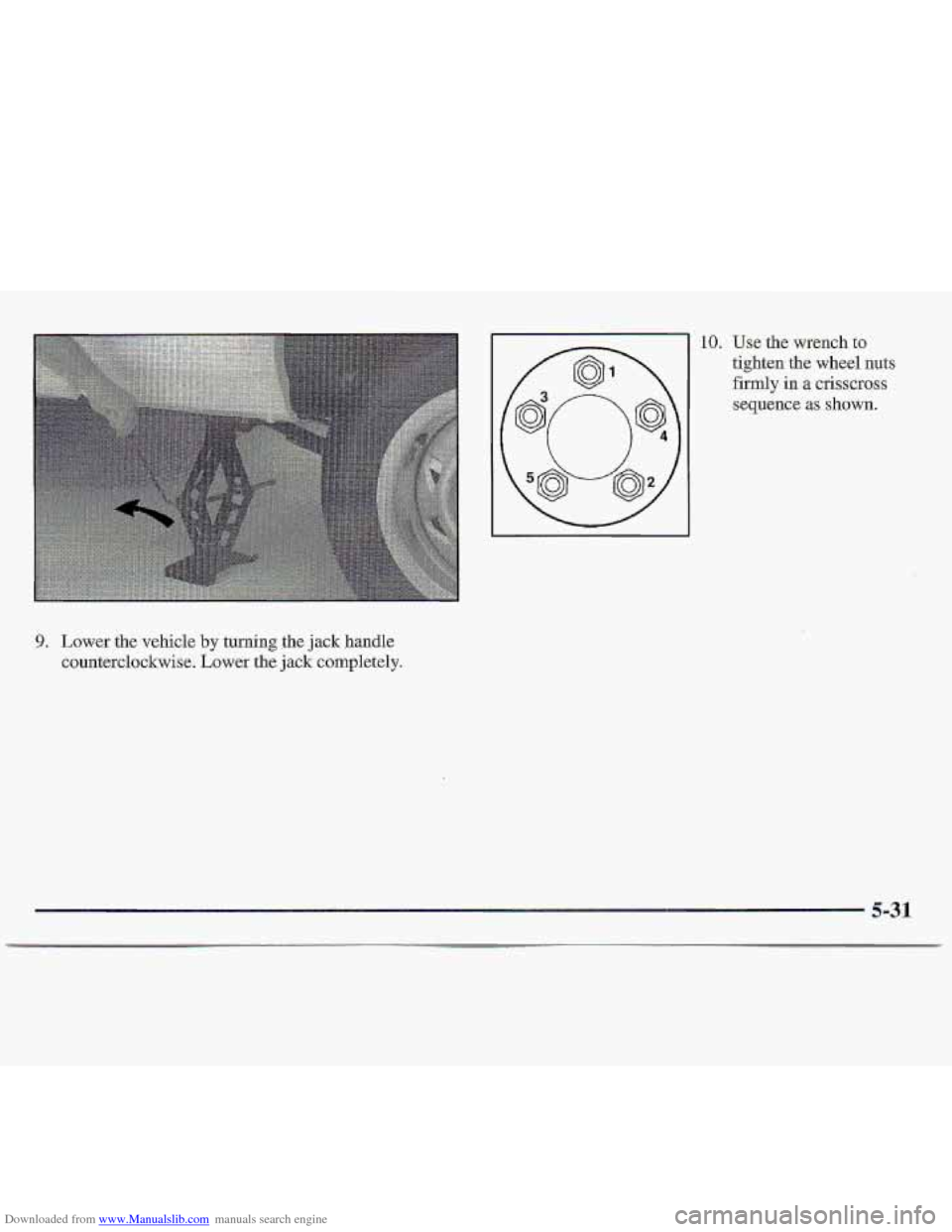
Downloaded from www.Manualslib.com manuals search engine 9. Lower the vehicle by turning the jack handle
counterclockwise. Lower the
jack completely.
10. Use the wrench.to
tighten the wheel nuts
firmly in a crisscross
sequence as
shown.
5-31
Page 242 of 402
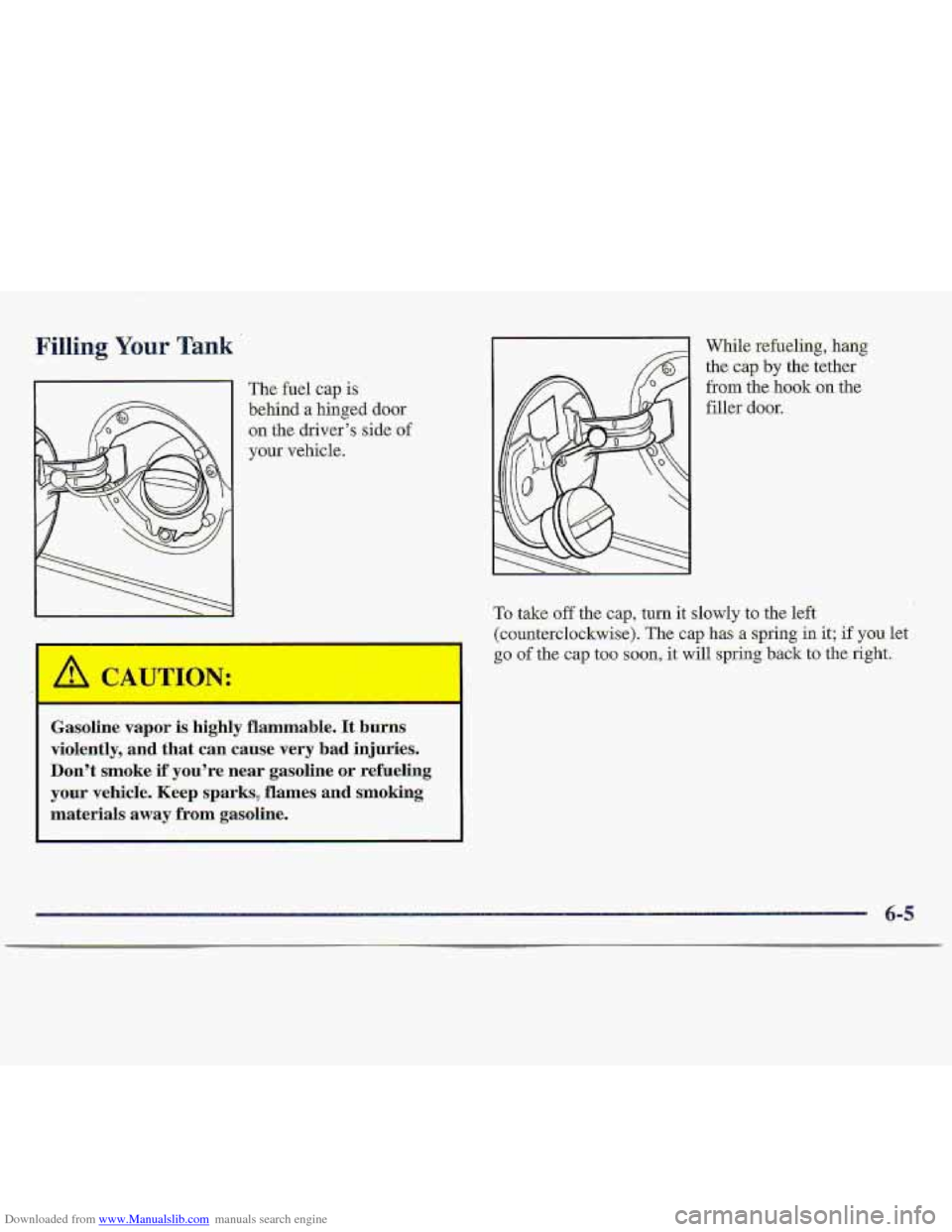
Downloaded from www.Manualslib.com manuals search engine behind .a hiLged door
on the driver’s side of
your vehicle. While refueling, hang
the cap by the tether
from the hook’on the
filler door.
4- soline ne vapor is highly flammable. It bums
violently, and that can cause very bad injuries.
Don’t smoke if you’re near gasoline
or refueling
your vehicle. Keep sparks, flames and
smoking
materials away from gasoline.
To take off the cap, turn it slowly to the left
(counterclockwise). The cap
has a spring in it; if you let
go of the cap too soon, it will spring back to the right.
Page 243 of 402
Downloaded from www.Manualslib.com manuals search engine som-ething ignites it; y0.u could. be badly burned.
Gasoline
can spray out on you if you open the
fuel fiIler cap too quickly. This spray can happen
if your tank is nearly full, and is more likely in
hot weather. Open the fuel fiier cap slowly and
wait for;ang ‘ShW’ noise to stop. Then unscte-w
the cap all the way.
Be- careful .not to spill gasolina. C1e.m gasoline from
painted
surfaces-as- SOO~ as possible. Se-e “Clean-ing the
Out; e
o lam Vehicle” in- the Index.
When y0.u put the cap back on, twn it to the right
(clockwise) until you hear a cli.cking sound. Make sure
you -fully install the cap. The-dia.gn
installed,
This would-allow fud to evaporate into the
atmos.phere.
See “Malfunction Indicator Lamp” in
the Index,
NOTICE:
If y0.u need .a new cap, be sure to get the right
type. Your dealer ean get. one for you. If you $-et
the wrong type, itmay not fit properly. This-may
cause your rnalfunctiori indicator lamp to
li.ght
and your fuel tank and emissions. system may be
damaged. S;ee “Malfunction Indicator Lamp” in
the
Index.
Checking Things Under the Ho
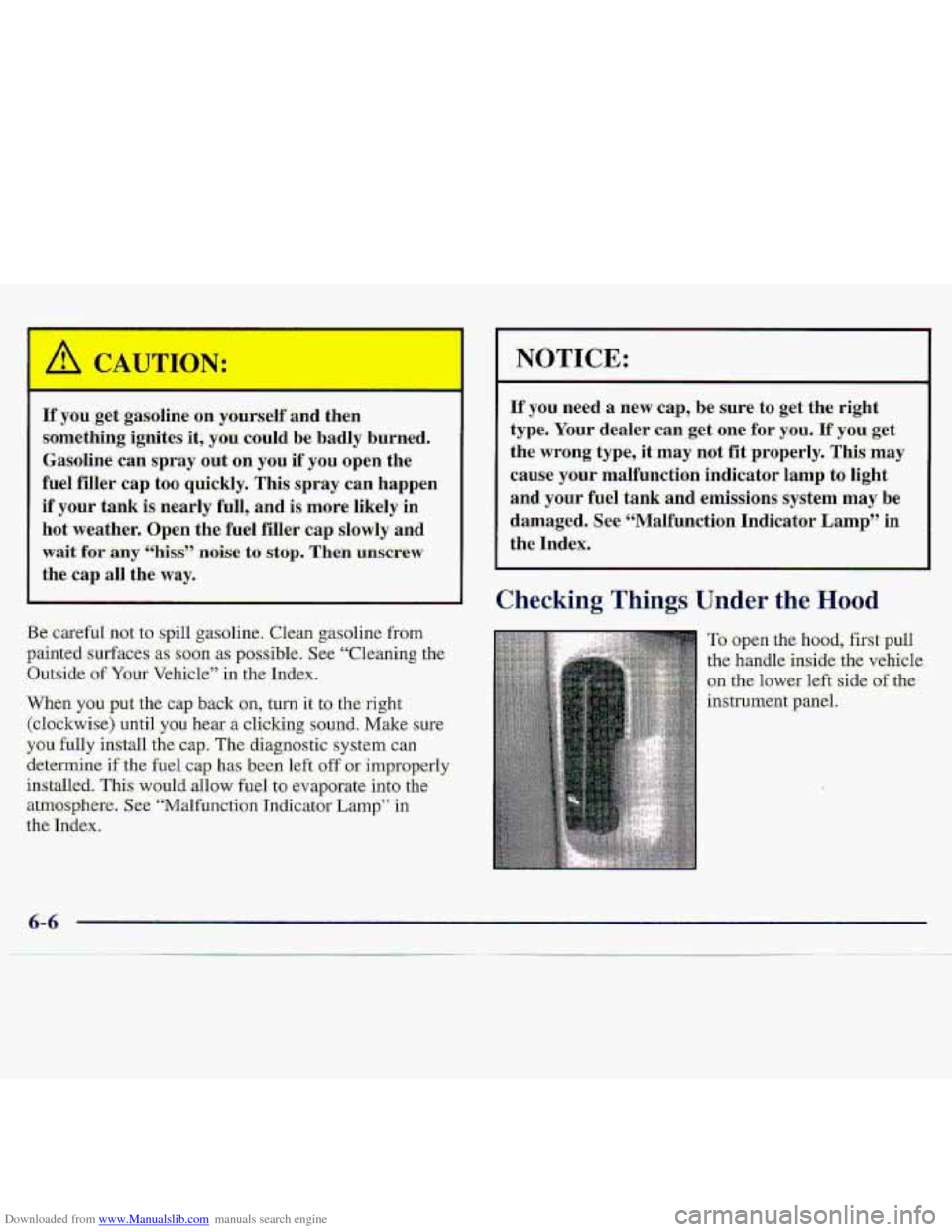
To open the hood, first pull
the handle- inside the vehicle
on the lower left side of the
instrument panel.