lock CHEVROLET SILVERADO 2000 1.G Manual PDF
[x] Cancel search | Manufacturer: CHEVROLET, Model Year: 2000, Model line: SILVERADO, Model: CHEVROLET SILVERADO 2000 1.GPages: 421, PDF Size: 2.87 MB
Page 242 of 421

yellowblue
4-46
Recreational Vehicle Towing
There may be times when you want to tow your vehicle
behind another vehicle for use at your destination. Be
sure to use the proper towing equipment designed for
recreational vehicle towing. Follow the instructions for
the towing equipment.
When towing your vehicle, turn the ignition to OFF.
To prevent your battery from draining while towing,
remove the IGN 0 fuse from the instrument panel fuse
block. Be sure to replace the fuse when you reach your
destination. See ªFuses and Circuit Breakersº in
the Index.
Two-Wheel-Drive Vehicles
Tw o-wheel-drive vehicles, should not be towed with
all four wheels on the ground. Two
-wheel-drive
transmissions have no provisions for internal lubrication
while being towed. To properly tow these vehicles, they
should be placed on a platform trailer with all four
wheels off the ground.
In rare cases when it's unavoidable that a
two
-wheel-drive vehicle is to be towed with all four
wheels on the ground, the propeller shaft to axle yoke
orientation should be marked and the propeller shaft
removed following the applicable service manual
removal/installation procedure.
Dust or dirt can enter the back of the transmission
through the opening created by removing the propeller
shaft if proper protection is not provided. Also, check
the transmission fluid level before driving the truck.
Page 243 of 421
yellowblue
4-47 Four-Wheel-Drive Vehicles
CAUTION:
Shifting the transfer case into NEUTRAL (N) can
cause your vehicle to roll even if the transmission
is in PARK (P), for an automatic transmission,
or if your vehicle is in gear, for a manual
transmission. You or others could be injured.
Make sure the parking brake is firmly set before
you shift the transfer case into NEUTRAL (N).
Use the following procedure to correctly tow your
vehicle on all four wheels:
1. Firmly set the parking brake.
2. Shift an automatic transmission to PARK (P), or a
manual transmission to FIRST (1).
3. Securely attach the vehicle being towed to the
tow vehicle.
4. Shift the transfer case to NEUTRAL (N). See
ªFour
-Wheel Driveº in the Index for the proper
procedure to select the neutral position for
your vehicle.
5. Release the parking brake only after the vehicle
being towed is firmly attached to the towing vehicle.
6. Turn the ignition to OFF. The OFF position unlocks
the steering column and reduces battery drain as long
as the IGN 0 fuse is removed. Unlocking the steering
column will allow the proper movement of the front
wheels and tires during towing.
Page 267 of 421
yellowblue
4-71
NOTICE:
When using the auxiliary battery provision, the
electrical load must not exceed 30 amps. Always
turn off any electrical equipment when not in use.
Leaving electrical equipment on for extended
periods will drain your battery.
Power Winches
If you wish to use a power winch on your vehicle, only
use it when your vehicle is stationary or anchored.
NOTICE:
Using a power winch with the transmission in
gear may damage the transmission. When
operating a power winch, always leave the
transmission in NEUTRAL (N).
Use the regular brakes, set the parking brake, or block
the wheels to keep your vehicle from rolling.
Step-Bumper Pad
If your vehicle has a rear step bumper, it may be
equipped with a rear step pad at the center of
the bumper.
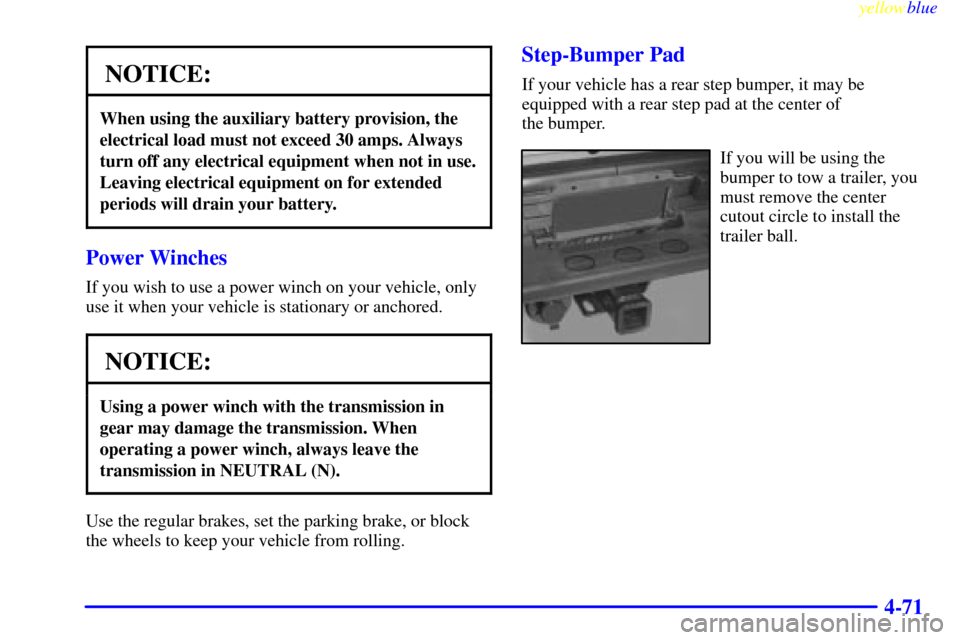
If you will be using the
bumper to tow a trailer, you
must remove the center
cutout circle to install the
trailer ball.
Page 283 of 421
yellowblue
5-16
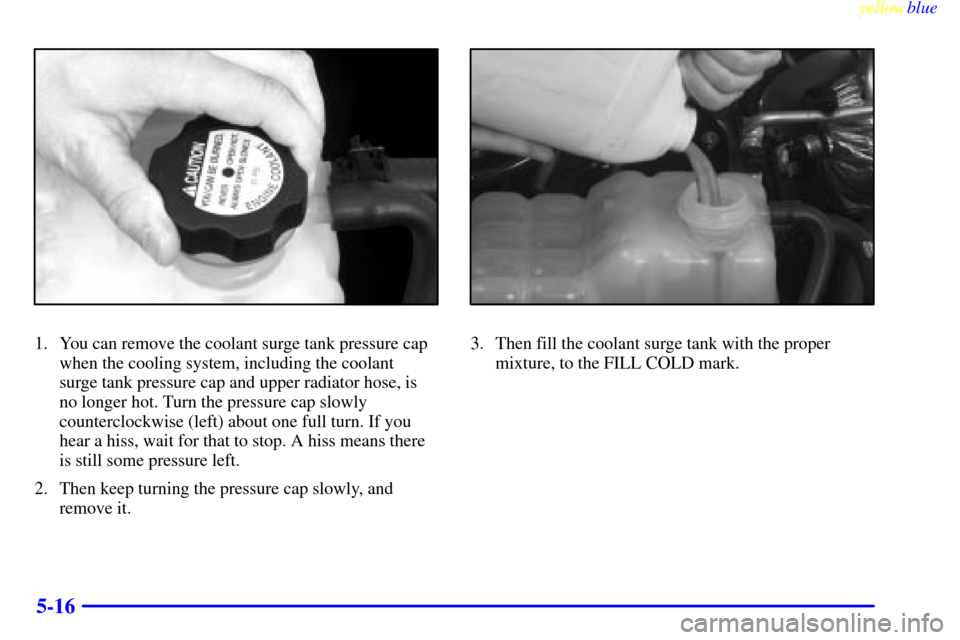
1. You can remove the coolant surge tank pressure cap
when the cooling system, including the coolant
surge tank pressure cap and upper radiator hose, is
no longer hot. Turn the pressure cap slowly
counterclockwise (left) about one full turn. If you
hear a hiss, wait for that to stop. A hiss means there
is still some pressure left.
2. Then keep turning the pressure cap slowly, and
remove it.3. Then fill the coolant surge tank with the proper
mixture, to the FILL COLD mark.
Page 286 of 421
yellowblue
5-19
CAUTION:
Changing a tire can cause an injury. The vehicle
can slip off the jack and roll over you or other
people. You and they could be badly injured.
Find a level place to change your tire. To help
prevent the vehicle from moving:
1. Set the parking brake firmly.
2. Put an automatic transmission shift
lever in PARK (P) or shift a manual
transmission to FIRST (1) or
REVERSE (R).
3. If you have a four
-wheel-drive vehicle,
be sure the transfer case is in a drive
gear
-- not in NEUTRAL (N).
4. Turn off the engine.
5. Put the wheel blocks at the front and
rear of the tire farthest away from the
one being changed. That would be the
tire on the other side of the vehicle, at
the opposite end.
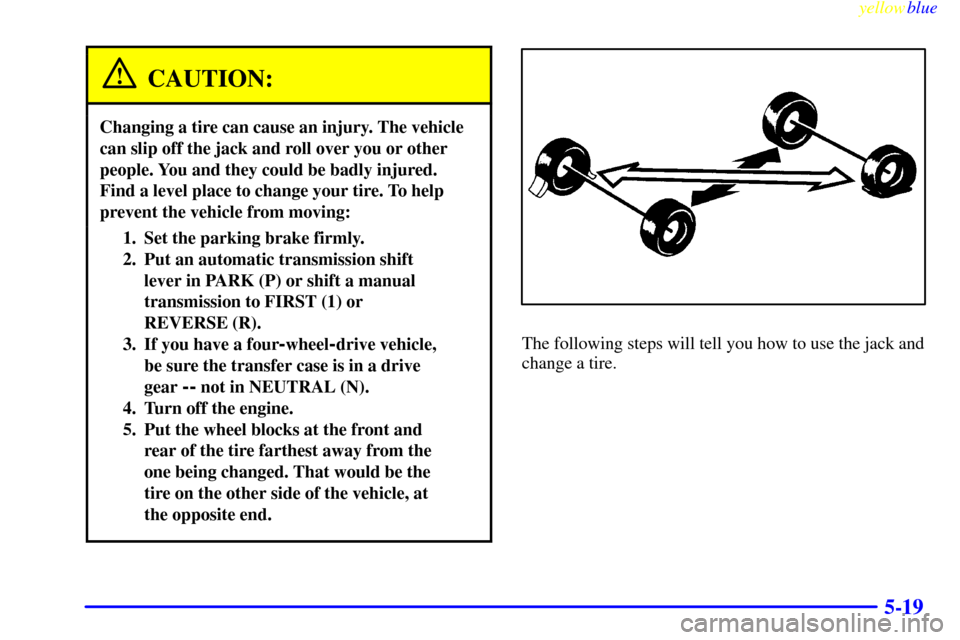
The following steps will tell you how to use the jack and
change a tire.
Page 288 of 421

yellowblue
5-21
The equipment you'll need is behind the
passenger's seat.
1. If there is a cover, move the seats forward and turn
the wing nut on the cover counterclockwise to
remove it.
2. The wheel blocks and the wheel block retainer
can be removed by turning the wing
nut counterclockwise.
3. To release the bottle jack from it's holder, turn the
knob on the bottle jack counterclockwise to lower
the jack head slightly.
4. There is also a wing nut used to retain the storage
bag and tools. To remove it, turn the wing
nut counterclockwise.
You'll use the jack handle and the wheel wrench to
remove the underbody
-mounted spare tire.A. Hoist Assembly
B. Wheel Wrench
C. Extensions
D. Hoist Shaft
E. Valve Stem,
Pointed Down
F. Spare TireG. Tire Retainer
H. Hoist Cable
I. Hoist Lock
J. Hoist Shaft
Access Hole
K. Hoist End
Page 289 of 421

yellowblue
5-22
Follow these instructions to lower the spare tire:
1. If the vehicle is equipped with a hoist lock, open the
spare tire lock cover on the bumper and use the
ignition key to remove the lock.
2. Assemble the wheel wrench and the two jack handle
extensions as shown. Insert the hoist end (open end)
of the extension through the hole in the rear bumper.
Be sure the hoist end of the extension connects into
the hoist shaft.
3. Turn the wheel wrench counterclockwise to lower
the spare tire to the ground. Continue to turn the
wheel wrench until the spare tire can be pulled out
from under the vehicle. The wheel wrench has a
hook that allows you to pull the hoist cable towards
you, to assist in reaching the spare tire.
4. When the tire has been lowered, tilt the retainer at
the end of the cable so it can be pulled up through
the wheel opening.
5. Put the spare tire near the flat tire.
The tools you'll be using include the bottle jack (A), the
wheel blocks (B), the jack handle (C), the jack handle
extensions (D), and the wheel wrench (E).
If the flat tire is on the rear of the vehicle, you'll need to
use both jack handle extensions.
Page 290 of 421
yellowblue
5-23
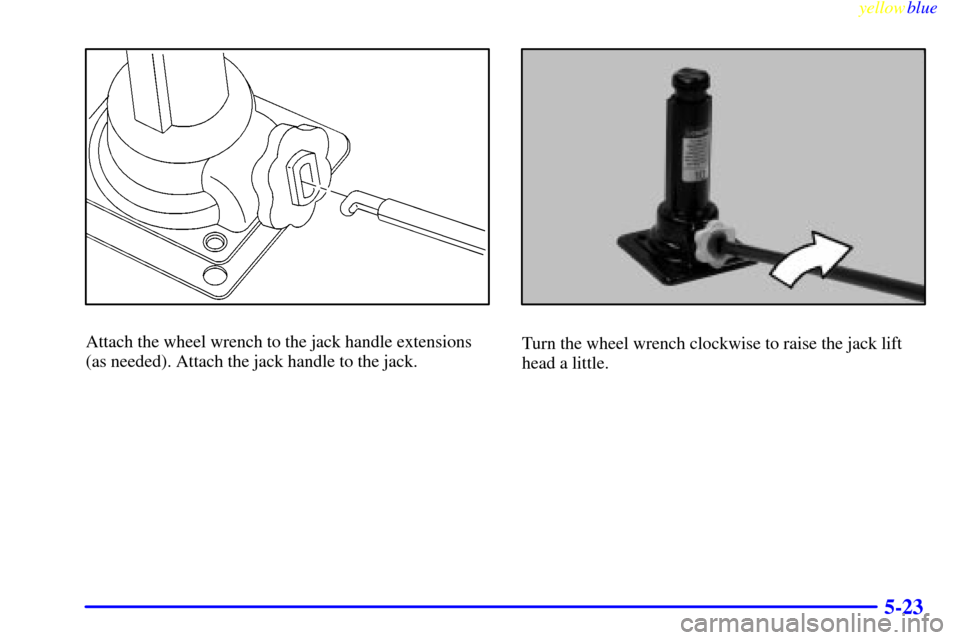
Attach the wheel wrench to the jack handle extensions
(as needed). Attach the jack handle to the jack.Turn the wheel wrench clockwise to raise the jack lift
head a little.
Page 291 of 421
yellowblue
5-24
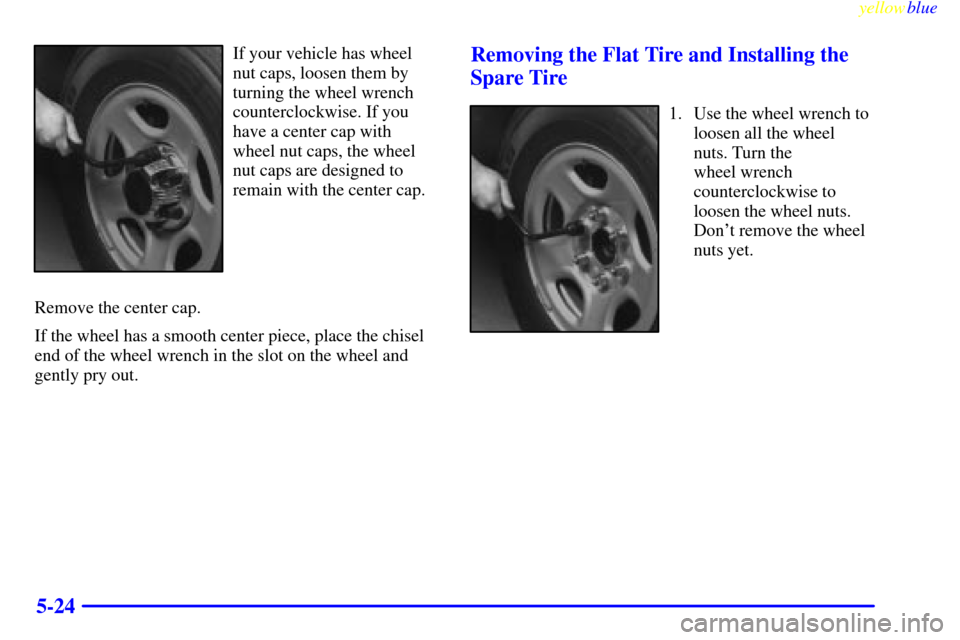
If your vehicle has wheel
nut caps, loosen them by
turning the wheel wrench
counterclockwise. If you
have a center cap with
wheel nut caps, the wheel
nut caps are designed to
remain with the center cap.
Remove the center cap.
If the wheel has a smooth center piece, place the chisel
end of the wheel wrench in the slot on the wheel and
gently pry out.Removing the Flat Tire and Installing the
Spare Tire
1. Use the wheel wrench to
loosen all the wheel
nuts. Turn the
wheel wrench
counterclockwise to
loosen the wheel nuts.
Don't remove the wheel
nuts yet.
Page 294 of 421
yellowblue
5-27
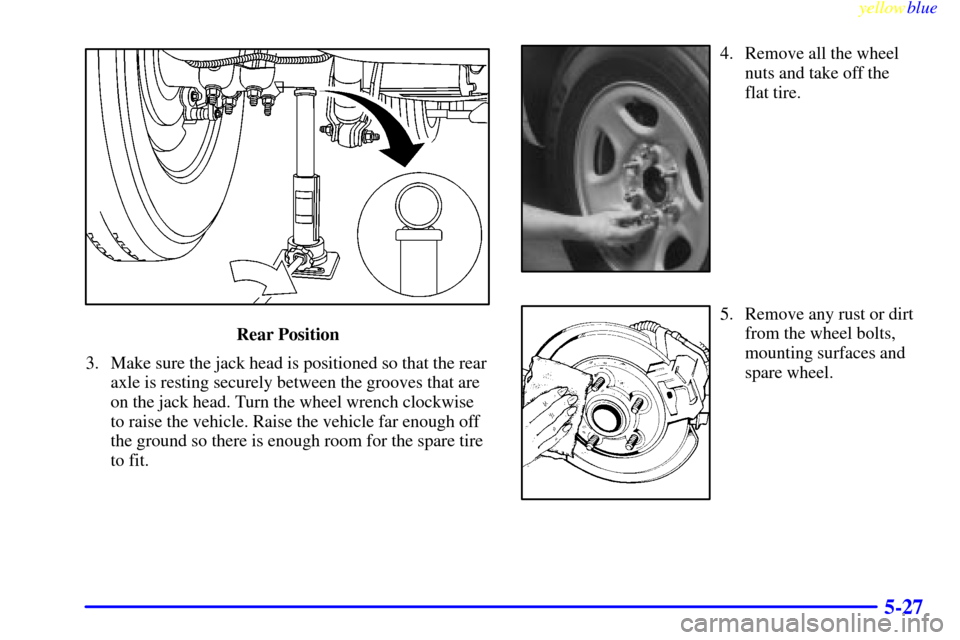
Rear Position
3. Make sure the jack head is positioned so that the rear
axle is resting securely between the grooves that are
on the jack head. Turn the wheel wrench clockwise
to raise the vehicle. Raise the vehicle far enough off
the ground so there is enough room for the spare tire
to fit.
4. Remove all the wheel
nuts and take off the
flat tire.
5. Remove any rust or dirt
from the wheel bolts,
mounting surfaces and
spare wheel.