wheel CHEVROLET SILVERADO 2003 1.G Owners Manual
[x] Cancel search | Manufacturer: CHEVROLET, Model Year: 2003, Model line: SILVERADO, Model: CHEVROLET SILVERADO 2003 1.GPages: 556, PDF Size: 3.56 MB
Page 361 of 556
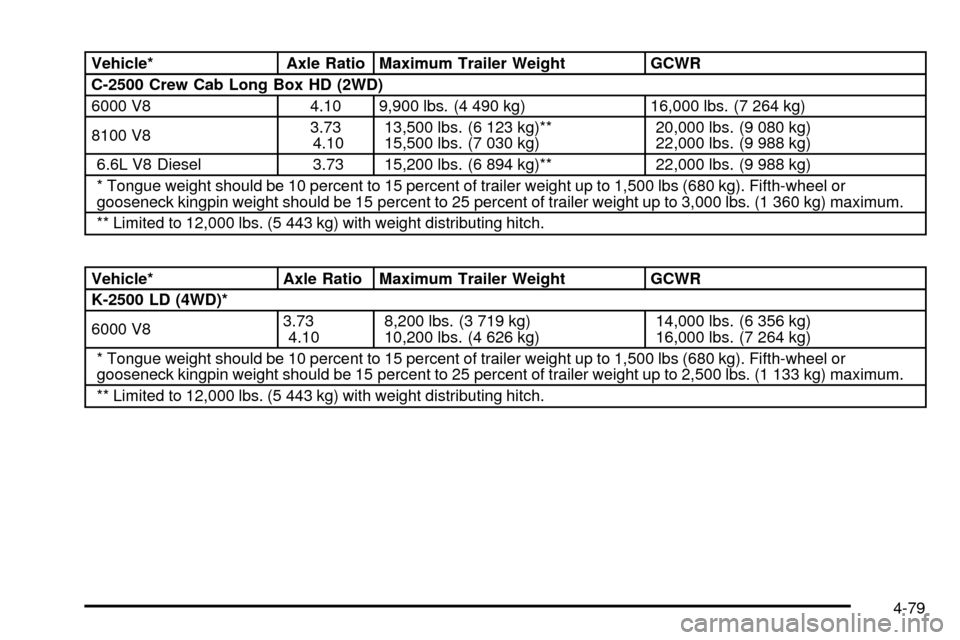
Vehicle* Axle Ratio Maximum Trailer Weight GCWR
C-2500 Crew Cab Long Box HD (2WD)
6000 V8 4.10 9,900 lbs. (4 490 kg) 16,000 lbs. (7 264 kg)
8100 V83.73
4.1013,500 lbs. (6 123 kg)**
15,500 lbs. (7 030 kg)20,000 lbs. (9 080 kg)
22,000 lbs. (9 988 kg)
6.6L V8 Diesel 3.73 15,200 lbs. (6 894 kg)** 22,000 lbs. (9 988 kg)
* Tongue weight should be 10 percent to 15 percent of trailer weight up to 1,500 lbs (680 kg). Fifth-wheel or
gooseneck kingpin weight should be 15 percent to 25 percent of trailer weight up to 3,000 lbs. (1 360 kg) maximum.
** Limited to 12,000 lbs. (5 443 kg) with weight distributing hitch.
Vehicle* Axle Ratio Maximum Trailer Weight GCWR
K-2500 LD (4WD)*
6000 V83.73
4.108,200 lbs. (3 719 kg)
10,200 lbs. (4 626 kg)14,000 lbs. (6 356 kg)
16,000 lbs. (7 264 kg)
* Tongue weight should be 10 percent to 15 percent of trailer weight up to 1,500 lbs (680 kg). Fifth-wheel or
gooseneck kingpin weight should be 15 percent to 25 percent of trailer weight up to 2,500 lbs. (1 133 kg) maximum.
** Limited to 12,000 lbs. (5 443 kg) with weight distributing hitch.
4-79
Page 362 of 556
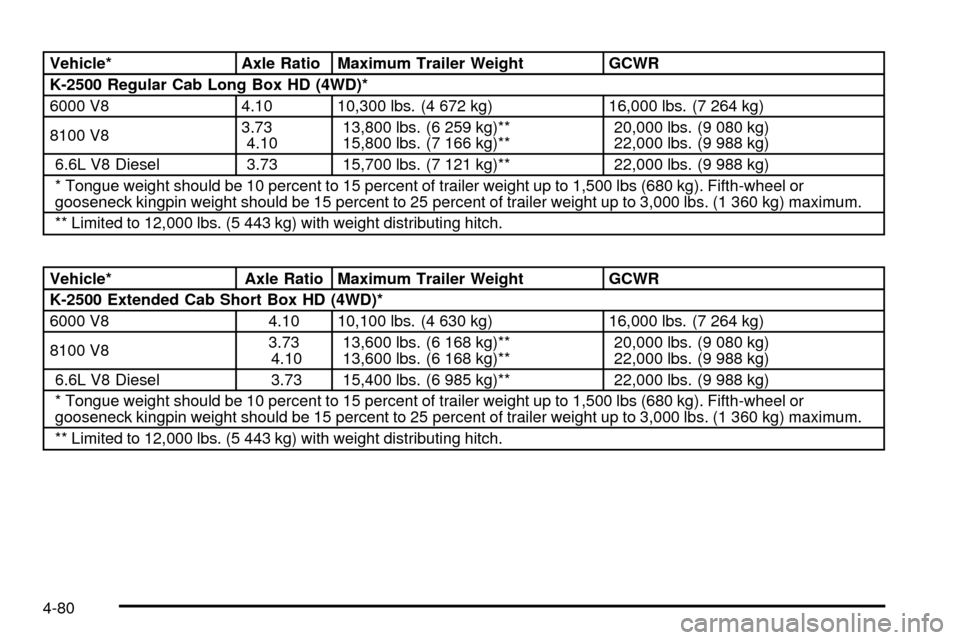
Vehicle* Axle Ratio Maximum Trailer Weight GCWR
K-2500 Regular Cab Long Box HD (4WD)*
6000 V8 4.10 10,300 lbs. (4 672 kg) 16,000 lbs. (7 264 kg)
8100 V83.73
4.1013,800 lbs. (6 259 kg)**
15,800 lbs. (7 166 kg)**20,000 lbs. (9 080 kg)
22,000 lbs. (9 988 kg)
6.6L V8 Diesel 3.73 15,700 lbs. (7 121 kg)** 22,000 lbs. (9 988 kg)
* Tongue weight should be 10 percent to 15 percent of trailer weight up to 1,500 lbs (680 kg). Fifth-wheel or
gooseneck kingpin weight should be 15 percent to 25 percent of trailer weight up to 3,000 lbs. (1 360 kg) maximum.
** Limited to 12,000 lbs. (5 443 kg) with weight distributing hitch.
Vehicle* Axle Ratio Maximum Trailer Weight GCWR
K-2500 Extended Cab Short Box HD (4WD)*
6000 V8 4.10 10,100 lbs. (4 630 kg) 16,000 lbs. (7 264 kg)
8100 V83.73
4.1013,600 lbs. (6 168 kg)**
13,600 lbs. (6 168 kg)**20,000 lbs. (9 080 kg)
22,000 lbs. (9 988 kg)
6.6L V8 Diesel 3.73 15,400 lbs. (6 985 kg)** 22,000 lbs. (9 988 kg)
* Tongue weight should be 10 percent to 15 percent of trailer weight up to 1,500 lbs (680 kg). Fifth-wheel or
gooseneck kingpin weight should be 15 percent to 25 percent of trailer weight up to 3,000 lbs. (1 360 kg) maximum.
** Limited to 12,000 lbs. (5 443 kg) with weight distributing hitch.
4-80
Page 363 of 556
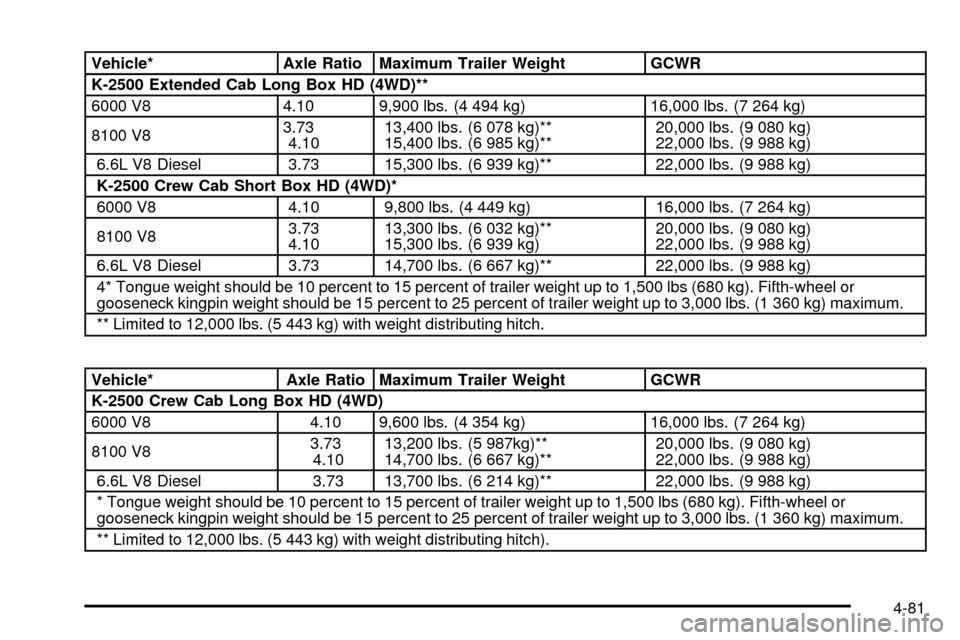
Vehicle* Axle Ratio Maximum Trailer Weight GCWR
K-2500 Extended Cab Long Box HD (4WD)**
6000 V8 4.10 9,900 lbs. (4 494 kg) 16,000 lbs. (7 264 kg)
8100 V83.73
4.1013,400 lbs. (6 078 kg)**
15,400 lbs. (6 985 kg)**20,000 lbs. (9 080 kg)
22,000 lbs. (9 988 kg)
6.6L V8 Diesel 3.73 15,300 lbs. (6 939 kg)** 22,000 lbs. (9 988 kg)
K-2500 Crew Cab Short Box HD (4WD)*
6000 V8 4.10 9,800 lbs. (4 449 kg) 16,000 lbs. (7 264 kg)
8100 V83.73
4.1013,300 lbs. (6 032 kg)**
15,300 lbs. (6 939 kg)20,000 lbs. (9 080 kg)
22,000 lbs. (9 988 kg)
6.6L V8 Diesel 3.73 14,700 lbs. (6 667 kg)** 22,000 lbs. (9 988 kg)
4* Tongue weight should be 10 percent to 15 percent of trailer weight up to 1,500 lbs (680 kg). Fifth-wheel or
gooseneck kingpin weight should be 15 percent to 25 percent of trailer weight up to 3,000 lbs. (1 360 kg) maximum.
** Limited to 12,000 lbs. (5 443 kg) with weight distributing hitch.
Vehicle* Axle Ratio Maximum Trailer Weight GCWR
K-2500 Crew Cab Long Box HD (4WD)
6000 V8 4.10 9,600 lbs. (4 354 kg) 16,000 lbs. (7 264 kg)
8100 V83.73
4.1013,200 lbs. (5 987kg)**
14,700 lbs. (6 667 kg)**20,000 lbs. (9 080 kg)
22,000 lbs. (9 988 kg)
6.6L V8 Diesel 3.73 13,700 lbs. (6 214 kg)** 22,000 lbs. (9 988 kg)
* Tongue weight should be 10 percent to 15 percent of trailer weight up to 1,500 lbs (680 kg). Fifth-wheel or
gooseneck kingpin weight should be 15 percent to 25 percent of trailer weight up to 3,000 lbs. (1 360 kg) maximum.
** Limited to 12,000 lbs. (5 443 kg) with weight distributing hitch).
4-81
Page 364 of 556
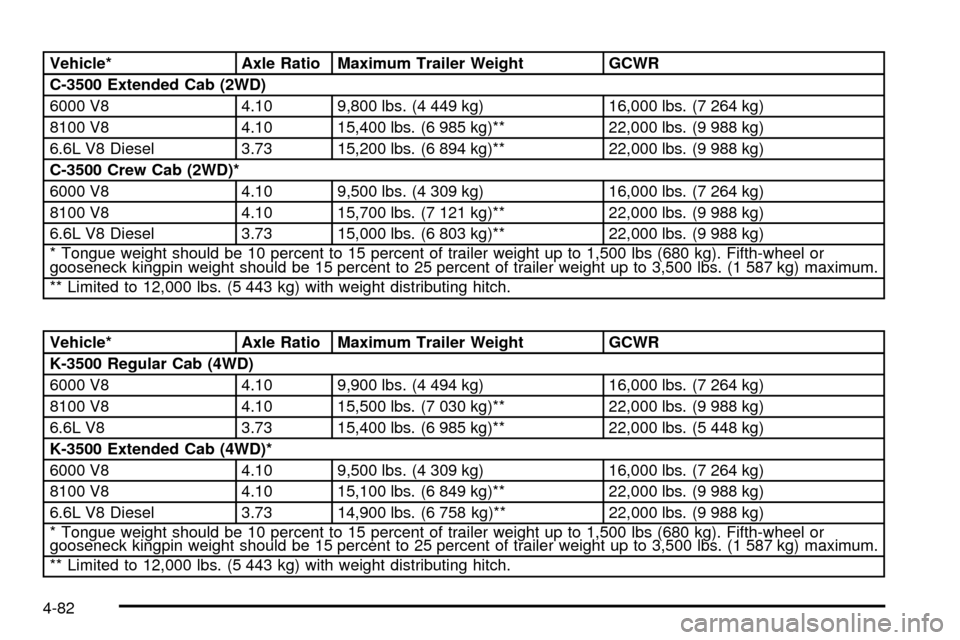
Vehicle* Axle Ratio Maximum Trailer Weight GCWR
C-3500 Extended Cab (2WD)
6000 V8 4.10 9,800 lbs. (4 449 kg) 16,000 lbs. (7 264 kg)
8100 V8 4.10 15,400 lbs. (6 985 kg)** 22,000 lbs. (9 988 kg)
6.6L V8 Diesel 3.73 15,200 lbs. (6 894 kg)** 22,000 lbs. (9 988 kg)
C-3500 Crew Cab (2WD)*
6000 V8 4.10 9,500 lbs. (4 309 kg) 16,000 lbs. (7 264 kg)
8100 V8 4.10 15,700 lbs. (7 121 kg)** 22,000 lbs. (9 988 kg)
6.6L V8 Diesel 3.73 15,000 lbs. (6 803 kg)** 22,000 lbs. (9 988 kg)
* Tongue weight should be 10 percent to 15 percent of trailer weight up to 1,500 lbs (680 kg). Fifth-wheel or
gooseneck kingpin weight should be 15 percent to 25 percent of trailer weight up to 3,500 lbs. (1 587 kg) maximum.
** Limited to 12,000 lbs. (5 443 kg) with weight distributing hitch.
Vehicle* Axle Ratio Maximum Trailer Weight GCWR
K-3500 Regular Cab (4WD)
6000 V8 4.10 9,900 lbs. (4 494 kg) 16,000 lbs. (7 264 kg)
8100 V8 4.10 15,500 lbs. (7 030 kg)** 22,000 lbs. (9 988 kg)
6.6L V8 3.73 15,400 lbs. (6 985 kg)** 22,000 lbs. (5 448 kg)
K-3500 Extended Cab (4WD)*
6000 V8 4.10 9,500 lbs. (4 309 kg) 16,000 lbs. (7 264 kg)
8100 V8 4.10 15,100 lbs. (6 849 kg)** 22,000 lbs. (9 988 kg)
6.6L V8 Diesel 3.73 14,900 lbs. (6 758 kg)** 22,000 lbs. (9 988 kg)
* Tongue weight should be 10 percent to 15 percent of trailer weight up to 1,500 lbs (680 kg). Fifth-wheel or
gooseneck kingpin weight should be 15 percent to 25 percent of trailer weight up to 3,500 lbs. (1 587 kg) maximum.
** Limited to 12,000 lbs. (5 443 kg) with weight distributing hitch.
4-82
Page 365 of 556

Vehicle* Axle Ratio Maximum Trailer Weight GCWR
K-3500 Crew Cab (4WD)*
6000 V8 4.10 9,200 lbs. (4 173 kg) 16,000 lbs. (7 264 kg)
8100 V8 4.10 14,800 lbs. (6 713 kg)** 22,000 lbs. (9 988 kg)
6.6L V8 Diesel 3.73 14,700 lbs. (6 667 kg)** 22,000 lbs. (9 988 kg)
* Tongue weight should be 10 percent to 15 percent of trailer weight up to 1,500 lbs (680 kg). Fifth-wheel or
gooseneck kingpin weight should be 15 percent to 25 percent of trailer weight up to 3,500 lbs. (1 587 kg) maximum.
** Limited to 12,000 lbs. (5 443 kg) with weight distributing hitch.
The Gross Combination Weight Rating (GCWR) is the
total allowable weight of the completely loaded
vehicle and trailer including any passengers, cargo,
equipment and conversions. The GCWR for your vehicle
should not be exceeded.
You can ask your dealer for our trailering information or
advice, or you can write us at the address listed in
your Warranty and Owner Assistance Information
Booklet.In Canada, write to:
General Motors of Canada Limited
Customer Communications Centre, 163-005
1908 Colonel Sam Drive
Oshawa, Ontario L1H 8P7
4-83
Page 368 of 556

Driving with a Trailer
Towing a trailer requires a certain amount of experience.
Before setting out for the open road, you'll want to get
to know your rig. Acquaint yourself with the feel of
handling and braking with the added weight of the trailer.
And always keep in mind that the vehicle you are
driving is now a good deal longer and not nearly as
responsive as your vehicle is by itself.
Before you start, check the trailer hitch and platform
(and attachments), safety chains, electrical connector,
lamps, tires and mirror adjustment. If the trailer has
electric brakes, start your vehicle and trailer moving and
then apply the trailer brake controller by hand to be
sure the brakes are working. This lets you check your
electrical connection at the same time.
During your trip, check occasionally to be sure that the
load is secure, and that the lamps and any trailer
brakes are still working.
While towing a trailer or when exposed to long periods
of sunshine, the ¯oor of the truck bed may become
very warm. Avoid putting items in the truck bed
that might be affected by high ambient temperatures.
Following Distance
Stay at least twice as far behind the vehicle ahead as you
would when driving your vehicle without a trailer. This can
help you avoid situations that require heavy braking and
sudden turns.
Passing
You'll need more passing distance up ahead when you're
towing a trailer. And, because you're a good deal longer,
you'll need to go much farther beyond the passed vehicle
before you can return to your lane.
Backing Up
Hold the bottom of the steering wheel with one hand.
Then, to move the trailer to the left, just move that hand to
the left. To move the trailer to the right, move your hand
to the right. Always back up slowly and, if possible, have
someone guide you.
Making Turns
Notice:Making very sharp turns while trailering
could cause the trailer to come in contact with the
vehicle. Your vehicle could be damaged. Avoid
making very sharp turns while trailering.
When you're turning with a trailer, make wider turns than
normal. Do this so your trailer won't strike soft shoulders,
curbs, road signs, trees or other objects. Avoid jerky or
sudden maneuvers. Signal well in advance.
4-86
Page 370 of 556
Parking on Hills
{CAUTION:
You really should not park your vehicle, with a
trailer attached, on a hill. If something goes
wrong, your rig could start to move. People
can be injured, and both your vehicle and the
trailer can be damaged.
But if you ever have to park your rig on a hill, here's
how to do it:
1. Apply your regular brakes, but don't shift into
PARK (P) yet for an automatic transmission, or into
gear for a manual transmission.
2. Have someone place chocks under the trailer
wheels.
3. When the wheel chocks are in place, release the
regular brakes until the chocks absorb the load.
4. Reapply the regular brakes. Then apply your
parking brake and shift into PARK (P) for an
automatic transmission, or REVERSE (R) for a
manual transmission.5. If you have a four-wheel-drive vehicle, be sure the
transfer case is in a drive gear and not in
NEUTRAL.
6. Release the regular brakes.{CAUTION:
It can be dangerous to get out of your vehicle if
the shift lever is not fully in PARK (P) with the
parking brake ®rmly set. Your vehicle can roll.
If you have left the engine running, the vehicle
can move suddenly. You or others could be
injured. To be sure your vehicle won't move,
even when you're on fairly level ground, use the
steps that follow.
Always put the shift lever fully in PARK (P) with
the parking brake ®rmly set.
If the transfer case on four-wheel-drive vehicles
is in NEUTRAL, your vehicle will be free to roll,
even if your shift lever is in PARK (P). So, be
sure the transfer case is in a drive gear Ð not in
NEUTRAL.
4-88
Page 373 of 556

The eight-wire harness contains the following trailer
circuits:
·Yellow: Left Stop/Turn Signal
·Dark Green: Right Stop/Turn Signal
·Brown: Taillamps
·White: Ground
·Light Green: Back-up Lamps
·Light Blue: CHMSL
·Red: Battery Feed
·Dark Blue: Trailer Brake
If your trailer is equipped with electric brakes, you can
get a jumper harness (electric trailer brake control)
with a trailer battery feed fuse from your dealer.
If you need to tow a light-duty trailer with a standard
four-way round pin connector you can also get an
adapter from your dealer.
Camper/Fifth-Wheel Trailer Wiring Package
The eight-wire camper harness is located under the
front edge of the pickup box on the driver's side of the
vehicle, attached to the frame bracket. A connector
will have to be added to the wiring harness which
connects to the camper.
The eight-wire harness contains the following
camper/trailer circuits:
·Yellow: Left Stop/Turn Signal
·Dark Green: Right Stop/Turn Signal
·Brown: Taillamps
·White: Ground
·Light Green: Back-up Lamps
·Light Blue: Center High-Mounted Stoplamp
(CHMSL)
·Red: Battery Feed
·Dark Blue: Trailer Brake
4-91
Page 381 of 556

Service............................................................5-3
Doing Your Own Service Work.........................5-3
Adding Equipment to the Outside of Your
Vehicle......................................................5-4
Fuel................................................................5-4
Gasoline Octane............................................5-4
Gasoline Speci®cations....................................5-5
California Fuel...............................................5-5
Additives.......................................................5-5
Fuels in Foreign Countries...............................5-6
Filling Your Tank............................................5-6
Filling a Portable Fuel Container.......................5-8
Checking Things Under
the Hood......................................................5-8
Hood Release................................................5-9
Engine Compartment Overview.......................5-10
Engine Oil...................................................5-16
Engine Air Cleaner/Filter................................5-21
Automatic Transmission Fluid (Except Allison
Transmission
ž) ..........................................5-23Automatic Transmission Fluid (Allison
Transmission
ž) ..........................................5-26
Manual Transmission Fluid.............................5-28
Hydraulic Clutch...........................................5-29
Engine Coolant.............................................5-30
Coolant Surge Tank Pressure Cap..................5-33
Engine Overheating.......................................5-33
Cooling System............................................5-36
Engine Fan Noise.........................................5-41
Power Steering Fluid.....................................5-42
Windshield Washer Fluid................................5-43
Brakes........................................................5-44
Battery........................................................5-47
Jump Starting...............................................5-48
All-Wheel Drive..............................................5-54
Rear Axle.......................................................5-55
Four-Wheel Drive............................................5-56
Noise Control System.....................................5-58
Tampering with Noise Control System
Prohibited.................................................5-58
Section 5 Service and Appearance Care
5-1
Page 382 of 556

Bulb Replacement..........................................5-59
Halogen Bulbs..............................................5-59
Headlamps..................................................5-59
Front Turn Signal, Sidemarker and Daytime
Running Lamps.........................................5-61
Roof Marker Lamps......................................5-62
Center High-Mounted Stoplamp (CHMSL) and
Cargo Lamp.............................................5-63
Pickup Box Identi®cation and Fender Marker
Lamps.....................................................5-65
Taillamps.....................................................5-65
Replacement Bulbs.......................................5-67
Windshield Wiper Blade Replacement..............5-68
Tires..............................................................5-69
In¯ation -- Tire Pressure................................5-69
Dual Tire Operation.......................................5-70
Tire Inspection and Rotation...........................5-71
When It Is Time for New Tires.......................5-73
Buying New Tires.........................................5-74
Uniform Tire Quality Grading..........................5-75
Wheel Alignment and Tire Balance..................5-76
Wheel Replacement......................................5-76
Tire Chains..................................................5-78
If a Tire Goes Flat........................................5-79
Changing a Flat Tire.....................................5-80Appearance Care..........................................5-100
Cleaning the Inside of Your Vehicle...............5-100
Care of Safety Belts....................................5-103
Weatherstrips.............................................5-103
Cleaning the Outside of Your Vehicle.............5-103
Sheet Metal Damage...................................5-105
Finish Damage...........................................5-106
Underbody Maintenance...............................5-106
Chemical Paint Spotting...............................5-106
Vehicle Care/Appearance Materials................5-107
Vehicle Identi®cation.....................................5-108
Vehicle Identi®cation Number (VIN)................5-108
Service Parts Identi®cation Label...................5-109
Electrical System..........................................5-109
Add-On Electrical Equipment.........................5-109
Windshield Wiper Fuses...............................5-109
Power Windows and Other Power Options......5-109
Fuses and Circuit Breakers..........................5-110
Capacities and Speci®cations........................5-118
Capacities and Speci®cations........................5-118
Normal Maintenance Replacement Parts.........5-121
Section 5 Service and Appearance Care
5-2