seats CHEVROLET SILVERADO 2003 1.G User Guide
[x] Cancel search | Manufacturer: CHEVROLET, Model Year: 2003, Model line: SILVERADO, Model: CHEVROLET SILVERADO 2003 1.GPages: 556, PDF Size: 3.56 MB
Page 30 of 556
The best way to protect the fetus is to protect the
mother. When a safety belt is worn properly, it's more
likely that the fetus won't be hurt in a crash. For
pregnant women, as for anyone, the key to making
safety belts effective is wearing them properly.
Right Front Passenger Position
To learn how to wear the right front passenger's safety
belt properly, seeDriver Position on page 1-16.
The right front passenger's safety belt works the same
way as the driver's safety beltÐexcept for one thing.
If you ever pull the shoulder portion of the belt out all the
way, you will engage the child restraint locking feature
which may turn off the passenger's frontal air bag. If this
happens unintentionally, just let the belt go back all
the way and start again.
Center Passenger Position
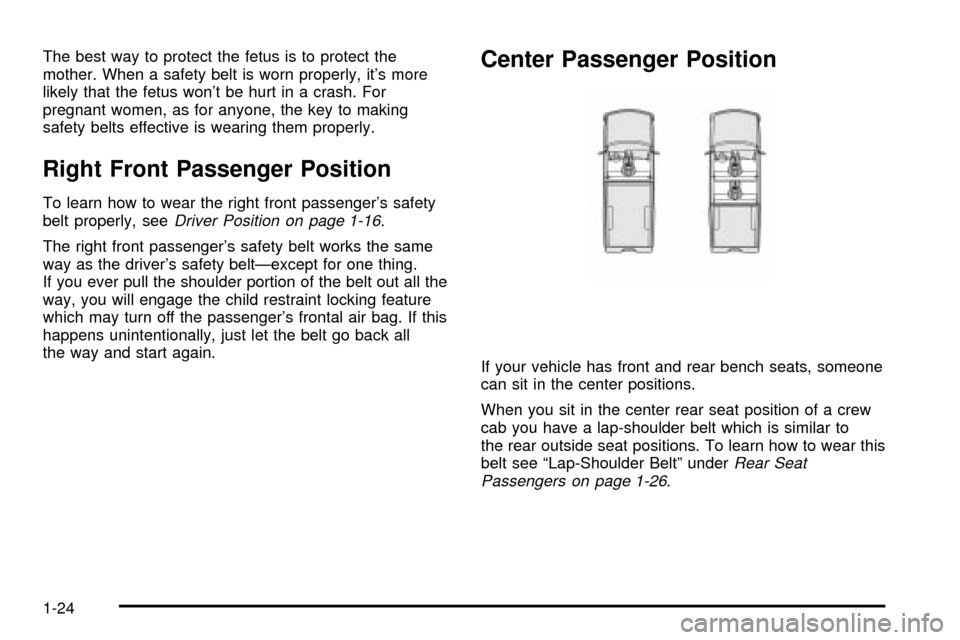
If your vehicle has front and rear bench seats, someone
can sit in the center positions.
When you sit in the center rear seat position of a crew
cab you have a lap-shoulder belt which is similar to
the rear outside seat positions. To learn how to wear this
belt see ªLap-Shoulder Beltº under
Rear Seat
Passengers on page 1-26.
1-24
Page 35 of 556
Rear Safety Belt Comfort Guides for
Children and Small Adults
Your vehicle may have this feature already. If it doesn't,
you can get it from any GM dealer.
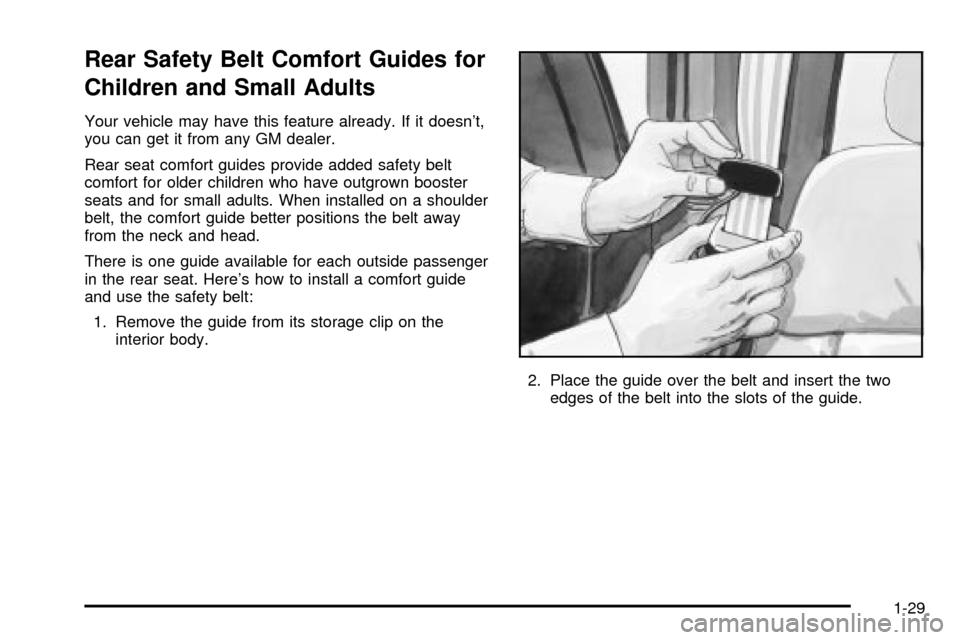
Rear seat comfort guides provide added safety belt
comfort for older children who have outgrown booster
seats and for small adults. When installed on a shoulder
belt, the comfort guide better positions the belt away
from the neck and head.
There is one guide available for each outside passenger
in the rear seat. Here's how to install a comfort guide
and use the safety belt:
1. Remove the guide from its storage clip on the
interior body.
2. Place the guide over the belt and insert the two
edges of the belt into the slots of the guide.
1-29
Page 37 of 556
Safety Belt Extender
If the vehicle's safety belt will fasten around you, you
should use it.
But if a safety belt isn't long enough to fasten, your
dealer will order you an extender. It's free. When you go
in to order it, take the heaviest coat you will wear, so
the extender will be long enough for you. The extender
will be just for you, and just for the seat in your
vehicle that you choose. Don't let someone else use it,
and use it only for the seat it is made to ®t. To wear
it, just attach it to the regular safety belt.
Child Restraints
Older Children
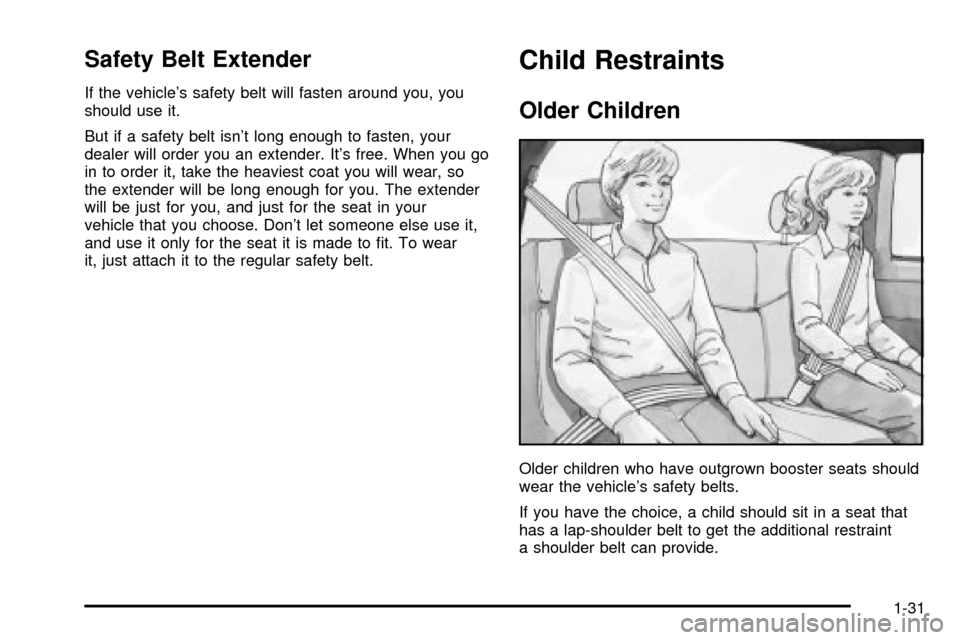
Older children who have outgrown booster seats should
wear the vehicle's safety belts.
If you have the choice, a child should sit in a seat that
has a lap-shoulder belt to get the additional restraint
a shoulder belt can provide.
1-31
Page 45 of 556
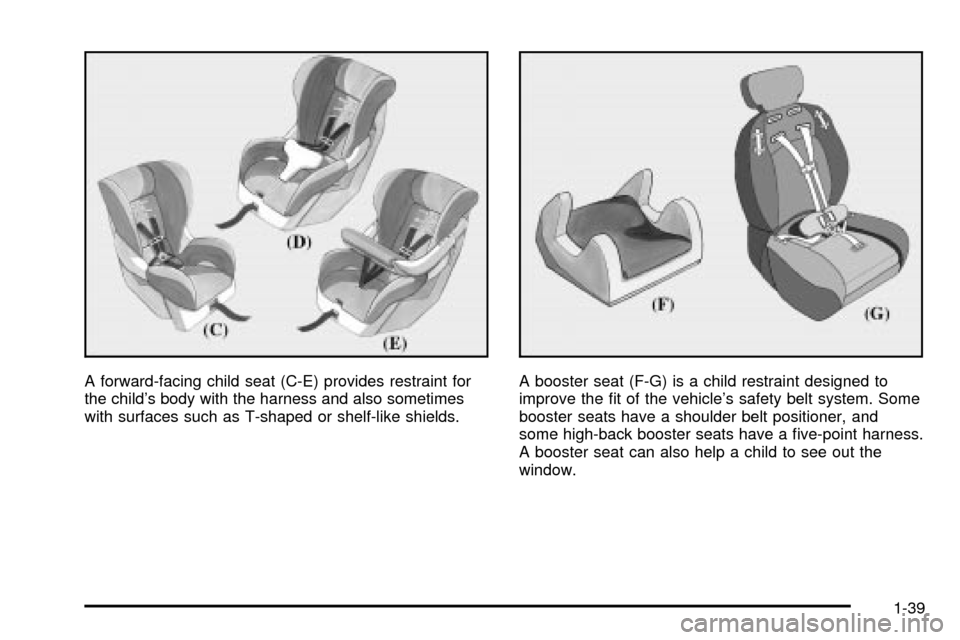
A forward-facing child seat (C-E) provides restraint for
the child's body with the harness and also sometimes
with surfaces such as T-shaped or shelf-like shields.A booster seat (F-G) is a child restraint designed to
improve the ®t of the vehicle's safety belt system. Some
booster seats have a shoulder belt positioner, and
some high-back booster seats have a ®ve-point harness.
A booster seat can also help a child to see out the
window.
1-39
Page 62 of 556
A rear seat is a safer place to secure a forward-facing
child restraint. If you need to secure a forward-facing
child restraint in the right front seat position, see
Where
to Put the Restraint on page 1-41.
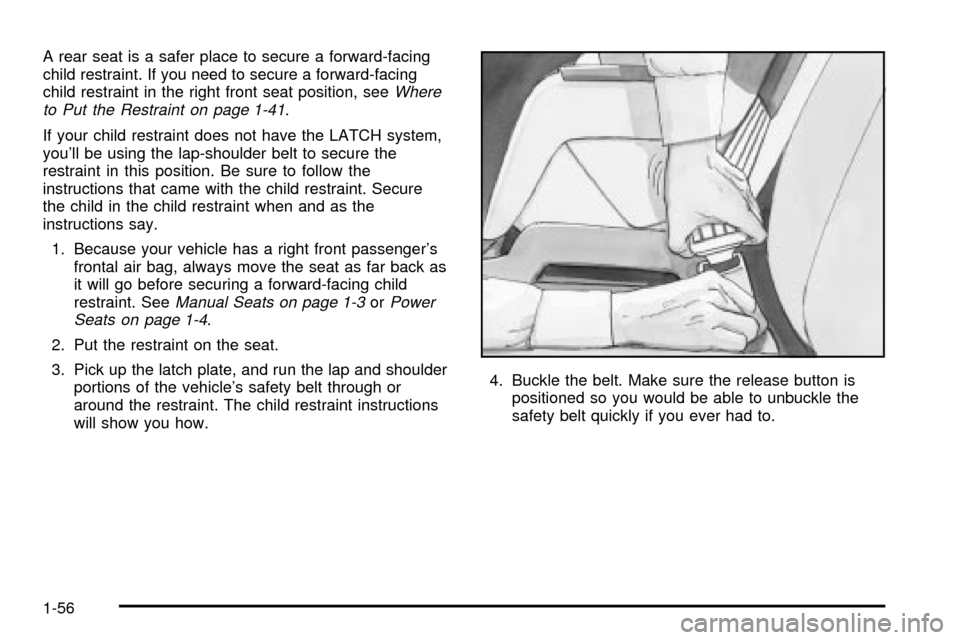
If your child restraint does not have the LATCH system,
you'll be using the lap-shoulder belt to secure the
restraint in this position. Be sure to follow the
instructions that came with the child restraint. Secure
the child in the child restraint when and as the
instructions say.
1. Because your vehicle has a right front passenger's
frontal air bag, always move the seat as far back as
it will go before securing a forward-facing child
restraint. See
Manual Seats on page 1-3orPower
Seats on page 1-4.
2. Put the restraint on the seat.
3. Pick up the latch plate, and run the lap and shoulder
portions of the vehicle's safety belt through or
around the restraint. The child restraint instructions
will show you how.4. Buckle the belt. Make sure the release button is
positioned so you would be able to unbuckle the
safety belt quickly if you ever had to.
1-56
Page 66 of 556
A rear seat is a safer place to secure a forward facing
child restraint. SeeWhere to Put the Restraint on
page 1-41. If you need to secure a forward-facing child
restraint in the right front seat position, move the
seat as far back as it will go before securing a
forward-facing child restraint. See
Manual Seats on
page 1-3orPower Seats on page 1-4.
{CAUTION:
If the air bag readiness light in the instrument
panel cluster ever comes on when you have
turned off the air bag, it means that something
may be wrong with the air bag system. The
right front passenger's air bag could in¯ate
even though the switch is off. If this ever
happens, have the vehicle serviced promptly.
Until you have the vehicle serviced, do not let
CAUTION: (Continued)
CAUTION: (Continued)
anyone whom the national government has
identi®ed as a member of a passenger air bag
risk group sit in the right front passenger's
position (for example, do not secure a
rear-facing child restraint in the right front
passenger's seat). See²Air Bag Off Switch²in
the Index.
In addition to the AIR BAG OFF switch, your vehicle
may have the passenger sensing system. See
Passenger Sensing System on page 1-76for more on
this, including important safety information.
If your child restraint is equipped with the LATCH
system, see
Lower Anchorages and Top Tethers for
Children (LATCH System) on page 1-47. SeeTop Strap
on page 1-42if your child restraint has one.
1-60
Page 67 of 556
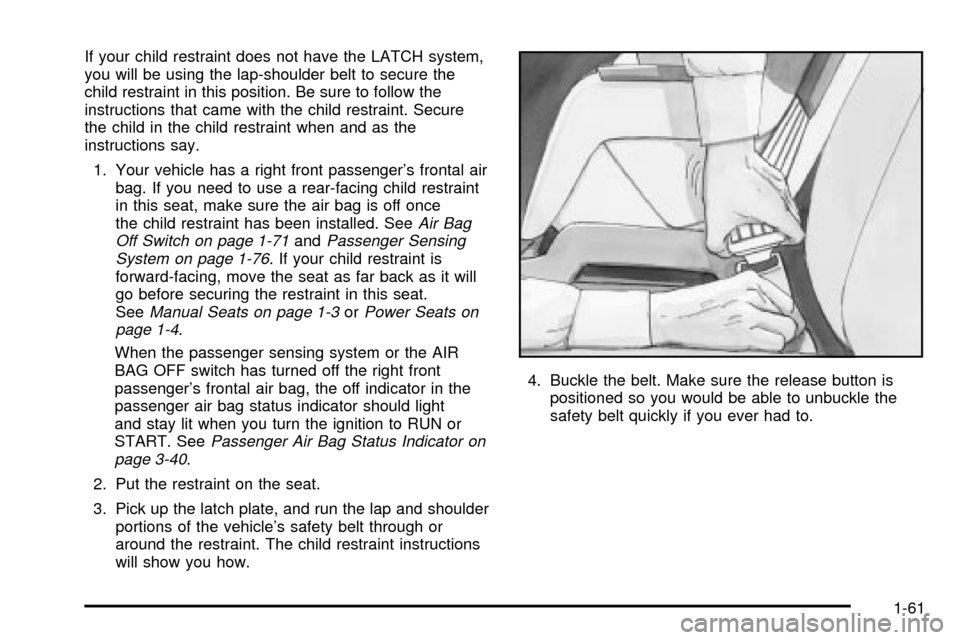
If your child restraint does not have the LATCH system,
you will be using the lap-shoulder belt to secure the
child restraint in this position. Be sure to follow the
instructions that came with the child restraint. Secure
the child in the child restraint when and as the
instructions say.
1. Your vehicle has a right front passenger's frontal air
bag. If you need to use a rear-facing child restraint
in this seat, make sure the air bag is off once
the child restraint has been installed. See
Air Bag
Off Switch on page 1-71andPassenger Sensing
System on page 1-76. If your child restraint is
forward-facing, move the seat as far back as it will
go before securing the restraint in this seat.
See
Manual Seats on page 1-3orPower Seats on
page 1-4.
When the passenger sensing system or the AIR
BAG OFF switch has turned off the right front
passenger's frontal air bag, the off indicator in the
passenger air bag status indicator should light
and stay lit when you turn the ignition to RUN or
START. See
Passenger Air Bag Status Indicator on
page 3-40.
2. Put the restraint on the seat.
3. Pick up the latch plate, and run the lap and shoulder
portions of the vehicle's safety belt through or
around the restraint. The child restraint instructions
will show you how.4. Buckle the belt. Make sure the release button is
positioned so you would be able to unbuckle the
safety belt quickly if you ever had to.
1-61
Page 75 of 556

Seat Position Sensors
Vehicle's with dual stage air bags are also equipped
with special sensors which enable the sensing system to
monitor the position of both the driver and passenger
front seats. The seat position sensor provides
information which is used to determine if the air bags
should deploy at a reduced level or at full deployment.
Single Stage Air Bags
If your vehicle has frontal air bags with single stage
deployment and your vehicle goes straight into a wall
that does not move or deform, the threshold level
is about 13 to 16 mph (20 to 25 km/h). The threshold
level can vary, however, with speci®c vehicle design, so
that it can be somewhat above or below this range.
If your vehicle strikes something that will move or
deform, such as a parked car, the threshold level will be
higher. The air bag is not designed to in¯ate in
rollovers, rear impacts, or in many side impacts because
in¯ation would not help the occupant.
What Makes an Air Bag In¯ate?
In an impact of sufficient severity, the air bag sensing
system detects that the vehicle is in a crash. The
sensing system triggers a release of gas from the
in¯ator, which in¯ates the air bag. The in¯ator, air bag,
and related hardware are all part of the air bag
modules inside the steering wheel and in the instrument
panel in front of the right front passenger.
How Does an Air Bag Restrain?
In moderate to severe frontal or near-frontal collisions,
even belted occupants can contact the steering wheel or
the instrument panel. Air bags supplement the
protection provided by safety belts. Air bags distribute
the force of the impact more evenly over the occupant's
upper body, stopping the occupant more gradually.
But air bags would not help you in many types of
collisions, including rollovers, rear impacts and many
side impacts, primarily because an occupant's motion is
not toward those air bags. Air bags should never be
regarded as anything more than a supplement to safety
belts, and then only in moderate to severe frontal or
near-frontal collisions.
1-69
Page 148 of 556
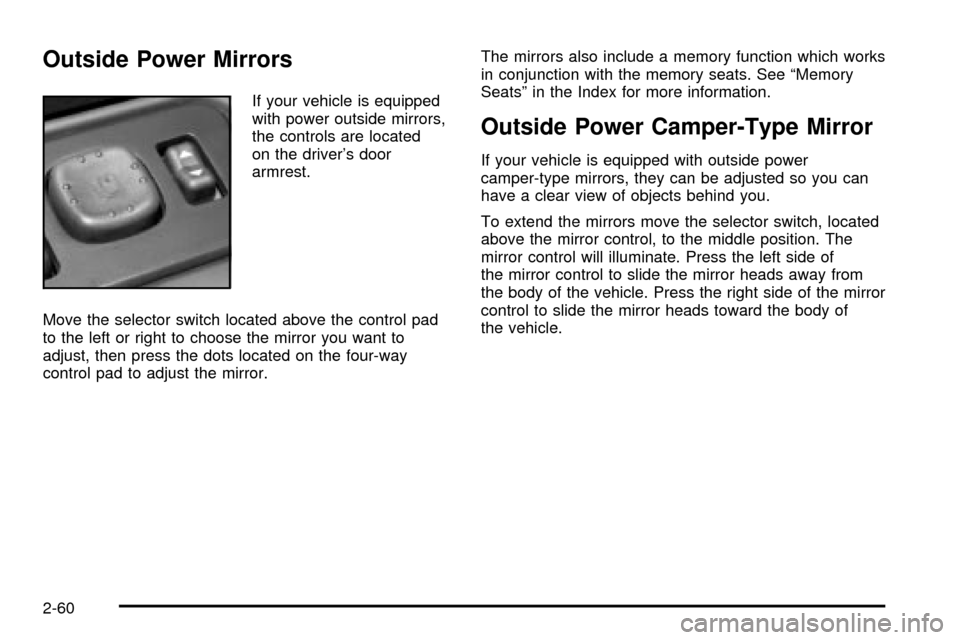
Outside Power Mirrors
If your vehicle is equipped
with power outside mirrors,
the controls are located
on the driver's door
armrest.
Move the selector switch located above the control pad
to the left or right to choose the mirror you want to
adjust, then press the dots located on the four-way
control pad to adjust the mirror.The mirrors also include a memory function which works
in conjunction with the memory seats. See ªMemory
Seatsº in the Index for more information.
Outside Power Camper-Type Mirror
If your vehicle is equipped with outside power
camper-type mirrors, they can be adjusted so you can
have a clear view of objects behind you.
To extend the mirrors move the selector switch, located
above the mirror control, to the middle position. The
mirror control will illuminate. Press the left side of
the mirror control to slide the mirror heads away from
the body of the vehicle. Press the right side of the mirror
control to slide the mirror heads toward the body of
the vehicle.
2-60
Page 153 of 556

Front Storage Area
Your vehicle may have a center armrest storage
compartment in the front bench seat.
To open it, fold down the armrest and press the latch
handle located at the front of the armrest. Then, let the
lid pop up and swing open.
The storage compartment has a cassette/compact disc
holder. The holder will store up to six compact disc
cases and ®ve cassette tape cases or a total of
11 cassette tape cases.
If not used to store cassette or compact disc cases, the
storage area can be used to store a laptop computer.
To use the writing table, pull the latch at the rear of the
table and swing the writing table forward. Use it to
hold a pad of paper and a pen.
Center Console Storage Area
Your vehicle may be equipped with a console
compartment between the bucket seats.
To open it, press the button and swing the console lid
open. The console has a place to store tissues,
pens and a clip to hold business cards.
Your console may have a cupholder that swings down
for the rear seat passengers to use. The front cupholder
pulls out and swivels 180É to provide clearance
between tall beverage containers and the manual
transmission shift lever (if equipped).
Your vehicle may have a compact disc holder in the
console.
2-65