automatic transmission CHEVROLET SILVERADO 2003 1.G Owner's Manual
[x] Cancel search | Manufacturer: CHEVROLET, Model Year: 2003, Model line: SILVERADO, Model: CHEVROLET SILVERADO 2003 1.GPages: 556, PDF Size: 3.56 MB
Page 294 of 556

If desired, you can change the TAS automatic
engagement feature so that the system will not come on
automatically when the engine is started. To do so:
1. Park the vehicle with the ignition off and the
transmission in PARK (P).
2. Turn the ignition to RUN; do not start the engine.
3. Apply the brake pedal, shift into NEUTRAL (N),
press the accelerator pedal to the ¯oor and then
press the TAS on/off button and hold it down for at
least six seconds.
4. Release the TAS button and both pedals.
5. Turn off the ignition and wait a few seconds.
The next time you start your vehicle, the TAS will not
automatically come on. You can restore the automatic
feature by using the same procedure. Whether the TAS
is set to come on automatically or not, you can always
turn the system on or off by pressing the TAS on/off
button.Manual Selectable Ride
The main function of this system is to provide superior
ride comfort while trailering or fully loaded, as well
as for unloaded driving. This system also helps
to provide:
·Improved trailering stability
·Improved handling response when trailering or fully
loaded
This button is located on
the center of the instrument
panel near the radio. Press
it to activate the selectable
ride setting as desired. An
indicator light near the
button will illuminate
whenever the system is
active.
It is recommended to use this system as follows:
·For optimum ride comfort in an unloaded vehicle
the button should be out and the indicator light
will not be illuminated. This switch position indicates
NORMAL levels of ride control or damping.
4-12
Page 338 of 556
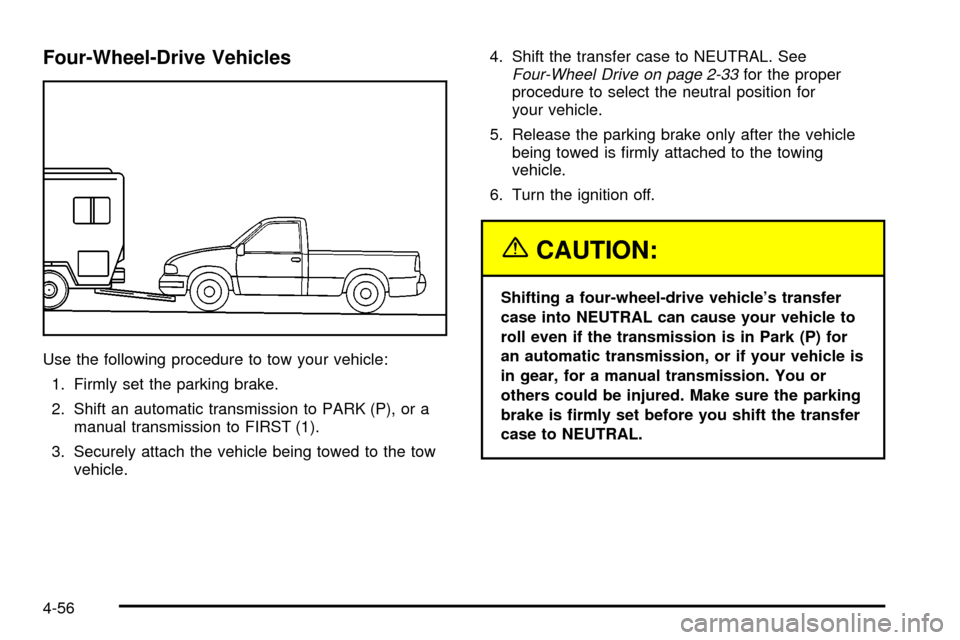
Four-Wheel-Drive Vehicles
Use the following procedure to tow your vehicle:
1. Firmly set the parking brake.
2. Shift an automatic transmission to PARK (P), or a
manual transmission to FIRST (1).
3. Securely attach the vehicle being towed to the tow
vehicle.4. Shift the transfer case to NEUTRAL. See
Four-Wheel Drive on page 2-33for the proper
procedure to select the neutral position for
your vehicle.
5. Release the parking brake only after the vehicle
being towed is ®rmly attached to the towing
vehicle.
6. Turn the ignition off.
{CAUTION:
Shifting a four-wheel-drive vehicle's transfer
case into NEUTRAL can cause your vehicle to
roll even if the transmission is in Park (P) for
an automatic transmission, or if your vehicle is
in gear, for a manual transmission. You or
others could be injured. Make sure the parking
brake is ®rmly set before you shift the transfer
case to NEUTRAL.
4-56
Page 339 of 556
Dolly Towing
Two-Wheel-Drive Vehicles
Two-wheel-drive vehicles should not be towed with the
rear wheels on the ground. Two-wheel-drive
transmissions have no provisions for internal lubrication
while being towed. To properly tow these vehicles, they
should be placed on a platform trailer with all four wheels
off the ground.
Four-Wheel-Drive Vehicles
Use the following procedure to tow your vehicle:
1. Firmly set the parking brake.
2. Shift an automatic transmission to PARK (P), or a
manual transmission to FIRST (1).
3. Securely attach the vehicle being towed to the tow
vehicle.
4. Shift the transfer case to NEUTRAL. See
Four-Wheel Drive on page 2-33for the proper
procedure to select the neutral position for
your vehicle.
5. Release the parking brake only after the vehicle
being towed is ®rmly attached to the towing
vehicle.
6. Turn the ignition off.
{CAUTION:
Shifting a four-wheel-drive vehicle's transfer
case into NEUTRAL can cause your vehicle to
roll even if the transmission is in Park (P) for
an automatic transmission, or if your vehicle is
in gear, for a manual transmission. You or
others could be injured. Make sure the parking
brake is ®rmly set before you shift the transfer
case to NEUTRAL.
All-Wheel Drive Vehicles
If your vehicle is equipped with the Silverado SS
package your vehicle was not designed to be towed
with any of its wheels on the ground. If your vehicle must
be towed, see
Towing Your Vehicle on page 4-55.
Notice:Towing an all-wheel-drive vehicle with all
four wheels on the ground, or even with only two of
its wheels on the ground, will damage drivetrain
components. Don't tow an all-wheel-drive vehicle if
any of its wheels will be on the ground.
4-57
Page 351 of 556

·Consider using a sway control if your trailer will
weigh less than 5,000 lbs. (2 270 kg) for light duty
vehicles, or less than 7,500 lbs. (3 405 kg) for heavy
duty vehicles. You should always use a sway control
if your trailer will weigh more than these limits. You
can ask a hitch dealer about sway controls.
·Don't tow a trailer at all during the ®rst 500 miles
(800 km) your new vehicle is driven. Your engine,
axle or other parts could be damaged.
·Then, during the ®rst 500 miles (800 km) that you tow
a trailer, don't drive over 50 mph (80 km/h) and don't
make starts at full throttle. This helps your engine
and other parts of your vehicle wear in at the heavier
loads.
·If you have an automatic transmission, you can tow
in DRIVE (D). You may want to shift the transmission
to THIRD (3) or, if necessary, a lower gear selection
if the transmission shifts too often (e.g., under heavy
loads and/or hilly conditions). If you have a manual
transmission and you are towing a trailer, it's better
not to use the highest gear. See
Tow/Haul Mode
Light on page 3-53.
Three important considerations have to do with weight:
·the weight of the trailer,
·the weight of the trailer tongue
·and the weight on your vehicle's tires.
Tow/Haul Mode
Tow/haul is a feature on automatic transmission
equipped vehicles that assists when pulling a heavy
trailer or a large or heavy load. The purpose of
the tow/haul mode is to:
·Reduce the frequency and improve the predictability
of transmission shifts when pulling a heavy trailer or
a large or heavy load.
·Provide the same solid shift feel when pulling a
heavy trailer or a large or heavy load as when
the vehicle is unloaded.
·Improve control of vehicle speed while requiring
less throttle pedal activity when pulling a heavy
trailer or a large or heavy load.
Automatic transmission equipped vehicles are provided
with a button at the end of the shift lever which when
pressed enables tow/haul. When the button is pressed,
a light on the instrument panel will illuminate to
indicate that tow/haul has been selected. Tow/haul may
be turned off by pressing the button again, at which
time the indicator light on the instrument panel will turn
off. The vehicle will automatically turn off tow/haul
every time it is started.
4-69
Page 369 of 556

Turn Signals When Towing a Trailer
The arrows on your instrument panel will ¯ash whenever
you signal a turn or lane change. Properly hooked up,
the trailer lamps will also ¯ash, telling other drivers
you're about to turn, change lanes or stop.
When towing a trailer, the arrows on your instrument
panel will ¯ash for turns even if the bulbs on the trailer
are burned out. Thus, you may think drivers behind
you are seeing your signal when they are not. It's
important to check occasionally to be sure the trailer
bulbs are still working.
Driving On Grades
Reduce speed and shift to a lower gearbeforeyou start
down a long or steep downgrade. If you don't shift
down, you might have to use your brakes so much that
they would get hot and no longer work well.
If you have an automatic transmission, you can tow in
DRIVE (D). You may want to shift the transmission
to lower gear selection if the transmission shifts too often
(e.g., under heavy loads and/or hilly conditions).
You may also want to activate the tow/haul mode if the
transmission shifts too often. See
Tow/Haul Mode
Light on page 3-53.If you have a 5-speed manual transmission and you are
towing a trailer, it's better not to use FIFTH (5) gear.
Just drive in FOURTH (4) gear (or, as you need
to, a lower gear).
If you have a 6-speed manual transmission and you are
towing a trailer, it's better not to use SIXTH (6) gear.
Drive in FIFTH (5) gear (or, as you need to, a lower gear).
When towing at high altitude on steep uphill grades,
consider the following: Engine coolant will boil at a lower
temperature than at normal altitudes. If you turn your
engine off immediately after towing at high altitude
on steep uphill grades, your vehicle may show signs
similar to engine overheating. To avoid this, let the
engine run while parked (preferably on level ground)
with the automatic transmission in PARK (P) (or
the manual transmission out of gear and the parking
brake applied) for a few minutes before turning the
engine off. If you do get the overheat warning,
see
Engine Overheating on page 5-33.
4-87
Page 370 of 556
Parking on Hills
{CAUTION:
You really should not park your vehicle, with a
trailer attached, on a hill. If something goes
wrong, your rig could start to move. People
can be injured, and both your vehicle and the
trailer can be damaged.
But if you ever have to park your rig on a hill, here's
how to do it:
1. Apply your regular brakes, but don't shift into
PARK (P) yet for an automatic transmission, or into
gear for a manual transmission.
2. Have someone place chocks under the trailer
wheels.
3. When the wheel chocks are in place, release the
regular brakes until the chocks absorb the load.
4. Reapply the regular brakes. Then apply your
parking brake and shift into PARK (P) for an
automatic transmission, or REVERSE (R) for a
manual transmission.5. If you have a four-wheel-drive vehicle, be sure the
transfer case is in a drive gear and not in
NEUTRAL.
6. Release the regular brakes.{CAUTION:
It can be dangerous to get out of your vehicle if
the shift lever is not fully in PARK (P) with the
parking brake ®rmly set. Your vehicle can roll.
If you have left the engine running, the vehicle
can move suddenly. You or others could be
injured. To be sure your vehicle won't move,
even when you're on fairly level ground, use the
steps that follow.
Always put the shift lever fully in PARK (P) with
the parking brake ®rmly set.
If the transfer case on four-wheel-drive vehicles
is in NEUTRAL, your vehicle will be free to roll,
even if your shift lever is in PARK (P). So, be
sure the transfer case is in a drive gear Ð not in
NEUTRAL.
4-88
Page 371 of 556
When You Are Ready to Leave After
Parking on a Hill
1. Apply your regular brakes and hold the pedal down
while you:
·start your engine,
·shift into a gear, and
·release the parking brake.
2. Let up on the brake pedal.
3. Drive slowly until the trailer is clear of the chocks.
4. Stop and have someone pick up and store the
chocks.
Maintenance When Trailer Towing
Your vehicle will need service more often when you're
pulling a trailer. See the Maintenance Schedule for more
on this. Things that are especially important in trailer
operation are automatic transmission ¯uid (don't over®ll),
engine oil, axle lubricant, belt, cooling system and
brake system. Each of these is covered in this manual,
and the Index will help you ®nd them quickly. If
you're trailering, it's a good idea to review these sections
before you start your trip.
Check periodically to see that all hitch nuts and bolts
are tight.
Trailer Wiring Harness
Your vehicle is equipped with one of the following wiring
harnesses for towing a trailer or hauling a slide-in
camper.
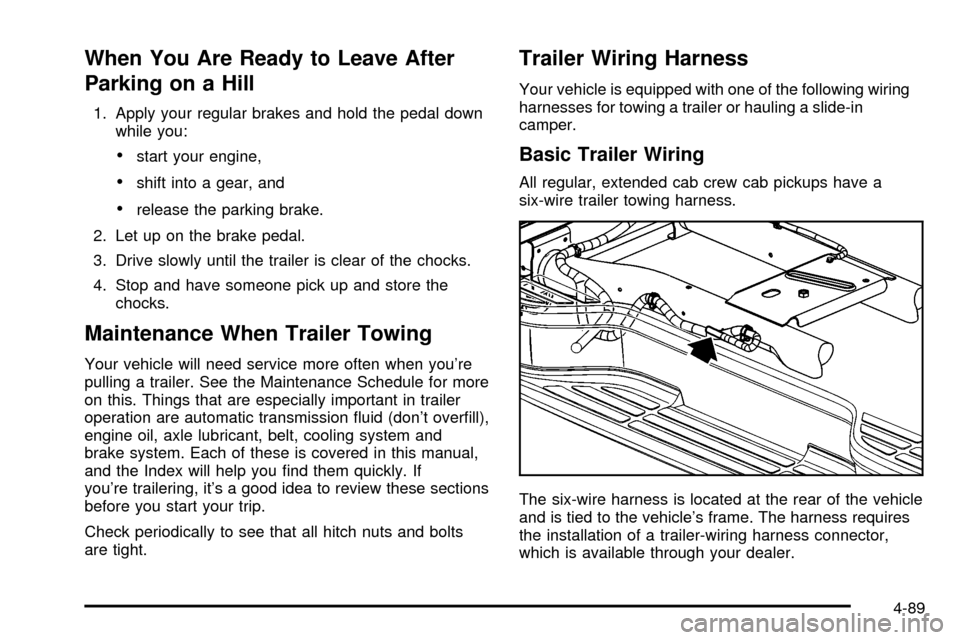
Basic Trailer Wiring
All regular, extended cab crew cab pickups have a
six-wire trailer towing harness.
The six-wire harness is located at the rear of the vehicle
and is tied to the vehicle's frame. The harness requires
the installation of a trailer-wiring harness connector,
which is available through your dealer.
4-89
Page 377 of 556

Power Take-Off (PTO)
Before using a PTO, if equipped, refer to the
manufacturer's or installer's instructions.
To engage a PTO on a vehicle with a manual
transmission do the following:
1. Hold the clutch pedal down.
2. Set the parking brake.
3. Shift the transmission into NEUTRAL (N).
4. Engage the PTO. Refer to the manufacturer's
or installer's for instructions on electrically
engaged PTOs.
5. For mobile operations, shift the transmission into
the gear you want, apply the regular brakes and
release the parking brake. For stationary operations,
leave the parking brake applied.
6. Release the clutch and regular brakes as you
normally would. When the clutch is released,
the PTO will start.
7. Turn the PTO rotary switch to ON.To engage a PTO on a vehicle with an automatic
transmission do the following:
1. For stationary use shift the transmission into
PARK (P).
2. Turn the PTO rotary switch ON.
3. If the engine speed is below the PTO engage
speed limit, the PTO will start. The blinking LED
on the PTO control switch indicates PTO engage is
requested. When PTO engages the LED will
switch from blinking to a steady light.
To use PTO speed control in Preset Mode (Factory
Setting) do the following:
1. Engage the PTO
2. Select PARK (P) or NEUTRAL (N) range. Apply the
parking brake if NEUTRAL (N) is selected. Torque
Converter Clutch (TCC) is not available in
NEUTRAL (N) and is available only in PARK (P)
when engine speed is above 1,100 rpm.
3. Make sure your foot is off the brake pedal (and off
the clutch on vehicles equipped with a manual
transmission).
4. Select the desired engine speed for PTO operation.
Read the following preset mode information
regarding operation.
4-95
Page 381 of 556

Service............................................................5-3
Doing Your Own Service Work.........................5-3
Adding Equipment to the Outside of Your
Vehicle......................................................5-4
Fuel................................................................5-4
Gasoline Octane............................................5-4
Gasoline Speci®cations....................................5-5
California Fuel...............................................5-5
Additives.......................................................5-5
Fuels in Foreign Countries...............................5-6
Filling Your Tank............................................5-6
Filling a Portable Fuel Container.......................5-8
Checking Things Under
the Hood......................................................5-8
Hood Release................................................5-9
Engine Compartment Overview.......................5-10
Engine Oil...................................................5-16
Engine Air Cleaner/Filter................................5-21
Automatic Transmission Fluid (Except Allison
Transmission
ž) ..........................................5-23Automatic Transmission Fluid (Allison
Transmission
ž) ..........................................5-26
Manual Transmission Fluid.............................5-28
Hydraulic Clutch...........................................5-29
Engine Coolant.............................................5-30
Coolant Surge Tank Pressure Cap..................5-33
Engine Overheating.......................................5-33
Cooling System............................................5-36
Engine Fan Noise.........................................5-41
Power Steering Fluid.....................................5-42
Windshield Washer Fluid................................5-43
Brakes........................................................5-44
Battery........................................................5-47
Jump Starting...............................................5-48
All-Wheel Drive..............................................5-54
Rear Axle.......................................................5-55
Four-Wheel Drive............................................5-56
Noise Control System.....................................5-58
Tampering with Noise Control System
Prohibited.................................................5-58
Section 5 Service and Appearance Care
5-1
Page 391 of 556

A. Engine Air Cleaner/Filter. SeeEngine Air
Cleaner/Filter on page 5-21.
B. Coolant Surge Tank. See
Engine Coolant on
page 5-30.
C. Air Filter Restriction Indicator (If Equipped). See
Engine Air Cleaner/Filter on page 5-21.
D. Engine Oil Dipstick. See
Engine Oil on page 5-16.
E. Automatic Transmission Dipstick (If equipped).
See
Automatic Transmission Fluid (Except Allison
Transmissionž) on page 5-23orAutomatic
Transmission Fluid (Allison Transmissionž)on
page 5-26.
F. Fan. See
Cooling System on page 5-36.
G. Engine Oil Fill. See
Engine Oil on page 5-16.H. Power Steering Fluid Reservoir. See
Power Steering
Fluid on page 5-42.
I. Remote Negative (-) Terminal (GND). See
Jump
Starting on page 5-48.
J. Remote Positive (+) Terminal. See
Jump Starting on
page 5-48.
K. Brake Fluid Reservoir. See
Brakes on page 5-44.
L. Clutch Fluid Reservoir (If Equipped). See
Hydraulic
Clutch on page 5-29.
M. Underhood Fuse Block. See
Fuses and Circuit
Breakers on page 5-110.
N. Battery. See
Battery on page 5-47.
O. Windshield Washer Fluid Reservoir. See
Windshield
Washer Fluid on page 5-43.
5-11