engine coolant CHEVROLET SILVERADO 2003 1.G Owner's Manual
[x] Cancel search | Manufacturer: CHEVROLET, Model Year: 2003, Model line: SILVERADO, Model: CHEVROLET SILVERADO 2003 1.GPages: 556, PDF Size: 3.56 MB
Page 416 of 556
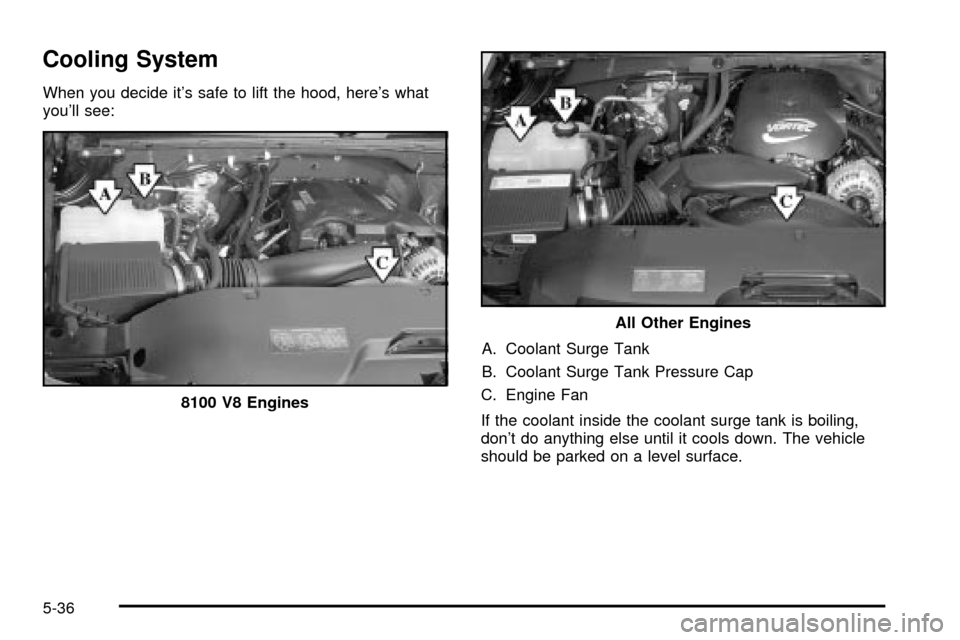
Cooling System
When you decide it's safe to lift the hood, here's what
you'll see:
A. Coolant Surge Tank
B. Coolant Surge Tank Pressure Cap
C. Engine Fan
If the coolant inside the coolant surge tank is boiling,
don't do anything else until it cools down. The vehicle
should be parked on a level surface. 8100 V8 Engines
All Other Engines
5-36
Page 417 of 556
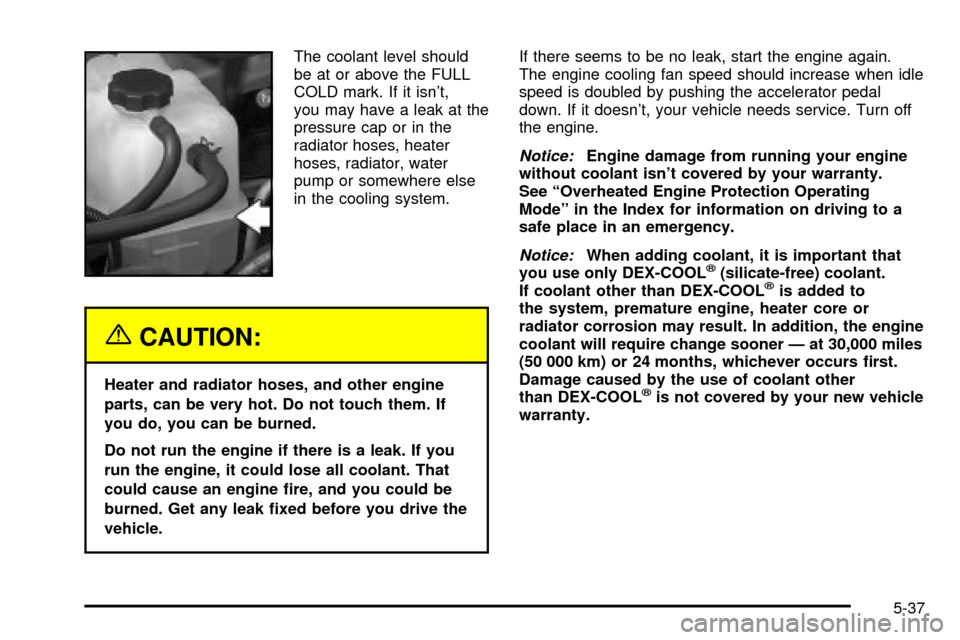
The coolant level should
be at or above the FULL
COLD mark. If it isn't,
you may have a leak at the
pressure cap or in the
radiator hoses, heater
hoses, radiator, water
pump or somewhere else
in the cooling system.
{CAUTION:
Heater and radiator hoses, and other engine
parts, can be very hot. Do not touch them. If
you do, you can be burned.
Do not run the engine if there is a leak. If you
run the engine, it could lose all coolant. That
could cause an engine ®re, and you could be
burned. Get any leak ®xed before you drive the
vehicle.If there seems to be no leak, start the engine again.
The engine cooling fan speed should increase when idle
speed is doubled by pushing the accelerator pedal
down. If it doesn't, your vehicle needs service. Turn off
the engine.
Notice:Engine damage from running your engine
without coolant isn't covered by your warranty.
See ªOverheated Engine Protection Operating
Modeº in the Index for information on driving to a
safe place in an emergency.
Notice:When adding coolant, it is important that
you use only DEX-COOLž(silicate-free) coolant.
If coolant other than DEX-COOLžis added to
the system, premature engine, heater core or
radiator corrosion may result. In addition, the engine
coolant will require change sooner Ð at 30,000 miles
(50 000 km) or 24 months, whichever occurs ®rst.
Damage caused by the use of coolant other
than DEX-COOL
žis not covered by your new vehicle
warranty.
5-37
Page 418 of 556
How to Add Coolant to the Coolant
Surge Tank Gasoline Engines
If you haven't found a problem yet, check to see if coolant
is visible in the surge tank. If coolant is visible but the
coolant level isn't at or above the FULL COLD mark, add
a 50/50 mixture of
clean, drinkable waterand
DEX-COOLžcoolant at the coolant surge tank, but be
sure the cooling system, including the coolant surge tank
pressure cap, is cool before you do it. See
Engine
Coolant on page 5-30for more information.
If no coolant is visible in the surge tank, add coolant as
follows:
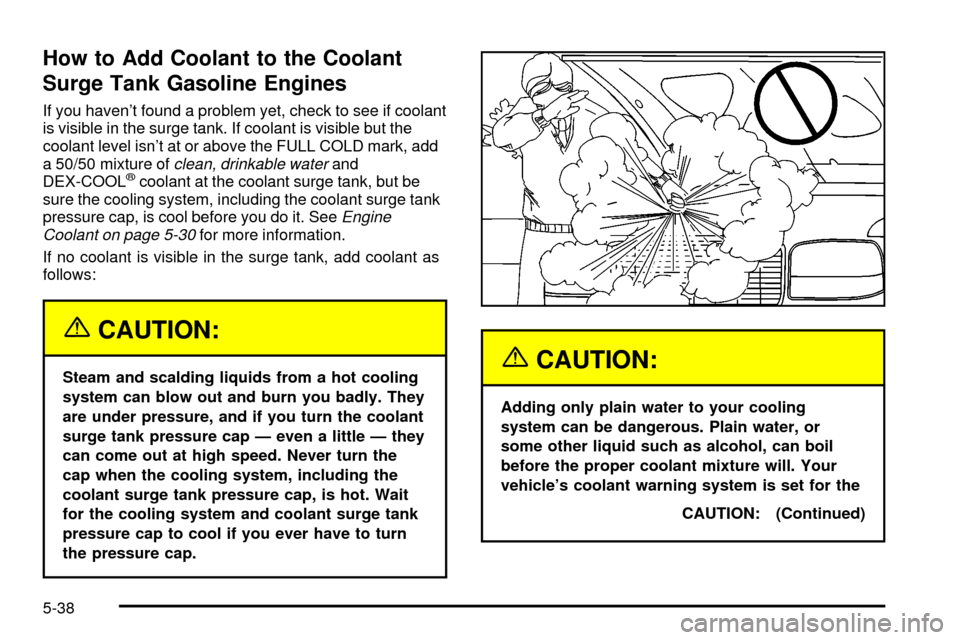
{CAUTION:
Steam and scalding liquids from a hot cooling
system can blow out and burn you badly. They
are under pressure, and if you turn the coolant
surge tank pressure cap Ð even a little Ð they
can come out at high speed. Never turn the
cap when the cooling system, including the
coolant surge tank pressure cap, is hot. Wait
for the cooling system and coolant surge tank
pressure cap to cool if you ever have to turn
the pressure cap.{CAUTION:
Adding only plain water to your cooling
system can be dangerous. Plain water, or
some other liquid such as alcohol, can boil
before the proper coolant mixture will. Your
vehicle's coolant warning system is set for the
CAUTION: (Continued)
5-38
Page 419 of 556
CAUTION: (Continued)
proper coolant mixture. With plain water or the
wrong mixture, your engine could get too hot
but you wouldn't get the overheat warning.
Your engine could catch ®re and you or others
could be burned. Use a 50/50 mixture of clean,
drinkable water and a proper coolant.
Notice:In cold weather, water can freeze and crack
the engine, radiator, heater core and other parts.
Use the recommended coolant and the proper
coolant mixture.
{CAUTION:
You can be burned if you spill coolant on hot
engine parts. Coolant contains ethylene glycol
and it will burn if the engine parts are hot
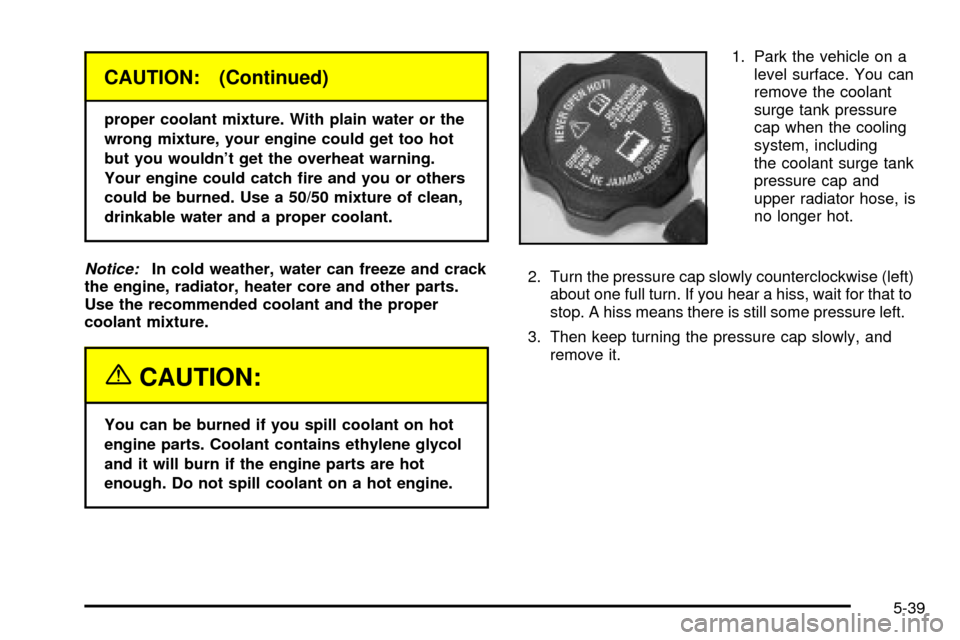
enough. Do not spill coolant on a hot engine.1. Park the vehicle on a
level surface. You can
remove the coolant
surge tank pressure
cap when the cooling
system, including
the coolant surge tank
pressure cap and
upper radiator hose, is
no longer hot.
2. Turn the pressure cap slowly counterclockwise (left)
about one full turn. If you hear a hiss, wait for that to
stop. A hiss means there is still some pressure left.
3. Then keep turning the pressure cap slowly, and
remove it.
5-39
Page 420 of 556
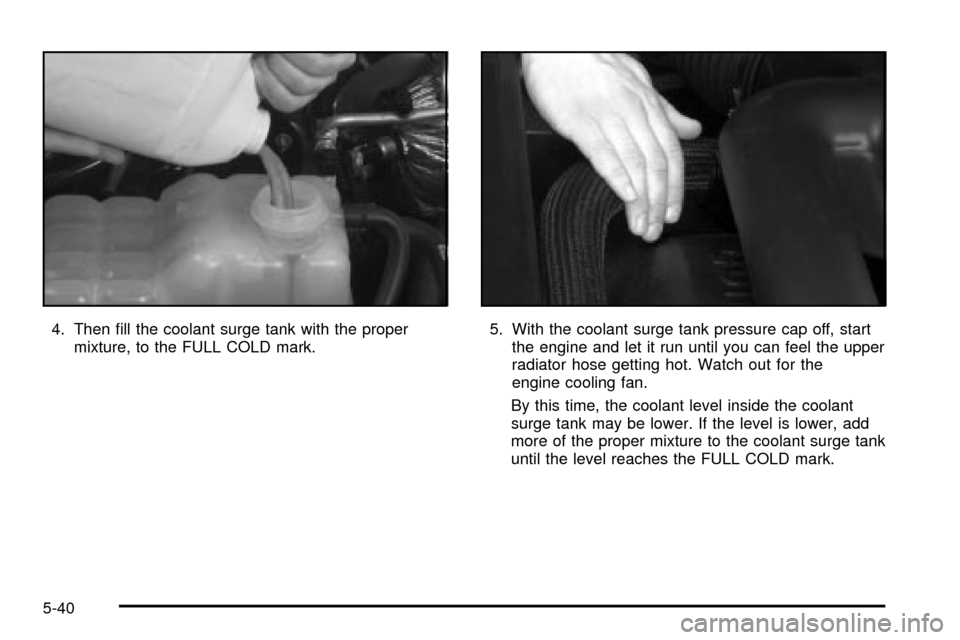
4. Then ®ll the coolant surge tank with the proper
mixture, to the FULL COLD mark.5. With the coolant surge tank pressure cap off, start
the engine and let it run until you can feel the upper
radiator hose getting hot. Watch out for the
engine cooling fan.
By this time, the coolant level inside the coolant
surge tank may be lower. If the level is lower, add
more of the proper mixture to the coolant surge tank
until the level reaches the FULL COLD mark.
5-40
Page 424 of 556

Notice:
·When using concentrated washer ¯uid, follow
the manufacturer's instructions for adding
water.
·Don't mix water with ready-to-use washer ¯uid.
Water can cause the solution to freeze and
damage your washer ¯uid tank and other parts
of the washer system. Also, water doesn't
clean as well as washer ¯uid.
·Fill your washer ¯uid tank only three-quarters
full when it's very cold. This allows for
expansion if freezing occurs, which could
damage the tank if it is completely full.
·Don't use engine coolant (antifreeze) in your
windshield washer. It can damage your
washer system and paint.
Brakes
Brake Fluid
Your brake master cylinder reservoir is ®lled with DOT-3
brake ¯uid. SeeEngine Compartment Overview on
page 5-10for the location of the reservoir.
There are only two reasons why the brake ¯uid level in
the reservoir might go down. The ®rst is that the
brake ¯uid goes down to an acceptable level during
normal brake lining wear. When new linings are put in,
the ¯uid level goes back up. The other reason is
that ¯uid is leaking out of the brake system. If it is, you
should have your brake system ®xed, since a leak
means that sooner or later your brakes will not work
well, or will not work at all.
So, it is not a good idea to ªtop offº your brake ¯uid.
Adding brake ¯uid will not correct a leak. If you add ¯uid
when your linings are worn, then you will have too
much ¯uid when you get new brake linings. You should
add (or remove) brake ¯uid, as necessary, only when
work is done on the brake hydraulic system.
5-44
Page 513 of 556

100,000 Miles (166 000 km)
qInspect spark plug wires.An Emission Control
Service.
qReplace spark plugs.An Emission Control Service.
qChange automatic transmission ¯uid and ®lter if
the vehicle's GVWR is over 8600 lbs, if the
vehicle has an Allison transmission or if the vehicle is
mainly driven under one or more of these conditions:
þ In heavy city traffic where the outside
temperature regularly reaches 90ÉF (32ÉC) or
higher.
þ In hilly or mountainous terrain.
þ When doing frequent trailer towing.
þ Uses such as found in taxi, police or delivery
service.
qIf you haven't used your vehicle under severe service
conditions listed previously and, therefore, haven't
changed your automatic transmission ¯uid, change
both the ¯uid and ®lterqAutomatic Transfer Case Only: Change transfer case
¯uid
qExcept 8.1L V8 Engine: Inspect Positive Crankcase
Ventilation (PCV) valve.
An Emission Control
Service.
150,000 Miles (240 000 km)
qDrain, ¯ush and re®ll cooling system (or every
60 months since last service, whichever occurs ®rst).
See
Engine Coolant on page 5-30for what to use.
Inspect hoses. Clean radiator, condenser, pressure
cap and neck. Pressure test the cooling system
and pressure cap.
An Emission Control Service.
qChange ®ve-speed manual transmission ¯uid (with
4300 V6 or 4800 V8 engines only).
qInspect engine accessory drive belt.
An Emission
Control Service.
200,000 Miles (332 000 km)
q6000 V8 Engine Only: Change ®ve-speed manual
transmission ¯uid.
6-11
Page 514 of 556

Part B: Owner Checks and Services
Listed in this part are owner checks and services
which should be performed at the intervals speci®ed to
help ensure the safety, dependability and emission
control performance of your vehicle.
Be sure any necessary repairs are completed at once.
Whenever any ¯uids or lubricants are added to your
vehicle, make sure they are the proper ones, as shown
in Part D.
At the First 100, 1,000 and 6,000
Miles (160, 1 600 and 10 000km)
Check dual wheel nut torque. For proper torque, seeCapacities and Speci®cations on page 5-118.
At Each Fuel Fill
It is important for you or a service station attendant to
perform these underhood checks at each fuel ®ll.
Engine Oil Level Check
Check the engine oil level and add the proper oil if
necessary. SeeEngine Oil on page 5-16for further
details.
Engine Coolant Level Check
Check the engine coolant level and add DEX-COOLž
coolant mixture if necessary. SeeEngine Coolant
on page 5-30for further details.
Windshield Washer Fluid Level Check
Check the windshield washer ¯uid level in the windshield
washer tank and add the proper ¯uid if necessary.
See
Windshield Washer Fluid on page 5-43for further
details.
At Least Once a Month
Tire In¯ation Check
Visually inspect your tires and make sure tires are
in¯ated to the correct pressures. Don't forget to check
your spare tire. See
Tires on page 5-69for further
details.
Cassette Tape Player Service
Clean cassette tape player. Cleaning should be done
every 50 hours of tape play. SeeAudio System(s)
on page 3-71for further details.
6-12
Page 521 of 556
Part D: Recommended Fluids and
Lubricants
Fluids and lubricants identi®ed below by name, part
number or speci®cation may be obtained from your
dealer.
Usage Fluid/Lubricant
Engine OilEngine oil with the American
Petroleum Institute Certi®ed for
Gasoline Engines starburst symbol
of the proper viscosity. To determine
the preferred viscosity for your
vehicle's engine, see
Engine Oil on
page 5-16.
Engine Coolant50/50 mixture of clean, drinkable
water and use only
DEX-COOL
žCoolant. SeeEngine
Coolant on page 5-30.
Hydraulic Brake
SystemDelco Supreme 11 Brake Fluid or
equivalent DOT-3 brake ¯uid.
Windshield
Washer SolventGM Optikleen
žWasher Solvent or
equivalent.
Usage Fluid/Lubricant
Hydraulic
Clutch System
(5±Speed
Trans.)Hydraulic Clutch Fluid (GM Part No.
U.S. 12345347, in Canada
10953517, or equivalent DOT-3
brake ¯uid).
Hydraulic
Clutch System
(6±Speed
Trans.)Hydraulic Clutch Fluid. Use only GM
Part No. U.S. 88958860, in Canada
88901244.
Power Steering
SystemGM Power Steering Fluid (GM Part
No. U.S. 1052884, in Canada
993294, or equivalent).
Manual
Transmission
(5±Speed with
Low Gear,
RPO MW3)GM Goodwrench Synthetic Manual
Transmission Fluid (GM Part No.
U.S. 12346190, in Canada
10953477) or equivalent SAE
75W-85 GL-4 gear oil.
Manual
Transmission
(5±Speed
without Low
Gear, RPO
MG5)Synchromesh Transmission Fluid
(GM Part No. U.S. 12345349, in
Canada 10953465, or equivalent).
6-19
Page 539 of 556

Bulb Replacement (cont.)
Taillamps....................................................5-65
Buying New Tires...........................................5-74
C
California Fuel.................................................. 5-5
Canada ± Customer Assistance.......................... 7-4
Canadian Owners................................................ ii
Canadian Roadside Assistance........................... 7-6
Capacities and Speci®cations..........................5-118
Car Washes for QUADRASTEERŸ Equipped
Vehicles.....................................................4-18
Carbon Monoxide...................4-48, 4-68, 2-13, 2-51
Care of........................................................5-103
Safety Belts..............................................5-103
Your Cassette Tape Player..........................3-123
Your CD and DVD Player...........................3-124
Your CDs and DVDs..................................3-124
CARGO LAMP ON.........................................3-65
Cargo Lamp...................................................3-17
Cassette Tape Messages.................................3-94
Cassette Tape Player Service...........................6-12
CD Adapter Kits.............................................3-95
Center Console Storage Area...........................2-65
Center High-Mounted Stoplamp (CHMSL) and
Cargo Lamp...............................................5-63
Center Instrument Panel Fuse Block................5-112
Center Passenger Position, Safety Belts.............1-24Chains, Tires..................................................5-78
CHANGE ENGINE OIL....................................3-66
Check Engine Light.........................................3-49
CHECK OIL LEVEL.........................................3-66
CHECK WASHER FLUID.................................3-66
Checking Brake Fluid......................................5-45
Checking Coolant............................................5-32
Checking Engine Oil........................................5-16
Checking Things Under the Hood....................... 5-8
Checking Your Restraint Systems......................1-81
Check...........................................................3-49
Engine Light...............................................3-49
Chemical Paint Spotting.................................5-106
Child Restraints..............................................1-38
Child Restraint Systems...............................1-38
Infants and Young Children...........................1-34
Lower Anchorages and Top Tethers for
Children (LATCH System)..........................1-47
Older Children.............................................1-31
Securing a Child Restraint Designed for the
LATCH System........................................1-49
Securing a Child Restraint in a Center Rear
Seat Position...........................................1-52
Securing a Child Restraint in a Rear Outside
Seat Position...........................................1-50
Securing a Child Restraint in the Center Front
Seat Position...........................................1-55
Securing a Child Restraint in the Right Front
Seat Position...................................1-55, 1-58
Top Strap Anchor Location............................1-44
3