oil capacity CHEVROLET SILVERADO 2004 1.G Owners Manual
[x] Cancel search | Manufacturer: CHEVROLET, Model Year: 2004, Model line: SILVERADO, Model: CHEVROLET SILVERADO 2004 1.GPages: 584, PDF Size: 3.52 MB
Page 217 of 584
Here are some situations you may experience with your
fuel gage. None of these indicate a problem with the
fuel gage.
At the gas station, the fuel pump shuts off before
the gage reads full.
It takes a little more or less fuel to ll up than the
fuel gage indicated. For example, the gage may
have indicated the tank was half full, but it actually
took a little more or less than half the tank’s
capacity to ll the tank.
The gage goes back to empty when you turn off
the ignition.
If you have a diesel engine, see “Fuel Gage” in the
Diesel Engine Supplement.
Low Fuel Warning Light
The light next to the fuel gage will come on briey when
you are starting the engine.
This light comes on when the fuel tank is low on fuel.
To turn it off, add fuel to the fuel tank. SeeFuel on
page 5-5.
Driver Information Center (DIC)
The DIC display is located on the instrument panel
cluster above the steering wheel. The DIC can display
information such as the trip odometer, fuel economy and
personalization features.
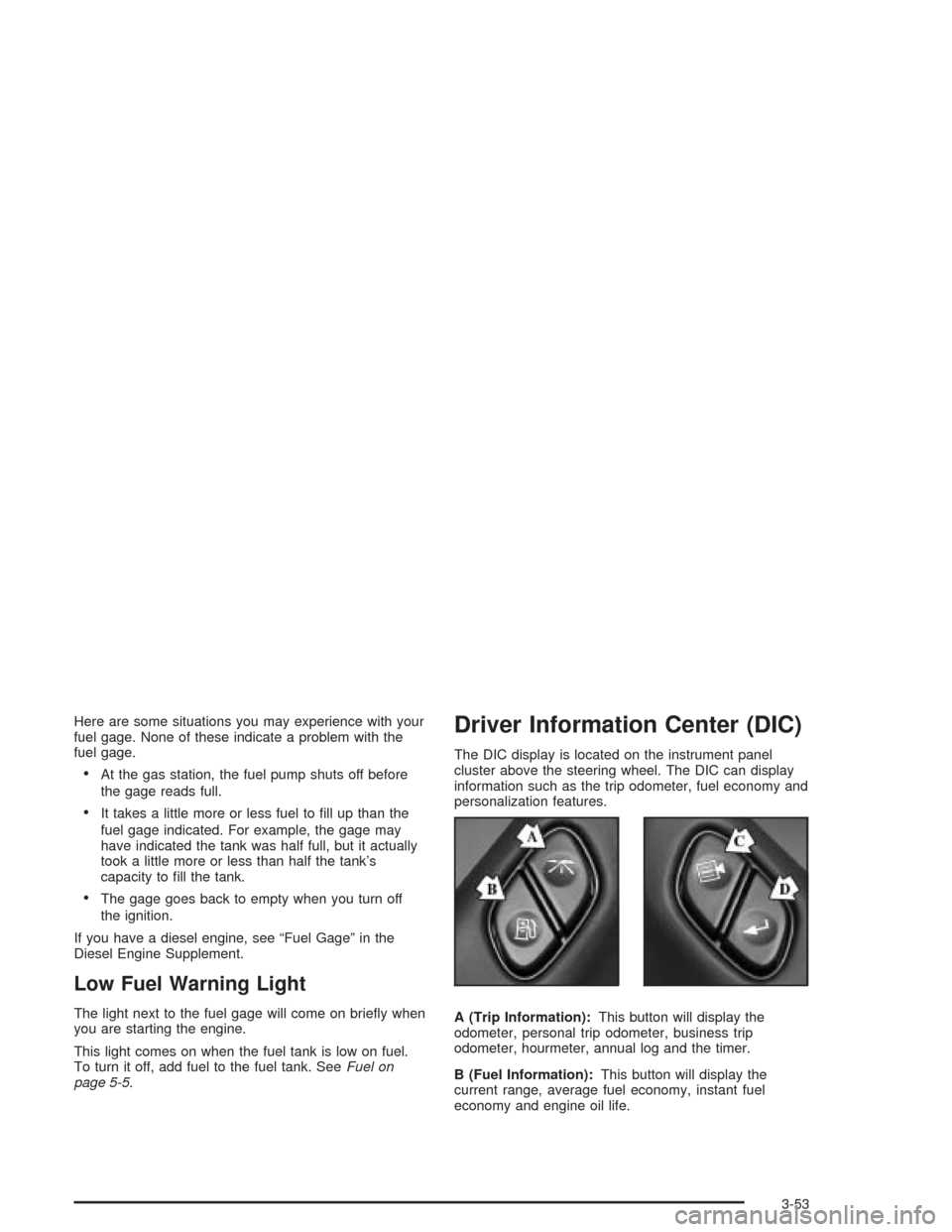
A (Trip Information):This button will display the
odometer, personal trip odometer, business trip
odometer, hourmeter, annual log and the timer.
B (Fuel Information):This button will display the
current range, average fuel economy, instant fuel
economy and engine oil life.
3-53
Page 417 of 584
When to Add Engine Oil
If the oil is at or below the cross-hatched area at the tip
of the dipstick, then you will need to add at least one
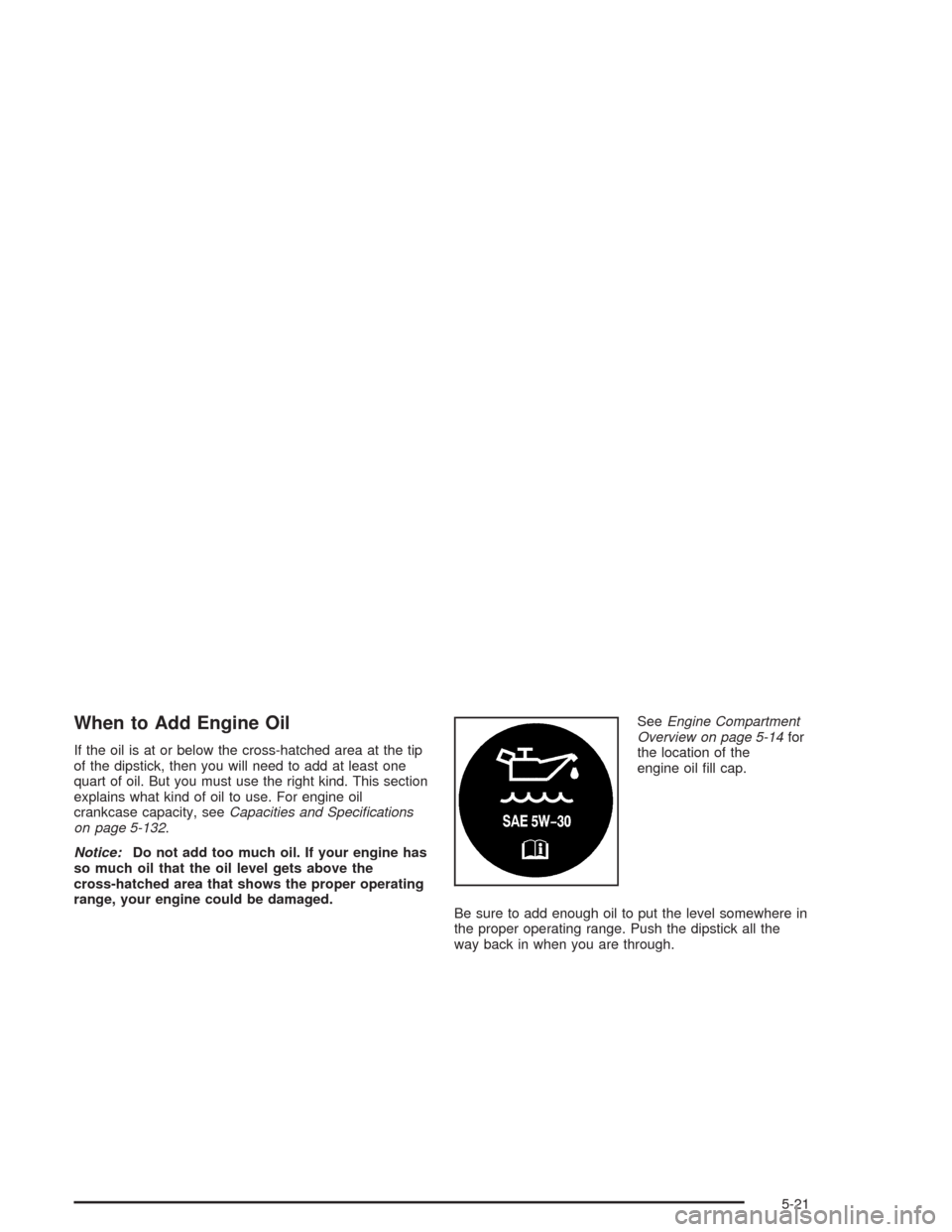
quart of oil. But you must use the right kind. This section
explains what kind of oil to use. For engine oil
crankcase capacity, seeCapacities and Specications
on page 5-132.
Notice:Do not add too much oil. If your engine has
so much oil that the oil level gets above the
cross-hatched area that shows the proper operating
range, your engine could be damaged.SeeEngine Compartment
Overview on page 5-14for
the location of the
engine oil ll cap.
Be sure to add enough oil to put the level somewhere in
the proper operating range. Push the dipstick all the
way back in when you are through.
5-21
Page 475 of 584
(D) Construction Code:A letter code is used to
indicate the type of ply construction in the tire. The letter
R means radial ply construction; the letter D means
diagonal or bias ply construction; and the letter B means
belted-bias ply construction.
(E) Rim Diameter:Diameter of the wheel in inches.
(F) Service Description:The service description
indicates the load range and speed rating of a tire. The
load index can range from 1 to 279. Speed ratings
range from A to Z. The light truck tire size example
above shows dual or single tire congurations.
Tire Terminology and Denitions
Air Pressure:The amount of air inside the tire pressing
outward on each square inch of the tire. Air pressure
is expressed in pounds per square inch (psi) or
kilopascal (kPa).
Accessory Weight:This means the combined weight
of optional accessories. Some examples of optional
accessories are, automatic transmission, power
steering, power brakes, power windows, power seats,
andair conditioning.
Aspect Ratio:The relationship of a tire’s height
to its width.Belt:A rubber coated layer of cords that is located
between the plies and the tread. Cords may be made
from steel or other reinforcing materials.
Bead:The tire bead contains steel wires wrapped by
steel cords that hold the tire onto the rim.
Bias Ply Tire:A pneumatic tire in which the plies are
laid at alternate angles less than 90 degrees to the
centerline of the tread.
Cold Ination Pressure:The amount of air pressure in
a tire, measured in pounds per square inch (psi) or
kilopascals (kPa) before a tire has built up heat
from driving. SeeInation - Tire Pressure on page 5-82.
Curb Weight:This means the weight of a motor
vehicle with standard and optional equipment including
the maximum capacity of fuel, oil and coolant, but
without passengers and cargo.
DOT Markings:A code molded into the sidewall of a
tire signifying that the tire is in compliance with the U.S.
Department of Transportation motor vehicle safety
standards. The DOT code includes the Tire Identication
Number (TIN), an alphanumeric designator which can
also identify the tire manufacturer, production plant,
brand and date of production.
5-79
Page 548 of 584
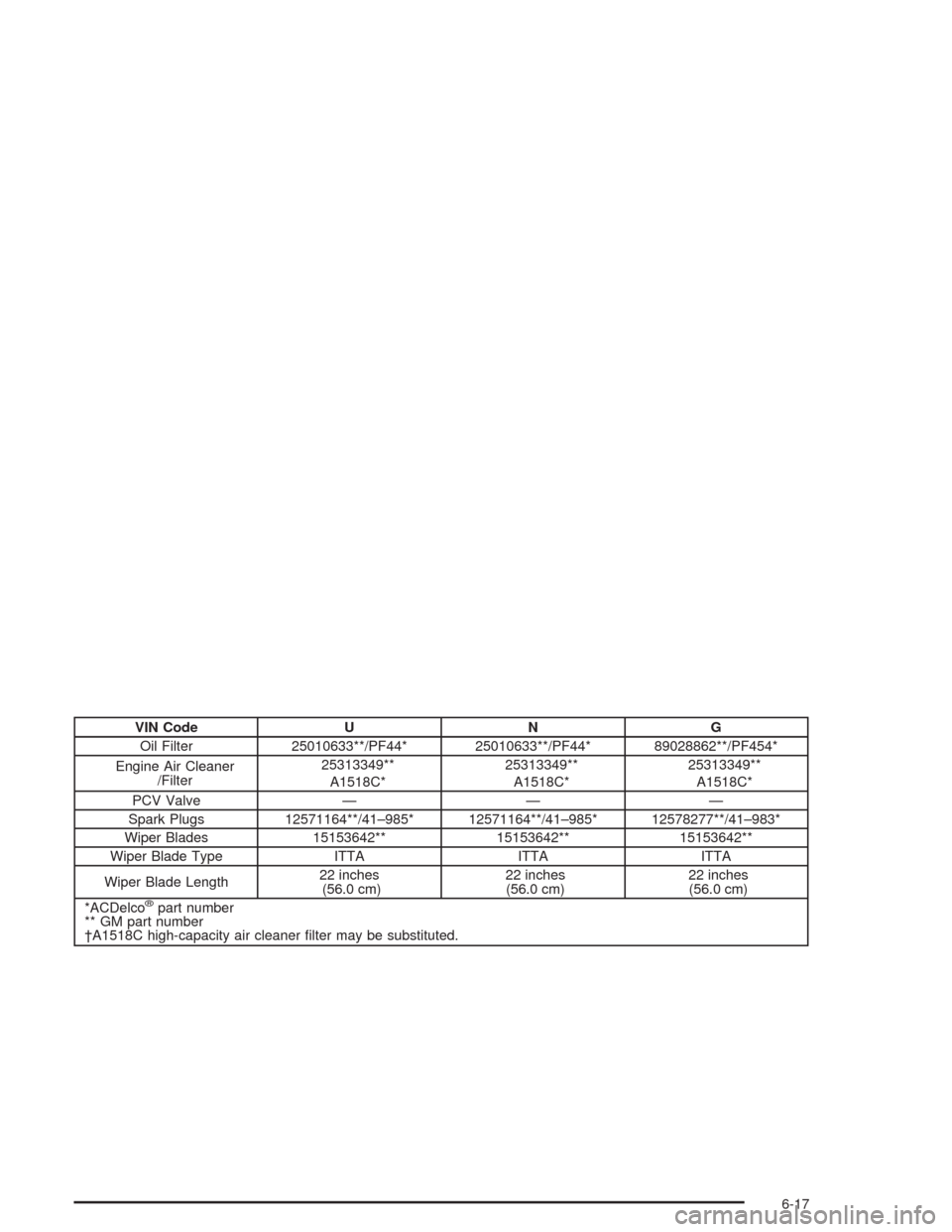
Normal Maintenance Replacement Parts
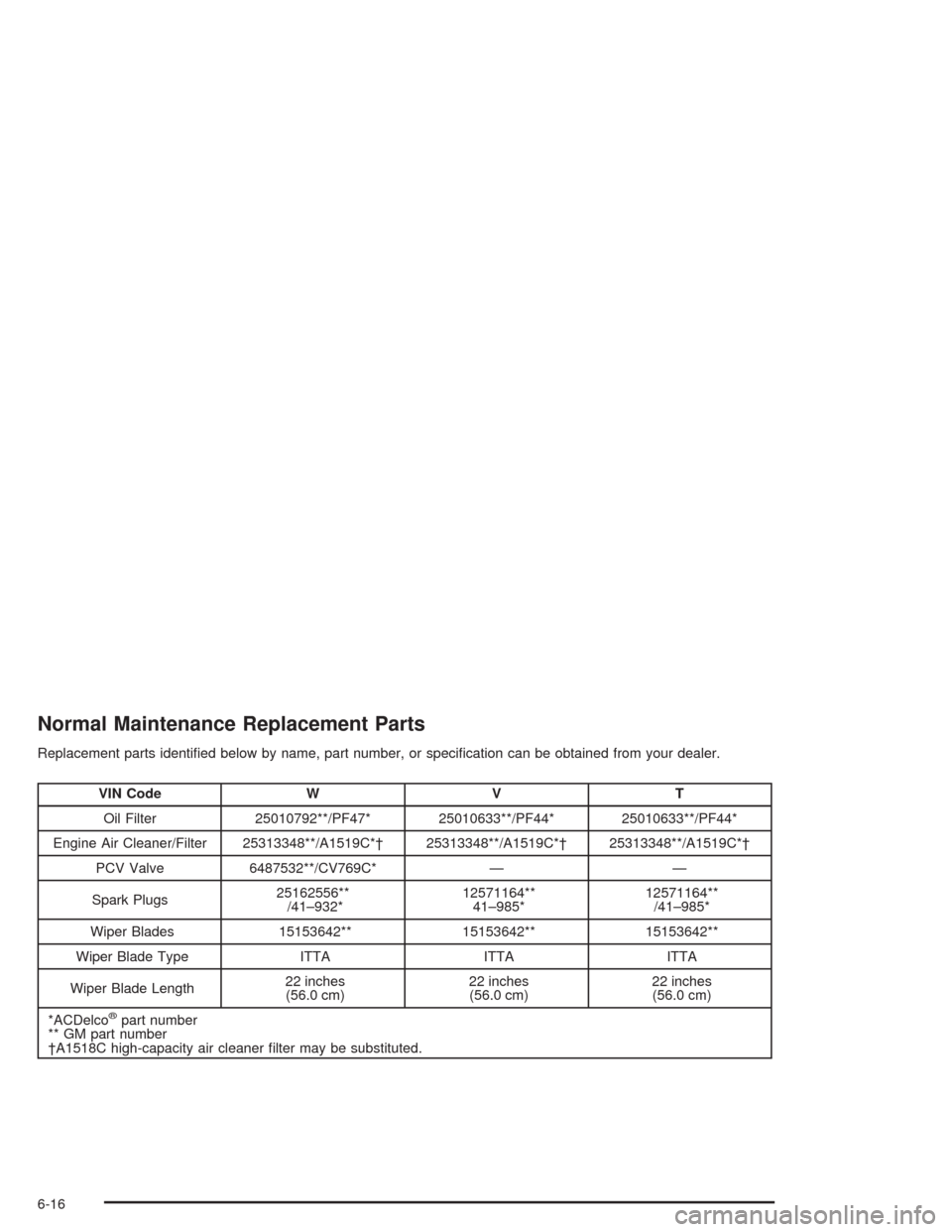
Replacement parts identied below by name, part number, or specication can be obtained from your dealer.
VIN Code W V T
Oil Filter 25010792**/PF47* 25010633**/PF44* 25010633**/PF44*
Engine Air Cleaner/Filter 25313348**/A1519C*† 25313348**/A1519C*† 25313348**/A1519C*†
PCV Valve 6487532**/CV769C* — —
Spark Plugs25162556**
/41–932*12571164**
41–985*12571164**
/41–985*
Wiper Blades 15153642** 15153642** 15153642**
Wiper Blade Type ITTA ITTA ITTA
Wiper Blade Length22 inches
(56.0 cm)22 inches
(56.0 cm)22 inches
(56.0 cm)
*ACDelco
®part number
** GM part number
†A1518C high-capacity air cleaner lter may be substituted.
6-16
Page 549 of 584
VIN Code U N G
Oil Filter 25010633**/PF44* 25010633**/PF44* 89028862**/PF454*
Engine Air Cleaner
/Filter25313349**
A1518C*25313349**
A1518C*25313349**
A1518C*
PCV Valve — — —
Spark Plugs 12571164**/41–985* 12571164**/41–985* 12578277**/41–983*
Wiper Blades 15153642** 15153642** 15153642**
Wiper Blade Type ITTA ITTA ITTA
Wiper Blade Length22 inches
(56.0 cm)22 inches
(56.0 cm)22 inches
(56.0 cm)
*ACDelco
®part number
** GM part number
†A1518C high-capacity air cleaner lter may be substituted.
6-17