engine CHEVROLET SILVERADO 2007 1.G Owners Manual
[x] Cancel search | Manufacturer: CHEVROLET, Model Year: 2007, Model line: SILVERADO, Model: CHEVROLET SILVERADO 2007 1.GPages: 684, PDF Size: 3.4 MB
Page 444 of 684
Dolly Towing
Front Towing
(Front Wheels Off the Ground)
Two-Wheel-Drive Vehicles
Notice:If you tow a two-wheel-drive vehicle
with the rear wheels on the ground, the
transmission could be damaged. The repairs
would not be covered by your warranty.
Never tow your vehicle with the rear wheels on
the ground.
Two-wheel-drive vehicles should not be towed
with the rear wheels on the ground.
Two-wheel-drive transmissions have no provisions
for internal lubrication while being towed.
To dolly tow a two-wheel-drive vehicle, you must
tow the vehicle with the rear wheels on the
dolly. See “Rear Towing (Rear Wheels Off the
Ground)” later in this section for more information.
Four-Wheel-Drive Vehicles
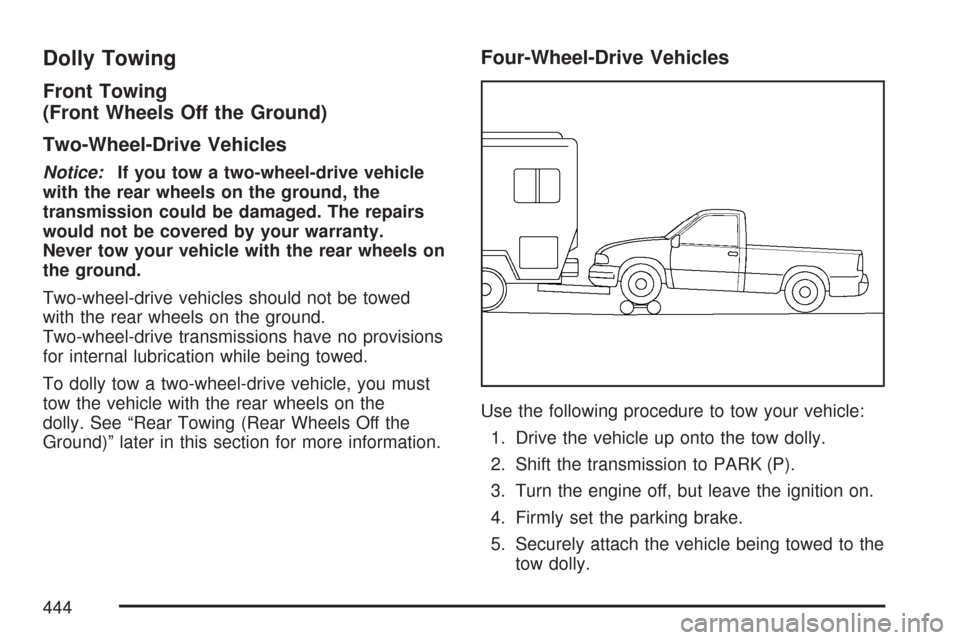
Use the following procedure to tow your vehicle:
1. Drive the vehicle up onto the tow dolly.
2. Shift the transmission to PARK (P).
3. Turn the engine off, but leave the ignition on.
4. Firmly set the parking brake.
5. Securely attach the vehicle being towed to the
tow dolly.
444
Page 447 of 684
Towing a Trailer
If your vehicle has a diesel engine, see the
DURAMAX®Diesel manual for more information.
Do not tow a trailer during break-in. SeeNew
Vehicle Break-In on page 134for more information.
{CAUTION:
If you do not use the correct equipment
and drive properly, you can lose control
when you pull a trailer. For example, if the
trailer is too heavy, the brakes may not
work well — or even at all. You and your
passengers could be seriously injured.
Pull a trailer only if you have followed all
the steps in this section. Ask your dealer
for advice and information about towing a
trailer with your vehicle.Notice:Pulling a trailer improperly can
damage your vehicle and result in costly
repairs not covered by your warranty. To pull
a trailer correctly, follow the advice in this
part, and see your dealer for important
information about towing a trailer with your
vehicle.
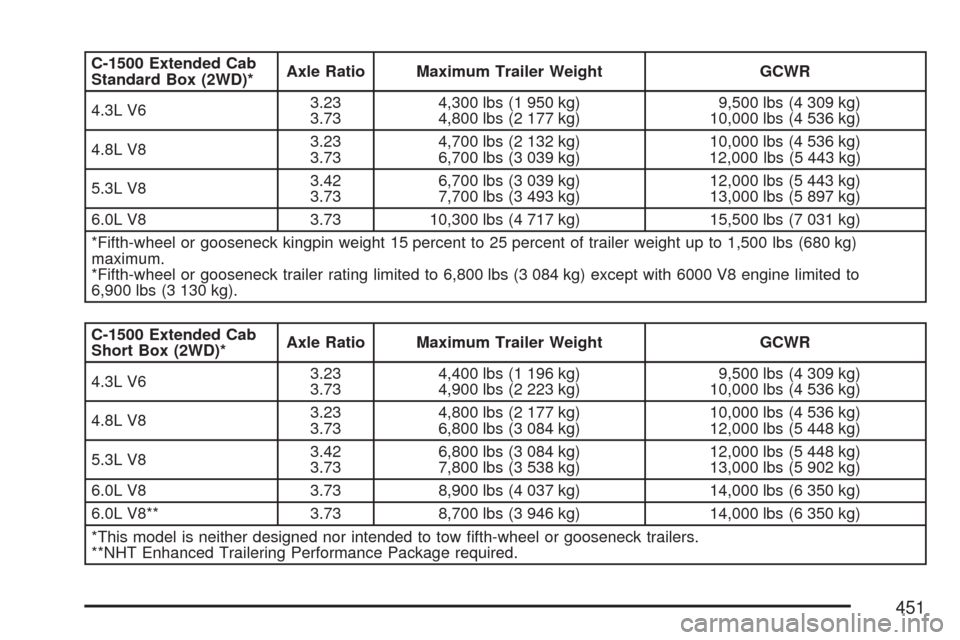
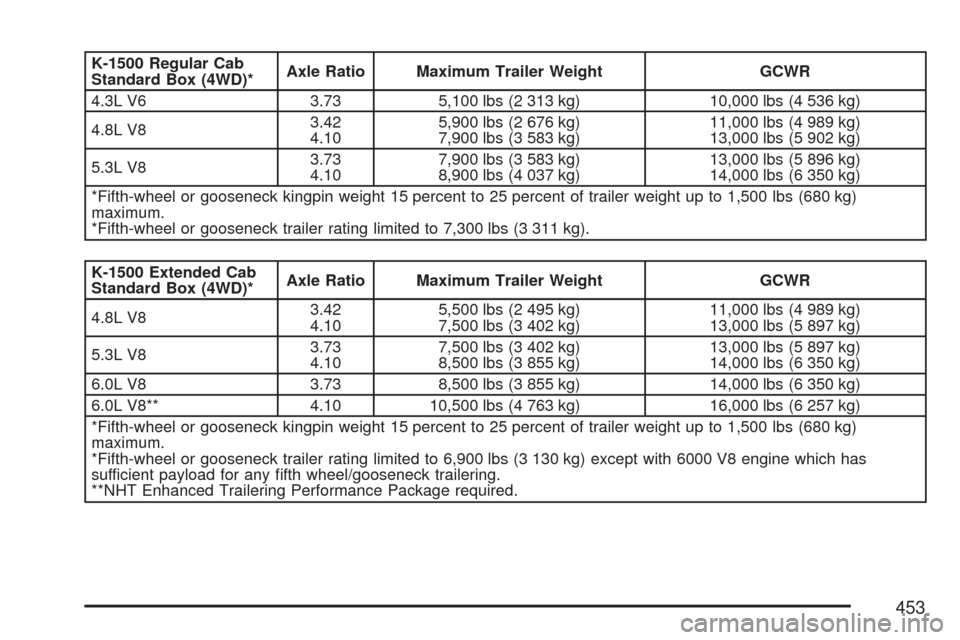
To identify the trailering capacity of your vehicle,
you should read the information in “Weight of
the Trailer” that appears later in this section.
Trailering is different than just driving your vehicle
by itself. Trailering means changes in acceleration,
braking, handling, durability and fuel economy.
Successful, safe trailering takes correct equipment,
and it has to be used properly.
That’s the reason for this part. In it are many
time-tested, important trailering tips and safety
rules. Many of these are important for your safety
and that of your passengers. So please read
this section carefully before you pull a trailer.
447
Page 448 of 684
If You Do Decide To Pull A Trailer
If you do, here are some important points:
There are many different laws, including speed
limit restrictions, having to do with trailering.
Make sure your rig will be legal, not only where
you live but also where you’ll be driving.
A good source for this information can be state
or provincial police.
Consider using a sway control. See “Hitches”
later in this section.
Don’t tow a trailer at all during the rst
500 miles (800 km) your new vehicle is driven.
Your engine, axle or other parts could be
damaged.
Then, during the rst 500 miles (800 km) that
you tow a trailer, don’t drive over 50 mph
(80 km/h) and don’t make starts at full throttle.
This helps your engine and other parts of
your vehicle wear in at the heavier loads.
You can tow in DRIVE (D). You may want to
shift the transmission to THIRD (3), or
FOURTH (4) with the Allison or Hydra-matic
6-speed transmissions, or if necessary, a lower
gear selection if the transmission shifts too
often, such as under heavy loads and/or hilly
conditions. SeeTow/Haul Mode Light on
page 268.
Three important considerations have to do with
weight:
The weight of the trailer
The weight of the trailer tongue
The weight on your vehicle’s tires
448
Page 449 of 684
Tow/Haul Mode
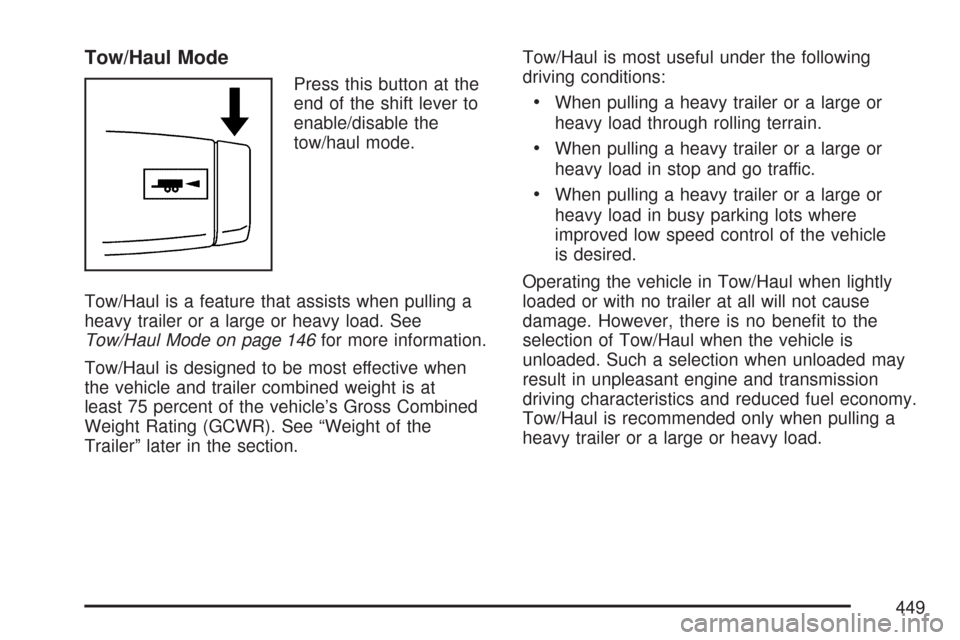
Press this button at the
end of the shift lever to
enable/disable the
tow/haul mode.
Tow/Haul is a feature that assists when pulling a
heavy trailer or a large or heavy load. See
Tow/Haul Mode on page 146for more information.
Tow/Haul is designed to be most effective when
the vehicle and trailer combined weight is at
least 75 percent of the vehicle’s Gross Combined
Weight Rating (GCWR). See “Weight of the
Trailer” later in the section.Tow/Haul is most useful under the following
driving conditions:
When pulling a heavy trailer or a large or
heavy load through rolling terrain.
When pulling a heavy trailer or a large or
heavy load in stop and go traffic.
When pulling a heavy trailer or a large or
heavy load in busy parking lots where
improved low speed control of the vehicle
is desired.
Operating the vehicle in Tow/Haul when lightly
loaded or with no trailer at all will not cause
damage. However, there is no benet to the
selection of Tow/Haul when the vehicle is
unloaded. Such a selection when unloaded may
result in unpleasant engine and transmission
driving characteristics and reduced fuel economy.
Tow/Haul is recommended only when pulling a
heavy trailer or a large or heavy load.
449
Page 451 of 684
C-1500 Extended Cab
Standard Box (2WD)*Axle Ratio Maximum Trailer Weight GCWR
4.3L V63.23
3.734,300 lbs (1 950 kg)
4,800 lbs (2 177 kg)9,500 lbs (4 309 kg)
10,000 lbs (4 536 kg)
4.8L V83.23
3.734,700 lbs (2 132 kg)
6,700 lbs (3 039 kg)10,000 lbs (4 536 kg)
12,000 lbs (5 443 kg)
5.3L V83.42
3.736,700 lbs (3 039 kg)
7,700 lbs (3 493 kg)12,000 lbs (5 443 kg)
13,000 lbs (5 897 kg)
6.0L V8 3.73 10,300 lbs (4 717 kg) 15,500 lbs (7 031 kg)
*Fifth-wheel or gooseneck kingpin weight 15 percent to 25 percent of trailer weight up to 1,500 lbs (680 kg)
maximum.
*Fifth-wheel or gooseneck trailer rating limited to 6,800 lbs (3 084 kg) except with 6000 V8 engine limited to
6,900 lbs (3 130 kg).
C-1500 Extended Cab
Short Box (2WD)*Axle Ratio Maximum Trailer Weight GCWR
4.3L V63.23
3.734,400 lbs (1 196 kg)
4,900 lbs (2 223 kg)9,500 lbs (4 309 kg)
10,000 lbs (4 536 kg)
4.8L V83.23
3.734,800 lbs (2 177 kg)
6,800 lbs (3 084 kg)10,000 lbs (4 536 kg)
12,000 lbs (5 448 kg)
5.3L V83.42
3.736,800 lbs (3 084 kg)
7,800 lbs (3 538 kg)12,000 lbs (5 448 kg)
13,000 lbs (5 902 kg)
6.0L V8 3.73 8,900 lbs (4 037 kg) 14,000 lbs (6 350 kg)
6.0L V8** 3.73 8,700 lbs (3 946 kg) 14,000 lbs (6 350 kg)
*This model is neither designed nor intended to tow fth-wheel or gooseneck trailers.
**NHT Enhanced Trailering Performance Package required.
451
Page 453 of 684
K-1500 Regular Cab
Standard Box (4WD)*Axle Ratio Maximum Trailer Weight GCWR
4.3L V6 3.73 5,100 lbs (2 313 kg) 10,000 lbs (4 536 kg)
4.8L V83.42
4.105,900 lbs (2 676 kg)
7,900 lbs (3 583 kg)11,000 lbs (4 989 kg)
13,000 lbs (5 902 kg)
5.3L V83.73
4.107,900 lbs (3 583 kg)
8,900 lbs (4 037 kg)13,000 lbs (5 896 kg)
14,000 lbs (6 350 kg)
*Fifth-wheel or gooseneck kingpin weight 15 percent to 25 percent of trailer weight up to 1,500 lbs (680 kg)
maximum.
*Fifth-wheel or gooseneck trailer rating limited to 7,300 lbs (3 311 kg).
K-1500 Extended Cab
Standard Box (4WD)*Axle Ratio Maximum Trailer Weight GCWR
4.8L V83.42
4.105,500 lbs (2 495 kg)
7,500 lbs (3 402 kg)11,000 lbs (4 989 kg)
13,000 lbs (5 897 kg)
5.3L V83.73
4.107,500 lbs (3 402 kg)
8,500 lbs (3 855 kg)13,000 lbs (5 897 kg)
14,000 lbs (6 350 kg)
6.0L V8 3.73 8,500 lbs (3 855 kg) 14,000 lbs (6 350 kg)
6.0L V8** 4.10 10,500 lbs (4 763 kg) 16,000 lbs (6 257 kg)
*Fifth-wheel or gooseneck kingpin weight 15 percent to 25 percent of trailer weight up to 1,500 lbs (680 kg)
maximum.
*Fifth-wheel or gooseneck trailer rating limited to 6,900 lbs (3 130 kg) except with 6000 V8 engine which has
sufficient payload for any fth wheel/gooseneck trailering.
**NHT Enhanced Trailering Performance Package required.
453
Page 475 of 684
Driving with a Trailer
{CAUTION:
If you have a rear-most window open and
you pull a trailer with your vehicle, carbon
monoxide (CO) could come into your
vehicle. You cannot see or smell CO. It
can cause unconsciousness or death. See
Engine Exhaust on page 169. To maximize
your safety when towing a trailer:
Have your exhaust system inspected
for leaks, and make necessary repairs
before starting on your trip.
Keep the rear-most windows closed.
CAUTION: (Continued)
CAUTION: (Continued)
If exhaust does come into your vehicle
through a window in the rear or
another opening, drive with your front,
main heating or cooling system on
and with the fan on any speed. This
will bring fresh, outside air into your
vehicle. Do not use the climate control
setting for maximum air because it
only recirculates the air inside your
vehicle. SeeClimate Control System
(With Air Conditioning ) on page 236
orClimate Control System (Heater
Only) on page 239.
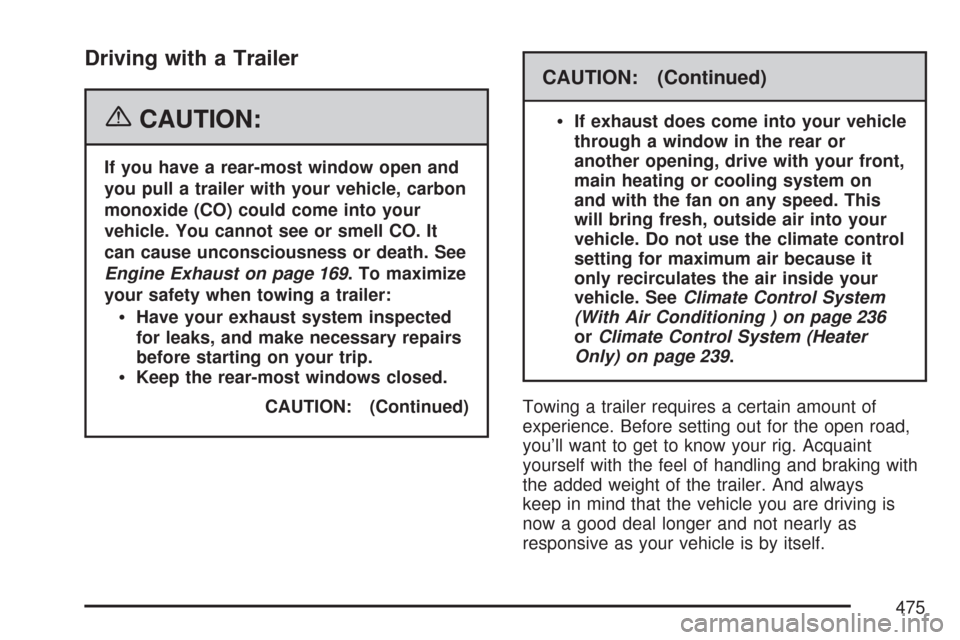
Towing a trailer requires a certain amount of
experience. Before setting out for the open road,
you’ll want to get to know your rig. Acquaint
yourself with the feel of handling and braking with
the added weight of the trailer. And always
keep in mind that the vehicle you are driving is
now a good deal longer and not nearly as
responsive as your vehicle is by itself.
475
Page 477 of 684
Turn Signals When Towing a Trailer
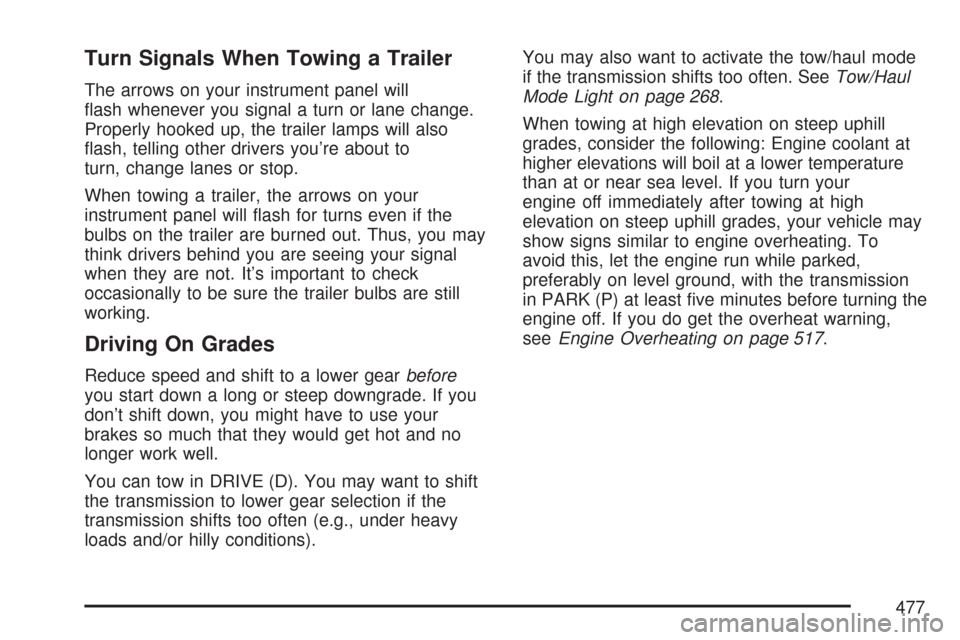
The arrows on your instrument panel will
ash whenever you signal a turn or lane change.
Properly hooked up, the trailer lamps will also
ash, telling other drivers you’re about to
turn, change lanes or stop.
When towing a trailer, the arrows on your
instrument panel will ash for turns even if the
bulbs on the trailer are burned out. Thus, you may
think drivers behind you are seeing your signal
when they are not. It’s important to check
occasionally to be sure the trailer bulbs are still
working.
Driving On Grades
Reduce speed and shift to a lower gearbefore
you start down a long or steep downgrade. If you
don’t shift down, you might have to use your
brakes so much that they would get hot and no
longer work well.
You can tow in DRIVE (D). You may want to shift
the transmission to lower gear selection if the
transmission shifts too often (e.g., under heavy
loads and/or hilly conditions).You may also want to activate the tow/haul mode
if the transmission shifts too often. SeeTow/Haul
Mode Light on page 268.
When towing at high elevation on steep uphill
grades, consider the following: Engine coolant at
higher elevations will boil at a lower temperature
than at or near sea level. If you turn your
engine off immediately after towing at high
elevation on steep uphill grades, your vehicle may
show signs similar to engine overheating. To
avoid this, let the engine run while parked,
preferably on level ground, with the transmission
in PARK (P) at least ve minutes before turning the
engine off. If you do get the overheat warning,
seeEngine Overheating on page 517.
477
Page 479 of 684
{CAUTION:
It can be dangerous to get out of your
vehicle if the shift lever is not fully in
PARK (P) with the parking brake rmly
set. Your vehicle can roll.
If you have left the engine running, the
vehicle can move suddenly. You or others
could be injured. To be sure your vehicle
will not move, even when you are on fairly
level ground, use the steps that follow.
Always put the shift lever fully in PARK (P)
with the parking brake rmly set.
If the transfer case on four-wheel-drive
vehicles is in NEUTRAL, your vehicle will
be free to roll, even if your shift lever is in
PARK (P). So, be sure the transfer case is
in a drive gear — not in NEUTRAL.
When You Are Ready to Leave After
Parking on a Hill
1. Apply your regular brakes and hold the pedal
down while you:
Start your engine
Shift into a gear
Release the parking brake
2. Let up on the brake pedal.
3. Drive slowly until the trailer is clear of the
chocks.
4. Stop and have someone pick up and store the
chocks.
479
Page 480 of 684
Maintenance When Trailer Towing
Your vehicle will need service more often when
you’re pulling a trailer. SeeScheduled
Maintenance (Gasoline Engine) on page 627for
more information. Things that are especially
important in trailer operation are automatic
transmission uid (don’t overll), engine oil, axle
lubricant, belt, cooling system and brake system.
Each of these is covered in this manual, and
the Index will help you nd them quickly. If you’re
trailering, it’s a good idea to review these
sections before you start your trip.
Check periodically to see that all hitch nuts and
bolts are tight.
Trailer Wiring Harness
Your vehicle is equipped with one of the following
wiring harnesses for towing a trailer or hauling
a slide-in camper.
Basic Trailer Wiring
All regular, extended cab and crew cab pickups
have a seven-wire trailer towing harness.
For vehicles not equipped with heavy duty
trailering, the harness is clipped to the vehicle’s
frame behind the spare tire mount. The harness
requires the installation of a trailer connector,
which is available through your dealer.
If you need to tow a light-duty trailer with a
standard four-way round pin connector, you can
also get an adapter from your dealer.
480