lock CHEVROLET SILVERADO 2007 1.G Owners Manual
[x] Cancel search | Manufacturer: CHEVROLET, Model Year: 2007, Model line: SILVERADO, Model: CHEVROLET SILVERADO 2007 1.GPages: 684, PDF Size: 3.4 MB
Page 501 of 684
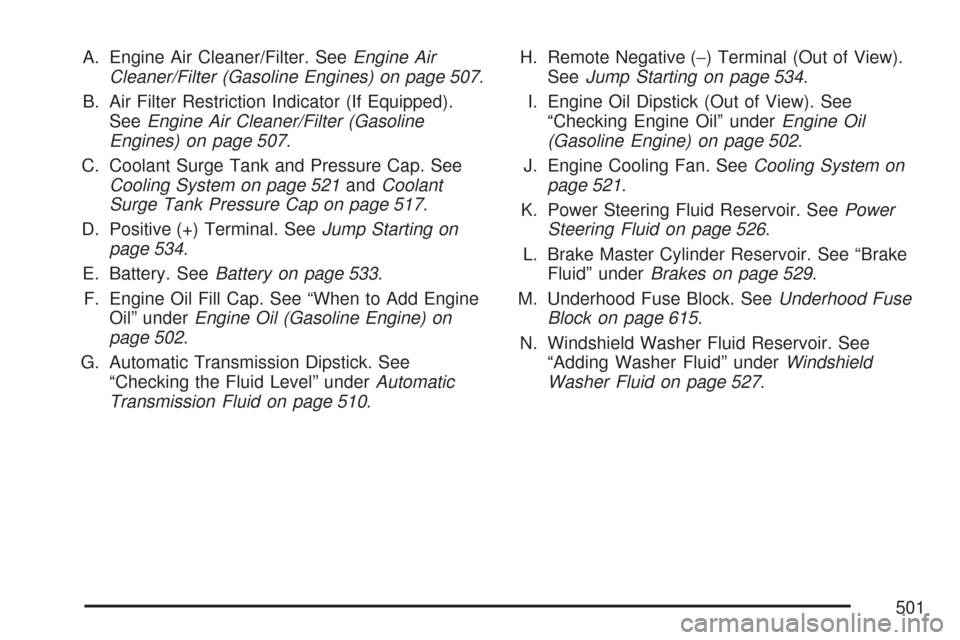
A. Engine Air Cleaner/Filter. SeeEngine Air
Cleaner/Filter (Gasoline Engines) on page 507.
B. Air Filter Restriction Indicator (If Equipped).
SeeEngine Air Cleaner/Filter (Gasoline
Engines) on page 507.
C. Coolant Surge Tank and Pressure Cap. See
Cooling System on page 521andCoolant
Surge Tank Pressure Cap on page 517.
D. Positive (+) Terminal. SeeJump Starting on
page 534.
E. Battery. SeeBattery on page 533.
F. Engine Oil Fill Cap. See “When to Add Engine
Oil” underEngine Oil (Gasoline Engine) on
page 502.
G. Automatic Transmission Dipstick. See
“Checking the Fluid Level” underAutomatic
Transmission Fluid on page 510.H. Remote Negative (−) Terminal (Out of View).
SeeJump Starting on page 534.
I. Engine Oil Dipstick (Out of View). See
“Checking Engine Oil” underEngine Oil
(Gasoline Engine) on page 502.
J. Engine Cooling Fan. SeeCooling System on
page 521.
K. Power Steering Fluid Reservoir. SeePower
Steering Fluid on page 526.
L. Brake Master Cylinder Reservoir. See “Brake
Fluid” underBrakes on page 529.
M. Underhood Fuse Block. SeeUnderhood Fuse
Block on page 615.
N. Windshield Washer Fluid Reservoir. See
“Adding Washer Fluid” underWindshield
Washer Fluid on page 527.
501
Page 512 of 684
3. Install the dipstick by pushing it back in all the
way, wait three seconds, and then pull it back
out again.
4. Check both sides of the dipstick, and read the
lower level. Repeat the check procedure to
verify the reading.
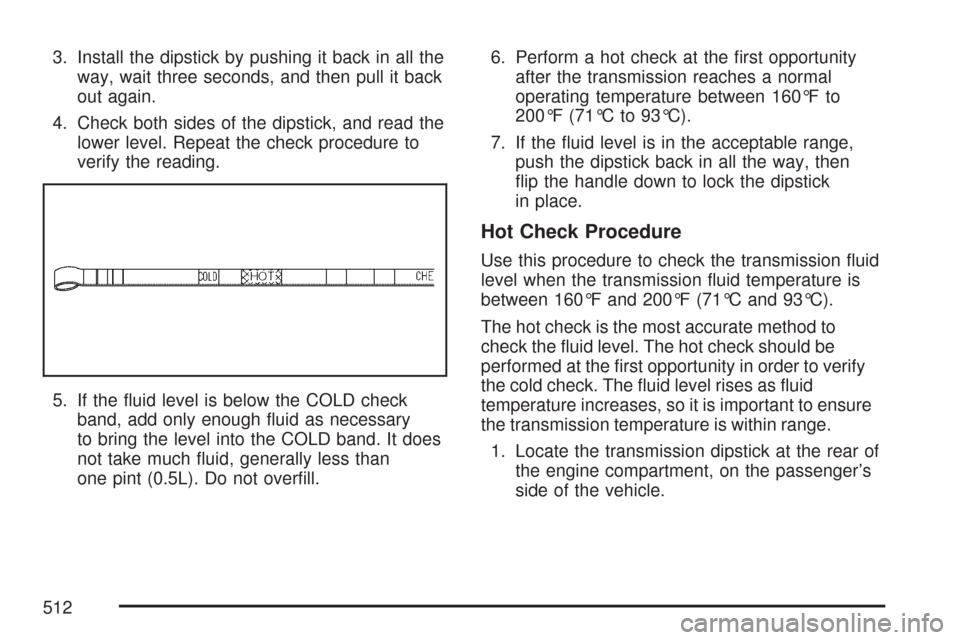
5. If the uid level is below the COLD check
band, add only enough uid as necessary
to bring the level into the COLD band. It does
not take much uid, generally less than
one pint (0.5L). Do not overll.6. Perform a hot check at the rst opportunity
after the transmission reaches a normal
operating temperature between 160°F to
200°F (71°C to 93°C).
7. If the uid level is in the acceptable range,
push the dipstick back in all the way, then
ip the handle down to lock the dipstick
in place.
Hot Check Procedure
Use this procedure to check the transmission uid
level when the transmission uid temperature is
between 160°F and 200°F (71°C and 93°C).
The hot check is the most accurate method to
check the uid level. The hot check should be
performed at the rst opportunity in order to verify
the cold check. The uid level rises as uid
temperature increases, so it is important to ensure
the transmission temperature is within range.
1. Locate the transmission dipstick at the rear of
the engine compartment, on the passenger’s
side of the vehicle.
512
Page 513 of 684
The dipstick handle has
this graphic. SeeEngine
Compartment Overview
on page 500for
more information.
2. Flip the handle up, and then pull out the
dipstick and wipe it with a clean rag or
paper towel.
3. Install the dipstick by pushing it back in all the
way, wait three seconds, and then pull it back
out again.
4. Check both sides of the dipstick, and read the
lower level. Repeat the check procedure to
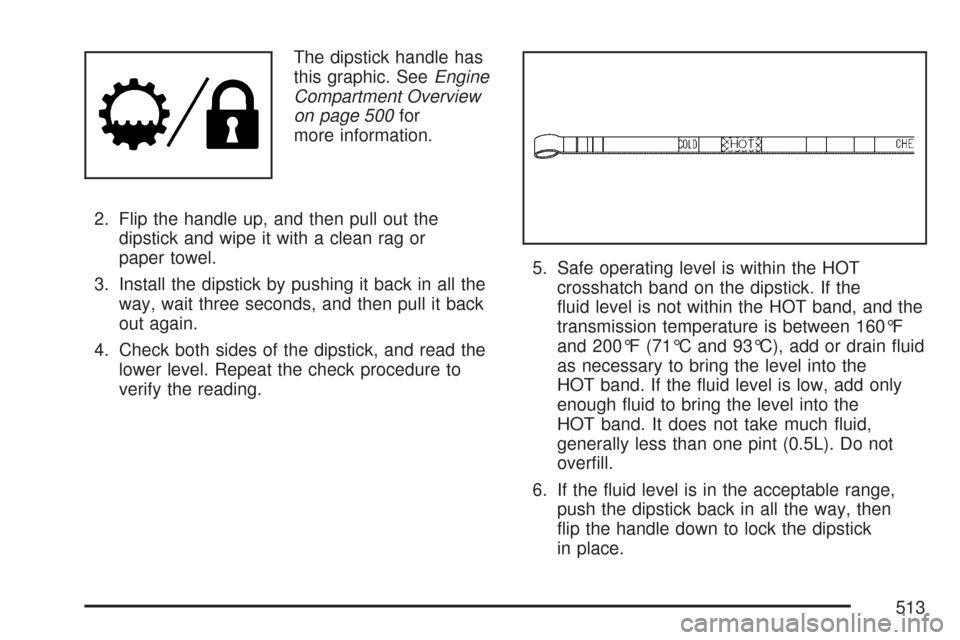
verify the reading.5. Safe operating level is within the HOT
crosshatch band on the dipstick. If the
uid level is not within the HOT band, and the
transmission temperature is between 160°F
and 200°F (71°C and 93°C), add or drain uid
as necessary to bring the level into the
HOT band. If the uid level is low, add only
enough uid to bring the level into the
HOT band. It does not take much uid,
generally less than one pint (0.5L). Do not
overll.
6. If the uid level is in the acceptable range,
push the dipstick back in all the way, then
ip the handle down to lock the dipstick
in place.
513
Page 524 of 684
{CAUTION:
Adding only plain water to your cooling
system can be dangerous. Plain water, or
some other liquid such as alcohol, can
boil before the proper coolant mixture will.
Your vehicle’s coolant warning system is
set for the proper coolant mixture. With
plain water or the wrong mixture, your
engine could get too hot but you would
not get the overheat warning. Your engine
could catch re and you or others could
be burned. Use a 50/50 mixture of clean,
drinkable water and a proper coolant.
Notice:In cold weather, water can freeze and
crack the engine, radiator, heater core and
other parts. Use the recommended coolant and
the proper coolant mixture.
{CAUTION:
You can be burned if you spill coolant on
hot engine parts. Coolant contains
ethylene glycol and it will burn if the
engine parts are hot enough. Do not spill
coolant on a hot engine.
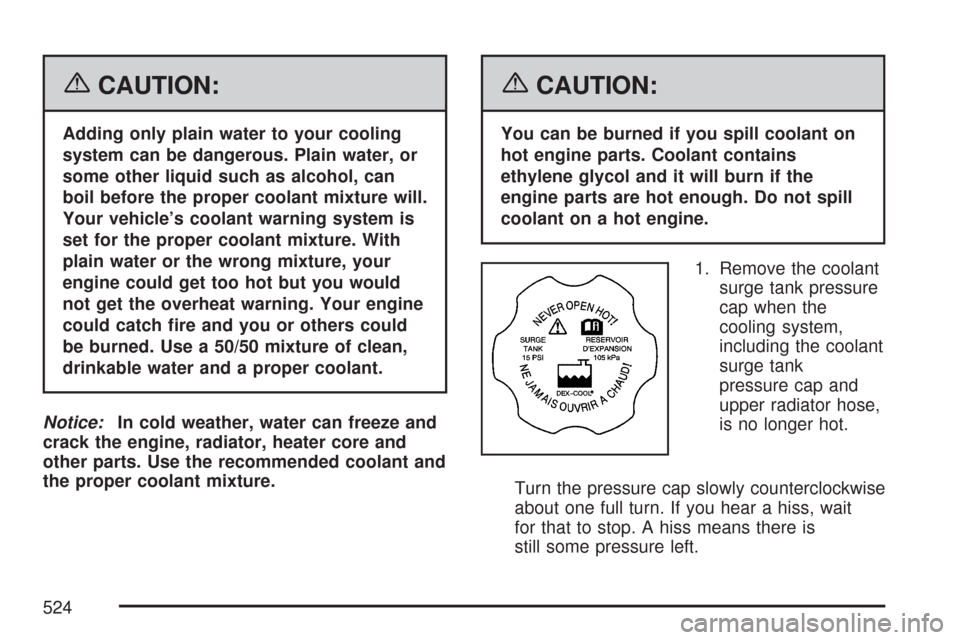
1. Remove the coolant
surge tank pressure
cap when the
cooling system,
including the coolant
surge tank
pressure cap and
upper radiator hose,
is no longer hot.
Turn the pressure cap slowly counterclockwise
about one full turn. If you hear a hiss, wait
for that to stop. A hiss means there is
still some pressure left.
524
Page 546 of 684
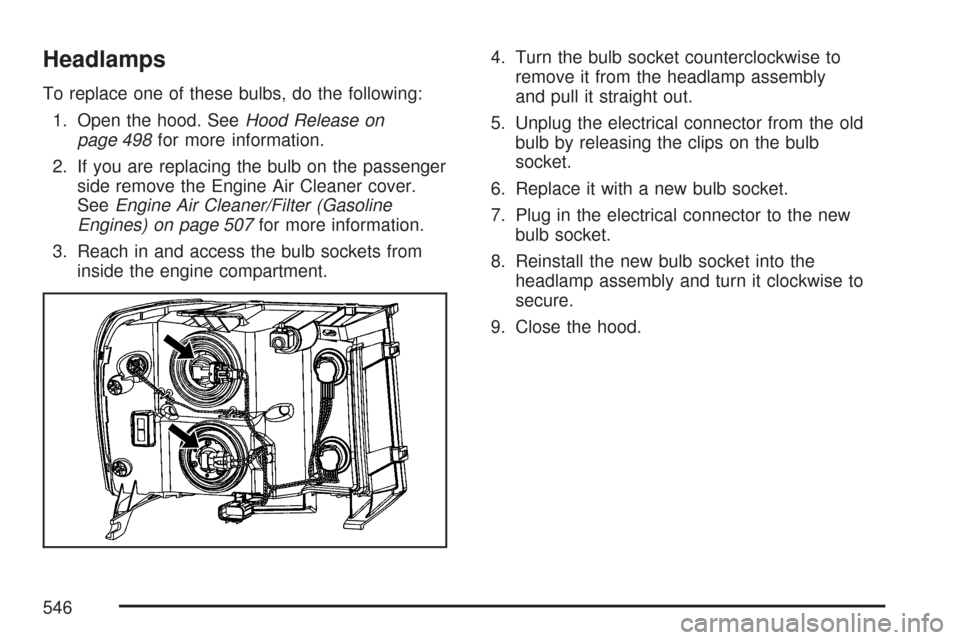
Headlamps
To replace one of these bulbs, do the following:
1. Open the hood. SeeHood Release on
page 498for more information.
2. If you are replacing the bulb on the passenger
side remove the Engine Air Cleaner cover.
SeeEngine Air Cleaner/Filter (Gasoline
Engines) on page 507for more information.
3. Reach in and access the bulb sockets from
inside the engine compartment.4. Turn the bulb socket counterclockwise to
remove it from the headlamp assembly
and pull it straight out.
5. Unplug the electrical connector from the old
bulb by releasing the clips on the bulb
socket.
6. Replace it with a new bulb socket.
7. Plug in the electrical connector to the new
bulb socket.
8. Reinstall the new bulb socket into the
headlamp assembly and turn it clockwise to
secure.
9. Close the hood.
546
Page 547 of 684
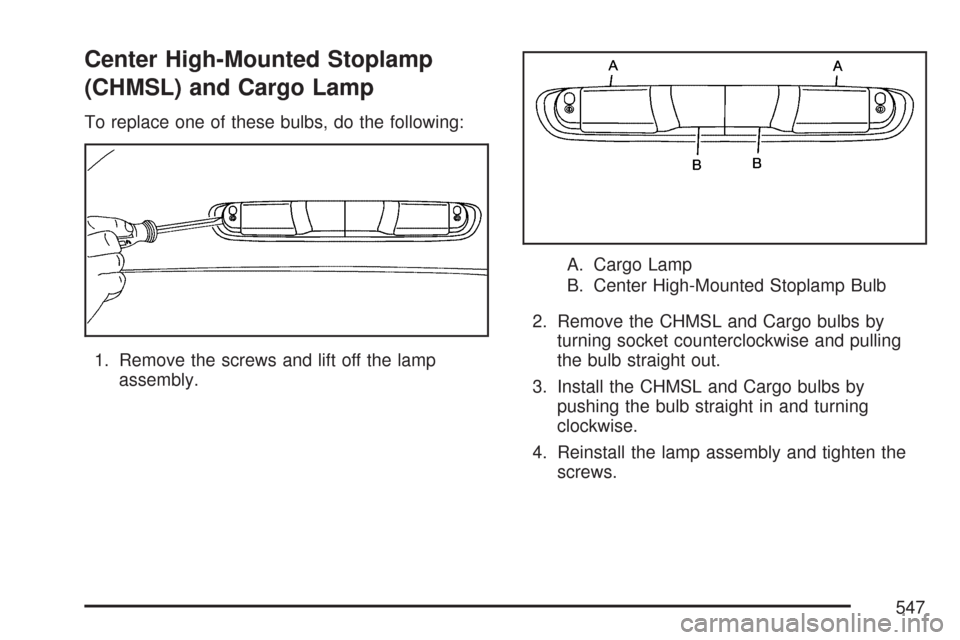
Center High-Mounted Stoplamp
(CHMSL) and Cargo Lamp
To replace one of these bulbs, do the following:
1. Remove the screws and lift off the lamp
assembly.A. Cargo Lamp
B. Center High-Mounted Stoplamp Bulb
2. Remove the CHMSL and Cargo bulbs by
turning socket counterclockwise and pulling
the bulb straight out.
3. Install the CHMSL and Cargo bulbs by
pushing the bulb straight in and turning
clockwise.
4. Reinstall the lamp assembly and tighten the
screws.
547
Page 549 of 684
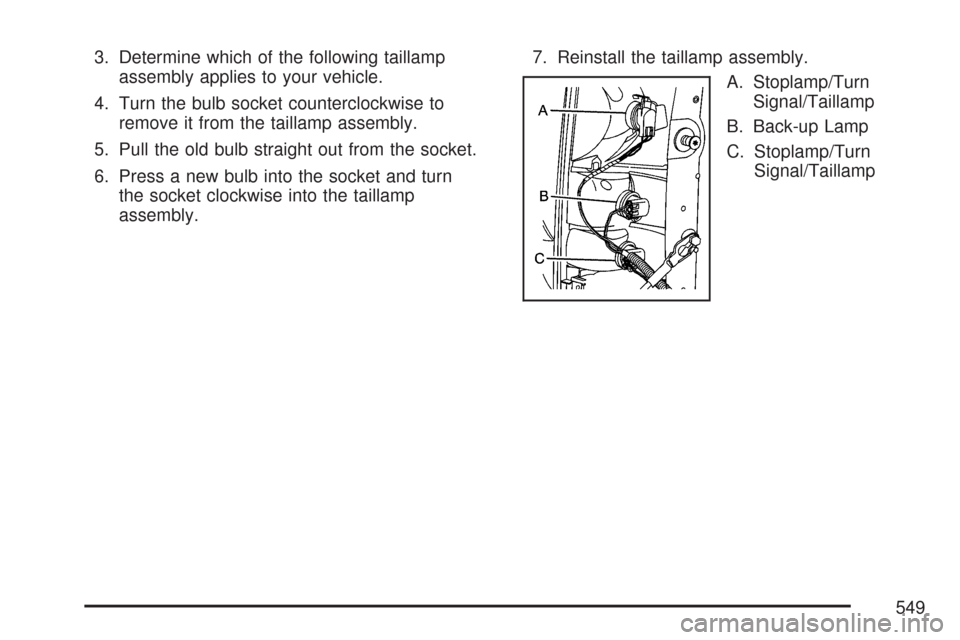
3. Determine which of the following taillamp
assembly applies to your vehicle.
4. Turn the bulb socket counterclockwise to
remove it from the taillamp assembly.
5. Pull the old bulb straight out from the socket.
6. Press a new bulb into the socket and turn
the socket clockwise into the taillamp
assembly.7. Reinstall the taillamp assembly.
A. Stoplamp/Turn
Signal/Taillamp
B. Back-up Lamp
C. Stoplamp/Turn
Signal/Taillamp
549
Page 550 of 684
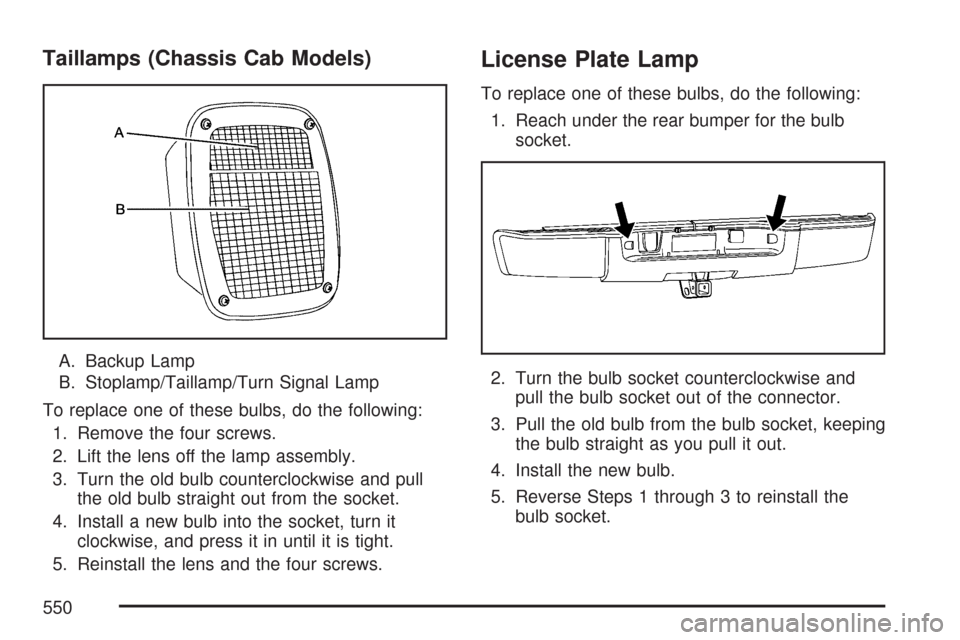
Taillamps (Chassis Cab Models)
A. Backup Lamp
B. Stoplamp/Taillamp/Turn Signal Lamp
To replace one of these bulbs, do the following:
1. Remove the four screws.
2. Lift the lens off the lamp assembly.
3. Turn the old bulb counterclockwise and pull
the old bulb straight out from the socket.
4. Install a new bulb into the socket, turn it
clockwise, and press it in until it is tight.
5. Reinstall the lens and the four screws.
License Plate Lamp
To replace one of these bulbs, do the following:
1. Reach under the rear bumper for the bulb
socket.
2. Turn the bulb socket counterclockwise and
pull the bulb socket out of the connector.
3. Pull the old bulb from the bulb socket, keeping
the bulb straight as you pull it out.
4. Install the new bulb.
5. Reverse Steps 1 through 3 to reinstall the
bulb socket.
550
Page 552 of 684
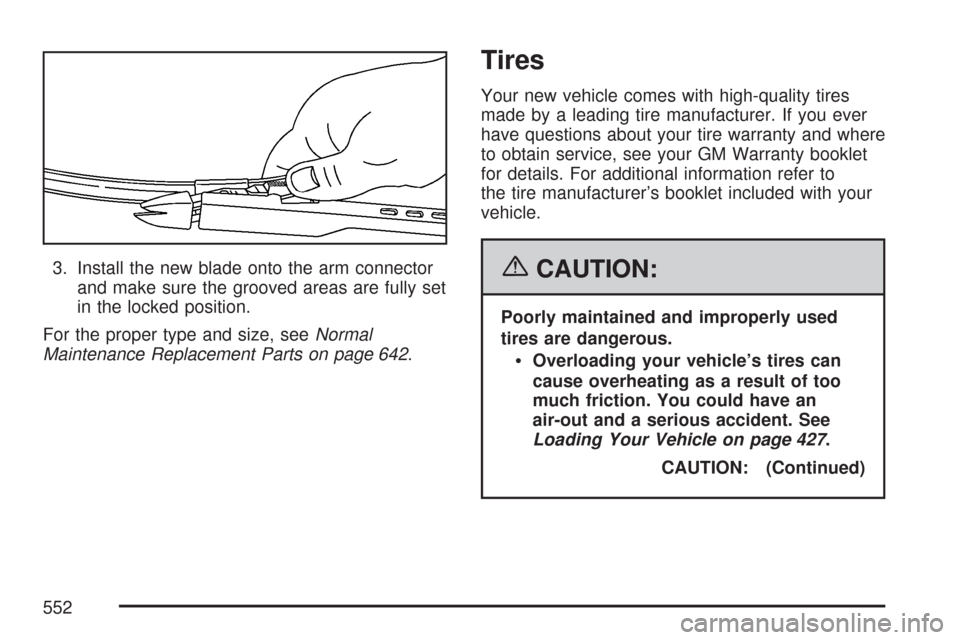
3. Install the new blade onto the arm connector
and make sure the grooved areas are fully set
in the locked position.
For the proper type and size, seeNormal
Maintenance Replacement Parts on page 642.
Tires
Your new vehicle comes with high-quality tires
made by a leading tire manufacturer. If you ever
have questions about your tire warranty and where
to obtain service, see your GM Warranty booklet
for details. For additional information refer to
the tire manufacturer’s booklet included with your
vehicle.
{CAUTION:
Poorly maintained and improperly used
tires are dangerous.
Overloading your vehicle’s tires can
cause overheating as a result of too
much friction. You could have an
air-out and a serious accident. See
Loading Your Vehicle on page 427.
CAUTION: (Continued)
552
Page 561 of 684
Ination - Tire Pressure
Tires need the correct amount of air pressure to
operate effectively.
Notice:Do not let anyone tell you that
under-ination or over-ination is all right. It is
not. If your tires do not have enough air
(under-ination), you can get the following:
Too much exing
Too much heat
Tire overloading
Premature or irregular wear
Poor handling
Reduced fuel economy
If your tires have too much air (over-ination),
you can get the following:
Unusual wear
Poor handling
Rough ride
Needless damage from road hazardsA Tire and Loading Information label is attached to
the vehicle’s center pillar (B-pillar), below the
driver’s door lock post (striker). This label lists your
vehicle’s original equipment tires and their
recommended cold tire ination pressures. The
recommended cold tire ination pressure,
shown on the label, is the minimum amount of air
pressure needed to support your vehicle’s
maximum load carrying capacity.
For additional information regarding how much
weight your vehicle can carry, and an example of
the tire and loading information label, see
Loading Your Vehicle on page 427.
When to Check
Check your tires once a month or more. Do not
forget to check the spare tire. For additional
information regarding the spare tire, seeSpare
Tire on page 600.
561