maintenance CHEVROLET SILVERADO 2007 1.G User Guide
[x] Cancel search | Manufacturer: CHEVROLET, Model Year: 2007, Model line: SILVERADO, Model: CHEVROLET SILVERADO 2007 1.GPages: 684, PDF Size: 3.4 MB
Page 394 of 684
Before You Go Off-Roading
There are some things to do before you go out.
For example, be sure to have all necessary
maintenance and service work done. Check to
make sure all underbody shields, if the vehicle has
them, are properly attached. Be sure you read
all the information about your four-wheel-drive
vehicle in this manual. Is there enough fuel? Is the
spare tire fully inated? Are the uid levels up
where they should be? What are the local laws
that apply to off-roading where you will be driving?
If you do not know, you should check with law
enforcement people in the area. Will you be
on someone’s private land? If so, be sure to get
the necessary permission.
Loading Your Vehicle for Off-Road
Driving
{CAUTION:
Cargo on the load oor piled higher
than the seatbacks can be thrown
forward during a sudden stop. You or
your passengers could be injured.
Keep cargo below the top of the
seatbacks.
Unsecured cargo on the load oor can
be tossed about when driving over
rough terrain. You or your passengers
can be struck by ying objects.
Secure the cargo properly.
Heavy loads on the roof raise the
vehicle’s center of gravity, making it
more likely to roll over. You can be
seriously or fatally injured if the
vehicle rolls over. Put heavy loads
inside the cargo area, not on the roof.
Keep cargo in the cargo area as far
forward and low as possible.
394
Page 408 of 684
Driving in Water
{CAUTION:
Driving through rushing water can be
dangerous. Deep water can sweep your
vehicle downstream and you and your
passengers could drown. If it is only
shallow water, it can still wash away the
ground from under your tires, and you
could lose traction and roll the vehicle
over. Do not drive through rushing water.
Heavy rain can mean ash ooding, and ood
waters demand extreme caution.
Find out how deep the water is before you drive
through it. If it is deep enough to cover your wheel
hubs, axles, or exhaust pipe, do not try it — you
probably will not get through. Also, water that deep
can damage your axle and other vehicle parts.If the water is not too deep, drive slowly through it.
At faster speeds, water splashes on your ignition
system and your vehicle can stall. Stalling can also
occur if you get your tailpipe under water. And,
as long as your tailpipe is under water, you
will never be able to start your engine. When you
go through water, remember that when your
brakes get wet, it may take you longer to stop.
SeeDriving in Rain and on Wet Roads on page 410
for more information on driving through water.
After Off-Road Driving
Remove any brush or debris that has collected on
the underbody, chassis, or under the hood.
These accumulations can be a re hazard.
After operation in mud or sand, have the brake
linings cleaned and checked. These substances
can cause glazing and uneven braking. Check the
body structure, steering, suspension, wheels,
tires, and exhaust system for damage. Also, check
the fuel lines and cooling system for any leakage.
Your vehicle will require more frequent service
due to off-road use. Refer to the Maintenance
Schedule for additional information.
408
Page 480 of 684
Maintenance When Trailer Towing
Your vehicle will need service more often when
you’re pulling a trailer. SeeScheduled
Maintenance (Gasoline Engine) on page 627for
more information. Things that are especially
important in trailer operation are automatic
transmission uid (don’t overll), engine oil, axle
lubricant, belt, cooling system and brake system.
Each of these is covered in this manual, and
the Index will help you nd them quickly. If you’re
trailering, it’s a good idea to review these
sections before you start your trip.
Check periodically to see that all hitch nuts and
bolts are tight.
Trailer Wiring Harness
Your vehicle is equipped with one of the following
wiring harnesses for towing a trailer or hauling
a slide-in camper.
Basic Trailer Wiring
All regular, extended cab and crew cab pickups
have a seven-wire trailer towing harness.
For vehicles not equipped with heavy duty
trailering, the harness is clipped to the vehicle’s
frame behind the spare tire mount. The harness
requires the installation of a trailer connector,
which is available through your dealer.
If you need to tow a light-duty trailer with a
standard four-way round pin connector, you can
also get an adapter from your dealer.
480
Page 487 of 684
Appearance Care........................................ 601
Cleaning the Inside of Your Vehicle.......... 601
Fabric/Carpet............................................. 602
Leather...................................................... 603
Instrument Panel, Vinyl, and Other
Plastic Surfaces..................................... 604
Care of Safety Belts.................................. 604
Weatherstrips............................................ 604
Washing Your Vehicle............................... 605
Cleaning Exterior Lamps/Lenses................ 605
Finish Care............................................... 605
Windshield and Wiper Blades.................... 606
Aluminum or Chrome-Plated Wheels
and Trim................................................ 607
Tires......................................................... 608
Sheet Metal Damage................................. 608
Finish Damage.......................................... 608Underbody Maintenance............................ 608
Chemical Paint Spotting............................ 609
Vehicle Care/Appearance Materials............ 609
Vehicle Identication.................................. 610
Vehicle Identication Number (VIN)........... 610
Service Parts Identication Label............... 611
Electrical System........................................ 611
Add-On Electrical Equipment..................... 611
Windshield Wiper Fuses............................ 611
Power Windows and Other Power
Options.................................................. 611
Fuses and Circuit Breakers....................... 612
Instrument Panel Fuse Block..................... 612
Center Instrument Panel Fuse Block......... 614
Underhood Fuse Block.............................. 615
Capacities and Specications.................... 620
Section 5 Service and Appearance Care
487
Page 489 of 684
California Proposition 65 Warning
Most motor vehicles, including this one, contain
and/or emit chemicals known to the State of
California to cause cancer and birth defects or other
reproductive harm. Engine exhaust, many parts and
systems (including some inside the vehicle), many
uids, and some component wear by-products
contain and/or emit these chemicals.
Doing Your Own Service Work
{CAUTION:
You can be injured and your vehicle could
be damaged if you try to do service work
on a vehicle without knowing enough
about it.
Be sure you have sufficient knowledge,
experience, the proper replacement
parts, and tools before you attempt any
vehicle maintenance task.
CAUTION: (Continued)
CAUTION: (Continued)
Be sure to use the proper nuts, bolts,
and other fasteners. English and
metric fasteners can be easily
confused. If you use the wrong
fasteners, parts can later break or fall
off. You could be hurt.
If you want to do some of your own service work,
you should use the proper service manual. It
tells you much more about how to service your
vehicle than this manual can. To order the proper
service manual, seeService Publications
Ordering Information on page 666.
Your vehicle has an airbag system. Before
attempting to do your own service work, see
Servicing Your Airbag-Equipped Vehicle on
page 104.
You should keep a record with all parts receipts
and list the mileage and the date of any service
work you perform. SeeMaintenance Record
on page 644.
489
Page 490 of 684
Adding Equipment to the Outside of
Your Vehicle
Things you might add to the outside of your
vehicle can affect the airow around it. This may
cause wind noise and affect windshield washer
performance. Check with your dealer before
adding equipment to the outside of your vehicle.
Fuel
If your vehicle has a diesel engine, see “Diesel
Fuel Requirements and Fuel System” in the
DURAMAX
®Diesel Supplement.
For vehicles with gasoline engines, please
read this.
Gasoline
Use of the recommended fuel is an important part
of the proper maintenance of your vehicle. To
help keep the engine clean and maintain optimum
vehicle performance, GM recommends the use
of gasoline advertised as TOP TIER Detergent
Gasoline.
The 8th digit of the Vehicle Identication Number
(VIN) shows the code letter or number that
identies your vehicle’s engine. The VIN is at the
top left of the instrument panel. SeeVehicle
Identication Number (VIN) on page 610.
If your vehicle has the 5.3L V8 engine (VIN
Code 0) or the 5.3L V8 engine (VIN Code 3), you
can use either regular unleaded gasoline or
ethanol fuel containing up to 85% ethanol (E85);
also seeFuel E85 (85% Ethanol) on page 493.
In all other gasoline engines, use only regular
unleaded gasoline.
490
Page 507 of 684
Engine Air Cleaner/Filter (Gasoline
Engines)
If your vehicle has a diesel engine, see “Pickup
Models” under “Engine Air Cleaner/Filter” in
the DURAMAX
®Diesel Supplement for the correct
inspection and replacement procedures.
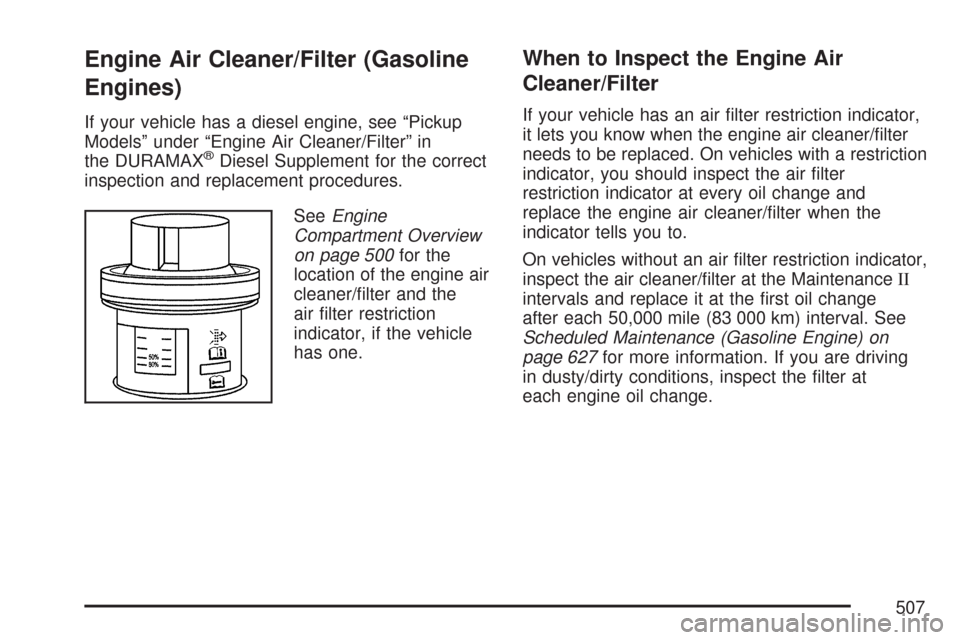
SeeEngine
Compartment Overview
on page 500for the
location of the engine air
cleaner/lter and the
air lter restriction
indicator, if the vehicle
has one.
When to Inspect the Engine Air
Cleaner/Filter
If your vehicle has an air lter restriction indicator,
it lets you know when the engine air cleaner/lter
needs to be replaced. On vehicles with a restriction
indicator, you should inspect the air lter
restriction indicator at every oil change and
replace the engine air cleaner/lter when the
indicator tells you to.
On vehicles without an air lter restriction indicator,
inspect the air cleaner/lter at the MaintenanceII
intervals and replace it at the rst oil change
after each 50,000 mile (83 000 km) interval. See
Scheduled Maintenance (Gasoline Engine) on
page 627for more information. If you are driving
in dusty/dirty conditions, inspect the lter at
each engine oil change.
507
Page 510 of 684
Automatic Transmission Fluid
When to Check and Change Automatic
Transmission Fluid
It is usually not necessary to check the
transmission uid level. The only reason for uid
loss is a transmission leak or overheating the
transmission. If you suspect a small leak, then use
the following checking procedures to check the
uid level. However, if there is a large leak, then it
may be necessary to have the vehicle towed to
a dealership service department and have it
repaired before driving the vehicle further.
Notice:Use of the incorrect automatic
transmission uid may damage your vehicle,
and the damages may not be covered by
your warranty. Always use the automatic
transmission uid listed inRecommended
Fluids and Lubricants on page 639.
Change the uid and lter at the intervals listed in
the Maintenance Schedule. SeeScheduled
Maintenance (Gasoline Engine) on page 627.Be
sure to use the transmission uid listed in
Recommended Fluids and Lubricants on page 639.
How to Check Automatic Transmission
Fluid
Notice:Too much or too little uid can
damage your transmission. Too much can
mean that some of the uid could come out
and fall on hot engine parts or exhaust system
parts, starting a re. Too little uid could
cause the transmission to overheat. Be sure to
get an accurate reading if you check your
transmission uid.
Before checking the uid level, prepare your
vehicle as follows:
1. Start the engine and park your vehicle on a
level surface. Keep the engine running.
2. Apply the parking brake and place the shift
lever in PARK (P).
510
Page 514 of 684
Consistency of Readings
Always check the uid level at least twice using
the procedures described. Consistency (repeatable
readings) is important to maintaining proper uid
level. If uid is added, it may take 15 minutes
or longer to obtain an accurate reading because of
residual uid draining down the dipstick tube. If
inconsistent readings persist, check the
transmission breather to be sure it is clean and
not clogged. If readings are still inconsistent,
contact your dealer.
Engine Coolant
If your vehicle has the DURAMAX®Diesel engine,
see the DURAMAX®Diesel manual for more
information.
The cooling system in your vehicle is lled with
DEX-COOL
®engine coolant. This coolant is
designed to remain in your vehicle for ve years or
150,000 miles (240 000 km), whichever occurs
rst, if you add only DEX-COOL
®extended
life coolant.The following explains your cooling system and
how to add coolant when it is low. If you have
a problem with engine overheating, seeEngine
Overheating on page 517.
A 50/50 mixture of clean, drinkable water and
DEX-COOL
®coolant will:
Give freezing protection down to
−34°F (−37°C).
Give boiling protection up to 265°F (129°C).
Protect against rust and corrosion.
Help keep the proper engine temperature.
Let the warning lights and gages work as they
should.
Notice:Using coolant other than DEX-COOL
®
may cause premature engine, heater core, or
radiator corrosion. In addition, the engine
coolant may require changing sooner, at the
rst maintenance service after each
30,000 miles (50 000 km) or 24 months,
whichever occurs rst. Any repairs would not
be covered by your warranty. Always use
DEX-COOL
®(silicate-free) coolant in your
vehicle.
514
Page 529 of 684
Brakes
Brake Fluid
The brake master
cylinder reservoir is
lled with DOT-3 brake
uid. SeeEngine
Compartment Overview
on page 500for the
location of the reservoir.
There are only two reasons why the brake uid
level in the reservoir might go down. The rst
is that the brake uid goes down to an acceptable
level during normal brake lining wear. When
new linings are put in, the uid level goes back
up. The other reason is that uid is leaking out of
the brake system. If it is, you should have the
brake system xed, since a leak means that
sooner or later the brakes will not work well.So, it is not a good idea to top off the brake uid.
Adding brake uid will not correct a leak. If
you add uid when the linings are worn, then you
will have too much uid when you get new
brake linings. You should add or remove brake
uid, as necessary, only when work is done on the
brake hydraulic system.
{CAUTION:
If you have too much brake uid, it can
spill on the engine. The uid will burn if
the engine is hot enough. You or others
could be burned, and your vehicle could
be damaged. Add brake uid only when
work is done on the brake hydraulic
system. See “Checking Brake Fluid” in
this section.
Refer to the Maintenance Schedule to determine
when to check the brake uid. SeeScheduled
Maintenance (Gasoline Engine) on page 627.
529