tire CHEVROLET SILVERADO 2007 1.G Workshop Manual
[x] Cancel search | Manufacturer: CHEVROLET, Model Year: 2007, Model line: SILVERADO, Model: CHEVROLET SILVERADO 2007 1.GPages: 684, PDF Size: 3.4 MB
Page 438 of 684
Q:What is total vehicle reserve capacity?
A:This is the difference between your GVWR and
the weight of your truck with full fuel and
passengers. It is the amount of weight you can
add to your vehicle before reaching your
GVWR. Keep in mind that reserve capacity
numbers are intended as a guide when
selecting the amount of equipment or cargo
your truck can carry. If you are unsure of your
vehicle’s front, rear, or total weight, go to a
weigh station and weigh your vehicle.
Your dealer can also help you with this.
The total vehicle reserve capacity for your
vehicle can be found in the lower right corner
of the Certication/Tire label as shown
previously.
See your dealer for additional advice and
information about using a snow plow on your
vehicle. Also, seeLoading Your Vehicle on
page 427.
Emergency Roof Lamp Provisions
Vehicles with the RPO VYU snow plow prep
package also have an emergency roof lamp
provision package, RPO TRW. Wiring for the
emergency roof lamp is provided above the
overhead console. SeeAuxiliary Roof Mounted
Lamp on page 227for switch location.
Truck-Camper Loading Information
Notice:Installing a truck-camper to a
vehicle that is equipped with the SS trim
package could damage the vehicle. Do not
install a truck-camper on a vehicle equipped
with the SS trim package.
A vehicle specic Truck-Camper Loading
information label is attached to the inside of your
vehicle’s glove box. This label will tell you if
your vehicle can carry a slide-in camper, how
much of a load your vehicle can carry, and how to
correctly spread out the load. Also, it will help
you match the right slide-in camper to your vehicle.
438
Page 440 of 684
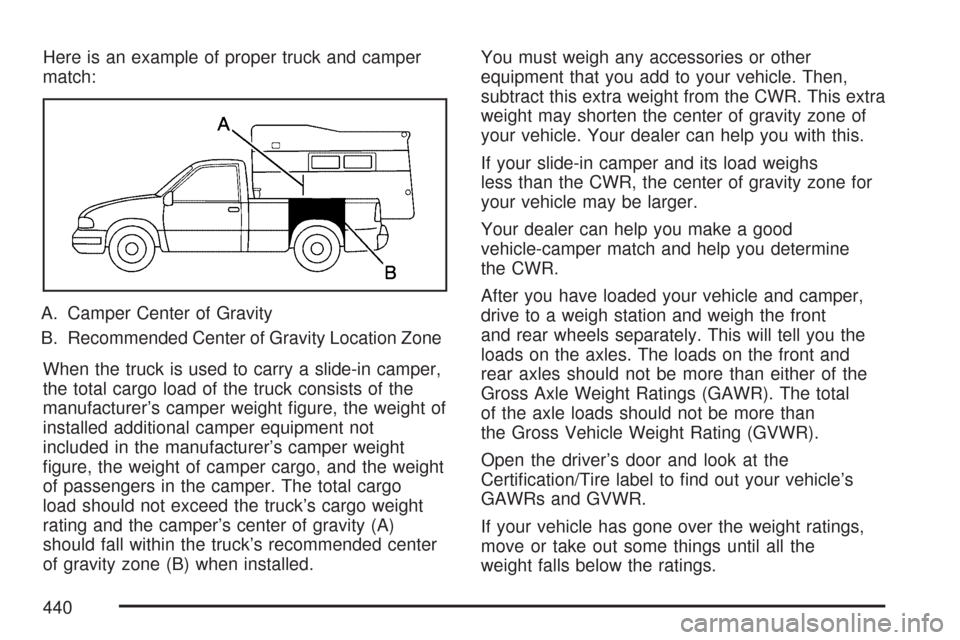
Here is an example of proper truck and camper
match:
A. Camper Center of Gravity
B. Recommended Center of Gravity Location Zone
When the truck is used to carry a slide-in camper,
the total cargo load of the truck consists of the
manufacturer’s camper weight gure, the weight of
installed additional camper equipment not
included in the manufacturer’s camper weight
gure, the weight of camper cargo, and the weight
of passengers in the camper. The total cargo
load should not exceed the truck’s cargo weight
rating and the camper’s center of gravity (A)
should fall within the truck’s recommended center
of gravity zone (B) when installed.You must weigh any accessories or other
equipment that you add to your vehicle. Then,
subtract this extra weight from the CWR. This extra
weight may shorten the center of gravity zone of
your vehicle. Your dealer can help you with this.
If your slide-in camper and its load weighs
less than the CWR, the center of gravity zone for
your vehicle may be larger.
Your dealer can help you make a good
vehicle-camper match and help you determine
the CWR.
After you have loaded your vehicle and camper,
drive to a weigh station and weigh the front
and rear wheels separately. This will tell you the
loads on the axles. The loads on the front and
rear axles should not be more than either of the
Gross Axle Weight Ratings (GAWR). The total
of the axle loads should not be more than
the Gross Vehicle Weight Rating (GVWR).
Open the driver’s door and look at the
Certication/Tire label to nd out your vehicle’s
GAWRs and GVWR.
If your vehicle has gone over the weight ratings,
move or take out some things until all the
weight falls below the ratings.
440
Page 441 of 684
Secure loose items to prevent weight shifts that
could affect the balance of your vehicle. When the
truck-camper is loaded, drive to a scale and
weigh on the front and on the rear wheels
separately to determine axle loads. Individual axle
loads should not exceed either of the gross
axle weight ratings (GAWR). The total of the axle
loads should not exceed your vehicle’s gross
vehicle weight rating (GVWR). These ratings are
given on the vehicle certication label attached
to the rear edge of the driver’s door. See
“Certication/Tire Label” underLoading Your
Vehicle on page 427. If weight ratings are
exceeded, move or remove items to bring all
weights below the ratings.
When you install and load your slide-in camper,
check the manufacturer’s instructions.
If you want more information on curb weights,
cargo weights, Cargo Weight Rating and the
correct center of gravity zone for your vehicle,
your dealer can help you. Just ask for a copy of
“Consumer Information, Truck-Camper Loading.”Pickup Conversion to Chassis Cab
General Motors is aware that some vehicle owners
may consider having the pickup box removed
and a commercial or recreational body installed.
Owners should be aware that, as manufactured,
there are differences between a chassis cab and a
pickup with the box removed which may affect
vehicle safety. The components necessary
to adapt a pickup to permit its safe use with a
specialized body should be installed by the
body builder.
Towing
Towing Your Vehicle
Consult your dealer or a professional towing
service if you need to have your disabled vehicle
towed. SeeRoadside Assistance Program on
page 654.
If you want to tow your vehicle behind another
vehicle for recreational purposes (such as behind
a motorhome), see “Recreational Vehicle
Towing” following.
441
Page 448 of 684
If You Do Decide To Pull A Trailer
If you do, here are some important points:
There are many different laws, including speed
limit restrictions, having to do with trailering.
Make sure your rig will be legal, not only where
you live but also where you’ll be driving.
A good source for this information can be state
or provincial police.
Consider using a sway control. See “Hitches”
later in this section.
Don’t tow a trailer at all during the rst
500 miles (800 km) your new vehicle is driven.
Your engine, axle or other parts could be
damaged.
Then, during the rst 500 miles (800 km) that
you tow a trailer, don’t drive over 50 mph
(80 km/h) and don’t make starts at full throttle.
This helps your engine and other parts of
your vehicle wear in at the heavier loads.
You can tow in DRIVE (D). You may want to
shift the transmission to THIRD (3), or
FOURTH (4) with the Allison or Hydra-matic
6-speed transmissions, or if necessary, a lower
gear selection if the transmission shifts too
often, such as under heavy loads and/or hilly
conditions. SeeTow/Haul Mode Light on
page 268.
Three important considerations have to do with
weight:
The weight of the trailer
The weight of the trailer tongue
The weight on your vehicle’s tires
448
Page 464 of 684
Total Weight on Your Vehicle’s Tires
Be sure your vehicle’s tires are inated to the
upper limit for cold tires. You’ll nd these numbers
on the Certication label at the rear edge of the
driver’s door or see Loading Your Vehicle for more
information. Then be sure you don’t go over the
GVW limit for your vehicle, or the GAWR, including
the weight of the trailer tongue. If you use a
weight distributing hitch, make sure you don’t go
over the rear axle limit before you apply the weight
distribution spring bars.
Hitches
It’s important to have the correct hitch equipment.
Crosswinds, large trucks going by and rough
roads are a few reasons why you’ll need the
right hitch.
Weight-Distributing Hitches and Weight
Carrying Hitches
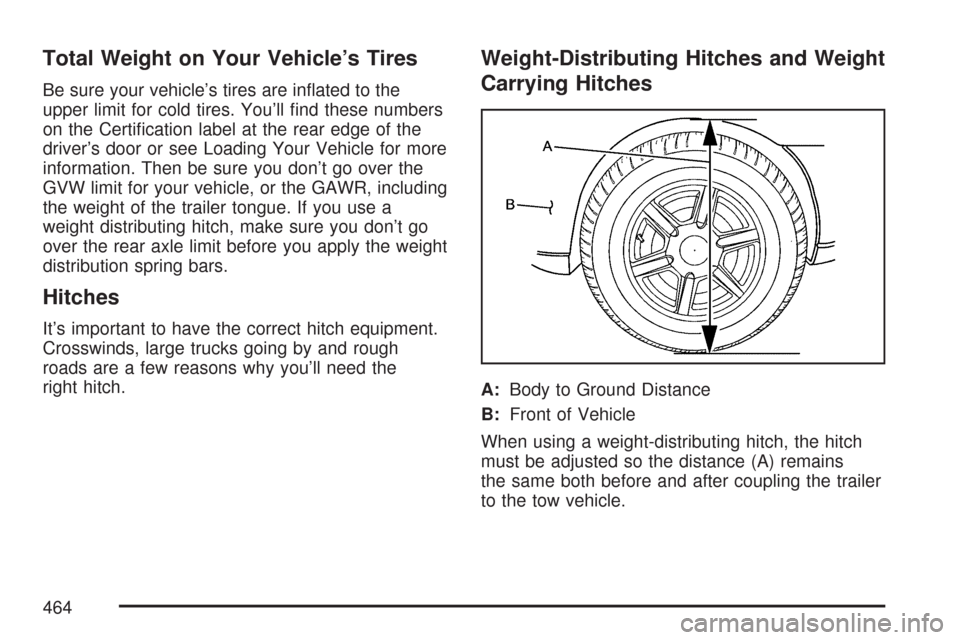
A:Body to Ground Distance
B:Front of Vehicle
When using a weight-distributing hitch, the hitch
must be adjusted so the distance (A) remains
the same both before and after coupling the trailer
to the tow vehicle.
464
Page 473 of 684
4. Adjust the Trailer Gain by using the gain
adjustment (+ / -) buttons on the Trailer
Brake Control Panel.
5. Drive the vehicle with the trailer attached on a
level road surface representative of the towing
condition and free of traffic at about 20 to
25 mph (32 to 40 km/h) and fully apply
the Manual Trailer Brake Apply lever.
Adjusting trailer gain at speeds lower than
20 to 25 mph (32 to 40 km/h) may result in an
incorrect gain setting.
6. Adjust the Trailer Gain to just below the point
of trailer wheel lock-up, indicated by trailer
wheel squeal or puffs of tire smoke when
a trailer wheel locks.
Trailer wheel lock-up may not occur if towing
a heavily loaded trailer. In this case, adjust
the Trailer Gain to the highest allowable
setting for the towing condition.
7. Re-adjust Trailer Gain any time vehicle
loading, trailer loading or road surface
conditions change or if you notice trailer wheel
lock-up at any time while you are towing.Other ITBC Related DIC Messages
In addition to displaying TRAILER GAIN and
TRAILER OUTPUT through the DIC, trailer
connection and ITBC system status is displayed in
the DIC.
TRAILER CONNECTED – This message will be
briey displayed when a trailer with electric brakes
is rst connected to the vehicle. This message
will automatically turn off in about ten seconds.
The driver can also acknowledge this message
before it automatically turns off.
CHECK TRAILER WIRING – This message will be
displayed if:
1. The ITBC system rst determines connection
to a trailer with electric brakes and then the
trailer harness becomes disconnected
from the vehicle.
If the disconnect occurs while the vehicle is
stationary, this message will automatically turn
off in about thirty seconds. This message
will also turn off if the driver acknowledges this
message off or if the trailer harness is
re-connected.
473
Page 476 of 684
Before you start, check all trailer hitch parts and
attachments, safety chains, electrical connector,
lamps, tires and mirror adjustment. If the trailer has
electric brakes, start your vehicle and trailer
moving and then apply the trailer brake controller
by hand to be sure the brakes are working.
This lets you check your electrical connection at
the same time.
During your trip, check occasionally to be sure
that the load is secure, and that the lamps and any
trailer brakes are still working.
While towing a trailer or when exposed to long
periods of sunshine, the oor of the truck bed may
become very warm. Avoid putting items in the
truck bed that might be affected by high ambient
temperatures.
Following Distance
Stay at least twice as far behind the vehicle ahead
as you would when driving your vehicle without a
trailer. This can help you avoid situations that
require heavy braking and sudden turns.
Passing
You’ll need more passing distance up ahead when
you’re towing a trailer. And, because you’re a good
deal longer, you’ll need to go much farther beyond
the passed vehicle before you can return to your
lane.
Backing Up
Hold the bottom of the steering wheel with one
hand. Then, to move the trailer to the left, just move
that hand to the left. To move the trailer to the right,
move your hand to the right. Always back up slowly
and, if possible, have someone guide you.
Making Turns
Notice:Making very sharp turns while
trailering could cause the trailer to come in
contact with the vehicle. Your vehicle could be
damaged. Avoid making very sharp turns while
trailering.
When you’re turning with a trailer, make wider
turns than normal. Do this so your trailer
won’t strike soft shoulders, curbs, road signs,
trees or other objects. Avoid jerky or sudden
maneuvers. Signal well in advance.
476
Page 480 of 684
Maintenance When Trailer Towing
Your vehicle will need service more often when
you’re pulling a trailer. SeeScheduled
Maintenance (Gasoline Engine) on page 627for
more information. Things that are especially
important in trailer operation are automatic
transmission uid (don’t overll), engine oil, axle
lubricant, belt, cooling system and brake system.
Each of these is covered in this manual, and
the Index will help you nd them quickly. If you’re
trailering, it’s a good idea to review these
sections before you start your trip.
Check periodically to see that all hitch nuts and
bolts are tight.
Trailer Wiring Harness
Your vehicle is equipped with one of the following
wiring harnesses for towing a trailer or hauling
a slide-in camper.
Basic Trailer Wiring
All regular, extended cab and crew cab pickups
have a seven-wire trailer towing harness.
For vehicles not equipped with heavy duty
trailering, the harness is clipped to the vehicle’s
frame behind the spare tire mount. The harness
requires the installation of a trailer connector,
which is available through your dealer.
If you need to tow a light-duty trailer with a
standard four-way round pin connector, you can
also get an adapter from your dealer.
480
Page 486 of 684
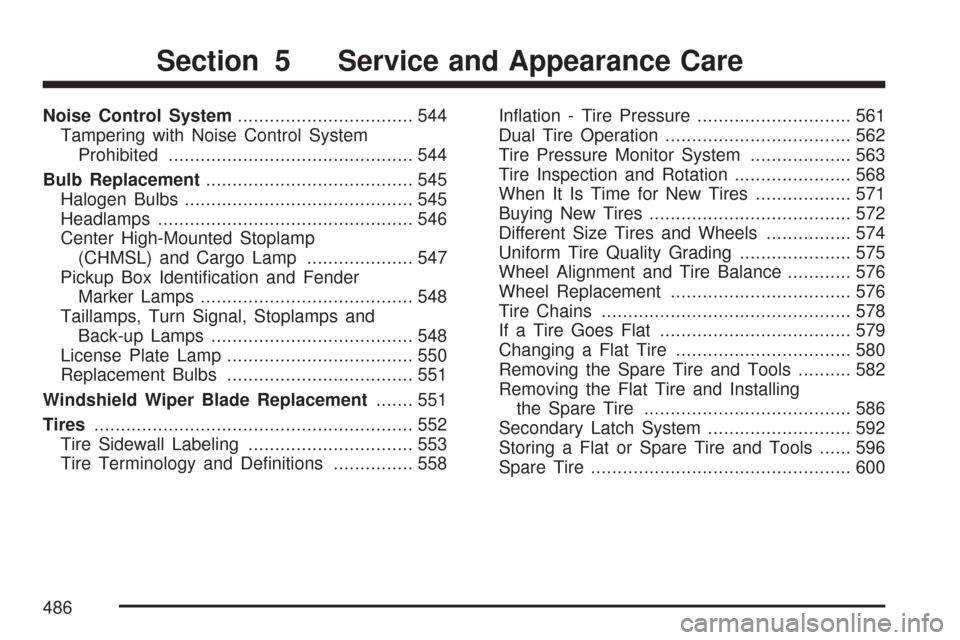
Noise Control System................................. 544
Tampering with Noise Control System
Prohibited.............................................. 544
Bulb Replacement....................................... 545
Halogen Bulbs........................................... 545
Headlamps................................................ 546
Center High-Mounted Stoplamp
(CHMSL) and Cargo Lamp.................... 547
Pickup Box Identication and Fender
Marker Lamps........................................ 548
Taillamps, Turn Signal, Stoplamps and
Back-up Lamps...................................... 548
License Plate Lamp................................... 550
Replacement Bulbs................................... 551
Windshield Wiper Blade Replacement....... 551
Tires............................................................ 552
Tire Sidewall Labeling............................... 553
Tire Terminology and Denitions............... 558Ination - Tire Pressure............................. 561
Dual Tire Operation................................... 562
Tire Pressure Monitor System................... 563
Tire Inspection and Rotation...................... 568
When It Is Time for New Tires.................. 571
Buying New Tires...................................... 572
Different Size Tires and Wheels................ 574
Uniform Tire Quality Grading..................... 575
Wheel Alignment and Tire Balance............ 576
Wheel Replacement.................................. 576
Tire Chains............................................... 578
If a Tire Goes Flat.................................... 579
Changing a Flat Tire................................. 580
Removing the Spare Tire and Tools.......... 582
Removing the Flat Tire and Installing
the Spare Tire....................................... 586
Secondary Latch System........................... 592
Storing a Flat or Spare Tire and Tools...... 596
Spare Tire................................................. 600
Section 5 Service and Appearance Care
486
Page 487 of 684
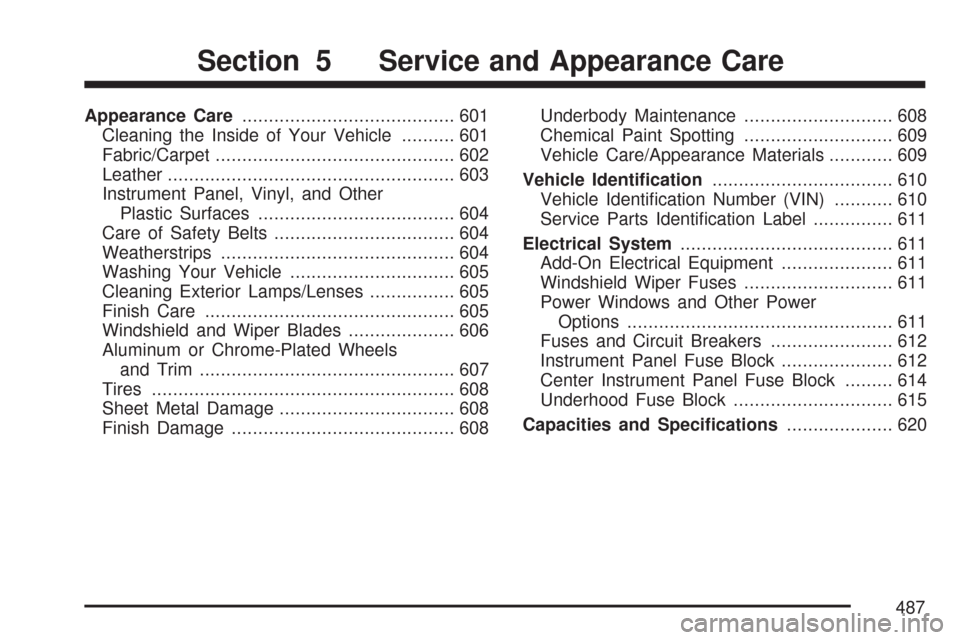
Appearance Care........................................ 601
Cleaning the Inside of Your Vehicle.......... 601
Fabric/Carpet............................................. 602
Leather...................................................... 603
Instrument Panel, Vinyl, and Other
Plastic Surfaces..................................... 604
Care of Safety Belts.................................. 604
Weatherstrips............................................ 604
Washing Your Vehicle............................... 605
Cleaning Exterior Lamps/Lenses................ 605
Finish Care............................................... 605
Windshield and Wiper Blades.................... 606
Aluminum or Chrome-Plated Wheels
and Trim................................................ 607
Tires......................................................... 608
Sheet Metal Damage................................. 608
Finish Damage.......................................... 608Underbody Maintenance............................ 608
Chemical Paint Spotting............................ 609
Vehicle Care/Appearance Materials............ 609
Vehicle Identication.................................. 610
Vehicle Identication Number (VIN)........... 610
Service Parts Identication Label............... 611
Electrical System........................................ 611
Add-On Electrical Equipment..................... 611
Windshield Wiper Fuses............................ 611
Power Windows and Other Power
Options.................................................. 611
Fuses and Circuit Breakers....................... 612
Instrument Panel Fuse Block..................... 612
Center Instrument Panel Fuse Block......... 614
Underhood Fuse Block.............................. 615
Capacities and Specications.................... 620
Section 5 Service and Appearance Care
487