transmission CHEVROLET SILVERADO 2007 1.G Workshop Manual
[x] Cancel search | Manufacturer: CHEVROLET, Model Year: 2007, Model line: SILVERADO, Model: CHEVROLET SILVERADO 2007 1.GPages: 684, PDF Size: 3.4 MB
Page 446 of 684
Four-Wheel-Drive Vehicles
Use the following procedure to tow your vehicle
from the rear:
1. Drive the vehicle onto the dolly.
2. Firmly set the parking brake. SeeParking
Brake on page 164.
3. Put the transmission in PARK (P).
4. Follow the dolly manufacturer’s instructions to
attach and secure the vehicle being towed to
the dolly and then the loaded dolly to the
tow vehicle.
Use an adequate clamping device to ensure
that the front wheels are locked into the
straight position.{CAUTION:
Shifting a four-wheel-drive vehicle’s
transfer case into NEUTRAL can cause
your vehicle to roll even if the transmission
is in PARK (P). You or others could be
injured. Make sure the parking brake is
rmly set before you shift the transfer case
to NEUTRAL.
5. Shift the transfer case to NEUTRAL.
SeeFour-Wheel Drive on page 149.
6. Release the parking brake only after the
vehicle being towed is rmly attached to
the tow vehicle.
7. Turn the ignition to LOCK.
446
Page 448 of 684
If You Do Decide To Pull A Trailer
If you do, here are some important points:
There are many different laws, including speed
limit restrictions, having to do with trailering.
Make sure your rig will be legal, not only where
you live but also where you’ll be driving.
A good source for this information can be state
or provincial police.
Consider using a sway control. See “Hitches”
later in this section.
Don’t tow a trailer at all during the rst
500 miles (800 km) your new vehicle is driven.
Your engine, axle or other parts could be
damaged.
Then, during the rst 500 miles (800 km) that
you tow a trailer, don’t drive over 50 mph
(80 km/h) and don’t make starts at full throttle.
This helps your engine and other parts of
your vehicle wear in at the heavier loads.
You can tow in DRIVE (D). You may want to
shift the transmission to THIRD (3), or
FOURTH (4) with the Allison or Hydra-matic
6-speed transmissions, or if necessary, a lower
gear selection if the transmission shifts too
often, such as under heavy loads and/or hilly
conditions. SeeTow/Haul Mode Light on
page 268.
Three important considerations have to do with
weight:
The weight of the trailer
The weight of the trailer tongue
The weight on your vehicle’s tires
448
Page 449 of 684
Tow/Haul Mode
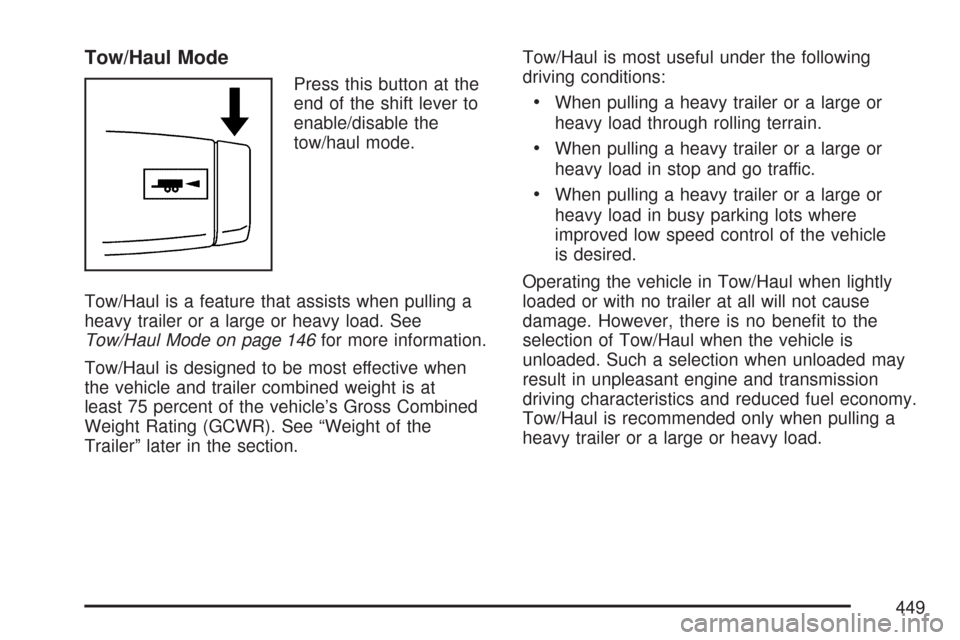
Press this button at the
end of the shift lever to
enable/disable the
tow/haul mode.
Tow/Haul is a feature that assists when pulling a
heavy trailer or a large or heavy load. See
Tow/Haul Mode on page 146for more information.
Tow/Haul is designed to be most effective when
the vehicle and trailer combined weight is at
least 75 percent of the vehicle’s Gross Combined
Weight Rating (GCWR). See “Weight of the
Trailer” later in the section.Tow/Haul is most useful under the following
driving conditions:
When pulling a heavy trailer or a large or
heavy load through rolling terrain.
When pulling a heavy trailer or a large or
heavy load in stop and go traffic.
When pulling a heavy trailer or a large or
heavy load in busy parking lots where
improved low speed control of the vehicle
is desired.
Operating the vehicle in Tow/Haul when lightly
loaded or with no trailer at all will not cause
damage. However, there is no benet to the
selection of Tow/Haul when the vehicle is
unloaded. Such a selection when unloaded may
result in unpleasant engine and transmission
driving characteristics and reduced fuel economy.
Tow/Haul is recommended only when pulling a
heavy trailer or a large or heavy load.
449
Page 477 of 684
Turn Signals When Towing a Trailer
The arrows on your instrument panel will
ash whenever you signal a turn or lane change.
Properly hooked up, the trailer lamps will also
ash, telling other drivers you’re about to
turn, change lanes or stop.
When towing a trailer, the arrows on your
instrument panel will ash for turns even if the
bulbs on the trailer are burned out. Thus, you may
think drivers behind you are seeing your signal
when they are not. It’s important to check
occasionally to be sure the trailer bulbs are still
working.
Driving On Grades
Reduce speed and shift to a lower gearbefore
you start down a long or steep downgrade. If you
don’t shift down, you might have to use your
brakes so much that they would get hot and no
longer work well.
You can tow in DRIVE (D). You may want to shift
the transmission to lower gear selection if the
transmission shifts too often (e.g., under heavy
loads and/or hilly conditions).You may also want to activate the tow/haul mode
if the transmission shifts too often. SeeTow/Haul
Mode Light on page 268.
When towing at high elevation on steep uphill
grades, consider the following: Engine coolant at
higher elevations will boil at a lower temperature
than at or near sea level. If you turn your
engine off immediately after towing at high
elevation on steep uphill grades, your vehicle may
show signs similar to engine overheating. To
avoid this, let the engine run while parked,
preferably on level ground, with the transmission
in PARK (P) at least ve minutes before turning the
engine off. If you do get the overheat warning,
seeEngine Overheating on page 517.
477
Page 480 of 684
Maintenance When Trailer Towing
Your vehicle will need service more often when
you’re pulling a trailer. SeeScheduled
Maintenance (Gasoline Engine) on page 627for
more information. Things that are especially
important in trailer operation are automatic
transmission uid (don’t overll), engine oil, axle
lubricant, belt, cooling system and brake system.
Each of these is covered in this manual, and
the Index will help you nd them quickly. If you’re
trailering, it’s a good idea to review these
sections before you start your trip.
Check periodically to see that all hitch nuts and
bolts are tight.
Trailer Wiring Harness
Your vehicle is equipped with one of the following
wiring harnesses for towing a trailer or hauling
a slide-in camper.
Basic Trailer Wiring
All regular, extended cab and crew cab pickups
have a seven-wire trailer towing harness.
For vehicles not equipped with heavy duty
trailering, the harness is clipped to the vehicle’s
frame behind the spare tire mount. The harness
requires the installation of a trailer connector,
which is available through your dealer.
If you need to tow a light-duty trailer with a
standard four-way round pin connector, you can
also get an adapter from your dealer.
480
Page 485 of 684
Service........................................................ 488
Accessories and Modications................... 488
California Proposition 65 Warning.............. 489
Doing Your Own Service Work.................. 489
Adding Equipment to the Outside of
Your Vehicle.......................................... 490
Fuel............................................................. 490
Gasoline Octane........................................ 491
Gasoline Specications.............................. 491
California Fuel........................................... 491
Additives................................................... 492
Fuel E85 (85% Ethanol)............................ 493
Fuels in Foreign Countries........................ 494
Filling the Tank......................................... 494
Filling a Portable Fuel Container............... 497
Checking Things Under the Hood.............. 498
Hood Release........................................... 498
Engine Compartment Overview.................. 500
Engine Oil (Gasoline Engine).................... 502
Engine Oil Life System.............................. 505Engine Air Cleaner/Filter
(Gasoline Engines)................................. 507
Automatic Transmission Fluid.................... 510
Engine Coolant.......................................... 514
Coolant Surge Tank Pressure Cap............ 517
Engine Overheating................................... 517
Overheated Engine Protection
Operating Mode (V8 Engines Only)........ 520
Cooling System......................................... 521
Engine Fan Noise..................................... 526
Power Steering Fluid................................. 526
Windshield Washer Fluid........................... 527
Brakes...................................................... 529
Battery...................................................... 533
Jump Starting............................................ 534
Rear Axle.................................................... 540
Four-Wheel Drive........................................ 541
Front Axle................................................... 543
Section 5 Service and Appearance Care
485
Page 501 of 684
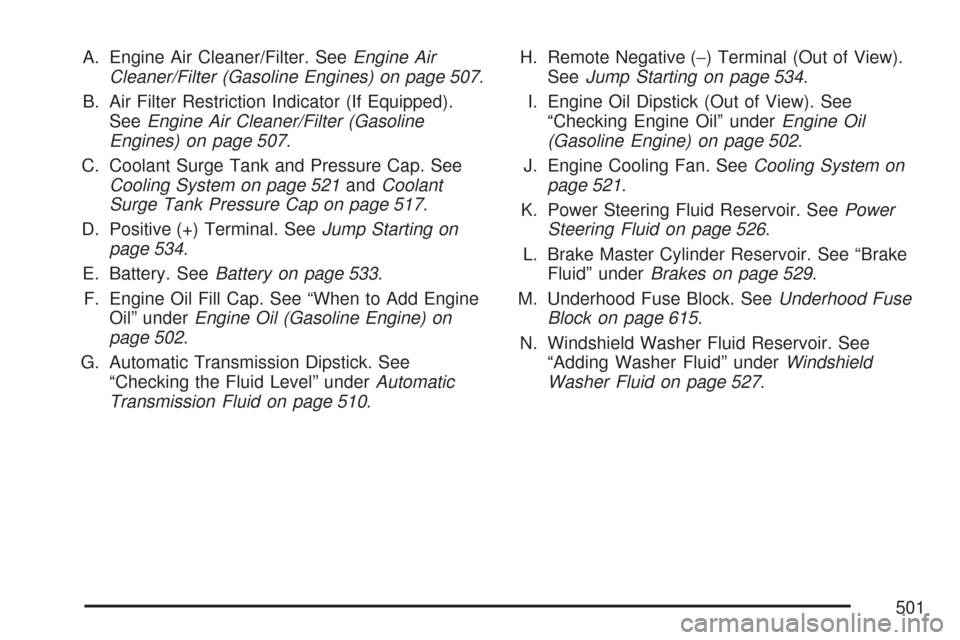
A. Engine Air Cleaner/Filter. SeeEngine Air
Cleaner/Filter (Gasoline Engines) on page 507.
B. Air Filter Restriction Indicator (If Equipped).
SeeEngine Air Cleaner/Filter (Gasoline
Engines) on page 507.
C. Coolant Surge Tank and Pressure Cap. See
Cooling System on page 521andCoolant
Surge Tank Pressure Cap on page 517.
D. Positive (+) Terminal. SeeJump Starting on
page 534.
E. Battery. SeeBattery on page 533.
F. Engine Oil Fill Cap. See “When to Add Engine
Oil” underEngine Oil (Gasoline Engine) on
page 502.
G. Automatic Transmission Dipstick. See
“Checking the Fluid Level” underAutomatic
Transmission Fluid on page 510.H. Remote Negative (−) Terminal (Out of View).
SeeJump Starting on page 534.
I. Engine Oil Dipstick (Out of View). See
“Checking Engine Oil” underEngine Oil
(Gasoline Engine) on page 502.
J. Engine Cooling Fan. SeeCooling System on
page 521.
K. Power Steering Fluid Reservoir. SeePower
Steering Fluid on page 526.
L. Brake Master Cylinder Reservoir. See “Brake
Fluid” underBrakes on page 529.
M. Underhood Fuse Block. SeeUnderhood Fuse
Block on page 615.
N. Windshield Washer Fluid Reservoir. See
“Adding Washer Fluid” underWindshield
Washer Fluid on page 527.
501
Page 510 of 684
Automatic Transmission Fluid
When to Check and Change Automatic
Transmission Fluid
It is usually not necessary to check the
transmission uid level. The only reason for uid
loss is a transmission leak or overheating the
transmission. If you suspect a small leak, then use
the following checking procedures to check the
uid level. However, if there is a large leak, then it
may be necessary to have the vehicle towed to
a dealership service department and have it
repaired before driving the vehicle further.
Notice:Use of the incorrect automatic
transmission uid may damage your vehicle,
and the damages may not be covered by
your warranty. Always use the automatic
transmission uid listed inRecommended
Fluids and Lubricants on page 639.
Change the uid and lter at the intervals listed in
the Maintenance Schedule. SeeScheduled
Maintenance (Gasoline Engine) on page 627.Be
sure to use the transmission uid listed in
Recommended Fluids and Lubricants on page 639.
How to Check Automatic Transmission
Fluid
Notice:Too much or too little uid can
damage your transmission. Too much can
mean that some of the uid could come out
and fall on hot engine parts or exhaust system
parts, starting a re. Too little uid could
cause the transmission to overheat. Be sure to
get an accurate reading if you check your
transmission uid.
Before checking the uid level, prepare your
vehicle as follows:
1. Start the engine and park your vehicle on a
level surface. Keep the engine running.
2. Apply the parking brake and place the shift
lever in PARK (P).
510
Page 511 of 684

3. With your foot on the brake pedal, move the
shift lever through each gear range, pausing
for about three seconds in each range.
Then, move the shift lever back to PARK (P).
4. Allow the engine to idle (500 – 800 rpm) for at
least one minute. Slowly release the brake
pedal.
5. Keep the engine running and press the
Trip/Fuel button or trip odometer reset
stem until TRANS TEMP (Transmission
Temperature) displays on the Driver
Information Center (DIC).
6. Using the TRANS TEMP reading, determine
and perform the appropriate check procedure.
If the TRANS TEMP reading is not within
the required temperature ranges, allow
the vehicle to cool, or operate the vehicle until
the appropriate transmission uid temperature
is reached.Cold Check Procedure
Use this procedure only as a reference to
determine if the transmission has enough uid to
be operated safely until a hot check procedure
can be made. The hot check procedure is the most
accurate method to check the uid level. Perform
the hot check procedure at the rst opportunity.
Use this cold check procedure to check uid level
when the transmission temperature is between
80°F and 90°F (27°C and 32°C).
1. Locate the transmission dipstick at the rear of
the engine compartment, on the passenger’s
side of the vehicle.
The dipstick handle has
this graphic. SeeEngine
Compartment Overview
on page 500for
more information.
2. Flip the handle up, and then pull out the
dipstick and wipe it with a clean rag or
paper towel.
511
Page 512 of 684
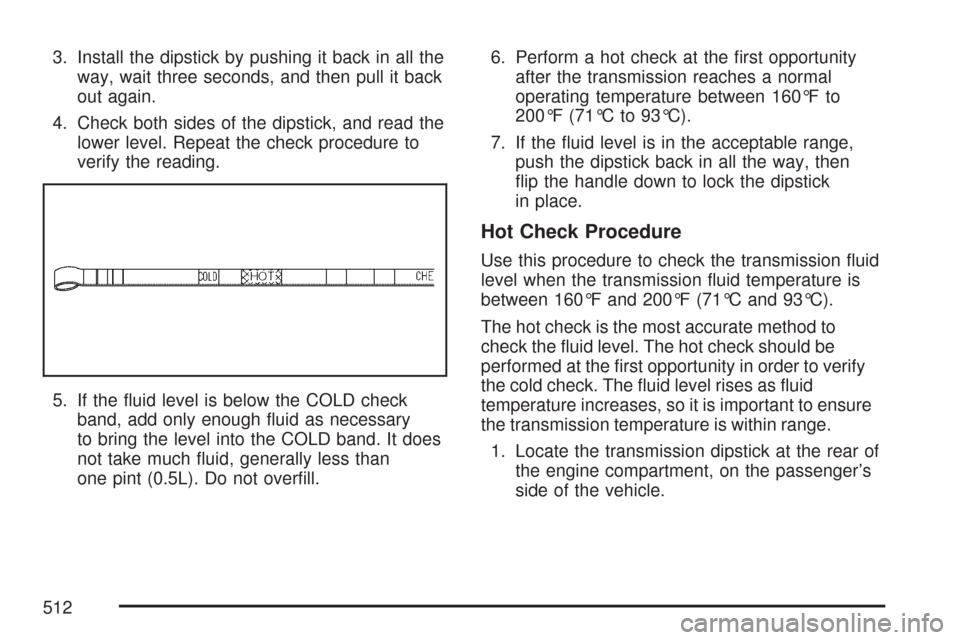
3. Install the dipstick by pushing it back in all the
way, wait three seconds, and then pull it back
out again.
4. Check both sides of the dipstick, and read the
lower level. Repeat the check procedure to
verify the reading.
5. If the uid level is below the COLD check
band, add only enough uid as necessary
to bring the level into the COLD band. It does
not take much uid, generally less than
one pint (0.5L). Do not overll.6. Perform a hot check at the rst opportunity
after the transmission reaches a normal
operating temperature between 160°F to
200°F (71°C to 93°C).
7. If the uid level is in the acceptable range,
push the dipstick back in all the way, then
ip the handle down to lock the dipstick
in place.
Hot Check Procedure
Use this procedure to check the transmission uid
level when the transmission uid temperature is
between 160°F and 200°F (71°C and 93°C).
The hot check is the most accurate method to
check the uid level. The hot check should be
performed at the rst opportunity in order to verify
the cold check. The uid level rises as uid
temperature increases, so it is important to ensure
the transmission temperature is within range.
1. Locate the transmission dipstick at the rear of
the engine compartment, on the passenger’s
side of the vehicle.
512