fuel cap CHEVROLET SILVERADO 2009 2.G User Guide
[x] Cancel search | Manufacturer: CHEVROLET, Model Year: 2009, Model line: SILVERADO, Model: CHEVROLET SILVERADO 2009 2.GPages: 600, PDF Size: 3.24 MB
Page 485 of 600
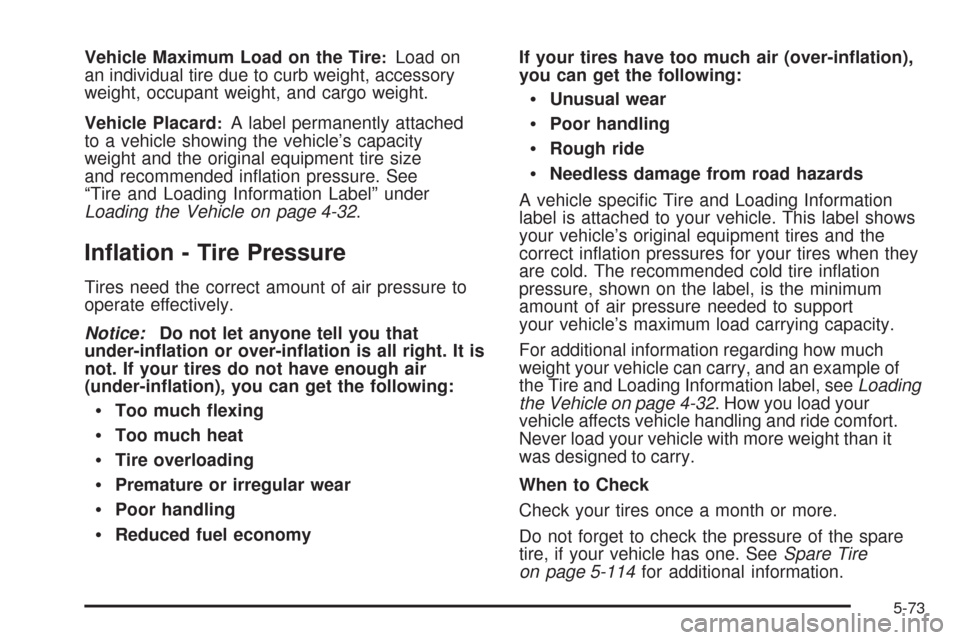
Vehicle Maximum Load on the Tire:Load on
an individual tire due to curb weight, accessory
weight, occupant weight, and cargo weight.
Vehicle Placard
:A label permanently attached
to a vehicle showing the vehicle’s capacity
weight and the original equipment tire size
and recommended ination pressure. See
“Tire and Loading Information Label” under
Loading the Vehicle on page 4-32.
Ination - Tire Pressure
Tires need the correct amount of air pressure to
operate effectively.
Notice:Do not let anyone tell you that
under-ination or over-ination is all right. It is
not. If your tires do not have enough air
(under-ination), you can get the following:
Too much exing
Too much heat
Tire overloading
Premature or irregular wear
Poor handling
Reduced fuel economyIf your tires have too much air (over-ination),
you can get the following:
Unusual wear
Poor handling
Rough ride
Needless damage from road hazards
A vehicle specic Tire and Loading Information
label is attached to your vehicle. This label shows
your vehicle’s original equipment tires and the
correct ination pressures for your tires when they
are cold. The recommended cold tire ination
pressure, shown on the label, is the minimum
amount of air pressure needed to support
your vehicle’s maximum load carrying capacity.
For additional information regarding how much
weight your vehicle can carry, and an example of
the Tire and Loading Information label, seeLoading
the Vehicle on page 4-32. How you load your
vehicle affects vehicle handling and ride comfort.
Never load your vehicle with more weight than it
was designed to carry.
When to Check
Check your tires once a month or more.
Do not forget to check the pressure of the spare
tire, if your vehicle has one. SeeSpare Tire
on page 5-114for additional information.
5-73
Page 543 of 600
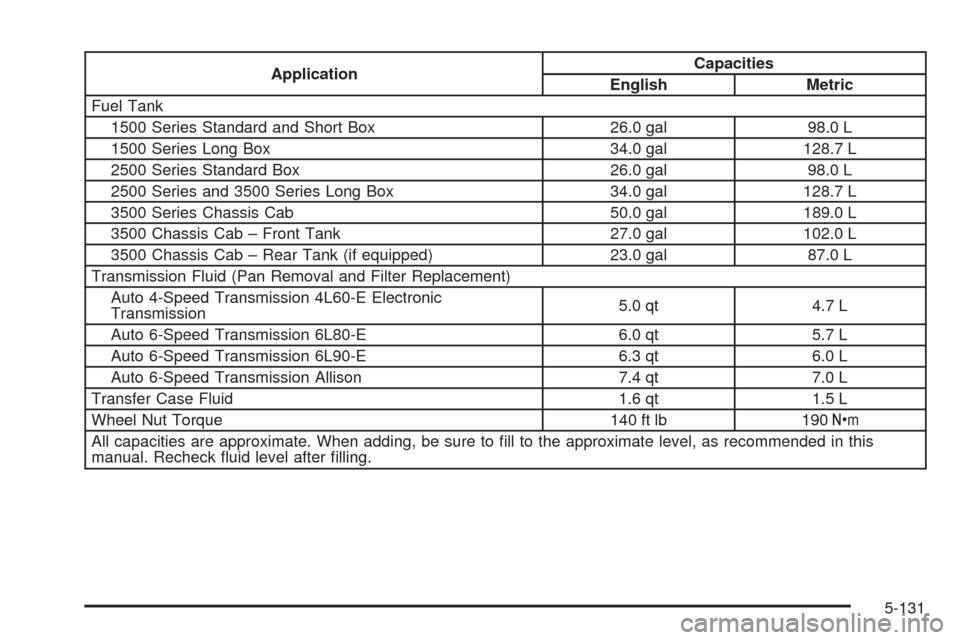
ApplicationCapacities
English Metric
Fuel Tank
1500 Series Standard and Short Box 26.0 gal 98.0 L
1500 Series Long Box 34.0 gal 128.7 L
2500 Series Standard Box 26.0 gal 98.0 L
2500 Series and 3500 Series Long Box 34.0 gal 128.7 L
3500 Series Chassis Cab 50.0 gal 189.0 L
3500 Chassis Cab – Front Tank 27.0 gal 102.0 L
3500 Chassis Cab – Rear Tank (if equipped) 23.0 gal 87.0 L
Transmission Fluid (Pan Removal and Filter Replacement)
Auto 4-Speed Transmission 4L60-E Electronic
Transmission5.0 qt 4.7 L
Auto 6-Speed Transmission 6L80-E 6.0 qt 5.7 L
Auto 6-Speed Transmission 6L90-E 6.3 qt 6.0 L
Auto 6-Speed Transmission Allison 7.4 qt 7.0 L
Transfer Case Fluid 1.6 qt 1.5 L
Wheel Nut Torque 140 ft lb 190Y
All capacities are approximate. When adding, be sure to ll to the approximate level, as recommended in this
manual. Recheck uid level after lling.
5-131
Page 554 of 600
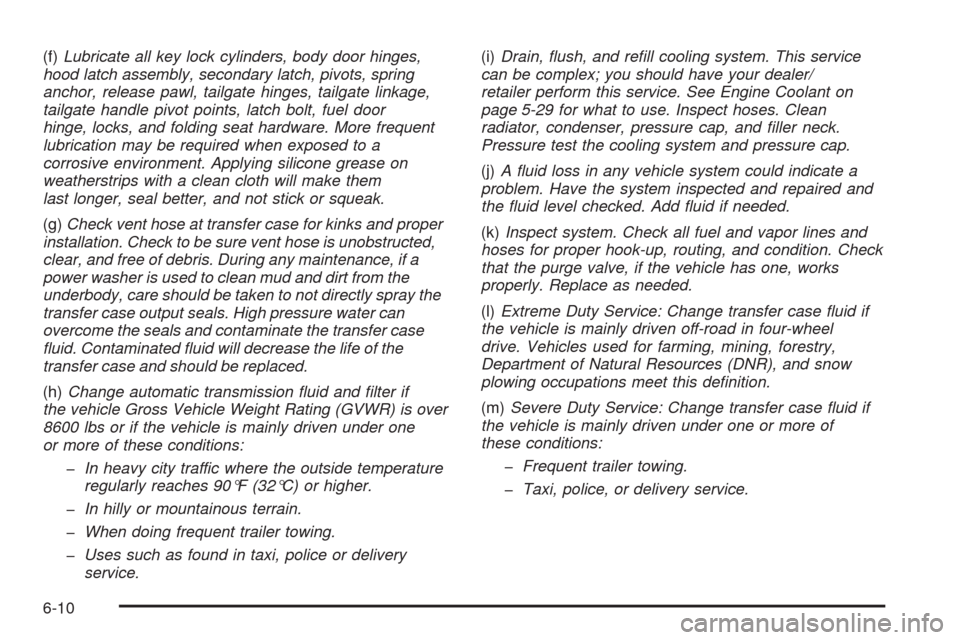
(f)Lubricate all key lock cylinders, body door hinges,
hood latch assembly, secondary latch, pivots, spring
anchor, release pawl, tailgate hinges, tailgate linkage,
tailgate handle pivot points, latch bolt, fuel door
hinge, locks, and folding seat hardware. More frequent
lubrication may be required when exposed to a
corrosive environment. Applying silicone grease on
weatherstrips with a clean cloth will make them
last longer, seal better, and not stick or squeak.
(g)Check vent hose at transfer case for kinks and proper
installation. Check to be sure vent hose is unobstructed,
clear, and free of debris. During any maintenance, if a
power washer is used to clean mud and dirt from the
underbody, care should be taken to not directly spray the
transfer case output seals. High pressure water can
overcome the seals and contaminate the transfer case
fluid. Contaminated fluid will decrease the life of the
transfer case and should be replaced.
(h)Change automatic transmission fluid and filter if
the vehicle Gross Vehicle Weight Rating (GVWR) is over
8600 lbs or if the vehicle is mainly driven under one
or more of these conditions:
In heavy city traffic where the outside temperature
regularly reaches 90°F (32°C) or higher.
In hilly or mountainous terrain.
When doing frequent trailer towing.
Uses such as found in taxi, police or delivery
service.(i)Drain, flush, and refill cooling system. This service
can be complex; you should have your dealer/
retailer perform this service. See Engine Coolant on
page 5-29 for what to use. Inspect hoses. Clean
radiator, condenser, pressure cap, and filler neck.
Pressure test the cooling system and pressure cap.
(j)A fluid loss in any vehicle system could indicate a
problem. Have the system inspected and repaired and
the fluid level checked. Add fluid if needed.
(k)Inspect system. Check all fuel and vapor lines and
hoses for proper hook-up, routing, and condition. Check
that the purge valve, if the vehicle has one, works
properly. Replace as needed.
(l)Extreme Duty Service: Change transfer case fluid if
the vehicle is mainly driven off-road in four-wheel
drive. Vehicles used for farming, mining, forestry,
Department of Natural Resources (DNR), and snow
plowing occupations meet this definition.
(m)Severe Duty Service: Change transfer case fluid if
the vehicle is mainly driven under one or more of
these conditions:
Frequent trailer towing.
Taxi, police, or delivery service.
6-10
Page 555 of 600
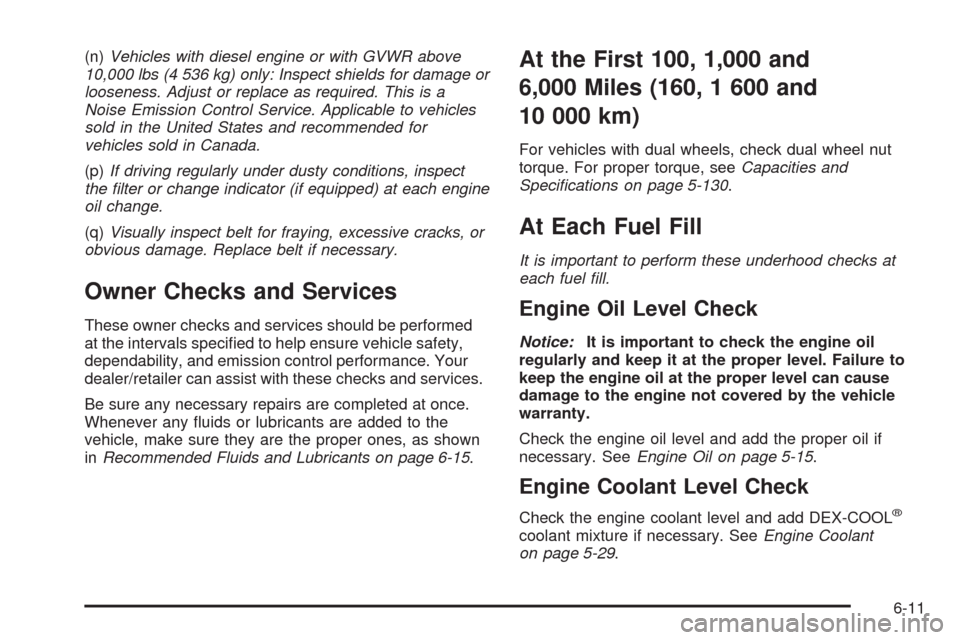
(n)Vehicles with diesel engine or with GVWR above
10,000 lbs (4 536 kg) only: Inspect shields for damage or
looseness. Adjust or replace as required. This is a
Noise Emission Control Service. Applicable to vehicles
sold in the United States and recommended for
vehicles sold in Canada.
(p)If driving regularly under dusty conditions, inspect
the filter or change indicator (if equipped) at each engine
oil change.
(q)Visually inspect belt for fraying, excessive cracks, or
obvious damage. Replace belt if necessary.
Owner Checks and Services
These owner checks and services should be performed
at the intervals specied to help ensure vehicle safety,
dependability, and emission control performance. Your
dealer/retailer can assist with these checks and services.
Be sure any necessary repairs are completed at once.
Whenever any uids or lubricants are added to the
vehicle, make sure they are the proper ones, as shown
inRecommended Fluids and Lubricants on page 6-15.
At the First 100, 1,000 and
6,000 Miles (160, 1 600 and
10 000 km)
For vehicles with dual wheels, check dual wheel nut
torque. For proper torque, seeCapacities and
Specifications on page 5-130.
At Each Fuel Fill
It is important to perform these underhood checks at
each fuel fill.
Engine Oil Level Check
Notice:It is important to check the engine oil
regularly and keep it at the proper level. Failure to
keep the engine oil at the proper level can cause
damage to the engine not covered by the vehicle
warranty.
Check the engine oil level and add the proper oil if
necessary. SeeEngine Oil on page 5-15.
Engine Coolant Level Check
Check the engine coolant level and add DEX-COOL®
coolant mixture if necessary. SeeEngine Coolant
on page 5-29.
6-11