airbag CHEVROLET SILVERADO 2017 3.G User Guide
[x] Cancel search | Manufacturer: CHEVROLET, Model Year: 2017, Model line: SILVERADO, Model: CHEVROLET SILVERADO 2017 3.GPages: 509, PDF Size: 8.87 MB
Page 77 of 509
Chevrolet Silverado Owner Manual (GMNA-Localizing-U.S./Canada/Mexico-9956065) - 2017 - CRC - 4/29/16
76 Seats and Restraints
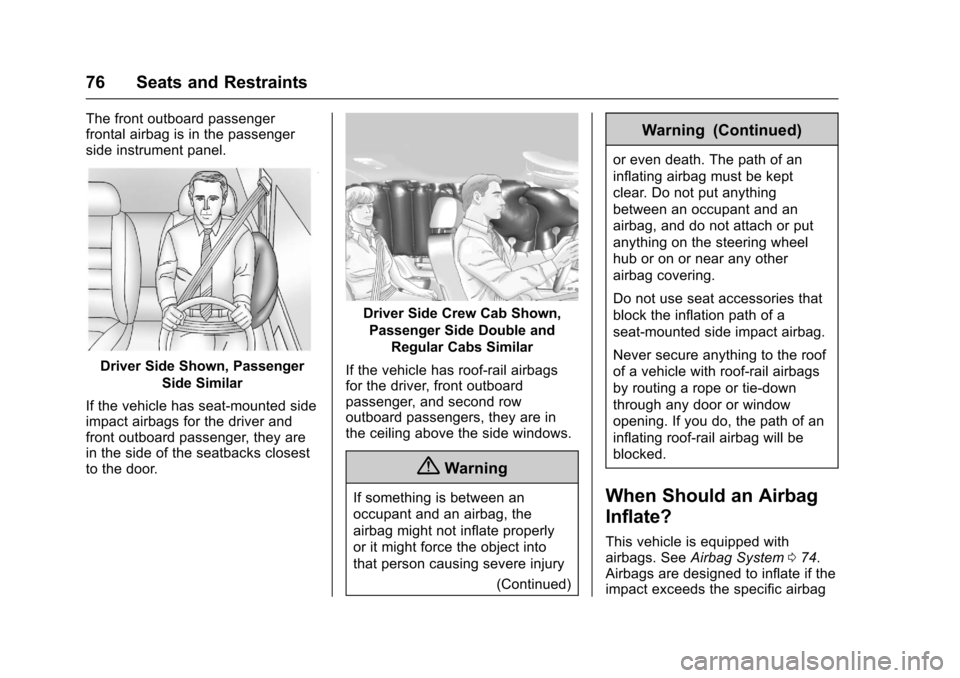
The front outboard passengerfrontal airbag is in the passengerside instrument panel.
Driver Side Shown, Passenger
Side Similar
If the vehicle has seat-mounted sideimpact airbags for the driver andfront outboard passenger, they arein the side of the seatbacks closestto the door.
Driver Side Crew Cab Shown,
Passenger Side Double and
Regular Cabs Similar
If the vehicle has roof-rail airbagsfor the driver, front outboardpassenger, and second rowoutboard passengers, they are inthe ceiling above the side windows.
{Warning
If something is between an
occupant and an airbag, the
airbag might not inflate properly
or it might force the object into
that person causing severe injury
(Continued)
Warning (Continued)
or even death. The path of an
inflating airbag must be kept
clear. Do not put anything
between an occupant and an
airbag, and do not attach or put
anything on the steering wheel
hub or on or near any other
airbag covering.
Do not use seat accessories that
block the inflation path of a
seat-mounted side impact airbag.
Never secure anything to the roof
of a vehicle with roof-rail airbags
by routing a rope or tie⇣down
through any door or window
opening. If you do, the path of an
inflating roof-rail airbag will be
blocked.
When Should an Airbag
Inflate?
This vehicle is equipped withairbags. SeeAirbag System074.Airbags are designed to inflate if theimpact exceeds the specific airbag
Page 78 of 509
Chevrolet Silverado Owner Manual (GMNA-Localizing-U.S./Canada/Mexico-9956065) - 2017 - CRC - 4/29/16
Seats and Restraints 77
system's deployment threshold.Deployment thresholds are used topredict how severe a crash is likelyto be in time for the airbags toinflate and help restrain theoccupants. The vehicle haselectronic sensors which help theairbag system determine theseverity of the impact. Deploymentthresholds can vary with specificvehicle design.
Frontal airbags are designed toinflate in moderate to severe frontalor near frontal crashes to helpreduce the potential for severeinjuries, mainly to the driver's orfront outboard passenger's headand chest.
Whether the frontal airbags will orshould inflate is not based primarilyon how fast the vehicle is traveling.It depends on what is hit, thedirection of the impact, and howquickly the vehicle slows down.
Frontal airbags may inflate atdifferent crash speeds depending onwhether the vehicle hits an objectstraight on or at an angle, and
whether the object is fixed ormoving, rigid or deformable, narrowor wide.
Frontal airbags are not intended toinflate during vehicle rollovers, inrear impacts, or in many sideimpacts.
In addition, if the GVWR (GrossVehicle Weight Rating) is at orbelow 3 855 kg (8,500 lb), thevehicle has advanced technologyfrontal airbags. You can find theGVWR on the Certification/Tire labelon the center pillar of the vehicle.SeeVehicle Load Limits0259formore information.
Advanced technology frontal airbagsadjust the restraint according tocrash severity. Vehicles withadvanced technology frontal airbagshave a seat position sensor thatenables the sensing system tomonitor the position of the driverseat. The seat position sensorprovides information that is used toadjust the deployment of the driverfrontal airbag.
If the GVWR is at or below 4 536 kg(10,000 lb), the vehicle hasseat-mounted side impact airbags.Vehicles with a GVWR above4536kg (10,000lb) may or may nothave seat-mounted side impactairbags. Seat-mounted side impactairbags, if equipped, are designedto inflate in moderate to severe sidecrashes depending on the locationof the impact. Seat-mounted sideimpact airbags are not designed toinflate in frontal impacts, near frontalimpacts, rollovers, or rear impacts.Aseat-mountedsideimpactairbagis designed to inflate on the side ofthe vehicle that is struck.
Vehicles with a GVWR at or below3855kg (8,500lb) have roof-railairbags. These roof-rail airbags aredesigned to inflate in moderate tosevere side crashes depending onthe location of the impact. Inaddition, these roof-rail airbags aredesigned to inflate during a rolloveror in a severe frontal impact. Theroof-rail airbags are not designed toinflate in rear impacts. Both roof-railairbags will inflate when either sideof the vehicle is struck or if the
Page 79 of 509
Chevrolet Silverado Owner Manual (GMNA-Localizing-U.S./Canada/Mexico-9956065) - 2017 - CRC - 4/29/16
78 Seats and Restraints
sensing system predicts that thevehicle is about to roll over on itsside, or in a severe frontal impact.
Vehicles with a GVWR above3855 kg (8,500lb) up to andincluding 4 536 kg (10,000 lb) alsohave roof-rail airbags. Theseroof-rail airbags are designed toinflate in moderate to severe sidecrashes depending on the locationof the impact. Both roof-rail airbagswill inflate when either side of thevehicle is struck. In addition, theseroof-rail airbags are designed toinflate in a severe frontal impact.The roof-rail airbags are alsorollover capable except on modelssold as an incomplete vehicle withthe pickup box removed. If theroof-rail airbags are rollovercapable, both roof-rail airbags willalso inflate if the sensing systempredicts that the vehicle is about toroll over on its side. The roof-railairbags are not designed to inflate inrear impacts.
Vehicles with a GVWR above4536kg(10,000lb)mayormaynotbe equipped with roof-rail airbags.These roof-rail airbags, if equipped,
are designed to inflate in moderateto severe side crashes dependingon the location of the impact. Bothroof-rail airbags will inflate wheneither side of the vehicle is struck.In addition, these roof-rail airbagsare designed to inflate in a severefrontal impact. If the vehicle hassingle rear wheels and has afactory-installed pickup box androof-rail airbags, the roof-rail airbagsare rollover capable. If the vehiclehas dual rear wheels, or is sold asan incomplete vehicle, as a chassiscab, or with the pickup boxremoved, and has roof-rail airbags,the roof-rail airbags are not rollovercapable. If the airbags are rollovercapable, both roof-rail airbags willalso inflate if the sensing systempredicts that the vehicle is about toroll over on its side. The roof-railairbags are not designed to inflate inrear impacts.
In any particular crash, no one cansay whether an airbag should haveinflated simply because of thevehicle damage or repair costs.
What Makes an Airbag
Inflate?
In a deployment event, the sensingsystem sends an electrical signaltriggering a release of gas from theinflator. Gas from the inflator fills theairbag causing the bag to break outof the cover. The inflator, the airbag,and related hardware are all part ofthe airbag module.
For airbag locations, seeWhere Arethe Airbags?075.
How Does an Airbag
Restrain?
In moderate to severe frontal ornear frontal collisions, even beltedoccupants can contact the steeringwheel or the instrument panel. Inmoderate to severe side collisions,even belted occupants can contactthe inside of the vehicle.
Airbags supplement the protectionprovided by safety belts bydistributing the force of the impactmore evenly over theoccupant's body.
Page 80 of 509
Chevrolet Silverado Owner Manual (GMNA-Localizing-U.S./Canada/Mexico-9956065) - 2017 - CRC - 4/29/16
Seats and Restraints 79
Rollover capable roof-rail airbagsare designed to help contain thehead and chest of occupants in theoutboard seating positions in thefirst and second rows. The rollovercapable roof-rail airbags aredesigned to help reduce the risk offull or partial ejection in rolloverevents, although no system canprevent all such ejections.
But airbags would not help in manytypes of collisions, primarilybecause the occupant's motion isnot toward those airbags. SeeWhenShould an Airbag Inflate?076.
Airbags should never be regardedas anything more than a supplementto safety belts.
What Will You See after
an Airbag Inflates?
For an eAssist vehicle, see theSilverado/Sierra eAssistsupplement.
After the frontal airbags andseat-mounted side impact airbagsinflate, they quickly deflate, soquickly that some people may not
even realize an airbag inflated.Roof-rail airbags may still be at leastpartially inflated for some time afterthey inflate. Some components ofthe airbag module may be hot forseveral minutes. For location of theairbags, seeWhere Are theAirbags?075.
The parts of the airbag that comeinto contact with you may be warm,but not too hot to touch. There maybe some smoke and dust comingfrom the vents in the deflatedairbags. Airbag inflation does notprevent the driver from seeing out ofthe windshield or being able to steerthe vehicle, nor does it preventpeople from leaving the vehicle.
{Warning
When an airbag inflates, there
may be dust in the air. This dust
could cause breathing problems
for people with a history of
asthma or other breathing trouble.
To a v o i d t h i s , e v e r y o n e i n t h e
vehicle should get out as soon as
(Continued)
Warning (Continued)
it is safe to do so. If you have
breathing problems but cannot
get out of the vehicle after an
airbag inflates, then get fresh air
by opening a window or a door.
If you experience breathing
problems following an airbag
deployment, you should seek
medical attention.
The vehicle has a feature that mayautomatically unlock the doors, turnon the interior lamps and hazardwarning flashers, and shut off thefuel system after the airbags inflate.The feature may also activate,without airbag inflation, after anevent that exceeds a predeterminedthreshold. You can lock the doors,and turn off the interior lamps, andturn off the hazard warning flashersby using the controls for thosefeatures.
Page 81 of 509
Chevrolet Silverado Owner Manual (GMNA-Localizing-U.S./Canada/Mexico-9956065) - 2017 - CRC - 4/29/16
80 Seats and Restraints
{Warning
Acrashsevereenoughtoinflate
the airbags may have also
damaged important functions in
the vehicle, such as the fuel
system, brake and steering
systems, etc. Even if the vehicle
appears to be drivable after a
moderate crash, there may be
concealed damage that could
make it difficult to safely operate
the vehicle.
Use caution if you should attempt
to restart the engine after a crash
has occurred.
In many crashes severe enough toinflate the airbag, windshields arebroken by vehicle deformation.Additional windshield breakage mayalso occur from the front outboardpassenger airbag.
.Airbags are designed to inflateonly once. After an airbaginflates, you will need some newparts for the airbag system.If you do not get them, the
airbag system will not be thereto help protect you in anothercrash. A new system will includeairbag modules and possiblyother parts. The service manualfor the vehicle covers the needto replace other parts.
.The vehicle has a crash sensingand diagnostic module whichrecords information after acrash. SeeVehicle DataRecording and Privacy0484andEvent DataRecorders0484.
.Let only qualified technicianswork on the airbag systems.Improper service can mean thatan airbag system will not workproperly. See your dealer forservice.
Airbag On-Off Switch
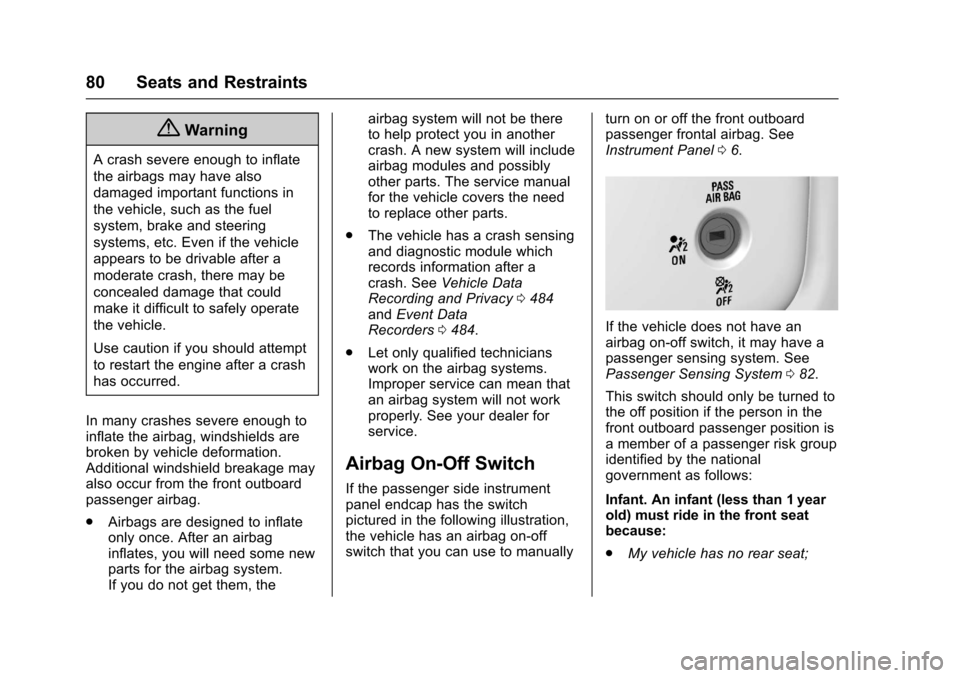
If the passenger side instrumentpanel endcap has the switchpictured in the following illustration,the vehicle has an airbag on-offswitch that you can use to manually
turn on or off the front outboardpassenger frontal airbag. SeeInstrument Panel06.
If the vehicle does not have anairbag on-off switch, it may have apassenger sensing system. SeePassenger Sensing System082.
This switch should only be turned tothe off position if the person in thefront outboard passenger position isamemberofapassengerriskgroupidentified by the nationalgovernment as follows:
Infant. An infant (less than 1 yearold) must ride in the front seatbecause:
.My vehicle has no rear seat;
Page 82 of 509
Chevrolet Silverado Owner Manual (GMNA-Localizing-U.S./Canada/Mexico-9956065) - 2017 - CRC - 4/29/16
Seats and Restraints 81
.My vehicle has a rear seat toosmall to accommodate arear-facing infant seat; or
.The infant has a medicalcondition which, according to theinfant's physician, makes itnecessary for the infant to ride inthe front seat so that the drivercan constantly monitor thechild's condition.
Child age 1 to 12. A childage 1 to 12 must ride in the frontseat because:
.My vehicle has no rear seat;
.Although children ages 1 to 12ride in the rear seat(s) wheneverpossible, children ages 1 to 12sometimes must ride in the frontbecause no space is available inthe rear seat(s) of my vehicle; or
.The child has a medicalcondition which, according to thechild's physician, makes itnecessary for the child to ride inthe front seat so that the drivercan constantly monitor thechild's condition.
Medical Condition. A passengerhas a medical condition which,according to his or her physician:
.Causes the passenger airbag topose a special risk for thepassenger; and
.Makes the potential harm fromthe passenger airbag in a crashgreater than the potential harmfrom turning off the airbag andallowing the passenger, even ifbelted, to hit the instrumentpanel or windshield in a crash.
{Warning
If the front outboard passenger
frontal airbag is turned off for a
person who is not in a risk group
identified by the national
government, that person will not
have the extra protection of an
airbag. In a crash, the airbag will
not be able to inflate and help
protect the person sitting there.
Do not turn off the front outboard
(Continued)
Warning (Continued)
passenger frontal airbag unless
the person sitting there is in a risk
group.
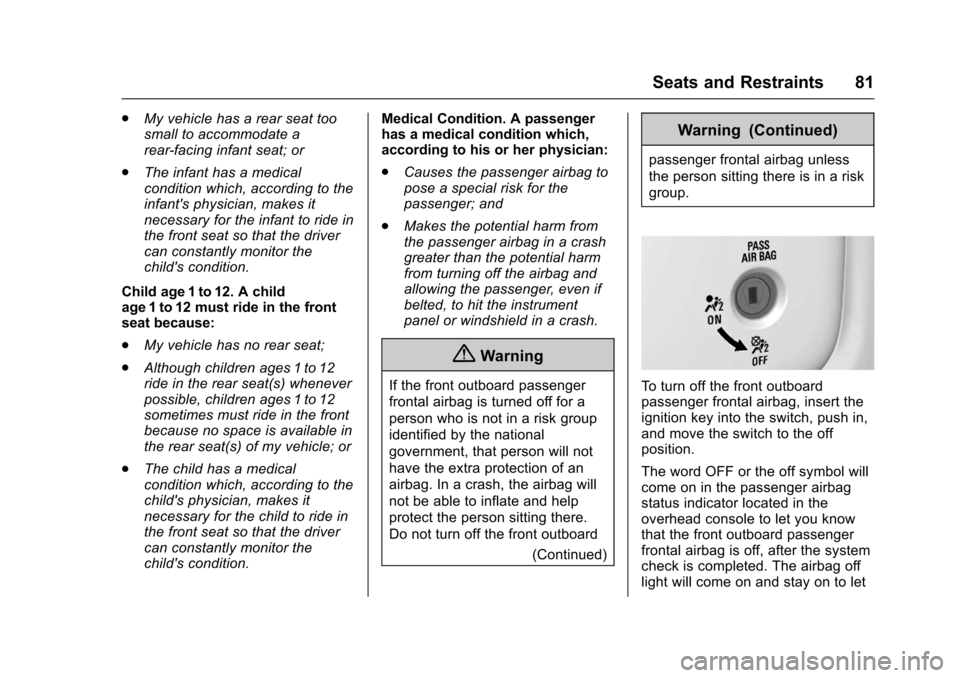
To t u r n o f f t h e f r o n t o u t b o a r dpassenger frontal airbag, insert theignition key into the switch, push in,and move the switch to the offposition.
The word OFF or the off symbol willcome on in the passenger airbagstatus indicator located in theoverhead console to let you knowthat the front outboard passengerfrontal airbag is off, after the systemcheck is completed. The airbag offlight will come on and stay on to let
Page 83 of 509
Chevrolet Silverado Owner Manual (GMNA-Localizing-U.S./Canada/Mexico-9956065) - 2017 - CRC - 4/29/16
82 Seats and Restraints
you know that the front outboardpassenger frontal airbag is off. SeeAirbag On-Off Light0136.Thefrontoutboard passenger airbag willremain off until you turn it back onagain.
{Warning
If the airbag readiness light ever
comes on and stays on, it means
that something may be wrong
with the airbag system. For
example, the front outboard
passenger frontal airbag could
inflate even though the airbag
on-off switch is turned off.
To h e l p a v o i d i n j u r y t o y o u r s e l f o r
others, have the vehicle serviced
right away. SeeAirbag Readiness
Light0135for more information,
including important safety
information.
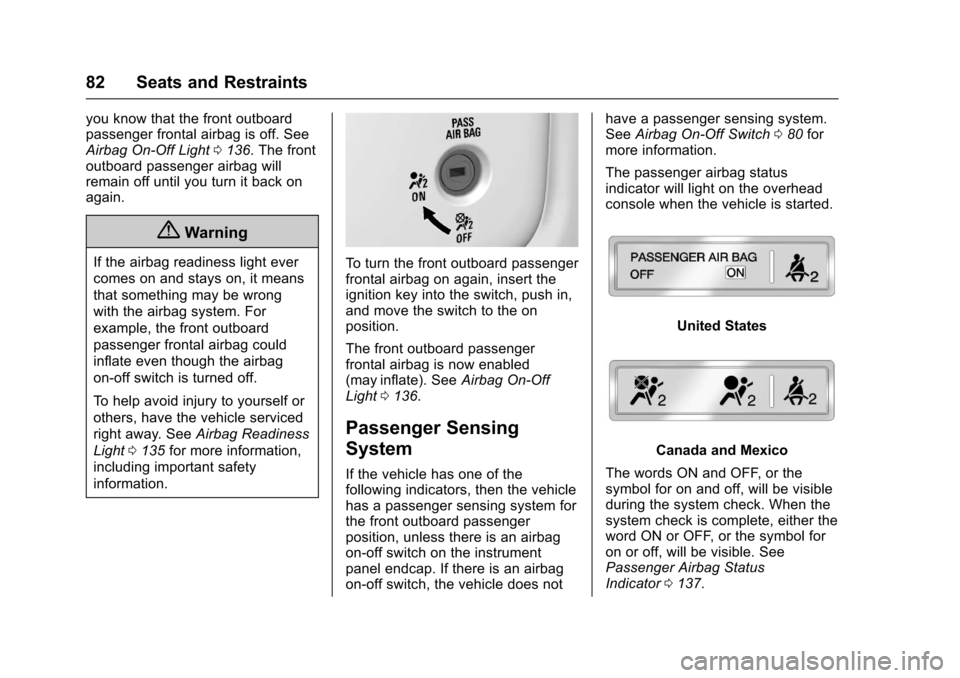
To t u r n t h e f r o n t o u t b o a r d p a s s e n g e rfrontal airbag on again, insert theignition key into the switch, push in,and move the switch to the onposition.
The front outboard passengerfrontal airbag is now enabled(may inflate). SeeAirbag On-OffLight0136.
Passenger Sensing
System
If the vehicle has one of thefollowing indicators, then the vehiclehas a passenger sensing system forthe front outboard passengerposition, unless there is an airbagon-off switch on the instrumentpanel endcap. If there is an airbagon-off switch, the vehicle does not
have a passenger sensing system.SeeAirbag On-Off Switch080formore information.
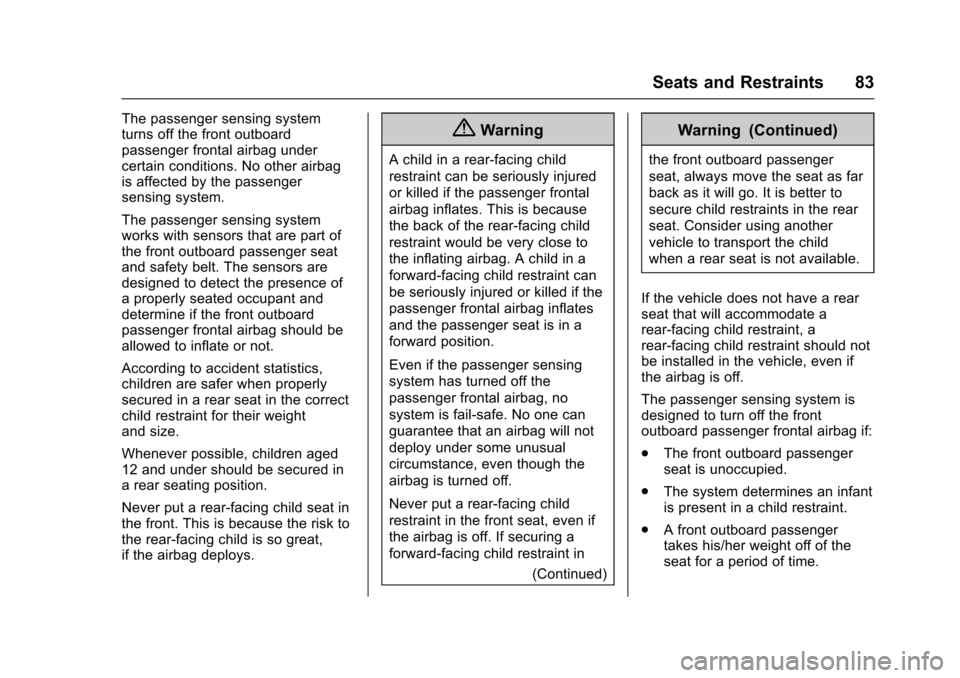
The passenger airbag statusindicator will light on the overheadconsole when the vehicle is started.
United States
Canada and Mexico
The words ON and OFF, or thesymbol for on and off, will be visibleduring the system check. When thesystem check is complete, either theword ON or OFF, or the symbol foron or off, will be visible. SeePassenger Airbag StatusIndicator0137.
Page 84 of 509
Chevrolet Silverado Owner Manual (GMNA-Localizing-U.S./Canada/Mexico-9956065) - 2017 - CRC - 4/29/16
Seats and Restraints 83
The passenger sensing systemturns off the front outboardpassenger frontal airbag undercertain conditions. No other airbagis affected by the passengersensing system.
The passenger sensing systemworks with sensors that are part ofthe front outboard passenger seatand safety belt. The sensors aredesigned to detect the presence ofaproperlyseatedoccupantanddetermine if the front outboardpassenger frontal airbag should beallowed to inflate or not.
According to accident statistics,children are safer when properlysecured in a rear seat in the correctchild restraint for their weightand size.
Whenever possible, children aged12 and under should be secured inarearseatingposition.
Never put a rear-facing child seat inthe front. This is because the risk tothe rear-facing child is so great,if the airbag deploys.
{Warning
Achildinarear-facingchild
restraint can be seriously injured
or killed if the passenger frontal
airbag inflates. This is because
the back of the rear-facing child
restraint would be very close to
the inflating airbag. A child in a
forward-facing child restraint can
be seriously injured or killed if the
passenger frontal airbag inflates
and the passenger seat is in a
forward position.
Even if the passenger sensing
system has turned off the
passenger frontal airbag, no
system is fail-safe. No one can
guarantee that an airbag will not
deploy under some unusual
circumstance, even though the
airbag is turned off.
Never put a rear-facing child
restraint in the front seat, even if
the airbag is off. If securing a
forward-facing child restraint in
(Continued)
Warning (Continued)
the front outboard passenger
seat, always move the seat as far
back as it will go. It is better to
secure child restraints in the rear
seat. Consider using another
vehicle to transport the child
when a rear seat is not available.
If the vehicle does not have a rearseat that will accommodate arear-facing child restraint, arear-facing child restraint should notbe installed in the vehicle, even ifthe airbag is off.
The passenger sensing system isdesigned to turn off the frontoutboard passenger frontal airbag if:
.The front outboard passengerseat is unoccupied.
.The system determines an infantis present in a child restraint.
.Afrontoutboardpassengertakes his/her weight off of theseat for a period of time.
Page 85 of 509
Chevrolet Silverado Owner Manual (GMNA-Localizing-U.S./Canada/Mexico-9956065) - 2017 - CRC - 4/29/16
84 Seats and Restraints
.There is a critical problem withthe airbag system or thepassenger sensing system.
When the passenger sensingsystem has turned off the frontoutboard passenger frontal airbag,the off indicator will light and stay litas a reminder that the airbag is off.SeePassenger Airbag StatusIndicator0137.
The passenger sensing system isdesigned to turn on the frontoutboard passenger frontal airbaganytime the system senses that aperson of adult size is sittingproperly in the front outboardpassenger seat.
When the passenger sensingsystem has allowed the airbag to beenabled, the on indicator will lightand stay lit as a reminder that theairbag is active.
For some children, includingchildren in child restraints, and forvery small adults, the passengersensing system may or may not turnoff the front outboard passenger
frontal airbag, depending upon theperson's seating posture and bodybuild. Everyone in the vehicle whohas outgrown child restraints shouldwear a safety beltproperly—whether or not there isan airbag for that person.
{Warning
If the airbag readiness light ever
comes on and stays on, it means
that something may be wrong
with the airbag system. To help
avoid injury to yourself or others,
have the vehicle serviced right
away. SeeAirbag Readiness
Light0135for more information,
including important safety
information.
If the On Indicator Is Lit for a
Child Restraint
The passenger sensing system isdesigned to turn off the frontoutboard passenger frontal airbag ifthe system determines that an infant
is present in a child restraint. If achild restraint has been installedand the on indicator is lit:
1. Turn the vehicle off.
2. Remove the child restraint fromthe vehicle.
3. Remove any additional itemsfrom the seat such as blankets,cushions, seat covers, seatheaters, or seat massagers.
4. Reinstall the child restraintfollowing the directionsprovided by the child restraintmanufacturer and refer toSecuring Child Restraints (Withthe Safety Belt in the CenterFront Seat)0106orSecuringChild Restraints (With theSafety Belt in the Rear Seat)0102orSecuring ChildRestraints (With the Safety Beltin the Front PassengerSeat)0106.
Make sure the safety beltretractor is locked by pullingthe shoulder belt all the wayout of the retractor wheninstalling the child restraint,
Page 86 of 509
Chevrolet Silverado Owner Manual (GMNA-Localizing-U.S./Canada/Mexico-9956065) - 2017 - CRC - 4/29/16
Seats and Restraints 85
even if the child restraint isequipped with a safety beltlock-off. When the retractorlock is set, the belt can betightened but not pulled out ofthe retractor.
5. If, after reinstalling the childrestraint and restarting thevehicle, the on indicator is stilllit, turn the vehicle off. Thenslightly recline the vehicleseatback and adjust the seatcushion, if adjustable, to makesure that the vehicle seatbackis not pushing the childrestraint into the seat cushion.
Also make sure the childrestraint is not trapped underthe vehicle head restraint.If this happens, adjust the headrestraint. SeeHeadRestraints057.
6. Restart the vehicle.
The passenger sensing system mayor may not turn off the airbag for achild in a child restraint dependingupon the child’ssize.Itisbettertosecure child restraints in the rearseat. Consider using another
vehicle to transport the child when arear seat is not available. Never putarear-facingchildrestraintinthefront seat, even if the on indicator isnot lit.
If the Off Indicator Is Lit for an
Adult-Sized Occupant
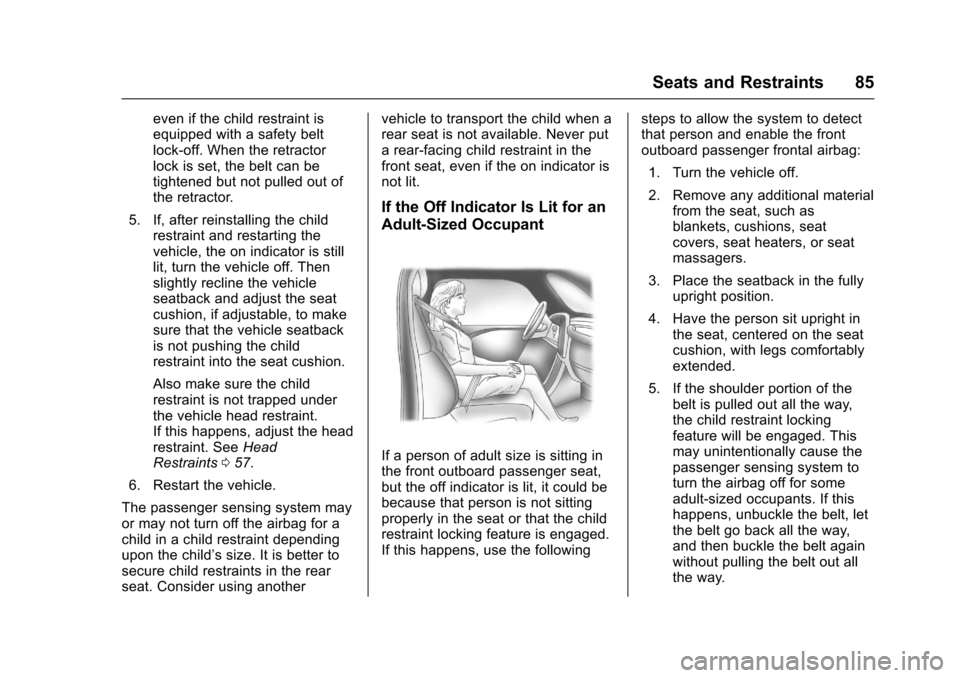
If a person of adult size is sitting inthe front outboard passenger seat,but the off indicator is lit, it could bebecause that person is not sittingproperly in the seat or that the childrestraint locking feature is engaged.If this happens, use the following
steps to allow the system to detectthat person and enable the frontoutboard passenger frontal airbag:
1. Turn the vehicle off.
2. Remove any additional materialfrom the seat, such asblankets, cushions, seatcovers, seat heaters, or seatmassagers.
3. Place the seatback in the fullyupright position.
4. Have the person sit upright inthe seat, centered on the seatcushion, with legs comfortablyextended.
5. If the shoulder portion of thebelt is pulled out all the way,the child restraint lockingfeature will be engaged. Thismay unintentionally cause thepassenger sensing system toturn the airbag off for someadult-sized occupants. If thishappens, unbuckle the belt, letthe belt go back all the way,and then buckle the belt againwithout pulling the belt out allthe way.