tires CHEVROLET SILVERADO 2017 3.G Owner's Manual
[x] Cancel search | Manufacturer: CHEVROLET, Model Year: 2017, Model line: SILVERADO, Model: CHEVROLET SILVERADO 2017 3.GPages: 509, PDF Size: 8.87 MB
Page 283 of 509
Chevrolet Silverado Owner Manual (GMNA-Localizing-U.S./Canada/Mexico-9956065) - 2017 - CRC - 4/29/16
282 Driving and Operating
If the vehicle has an exhaust brake,it can also be used, but will notautomatically downshift thetransmission. See“Exhaust Brake”in the Duramax diesel supplement.
Caution
Spinning the tires or holding the
vehicle in one place on a hill
using only the accelerator pedal
may damage the transmission.
The repair will not be covered by
the vehicle warranty. If you are
stuck, do not spin the tires. When
stopping on a hill, use the brakes
to hold the vehicle in place.
Low Traction Mode
If equipped, Low Traction Modeassists in vehicle acceleration whenroad conditions are slippery, suchas with ice or snow. While thevehicle is at a stop, select L2 usingRange Selection Mode. This willlimit torque to the wheels and helpto prevent the tires from spinning.
Tow/Haul Mode
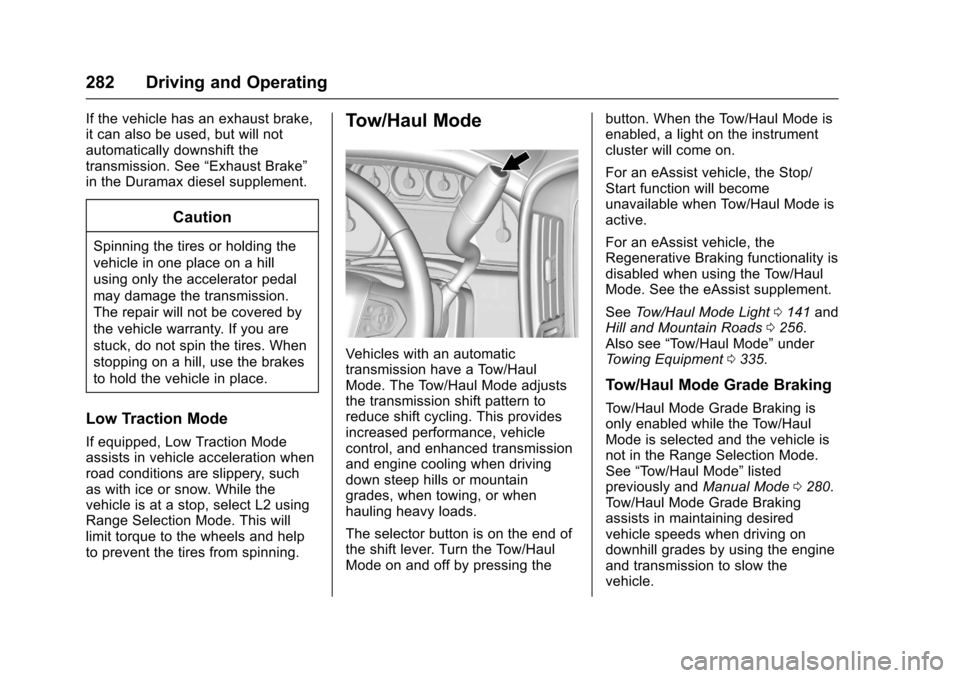
Vehicles with an automatictransmission have a Tow/HaulMode. The Tow/Haul Mode adjuststhe transmission shift pattern toreduce shift cycling. This providesincreased performance, vehiclecontrol, and enhanced transmissionand engine cooling when drivingdown steep hills or mountaingrades, when towing, or whenhauling heavy loads.
The selector button is on the end ofthe shift lever. Turn the Tow/HaulMode on and off by pressing the
button. When the Tow/Haul Mode isenabled, a light on the instrumentcluster will come on.
For an eAssist vehicle, the Stop/Start function will becomeunavailable when Tow/Haul Mode isactive.
For an eAssist vehicle, theRegenerative Braking functionality isdisabled when using the Tow/HaulMode. See the eAssist supplement.
SeeTo w / H a u l M o d e L i g h t0141andHill and Mountain Roads0256.Also see“To w / H a u l M o d e”underTo w i n g E q u i p m e n t0335.
Tow/Haul Mode Grade Braking
To w / H a u l M o d e G r a d e B r a k i n g i sonly enabled while the Tow/HaulMode is selected and the vehicle isnot in the Range Selection Mode.See“To w / H a u l M o d e”listedpreviously andManual Mode0280.To w / H a u l M o d e G r a d e B r a k i n gassists in maintaining desiredvehicle speeds when driving ondownhill grades by using the engineand transmission to slow thevehicle.
Page 285 of 509
Chevrolet Silverado Owner Manual (GMNA-Localizing-U.S./Canada/Mexico-9956065) - 2017 - CRC - 4/29/16
284 Driving and Operating
Neutral and release the clutchpedal. Then press the clutch againand shift into R (Reverse). Do notattempt to shift into 5 (Fifth) prior toshifting into R (Reverse). Thetransmission has a lock out feature,which prevents a 5 (Fifth) gear toR(Reverse) gear shift.
Caution
Shifting to R (Reverse) while the
vehicle is moving forward could
damage the transmission. The
repairs would not be covered by
the vehicle warranty. Shift to
R(Reverse) only after the vehicle
is stopped.
Use R (Reverse), along with theparking brake, for parking thevehicle.
Shift Speeds
{Warning
If you skip a gear when
downshifting, you could lose
control of the vehicle. You could
injure yourself or others. Do not
shift down more than one gear at
atimewhendownshifting.
Drive Systems
Four-Wheel Drive
If equipped, four-wheel driveengages the front axle for extratraction. Read the appropriatesection for transfer case operationbefore using.
Caution
Do not drive on clean, dry
pavement in 4mand 4n(if
equipped) for an extended period
of time. These conditions may
cause premature wear on the
vehicle’spowertrain.
Driving on clean, dry pavement in4HI or 4LO may:
.Cause a vibration to be felt inthe steering system.
.Cause tires to wear faster.
.Make the transfer case harder toshift, and cause it to run noisier.
Page 317 of 509
Chevrolet Silverado Owner Manual (GMNA-Localizing-U.S./Canada/Mexico-9956065) - 2017 - CRC - 4/29/16
316 Driving and Operating
.The trailer must be equippedwith brakes adequate for theintended use. A loaded trailerweighing more than 900 kg(2,000 lb) must be equipped withits own brake system, withbrakes working on all axles.Trailer braking equipmentconforming to CanadianStandards Association (CSA)requirement CAN3-D313, or itsequivalent, is recommended.
.Do not tow a trailer during thefirst 800 km (500 mi) to preventdamage to the engine, axle,or other parts.
.Then during the first 800 km(500 mi) of trailer towing, do notdrive over 80 km/h (50 mph) anddo not make starts at full throttle.
.Vehicles can tow in D (Drive).The Tow/Haul Mode may beused if the transmission shiftstoo often. SeeTo w / H a u lMode0282.
.Turn off Park Assist whentowing.
{Warning
When towing a trailer, exhaust
gases may collect at the rear of
the vehicle and enter if the
liftgate, trunk/hatch, or rear-most
window is open.
When towing a trailer:
.Do not drive with theliftgate, trunk/hatch,or rear-most window open.
.Fully open the air outlets onor under the instrumentpanel.
.Also adjust the climatecontrol system to a settingthat brings in only outsideair. See“Climate ControlSystems”in the Index.
For more information about
carbon monoxide, seeEngine
Exhaust0276.
To w i n g a t r a i l e r r e q u i r e s a c e r t a i namount of experience. Thecombination you are driving islonger and not as responsive as the
vehicle itself. Get acquainted withthe handling and braking of the rigbefore setting out for the open road.
The structure, tires, and brakes ofthe trailer must be rated to carry theload. Inadequate trailer equipmentcan cause the combination tooperate in an unexpected or unsafemanner.
Before starting, check all trailer hitchparts and attachments, safetychains, electrical connectors, lamps,tires, and mirrors. Get familiar withthe handling and braking of the rig.If the trailer has electric brakes, startthe combination moving and thenapply the trailer brake controller byhand to be sure the brakes work.
During the trip, check occasionallyto be sure that the load is secureand the lamps and any trailerbrakes still work.
Following Distance
Stay at least twice as far behind thevehicle ahead as you would whendriving the vehicle without a trailer.This can help to avoid heavybraking and sudden turns.
Page 335 of 509
Chevrolet Silverado Owner Manual (GMNA-Localizing-U.S./Canada/Mexico-9956065) - 2017 - CRC - 5/6/16
334 Driving and Operating
Vehicle Series Hitch TypeMaximum TongueWeight
1500Weight-Carrying363 kg (800 lb)
1500Weight-Distributing 567 kg (1,250 lb)
2500/3500Standard BoxWeight-Carrying orWeight-Distributing680 kg (1,500 lb)
2500/3500 Long BoxWeight-Carrying orWeight-Distributing907 kg (2,000 lb)
2500Fifth-Wheel Gooseneck 1 361 kg (3,000 lb)
3500 Single RearWheelsFifth-Wheel Gooseneck 1 814 kg (4,000 lb)
3500 Dual RearWheelsFifth-Wheel Gooseneck 2 495 kg (5,500 lb)
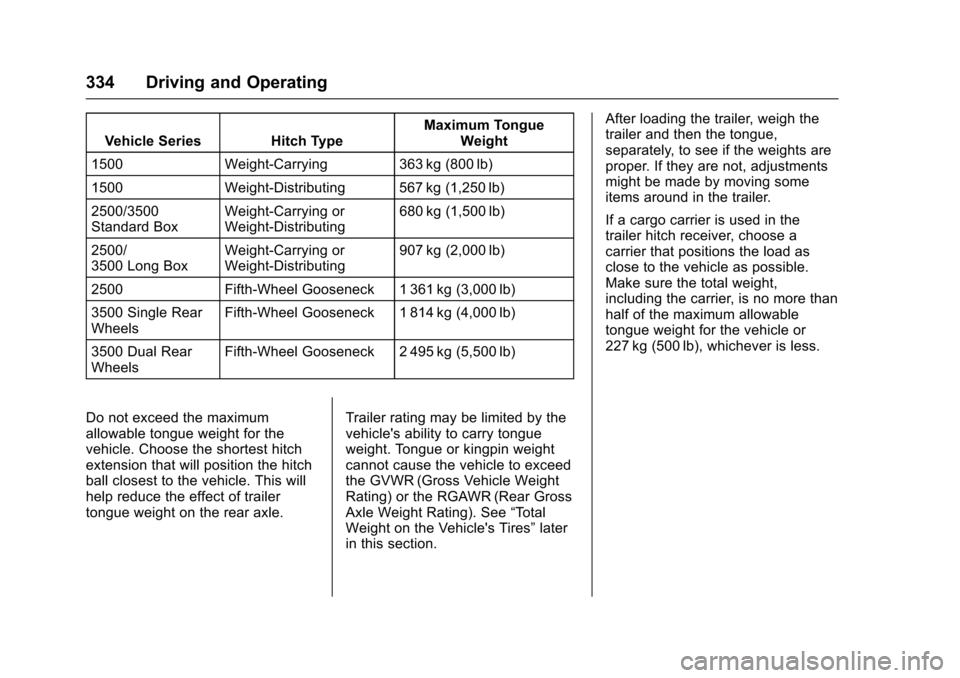
Do not exceed the maximumallowable tongue weight for thevehicle. Choose the shortest hitchextension that will position the hitchball closest to the vehicle. This willhelp reduce the effect of trailertongue weight on the rear axle.
Trailer rating may be limited by thevehicle's ability to carry tongueweight. Tongue or kingpin weightcannot cause the vehicle to exceedthe GVWR (Gross Vehicle WeightRating) or the RGAWR (Rear GrossAxle Weight Rating). See“To t a lWeight on the Vehicle's Tires”laterin this section.
After loading the trailer, weigh thetrailer and then the tongue,separately, to see if the weights areproper. If they are not, adjustmentsmight be made by moving someitems around in the trailer.
If a cargo carrier is used in thetrailer hitch receiver, choose acarrier that positions the load asclose to the vehicle as possible.Make sure the total weight,including the carrier, is no more thanhalf of the maximum allowabletongue weight for the vehicle or227 kg (500 lb), whichever is less.
Page 336 of 509
Chevrolet Silverado Owner Manual (GMNA-Localizing-U.S./Canada/Mexico-9956065) - 2017 - CRC - 4/29/16
Driving and Operating 335
Total Weight on the Vehicle's
Tires
Be sure the vehicle's tires areinflated to the inflation pressuresfound on the Certification/Tire labelon the center pillar or seeVehicleLoad Limits0259.Makesurenottoexceed the GVWR limit for thevehicle, or the RGAWR, with the towvehicle and trailer fully loaded forthe trip including the weight of thetrailer tongue. If using aweight-distributing hitch, make surenot to exceed the RGAWR beforeapplying the weight distributionspring bars.
Weight of the Trailering
Combination
It is important that the combinationof the tow vehicle and trailer doesnot exceed any of its weightratings—GCWR, GVWR, RGAWR,Trailer Weight Rating, or TongueWeight. The only way to be sure it is
not exceeding any of these ratingsis to weigh the tow vehicle andtrailer combination, fully loaded forthe trip, getting individual weightsfor each of these items.
Towing Equipment
Hitches
The correct hitch equipment helpsmaintain combination control. Manytrailers can be towed with aweight-carrying hitch which simplyfeatures a coupler latched to thehitch ball, or a tow eye latched to apintle hook. Other trailers mayrequire a weight-distributing hitchthat uses spring bars to distributethe trailer tongue weight among thetow vehicle and trailer axles.Fifth-wheel and gooseneck hitchesmay also be used. See“Weight ofthe Trailer Tongue”underTr a i l e rTo w i n g0318for rating limits withvarious hitch types.
If a step-bumper hitch will be used,the bumper could be damaged insharp turns. Make sure thereis ample room when turning to avoidcontact between the trailer and thebumper.
Consider using sway controls withany trailer. Ask a traileringprofessional about sway controls orrefer to the trailer manufacturer'srecommendations and instructions.
Weight-Distributing Hitch and
Adjustment
Aweight-distributinghitchmaybeuseful with some trailers. Use thefollowing guidelines to determine if aweight-distributing hitch shouldbe used.
Page 345 of 509
Chevrolet Silverado Owner Manual (GMNA-Localizing-U.S./Canada/Mexico-9956065) - 2017 - CRC - 4/29/16
344 Driving and Operating
AGMdealermaybeabletodiagnose and repair problems withthe trailer. However, any diagnosisand repair of the trailer is notcovered under the vehicle warranty.Contact your trailer dealer forassistance with trailer repairs andtrailer warranty information.
Trailer Sway
Control (TSC)
Vehicles with StabiliTrak have aTrailer Sway Control (TSC) feature.Trailer sway is unintendedside-to-side motion of a trailer whilebeing towed. If the vehicle is towingatrailerandtheTSCdetectsthatsway is increasing, the vehiclebrakes are selectively applied ateach wheel, to help reduceexcessive trailer sway. If the vehicleis equipped with the IntegratedTrailer Brake Control (ITBC) system,and the trailer has the electricactuated brake system, StabiliTrakmay also apply the trailer brakes.
If TSC is enabled, the TractionControl System (TCS)/StabiliTrakwarning light will flash on theinstrument cluster. Vehicle speedmust be reduced. If trailer swaycontinues, StabiliTrak can reduceengine torque to help slow thevehicle. SeeTr a c t i o n C o n t r o l /Electronic Stability Control0295.
{Warning
Even if the vehicle is equipped
with TSC, trailer sway could result
in loss of control and the vehicle
could crash. If excessive trailer
sway is detected, slow down to a
safe speed. Check the trailer and
vehicle to help correct possible
causes. These could include an
improperly or overloaded trailer,
unrestrained cargo, improper
(Continued)
Warning (Continued)
trailer hitch configuration,
excessive vehicle-trailer speed,
or improperly inflated or incorrect
vehicle or trailer tires. SeeTo w i n g
Equipment0335for trailer ratings
and hitch setup
recommendations.
Adding non-dealer accessories canaffect the vehicle performance.SeeAccessories andModifications0352.
Page 352 of 509
Chevrolet Silverado Owner Manual (GMNA-Localizing-U.S./Canada/Mexico-9956065) - 2017 - CRC - 4/29/16
Vehicle Care 351
Wheels and Tires
Tires . . . . . . . . . . . . . . . . . . . . . . . . . . 397All-Season Tires . . . . . . . . . . . . . . 398Winter Tires . . . . . . . . . . . . . . . . . . 398Low-Profile Tires . . . . . . . . . . . . . 399All-Terrain Tires . . . . . . . . . . . . . . . 399Tire Sidewall Labeling . . . . . . . . 399Tire Designations . . . . . . . . . . . . . 402Tire Terminology andDefinitions . . . . . . . . . . . . . . . . . . 403Tire Pressure . . . . . . . . . . . . . . . . . 405Tire Pressure for High-SpeedOperation . . . . . . . . . . . . . . . . . . . 407Tire Pressure MonitorSystem . . . . . . . . . . . . . . . . . . . . . . 407Tire Pressure MonitorOperation . . . . . . . . . . . . . . . . . . . 408Tire Inspection . . . . . . . . . . . . . . . . 411Tire Rotation . . . . . . . . . . . . . . . . . 412When It Is Time for NewTires . . . . . . . . . . . . . . . . . . . . . . . . 414Buying New Tires . . . . . . . . . . . . . 415Different Size Tires andWheels . . . . . . . . . . . . . . . . . . . . . . 416Uniform Tire QualityGrading . . . . . . . . . . . . . . . . . . . . . 417Wheel Alignment and TireBalance . . . . . . . . . . . . . . . . . . . . . 418Wheel Replacement . . . . . . . . . . 418Tire Chains . . . . . . . . . . . . . . . . . . . 419If a Tire Goes Flat . . . . . . . . . . . . 420
Tire Changing . . . . . . . . . . . . . . . . 422Full-Size Spare Tire . . . . . . . . . . 431
Jump Starting
Jump Starting - NorthAmerica . . . . . . . . . . . . . . . . . . . . . 432
Towing the Vehicle
To w i n g t h e V e h i c l e . . . . . . . . . . . 4 3 6Recreational VehicleTo w i n g . . . . . . . . . . . . . . . . . . . . . . 4 3 7
Appearance Care
Exterior Care . . . . . . . . . . . . . . . . . 441Interior Care . . . . . . . . . . . . . . . . . . 446Floor Mats . . . . . . . . . . . . . . . . . . . . 449
General Information
For service and parts needs, visityour dealer. You will receivegenuine GM parts and GM-trainedand supported service people.
Genuine GM parts have one ofthese marks:
California Proposition
65 Warning
WARNING:Most motor vehicles,including this one, as well as manyof its service parts and fluids,contain and/or emit chemicalsknown to the State of California to
Page 378 of 509
Chevrolet Silverado Owner Manual (GMNA-Localizing-U.S./Canada/Mexico-9956065) - 2017 - CRC - 4/29/16
Vehicle Care 377
Caution
Continuing to drive with worn-out
brake pads could result in costly
brake repair.
Some driving conditions or climatescan cause a brake squeal when thebrakes are first applied or lightlyapplied. This does not meansomething is wrong with the brakes.
Properly torqued wheel nuts arenecessary to help prevent brakepulsation. When tires are rotated,inspect brake pads for wear andevenly tighten wheel nuts in theproper sequence to torquespecifications inCapacities andSpecifications0468.
Brake linings should always bereplaced as complete axle sets.
Brake Pedal Travel
See your dealer if the brake pedaldoes not return to normal height,or if there is a rapid increase inpedal travel. This could be a signthat brake service may be required.
Replacing Brake System Parts
Always replace brake system partswith new, approved replacementparts. If this is not done, the brakesmay not work properly. The brakingperformance expected can changein many other ways if the wrongreplacement brake parts areinstalled or parts are improperlyinstalled.
Brake Fluid
The brake master cylinder reservoiris filled with DOT 3 brake fluid. SeeEngine Compartment Overview0354for the location of thereservoir.
There are only two reasons why thebrake fluid level in the reservoir maygo down:
.Normal brake lining wear. Whennew linings are installed, thefluid level goes back up.
.Afluidleakinthebrakehydraulic system. Have thebrake hydraulic system fixed.With a leak, the brakes will notwork well.
Always clean the brake fluidreservoir cap and the area aroundthe cap before removing it.
Do not top off the brake fluid.Adding fluid does not correct a leak.If fluid is added when the linings areworn, there will be too much fluidwhen new brake linings areinstalled. Add or remove fluid, asnecessary, only when work is doneon the brake hydraulic system.
{Warning
If too much brake fluid is added, it
can spill on the engine and burn,
if the engine is hot enough. You
or others could be burned, and
the vehicle could be damaged.
(Continued)
Page 398 of 509
Chevrolet Silverado Owner Manual (GMNA-Localizing-U.S./Canada/Mexico-9956065) - 2017 - CRC - 4/29/16
Vehicle Care 397
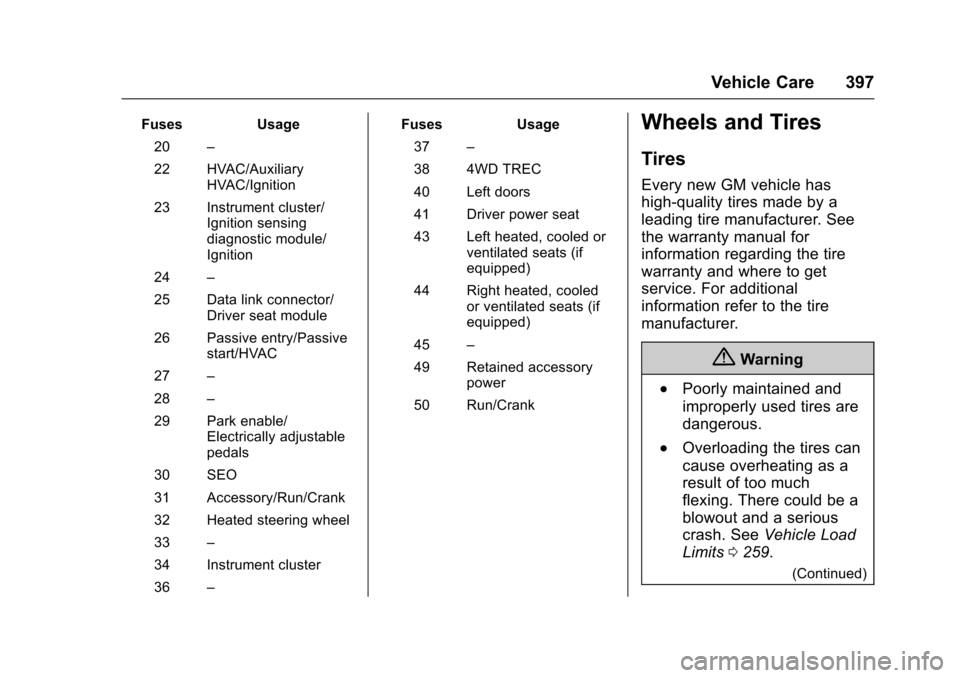
FusesUsage
20–
22 HVAC/AuxiliaryHVAC/Ignition
23 Instrument cluster/Ignition sensingdiagnostic module/Ignition
24–
25 Data link connector/Driver seat module
26 Passive entry/Passivestart/HVAC
27–
28–
29 Park enable/Electrically adjustablepedals
30 SEO
31 Accessory/Run/Crank
32 Heated steering wheel
33–
34 Instrument cluster
36–
FusesUsage
37–
38 4WD TREC
40 Left doors
41 Driver power seat
43 Left heated, cooled orventilated seats (ifequipped)
44 Right heated, cooledor ventilated seats (ifequipped)
45–
49 Retained accessorypower
50 Run/Crank
Wheels and Tires
Tires
Every new GM vehicle has
high-quality tires made by a
leading tire manufacturer. See
the warranty manual for
information regarding the tire
warranty and where to get
service. For additional
information refer to the tire
manufacturer.
{Warning
.Poorly maintained and
improperly used tires are
dangerous.
.Overloading the tires can
cause overheating as a
result of too much
flexing. There could be a
blowout and a serious
crash. SeeVehicle Load
Limits0259.
(Continued)
Page 399 of 509
Chevrolet Silverado Owner Manual (GMNA-Localizing-U.S./Canada/Mexico-9956065) - 2017 - CRC - 4/29/16
398 Vehicle Care
Warning (Continued)
.Underinflated tires pose
the same danger as
overloaded tires. The
resulting crash could
cause serious injury.
Check all tires frequently
to maintain the
recommended pressure.
Tire pressure should be
checked when the tires
are cold.
.Overinflated tires are
more likely to be cut,
punctured, or broken by
asuddenimpact—such
as when hitting a pothole.
Keep tires at the
recommended pressure.
.Worn or old tires can
cause a crash. If the
tread is badly worn,
replace them.
(Continued)
Warning (Continued)
.Replace any tires that
have been damaged by
impacts with potholes,
curbs, etc.
.Improperly repaired tires
can cause a crash. Only
the dealer or an
authorized tire service
center should repair,
replace, dismount, and
mount the tires.
.Do not spin the tires in
excess of 56 km/h
(35 mph) on slippery
surfaces such as snow,
mud, ice, etc. Excessive
spinning may cause the
tires to explode.
All-Season Tires
This vehicle may come withall-season tires. These tires aredesigned to provide good overallperformance on most road surfaces
and weather conditions. Originalequipment tires designed to GM'sspecific tire performance criteriahave a TPC specification codemolded onto the sidewall. Originalequipment all-season tires can beidentified by the last two charactersof this TPC code, which willbe“MS.”
Consider installing winter tires onthe vehicle if frequent driving onsnow or ice-covered roads isexpected. All-season tires provideadequate performance for mostwinter driving conditions, but theymay not offer the same level oftraction or performance as wintertires on snow or ice-covered roads.SeeWinter Tires0398.
Winter Tires
This vehicle was not originallyequipped with winter tires. Wintertires are designed for increasedtraction on snow and ice-coveredroads. Consider installing wintertires on the vehicle if frequentdriving on ice or snow coveredroads is expected. See your dealer