Transmission CHEVROLET SILVERADO 2017 3.G Repair Manual
[x] Cancel search | Manufacturer: CHEVROLET, Model Year: 2017, Model line: SILVERADO, Model: CHEVROLET SILVERADO 2017 3.GPages: 509, PDF Size: 8.87 MB
Page 360 of 509
Chevrolet Silverado Owner Manual (GMNA-Localizing-U.S./Canada/Mexico-9956065) - 2017 - CRC - 4/29/16
Vehicle Care 359
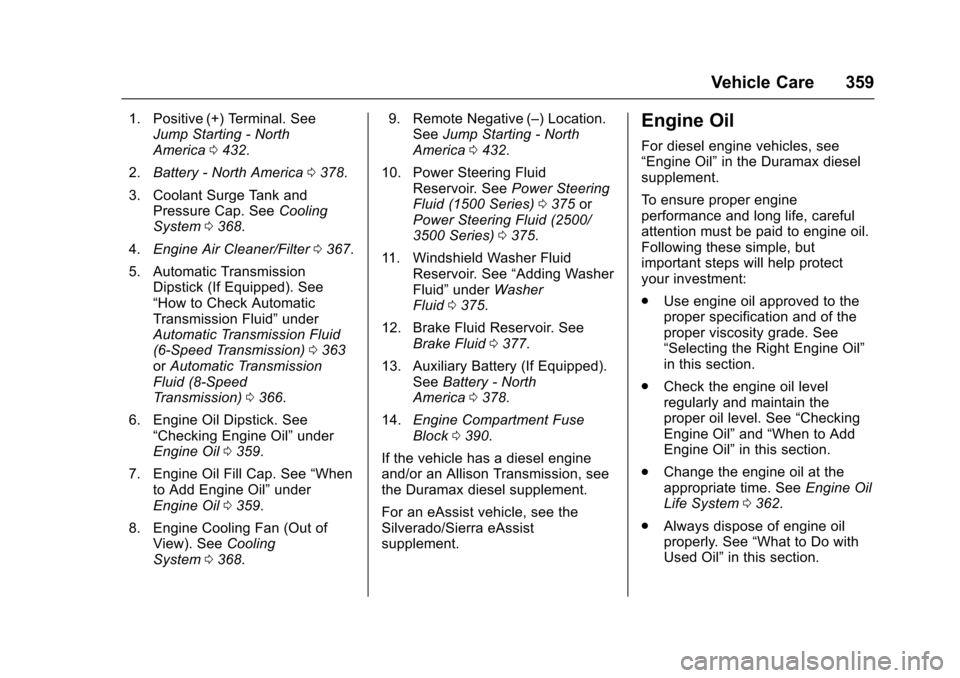
1. Positive (+) Terminal. SeeJump Starting - NorthAmerica0432.
2.Battery - North America0378.
3. Coolant Surge Tank andPressure Cap. SeeCoolingSystem0368.
4.Engine Air Cleaner/Filter0367.
5. Automatic TransmissionDipstick (If Equipped). See“How to Check AutomaticTransmission Fluid”underAutomatic Transmission Fluid(6-Speed Transmission)0363orAutomatic TransmissionFluid (8-SpeedTr a n s m i s s i o n )0366.
6. Engine Oil Dipstick. See“Checking Engine Oil”underEngine Oil0359.
7. Engine Oil Fill Cap. See“Whento Add Engine Oil”underEngine Oil0359.
8. Engine Cooling Fan (Out ofView). SeeCoolingSystem0368.
9. Remote Negative (–)Location.SeeJump Starting - NorthAmerica0432.
10. Power Steering FluidReservoir. SeePower SteeringFluid (1500 Series)0375orPower Steering Fluid (2500/3500 Series)0375.
11 . W i n d s h i e l d Wa s h e r F l u i dReservoir. See“Adding WasherFluid”underWasherFluid0375.
12. Brake Fluid Reservoir. SeeBrake Fluid0377.
13. Auxiliary Battery (If Equipped).SeeBattery - NorthAmerica0378.
14.Engine Compartment FuseBlock0390.
If the vehicle has a diesel engineand/or an Allison Transmission, seethe Duramax diesel supplement.
For an eAssist vehicle, see theSilverado/Sierra eAssistsupplement.
Engine Oil
For diesel engine vehicles, see“Engine Oil”in the Duramax dieselsupplement.
To e n s u r e p r o p e r e n g i n eperformance and long life, carefulattention must be paid to engine oil.Following these simple, butimportant steps will help protectyour investment:
.Use engine oil approved to theproper specification and of theproper viscosity grade. See“Selecting the Right Engine Oil”in this section.
.Check the engine oil levelregularly and maintain theproper oil level. See“CheckingEngine Oil”and“When to AddEngine Oil”in this section.
.Change the engine oil at theappropriate time. SeeEngine OilLife System0362.
.Always dispose of engine oilproperly. See“What to Do withUsed Oil”in this section.
Page 364 of 509
Chevrolet Silverado Owner Manual (GMNA-Localizing-U.S./Canada/Mexico-9956065) - 2017 - CRC - 4/29/16
Vehicle Care 363
3. Display the OIL LIFEREMAINING on the DIC. If thedisplay shows 100%, thesystem is reset.
If the vehicle has a CHANGEENGINE OIL SOON message and itcomes back on when the vehicle isstarted and/or the OIL LIFEREMAINING is near 0%, the engineoil life system has not been reset.Repeat the procedure.
Automatic Transmission
Fluid (6-Speed
Transmission)
When to Check and Change
Automatic Transmission Fluid
It is usually not necessary to checkthe transmission fluid level. The onlyreason for fluid loss is atransmission leak or overheatedtransmission. If a small leak issuspected, then use the followingchecking procedures to check thefluid level. However, if there is alarge leak, then it may be necessaryto have the vehicle towed to a
dealer service department and haveit repaired before driving the vehiclefurther.
Caution
Use of the incorrect automatic
transmission fluid may damage
the vehicle, and the damage may
not be covered by the vehicle
warranty. Always use the
automatic transmission fluid listed
inRecommended Fluids and
Lubricants0462.
Change the fluid and filter at thescheduled maintenance intervalslisted inMaintenance Schedule0452.Besuretousethetransmission fluid listed inRecommended Fluids andLubricants0462.
How to Check Automatic
Transmission Fluid
Caution
To o m u c h o r t o o l i t t l e f l u i d c a n
damage the transmission. Too
much can mean that some of the
fluid could come out and fall on
hot engine parts or exhaust
system parts, starting a fire. Too
little fluid could cause the
transmission to overheat. Be sure
to get an accurate reading if
checking the transmission fluid.
Before checking the fluid level,prepare the vehicle:
1. Start the engine and park thevehicle on a level surface.Keep the engine running.
2. Apply the parking brake andplace the shift lever in P (Park).
3. With your foot on the brakepedal, move the shift leverthrough each gear range,pausing for about
Page 365 of 509
Chevrolet Silverado Owner Manual (GMNA-Localizing-U.S./Canada/Mexico-9956065) - 2017 - CRC - 4/29/16
364 Vehicle Care
three seconds in each range.Then, move the shift lever backto P (Park).
4. Allow the engine to idle (500–800 rpm) for at leastone minute. Slowly release thebrake pedal.
5. Keep the engine running andcheck the transmission fluidtemperature on the DriverInformation Center (DIC). SeeDriver Information Center (DIC)(Base Level)0145orDriverInformation Center (DIC)(Uplevel)0147.
6. Using the transmission fluidtemperature reading, determineand perform the appropriatecheck procedure. If thetransmission fluid temperaturereading is not within therequired temperature ranges,allow the vehicle to cool,or operate the vehicle until theappropriate transmission fluidtemperature is reached.
Cold Check Procedure
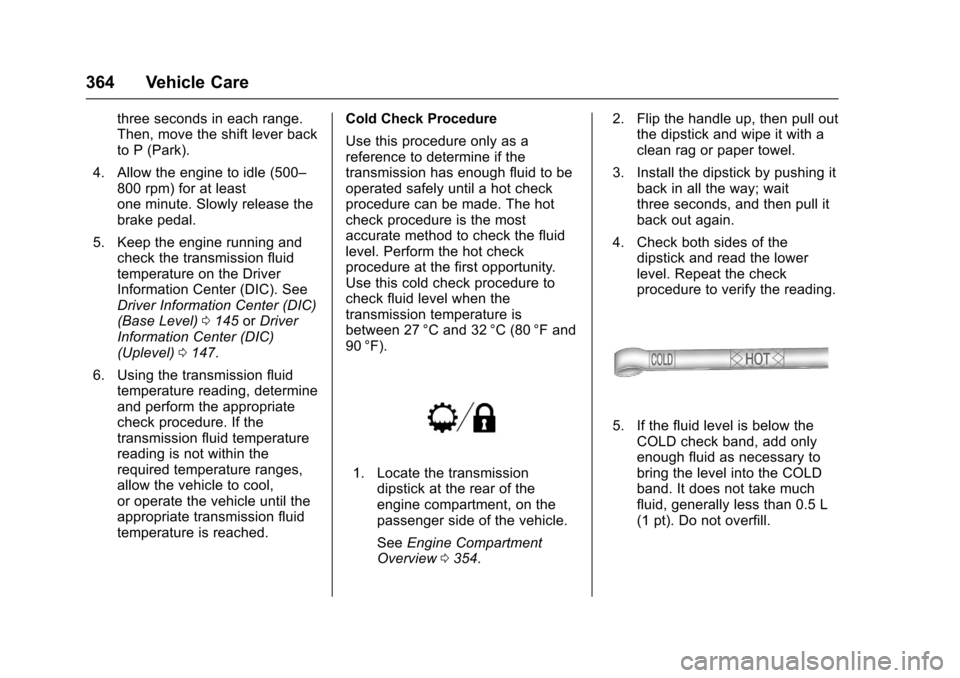
Use this procedure only as areference to determine if thetransmission has enough fluid to beoperated safely until a hot checkprocedure can be made. The hotcheck procedure is the mostaccurate method to check the fluidlevel. Perform the hot checkprocedure at the first opportunity.Use this cold check procedure tocheck fluid level when thetransmission temperature isbetween 27 °C and 32 °C (80 °F and90 °F).
1. Locate the transmissiondipstick at the rear of theengine compartment, on thepassenger side of the vehicle.
SeeEngine CompartmentOverview0354.
2. Flip the handle up, then pull outthe dipstick and wipe it with aclean rag or paper towel.
3. Install the dipstick by pushing itback in all the way; waitthree seconds, and then pull itback out again.
4. Check both sides of thedipstick and read the lowerlevel. Repeat the checkprocedure to verify the reading.
5. If the fluid level is below theCOLD check band, add onlyenough fluid as necessary tobring the level into the COLDband. It does not take muchfluid, generally less than 0.5 L(1 pt). Do not overfill.
Page 366 of 509
Chevrolet Silverado Owner Manual (GMNA-Localizing-U.S./Canada/Mexico-9956065) - 2017 - CRC - 4/29/16
Vehicle Care 365
6. Perform a hot check at the firstopportunity after thetransmission reaches a normaloperating temperature between71 °C to 93 °C (160 °F to200 °F).
7. If the fluid level is in theacceptable range, push thedipstick back in all the way,then flip the handle down tolock the dipstick in place.
Hot Check Procedure
Use this procedure to check thetransmission fluid level when thetransmission fluid temperature isbetween 71 °C and 93 °C (160 °Fand 200 °F).
The hot check is the most accuratemethod to check the fluid level. Thehot check should be performed atthe first opportunity in order to verifythe cold check. The fluid level risesas fluid temperature increases, so itis important to ensure thetransmission temperature is withinrange.
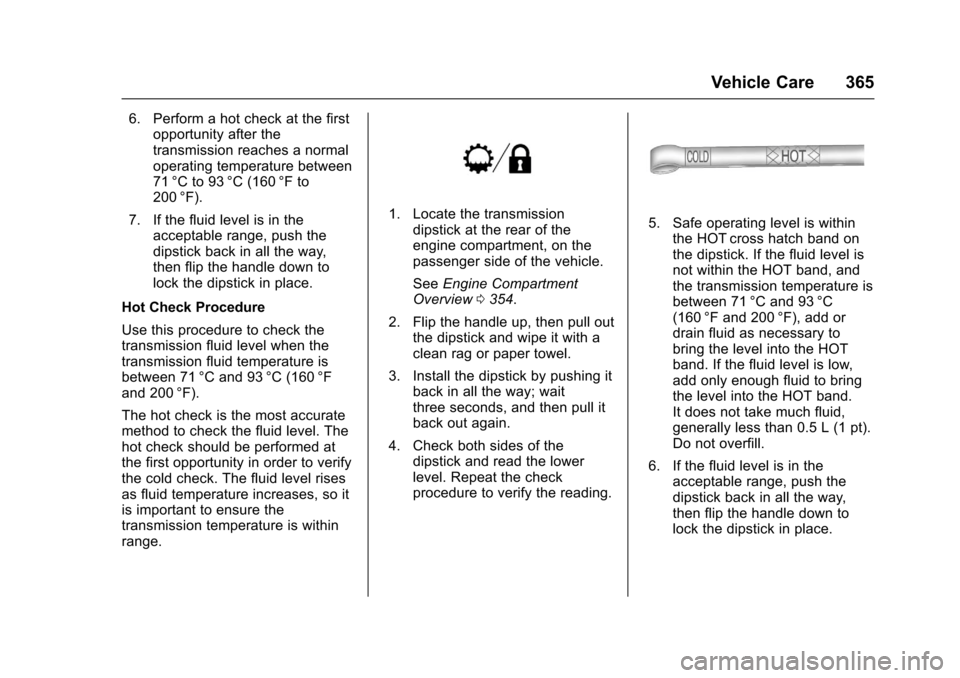
1. Locate the transmissiondipstick at the rear of theengine compartment, on thepassenger side of the vehicle.
SeeEngine CompartmentOverview0354.
2. Flip the handle up, then pull outthe dipstick and wipe it with aclean rag or paper towel.
3. Install the dipstick by pushing itback in all the way; waitthree seconds, and then pull itback out again.
4. Check both sides of thedipstick and read the lowerlevel. Repeat the checkprocedure to verify the reading.
5. Safe operating level is withinthe HOT cross hatch band onthe dipstick. If the fluid level isnot within the HOT band, andthe transmission temperature isbetween 71 °C and 93 °C(160 °F and 200 °F), add ordrain fluid as necessary tobring the level into the HOTband. If the fluid level is low,add only enough fluid to bringthe level into the HOT band.It does not take much fluid,generally less than 0.5 L (1 pt).Do not overfill.
6. If the fluid level is in theacceptable range, push thedipstick back in all the way,then flip the handle down tolock the dipstick in place.
Page 367 of 509
Chevrolet Silverado Owner Manual (GMNA-Localizing-U.S./Canada/Mexico-9956065) - 2017 - CRC - 4/29/16
366 Vehicle Care
Consistency of Readings
Always check the fluid level at leasttwice using the procedure describedpreviously. Consistency (repeatablereadings) is important to maintainingproper fluid level. If readings are stillinconsistent, contact the dealer.
Automatic Transmission
Fluid (8-Speed
Transmission)
When to Check and Change
Automatic Transmission Fluid
It is usually not necessary to checkthe transmission fluid level. The onlyreason for fluid loss is atransmission leak or overheatedtransmission. This vehicle is notequipped with a transmission fluidlevel dipstick. There is a specialprocedure for checking andchanging the transmission fluid inthese vehicles. Because thisprocedure is difficult, this should be
done at the dealer. Contact thedealer for additional information orthe procedure can be found in theservice manual. SeeServicePublications OrderingInformation0481.
Caution
Use of the incorrect automatic
transmission fluid may damage
the vehicle, and the damage may
not be covered by the vehicle
warranty. Always use the
automatic transmission fluid listed
inRecommended Fluids and
Lubricants0462.
Change the fluid and filter at thescheduled maintenance intervalslisted inMaintenance Schedule0452.Besuretousethetransmission fluid listed inRecommended Fluids andLubricants0462.
Manual Transmission
Fluid
It is not necessary to check themanual transmission fluid level.Atransmissionfluidleakistheonlyreason for fluid loss. If a leakoccurs, take the vehicle to yourdealer service department and haveit repaired as soon as possible. SeeRecommended Fluids andLubricants0462for the proper fluidto use.
Hydraulic Clutch
For vehicles with a manualtransmission, it is not necessary toregularly check clutch fluid unlessyou suspect there is a leak in thesystem. Adding fluid will not correctaleak.Afluidlossinthissystemcould indicate a problem. Have thesystem inspected and repaired.
Page 375 of 509
Chevrolet Silverado Owner Manual (GMNA-Localizing-U.S./Canada/Mexico-9956065) - 2017 - CRC - 4/29/16
374 Vehicle Care
Overheated Engine
Protection
Operating Mode
If an overheated engine conditionexists and the ENGINE POWER ISREDUCED message displays, anoverheat protection mode whichalternates firing groups of cylindershelps to prevent engine damage. Inthis mode, a loss in power andengine performance will be noticed.This operating mode allows thevehicle to be driven to a safe placein an emergency. Driving extendeddistances and/or towing a trailer inthe overheat protection modeshould be avoided.
Caution
After driving in the overheated
engine protection operating
mode, the engine oil will be
severely degraded. Any repairs
performed before the engine is
cool may cause engine damage.
Allow the engine to cool before
(Continued)
Caution (Continued)
attempting any repair. Repair the
cause of coolant loss, change the
oil, and reset the oil life system.
SeeEngine Oil0359.
Engine Fan
If the vehicle has a clutched enginecooling fan, when the clutch isengaged, the fan spins faster toprovide more air to cool the engine.In most everyday driving conditions,the fan is spinning slower and theclutch is not fully engaged. Thisimproves fuel economy and reducesfan noise. Under heavy vehicleloading, trailer towing, and/or highoutside temperatures, the fan speedincreases as the clutch more fullyengages, so an increase in fannoise may be heard. This is normaland should not be mistaken as thetransmission slipping or makingextra shifts. It is merely the coolingsystem functioning properly. The fanwill slow down when additionalcooling is not required and theclutch disengages.
This fan noise may also be heardwhen starting the engine. It will goaway as the fan clutch partiallydisengages.
If the vehicle has electric coolingfan(s), the fans may be heardspinning at low speed during mosteveryday driving. The fans may turnoff if no cooling is required. Underheavy vehicle loading, trailer towing,high outside temperatures,or operation of the air conditioningsystem, the fans may change tohigh speed and an increase in fannoise may be heard. This is normaland indicates that the coolingsystem is functioning properly. Thefans will change to low speed whenadditional cooling is no longerrequired.
The electric engine cooling fansmay run after the engine has beenturned. off. This is normal and noservice is required.
Page 384 of 509
Chevrolet Silverado Owner Manual (GMNA-Localizing-U.S./Canada/Mexico-9956065) - 2017 - CRC - 4/29/16
Vehicle Care 383
Starter Switch Check
{Warning
When you are doing this
inspection, the vehicle could
move suddenly. If the vehicle
moves, you or others could be
injured.
1. Before starting this check, besure there is enough roomaround the vehicle.
2. Apply both the parking brakeand the regular brake.
Do not use the acceleratorpedal, and be ready to turn offthe engine immediately if itstarts.
3. For automatic transmissionvehicles, try to start the enginein each gear. The vehicleshould start only in P (Park) orN(Neutral). If the vehicle startsin any other position, contactyour dealer for service.
For manual transmissionvehicles, put the shift lever inNeutral, push the clutch pedaldown halfway, and try to startthe engine. The vehicle shouldstart only when the clutchpedal is pushed down all theway to the floor. If the vehiclestarts when the clutch pedal isnot pushed all the way down,contact your dealer for service.
Automatic Transmission
Shift Lock Control
Function Check
{Warning
When you are doing this
inspection, the vehicle could
move suddenly. If the vehicle
moves, you or others could be
injured.
1. Before starting this check, besure there is enough roomaround the vehicle. It should beparked on a level surface.
2. Apply the parking brake. Beready to apply the regularbrake immediately if the vehiclebegins to move.
3. With the engine off, turn theignition on, but do not start theengine. Without applying theregular brake, try to move theshift lever out of P (Park) withnormal effort. If the shift levermoves out of P (Park), contactyour dealer for service.
Ignition Transmission
Lock Check
While parked, and with the parkingbrake set, try to turn the ignition toLOCK/OFF in each shift leverposition.
.For automatic transmissionvehicles, the ignition should turnto LOCK/OFF only when theshift lever is in P (Park).
.For manual transmissionvehicles, the ignition should turnto LOCK/OFF only when youpress the key release button.
Page 385 of 509
Chevrolet Silverado Owner Manual (GMNA-Localizing-U.S./Canada/Mexico-9956065) - 2017 - CRC - 4/29/16
384 Vehicle Care
On all vehicles, the ignition keyshould come out only in LOCK/OFF.
Contact your dealer if service isrequired.
Park Brake and P (Park)
Mechanism Check
{Warning
When you are doing this check,
the vehicle could begin to move.
Yo u o r o t h e r s c o u l d b e i n j u r e d
and property could be damaged.
Make sure there is room in front
of the vehicle in case it begins to
roll. Be ready to apply the regular
brake at once should the vehicle
begin to move.
Park on a fairly steep hill, with thevehicle facing downhill. Keepingyour foot on the regular brake, setthe parking brake.
.To c h e c k t h e p a r k i n g b r a k e ' sholding ability: With the enginerunning and the transmission inN(Neutral), slowly remove foot
pressure from the regular brakepedal. Do this until the vehicle isheld by the parking brake only.
.To c h e c k t h e P ( P a r k )mechanism's holding ability:With the engine running, shift toP(Park). Then release theparking brake followed by theregular brake.
Contact your dealer if service isrequired.
Wiper Blade Replacement
Windshield wiper blades should beinspected for wear or cracking.
Replacement blades come indifferent types and are removed indifferent ways. For properwindshield wiper blade length andtype, seeMaintenanceReplacement Parts0464.
Caution
Allowing the wiper arm to touch
the windshield when no wiper
blade is installed could damage
(Continued)
Caution (Continued)
the windshield. Any damage that
occurs would not be covered by
the vehicle warranty. Do not allow
the wiper arm to touch the
windshield.
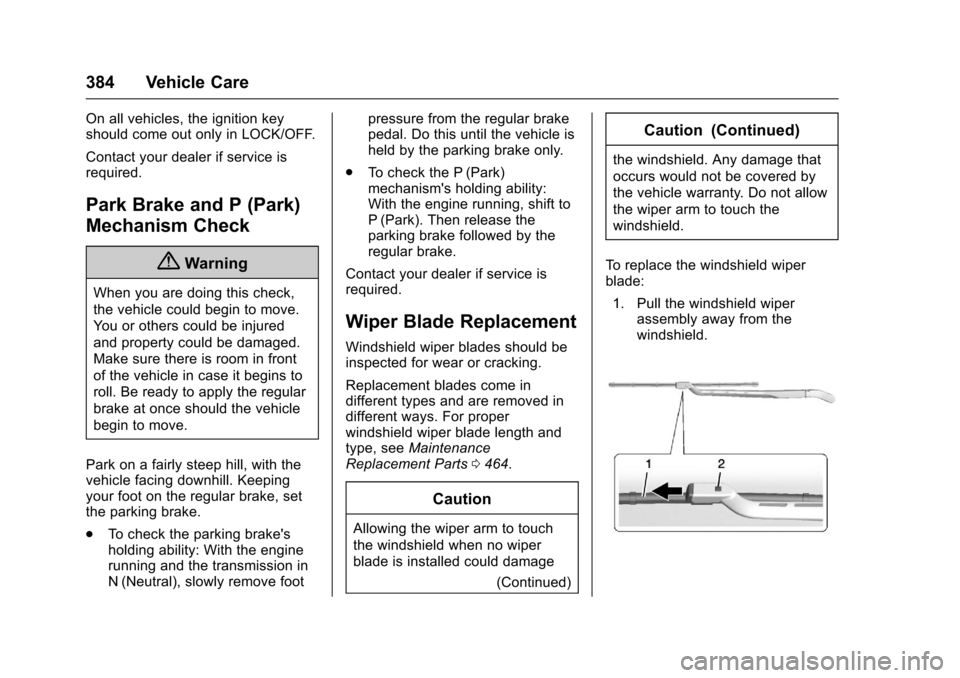
To r e p l a c e t h e w i n d s h i e l d w i p e rblade:
1. Pull the windshield wiperassembly away from thewindshield.
Page 393 of 509
Chevrolet Silverado Owner Manual (GMNA-Localizing-U.S./Canada/Mexico-9956065) - 2017 - CRC - 4/29/16
392 Vehicle Care
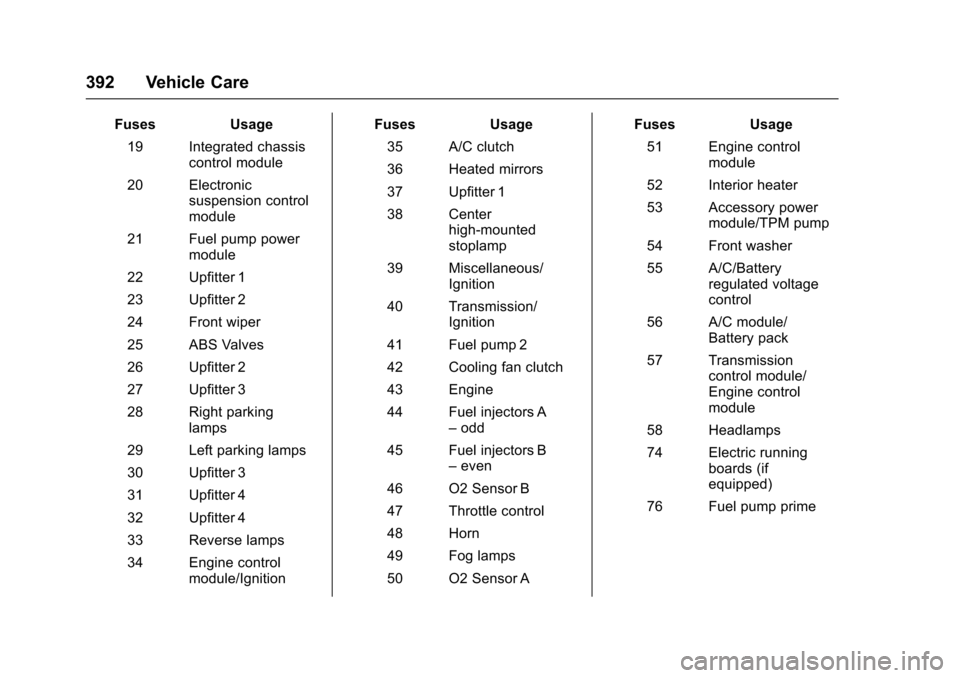
FusesUsage
19 Integrated chassiscontrol module
20 Electronicsuspension controlmodule
21 Fuel pump powermodule
22 Upfitter 1
23 Upfitter 2
24 Front wiper
25 ABS Valves
26 Upfitter 2
27 Upfitter 3
28 Right parkinglamps
29 Left parking lamps
30 Upfitter 3
31 Upfitter 4
32 Upfitter 4
33 Reverse lamps
34 Engine controlmodule/Ignition
FusesUsage
35 A/C clutch
36 Heated mirrors
37 Upfitter 1
38 Centerhigh-mountedstoplamp
39 Miscellaneous/Ignition
40 Transmission/Ignition
41 Fuel pump 2
42 Cooling fan clutch
43 Engine
44 Fuel injectors A–odd
45 Fuel injectors B–even
46 O2 Sensor B
47 Throttle control
48 Horn
49 Fog lamps
50 O2 Sensor A
FusesUsage
51 Engine controlmodule
52 Interior heater
53 Accessory powermodule/TPM pump
54 Front washer
55 A/C/Batteryregulated voltagecontrol
56 A/C module/Battery pack
57 Transmissioncontrol module/Engine controlmodule
58 Headlamps
74 Electric runningboards (ifequipped)
76 Fuel pump prime
Page 404 of 509
Chevrolet Silverado Owner Manual (GMNA-Localizing-U.S./Canada/Mexico-9956065) - 2017 - CRC - 4/29/16
Vehicle Care 403
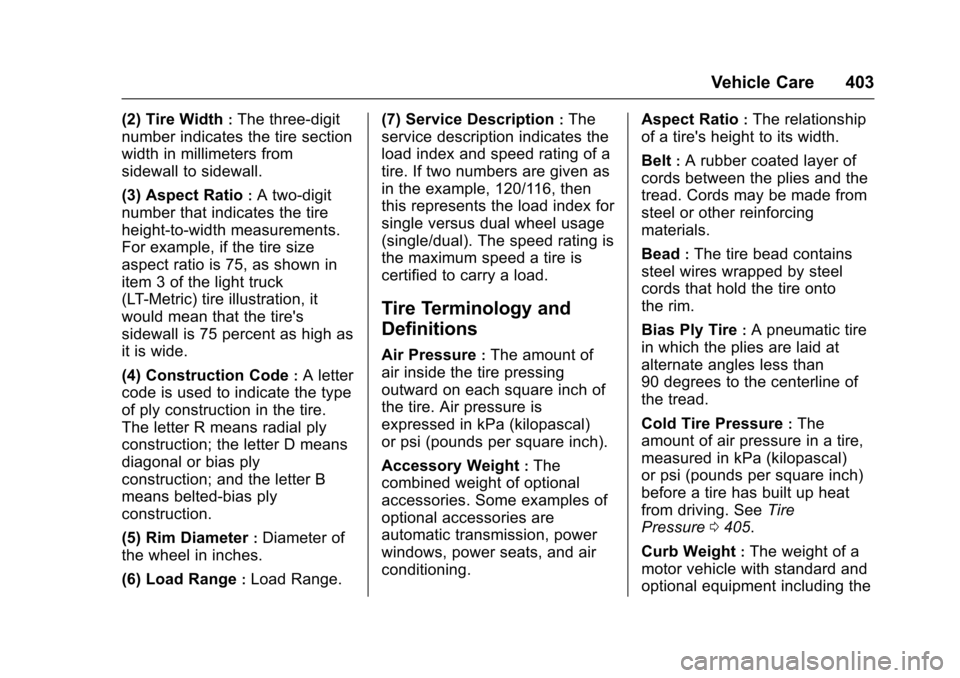
(2) Tire Width:The three-digit
number indicates the tire section
width in millimeters from
sidewall to sidewall.
(3) Aspect Ratio:Atwo-digit
number that indicates the tire
height-to-width measurements.
For example, if the tire size
aspect ratio is 75, as shown in
item 3 of the light truck
(LT-Metric) tire illustration, it
would mean that the tire's
sidewall is 75 percent as high as
it is wide.
(4) Construction Code:Aletter
code is used to indicate the type
of ply construction in the tire.
The letter R means radial ply
construction; the letter D means
diagonal or bias ply
construction; and the letter B
means belted-bias ply
construction.
(5) Rim Diameter:Diameter of
the wheel in inches.
(6) Load Range:Load Range.
(7) Service Description:The
service description indicates the
load index and speed rating of a
tire. If two numbers are given as
in the example, 120/116, then
this represents the load index for
single versus dual wheel usage
(single/dual). The speed rating is
the maximum speed a tire is
certified to carry a load.
Tire Terminology and
Definitions
Air Pressure:The amount of
air inside the tire pressing
outward on each square inch of
the tire. Air pressure is
expressed in kPa (kilopascal)
or psi (pounds per square inch).
Accessory Weight:The
combined weight of optional
accessories. Some examples of
optional accessories are
automatic transmission, power
windows, power seats, and air
conditioning.
Aspect Ratio:The relationship
of a tire's height to its width.
Belt:Arubbercoatedlayerof
cords between the plies and the
tread. Cords may be made from
steel or other reinforcing
materials.
Bead:The tire bead contains
steel wires wrapped by steel
cords that hold the tire onto
the rim.
Bias Ply Tire:Apneumatictire
in which the plies are laid at
alternate angles less than
90 degrees to the centerline of
the tread.
Cold Tire Pressure:The
amount of air pressure in a tire,
measured in kPa (kilopascal)
or psi (pounds per square inch)
before a tire has built up heat
from driving. SeeTire
Pressure0405.
Curb Weight:The weight of a
motor vehicle with standard and
optional equipment including the