ECO mode CHEVROLET SONIC 2016 2.G User Guide
[x] Cancel search | Manufacturer: CHEVROLET, Model Year: 2016, Model line: SONIC, Model: CHEVROLET SONIC 2016 2.GPages: 353, PDF Size: 7.74 MB
Page 267 of 353
Chevrolet Sonic Owner Manual (GMNA-Localizing-U.S/Canada-9085902) -
2016 - CRC - 5/27/15
266 Vehicle Care
3. Press the MENU button todisplay the menu items in the
Driver Information
Center (DIC).
4. Use the thumbwheel to scroll to the Tire Learn menu item
screen.
5. Press and hold the SET/CLR button to begin the sensor
matching process.
6. The horn sounds twice to signal the receiver is in relearn
mode and the TIRE LEARN
message displays on the DIC
screen.
7. Start with the driver side front tire.
8. Place the relearn tool against the tire sidewall, near the valve
stem. Then press the button to
activate the TPMS sensor.
A horn chirp confirms that the
sensor identification code has
been matched to this tire and
wheel position.
9. Proceed to the passenger side front tire, and repeat the
procedure in Step 8. 10. Proceed to the passenger side
rear tire, and repeat the
procedure in Step 8.
11. Proceed to the driver side rear tire, and repeat the procedure
in Step 8. The horn sounds two
times to indicate the sensor
identification code has been
matched to the driver side rear
tire, and the TPMS sensor
matching process is no longer
active. The TIRE LEARN
message on the DIC display
screen goes off.
12. Turn the ignition to LOCK/OFF.
13. Set all four tires to the recommended air pressure
level as indicated on the Tire
and Loading Information label.
Tire Inspection
We recommend that the tires,
including the spare tire, if the
vehicle has one, be inspected
for signs of wear or damage at
least once a month. Replace the tire if:
.The indicators at three or
more places around the tire
can be seen.
.There is cord or fabric
showing through the tire's
rubber.
.The tread or sidewall is
cracked, cut, or snagged
deep enough to show cord or
fabric.
.The tire has a bump, bulge,
or split.
.The tire has a puncture, cut,
or other damage that cannot
be repaired well because of
the size or location of the
damage.
Tire Rotation
Tires should be rotated every
12 000 km (7,500 mi). See
Maintenance Schedule
0302.
Page 291 of 353
Chevrolet Sonic Owner Manual (GMNA-Localizing-U.S/Canada-9085902) -
2016 - CRC - 5/27/15
290 Vehicle Care
Recreational Vehicle
Towing
Recreational vehicle towing means
towing the vehicle behind another
vehicle, such as a motor home. The
two most common types of
recreational vehicle towing are
known as dinghy towing and dolly
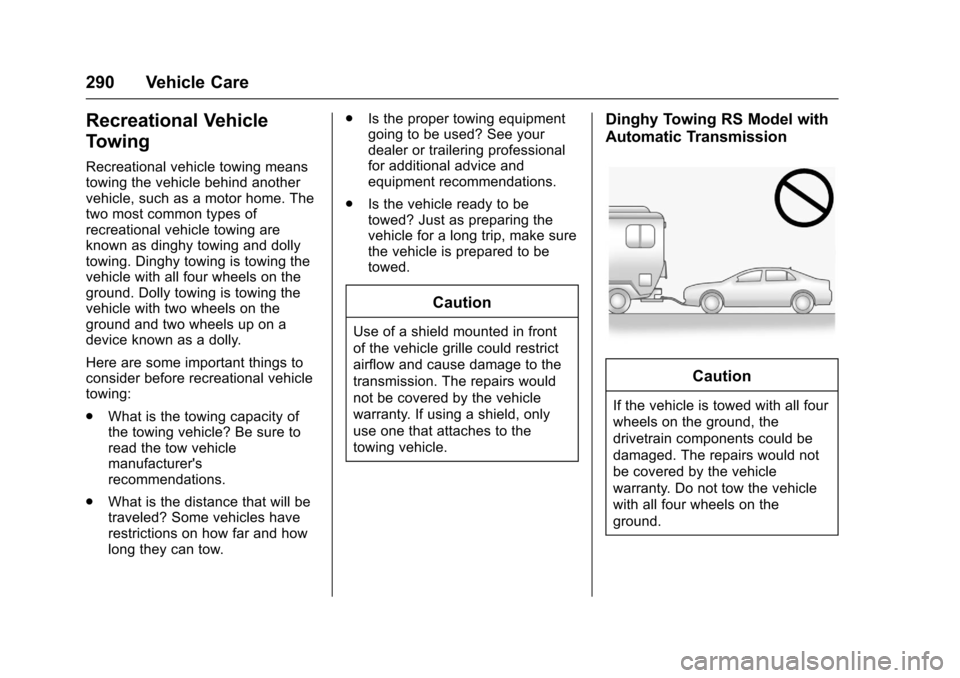
towing. Dinghy towing is towing the
vehicle with all four wheels on the
ground. Dolly towing is towing the
vehicle with two wheels on the
ground and two wheels up on a
device known as a dolly.
Here are some important things to
consider before recreational vehicle
towing:
.What is the towing capacity of
the towing vehicle? Be sure to
read the tow vehicle
manufacturer's
recommendations.
. What is the distance that will be
traveled? Some vehicles have
restrictions on how far and how
long they can tow. .
Is the proper towing equipment
going to be used? See your
dealer or trailering professional
for additional advice and
equipment recommendations.
. Is the vehicle ready to be
towed? Just as preparing the
vehicle for a long trip, make sure
the vehicle is prepared to be
towed.
Caution
Use of a shield mounted in front
of the vehicle grille could restrict
airflow and cause damage to the
transmission. The repairs would
not be covered by the vehicle
warranty. If using a shield, only
use one that attaches to the
towing vehicle.
Dinghy Towing RS Model with
Automatic Transmission
Caution
If the vehicle is towed with all four
wheels on the ground, the
drivetrain components could be
damaged. The repairs would not
be covered by the vehicle
warranty. Do not tow the vehicle
with all four wheels on the
ground.
Page 328 of 353
Chevrolet Sonic Owner Manual (GMNA-Localizing-U.S/Canada-9085902) -
2016 - CRC - 5/27/15
Customer Information 327
For emergency towing see
Roadside Assistance Program
0322.
Gather the following information:
. Driver name, address, and
telephone number.
. Driver license number.
. Owner name, address, and
telephone number.
. Vehicle license plate number.
. Vehicle make, model, and
model year.
. Vehicle Identification
Number (VIN).
. Insurance company and policy
number.
. General description of the
damage to the other vehicle.
Choose a reputable repair facility
that uses quality replacement parts.
See “Collision Parts” earlier in this
section.
If the airbag has inflated, see What
Will You See after an Airbag
Inflates? 061.Managing the Vehicle Damage
Repair Process
In the event that the vehicle requires
damage repairs, GM recommends
that you take an active role in its
repair. If you have a pre-determined
repair facility of choice, take the
vehicle there, or have it towed there.
Specify to the facility that any
required replacement collision parts
be original equipment parts, either
new Genuine GM parts or recycled
original GM parts. Remember,
recycled parts will not be covered by
the GM vehicle warranty.
Insurance pays the bill for the repair,
but you must live with the repair.
Depending on your policy limits,
your insurance company may
initially value the repair using
aftermarket parts. Discuss this with
the repair professional, and insist on
Genuine GM parts. Remember,
if the vehicle is leased, you may be
obligated to have the vehicle
repaired with Genuine GM parts,
even if your insurance coverage
does not pay the full cost. If another party's insurance
company is paying for the repairs,
you are not obligated to accept a
repair valuation based on that
insurance company's collision policy
repair limits, as you have no
contractual limits with that company.
In such cases, you can have control
of the repair and parts choices as
long as the cost stays within
reasonable limits.
Service Publications
Ordering Information
(US and Canada Only)
Service Manuals
Service Manuals have the diagnosis
and repair information on the
engines, transmission, axle,
suspension, brakes, electrical,
steering, body, etc.
Page 348 of 353
Chevrolet Sonic Owner Manual (GMNA-Localizing-U.S/Canada-9085902) -
2016 - CRC - 5/27/15
Index 347
Lap-Shoulder Belt . . . . . . . . . . . . . . . 52
LATCH SystemReplacing Parts after aCrash . . . . . . . . . . . . . . . . . . . . . . . . . 80
LATCH, Lower Anchors and Tethers for Children . . . . . . . . . . . . 74
Liftgate . . . . . . . . . . . . . . . . . . . . . . . . . . 35
Lighting
Entry . . . . . . . . . . . . . . . . . . . . . . . . . 125
Exit . . . . . . . . . . . . . . . . . . . . . . . . . . . 125
Illumination Control . . . . . . . . . . . 124
Lights . . . . . . . . . . . . . . . . . . . . . . . . . . . 104 Airbag Readiness . . . . . . . . . . . . . . . 99
Antilock Brake System(ABS) Warning . . . . . . . . . . . . . . 103
Brake System Warning . . . . . . . 102
Charging System . . . . . . . . . . . . . 100
Cruise Control . . . . . . . . . . . . . . . . 108
Daytime Running
Lamps (DRL) . . . . . . . . . . . . . . . . 108
Door Ajar . . . . . . . . . . . . . . . . . . . . . 109
Engine Coolant
Temperature Warning . . . . . . . 106
Engine Oil Pressure . . . . . . . . . . 106
Flash-to-Pass . . . . . . . . . . . . . . . . . 121
Front Fog Lamp . . . . . . . . . . . . . . 108
High-Beam On . . . . . . . . . . . . . . . . 108
High/Low Beam Changer . . . . . 121 Lights (cont'd)
Immobilizer . . . . . . . . . . . . . . . . . . . 107
Lane Departure Warning . . . . . . 104
Low Fuel Warning . . . . . . . . . . . . 107
Reduced Engine Power . . . . . . 107
Safety Belt Reminders . . . . . . . . . . 98
Service Vehicle Soon . . . . . . . . . 102
StabiliTrak
®OFF . . . . . . . . . . . . . 105
Tire Pressure . . . . . . . . . . . . . . . . . 106
Traction Control System
(TCS)/StabiliTrak
®. . . . . . . . . . 105
Traction Off . . . . . . . . . . . . . . . . . . . 105
Up-Shift . . . . . . . . . . . . . . . . . . . . . . 103
Warning, Power Steering . . . . . 104
Link Smartphone . . . . . . . . 160, 162, 164
Load Compartment . . . . . . . . . . . . . . 87
Locks Automatic Door . . . . . . . . . . . . . . . . . 32
Delayed Locking . . . . . . . . . . . . . . . . 31
Door . . . . . . . . . . . . . . . . . . . . . . . . . . . . 30
Lockout Protection . . . . . . . . . . . . . . 32
Safety . . . . . . . . . . . . . . . . . . . . . . . . . . 32
Loss of Control . . . . . . . . . . . . . . . . . 183
Low Fuel Warning Light . . . . . . . . . 107
Lower Anchors and Tethers for Children (LATCH
System) . . . . . . . . . . . . . . . . . . . . . . . . 74
M
MaintenanceRecords . . . . . . . . . . . . . . . . . . . . . . 313
Maintenance and Care Additional . . . . . . . . . . . . . . . . . . . . . 308
Maintenance Schedule . . . . . . . . . 302 Recommended Fluids andLubricants . . . . . . . . . . . . . . . . . . . .311
Malfunction Indicator Lamp . . . . . 100
Manual Mirrors . . . . . . . . . . . . . . . . . . 38
Manual Mode . . . . . . . . . . . . . . . . . . . 199
Manual Transmission . . . . . . . . . . . 200 Fluid . . . . . . . . . . . . . . . . . . . . . . . . . . 230
Manual Windows . . . . . . . . . . . . . . . . 40
Messages
Engine Oil . . . . . . . . . . . . . . . . . . . . . 111
Tire . . . . . . . . . . . . . . . . . . . . . . . . . . . . 111
Vehicle . . . . . . . . . . . . . . . . . . . . . . . . 111
Mirrors
Convex . . . . . . . . . . . . . . . . . . . . . . . . . 38
Folding . . . . . . . . . . . . . . . . . . . . . . . . . 39
Heated . . . . . . . . . . . . . . . . . . . . . . . . . 39
Manual . . . . . . . . . . . . . . . . . . . . . . . . . 38
Manual Rearview . . . . . . . . . . . . . . . 39
Power . . . . . . . . . . . . . . . . . . . . . . . . . . 38
Monitor System, Tire Pressure . . . . . . . . . . . . . . . . . . . . . . 262
Multi-band Antenna . . . . . . . . . . . . . 142