warning light CHEVROLET SONIC 2016 2.G Service Manual
[x] Cancel search | Manufacturer: CHEVROLET, Model Year: 2016, Model line: SONIC, Model: CHEVROLET SONIC 2016 2.GPages: 353, PDF Size: 7.74 MB
Page 240 of 353
Chevrolet Sonic Owner Manual (GMNA-Localizing-U.S/Canada-9085902) -
2016 - CRC - 5/27/15
Vehicle Care 239
Brake Fluid
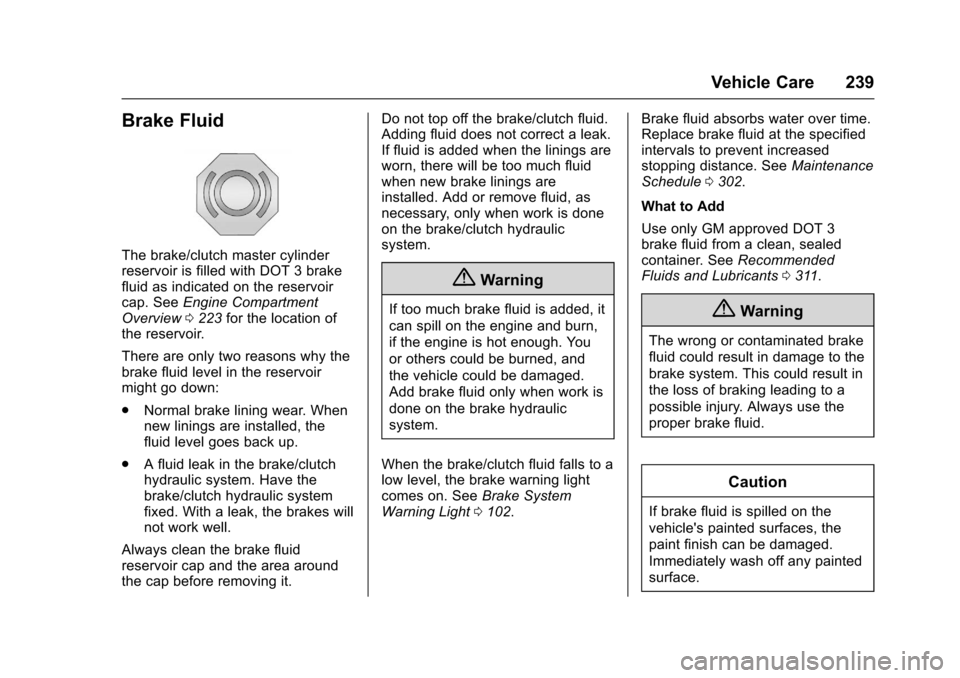
The brake/clutch master cylinder
reservoir is filled with DOT 3 brake
fluid as indicated on the reservoir
cap. SeeEngine Compartment
Overview 0223 for the location of
the reservoir.
There are only two reasons why the
brake fluid level in the reservoir
might go down:
. Normal brake lining wear. When
new linings are installed, the
fluid level goes back up.
. A fluid leak in the brake/clutch
hydraulic system. Have the
brake/clutch hydraulic system
fixed. With a leak, the brakes will
not work well.
Always clean the brake fluid
reservoir cap and the area around
the cap before removing it. Do not top off the brake/clutch fluid.
Adding fluid does not correct a leak.
If fluid is added when the linings are
worn, there will be too much fluid
when new brake linings are
installed. Add or remove fluid, as
necessary, only when work is done
on the brake/clutch hydraulic
system.
{Warning
If too much brake fluid is added, it
can spill on the engine and burn,
if the engine is hot enough. You
or others could be burned, and
the vehicle could be damaged.
Add brake fluid only when work is
done on the brake hydraulic
system.
When the brake/clutch fluid falls to a
low level, the brake warning light
comes on. See Brake System
Warning Light 0102. Brake fluid absorbs water over time.
Replace brake fluid at the specified
intervals to prevent increased
stopping distance. See
Maintenance
Schedule 0302.
What to Add
Use only GM approved DOT 3
brake fluid from a clean, sealed
container. See Recommended
Fluids and Lubricants 0311.{Warning
The wrong or contaminated brake
fluid could result in damage to the
brake system. This could result in
the loss of braking leading to a
possible injury. Always use the
proper brake fluid.
Caution
If brake fluid is spilled on the
vehicle's painted surfaces, the
paint finish can be damaged.
Immediately wash off any painted
surface.
Page 255 of 353
Chevrolet Sonic Owner Manual (GMNA-Localizing-U.S/Canada-9085902) -
2016 - CRC - 5/27/15
254 Vehicle Care
Number Usage29 Trailer Run/Crank
30 Clock Spring
31 Heating, Ventilation, and Air
Conditioning
32 Spare
33 Sunroof
34 Cigarette Lighter
35 Spare
36 Rear Power Windows
37 Front Power Windows
38 RAP/ACCY
39 DC/DC Converter
40 Driver Power Window Express
Up/Down
41 PTC2
42 PTC1
43 Battery ConnectorWheels and Tires
Tires
Every new GM vehicle has
high-quality tires made by a
leading tire manufacturer. See
the warranty manual for
information regarding the tire
warranty and where to get
service. For additional
information refer to the tire
manufacturer.
{Warning
.Poorly maintained and
improperly used tires are
dangerous.
.Overloading the tires can
cause overheating as a
result of too much
flexing. There could be a
blowout and a serious
crash. See Vehicle Load
Limits 0187.
(Continued)
Warning (Continued)
.Underinflated tires pose
the same danger as
overloaded tires. The
resulting crash could
cause serious injury.
Check all tires frequently
to maintain the
recommended pressure.
Tire pressure should be
checked when the tires
are cold.
.Overinflated tires are
more likely to be cut,
punctured, or broken by
a sudden impact —such
as when hitting a pothole.
Keep tires at the
recommended pressure.
.Worn or old tires can
cause a crash. If the
tread is badly worn,
replace them.
(Continued)
Page 265 of 353
Chevrolet Sonic Owner Manual (GMNA-Localizing-U.S/Canada-9085902) -
2016 - CRC - 5/27/15
264 Vehicle Care
the tires and transmit the tire
pressure readings to a receiver
located in the vehicle.
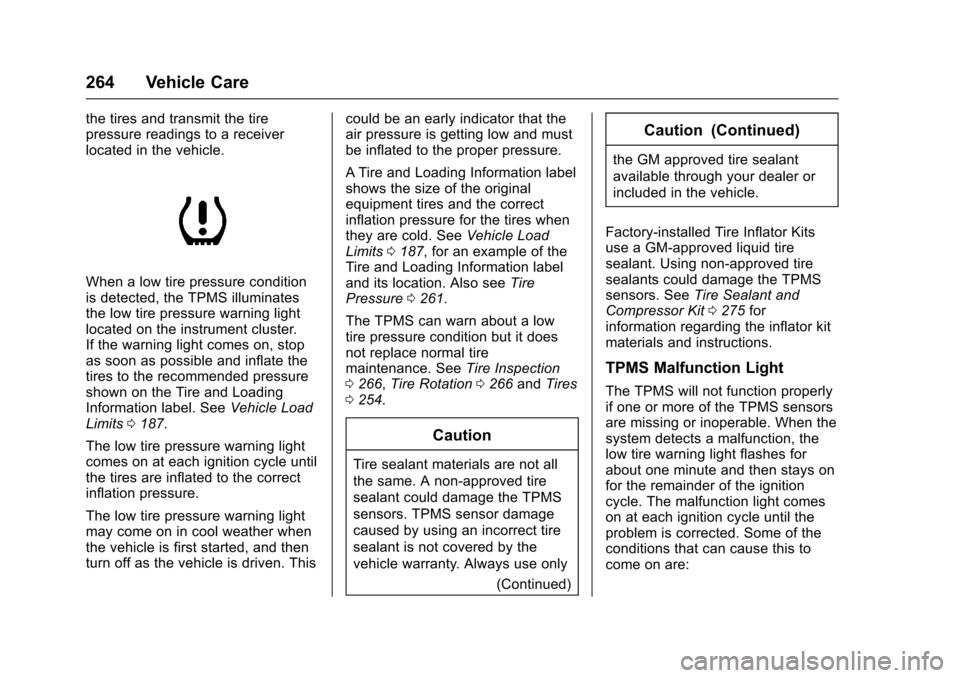
When a low tire pressure condition
is detected, the TPMS illuminates
the low tire pressure warning light
located on the instrument cluster.
If the warning light comes on, stop
as soon as possible and inflate the
tires to the recommended pressure
shown on the Tire and Loading
Information label. SeeVehicle Load
Limits 0187.
The low tire pressure warning light
comes on at each ignition cycle until
the tires are inflated to the correct
inflation pressure.
The low tire pressure warning light
may come on in cool weather when
the vehicle is first started, and then
turn off as the vehicle is driven. This could be an early indicator that the
air pressure is getting low and must
be inflated to the proper pressure.
A Tire and Loading Information label
shows the size of the original
equipment tires and the correct
inflation pressure for the tires when
they are cold. See
Vehicle Load
Limits 0187, for an example of the
Tire and Loading Information label
and its location. Also see Tire
Pressure 0261.
The TPMS can warn about a low
tire pressure condition but it does
not replace normal tire
maintenance. See Tire Inspection
0 266, Tire Rotation 0266 andTires
0 254.
Caution
Tire sealant materials are not all
the same. A non-approved tire
sealant could damage the TPMS
sensors. TPMS sensor damage
caused by using an incorrect tire
sealant is not covered by the
vehicle warranty. Always use only
(Continued)
Caution (Continued)
the GM approved tire sealant
available through your dealer or
included in the vehicle.
Factory-installed Tire Inflator Kits
use a GM-approved liquid tire
sealant. Using non-approved tire
sealants could damage the TPMS
sensors. See Tire Sealant and
Compressor Kit 0275 for
information regarding the inflator kit
materials and instructions.
TPMS Malfunction Light
The TPMS will not function properly
if one or more of the TPMS sensors
are missing or inoperable. When the
system detects a malfunction, the
low tire warning light flashes for
about one minute and then stays on
for the remainder of the ignition
cycle. The malfunction light comes
on at each ignition cycle until the
problem is corrected. Some of the
conditions that can cause this to
come on are:
Page 268 of 353
Chevrolet Sonic Owner Manual (GMNA-Localizing-U.S/Canada-9085902) -
2016 - CRC - 5/27/15
Vehicle Care 267
Tires are rotated to achieve a
more uniform wear for all tires.
The first rotation is the most
important.
Anytime unusual wear is
noticed, rotate the tires as soon
as possible, check for proper tire
inflation pressure, and check for
damaged tires or wheels. If the
unusual wear continues after the
rotation, check the wheel
alignment. SeeWhen It Is Time
for New Tires 0267 andWheel
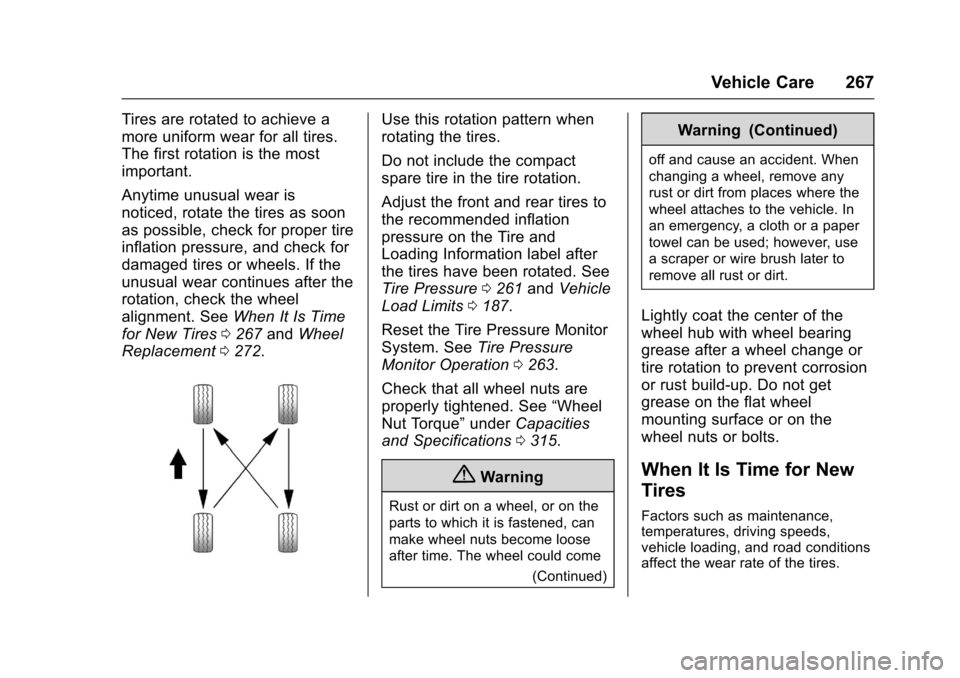
Replacement 0272.Use this rotation pattern when
rotating the tires.
Do not include the compact
spare tire in the tire rotation.
Adjust the front and rear tires to
the recommended inflation
pressure on the Tire and
Loading Information label after
the tires have been rotated. See
Tire Pressure 0261 and Vehicle
Load Limits 0187.
Reset the Tire Pressure Monitor
System. See Tire Pressure
Monitor Operation 0263.
Check that all wheel nuts are
properly tightened. See “Wheel
Nut Torque” underCapacities
and Specifications 0315.
{Warning
Rust or dirt on a wheel, or on the
parts to which it is fastened, can
make wheel nuts become loose
after time. The wheel could come
(Continued)
Warning (Continued)
off and cause an accident. When
changing a wheel, remove any
rust or dirt from places where the
wheel attaches to the vehicle. In
an emergency, a cloth or a paper
towel can be used; however, use
a scraper or wire brush later to
remove all rust or dirt.
Lightly coat the center of the
wheel hub with wheel bearing
grease after a wheel change or
tire rotation to prevent corrosion
or rust build-up. Do not get
grease on the flat wheel
mounting surface or on the
wheel nuts or bolts.
When It Is Time for New
Tires
Factors such as maintenance,
temperatures, driving speeds,
vehicle loading, and road conditions
affect the wear rate of the tires.
Page 271 of 353
Chevrolet Sonic Owner Manual (GMNA-Localizing-U.S/Canada-9085902) -
2016 - CRC - 5/27/15
270 Vehicle Care
The Tire and Loading
Information label indicates the
original equipment tires on the
vehicle. SeeVehicle Load Limits
0 187.
Different Size Tires and
Wheels
If wheels or tires are installed that
are a different size than the original
equipment wheels and tires, vehicle
performance, including its braking,
ride and handling characteristics,
stability, and resistance to rollover
may be affected. If the vehicle has
electronic systems such as antilock
brakes, rollover airbags, traction
control, electronic stability control,
or All-Wheel Drive, the performance
of these systems can also be
affected.
{Warning
If different sized wheels are used,
there may not be an acceptable
level of performance and safety if
(Continued)
Warning (Continued)
tires not recommended for those
wheels are selected. This
increases the chance of a crash
and serious injury. Only use GM
specific wheel and tire systems
developed for the vehicle, and
have them properly installed by a
GM certified technician.
See Buying New Tires 0268 and
Accessories and Modifications
0 220.
Uniform Tire Quality
Grading
The following information relates
to the system developed by the
United States National Highway
Traffic Safety Administration
(NHTSA), which grades tires by
treadwear, traction, and
temperature performance. This
applies only to vehicles sold in
the United States. The grades
are molded on the sidewalls of most passenger car tires. The
Uniform Tire Quality Grading
(UTQG) system does not apply
to deep tread, winter tires,
compact spare tires, tires with
nominal rim diameters of
10 to 12 inches (25 to 30 cm),
or to some limited-production
tires.
While the tires available on
General Motors passenger cars
and light trucks may vary with
respect to these grades, they
must also conform to federal
safety requirements and
additional General Motors Tire
Performance Criteria (TPC)
standards.
Quality grades can be found
where applicable on the tire
sidewall between tread shoulder
and maximum section width. For
example:
Page 273 of 353
Chevrolet Sonic Owner Manual (GMNA-Localizing-U.S/Canada-9085902) -
2016 - CRC - 5/27/15
272 Vehicle Care
Wheel Alignment and Tire
Balance
The tires and wheels were aligned
and balanced at the factory to
provide the longest tire life and best
overall performance. Adjustments to
wheel alignment and tire balancing
are not necessary on a regular
basis. Consider an alignment check
if there is unusual tire wear or the
vehicle is significantly pulling to one
side or the other. Some slight pull to
the left or right, depending on the
crown of the road and/or other road
surface variations such as troughs
or ruts, is normal. If the vehicle is
vibrating when driving on a smooth
road, the tires and wheels may need
to be rebalanced. See your dealer
for proper diagnosis.
Wheel Replacement
Replace any wheel that is bent,
cracked, or badly rusted or
corroded. If wheel nuts keep coming
loose, the wheel, wheel bolts, and
wheel nuts should be replaced.
If the wheel leaks air, replace it.Some aluminum wheels can be
repaired. See your dealer if any of
these conditions exist.
Your dealer will know the kind of
wheel that is needed.
Each new wheel should have the
same load-carrying capacity,
diameter, width, offset, and be
mounted the same way as the one it
replaces.
Replace wheels, wheel bolts, wheel
nuts, or Tire Pressure Monitor
System (TPMS) sensors with new
GM original equipment parts.
{Warning
Using the wrong replacement
wheels, wheel bolts, or wheel
nuts can be dangerous. It could
affect the braking and handling of
the vehicle. Tires can lose air,
and cause loss of control, causing
a crash. Always use the correct
wheel, wheel bolts, and wheel
nuts for replacement.
Caution
The wrong wheel can also cause
problems with bearing life, brake
cooling, speedometer or
odometer calibration, headlamp
aim, bumper height, vehicle
ground clearance, and tire or tire
chain clearance to the body and
chassis.
Used Replacement Wheels
{Warning
Replacing a wheel with a used
one is dangerous. How it has
been used or how far it has been
driven may be unknown. It could
fail suddenly and cause a crash.
When replacing wheels, use a
new GM original equipment
wheel.
Page 289 of 353
Chevrolet Sonic Owner Manual (GMNA-Localizing-U.S/Canada-9085902) -
2016 - CRC - 5/27/15
288 Vehicle Care
The positive jump start connection
for the discharged battery is under a
trim cover. Open the cover to
expose the terminal.1. Check the other vehicle. It must have a 12-volt battery
with a negative ground system.
Caution
If the other vehicle does not have
a 12-volt system with a negative
ground, both vehicles can be
damaged. Only use a vehicle that
has a 12-volt system with a
negative ground for jump starting.
2. Position the two vehicles so that they are not touching.
3. Set the parking brake firmly and put the shift lever in
P (Park) with an automatic
transmission, or Neutral with a
manual transmission. See
Shifting Into Park (Automatic
Transmission) 0195 with an
automatic transmission,
or Parking 0196 with a manual
transmission.
Caution
If any accessories are left on or
plugged in during the jump
starting procedure, they could be
damaged. The repairs would not
be covered by the vehicle
warranty. Whenever possible, turn
off or unplug all accessories on
either vehicle when jump starting.
4. Turn the ignition to LOCK/OFF. Turn off all lights and
accessories in both vehicles,
except the hazard warning
flashers if needed.
{Warning
An electric fan can start up even
when the engine is not running
and can injure you. Keep hands,
clothing, and tools away from any
underhood electric fan.
{Warning
Using a match near a battery can
cause battery gas to explode.
People have been hurt doing this,
and some have been blinded.
Use a flashlight if you need more
light.
Battery fluid contains acid that
can burn you. Do not get it on
you. If you accidentally get it in
your eyes or on your skin, flush
the place with water and get
medical help immediately.
{Warning
Fans or other moving engine
parts can injure you badly. Keep
your hands away from moving
parts once the engine is running.
5. Connect one end of the red positive (+) cable to the
positive (+) terminal on the
discharged battery.
Page 343 of 353
Chevrolet Sonic Owner Manual (GMNA-Localizing-U.S/Canada-9085902) -
2016 - CRC - 5/27/15
342 Index
IndexA
Accessories andModifications . . . . . . . . . . . . . . . . . . 220
Accessory Power . . . . . . . . . . . . . . . 194
Add-On Electrical Equipment . . . 217
Additional Information OnStar
®. . . . . . . . . . . . . . . . . . . . . . 336
Additional Maintenance and Care . . . . . . . . . . . . . . . . . . . . . . 308
Agreements
Trademarks and License . . . . . 174
Air Cleaner/Filter, Engine . . . . . . . 230
Air Filter, Passenger Compartment . . . . . . . . . . . . . . . . . 179
Air Intake . . . . . . . . . . . . . . . . . . . . . . . 179
Air Vents . . . . . . . . . . . . . . . . . . . . . . . 178
Airbag System Check . . . . . . . . . . . . . . . . . . . . . . . . . . 67
How Does an AirbagRestrain? . . . . . . . . . . . . . . . . . . . . . 60
Passenger Sensing System . . . . 62
What Makes an Airbag Inflate? . . . . . . . . . . . . . . . . . . . . . . . . 60
What Will You See after an
Airbag Inflates? . . . . . . . . . . . . . . . 61
When Should an Airbag Inflate? . . . . . . . . . . . . . . . . . . . . . . . . 59
Where Are the Airbags? . . . . . . . . 58 Airbags
Adding Equipment to the
Vehicle . . . . . . . . . . . . . . . . . . . . . . . . 66
Passenger Status Indicator . . . . . 99
Readiness Light . . . . . . . . . . . . . . . . 99
Servicing Airbag-Equipped Vehicles . . . . . . . . . . . . . . . . . . . . . . . 66
System Check . . . . . . . . . . . . . . . . . . 56
Alarm Vehicle Security . . . . . . . . . . . . . . . . 36
All-Season Tires . . . . . . . . . . . . . . . . 255
AM-FM Radio . . . . . . . . . . . . . . . . . . . 136
Antenna
Multi-band . . . . . . . . . . . . . . . . . . . . 142
Satellite Radio . . . . . . . . . . . . . . . . 142
Antilock Brake System (ABS) . . . 202
Warning Light . . . . . . . . . . . . . . . . . 103
Appearance Care Exterior . . . . . . . . . . . . . . . . . . . . . . . 292
Interior . . . . . . . . . . . . . . . . . . . . . . . . 297
Armrest
Front Seat . . . . . . . . . . . . . . . . . . . . . . 47
Assistance Program, Roadside . . . . . . . . . . . . . . . . . . . . . . 322
Audio
Bluetooth . . . . . . . . . . . . . . . . . . . . . 145
Theft-Deterrent Feature . . . . . . . 128
Page 344 of 353
Chevrolet Sonic Owner Manual (GMNA-Localizing-U.S/Canada-9085902) -
2016 - CRC - 5/27/15
Index 343
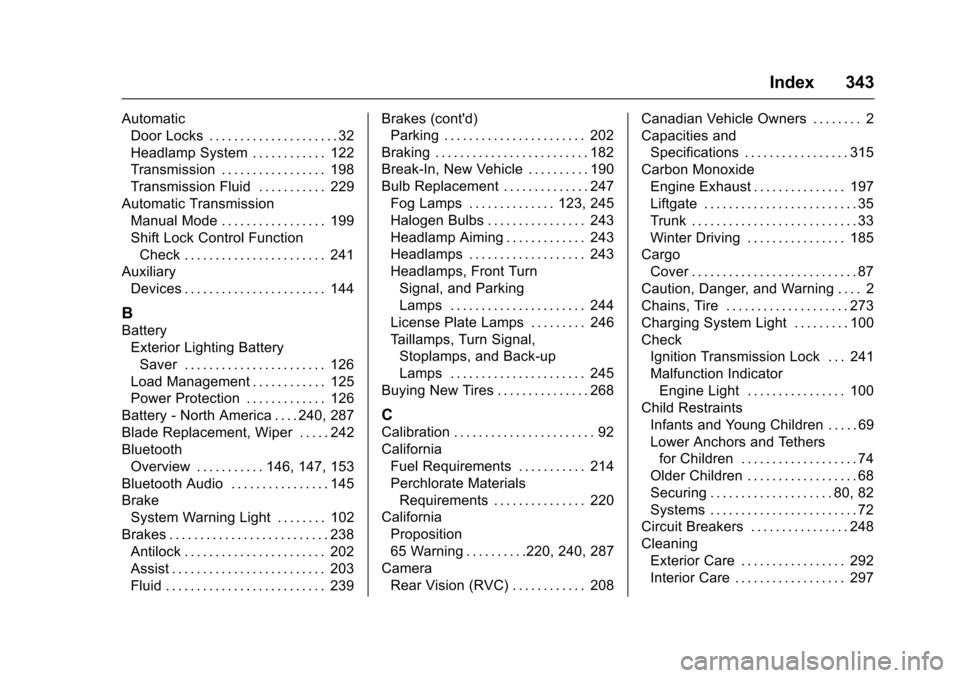
AutomaticDoor Locks . . . . . . . . . . . . . . . . . . . . . 32
Headlamp System . . . . . . . . . . . . 122
Transmission . . . . . . . . . . . . . . . . . 198
Transmission Fluid . . . . . . . . . . . 229
Automatic Transmission Manual Mode . . . . . . . . . . . . . . . . . 199
Shift Lock Control Function
Check . . . . . . . . . . . . . . . . . . . . . . . 241
Auxiliary Devices . . . . . . . . . . . . . . . . . . . . . . . 144
B
Battery
Exterior Lighting BatterySaver . . . . . . . . . . . . . . . . . . . . . . . 126
Load Management . . . . . . . . . . . . 125
Power Protection . . . . . . . . . . . . . 126
Battery - North America . . . . 240, 287
Blade Replacement, Wiper . . . . . 242
Bluetooth Overview . . . . . . . . . . . 146, 147, 153
Bluetooth Audio . . . . . . . . . . . . . . . . 145
Brake System Warning Light . . . . . . . . 102
Brakes . . . . . . . . . . . . . . . . . . . . . . . . . . 238
Antilock . . . . . . . . . . . . . . . . . . . . . . . 202
Assist . . . . . . . . . . . . . . . . . . . . . . . . . 203
Fluid . . . . . . . . . . . . . . . . . . . . . . . . . . 239 Brakes (cont'd)
Parking . . . . . . . . . . . . . . . . . . . . . . . 202
Braking . . . . . . . . . . . . . . . . . . . . . . . . . 182
Break-In, New Vehicle . . . . . . . . . . 190
Bulb Replacement . . . . . . . . . . . . . . 247 Fog Lamps . . . . . . . . . . . . . . 123, 245
Halogen Bulbs . . . . . . . . . . . . . . . . 243
Headlamp Aiming . . . . . . . . . . . . . 243
Headlamps . . . . . . . . . . . . . . . . . . . 243
Headlamps, Front TurnSignal, and Parking
Lamps . . . . . . . . . . . . . . . . . . . . . . 244
License Plate Lamps . . . . . . . . . 246
Taillamps, Turn Signal, Stoplamps, and Back-up
Lamps . . . . . . . . . . . . . . . . . . . . . . 245
Buying New Tires . . . . . . . . . . . . . . . 268
C
Calibration . . . . . . . . . . . . . . . . . . . . . . . 92
California Fuel Requirements . . . . . . . . . . . 214
Perchlorate MaterialsRequirements . . . . . . . . . . . . . . . 220
California Proposition
65 Warning . . . . . . . . . .220, 240, 287
Camera
Rear Vision (RVC) . . . . . . . . . . . . 208 Canadian Vehicle Owners . . . . . . . . 2
Capacities and
Specifications . . . . . . . . . . . . . . . . . 315
Carbon Monoxide Engine Exhaust . . . . . . . . . . . . . . . 197
Liftgate . . . . . . . . . . . . . . . . . . . . . . . . . 35
Trunk . . . . . . . . . . . . . . . . . . . . . . . . . . . 33
Winter Driving . . . . . . . . . . . . . . . . 185
Cargo Cover . . . . . . . . . . . . . . . . . . . . . . . . . . . 87
Caution, Danger, and Warning . . . . 2
Chains, Tire . . . . . . . . . . . . . . . . . . . . 273
Charging System Light . . . . . . . . . 100
Check
Ignition Transmission Lock . . . 241
Malfunction IndicatorEngine Light . . . . . . . . . . . . . . . . 100
Child Restraints Infants and Young Children . . . . . 69
Lower Anchors and Tethersfor Children . . . . . . . . . . . . . . . . . . . 74
Older Children . . . . . . . . . . . . . . . . . . 68
Securing . . . . . . . . . . . . . . . . . . . . 80, 82
Systems . . . . . . . . . . . . . . . . . . . . . . . . 72
Circuit Breakers . . . . . . . . . . . . . . . . 248
Cleaning
Exterior Care . . . . . . . . . . . . . . . . . 292
Interior Care . . . . . . . . . . . . . . . . . . 297
Page 345 of 353
Chevrolet Sonic Owner Manual (GMNA-Localizing-U.S/Canada-9085902) -
2016 - CRC - 5/27/15
344 Index
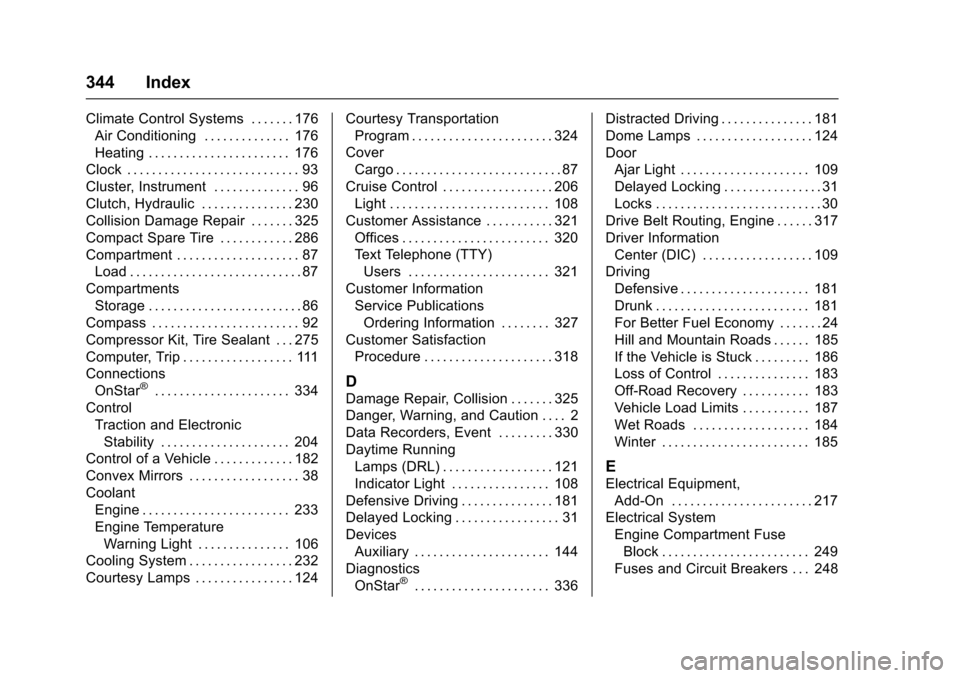
Climate Control Systems . . . . . . . 176Air Conditioning . . . . . . . . . . . . . . 176
Heating . . . . . . . . . . . . . . . . . . . . . . . 176
Clock . . . . . . . . . . . . . . . . . . . . . . . . . . . . 93
Cluster, Instrument . . . . . . . . . . . . . . 96
Clutch, Hydraulic . . . . . . . . . . . . . . . 230
Collision Damage Repair . . . . . . . 325
Compact Spare Tire . . . . . . . . . . . . 286
Compartment . . . . . . . . . . . . . . . . . . . . 87 Load . . . . . . . . . . . . . . . . . . . . . . . . . . . . 87
Compartments
Storage . . . . . . . . . . . . . . . . . . . . . . . . . 86
Compass . . . . . . . . . . . . . . . . . . . . . . . . 92
Compressor Kit, Tire Sealant . . . 275
Computer, Trip . . . . . . . . . . . . . . . . . . 111
Connections OnStar
®. . . . . . . . . . . . . . . . . . . . . . 334
Control Traction and ElectronicStability . . . . . . . . . . . . . . . . . . . . . 204
Control of a Vehicle . . . . . . . . . . . . . 182
Convex Mirrors . . . . . . . . . . . . . . . . . . 38
Coolant
Engine . . . . . . . . . . . . . . . . . . . . . . . . 233
Engine TemperatureWarning Light . . . . . . . . . . . . . . . 106
Cooling System . . . . . . . . . . . . . . . . . 232
Courtesy Lamps . . . . . . . . . . . . . . . . 124 Courtesy Transportation
Program . . . . . . . . . . . . . . . . . . . . . . . 324
Cover Cargo . . . . . . . . . . . . . . . . . . . . . . . . . . . 87
Cruise Control . . . . . . . . . . . . . . . . . . 206 Light . . . . . . . . . . . . . . . . . . . . . . . . . . 108
Customer Assistance . . . . . . . . . . . 321
Offices . . . . . . . . . . . . . . . . . . . . . . . . 320
Text Telephone (TTY)Users . . . . . . . . . . . . . . . . . . . . . . . 321
Customer Information
Service PublicationsOrdering Information . . . . . . . . 327
Customer Satisfaction Procedure . . . . . . . . . . . . . . . . . . . . . 318D
Damage Repair, Collision . . . . . . . 325
Danger, Warning, and Caution . . . . 2
Data Recorders, Event . . . . . . . . . 330
Daytime RunningLamps (DRL) . . . . . . . . . . . . . . . . . . 121
Indicator Light . . . . . . . . . . . . . . . . 108
Defensive Driving . . . . . . . . . . . . . . . 181
Delayed Locking . . . . . . . . . . . . . . . . . 31
Devices Auxiliary . . . . . . . . . . . . . . . . . . . . . . 144
Diagnostics OnStar
®. . . . . . . . . . . . . . . . . . . . . . 336 Distracted Driving . . . . . . . . . . . . . . . 181
Dome Lamps . . . . . . . . . . . . . . . . . . . 124
Door
Ajar Light . . . . . . . . . . . . . . . . . . . . . 109
Delayed Locking . . . . . . . . . . . . . . . . 31
Locks . . . . . . . . . . . . . . . . . . . . . . . . . . . 30
Drive Belt Routing, Engine . . . . . . 317
Driver Information
Center (DIC) . . . . . . . . . . . . . . . . . . 109
Driving Defensive . . . . . . . . . . . . . . . . . . . . . 181
Drunk . . . . . . . . . . . . . . . . . . . . . . . . . 181
For Better Fuel Economy . . . . . . . 24
Hill and Mountain Roads . . . . . . 185
If the Vehicle is Stuck . . . . . . . . . 186
Loss of Control . . . . . . . . . . . . . . . 183
Off-Road Recovery . . . . . . . . . . . 183
Vehicle Load Limits . . . . . . . . . . . 187
Wet Roads . . . . . . . . . . . . . . . . . . . 184
Winter . . . . . . . . . . . . . . . . . . . . . . . . 185
E
Electrical Equipment,
Add-On . . . . . . . . . . . . . . . . . . . . . . . 217
Electrical System Engine Compartment Fuse
Block . . . . . . . . . . . . . . . . . . . . . . . . 249
Fuses and Circuit Breakers . . . 248