instrument cluster CHEVROLET SPARK 2022 Owner's Manual
[x] Cancel search | Manufacturer: CHEVROLET, Model Year: 2022, Model line: SPARK, Model: CHEVROLET SPARK 2022Pages: 270, PDF Size: 8.57 MB
Page 144 of 270

Chevrolet Spark Owner Manual (GMNA-Localizing-U.S./Canada-14622955) -
2021 - CRC - 8/17/20
Driving and Operating 143
Engine Exhaust0142. If the vehicle has a
manual transmission, see Parking (Manual
Transmission) 0141.
Automatic Transmission
Continuously Variable Transmission (CVT)
The CVT is electronically controlled to
produce maximum power and smooth
operation. A display in the instrument
cluster indicates the selected range.
P : This position locks the drive wheels. Use
P (Park) when starting the engine because
the vehicle cannot move easily.
{Warning
It is dangerous to get out of the vehicle
if the shift lever is not fully in P (Park)
with the parking brake firmly set. The
vehicle can roll.
Do not leave the vehicle when the engine
is running. If you have left the engine
running, the vehicle can move suddenly.
You or others could be injured. To be
sure the vehicle will not move, even
when you are on fairly level ground,
always set the parking brake and move
the shift lever to P (Park). See Shifting
Into Park 0140.
Make sure the shift lever is fully in P (Park)
before starting the engine. The vehicle has a
shift lock release control. The brake pedal
must be fully applied, and the shift lever
button must be pressed before shifting from
P (Park) while the ignition is on. If the
transmission will not shift out of P (Park),
ease pressure on the shift lever and push
the shift lever all the way into P (Park) while
maintaining brake application. Then move
the shift lever into another gear. See
Shifting out of Park 0141.
R : Use this gear to back up.
Caution
Shifting to R (Reverse) while the vehicle is
moving forward could damage the
transmission. The repairs would not be
covered by the vehicle warranty. Shift to
R (Reverse) only after the vehicle is
stopped.
To rock the vehicle back and forth to get
out of snow, ice, or sand without damaging
the transmission, see If the Vehicle Is Stuck
0 130.
N : In this position, the engine does not
connect with the wheels. To restart the
engine when the vehicle is already moving,
use N (Neutral) only.
{Warning
Shifting into a drive gear while the
engine is running at high speed is
dangerous. Unless your foot is firmly on
the brake pedal, the vehicle could move
very rapidly. You could lose control and
hit people or objects. Do not shift into a
drive gear while the engine is running at
high speed.
Page 149 of 270
Chevrolet Spark Owner Manual (GMNA-Localizing-U.S./Canada-14622955) -
2021 - CRC - 8/17/20
148 Driving and Operating
The indicator light for both systems is in the
instrument cluster. This light will:
.Flash when TCS is limiting wheel spin.
.Flash when StabiliTrak/ESC is activated.
.Turn on and stay on when either system
is not working.
If either system fails to turn on or to
activate, a message displays in the Driver
Information Center (DIC), and
dcomes on
and stays on to indicate that the system is
inactive and is not assisting the driver in
maintaining control. The vehicle is safe to
drive, but driving should be adjusted
accordingly.
If
dcomes on and stays on:
1. Stop the vehicle.
2. Turn the engine off and wait 15 seconds.
3. Start the engine. Drive the vehicle. If
dcomes on and stays
on, the vehicle may need more time to
diagnose the problem. If the condition
persists, see your dealer.
Turning the Systems Off and On
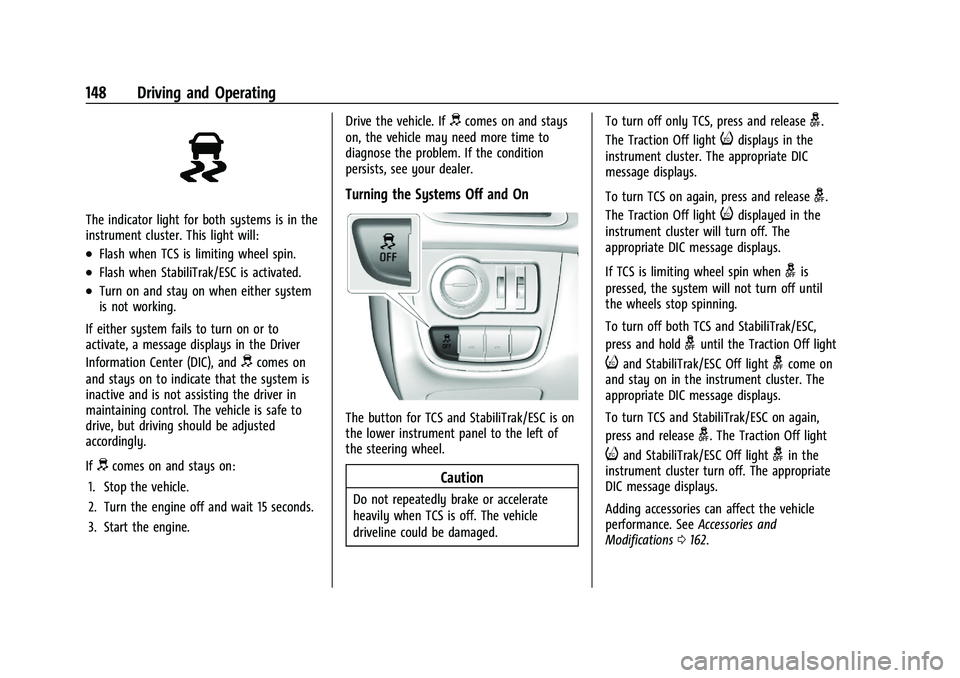
The button for TCS and StabiliTrak/ESC is on
the lower instrument panel to the left of
the steering wheel.
Caution
Do not repeatedly brake or accelerate
heavily when TCS is off. The vehicle
driveline could be damaged. To turn off only TCS, press and release
g.
The Traction Off light
idisplays in the
instrument cluster. The appropriate DIC
message displays.
To turn TCS on again, press and release
g.
The Traction Off light
idisplayed in the
instrument cluster will turn off. The
appropriate DIC message displays.
If TCS is limiting wheel spin when
gis
pressed, the system will not turn off until
the wheels stop spinning.
To turn off both TCS and StabiliTrak/ESC,
press and hold
guntil the Traction Off light
iand StabiliTrak/ESC Off lightgcome on
and stay on in the instrument cluster. The
appropriate DIC message displays.
To turn TCS and StabiliTrak/ESC on again,
press and release
g. The Traction Off light
iand StabiliTrak/ESC Off lightgin the
instrument cluster turn off. The appropriate
DIC message displays.
Adding accessories can affect the vehicle
performance. See Accessories and
Modifications 0162.
Page 150 of 270

Chevrolet Spark Owner Manual (GMNA-Localizing-U.S./Canada-14622955) -
2021 - CRC - 8/17/20
Driving and Operating 149
Cruise Control
If the vehicle is equipped with cruise control,
a speed of about 40 km/h (25 mph) or more
can be maintained without keeping your
foot on the accelerator. Cruise control does
not work at speeds below 40 km/h (25 mph).
{Warning
Cruise control can be dangerous where
you cannot drive safely at a steady
speed. Do not use cruise control on
winding roads or in heavy traffic.
Cruise control can be dangerous on
slippery roads. On such roads, fast
changes in tire traction can cause
excessive wheel slip, and you could lose
control. Do not use cruise control on
slippery roads.
If the vehicle's Traction Control System (TCS)
or StabiliTrak/Electronic Stability Control
(ESC) system begins to limit wheel spin
while using cruise control, the cruise control
will automatically disengage. See Traction
Control/Electronic Stability Control 0147. If a
collision alert occurs when cruise control is
activated, cruise control is disengaged. See
Forward Collision Alert (FCA) System 0154. When road conditions allow you to safely
use it again, the cruise control can be
turned back on. Cruise control will disengage
if either TCS or StabiliTrak/ESC is turned off.
If the brakes are applied, cruise control
disengages.
J:
Press to turn the cruise control system
on and off. A white indicator comes on in
the instrument cluster when cruise is
turned on.
RES/+ : If there is a set speed in memory,
move the thumbwheel up briefly to resume
to that speed or hold upward to accelerate.
If cruise control is already active, use to
increase vehicle speed. SET/−
:Move the thumbwheel down briefly
to set the speed and activate cruise control.
If cruise control is already active, use to
decrease speed.
*: Press to disengage cruise control
without erasing the set speed from memory.
Setting Cruise Control
If
Jis on when not in use, SET/- or RES/+
could get bumped and go into cruise when
not desired. Keep
Joff when cruise
control is not being used.
To set cruise control:
1. Press
Jto turn the cruise system on.
2. Get to the speed desired.
3. Move the thumbwheel down to SET/- and release it.
4. Take your foot off the accelerator pedal.
The cruise control indicator on the
instrument cluster turns green after cruise
control has been set to the desired speed.
See Instrument Cluster 072.
Page 190 of 270
Chevrolet Spark Owner Manual (GMNA-Localizing-U.S./Canada-14622955) -
2021 - CRC - 8/17/20
Vehicle Care 189
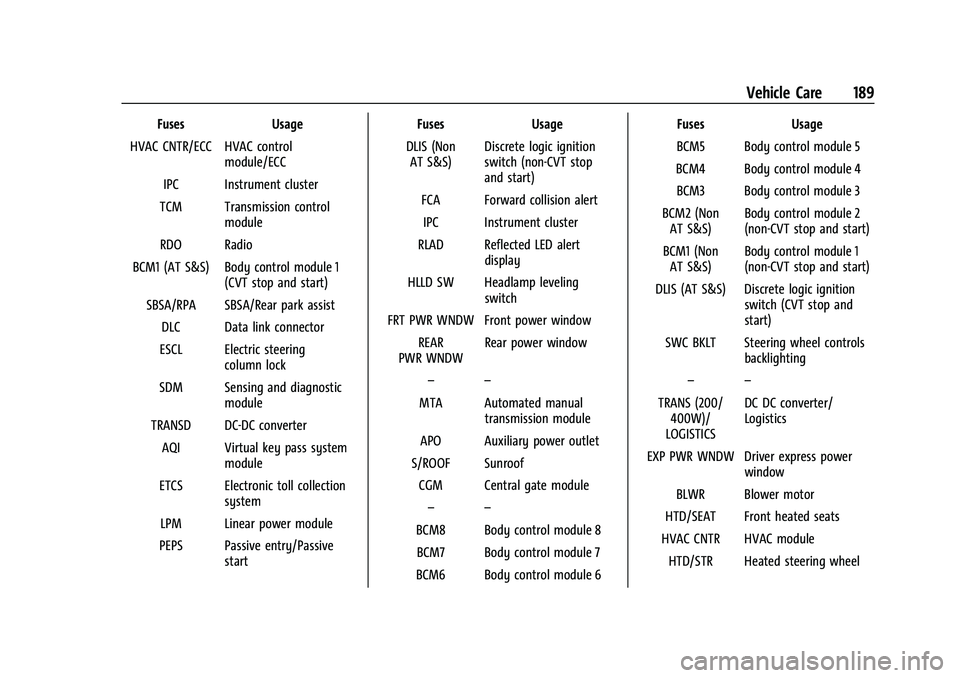
FusesUsage
HVAC CNTR/ECC HVAC control module/ECC
IPC Instrument cluster
TCM Transmission control module
RDO Radio
BCM1 (AT S&S) Body control module 1 (CVT stop and start)
SBSA/RPA SBSA/Rear park assist DLC Data link connector
ESCL Electric steering column lock
SDM Sensing and diagnostic module
TRANSD DC-DC converter AQI Virtual key pass system module
ETCS Electronic toll collection system
LPM Linear power module
PEPS Passive entry/Passive start Fuses
Usage
DLIS (Non AT S&S) Discrete logic ignition
switch (non-CVT stop
and start)
FCA Forward collision alert IPC Instrument cluster
RLAD Reflected LED alert display
HLLD SW Headlamp leveling switch
FRT PWR WNDW Front power window REAR
PWR WNDW Rear power window
– –
MTA Automated manual transmission module
APO Auxiliary power outlet
S/ROOF Sunroof CGM Central gate module – –
BCM8 Body control module 8 BCM7 Body control module 7
BCM6 Body control module 6 Fuses
Usage
BCM5 Body control module 5
BCM4 Body control module 4 BCM3 Body control module 3
BCM2 (Non AT S&S) Body control module 2
(non-CVT stop and start)
BCM1 (Non AT S&S) Body control module 1
(non-CVT stop and start)
DLIS (AT S&S) Discrete logic ignition switch (CVT stop and
start)
SWC BKLT Steering wheel controls backlighting
– –
TRANS (200/ 400W)/
LOGISTICS DC DC converter/
Logistics
EXP PWR WNDW Driver express power window
BLWR Blower motor
HTD/SEAT Front heated seats
HVAC CNTR HVAC module HTD/STR Heated steering wheel
Page 198 of 270

Chevrolet Spark Owner Manual (GMNA-Localizing-U.S./Canada-14622955) -
2021 - CRC - 8/17/20
Vehicle Care 197
As an added safety feature, your vehicle has
been equipped with a tire pressure
monitoring system (TPMS) that illuminates a
low tire pressure telltale when one or more
of your tires is significantly under-inflated.
Accordingly, when the low tire pressure
telltale illuminates, you should stop and
check your tires as soon as possible, and
inflate them to the proper pressure. Driving
on a significantly under-inflated tire causes
the tire to overheat and can lead to tire
failure. Under-inflation also reduces fuel
efficiency and tire tread life, and may affect
the vehicle's handling and stopping ability.
Please note that the TPMS is not a
substitute for proper tire maintenance, and
it is the driver's responsibility to maintain
correct tire pressure, even if under-inflation
has not reached the level to trigger
illumination of the TPMS low tire pressure
telltale.
Your vehicle has also been equipped with a
TPMS malfunction indicator to indicate when
the system is not operating properly. The
TPMS malfunction indicator is combined
with the low tire pressure telltale. When the
system detects a malfunction, the telltale
will flash for approximately one minute and
then remain continuously illuminated. Thissequence will continue upon subsequent
vehicle start-ups as long as the malfunction
exists.
When the malfunction indicator is
illuminated, the system may not be able to
detect or signal low tire pressure as
intended. TPMS malfunctions may occur for
a variety of reasons, including the
installation of replacement or alternate tires
or wheels on the vehicle that prevent the
TPMS from functioning properly. Always
check the TPMS malfunction telltale after
replacing one or more tires or wheels on
your vehicle to ensure that the replacement
or alternate tires and wheels allow the
TPMS to continue to function properly.
See
Tire Pressure Monitor Operation 0197.
See Radio Frequency Statement 0248.
Tire Pressure Monitor Operation
This vehicle may have a Tire Pressure
Monitor System (TPMS). The TPMS is
designed to warn the driver when a low tire
pressure condition exists. TPMS sensors are
mounted onto each tire and wheel
assembly, excluding the spare tire and
wheel assembly. The TPMS sensors monitor the air pressure in the tires and transmit the
tire pressure readings to a receiver located
in the vehicle.
When a low tire pressure condition is
detected, the TPMS illuminates the low tire
pressure warning light located on the
instrument cluster. If the warning light
comes on, stop as soon as possible and
inflate the tires to the recommended
pressure shown on the Tire and Loading
Information label. See
Vehicle Load Limits
0 131.
A message to check the pressure in a
specific tire may display in the Driver
Information Center (DIC). The low tire
pressure warning light and the DIC warning
message, if equipped, come on at each
ignition cycle until the tires are inflated to
the correct inflation pressure. Using the DIC,
it may be possible to view the tire pressure
levels. For additional information and details
about the DIC operation and displays, see
Driver Information Center (DIC) 083.
Page 221 of 270

Chevrolet Spark Owner Manual (GMNA-Localizing-U.S./Canada-14622955) -
2021 - CRC - 8/17/20
220 Vehicle Care
Caution (Continued)
or brushes. Use only GM approved
cleaners. Do not drive the vehicle through
an automatic car wash that uses silicon
carbide tire/wheel cleaning brushes.
Damage could occur and the repairs
would not be covered by the vehicle
warranty.
Brake System
Visually inspect brake lines and hoses for
proper hook-up, binding, leaks, cracks,
chafing, etc. Inspect disc brake pads for wear
and rotors for surface condition. Inspect
drum brake linings/shoes for wear or cracks.
Inspect all other brake parts.
Steering, Suspension, and Chassis
Components
Visually inspect steering, suspension, and
chassis components for damaged, loose,
or missing parts or signs of wear at least
once a year.
Inspect power steering for proper
attachment, connections, binding, leaks,
cracks, chafing, etc.Visually check constant velocity joint boots
and axle seals for leaks.
Body Component Lubrication
Lubricate all key lock cylinders, hood hinges,
liftgate hinges, and the steel fuel door
hinges, unless the components are plastic.
Applying silicone grease on weatherstrips
with a clean cloth will make them last
longer, seal better, and not stick or squeak.
Underbody Maintenance
At least twice a year, spring and fall, use
plain water to flush any corrosive materials
from the underbody. Take care to
thoroughly clean any areas where mud and
other debris can collect.
Do not directly power wash the transfer
case and/or front/rear axle output seals.
High pressure water can overcome the seals
and contaminate the fluid. Contaminated
fluid will decrease the life of the transfer
case and/or axles and should be replaced.
Sheet Metal Damage
If the vehicle is damaged and requires sheet
metal repair or replacement, make sure the
body repair shop applies anti-corrosion
material to parts repaired or replaced to
restore corrosion protection.Original manufacturer replacement parts will
provide the corrosion protection while
maintaining the vehicle warranty.
Finish Damage
Quickly repair minor chips and scratches
with touch-up materials available from your
dealer to avoid corrosion. Larger areas of
finish damage can be corrected in your
dealer's body and paint shop.
Chemical Paint Spotting
Airborne pollutants can fall upon and attack
painted vehicle surfaces causing blotchy,
ring-shaped discolorations, and small,
irregular dark spots etched into the paint
surface. See
“Finish Care” previously in this
section.
Interior Care
To prevent dirt particle abrasions, regularly
clean the vehicle's interior. Immediately
remove any soils. Newspapers or dark
garments can transfer color to the vehicle’s
interior.
Use a soft bristle brush to remove dust from
knobs and crevices on the instrument
cluster. Using a mild soap solution,
immediately remove hand lotions,
Page 233 of 270

Chevrolet Spark Owner Manual (GMNA-Localizing-U.S./Canada-14622955) -
2021 - CRC - 8/17/20
232 Service and Maintenance
Brakes
Brakes stop the vehicle and are crucial to
safe driving.
.Signs of brake wear may include chirping,
grinding, or squealing noises, or difficulty
stopping.
.Trained dealer technicians have access to
tools and equipment to inspect the brakes
and recommend quality parts engineered
for the vehicle.
Fluids
Proper fluid levels and approved fluids
protect the vehicle’s systems and
components. See Recommended Fluids and
Lubricants 0234 for GM approved fluids.
.Engine oil and windshield washer fluid
levels should be checked at every fuel fill.
.Instrument cluster lights may come on to
indicate that fluids may be low and need
to be filled.
Hoses
Hoses transport fluids and should be
regularly inspected to ensure that there are
no cracks or leaks. With a multi-point
inspection, your dealer can inspect the hoses
and advise if replacement is needed. Lamps
Properly working headlamps, taillamps, and
brake lamps are important to see and be
seen on the road.
.Signs that the headlamps need attention
include dimming, failure to light, cracking,
or damage. The brake lamps need to be
checked periodically to ensure that they
light when braking.
.With a multi-point inspection, your dealer
can check the lamps and note any
concerns.
Shocks and Struts
Shocks and struts help aid in control for a
smoother ride.
.Signs of wear may include steering wheel
vibration, bounce/sway while braking,
longer stopping distance, or uneven
tire wear.
.As part of the multi-point inspection,
trained dealer technicians can visually
inspect the shocks and struts for signs of
leaking, blown seals, or damage, and can
advise when service is needed. Tires
Tires need to be properly inflated, rotated,
and balanced. Maintaining the tires can save
money and fuel, and can reduce the risk of
tire failure.
.Signs that the tires need to be replaced
include three or more visible treadwear
indicators; cord or fabric showing through
the rubber; cracks or cuts in the tread or
sidewall; or a bulge or split in the tire.
.Trained dealer technicians can inspect and
recommend the right tires. Your dealer
can also provide tire/wheel balancing
services to ensure smooth vehicle
operation at all speeds. Your dealer sells
and services name brand tires.
Vehicle Care
To help keep the vehicle looking like new,
vehicle care products are available from your
dealer. For information on how to clean and
protect the vehicle’s interior and exterior,
see Interior Care 0220 and
Exterior Care 0217.
Wheel Alignment
Wheel alignment is critical for ensuring that
the tires deliver optimal wear and
performance.
Page 261 of 270
Chevrolet Spark Owner Manual (GMNA-Localizing-U.S./Canada-14622955) -
2021 - CRC - 8/17/20
260 Index
Auxiliary Jack . . . . . . . . . . . . . . . . . . . . . . . . . . . . 106
Avoiding Untrusted Media Devices . . . . . . . 103
B
BatteryExterior Lighting Battery Saver . . . . . . . . . 96
Power Protection . . . . . . . . . . . . . . . . . . . . . . . 96
Battery - North America . . . . . . . . . . . . . 176, 211
Blade Replacement, Wiper . . . . . . . . . . . . . . . 179
Bluetooth Overview . . . . . . . . . . . . . . . . . . . . . . . . . 108, 109
Bluetooth Audio . . . . . . . . . . . . . . . . . . . . . . . . . 106
Brake
System Warning Light . . . . . . . . . . . . . . . . . . 77
Brakes . . . . . . . . . . . . . . . . . . . . . . . . . . . . . . . . . . . . 175 Antilock . . . . . . . . . . . . . . . . . . . . . . . . . . . . . . . . 146
Assist . . . . . . . . . . . . . . . . . . . . . . . . . . . . . . . . . . 147
Fluid . . . . . . . . . . . . . . . . . . . . . . . . . . . . . . . . . . . . 175
Parking . . . . . . . . . . . . . . . . . . . . . . . . . . . . . . . . 146
Braking . . . . . . . . . . . . . . . . . . . . . . . . . . . . . . . . . . 126 Automatic Emergency (AEB) . . . . . . . . . . . 155
Break-In, New Vehicle . . . . . . . . . . . . . . . . . . . . .134
Bulb Replacement Halogen Bulbs . . . . . . . . . . . . . . . . . . . . . . . . . . 181
Headlamp Aiming . . . . . . . . . . . . . . . . . . . . . . . 181
Headlamps . . . . . . . . . . . . . . . . . . . . . . . . . . . . . 181
Headlamps, Front Turn Signal,Sidemarker, and Parking Lamps . . . . . . 182 Bulb Replacement (cont'd)
High Intensity Discharge (HID)
Lighting . . . . . . . . . . . . . . . . . . . . . . . . . . . . . . . 181
License Plate Lamps . . . . . . . . . . . . . . . . . . . 184
Taillamps, Turn Signal, Stoplamps, and Back-up Lamps . . . . . . . . . . . . . . . . . . 184
Buying New Tires . . . . . . . . . . . . . . . . . . . . . . . . 202
C
Calibration . . . . . . . . . . . . . . . . . . . . . . . . . . . . . . . . 70
California Perchlorate Materials Requirements . . . 162
California Proposition 65 Warning . . . . . . . . . . . . . . . . . . . .162, 176, 211, Back Cover
Camera Rear Vision (RVC) . . . . . . . . . . . . . . . . . . . . . . 152
Canadian Vehicle Owners . . . . . . . . . . . . . . . . . . . 1
Capacities and Specifications . . . . . . . . . . . . . 238
Carbon Monoxide Engine Exhaust . . . . . . . . . . . . . . . . . . . . . . . . 142
Liftgate . . . . . . . . . . . . . . . . . . . . . . . . . . . . . . . . . . 17
Winter Driving . . . . . . . . . . . . . . . . . . . . . . . . . 129
Cargo Cover . . . . . . . . . . . . . . . . . . . . . . . . . . . . . . . . . . . 65
Tie-Downs . . . . . . . . . . . . . . . . . . . . . . . . . . . . . . 66
Caution, Danger, and Warning . . . . . . . . . . . . . .2
Chains, Tire . . . . . . . . . . . . . . . . . . . . . . . . . . . . . . 205 Charging System Light . . . . . . . . . . . . . . . . . . . . .75
Check
Engine Light (Malfunction Indicator) . . . . 75
Ignition Transmission Lock . . . . . . . . . . . . . 178
Child Restraints Infants and Young Children . . . . . . . . . . . . . 48
Lower Anchors and Tethers forChildren . . . . . . . . . . . . . . . . . . . . . . . . . . . . . . . 53
Older Children . . . . . . . . . . . . . . . . . . . . . . . . . . 47
Securing . . . . . . . . . . . . . . . . . . . . . . . . . . . . 60, 62
Systems . . . . . . . . . . . . . . . . . . . . . . . . . . . . . . . . 50
Circuit Breakers . . . . . . . . . . . . . . . . . . . . . . . . . . .185
Cleaning Exterior Care . . . . . . . . . . . . . . . . . . . . . . . . . . . . 217
Interior Care . . . . . . . . . . . . . . . . . . . . . . . . . . . 220
Climate Control Systems . . . . . . . . . . . . . . . . . . 119
Air Conditioning . . . . . . . . . . . . . . . . . . . . . . . . 119
Heating . . . . . . . . . . . . . . . . . . . . . . . . . . . . . . . . . 119
Clock . . . . . . . . . . . . . . . . . . . . . . . . . . . . . . . . . . . . . 70
Cluster, Instrument . . . . . . . . . . . . . . . . . . . . . . . .72
Clutch, Hydraulic . . . . . . . . . . . . . . . . . . . . . . . . 169
Collision Damage Repair . . . . . . . . . . . . . . . . . 246
Compact Spare Tire . . . . . . . . . . . . . . . . . . . . . . 210
Compartments Storage . . . . . . . . . . . . . . . . . . . . . . . . . . . . . . . . . 65
Compass . . . . . . . . . . . . . . . . . . . . . . . . . . . . . . . . . . 70
Connected Services Connections . . . . . . . . . . . . . . . . . . . . . . . . . . . 257
Page 264 of 270
Chevrolet Spark Owner Manual (GMNA-Localizing-U.S./Canada-14622955) -
2021 - CRC - 8/17/20
Index 263
Headlamps (cont'd)High-Beam On Light . . . . . . . . . . . . . . . . . . . . 82
High/Low Beam Changer . . . . . . . . . . . . . . . 92
Lamps On Reminder . . . . . . . . . . . . . . . . . . . . 82
Heated Front Seats . . . . . . . . . . . . . . . . . . . . . . . 28
Heated Mirrors . . . . . . . . . . . . . . . . . . . . . . . . . . . . 21
Heater Engine . . . . . . . . . . . . . . . . . . . . . . . . . . . . . . . . . 139
Heating . . . . . . . . . . . . . . . . . . . . . . . . . . . . . . . . . . . 119
High-Beam On Light . . . . . . . . . . . . . . . . . . . . . . 82
Hill and Mountain Roads . . . . . . . . . . . . . . . . 129
Hill Start Assist (HSA) . . . . . . . . . . . . . . . . . . . . .147
Hood . . . . . . . . . . . . . . . . . . . . . . . . . . . . . . . . . . . . 163
Hood Ajar Light . . . . . . . . . . . . . . . . . . . . . . . . . . . 83
Horn . . . . . . . . . . . . . . . . . . . . . . . . . . . . . . . . . . . . . . 68
How to Wear Seat Belts Properly . . . . . . . . . . 31
HVAC . . . . . . . . . . . . . . . . . . . . . . . . . . . . . . . . . . . . . 119
Hydraulic Clutch . . . . . . . . . . . . . . . . . . . . . . . . . 169
I
Ignition Positions . . . . . . . . . . . . . . . . . . . . 134, 136
Ignition Transmission Lock Check . . . . . . . . .178
Immobilizer . . . . . . . . . . . . . . . . . . . . . . . . . . . . . . . .19 Light . . . . . . . . . . . . . . . . . . . . . . . . . . . . . . . . . . . . 81
Indicator Owner Manual . . . . . . . . . . . . . . . . . . . . . . . . . . 77
Vehicle Ahead . . . . . . . . . . . . . . . . . . . . . . . . . . 79
Infants and Young Children, Restraints . . . . 48 Information
Publication Ordering . . . . . . . . . . . . . . . . . . . 247
Instrument Cluster . . . . . . . . . . . . . . . . . . . . . . . . .72
Instrument Panel Overview . . . . . . . . . . . . . . . . 4
Interior Rearview Mirrors . . . . . . . . . . . . . . . . . . 21
Introduction . . . . . . . . . . . . . . . . . . . . . . . . . . . . 1, 97
J
Jack Auxiliary . . . . . . . . . . . . . . . . . . . . . . . . . . . . . . . 106
Jump Starting - North America . . . . . . . . . . . . 211
K
Keyless Entry Remote (RKE) System . . . . . . . . . . . . . . . . . 9, 11
Keys . . . . . . . . . . . . . . . . . . . . . . . . . . . . . . . . . . . . . . . 6
L
Labeling, Tire Sidewall . . . . . . . . . . . . . . . . . . . . 191
Lamps Courtesy . . . . . . . . . . . . . . . . . . . . . . . . . . . . . . . . 95
Daytime Running (DRL) . . . . . . . . . . . . . . . . . 93
Dome . . . . . . . . . . . . . . . . . . . . . . . . . . . . . . . . . . . 95
Exterior Controls . . . . . . . . . . . . . . . . . . . . . . . . 92
Exterior Lamps Off Reminder . . . . . . . . . . . 92
Exterior Lighting Battery Saver . . . . . . . . . 96
License Plate . . . . . . . . . . . . . . . . . . . . . . . . . . . 184
Malfunction Indicator (Check Engine) . . . 75
On Reminder . . . . . . . . . . . . . . . . . . . . . . . . . . . 82 Lamps (cont'd)
Reading . . . . . . . . . . . . . . . . . . . . . . . . . . . . . . . . . 96
Lane Departure Warning (LDW) . . . . . . . . . . 156
Lane Departure Warning Light . . . . . . . . . . . . 78
Lap-Shoulder Belt . . . . . . . . . . . . . . . . . . . . . . . . . .33
LATCH System Replacing Parts after a Crash . . . . . . . . . . . 59
LATCH, Lower Anchors and Tethers for Children . . . . . . . . . . . . . . . . . . . . . . . . . . . . . . . . . .53
LED Lighting . . . . . . . . . . . . . . . . . . . . . . . . . . . . . .182
Liftgate . . . . . . . . . . . . . . . . . . . . . . . . . . . . . . . . . . . . 17
Lighting Entry . . . . . . . . . . . . . . . . . . . . . . . . . . . . . . . . . . . 96
Exit . . . . . . . . . . . . . . . . . . . . . . . . . . . . . . . . . . . . . 96
Illumination Control . . . . . . . . . . . . . . . . . . . . 95
LED . . . . . . . . . . . . . . . . . . . . . . . . . . . . . . . . . . . . 182
Lights Airbag Readiness . . . . . . . . . . . . . . . . . . . . . . . 74
Antilock Brake System (ABS)Warning . . . . . . . . . . . . . . . . . . . . . . . . . . . . . . 78
Brake System Warning . . . . . . . . . . . . . . . . . 77
Charging System . . . . . . . . . . . . . . . . . . . . . . . 75
Check Engine (Malfunction Indicator) . . . 75
Cruise Control . . . . . . . . . . . . . . . . . . . . . . . . . . 82
Door Ajar . . . . . . . . . . . . . . . . . . . . . . . . . . . . . . . 83
Engine Coolant Temperature
Warning . . . . . . . . . . . . . . . . . . . . . . . . . . . . . . 80
Engine Oil Pressure . . . . . . . . . . . . . . . . . . . . . 81