instrument panel CHEVROLET SS 2014 Owner's Manual
[x] Cancel search | Manufacturer: CHEVROLET, Model Year: 2014, Model line: SS, Model: CHEVROLET SS 2014Pages: 422, PDF Size: 6.18 MB
Page 229 of 422
Black plate (3,1)Chevrolet SS Sedan Owner Manual (GMNA-Localizing-U.S.-6014851) - 2014 -
1st Edition - 8/22/13
Climate Controls 8-3
infotainment display. Turn the driver
temperature control to adjust the
system temperature.
Dual-Zone Mode:Allows different
temperatures to be set for the driver
and passenger sides.
Enter Dual-Zone mode by adjusting
the passenger side temperature
when in Single-Zone mode.
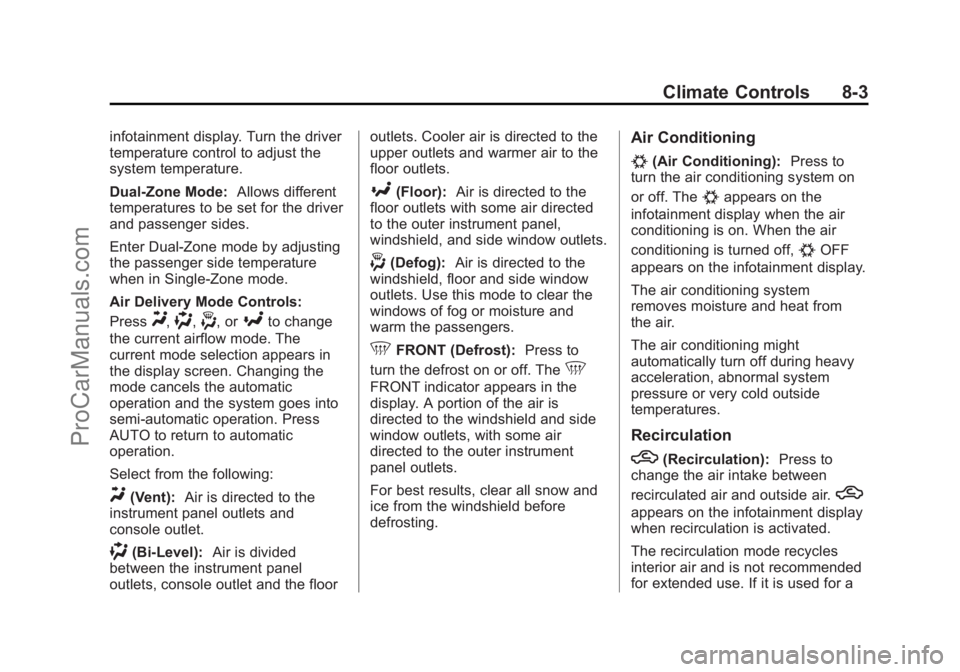
Air Delivery Mode Controls:
Press
Y,),-, or[to change
the current airflow mode. The
current mode selection appears in
the display screen. Changing the
mode cancels the automatic
operation and the system goes into
semi-automatic operation. Press
AUTO to return to automatic
operation.
Select from the following:
Y(Vent): Air is directed to the
instrument panel outlets and
console outlet.
)(Bi-Level): Air is divided
between the instrument panel
outlets, console outlet and the floor outlets. Cooler air is directed to the
upper outlets and warmer air to the
floor outlets.
[(Floor):
Air is directed to the
floor outlets with some air directed
to the outer instrument panel,
windshield, and side window outlets.
-(Defog): Air is directed to the
windshield, floor and side window
outlets. Use this mode to clear the
windows of fog or moisture and
warm the passengers.
5FRONT (Defrost): Press to
turn the defrost on or off. The
5
FRONT indicator appears in the
display. A portion of the air is
directed to the windshield and side
window outlets, with some air
directed to the outer instrument
panel outlets.
For best results, clear all snow and
ice from the windshield before
defrosting.
Air Conditioning
#(Air Conditioning): Press to
turn the air conditioning system on
or off. The
#appears on the
infotainment display when the air
conditioning is on. When the air
conditioning is turned off,
#OFF
appears on the infotainment display.
The air conditioning system
removes moisture and heat from
the air.
The air conditioning might
automatically turn off during heavy
acceleration, abnormal system
pressure or very cold outside
temperatures.
Recirculation
h(Recirculation): Press to
change the air intake between
recirculated air and outside air.
h
appears on the infotainment display
when recirculation is activated.
The recirculation mode recycles
interior air and is not recommended
for extended use. If it is used for a
ProCarManuals.com
Page 230 of 422
Black plate (4,1)Chevrolet SS Sedan Owner Manual (GMNA-Localizing-U.S.-6014851) - 2014 -
1st Edition - 8/22/13
8-4 Climate Controls
long period of time, the system
automatically lets some outside air
into the vehicle for ventilation.
Do not use the recirculation mode if
occupants are smoking.
The recirculation mode cannot be
turned on in defrost mode.
AUTO
his displayed when the
system is automatically controlling
the combination of outside and
recirculated air for best
performance.
Pollution Mode: This mode selects
recirculation when the vehicle speed
is less than 15 km/h (9 mph) to
prevent exhaust fumes from
entering the vehicle in slow moving
traffic.
To select, see “Pollution Mode” in
the Climate and Air Quality menu
under Vehicle Personalization on
page 5-33.
Rear Window Defogger
The rear window defogger uses a
warming grid to remove fog or frost
from the rear window. It only works
when the ignition is in ON/RUN.
+REAR (Rear Window
Defogger): Press to turn the rear
window defogger on or off. The
indicator on the button turns on. The
rear window defogger turns off
automatically if it is left on.
{Caution
Using a razor blade or sharp
object on the inside rear window
can damage the antenna or
defogger. Repairs would not be
covered by the vehicle warranty.
Do not stick anything to the rear
window.
Heated Mirrors: If equipped with
heated outside rearview mirrors, the
mirrors heat to help clear fog or frost
from the surface of the mirror when the rear window defog button is
pressed. See
Heated Mirrors on
page 2-17.
Sensors
The automatic climate control
system uses sensors to maintain
temperatures. The solar sensor is
on the instrument panel near the
windshield, and the outside
temperature sensor is in front of the
radiator.
The solar sensor monitors the solar
radiation when operating in AUTO
mode, adjusting the temperature,
fan speed and air delivery.
The system may also supply cooler
air to the side of the vehicle facing
the sun. The recirculation mode will
also be activated, as necessary.
The outside temperature sensor can
be affected by radiant heat when
the vehicle is not moving.
To prevent false temperature
readings, the displayed temperature
will not update at low vehicle
speeds.
ProCarManuals.com
Page 232 of 422
Black plate (6,1)Chevrolet SS Sedan Owner Manual (GMNA-Localizing-U.S.-6014851) - 2014 -
1st Edition - 8/22/13
8-6 Climate Controls
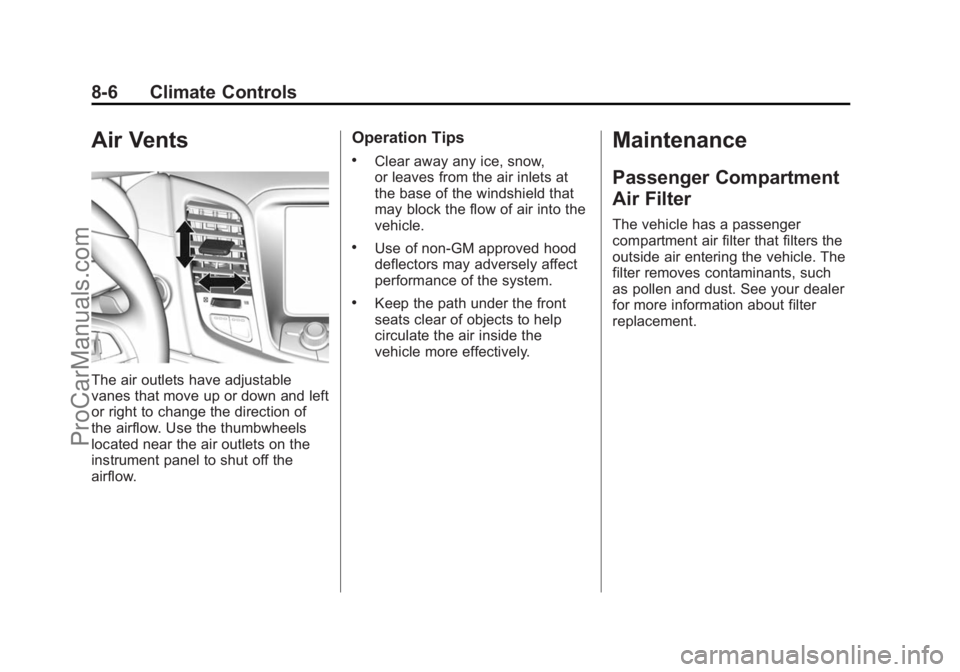
Air Vents
The air outlets have adjustable
vanes that move up or down and left
or right to change the direction of
the airflow. Use the thumbwheels
located near the air outlets on the
instrument panel to shut off the
airflow.
Operation Tips
.Clear away any ice, snow,
or leaves from the air inlets at
the base of the windshield that
may block the flow of air into the
vehicle.
.Use of non-GM approved hood
deflectors may adversely affect
performance of the system.
.Keep the path under the front
seats clear of objects to help
circulate the air inside the
vehicle more effectively.
Maintenance
Passenger Compartment
Air Filter
The vehicle has a passenger
compartment air filter that filters the
outside air entering the vehicle. The
filter removes contaminants, such
as pollen and dust. See your dealer
for more information about filter
replacement.
ProCarManuals.com
Page 241 of 422
Black plate (9,1)Chevrolet SS Sedan Owner Manual (GMNA-Localizing-U.S.-6014851) - 2014 -
1st Edition - 8/22/13
Driving and Operating 9-9
Blizzard Conditions
Being stuck in snow can be a
serious situation. Stay with the
vehicle unless there is help nearby.
If possible, use Roadside
Assistance. SeeRoadside
Assistance Program on page 13-5.
To get help and keep everyone in
the vehicle safe:
.Turn on the hazard warning
flashers.
.Tie a red cloth to an outside
mirror.
{Warning
Snow can trap engine exhaust
under the vehicle. This may
cause exhaust gases to get
inside. Engine exhaust contains
carbon monoxide (CO) which
cannot be seen or smelled. It can
cause unconsciousness and even
death.
(Continued)
Warning (Continued)
If the vehicle is stuck in the snow:
.Clear away snow from around
the base of your vehicle,
especially any that is blocking
the exhaust pipe.
.Check again from time to
time to be sure snow does
not collect there.
.Open a window about 5 cm
(2 in) on the side of the
vehicle that is away from the
wind to bring in fresh air.
.Fully open the air outlets on
or under the instrument
panel.
.Adjust the climate control
system to a setting that
circulates the air inside the(Continued)
Warning (Continued)
vehicle and set the fan speed to
the highest setting. See “Climate
Control Systems”.
For more information about
carbon monoxide, see Engine
Exhaust on page 9-21.
To save fuel, run the engine for only
short periods as needed to warm
the vehicle and then shut the engine
off and close the window most of
the way to save heat. Repeat this
until help arrives but only when you
feel really uncomfortable from the
cold. Moving about to keep warm
also helps.
If it takes some time for help to
arrive, now and then when you run
the engine, push the accelerator
pedal slightly so the engine runs
faster than the idle speed. This
keeps the battery charged to restart
ProCarManuals.com
Page 283 of 422
Black plate (1,1)Chevrolet SS Sedan Owner Manual (GMNA-Localizing-U.S.-6014851) - 2014 -
1st Edition - 8/22/13
Vehicle Care 10-1
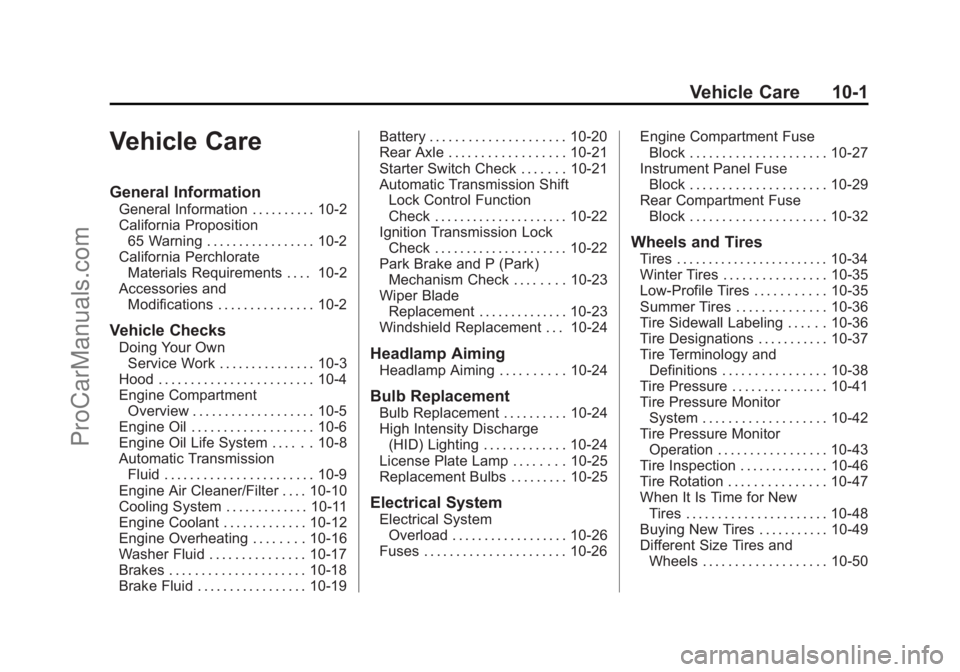
Vehicle Care
General Information
General Information . . . . . . . . . . 10-2
California Proposition65 Warning . . . . . . . . . . . . . . . . . 10-2
California Perchlorate Materials Requirements . . . . 10-2
Accessories and Modifications . . . . . . . . . . . . . . . 10-2
Vehicle Checks
Doing Your OwnService Work . . . . . . . . . . . . . . . 10-3
Hood . . . . . . . . . . . . . . . . . . . . . . . . 10-4
Engine Compartment Overview . . . . . . . . . . . . . . . . . . . 10-5
Engine Oil . . . . . . . . . . . . . . . . . . . 10-6
Engine Oil Life System . . . . . . 10-8
Automatic Transmission Fluid . . . . . . . . . . . . . . . . . . . . . . . 10-9
Engine Air Cleaner/Filter . . . . 10-10
Cooling System . . . . . . . . . . . . . 10-11
Engine Coolant . . . . . . . . . . . . . 10-12
Engine Overheating . . . . . . . . 10-16
Washer Fluid . . . . . . . . . . . . . . . 10-17
Brakes . . . . . . . . . . . . . . . . . . . . . 10-18
Brake Fluid . . . . . . . . . . . . . . . . . 10-19 Battery . . . . . . . . . . . . . . . . . . . . . 10-20
Rear Axle . . . . . . . . . . . . . . . . . . 10-21
Starter Switch Check . . . . . . . 10-21
Automatic Transmission Shift
Lock Control Function
Check . . . . . . . . . . . . . . . . . . . . . 10-22
Ignition Transmission Lock Check . . . . . . . . . . . . . . . . . . . . . 10-22
Park Brake and P (Park) Mechanism Check . . . . . . . . 10-23
Wiper Blade Replacement . . . . . . . . . . . . . . 10-23
Windshield Replacement . . . 10-24Headlamp Aiming
Headlamp Aiming . . . . . . . . . . 10-24
Bulb Replacement
Bulb Replacement . . . . . . . . . . 10-24
High Intensity Discharge (HID) Lighting . . . . . . . . . . . . . 10-24
License Plate Lamp . . . . . . . . 10-25
Replacement Bulbs . . . . . . . . . 10-25
Electrical System
Electrical System Overload . . . . . . . . . . . . . . . . . . 10-26
Fuses . . . . . . . . . . . . . . . . . . . . . . 10-26 Engine Compartment Fuse
Block . . . . . . . . . . . . . . . . . . . . . 10-27
Instrument Panel Fuse Block . . . . . . . . . . . . . . . . . . . . . 10-29
Rear Compartment Fuse
Block . . . . . . . . . . . . . . . . . . . . . 10-32
Wheels and Tires
Tires . . . . . . . . . . . . . . . . . . . . . . . . 10-34
Winter Tires . . . . . . . . . . . . . . . . 10-35
Low-Profile Tires . . . . . . . . . . . 10-35
Summer Tires . . . . . . . . . . . . . . 10-36
Tire Sidewall Labeling . . . . . . 10-36
Tire Designations . . . . . . . . . . . 10-37
Tire Terminology andDefinitions . . . . . . . . . . . . . . . . 10-38
Tire Pressure . . . . . . . . . . . . . . . 10-41
Tire Pressure Monitor
System . . . . . . . . . . . . . . . . . . . 10-42
Tire Pressure Monitor Operation . . . . . . . . . . . . . . . . . 10-43
Tire Inspection . . . . . . . . . . . . . . 10-46
Tire Rotation . . . . . . . . . . . . . . . 10-47
When It Is Time for New Tires . . . . . . . . . . . . . . . . . . . . . . 10-48
Buying New Tires . . . . . . . . . . . 10-49
Different Size Tires and Wheels . . . . . . . . . . . . . . . . . . . 10-50
ProCarManuals.com
Page 286 of 422
Black plate (4,1)Chevrolet SS Sedan Owner Manual (GMNA-Localizing-U.S.-6014851) - 2014 -
1st Edition - 8/22/13
10-4 Vehicle Care
Hood
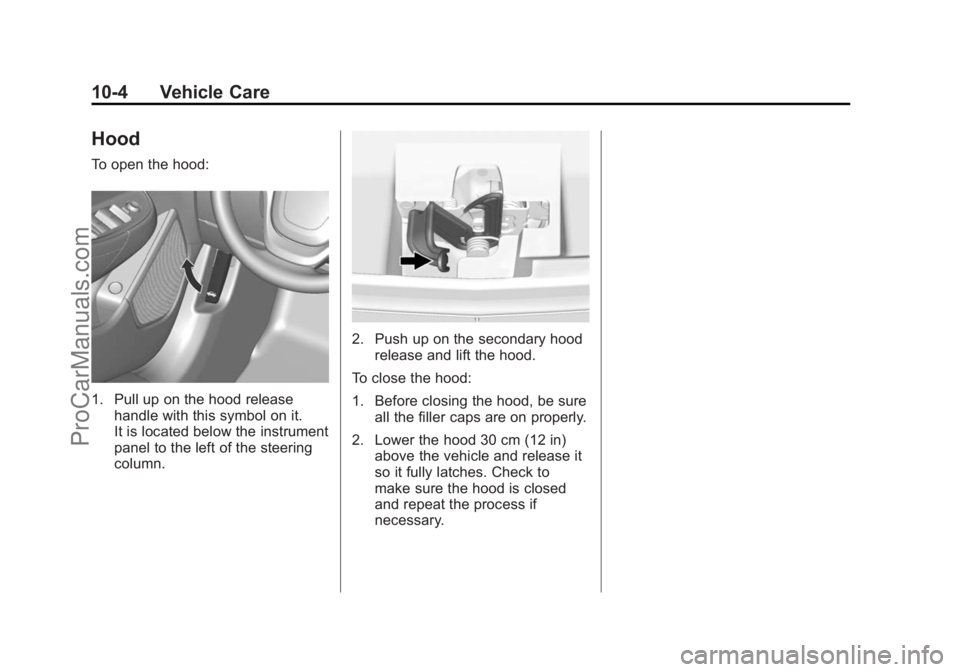
To open the hood:
1. Pull up on the hood releasehandle with this symbol on it.
It is located below the instrument
panel to the left of the steering
column.
2. Push up on the secondary hoodrelease and lift the hood.
To close the hood:
1. Before closing the hood, be sure all the filler caps are on properly.
2. Lower the hood 30 cm (12 in) above the vehicle and release it
so it fully latches. Check to
make sure the hood is closed
and repeat the process if
necessary.
ProCarManuals.com
Page 298 of 422
Black plate (16,1)Chevrolet SS Sedan Owner Manual (GMNA-Localizing-U.S.-6014851) - 2014 -
1st Edition - 8/22/13
10-16 Vehicle Care
{Caution
If the pressure cap is not tightly
installed, coolant loss and
possible engine damage may
occur. Be sure the cap is properly
and tightly secured.
Engine Overheating
The vehicle has an indicator to warn
of engine overheating.
There is an engine coolant
temperature gauge on your vehicle's
instrument panel. SeeEngine
Coolant Temperature Gauge on
page 5-9.
You may decide not to lift the hood
when this warning appears, but
instead get service help right away.
See Roadside Assistance Program
on page 13-5.
If you do decide to lift the hood,
make sure the vehicle is parked on
a level surface. Then check to see if the engine
cooling fans are running. If the
engine is overheating, both fans
should be running. If they are not,
do not continue to run the engine
and have the vehicle serviced.
{Caution
Running the engine without
coolant may cause damage or a
fire. Vehicle damage would not be
covered by the vehicle warranty.
If Steam is Coming from the
Engine Compartment
{Warning
Steam from an overheated engine
can burn you badly, even if you
just open the hood. Stay away
from the engine if you see or hear
steam coming from it. Just turn it
off and get everyone away from
the vehicle until it cools down.
(Continued)
Warning (Continued)
Wait until there is no sign of
steam or coolant before you open
the hood.
If you keep driving when the
engine is overheated, the liquids
in it can catch fire. You or others
could be badly burned. Stop the
engine if it overheats, and get out
of the vehicle until the engine
is cool.
If No Steam is Coming from
the Engine Compartment
If an engine overheat warning is
displayed but no steam can be seen
or heard, the problem may not be
too serious. Sometimes the engine
can get a little too hot when the
vehicle:
.Climbs a long hill on a hot day.
.Stops after high-speed driving.
.Idles for long periods in traffic.
ProCarManuals.com
Page 311 of 422
Black plate (29,1)Chevrolet SS Sedan Owner Manual (GMNA-Localizing-U.S.-6014851) - 2014 -
1st Edition - 8/22/13
Vehicle Care 10-29
FusesUsage
F44 Left HID Headlamp
F45 Right HID Headlamp
F46 Left & Right High-Beam Headlamp
F47 Horn
F48 Engine Cooling Fan
F49 Automatic Headlamp Leveling
F50 Transmission Control Module Ignition
F51 Engine Control Module Ignition
F52 Brake Vacuum Pump
F53 Air Conditioning Compressor Clutch
F54 Vaporizer Control Module
Relays Relays Usage
R1 Driving Lamps Relays
Usage
R2 Headlamp Washer
R3 Rear Washer Pump
R4 Front Washer Pump
R5 Rear Defogger
R6 Front Wiper Control
R7 Wiper Speed
R8 Engine Control Module
R9 Not Used
R10 INCLR Pump R11 Not Used
R12 Rear Wiper Control
R13 Fog Lamps
R14 Low-Beam Headlamps
R15 High-Beam Headlamps
R16 Starter
R17 Run/Crank Relays
Usage
R18 Brake Vacuum Pump
R19 Air Conditioning Control
R20 Horn
Relays R3, R4, R12, R13, and R20
are PCB mounted relays.
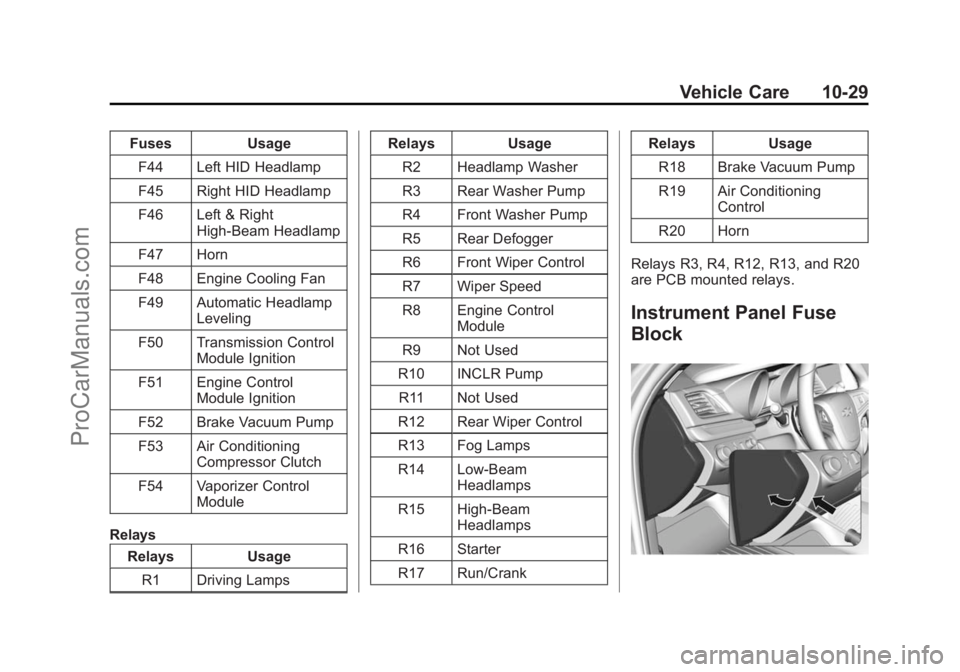
Instrument Panel Fuse
Block
ProCarManuals.com
Page 312 of 422
Black plate (30,1)Chevrolet SS Sedan Owner Manual (GMNA-Localizing-U.S.-6014851) - 2014 -
1st Edition - 8/22/13
10-30 Vehicle Care
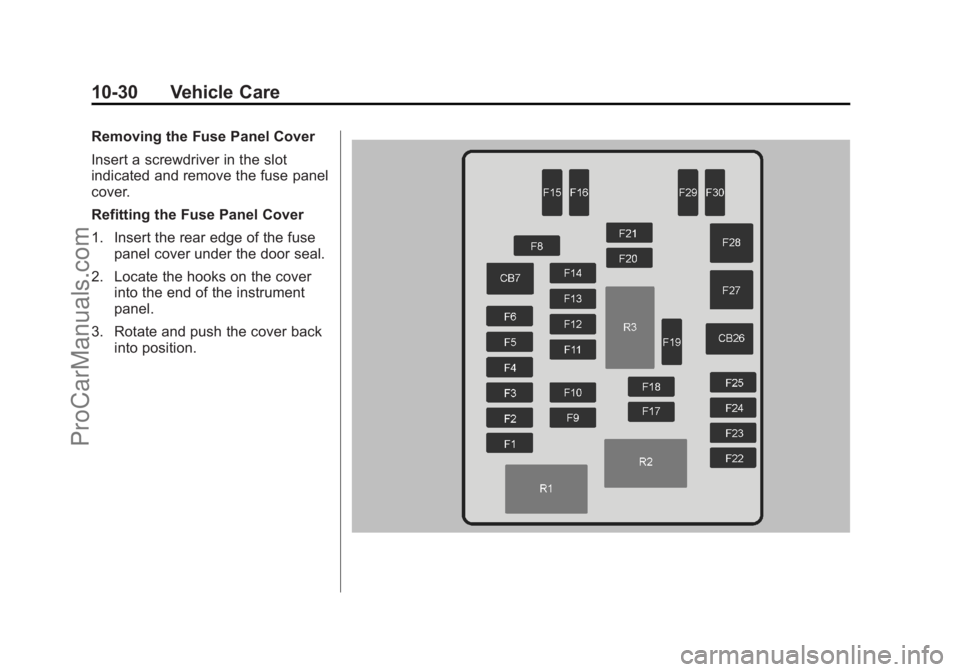
Removing the Fuse Panel Cover
Insert a screwdriver in the slot
indicated and remove the fuse panel
cover.
Refitting the Fuse Panel Cover
1. Insert the rear edge of the fusepanel cover under the door seal.
2. Locate the hooks on the cover into the end of the instrument
panel.
3. Rotate and push the cover back into position.
ProCarManuals.com
Page 362 of 422
Black plate (80,1)Chevrolet SS Sedan Owner Manual (GMNA-Localizing-U.S.-6014851) - 2014 -
1st Edition - 8/22/13
10-80 Vehicle Care
Instrument Panel, Leather,
Vinyl, Other Plastic Surfaces,
Low Gloss Paint Surfaces and
Natural Open Pore Wood
Surfaces
Use a soft microfiber cloth
dampened with water to remove
dust and loose dirt. For a more
thorough cleaning, use a soft
microfiber cloth dampened with a
mild soap solution.
{Caution
Soaking or saturating leather,
especially perforated leather, as
well as other interior surfaces,
may cause permanent damage.
Wipe excess moisture from these
surfaces after cleaning and allow
them to dry naturally. Never use
heat, steam, spot lifters, or spot
removers. Do not use cleaners
that contain silicone or wax-based
products. Cleaners containing(Continued)
Caution (Continued)
these solvents can permanently
change the appearance and feel
of leather or soft trim and are not
recommended.
Do not use cleaners that increase
gloss, especially on the instrument
panel. Reflected glare can decrease
visibility through the windshield
under certain conditions.
{Caution
Use of air fresheners may cause
permanent damage to plastics
and painted surfaces. If an air
freshener comes in contact with
any plastic or painted surface in
the vehicle, blot immediately and
clean with a soft cloth dampened
with a mild soap solution.
Damage caused by air fresheners
would not be covered by the
vehicle warranty.
Cargo Cover and
Convenience Net
Wash with warm water and mild
detergent. Do not use chlorine
bleach. Rinse with cold water, and
then dry completely.
Care of Safety Belts
Keep belts clean and dry.
{Warning
Do not bleach or dye safety belts.
It may severely weaken them. In
a crash, they might not be able to
provide adequate protection.
Clean safety belts only with mild
soap and lukewarm water.
ProCarManuals.com