coolant CHEVROLET SS 2016 User Guide
[x] Cancel search | Manufacturer: CHEVROLET, Model Year: 2016, Model line: SS, Model: CHEVROLET SS 2016Pages: 397, PDF Size: 7.17 MB
Page 279 of 397
Chevrolet SS Sedan Owner Manual (GMNA-Localizing-U.S.-9234782) - 2016 -
CRC - 8/24/15
278 Vehicle Care
sewers, streams or bodies of water.
Have the coolant changed by an
authorized service center, familiar
with legal requirements regarding
used coolant disposal. This will help
protect the environment and your
health.
Checking Coolant
The vehicle must be on a level
surface when checking the coolant
level.
To check coolant:1. Turn the ignition off.
2. Locate the coolant recovery reservoir. See Engine
Compartment Overview 0270
ii.
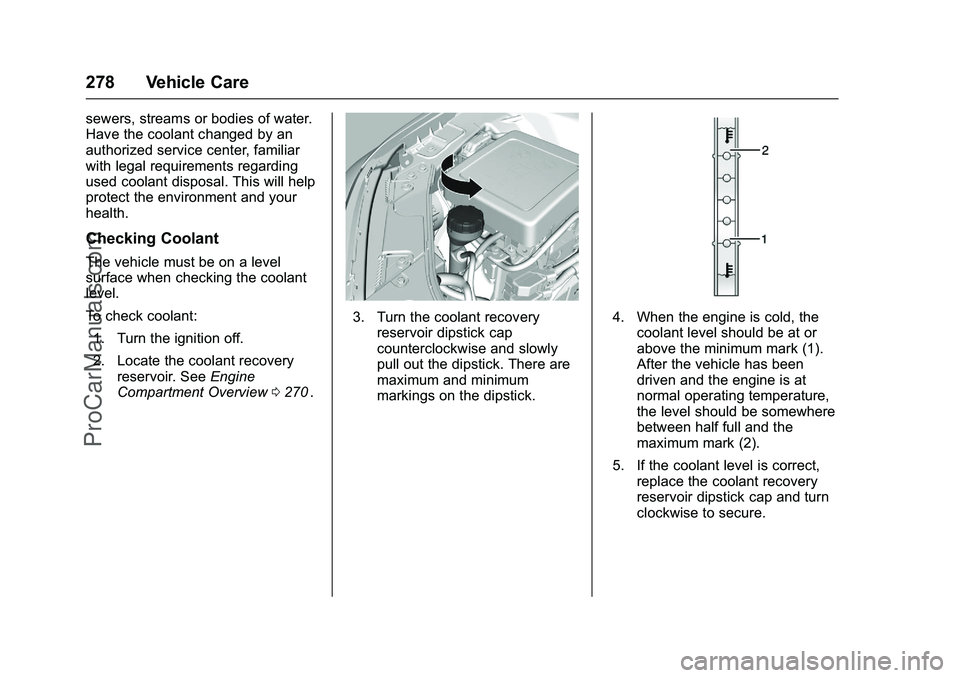
3. Turn the coolant recovery
reservoir dipstick cap
counterclockwise and slowly
pull out the dipstick. There are
maximum and minimum
markings on the dipstick.4. When the engine is cold, thecoolant level should be at or
above the minimum mark (1).
After the vehicle has been
driven and the engine is at
normal operating temperature,
the level should be somewhere
between half full and the
maximum mark (2).
5. If the coolant level is correct, replace the coolant recovery
reservoir dipstick cap and turn
clockwise to secure.
ProCarManuals.com
Page 280 of 397
Chevrolet SS Sedan Owner Manual (GMNA-Localizing-U.S.-9234782) - 2016 -
CRC - 8/24/15
Vehicle Care 279
How to Add Coolant to the
Coolant Recovery Bottle
{Warning
You can be burned if you spill
coolant on hot engine parts.
Coolant contains ethylene glycol
and it will burn if the engine parts
are hot enough. Do not spill
coolant on a hot engine.
Caution
This vehicle has a specific
coolant fill procedure. Failure to
follow this procedure could cause
the engine to overheat and be
severely damaged.
To add coolant: 1. Turn the engine coolant recovery reservoir dipstick cap
counterclockwise 1/8 of a turn
and slowly pull out the dipstick. 2. Pour the coolant into the
engine coolant recovery
reservoir.
3. When the level is correct, as per the markings on the
dipstick, replace the coolant
recovery reservoir dipstick cap
and turn clockwise to secure.
How to Add Coolant to the
Radiator
{Warning
You can be burned if you spill
coolant on hot engine parts.
Coolant contains ethylene glycol
and it will burn if the engine parts
are hot enough. Do not spill
coolant on a hot engine.
Caution
This vehicle has a specific
coolant fill procedure. Failure to
follow this procedure could cause
the engine to overheat and be
severely damaged.
{Warning
An electric engine cooling fan
under the hood can start up even
when the engine is not running
and can cause injury. Keep
hands, clothing, and tools away
from any underhood electric fan.
{Warning
Steam and scalding liquids from a
hot cooling system can blow out
and burn you badly. They are
under pressure, and if you turn
the radiator cap —even a
little —they can come out at high
speed. Never turn the cap when
the cooling system, including the
radiator cap, is hot. Wait for the
cooling system and radiator cap
to cool if you ever have to turn
the pressure cap.
ProCarManuals.com
Page 281 of 397
Chevrolet SS Sedan Owner Manual (GMNA-Localizing-U.S.-9234782) - 2016 -
CRC - 8/24/15
280 Vehicle Care
If no coolant is visible in the engine
coolant recovery reservoir, add
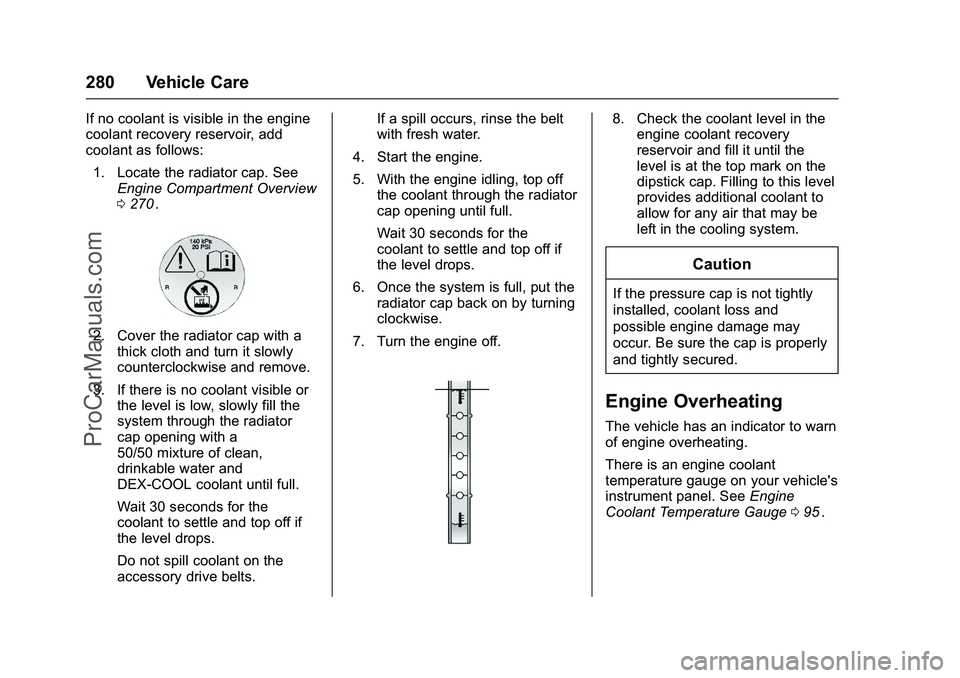
coolant as follows:1. Locate the radiator cap. See Engine Compartment Overview
0270
ii.
2. Cover the radiator cap with a
thick cloth and turn it slowly
counterclockwise and remove.
3. If there is no coolant visible or the level is low, slowly fill the
system through the radiator
cap opening with a
50/50 mixture of clean,
drinkable water and
DEX-COOL coolant until full.
Wait 30 seconds for the
coolant to settle and top off if
the level drops.
Do not spill coolant on the
accessory drive belts. If a spill occurs, rinse the belt
with fresh water.
4. Start the engine.
5. With the engine idling, top off the coolant through the radiator
cap opening until full.
Wait 30 seconds for the
coolant to settle and top off if
the level drops.
6. Once the system is full, put the radiator cap back on by turning
clockwise.
7. Turn the engine off.
8. Check the coolant level in the engine coolant recovery
reservoir and fill it until the
level is at the top mark on the
dipstick cap. Filling to this level
provides additional coolant to
allow for any air that may be
left in the cooling system.
Caution
If the pressure cap is not tightly
installed, coolant loss and
possible engine damage may
occur. Be sure the cap is properly
and tightly secured.
Engine Overheating
The vehicle has an indicator to warn
of engine overheating.
There is an engine coolant
temperature gauge on your vehicle's
instrument panel. See Engine
Coolant Temperature Gauge 095
ii.
ProCarManuals.com
Page 282 of 397
Chevrolet SS Sedan Owner Manual (GMNA-Localizing-U.S.-9234782) - 2016 -
CRC - 8/24/15
Vehicle Care 281
You may decide not to lift the hood
when this warning appears, but
instead get service help right away.
SeeRoadside Assistance Program
0 365
ii.
If you do decide to lift the hood,
make sure the vehicle is parked on
a level surface.
Then check to see if the engine
cooling fans are running. If the
engine is overheating, both fans
should be running. If they are not,
do not continue to run the engine
and have the vehicle serviced.
Caution
Running the engine without
coolant may cause damage or a
fire. Vehicle damage would not be
covered by the vehicle warranty.
If Steam is Coming from the
Engine Compartment
{Warning
Steam from an overheated engine
can burn you badly, even if you
just open the hood. Stay away
from the engine if you see or hear
steam coming from it. Just turn it
off and get everyone away from
the vehicle until it cools down.
Wait until there is no sign of
steam or coolant before you open
the hood.
If you keep driving when the
engine is overheated, the liquids
in it can catch fire. You or others
could be badly burned. Stop the
engine if it overheats, and get out
of the vehicle until the engine
is cool.
If No Steam is Coming from
the Engine Compartment
If an engine overheat warning is
displayed but no steam can be seen
or heard, the problem may not be too serious. Sometimes the engine
can get a little too hot when the
vehicle:
.
Climbs a long hill on a hot day.
. Stops after high-speed driving.
. Idles for long periods in traffic.
If the overheat warning is displayed
with no sign of steam: 1. Turn the air conditioning off.
2. Turn the heater on to the highest temperature and to the
highest fan speed. Open the
windows as necessary.
3. When it is safe to do so, pull off the road, shift to P (Park) or
N (Neutral), and let the
engine idle.
If the temperature overheat gauge is
no longer in the overheat zone or an
overheat warning no longer
displays, the vehicle can be driven.
Continue to drive the vehicle slowly
for about 10 minutes. Keep a safe
vehicle distance from the vehicle in
front. If the warning does not come
ProCarManuals.com
Page 283 of 397
Chevrolet SS Sedan Owner Manual (GMNA-Localizing-U.S.-9234782) - 2016 -
CRC - 8/24/15
282 Vehicle Care
back on, continue to drive normally
and have the cooling system
checked for proper fill and function.
If the warning continues, pull over,
stop, and park the vehicle
right away.
If there is no sign of steam, idle the
engine for three minutes while
parked. If the warning is still
displayed, turn off the engine until it
cools down.
Washer Fluid
What to Use
When windshield washer fluid is
needed, be sure to read the
manufacturer's instructions before
use. If operating the vehicle in an
area where the temperature may fall
below freezing, use a fluid that has
sufficient protection against
freezing.
Adding Washer Fluid
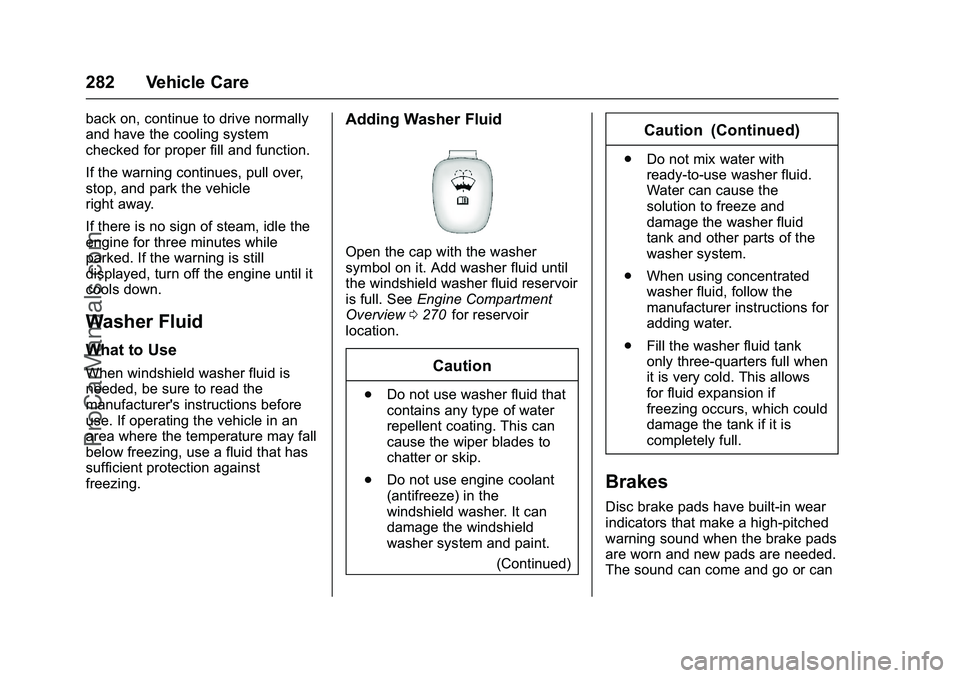
Open the cap with the washer
symbol on it. Add washer fluid until
the windshield washer fluid reservoir
is full. SeeEngine Compartment
Overview 0270
iifor reservoir
location.
Caution
. Do not use washer fluid that
contains any type of water
repellent coating. This can
cause the wiper blades to
chatter or skip.
. Do not use engine coolant
(antifreeze) in the
windshield washer. It can
damage the windshield
washer system and paint.
(Continued)
Caution (Continued)
.Do not mix water with
ready-to-use washer fluid.
Water can cause the
solution to freeze and
damage the washer fluid
tank and other parts of the
washer system.
. When using concentrated
washer fluid, follow the
manufacturer instructions for
adding water.
. Fill the washer fluid tank
only three-quarters full when
it is very cold. This allows
for fluid expansion if
freezing occurs, which could
damage the tank if it is
completely full.
Brakes
Disc brake pads have built-in wear
indicators that make a high-pitched
warning sound when the brake pads
are worn and new pads are needed.
The sound can come and go or can
ProCarManuals.com
Page 304 of 397
Chevrolet SS Sedan Owner Manual (GMNA-Localizing-U.S.-9234782) - 2016 -
CRC - 8/24/15
Vehicle Care 303
Tire Terminology and
Definitions
Air Pressure:The amount of
air inside the tire pressing
outward on each square inch of
the tire. Air pressure is
expressed in kPa (kilopascal)
or psi (pounds per square inch).
Accessory Weight
:The
combined weight of optional
accessories. Some examples of
optional accessories are
automatic transmission, power
windows, power seats, and air
conditioning.
Aspect Ratio
:The relationship
of a tire's height to its width.
Belt
:A rubber coated layer of
cords between the plies and the
tread. Cords may be made from
steel or other reinforcing
materials. Bead
:The tire bead contains
steel wires wrapped by steel
cords that hold the tire onto
the rim.
Bias Ply Tire
:A pneumatic tire
in which the plies are laid at
alternate angles less than
90 degrees to the centerline of
the tread.
Cold Tire Pressure
:The
amount of air pressure in a tire,
measured in kPa (kilopascal)
or psi (pounds per square inch)
before a tire has built up heat
from driving. See Tire Pressure
0 305
ii.
Curb Weight
:The weight of a
motor vehicle with standard and
optional equipment including the
maximum capacity of fuel, oil,
and coolant, but without
passengers and cargo.
DOT Markings
:A code molded
into the sidewall of a tire
signifying that the tire is in
compliance with the U.S. Department of Transportation
(DOT) Motor Vehicle Safety
Standards. The DOT code
includes the Tire Identification
Number (TIN), an alphanumeric
designator which can also
identify the tire manufacturer,
production plant, brand, and
date of production.
GVWR
:Gross Vehicle Weight
Rating. See Vehicle Load Limits
0 223
ii.
GAWR FRT
:Gross Axle Weight
Rating for the front axle. See
Vehicle Load Limits 0223
ii.
GAWR RR
:Gross Axle Weight
Rating for the rear axle. See
Vehicle Load Limits 0223
ii.
Intended Outboard Sidewall
:
The side of an asymmetrical tire
that must always face outward
when mounted on a vehicle.
Kilopascal (kPa)
:The metric
unit for air pressure.
ProCarManuals.com
Page 347 of 397
Chevrolet SS Sedan Owner Manual (GMNA-Localizing-U.S.-9234782) - 2016 -
CRC - 8/24/15
346 Service and Maintenance
Maintenance
Schedule
Owner Checks and Services
At Each Fuel Stop
.Check the engine oil level. See
Engine Oil 0271
ii.
Once a Month
. Check the tire inflation
pressures. See Tire Pressure
0 305
ii.
. Inspect the tires for wear. See
Tire Inspection 0311
ii.
. Check the windshield washer
fluid level. See Washer Fluid
0 282
ii.
Engine Oil Change
When the CHANGE ENGINE OIL
SOON message displays, have the
engine oil and filter changed within
the next 1 000 km/600 mi. If driven
under the best conditions, the engine oil life system may not
indicate the need for vehicle service
for up to a year. The engine oil and
filter must be changed at least once
a year and the oil life system must
be reset. Your trained dealer
technician can perform this work.
If the engine oil life system is reset
accidentally, service the vehicle
within 5 000 km/3,000 mi since the
last service. Reset the oil life
system when the oil is changed.
See
Engine Oil Life System 0273
ii.
Tire Rotation and Required
Services Every 12 000 km/
7,500 mi
Rotate the tires, if recommended for
the vehicle, and perform the
following services. See Tire
Rotation 0311
ii.
. Check engine oil level and oil
life percentage. If needed,
change engine oil and filter, and
reset oil life system. See Engine
Oil 0271
iiand Engine Oil Life
System 0273ii. .
Check engine coolant level. See
Engine Coolant 0277
ii.
. Check windshield washer fluid
level. See Washer Fluid 0282
ii.
. Visually inspect windshield wiper
blades for wear, cracking,
or contamination. See Exterior
Care 0335
ii. Replace worn or
damaged wiper blades. See
Wiper Blade Replacement
0 287
ii.
. Check tire inflation pressures.
See Tire Pressure 0305
ii.
. Check spare wheel retainer.
If loose, tighten with a torque
wrench to 4.5 +/− 0.5Y.
. Inspect tire wear. See Tire
Inspection 0311
ii.
. Visually check for fluid leaks.
. Inspect engine air cleaner filter.
See Engine Air Cleaner/Filter
0 275
ii.
ProCarManuals.com
Page 355 of 397
Chevrolet SS Sedan Owner Manual (GMNA-Localizing-U.S.-9234782) - 2016 -
CRC - 8/24/15
354 Service and Maintenance
Recommended Fluids
Recommended Fluids and Lubricants
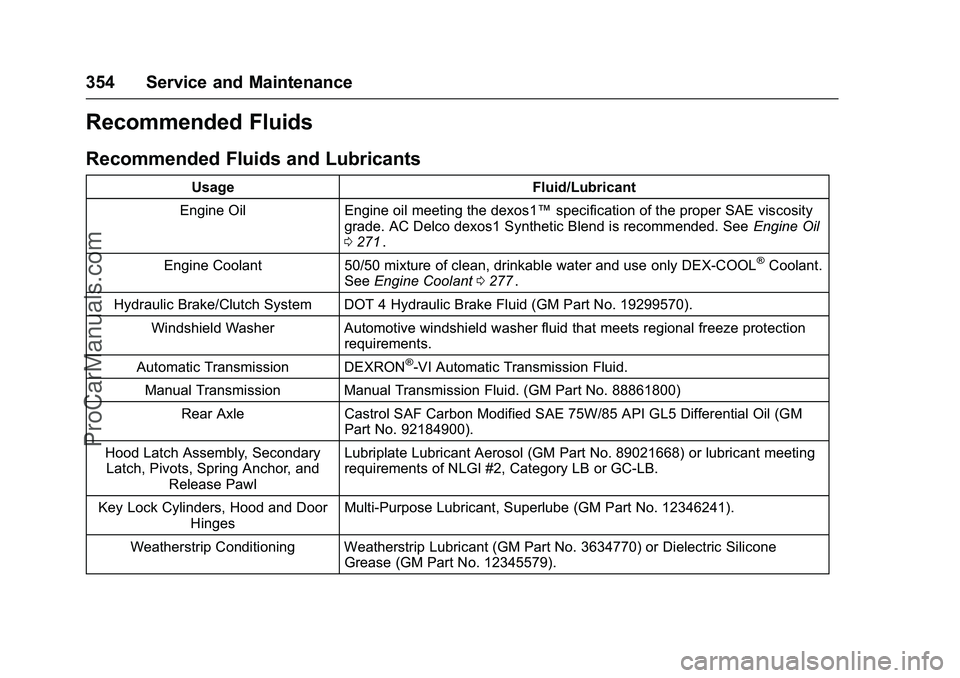
UsageFluid/Lubricant
Engine Oil Engine oil meeting the dexos1™ specification of the proper SAE viscosity
grade. AC Delco dexos1 Synthetic Blend is recommended. See Engine Oil
0 271
ii.
Engine Coolant 50/50 mixture of clean, drinkable water and use only DEX-COOL
®Coolant.
See Engine Coolant 0277ii.
Hydraulic Brake/Clutch System DOT 4 Hydraulic Brake Fluid (GM Part No. 19299570). Windshield Washer Automotive windshield washer fluid that meets regional freeze protection requirements.
Automatic Transmission DEXRON
®-VI Automatic Transmission Fluid.
Manual Transmission Manual Transmission Fluid. (GM Part No. 88861800) Rear Axle Castrol SAF Carbon Modified SAE 75W/85 API GL5 Differential Oil (GM
Part No. 92184900).
Hood Latch Assembly, Secondary Latch, Pivots, Spring Anchor, and Release Pawl Lubriplate Lubricant Aerosol (GM Part No. 89021668) or lubricant meeting
requirements of NLGI #2, Category LB or GC-LB.
Key Lock Cylinders, Hood and Door Hinges Multi-Purpose Lubricant, Superlube (GM Part No. 12346241).
Weatherstrip Conditioning Weatherstrip Lubricant (GM Part No. 3634770) or Dielectric Silicone Grease (GM Part No. 12345579).
ProCarManuals.com
Page 388 of 397
Chevrolet SS Sedan Owner Manual (GMNA-Localizing-U.S.-9234782) - 2016 -
CRC - 8/24/15
Index 387
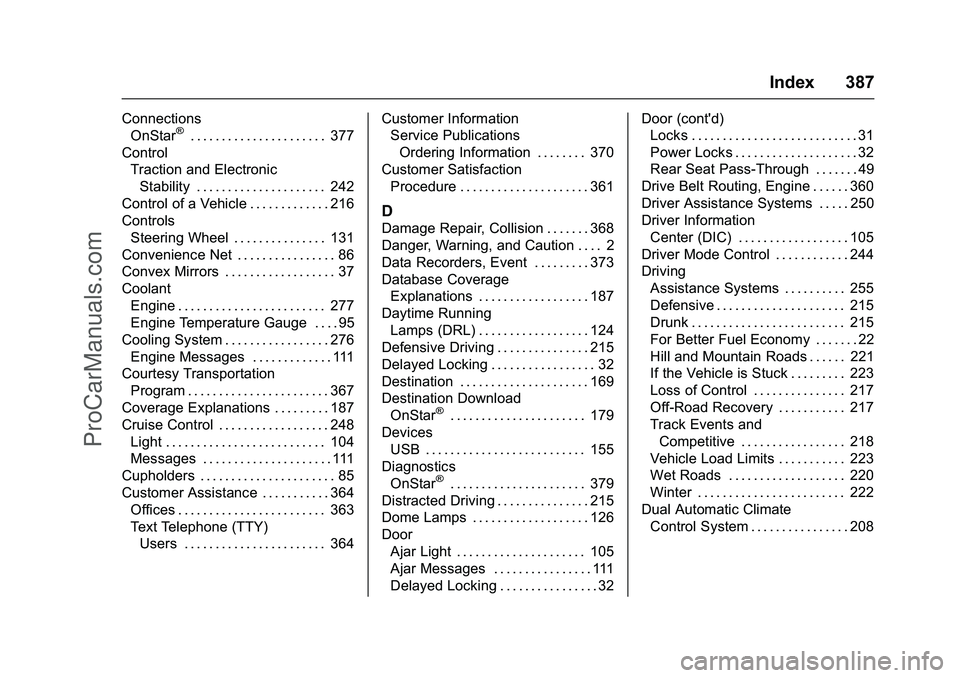
ConnectionsOnStar®. . . . . . . . . . . . . . . . . . . . . . 377
Control Traction and ElectronicStability . . . . . . . . . . . . . . . . . . . . . 242
Control of a Vehicle . . . . . . . . . . . . . 216
Controls Steering Wheel . . . . . . . . . . . . . . . 131
Convenience Net . . . . . . . . . . . . . . . . 86
Convex Mirrors . . . . . . . . . . . . . . . . . . 37
Coolant Engine . . . . . . . . . . . . . . . . . . . . . . . . 277
Engine Temperature Gauge . . . . 95
Cooling System . . . . . . . . . . . . . . . . . 276 Engine Messages . . . . . . . . . . . . . 111
Courtesy Transportation
Program . . . . . . . . . . . . . . . . . . . . . . . 367
Coverage Explanations . . . . . . . . . 187
Cruise Control . . . . . . . . . . . . . . . . . . 248 Light . . . . . . . . . . . . . . . . . . . . . . . . . . 104
Messages . . . . . . . . . . . . . . . . . . . . . 111
Cupholders . . . . . . . . . . . . . . . . . . . . . . 85
Customer Assistance . . . . . . . . . . . 364 Offices . . . . . . . . . . . . . . . . . . . . . . . . 363
Text Telephone (TTY)Users . . . . . . . . . . . . . . . . . . . . . . . 364 Customer Information
Service Publications
Ordering Information . . . . . . . . 370
Customer Satisfaction Procedure . . . . . . . . . . . . . . . . . . . . . 361
D
Damage Repair, Collision . . . . . . . 368
Danger, Warning, and Caution . . . . 2
Data Recorders, Event . . . . . . . . . 373
Database CoverageExplanations . . . . . . . . . . . . . . . . . . 187
Daytime Running Lamps (DRL) . . . . . . . . . . . . . . . . . . 124
Defensive Driving . . . . . . . . . . . . . . . 215
Delayed Locking . . . . . . . . . . . . . . . . . 32
Destination . . . . . . . . . . . . . . . . . . . . . 169
Destination Download OnStar
®. . . . . . . . . . . . . . . . . . . . . . 179
Devices USB . . . . . . . . . . . . . . . . . . . . . . . . . . 155
Diagnostics OnStar
®. . . . . . . . . . . . . . . . . . . . . . 379
Distracted Driving . . . . . . . . . . . . . . . 215
Dome Lamps . . . . . . . . . . . . . . . . . . . 126
Door Ajar Light . . . . . . . . . . . . . . . . . . . . . 105
Ajar Messages . . . . . . . . . . . . . . . . 111
Delayed Locking . . . . . . . . . . . . . . . . 32 Door (cont'd)
Locks . . . . . . . . . . . . . . . . . . . . . . . . . . . 31
Power Locks . . . . . . . . . . . . . . . . . . . . 32
Rear Seat Pass-Through . . . . . . . 49
Drive Belt Routing, Engine . . . . . . 360
Driver Assistance Systems . . . . . 250
Driver Information Center (DIC) . . . . . . . . . . . . . . . . . . 105
Driver Mode Control . . . . . . . . . . . . 244
Driving
Assistance Systems . . . . . . . . . . 255
Defensive . . . . . . . . . . . . . . . . . . . . . 215
Drunk . . . . . . . . . . . . . . . . . . . . . . . . . 215
For Better Fuel Economy . . . . . . . 22
Hill and Mountain Roads . . . . . . 221
If the Vehicle is Stuck . . . . . . . . . 223
Loss of Control . . . . . . . . . . . . . . . 217
Off-Road Recovery . . . . . . . . . . . 217
Track Events andCompetitive . . . . . . . . . . . . . . . . . 218
Vehicle Load Limits . . . . . . . . . . . 223
Wet Roads . . . . . . . . . . . . . . . . . . . 220
Winter . . . . . . . . . . . . . . . . . . . . . . . . 222
Dual Automatic Climate Control System . . . . . . . . . . . . . . . . 208
ProCarManuals.com
Page 389 of 397
Chevrolet SS Sedan Owner Manual (GMNA-Localizing-U.S.-9234782) - 2016 -
CRC - 8/24/15
388 Index
E
Electric Parking Brake . . . . . . . . . . 240
Electric Parking Brake Light . . . . 100
Electrical Equipment,Add-On . . . . . . . . . . . . . . . . . . . . . . . 265
Electrical System Engine Compartment FuseBlock . . . . . . . . . . . . . . . . . . . . . . . . 291
Fuses . . . . . . . . . . . . . . . . . . . . . . . . 291
Instrument Panel Fuse Block . . . . . . . . . . . . . . . . . . . . . . . . 294
Overload . . . . . . . . . . . . . . . . . . . . . 290
Rear Compartment Fuse Block . . . . . . . . . . . . . . . . . . . . . . . . 296
Emergency OnStar
®. . . . . . . . . . . . . . . . . . . . . . 376
Engine Air Cleaner/Filter . . . . . . . . . . . . . 275
Check and Service EngineSoon Light . . . . . . . . . . . . . . . . . . . . 97
Compartment Overview . . . . . . . 270
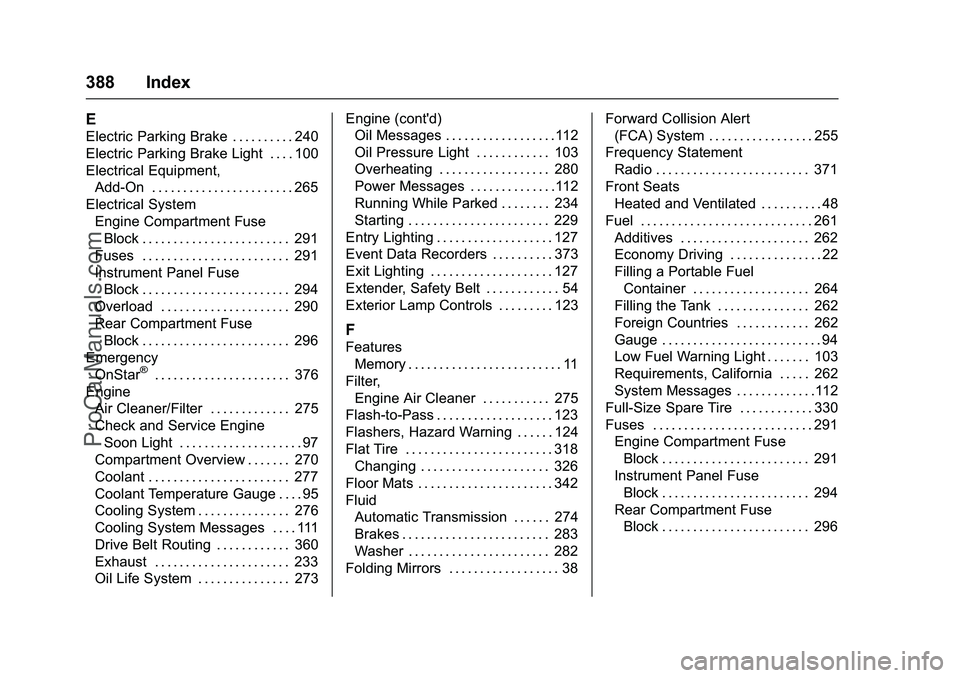
Coolant . . . . . . . . . . . . . . . . . . . . . . . 277
Coolant Temperature Gauge . . . . 95
Cooling System . . . . . . . . . . . . . . . 276
Cooling System Messages . . . . 111
Drive Belt Routing . . . . . . . . . . . . 360
Exhaust . . . . . . . . . . . . . . . . . . . . . . 233
Oil Life System . . . . . . . . . . . . . . . 273 Engine (cont'd)
Oil Messages . . . . . . . . . . . . . . . . . .112
Oil Pressure Light . . . . . . . . . . . . 103
Overheating . . . . . . . . . . . . . . . . . . 280
Power Messages . . . . . . . . . . . . . .112
Running While Parked . . . . . . . . 234
Starting . . . . . . . . . . . . . . . . . . . . . . . 229
Entry Lighting . . . . . . . . . . . . . . . . . . . 127
Event Data Recorders . . . . . . . . . . 373
Exit Lighting . . . . . . . . . . . . . . . . . . . . 127
Extender, Safety Belt . . . . . . . . . . . . 54
Exterior Lamp Controls . . . . . . . . . 123
F
Features Memory . . . . . . . . . . . . . . . . . . . . . . . . . 11
Filter, Engine Air Cleaner . . . . . . . . . . . 275
Flash-to-Pass . . . . . . . . . . . . . . . . . . . 123
Flashers, Hazard Warning . . . . . . 124
Flat Tire . . . . . . . . . . . . . . . . . . . . . . . . 318
Changing . . . . . . . . . . . . . . . . . . . . . 326
Floor Mats . . . . . . . . . . . . . . . . . . . . . . 342
Fluid Automatic Transmission . . . . . . 274
Brakes . . . . . . . . . . . . . . . . . . . . . . . . 283
Washer . . . . . . . . . . . . . . . . . . . . . . . 282
Folding Mirrors . . . . . . . . . . . . . . . . . . 38 Forward Collision Alert
(FCA) System . . . . . . . . . . . . . . . . . 255
Frequency Statement Radio . . . . . . . . . . . . . . . . . . . . . . . . . 371
Front Seats Heated and Ventilated . . . . . . . . . . 48
Fuel . . . . . . . . . . . . . . . . . . . . . . . . . . . . 261
Additives . . . . . . . . . . . . . . . . . . . . . 262
Economy Driving . . . . . . . . . . . . . . . 22
Filling a Portable FuelContainer . . . . . . . . . . . . . . . . . . . 264
Filling the Tank . . . . . . . . . . . . . . . 262
Foreign Countries . . . . . . . . . . . . 262
Gauge . . . . . . . . . . . . . . . . . . . . . . . . . . 94
Low Fuel Warning Light . . . . . . . 103
Requirements, California . . . . . 262
System Messages . . . . . . . . . . . . .112
Full-Size Spare Tire . . . . . . . . . . . . 330
Fuses . . . . . . . . . . . . . . . . . . . . . . . . . . 291 Engine Compartment FuseBlock . . . . . . . . . . . . . . . . . . . . . . . . 291
Instrument Panel Fuse Block . . . . . . . . . . . . . . . . . . . . . . . . 294
Rear Compartment Fuse Block . . . . . . . . . . . . . . . . . . . . . . . . 296
ProCarManuals.com