clock CHEVROLET SS 2017 1.G User Guide
[x] Cancel search | Manufacturer: CHEVROLET, Model Year: 2017, Model line: SS, Model: CHEVROLET SS 2017 1.GPages: 400, PDF Size: 7.31 MB
Page 248 of 400
Chevrolet SS Sedan Owner Manual (GMNA-Localizing-U.S.-10122752) -2017 - crc - 8/31/16
Driving and Operating 247
Driver Mode Control
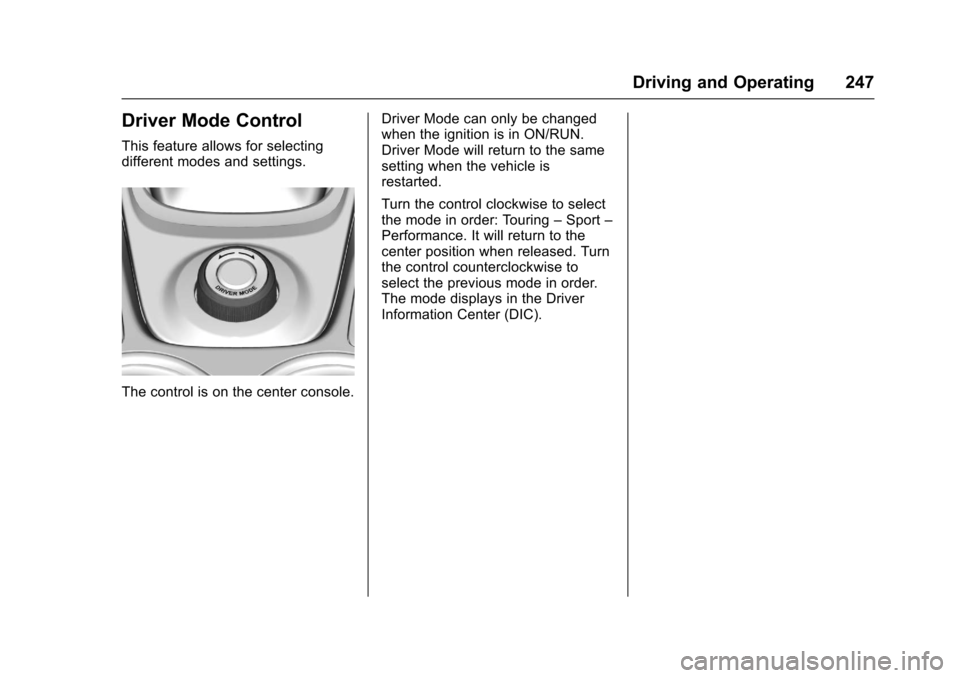
This feature allows for selectingdifferent modes and settings.
The control is on the center console.
Driver Mode can only be changedwhen the ignition is in ON/RUN.Driver Mode will return to the samesetting when the vehicle isrestarted.
Turn the control clockwise to selectthe mode in order: Touring–Sport–Performance. It will return to thecenter position when released. Turnthe control counterclockwise toselect the previous mode in order.The mode displays in the DriverInformation Center (DIC).
Page 268 of 400
Chevrolet SS Sedan Owner Manual (GMNA-Localizing-U.S.-10122752) -2017 - crc - 8/31/16
Driving and Operating 267
The fuel cap is behind a hinged fueldoor on the passenger side of thevehicle. To open the fuel door, pushand release the rearward centeredge of the door.
{Warning
Overfilling the fuel tank by more
than three clicks of a standard fill
nozzle may cause:
.Vehicle performance issues,including engine stalling anddamage to the fuel system.
.Fuel spills.
.Potential fuel fires.
Be careful not to spill fuel. Wait afew seconds after you have finishedpumping before removing thenozzle. Clean fuel from paintedsurfaces as soon as possible. SeeExterior Care0338.
When replacing the fuel cap, turn itclockwise until it clicks. Make surethe cap is fully installed. Thediagnostic system can determine ifthe fuel cap has been left off or
improperly installed. This wouldallow fuel to evaporate into theatmosphere. SeeMalfunctionIndicator Lamp (Check EngineLight)0100.
{Warning
If a fire starts while you are
refueling, do not remove the
nozzle. Shut off the flow of fuel by
shutting off the pump or by
notifying the station attendant.
Leave the area immediately.
Caution
If a new fuel cap is needed, be
sure to get the right type of cap
from your dealer. The wrong type
of fuel cap may not fit properly,
may cause the malfunction
indicator lamp to light, and could
damage the fuel tank and
emissions system. See
Malfunction Indicator Lamp
(Check Engine Light)0100.
Filling a Portable Fuel
Container
{Warning
Filling a portable fuel container
while it is in the vehicle can cause
fuel vapors that can ignite either
by static electricity or other
means. You or others could be
badly burned and the vehicle
could be damaged. Always:
.Use approved fuelcontainers.
.Remove the container fromthe vehicle, trunk, or pickupbed before filling.
.Place the container on theground.
.Place the nozzle inside thefill opening of the containerbefore dispensing fuel, andkeep it in contact with the fillopening until filling iscomplete.
(Continued)
Page 283 of 400
Chevrolet SS Sedan Owner Manual (GMNA-Localizing-U.S.-10122752) -2017 - crc - 8/31/16
282 Vehicle Care
Caution
If improper coolant mixture,
inhibitors, or additives are used in
the vehicle cooling system, the
engine could overheat and be
damaged. Too much water in the
mixture can freeze and crack
engine cooling parts. The repairs
would not be covered by the
vehicle warranty. Use only the
proper mixture of engine coolant
for the cooling system. See
Recommended Fluids and
Lubricants0358.
Never dispose of engine coolant byputting it in the trash, pouring it onthe ground, or pouring it intosewers, streams or bodies of water.Have the coolant changed by anauthorized service center, familiarwith legal requirements regardingused coolant disposal. This will helpprotect the environment and yourhealth.
Checking Coolant
The vehicle must be on a levelsurface when checking the coolantlevel.
To c h e c k c o o l a n t :
1. Turn the ignition off.
2. Locate the coolant recoveryreservoir. SeeEngineCompartment Overview0274.
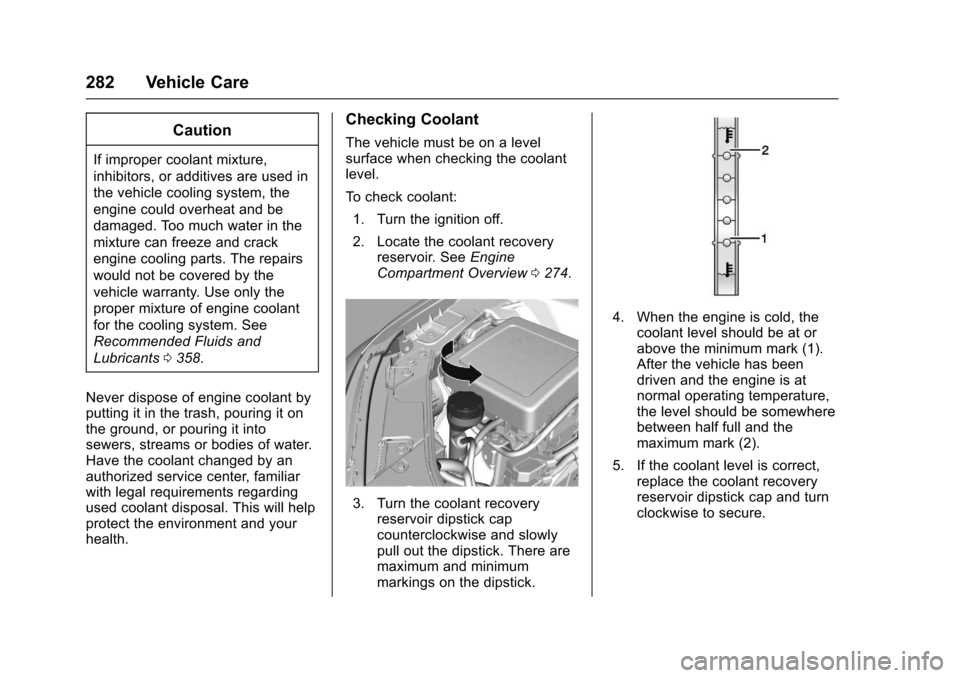
3. Turn the coolant recoveryreservoir dipstick capcounterclockwise and slowlypull out the dipstick. There aremaximum and minimummarkings on the dipstick.
4. When the engine is cold, thecoolant level should be at orabove the minimum mark (1).After the vehicle has beendriven and the engine is atnormal operating temperature,the level should be somewherebetween half full and themaximum mark (2).
5. If the coolant level is correct,replace the coolant recoveryreservoir dipstick cap and turnclockwise to secure.
Page 284 of 400
Chevrolet SS Sedan Owner Manual (GMNA-Localizing-U.S.-10122752) -2017 - crc - 8/31/16
Vehicle Care 283
How to Add Coolant to the
Coolant Recovery Bottle
{Warning
Yo u c a n b e b u r n e d i f y o u s p i l l
coolant on hot engine parts.
Coolant contains ethylene glycol
and it will burn if the engine parts
are hot enough. Do not spill
coolant on a hot engine.
Caution
This vehicle has a specific
coolant fill procedure. Failure to
follow this procedure could cause
the engine to overheat and be
severely damaged.
To a d d c o o l a n t :
1. Turn the engine coolantrecovery reservoir dipstick capcounterclockwise 1/8 of a turnand slowly pull out the dipstick.
2. Pour the coolant into theengine coolant recoveryreservoir.
3. When the level is correct, asper the markings on thedipstick, replace the coolantrecovery reservoir dipstick capand turn clockwise to secure.
How to Add Coolant to the
Radiator
{Warning
Yo u c a n b e b u r n e d i f y o u s p i l l
coolant on hot engine parts.
Coolant contains ethylene glycol
and it will burn if the engine parts
are hot enough. Do not spill
coolant on a hot engine.
Caution
This vehicle has a specific
coolant fill procedure. Failure to
follow this procedure could cause
the engine to overheat and be
severely damaged.
{Warning
An electric engine cooling fan
under the hood can start up even
when the engine is not running
and can cause injury. Keep
hands, clothing, and tools away
from any underhood electric fan.
{Warning
Steam and scalding liquids from a
hot cooling system can blow out
and burn you badly. They are
under pressure, and if you turn
the radiator cap—even a
little—they can come out at high
speed. Never turn the cap when
the cooling system, including the
radiator cap, is hot. Wait for the
cooling system and radiator cap
to cool if you ever have to turn
the pressure cap.
Page 285 of 400
Chevrolet SS Sedan Owner Manual (GMNA-Localizing-U.S.-10122752) -2017 - crc - 8/31/16
284 Vehicle Care
If no coolant is visible in the enginecoolant recovery reservoir, addcoolant as follows:
1. Locate the radiator cap. SeeEngine Compartment Overview0274.
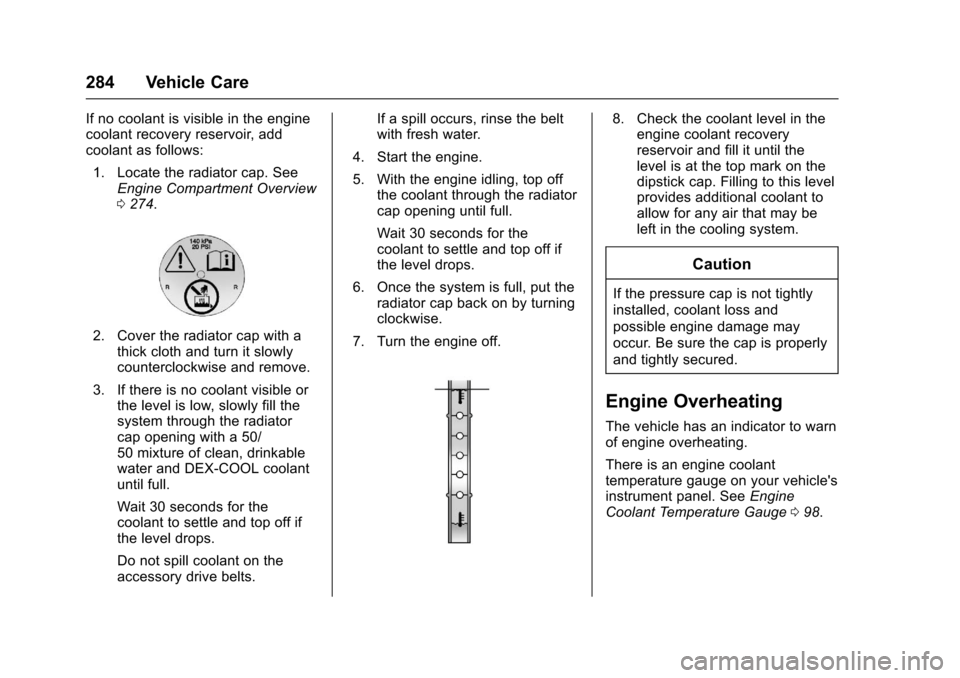
2. Cover the radiator cap with athick cloth and turn it slowlycounterclockwise and remove.
3. If there is no coolant visible orthe level is low, slowly fill thesystem through the radiatorcap opening with a 50/50 mixture of clean, drinkablewater and DEX-COOL coolantuntil full.
Wait 30 seconds for thecoolant to settle and top off ifthe level drops.
Do not spill coolant on theaccessory drive belts.
If a spill occurs, rinse the beltwith fresh water.
4. Start the engine.
5. With the engine idling, top offthe coolant through the radiatorcap opening until full.
Wait 30 seconds for thecoolant to settle and top off ifthe level drops.
6. Once the system is full, put theradiator cap back on by turningclockwise.
7. Turn the engine off.
8. Check the coolant level in theengine coolant recoveryreservoir and fill it until thelevel is at the top mark on thedipstick cap. Filling to this levelprovides additional coolant toallow for any air that may beleft in the cooling system.
Caution
If the pressure cap is not tightly
installed, coolant loss and
possible engine damage may
occur. Be sure the cap is properly
and tightly secured.
Engine Overheating
The vehicle has an indicator to warnof engine overheating.
There is an engine coolanttemperature gauge on your vehicle'sinstrument panel. SeeEngineCoolant Temperature Gauge098.
Page 295 of 400
Chevrolet SS Sedan Owner Manual (GMNA-Localizing-U.S.-10122752) -2017 - crc - 8/31/16
294 Vehicle Care
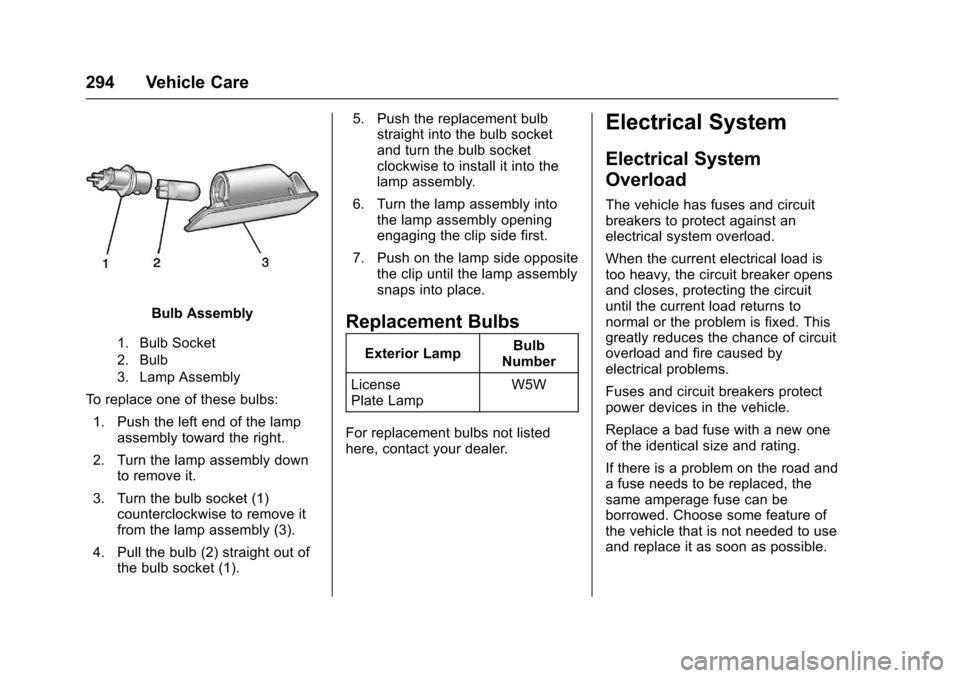
Bulb Assembly
1. Bulb Socket
2. Bulb
3. Lamp Assembly
To r e p l a c e o n e o f t h e s e b u l b s :
1. Push the left end of the lampassembly toward the right.
2. Turn the lamp assembly downto remove it.
3. Turn the bulb socket (1)counterclockwise to remove itfrom the lamp assembly (3).
4. Pull the bulb (2) straight out ofthe bulb socket (1).
5. Push the replacement bulbstraight into the bulb socketand turn the bulb socketclockwise to install it into thelamp assembly.
6. Turn the lamp assembly intothe lamp assembly openingengaging the clip side first.
7. Push on the lamp side oppositethe clip until the lamp assemblysnaps into place.
Replacement Bulbs
Exterior LampBulbNumber
LicensePlate LampW5W
For replacement bulbs not listedhere, contact your dealer.
Electrical System
Electrical System
Overload
The vehicle has fuses and circuitbreakers to protect against anelectrical system overload.
When the current electrical load istoo heavy, the circuit breaker opensand closes, protecting the circuituntil the current load returns tonormal or the problem is fixed. Thisgreatly reduces the chance of circuitoverload and fire caused byelectrical problems.
Fuses and circuit breakers protectpower devices in the vehicle.
Replace a bad fuse with a new oneof the identical size and rating.
If there is a problem on the road andafuseneedstobereplaced,thesame amperage fuse can beborrowed. Choose some feature ofthe vehicle that is not needed to useand replace it as soon as possible.
Page 301 of 400
Chevrolet SS Sedan Owner Manual (GMNA-Localizing-U.S.-10122752) -2017 - crc - 8/31/16
300 Vehicle Care
FusesUsage
F19 Steering wheelcontrols backlighting
F20–
F21–
F22 Shunt 2
F23 Body control module 4
F24 Body control module 5
F25 Body control module 6
CB26–
F27 Body control module 8
F28 Blower fan
F29 Accessories
F30 Body control module 7
RelaysUsage
R1 Logistics
R2 LPG shut-offsolenoid 1
R3 LPG shut-offsolenoid 2
Rear Compartment Fuse
Block
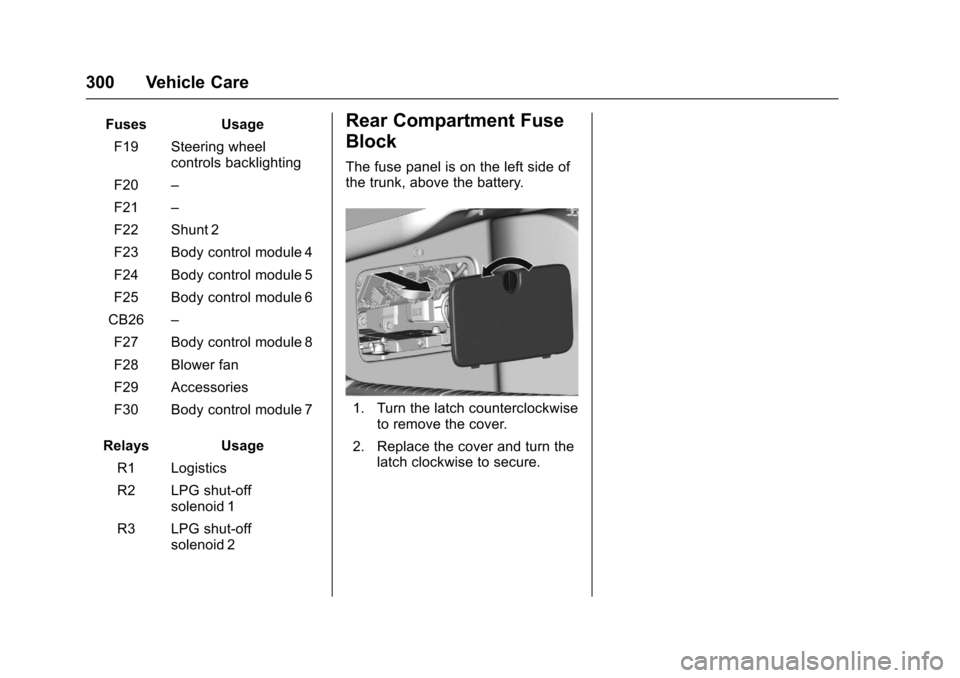
The fuse panel is on the left side ofthe trunk, above the battery.
1. Turn the latch counterclockwiseto remove the cover.
2. Replace the cover and turn thelatch clockwise to secure.
Page 326 of 400
Chevrolet SS Sedan Owner Manual (GMNA-Localizing-U.S.-10122752) -2017 - crc - 8/31/16
Vehicle Care 325
If a tire goes flat, avoid further tireand wheel damage by driving slowlyto a level place. Turn on the hazardwarning flashers. SeeHazardWarning Flashers0127.
SeeIf a Tire Goes Flat0322forother important safety warnings.
Do not remove any objects thathave penetrated the tire.
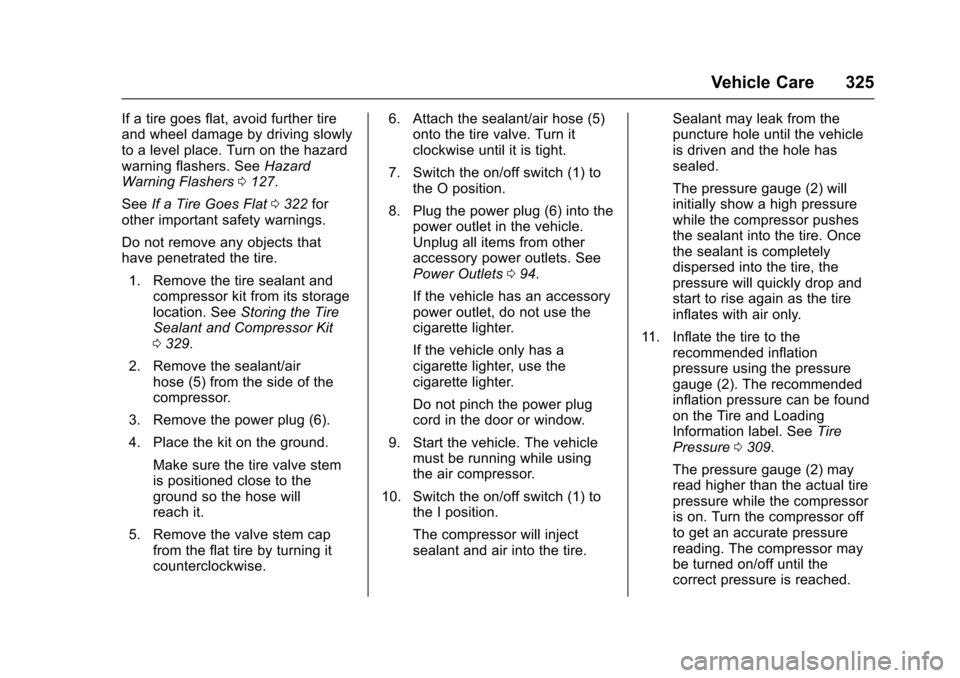
1. Remove the tire sealant andcompressor kit from its storagelocation. SeeStoring the TireSealant and Compressor Kit0329.
2. Remove the sealant/airhose (5) from the side of thecompressor.
3. Remove the power plug (6).
4. Place the kit on the ground.
Make sure the tire valve stemis positioned close to theground so the hose willreach it.
5. Remove the valve stem capfrom the flat tire by turning itcounterclockwise.
6. Attach the sealant/air hose (5)onto the tire valve. Turn itclockwise until it is tight.
7. Switch the on/off switch (1) tothe O position.
8. Plug the power plug (6) into thepower outlet in the vehicle.Unplug all items from otheraccessory power outlets. SeePower Outlets094.
If the vehicle has an accessorypower outlet, do not use thecigarette lighter.
If the vehicle only has acigarette lighter, use thecigarette lighter.
Do not pinch the power plugcord in the door or window.
9. Start the vehicle. The vehiclemust be running while usingthe air compressor.
10. Switch the on/off switch (1) tothe I position.
The compressor will injectsealant and air into the tire.
Sealant may leak from thepuncture hole until the vehicleis driven and the hole hassealed.
The pressure gauge (2) willinitially show a high pressurewhile the compressor pushesthe sealant into the tire. Oncethe sealant is completelydispersed into the tire, thepressure will quickly drop andstart to rise again as the tireinflates with air only.
11 . I n f l a t e t h e t i r e t o t h erecommended inflationpressure using the pressuregauge (2). The recommendedinflation pressure can be foundon the Tire and LoadingInformation label. SeeTirePressure0309.
The pressure gauge (2) mayread higher than the actual tirepressure while the compressoris on. Turn the compressor offto get an accurate pressurereading. The compressor maybe turned on/off until thecorrect pressure is reached.
Page 327 of 400

Chevrolet SS Sedan Owner Manual (GMNA-Localizing-U.S.-10122752) -2017 - crc - 8/31/16
326 Vehicle Care
Caution
If the recommended pressure
cannot be reached after
approximately 25 minutes, the
vehicle should not be driven
farther. The tire is too severely
damaged and the tire sealant and
compressor kit cannot inflate the
tire. Remove the power plug from
the accessory power outlet and
unscrew the inflating hose from
the tire valve. SeeRoadside
Assistance Program0368.
12. Switch the on/off switch (1) tothe O position.
The tire is not sealed and willcontinue to leak air until thevehicle is driven and thesealant is distributed in the tire.Therefore, Steps 13–19 mustbe done immediately afterStep 12.
Be careful while handling thetire sealant and compressor kitas it could be warm afterusage.
13. Unplug the power plug (6) fromthe accessory power outlet inthe vehicle.
14. Turn the sealant/air hose (5)counterclockwise to remove itfrom the tire valve stem.
15. Replace the tire valvestem cap.
16. Replace the sealant/airhose (5), and the power plug (6back in their original location.
17. If the flat tire was able to inflateto the recommended inflationpressure, remove themaximum speed label from thetire sealant canister (3) andplace it in a highly visiblelocation.
Do not exceed the speed onthis label until the damaged tireis repaired or replaced.
18. Return the equipment to itsoriginal storage location in thevehicle.
19. Immediately drive the vehicle8km(5mi)todistributethesealant in the tire.
20. Stop at a safe location andcheck the tire pressure. Referto Steps 1–10 under“Using theTire Sealant and CompressorKit without Sealant to Inflate aTire (Not Punctured).”
If the tire pressure has fallenmore than 68 kPa (10 psi)below the recommendedinflation pressure, stop drivingthe vehicle. The tire is tooseverely damaged and the tiresealant cannot seal the tire.SeeRoadside AssistanceProgram0368.
If the tire pressure has notdropped more than 68 kPa(10 psi) from the recommendedinflation pressure, inflate thetire to the recommendedinflation pressure.
Page 328 of 400
Chevrolet SS Sedan Owner Manual (GMNA-Localizing-U.S.-10122752) -2017 - crc - 8/31/16
Vehicle Care 327
21. Wipe off any sealant from thewheel, tire or vehicle.
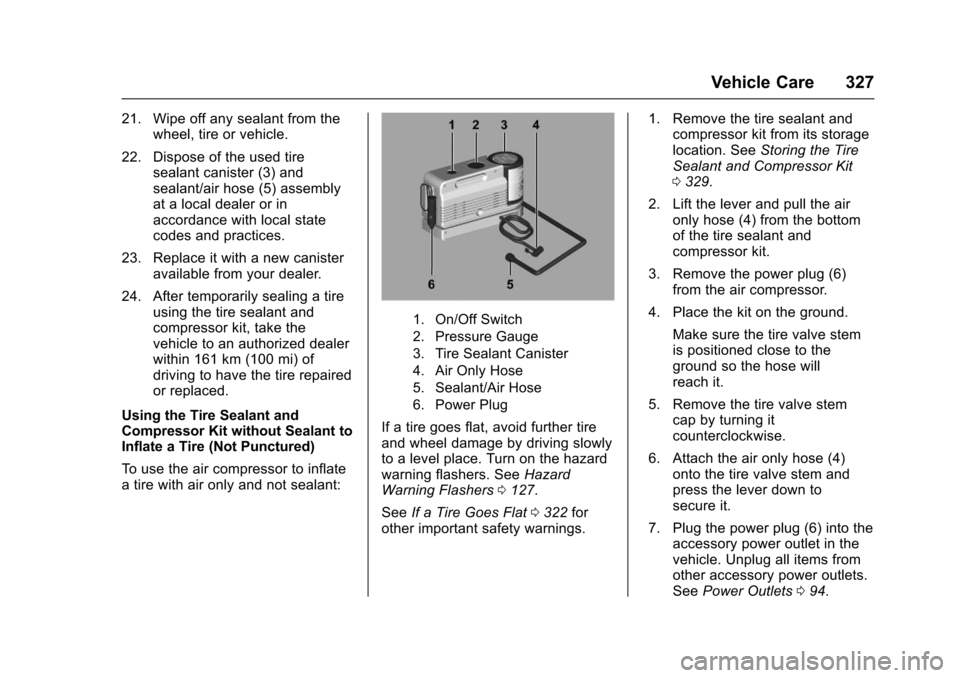
22. Dispose of the used tiresealant canister (3) andsealant/air hose (5) assemblyat a local dealer or inaccordance with local statecodes and practices.
23. Replace it with a new canisteravailable from your dealer.
24. After temporarily sealing a tireusing the tire sealant andcompressor kit, take thevehicle to an authorized dealerwithin 161 km (100 mi) ofdriving to have the tire repairedor replaced.
Using the Tire Sealant andCompressor Kit without Sealant toInflate a Tire (Not Punctured)
To u s e t h e a i r c o m p r e s s o r t o i n f l a t eatirewithaironlyandnotsealant:
1. On/Off Switch
2. Pressure Gauge
3. Tire Sealant Canister
4. Air Only Hose
5. Sealant/Air Hose
6. Power Plug
If a tire goes flat, avoid further tireand wheel damage by driving slowlyto a level place. Turn on the hazardwarning flashers. SeeHazardWarning Flashers0127.
SeeIf a Tire Goes Flat0322forother important safety warnings.
1. Remove the tire sealant andcompressor kit from its storagelocation. SeeStoring the TireSealant and Compressor Kit0329.
2. Lift the lever and pull the aironly hose (4) from the bottomof the tire sealant andcompressor kit.
3. Remove the power plug (6)from the air compressor.
4. Place the kit on the ground.
Make sure the tire valve stemis positioned close to theground so the hose willreach it.
5. Remove the tire valve stemcap by turning itcounterclockwise.
6. Attach the air only hose (4)onto the tire valve stem andpress the lever down tosecure it.
7. Plug the power plug (6) into theaccessory power outlet in thevehicle. Unplug all items fromother accessory power outlets.SeePower Outlets094.