automatic transmission CHEVROLET SS 2017 1.G Owner's Manual
[x] Cancel search | Manufacturer: CHEVROLET, Model Year: 2017, Model line: SS, Model: CHEVROLET SS 2017 1.GPages: 400, PDF Size: 7.31 MB
Page 240 of 400
Chevrolet SS Sedan Owner Manual (GMNA-Localizing-U.S.-10122752) -2017 - crc - 8/31/16
Driving and Operating 239
On the bottom of the display, M andthe currently selected gear appearas long as A/S mode is selected.
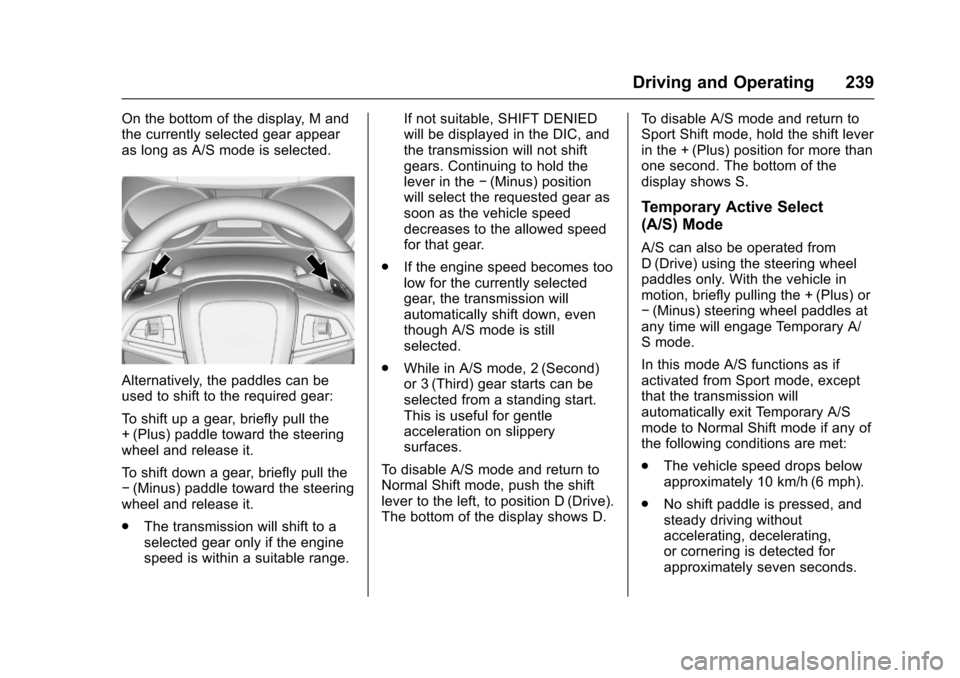
Alternatively, the paddles can beused to shift to the required gear:
To s h i f t u p a g e a r, b r i e f l y p u l l t h e+(Plus) paddle toward the steeringwheel and release it.
To s h i f t d o w n a g e a r, b r i e f l y p u l l t h e✓(Minus) paddle toward the steeringwheel and release it.
.The transmission will shift to aselected gear only if the enginespeed is within a suitable range.
If not suitable, SHIFT DENIEDwill be displayed in the DIC, andthe transmission will not shiftgears. Continuing to hold thelever in the✓(Minus) positionwill select the requested gear assoon as the vehicle speeddecreases to the allowed speedfor that gear.
.If the engine speed becomes toolow for the currently selectedgear, the transmission willautomatically shift down, eventhough A/S mode is stillselected.
.While in A/S mode, 2 (Second)or 3 (Third) gear starts can beselected from a standing start.This is useful for gentleacceleration on slipperysurfaces.
To d i s a b l e A / S m o d e a n d r e t u r n t oNormal Shift mode, push the shiftlever to the left, to position D (Drive).The bottom of the display shows D.
To d i s a b l e A / S m o d e a n d r e t u r n t oSport Shift mode, hold the shift leverin the + (Plus) position for more thanone second. The bottom of thedisplay shows S.
Temporary Active Select
(A/S) Mode
A/S can also be operated fromD(Drive) using the steering wheelpaddles only. With the vehicle inmotion, briefly pulling the + (Plus) or✓(Minus) steering wheel paddles atany time will engage Temporary A/Smode.
In this mode A/S functions as ifactivated from Sport mode, exceptthat the transmission willautomatically exit Temporary A/Smode to Normal Shift mode if any ofthe following conditions are met:
.The vehicle speed drops belowapproximately 10 km/h (6 mph).
.No shift paddle is pressed, andsteady driving withoutaccelerating, decelerating,or cornering is detected forapproximately seven seconds.
Page 244 of 400
Chevrolet SS Sedan Owner Manual (GMNA-Localizing-U.S.-10122752) -2017 - crc - 8/31/16
Driving and Operating 243
2. Lift up the EPB switchmomentarily.
The red parking brake status lightwill flash and then stay on once theEPB is fully applied. If the redparking brake status light flashescontinuously, then the EPB is onlypartially applied or there is aproblem with the EPB. A DICmessage will display. Release theEPB and try to apply it again. If thelight does not come on, or keepsflashing, have the vehicle serviced.Do not drive the vehicle if the redparking brake status light is flashing.See your dealer. SeeElectricParking Brake Light0103.
If the amber parking brake warninglight is on, lift up on the EPB switchand hold it up. Continue to hold theswitch until the red parking brakestatus light remains on. If the amberparking brake warning light remainson, see your dealer.
If the EPB is applied while thevehicle is moving, the vehicle willdecelerate as long as the switch is
held up. If the switch is held up untilthe vehicle comes to a stop, theEPB will remain applied.
If the EPB fails to apply, the rearwheels should be blocked toprevent vehicle movement.
EPB Release
To r e l e a s e t h e E P B :
1. Place the ignition in the ACC/ACCESSORY or ON/RUNposition.
2. Apply and hold the brakepedal.
3. Push down momentarily on theEPB switch.
The EPB is released when the redparking brake status light is off.
If the amber parking brake warninglight is on, release the EPB bypushing down on the EPB switchand holding it down. Continue tohold the switch until the red parkingbrake status light is off. If either lightstays on after release is attempted,see your dealer.
Caution
Driving with the parking brake on
can overheat the brake system
and cause premature wear or
damage to brake system parts.
Make sure that the parking brake
is fully released and the brake
warning light is off before driving.
Automatic EPB Release
The EPB will automatically release ifthe vehicle is running, placed intogear, and an attempt is made todrive away. Avoid rapid accelerationwhen the EPB is applied, topreserve parking brake lining life.
The EPB can also be used toprevent roll back for vehicles with amanual transmission taking off on ahill. When no roll back is desired, anapplied EPB will allow both feet tobe used for the clutch andaccelerator pedals in preparation forstarting the vehicle moving in theintended direction. In this case,there is no need to push the switchto release the EPB.
Page 259 of 400
Chevrolet SS Sedan Owner Manual (GMNA-Localizing-U.S.-10122752) -2017 - crc - 8/31/16
258 Driving and Operating
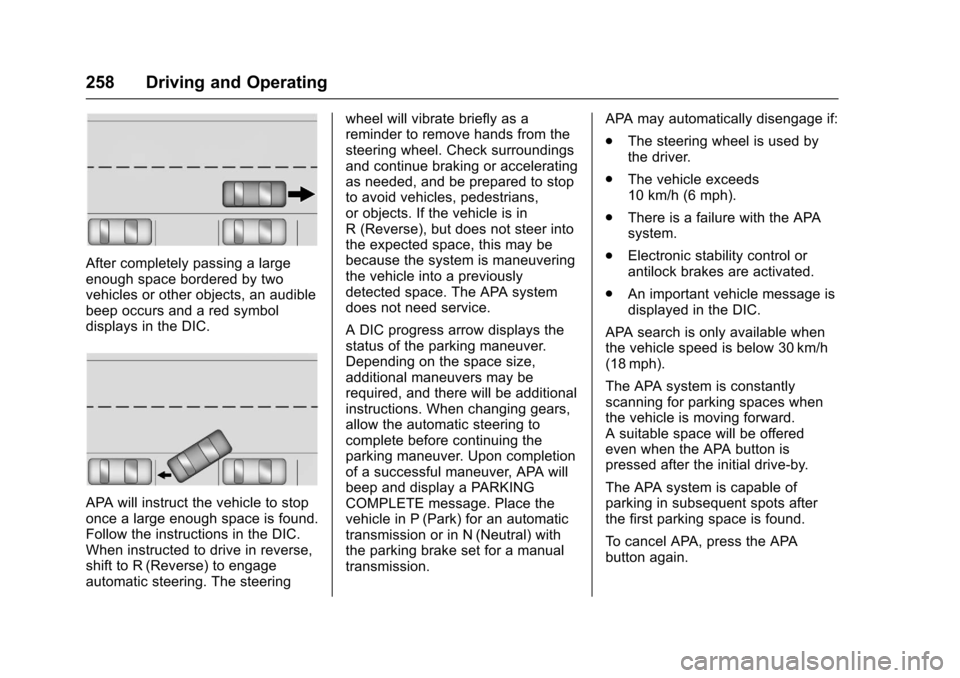
After completely passing a largeenough space bordered by twovehicles or other objects, an audiblebeep occurs and a red symboldisplays in the DIC.
APA will instruct the vehicle to stoponce a large enough space is found.Follow the instructions in the DIC.When instructed to drive in reverse,shift to R (Reverse) to engageautomatic steering. The steering
wheel will vibrate briefly as areminder to remove hands from thesteering wheel. Check surroundingsand continue braking or acceleratingas needed, and be prepared to stopto avoid vehicles, pedestrians,or objects. If the vehicle is inR(Reverse),butdoesnotsteerintothe expected space, this may bebecause the system is maneuveringthe vehicle into a previouslydetected space. The APA systemdoes not need service.
ADICprogressarrowdisplaysthestatus of the parking maneuver.Depending on the space size,additional maneuvers may berequired, and there will be additionalinstructions. When changing gears,allow the automatic steering tocomplete before continuing theparking maneuver. Upon completionof a successful maneuver, APA willbeep and display a PARKINGCOMPLETE message. Place thevehicle in P (Park) for an automatictransmission or in N (Neutral) withthe parking brake set for a manualtransmission.
APA may automatically disengage if:
.The steering wheel is used bythe driver.
.The vehicle exceeds10 km/h (6 mph).
.There is a failure with the APAsystem.
.Electronic stability control orantilock brakes are activated.
.An important vehicle message isdisplayed in the DIC.
APA search is only available whenthe vehicle speed is below 30 km/h(18 mph).
The APA system is constantlyscanning for parking spaces whenthe vehicle is moving forward.Asuitablespacewillbeofferedeven when the APA button ispressed after the initial drive-by.
The APA system is capable ofparking in subsequent spots afterthe first parking space is found.
To c a n c e l A PA , p r e s s t h e A PAbutton again.
Page 271 of 400
Chevrolet SS Sedan Owner Manual (GMNA-Localizing-U.S.-10122752) -2017 - crc - 8/31/16
270 Vehicle Care
Vehicle Care
General Information
General Information . . . . . . . . . . 271California Proposition65 Warning . . . . . . . . . . . . . . . . . 271California PerchlorateMaterials Requirements . . . . . 271Accessories andModifications . . . . . . . . . . . . . . . . 272
Vehicle Checks
Doing Your OwnService Work . . . . . . . . . . . . . . . 272Hood . . . . . . . . . . . . . . . . . . . . . . . . . 273Engine CompartmentOverview . . . . . . . . . . . . . . . . . . . . 274Engine Oil . . . . . . . . . . . . . . . . . . . . 275Engine Oil Life System . . . . . . . 277Automatic TransmissionFluid . . . . . . . . . . . . . . . . . . . . . . . . 278Manual Transmission Fluid . . . 278Hydraulic Clutch . . . . . . . . . . . . . . 279Engine Air Cleaner/Filter . . . . . . 279Cooling System . . . . . . . . . . . . . . 280Engine Coolant . . . . . . . . . . . . . . . 281Engine Overheating . . . . . . . . . . 284Washer Fluid . . . . . . . . . . . . . . . . . 286Brakes . . . . . . . . . . . . . . . . . . . . . . . 287Brake Fluid . . . . . . . . . . . . . . . . . . . 287
Battery - North America . . . . . . 288Rear Axle . . . . . . . . . . . . . . . . . . . . 289Starter Switch Check . . . . . . . . . 290Automatic Transmission ShiftLock Control FunctionCheck . . . . . . . . . . . . . . . . . . . . . . . 290Park Brake and P (Park)Mechanism Check . . . . . . . . . . 291Wiper Blade Replacement . . . . 291Windshield Replacement . . . . . 292
Headlamp Aiming
Headlamp Aiming . . . . . . . . . . . . 292
Bulb Replacement
Bulb Replacement . . . . . . . . . . . . 293High Intensity Discharge (HID)Lighting . . . . . . . . . . . . . . . . . . . . . 293License Plate Lamp . . . . . . . . . . 293Replacement Bulbs . . . . . . . . . . . 294
Electrical System
Electrical System Overload . . . 294Fuses . . . . . . . . . . . . . . . . . . . . . . . . 295Engine Compartment FuseBlock . . . . . . . . . . . . . . . . . . . . . . . . 295Instrument Panel FuseBlock . . . . . . . . . . . . . . . . . . . . . . . . 298Rear Compartment FuseBlock . . . . . . . . . . . . . . . . . . . . . . . . 300
Wheels and Tires
Tires . . . . . . . . . . . . . . . . . . . . . . . . . . 303Winter Tires . . . . . . . . . . . . . . . . . . 304Low-Profile Tires . . . . . . . . . . . . . 304Summer Tires . . . . . . . . . . . . . . . . 304Tire Sidewall Labeling . . . . . . . . 305Tire Designations . . . . . . . . . . . . . 306Tire Terminology andDefinitions . . . . . . . . . . . . . . . . . . 307Tire Pressure . . . . . . . . . . . . . . . . . 309Tire Pressure for High-SpeedOperation . . . . . . . . . . . . . . . . . . . 310Tire Pressure MonitorSystem . . . . . . . . . . . . . . . . . . . . . . 311Tire Pressure MonitorOperation . . . . . . . . . . . . . . . . . . . 312Tire Inspection . . . . . . . . . . . . . . . . 315Tire Rotation . . . . . . . . . . . . . . . . . 315When It Is Time for NewTires . . . . . . . . . . . . . . . . . . . . . . . . 316Buying New Tires . . . . . . . . . . . . . 317Different Size Tires andWheels . . . . . . . . . . . . . . . . . . . . . . 318Uniform Tire QualityGrading . . . . . . . . . . . . . . . . . . . . . 319Wheel Alignment and TireBalance . . . . . . . . . . . . . . . . . . . . . 320Wheel Replacement . . . . . . . . . . 320Tire Chains . . . . . . . . . . . . . . . . . . . 321If a Tire Goes Flat . . . . . . . . . . . . 322
Page 279 of 400
Chevrolet SS Sedan Owner Manual (GMNA-Localizing-U.S.-10122752) -2017 - crc - 8/31/16
278 Vehicle Care
If the system is ever resetaccidentally, the oil must bechanged at 5 000 km (3,000 mi)since the last oil change.Remember to reset the oil lifesystem whenever the oil is changed.
How to Reset the Engine Oil
Life System
Reset the system whenever theengine oil is changed so that thesystem can calculate the nextengine oil change. To reset thesystem:
1. Display the REMAINING OILLIFE on the DIC. SeeDriverInformation Center (DIC)0108.
2. Press and hold SET/CLR onthe DIC while the Oil Lifedisplay is active. The oil life willchange to 100%.
The oil life system can also be resetas follows:
1. Display the REMAINING OILLIFE on the DIC. SeeDriverInformation Center (DIC)0108.
2. Fully press and release theaccelerator pedal three timeswithin five seconds.
The system is reset when theCHANGE ENGINE OIL SOONmessage goes off.
If the CHANGE ENGINE OIL SOONmessage comes back on when thevehicle is started, the engine oil lifesystem has not been reset. Repeatthe procedure.
Automatic Transmission
Fluid
How to Check Automatic
Transmission Fluid
It is not necessary to check thetransmission fluid level.Atransmissionfluidleakistheonlyreason for fluid loss. If a leakoccurs, take the vehicle to yourdealer service department and haveit repaired as soon as possible.
There is a special procedure forchecking and changing thetransmission fluid. Because thisprocedure is difficult, you shouldhave this done at your dealer
service department. Contact yourdealer for additional information orthe procedure can be found in theservice manual. To purchase aservice manual, seeServicePublications Ordering Information0373.
Change the fluid and filter at theintervals listed inMaintenanceSchedule0349,andbesuretousethe fluid listed inRecommendedFluids and Lubricants0358.
Manual Transmission
Fluid
It is not necessary to check themanual transmission fluid level.Atransmissionfluidleakistheonlyreason for fluid loss. If a leakoccurs, take the vehicle to thedealer and have it repaired as soonas possible. SeeRecommendedFluids and Lubricants0358for theproper fluid to use.
Page 291 of 400
Chevrolet SS Sedan Owner Manual (GMNA-Localizing-U.S.-10122752) -2017 - crc - 8/31/16
290 Vehicle Care
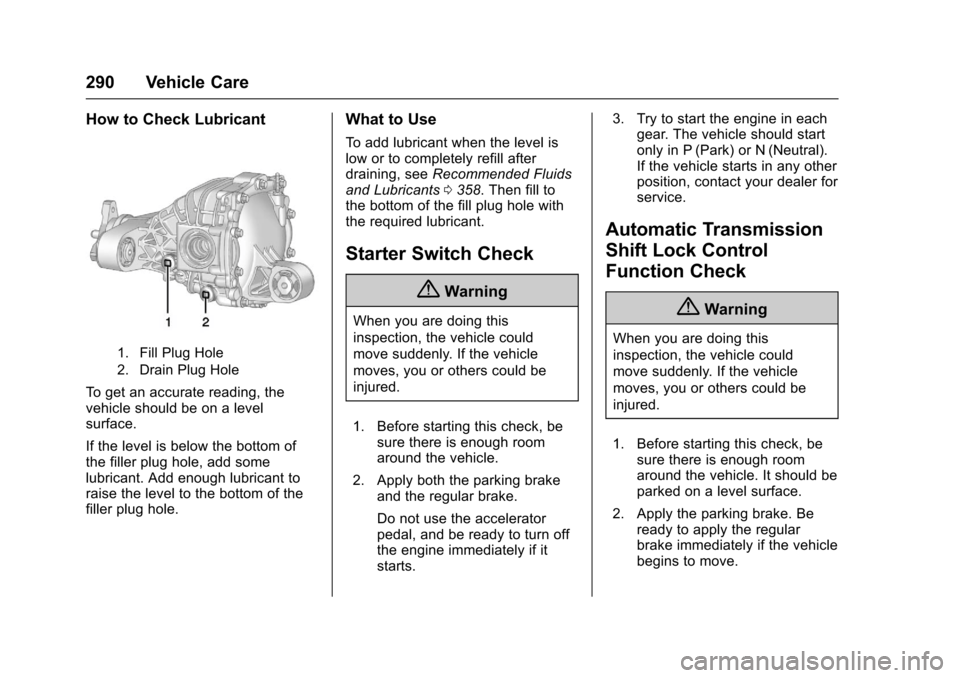
How to Check Lubricant
1. Fill Plug Hole
2. Drain Plug Hole
To g e t a n a c c u r a t e r e a d i n g , t h evehicle should be on a levelsurface.
If the level is below the bottom ofthe filler plug hole, add somelubricant. Add enough lubricant toraise the level to the bottom of thefiller plug hole.
What to Use
To a d d l u b r i c a n t w h e n t h e l e v e l i slow or to completely refill afterdraining, seeRecommended Fluidsand Lubricants0358.Thenfilltothe bottom of the fill plug hole withthe required lubricant.
Starter Switch Check
{Warning
When you are doing this
inspection, the vehicle could
move suddenly. If the vehicle
moves, you or others could be
injured.
1. Before starting this check, besure there is enough roomaround the vehicle.
2. Apply both the parking brakeand the regular brake.
Do not use the acceleratorpedal, and be ready to turn offthe engine immediately if itstarts.
3. Try to start the engine in eachgear. The vehicle should startonly in P (Park) or N (Neutral).If the vehicle starts in any otherposition, contact your dealer forservice.
Automatic Transmission
Shift Lock Control
Function Check
{Warning
When you are doing this
inspection, the vehicle could
move suddenly. If the vehicle
moves, you or others could be
injured.
1. Before starting this check, besure there is enough roomaround the vehicle. It should beparked on a level surface.
2. Apply the parking brake. Beready to apply the regularbrake immediately if the vehiclebegins to move.
Page 298 of 400
Chevrolet SS Sedan Owner Manual (GMNA-Localizing-U.S.-10122752) -2017 - crc - 8/31/16
Vehicle Care 297
FusesUsage
F22 Rear wiper
F23 Sunroof
F24 Front wipers
F25 Automatic occupantsensing/Instrumentcluster/Ignition
F26 Left rear bus electricalcenter/Ignition
F27–
F28 Ignition/Injectors even–V8
F29 Engine control module–V8/Ignition odd–V6/Emissions
F30–
F31–
F32–
F33 Ignition/Instrumentpanel body
F34 Fuel system controlmodule/Ignition
F35–
FusesUsage
F36 Electric steeringcolumn lock
F37 Emission 2/Ignitioneven–V6
F38 Engine control module–V6/Injectors/Ignitionodd–V8
F39 Intercooler pump
F40–
F41 Transmission controlmodule/Electric powersteering
F42 Starter motor
F43–
F44 Left HID headlamp
F45 Right HID headlamp
F46 High-beamheadlamps
F47 Horn
F48 Engine cooling fan
F49 Automatic headlampleveling
FusesUsage
F50 Transmission controlmodule ignition
F51 Engine control moduleignition
F52 Brake vacuum pump
F53 A/C clutch
F54 Vaporizer controlmodule
RelaysUsage
R1 Driving lamps
R2 Headlamp washer
R3 Rear washer pump
R4 Front washer pump
R5 Rear defogger
R6 Front wiper control
R7 Wiper speed
R8 Engine control module
R9–
R10 Intercooler pump
R11–
Page 308 of 400
Chevrolet SS Sedan Owner Manual (GMNA-Localizing-U.S.-10122752) -2017 - crc - 8/31/16
Vehicle Care 307
Tire Terminology and
Definitions
Air Pressure:The amount of
air inside the tire pressing
outward on each square inch of
the tire. Air pressure is
expressed in kPa (kilopascal)
or psi (pounds per square inch).
Accessory Weight:The
combined weight of optional
accessories. Some examples of
optional accessories are
automatic transmission, power
windows, power seats, and air
conditioning.
Aspect Ratio:The relationship
of a tire's height to its width.
Belt:Arubbercoatedlayerof
cords between the plies and the
tread. Cords may be made from
steel or other reinforcing
materials.
Bead:The tire bead contains
steel wires wrapped by steel
cords that hold the tire onto
the rim.
Bias Ply Tire:Apneumatictire
in which the plies are laid at
alternate angles less than
90 degrees to the centerline of
the tread.
Cold Tire Pressure:The
amount of air pressure in a tire,
measured in kPa (kilopascal)
or psi (pounds per square inch)
before a tire has built up heat
from driving. SeeTire Pressure
0309.
Curb Weight:The weight of a
motor vehicle with standard and
optional equipment including the
maximum capacity of fuel, oil,
and coolant, but without
passengers and cargo.
DOT Markings:Acodemolded
into the sidewall of a tire
signifying that the tire is in
compliance with the U.S.
Department of Transportation
(DOT) Motor Vehicle Safety
Standards. The DOT code
includes the Tire Identification
Number (TIN), an alphanumeric
designator which can also
identify the tire manufacturer,
production plant, brand, and
date of production.
GVWR:Gross Vehicle Weight
Rating. SeeVehicle Load Limits
0226.
GAWR FRT:Gross Axle Weight
Rating for the front axle. See
Vehicle Load Limits0226.
GAWR RR:Gross Axle Weight
Rating for the rear axle. See
Vehicle Load Limits0226.
Intended Outboard Sidewall:
The side of an asymmetrical tire
that must always face outward
when mounted on a vehicle.
Kilopascal (kPa):The metric
unit for air pressure.
Page 324 of 400
Chevrolet SS Sedan Owner Manual (GMNA-Localizing-U.S.-10122752) -2017 - crc - 8/31/16
Vehicle Care 323
Warning (Continued)
2. Put an automatictransmission in P (Park) or amanual transmission in1(First) or R(Reverse).
3. Turn off the engine and donot restart while the vehicleis raised.
4. Do not allow passengers toremain in the vehicle.
5. Place wheel blocks,if equipped, on both sides ofthe tire at the oppositecorner of the tire beingchanged.
This vehicle may come with a jackand spare tire or a tire sealant andcompressor kit. To use the jackingequipment to change a spare tiresafely, follow the instructions below.Then seeTire Changing0329.Touse the tire sealant and compressorkit, seeTire Sealant andCompressor Kit0323.
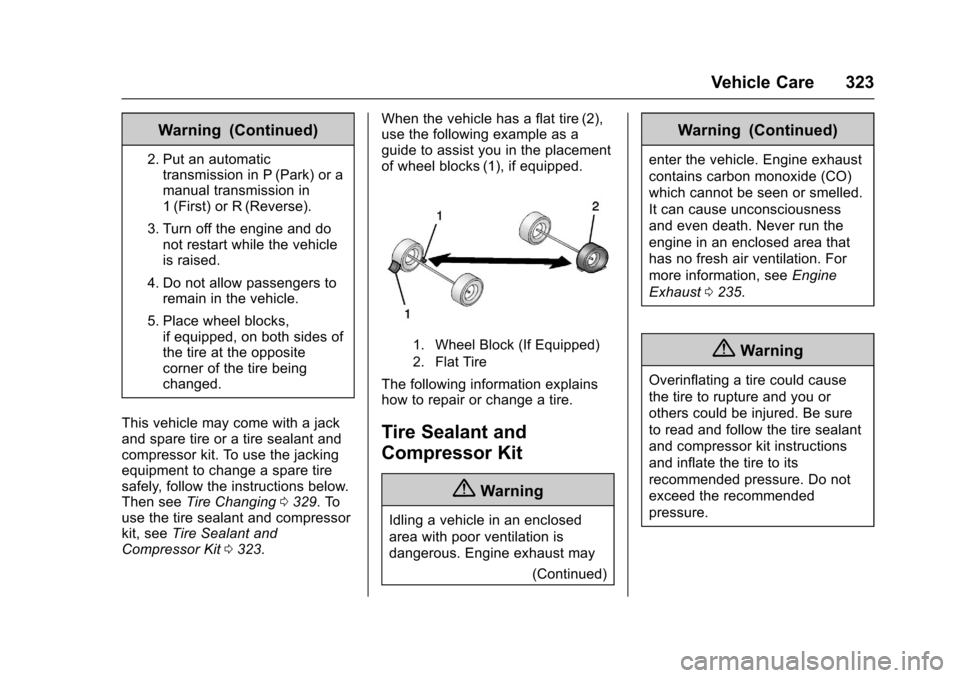
When the vehicle has a flat tire (2),use the following example as aguide to assist you in the placementof wheel blocks (1), if equipped.
1. Wheel Block (If Equipped)
2. Flat Tire
The following information explainshow to repair or change a tire.
Tire Sealant and
Compressor Kit
{Warning
Idling a vehicle in an enclosed
area with poor ventilation is
dangerous. Engine exhaust may
(Continued)
Warning (Continued)
enter the vehicle. Engine exhaust
contains carbon monoxide (CO)
which cannot be seen or smelled.
It can cause unconsciousness
and even death. Never run the
engine in an enclosed area that
has no fresh air ventilation. For
more information, seeEngine
Exhaust0235.
{Warning
Overinflating a tire could cause
the tire to rupture and you or
others could be injured. Be sure
to read and follow the tire sealant
and compressor kit instructions
and inflate the tire to its
recommended pressure. Do not
exceed the recommended
pressure.
Page 337 of 400
Chevrolet SS Sedan Owner Manual (GMNA-Localizing-U.S.-10122752) -2017 - crc - 8/31/16
336 Vehicle Care
The jump start positive (1) andnegative (2) posts are in the enginecompartment on the driver side ofthe vehicle.
These posts are used instead of adirect connection to the battery.
The positive jump start connectionis covered by a red cap. Remove toexpose the terminal.
1. Check the other vehicle.It must have a 12-volt batterywith a negative ground system.
Caution
If the other vehicle does not have
a12-voltsystemwithanegative
ground, both vehicles can be
damaged. Only use a vehicle that
has a 12-volt system with a
negative ground for jump starting.
2. Position the two vehicles sothat they are not touching.
3. Set the parking brake firmlyand put the shift lever inP(Park)withanautomatictransmission. SeeShifting IntoPark (Automatic Transmission)0232.Vehicleswithamanualtransmission should be inNeutral. SeeParking0234.
Caution
If any accessories are left on or
plugged in during the jump
starting procedure, they could be
damaged. The repairs would not
be covered by the vehicle
warranty. Whenever possible, turn
off or unplug all accessories on
either vehicle when jump starting.
4. Turn the ignition to LOCK/OFFand switch off all lights andaccessories in both vehicles,except the hazard warningflashers if needed.
{Warning
An electric fan can start up even
when the engine is not running
and can injure you. Keep hands,
clothing, and tools away from any
underhood electric fan.
{Warning
Using a match near a battery can
cause battery gas to explode.
People have been hurt doing this,
and some have been blinded.
Use a flashlight if you need more
light.
Battery fluid contains acid that
can burn you. Do not get it on
you. If you accidentally get it in
your eyes or on your skin, flush
the place with water and get
medical help immediately.