check engine CHEVROLET SS 2017 1.G Owner's Manual
[x] Cancel search | Manufacturer: CHEVROLET, Model Year: 2017, Model line: SS, Model: CHEVROLET SS 2017 1.GPages: 400, PDF Size: 7.31 MB
Page 277 of 400
Chevrolet SS Sedan Owner Manual (GMNA-Localizing-U.S.-10122752) -2017 - crc - 8/31/16
276 Vehicle Care
checking a cold engine prior tostarting. Remove the dipstickand check the level.
.If unable to wait two hours, theengine must be off for at least15 minutes if the engine iswarm, or at least 30 minutes ifthe engine is not warm. Pull outthe dipstick, wipe it with a cleanpaper towel or cloth, then push itback in all the way. Remove itagain, keeping the tip down, andcheck the level.
When to Add Engine Oil
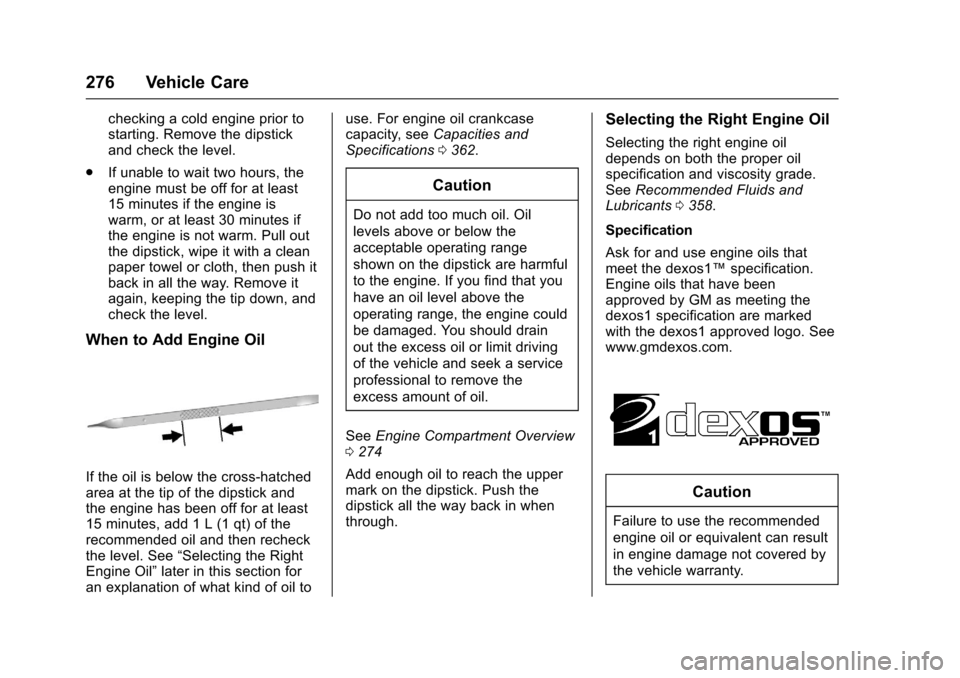
If the oil is below the cross-hatchedarea at the tip of the dipstick andthe engine has been off for at least15 minutes, add 1 L (1 qt) of therecommended oil and then recheckthe level. See“Selecting the RightEngine Oil”later in this section foran explanation of what kind of oil to
use. For engine oil crankcasecapacity, seeCapacities andSpecifications0362.
Caution
Do not add too much oil. Oil
levels above or below the
acceptable operating range
shown on the dipstick are harmful
to the engine. If you find that you
have an oil level above the
operating range, the engine could
be damaged. You should drain
out the excess oil or limit driving
of the vehicle and seek a service
professional to remove the
excess amount of oil.
SeeEngine Compartment Overview0274
Add enough oil to reach the uppermark on the dipstick. Push thedipstick all the way back in whenthrough.
Selecting the Right Engine Oil
Selecting the right engine oildepends on both the proper oilspecification and viscosity grade.SeeRecommended Fluids andLubricants0358.
Specification
Ask for and use engine oils thatmeet the dexos1™specification.Engine oils that have beenapproved by GM as meeting thedexos1 specification are markedwith the dexos1 approved logo. Seewww.gmdexos.com.
Caution
Failure to use the recommended
engine oil or equivalent can result
in engine damage not covered by
the vehicle warranty.
Page 278 of 400
Chevrolet SS Sedan Owner Manual (GMNA-Localizing-U.S.-10122752) -2017 - crc - 8/31/16
Vehicle Care 277
Viscosity Grade
Use SAE 5W-30 viscosity gradeengine oil.
Cold Temperature Operation: In anarea of extreme cold, where thetemperature falls below✓29 °C(✓20 °F), an SAE 0W-30 oil may beused. An oil of this viscosity gradewill provide easier cold starting forthe engine at extremely lowtemperatures. When selecting an oilof the appropriate viscosity grade, itis recommended to select an oil ofthe correct specification. See“Specification”earlier in this section.
Engine Oil Additives/Engine
Oil Flushes
Do not add anything to the oil. Therecommended oils meeting thedexos1 specification are all that isneeded for good performance andengine protection.
Engine oil system flushes are notrecommended and could causeengine damage not covered by thevehicle warranty.
What to Do with Used Oil
Used engine oil contains certainelements that can be unhealthy foryour skin and could even causecancer. Do not let used oil stay onyour skin for very long. Clean yourskin and nails with soap and water,or a good hand cleaner. Wash orproperly dispose of clothing or ragscontaining used engine oil. See themanufacturer's warnings about theuse and disposal of oil products.
Used oil can be a threat to theenvironment. If you change yourown oil, be sure to drain all the oilfrom the filter before disposal. Neverdispose of oil by putting it in thetrash or pouring it on the ground,into sewers, or into streams orbodies of water. Recycle it by takingit to a place that collects used oil.
Engine Oil Life System
When to Change Engine Oil
This vehicle has a computer systemthat indicates when to change theengine oil and filter. This is basedon a combination of factors which
include engine revolutions, enginetemperature, and miles driven.Based on driving conditions, themileage at which an oil change isindicated can vary considerably. Forthe oil life system to work properly,the system must be reset every timethe oil is changed.
When the system has calculatedthat oil life has been diminished, itindicates that an oil change isnecessary. A CHANGE ENGINEOIL SOON message comes on. SeeEngine Oil Messages011 5.Change the oil as soon as possiblewithin the next 1 000 km (600 mi).It is possible that, if driving underthe best conditions, the oil lifesystem might indicate that an oilchange is not necessary for up to ayear. The engine oil and filter mustbe changed at least once a yearand, at this time, the system mustbe reset. Your dealer has trainedservice people who will perform thiswork and reset the system. It is alsoimportant to check the oil regularlyover the course of an oil draininterval and keep it at the properlevel.
Page 279 of 400
Chevrolet SS Sedan Owner Manual (GMNA-Localizing-U.S.-10122752) -2017 - crc - 8/31/16
278 Vehicle Care
If the system is ever resetaccidentally, the oil must bechanged at 5 000 km (3,000 mi)since the last oil change.Remember to reset the oil lifesystem whenever the oil is changed.
How to Reset the Engine Oil
Life System
Reset the system whenever theengine oil is changed so that thesystem can calculate the nextengine oil change. To reset thesystem:
1. Display the REMAINING OILLIFE on the DIC. SeeDriverInformation Center (DIC)0108.
2. Press and hold SET/CLR onthe DIC while the Oil Lifedisplay is active. The oil life willchange to 100%.
The oil life system can also be resetas follows:
1. Display the REMAINING OILLIFE on the DIC. SeeDriverInformation Center (DIC)0108.
2. Fully press and release theaccelerator pedal three timeswithin five seconds.
The system is reset when theCHANGE ENGINE OIL SOONmessage goes off.
If the CHANGE ENGINE OIL SOONmessage comes back on when thevehicle is started, the engine oil lifesystem has not been reset. Repeatthe procedure.
Automatic Transmission
Fluid
How to Check Automatic
Transmission Fluid
It is not necessary to check thetransmission fluid level.Atransmissionfluidleakistheonlyreason for fluid loss. If a leakoccurs, take the vehicle to yourdealer service department and haveit repaired as soon as possible.
There is a special procedure forchecking and changing thetransmission fluid. Because thisprocedure is difficult, you shouldhave this done at your dealer
service department. Contact yourdealer for additional information orthe procedure can be found in theservice manual. To purchase aservice manual, seeServicePublications Ordering Information0373.
Change the fluid and filter at theintervals listed inMaintenanceSchedule0349,andbesuretousethe fluid listed inRecommendedFluids and Lubricants0358.
Manual Transmission
Fluid
It is not necessary to check themanual transmission fluid level.Atransmissionfluidleakistheonlyreason for fluid loss. If a leakoccurs, take the vehicle to thedealer and have it repaired as soonas possible. SeeRecommendedFluids and Lubricants0358for theproper fluid to use.
Page 280 of 400
Chevrolet SS Sedan Owner Manual (GMNA-Localizing-U.S.-10122752) -2017 - crc - 8/31/16
Vehicle Care 279
Hydraulic Clutch
For vehicles with a manualtransmission, it is not necessary toregularly check brake/clutch fluidunless there is a leak suspected.Adding fluid will not correct a leak.Afluidlossinthissystemcouldindicate a problem. Have thesystem inspected and repaired.
When to Check and What
to Use
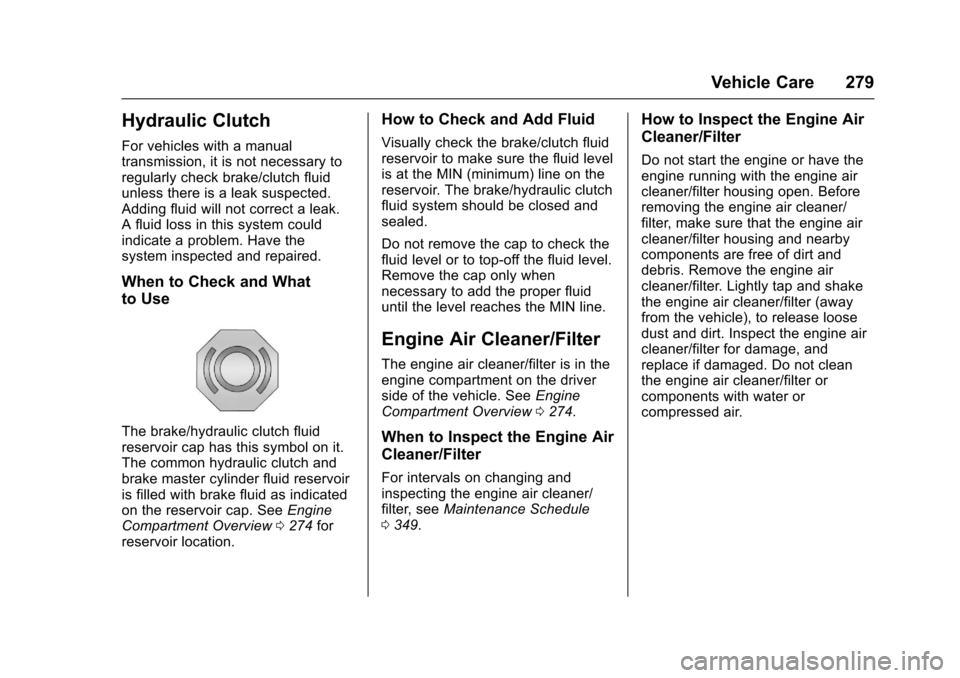
The brake/hydraulic clutch fluidreservoir cap has this symbol on it.The common hydraulic clutch andbrake master cylinder fluid reservoiris filled with brake fluid as indicatedon the reservoir cap. SeeEngineCompartment Overview0274forreservoir location.
How to Check and Add Fluid
Visually check the brake/clutch fluidreservoir to make sure the fluid levelis at the MIN (minimum) line on thereservoir. The brake/hydraulic clutchfluid system should be closed andsealed.
Do not remove the cap to check thefluid level or to top-off the fluid level.Remove the cap only whennecessary to add the proper fluiduntil the level reaches the MIN line.
Engine Air Cleaner/Filter
The engine air cleaner/filter is in theengine compartment on the driverside of the vehicle. SeeEngineCompartment Overview0274.
When to Inspect the Engine Air
Cleaner/Filter
For intervals on changing andinspecting the engine air cleaner/filter, seeMaintenance Schedule0349.
How to Inspect the Engine Air
Cleaner/Filter
Do not start the engine or have theengine running with the engine aircleaner/filter housing open. Beforeremoving the engine air cleaner/filter, make sure that the engine aircleaner/filter housing and nearbycomponents are free of dirt anddebris. Remove the engine aircleaner/filter. Lightly tap and shakethe engine air cleaner/filter (awayfrom the vehicle), to release loosedust and dirt. Inspect the engine aircleaner/filter for damage, andreplace if damaged. Do not cleanthe engine air cleaner/filter orcomponents with water orcompressed air.
Page 282 of 400
Chevrolet SS Sedan Owner Manual (GMNA-Localizing-U.S.-10122752) -2017 - crc - 8/31/16
Vehicle Care 281
{Warning
Heater and radiator hoses, and
other engine parts, can be very
hot. Do not touch them. If you do,
you can be burned.
Do not run the engine if there is a
leak. If you run the engine, it
could lose all coolant. That could
cause an engine fire, and you
could be burned. Get any leak
fixed before you drive the vehicle.
Caution
Using coolant other than
DEX-COOL®can cause
premature engine, heater core,
or radiator corrosion. In addition,
the engine coolant could require
changing sooner. Any repairs
would not be covered by the
vehicle warranty. Always use
DEX-COOL (silicate-free) coolant
in the vehicle.
Engine Coolant
The cooling system in the vehicle isfilled with DEX-COOL®enginecoolant. This coolant is designed toremain in the vehicle for 5 years or240 000 km (150,000 mi), whicheveroccurs first.
The following explains the coolingsystem and how to check and addcoolant when it is low. If there is aproblem with engine overheating,seeEngine Overheating0284.
What to Use
{Warning
Adding only plain water or some
other liquid to the cooling system
can be dangerous. Plain water
and other liquids, can boil before
the proper coolant mixture will.
The coolant warning system is set
for the proper coolant mixture.
With plain water or the wrong
mixture, the engine could get too
hot but you would not get the
(Continued)
Warning (Continued)
overheat warning. The engine
could catch fire and you or others
could be burned. Use a 50/
50 mixture of clean, drinkable
water and DEX-COOL coolant.
Use a 50/50 mixture of clean,drinkable water and DEX-COOLcoolant. If using this mixture,nothing else needs to be added.This mixture:
.Gives freezing protection downto✓37 °C (✓34 °F), outsidetemperature.
.Gives boiling protection up to129 °C (265 °F), enginetemperature.
.Protects against rust andcorrosion.
.Will not damage aluminum parts.
.Helps keep the proper enginetemperature.
Page 283 of 400
Chevrolet SS Sedan Owner Manual (GMNA-Localizing-U.S.-10122752) -2017 - crc - 8/31/16
282 Vehicle Care
Caution
If improper coolant mixture,
inhibitors, or additives are used in
the vehicle cooling system, the
engine could overheat and be
damaged. Too much water in the
mixture can freeze and crack
engine cooling parts. The repairs
would not be covered by the
vehicle warranty. Use only the
proper mixture of engine coolant
for the cooling system. See
Recommended Fluids and
Lubricants0358.
Never dispose of engine coolant byputting it in the trash, pouring it onthe ground, or pouring it intosewers, streams or bodies of water.Have the coolant changed by anauthorized service center, familiarwith legal requirements regardingused coolant disposal. This will helpprotect the environment and yourhealth.
Checking Coolant
The vehicle must be on a levelsurface when checking the coolantlevel.
To c h e c k c o o l a n t :
1. Turn the ignition off.
2. Locate the coolant recoveryreservoir. SeeEngineCompartment Overview0274.
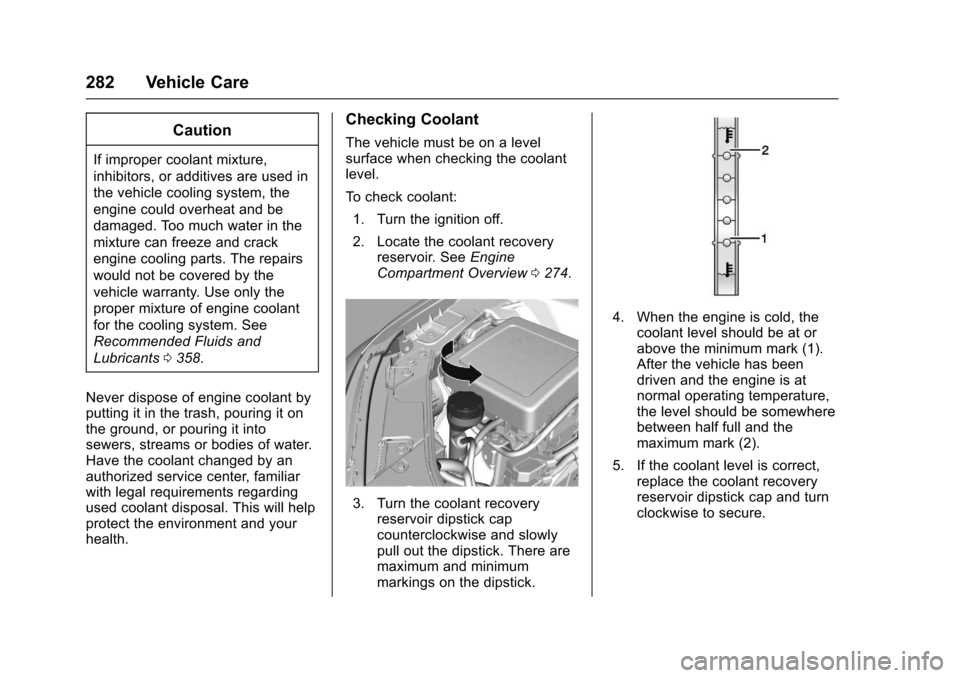
3. Turn the coolant recoveryreservoir dipstick capcounterclockwise and slowlypull out the dipstick. There aremaximum and minimummarkings on the dipstick.
4. When the engine is cold, thecoolant level should be at orabove the minimum mark (1).After the vehicle has beendriven and the engine is atnormal operating temperature,the level should be somewherebetween half full and themaximum mark (2).
5. If the coolant level is correct,replace the coolant recoveryreservoir dipstick cap and turnclockwise to secure.
Page 285 of 400
Chevrolet SS Sedan Owner Manual (GMNA-Localizing-U.S.-10122752) -2017 - crc - 8/31/16
284 Vehicle Care
If no coolant is visible in the enginecoolant recovery reservoir, addcoolant as follows:
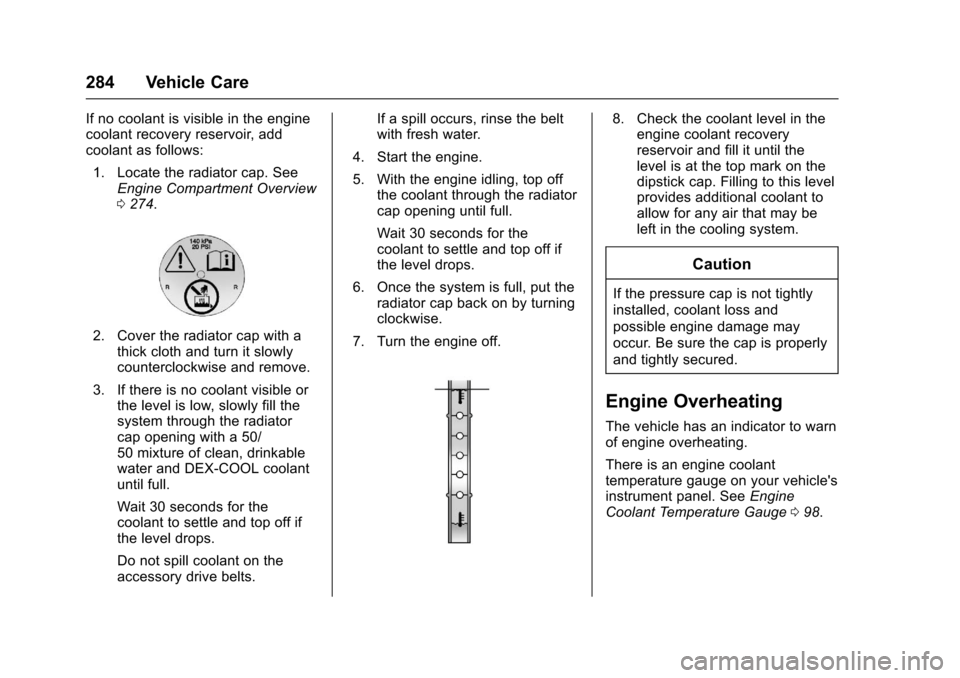
1. Locate the radiator cap. SeeEngine Compartment Overview0274.
2. Cover the radiator cap with athick cloth and turn it slowlycounterclockwise and remove.
3. If there is no coolant visible orthe level is low, slowly fill thesystem through the radiatorcap opening with a 50/50 mixture of clean, drinkablewater and DEX-COOL coolantuntil full.
Wait 30 seconds for thecoolant to settle and top off ifthe level drops.
Do not spill coolant on theaccessory drive belts.
If a spill occurs, rinse the beltwith fresh water.
4. Start the engine.
5. With the engine idling, top offthe coolant through the radiatorcap opening until full.
Wait 30 seconds for thecoolant to settle and top off ifthe level drops.
6. Once the system is full, put theradiator cap back on by turningclockwise.
7. Turn the engine off.
8. Check the coolant level in theengine coolant recoveryreservoir and fill it until thelevel is at the top mark on thedipstick cap. Filling to this levelprovides additional coolant toallow for any air that may beleft in the cooling system.
Caution
If the pressure cap is not tightly
installed, coolant loss and
possible engine damage may
occur. Be sure the cap is properly
and tightly secured.
Engine Overheating
The vehicle has an indicator to warnof engine overheating.
There is an engine coolanttemperature gauge on your vehicle'sinstrument panel. SeeEngineCoolant Temperature Gauge098.
Page 286 of 400
Chevrolet SS Sedan Owner Manual (GMNA-Localizing-U.S.-10122752) -2017 - crc - 8/31/16
Vehicle Care 285
Yo u m a y d e c i d e n o t t o l i f t t h e h o o dwhen this warning appears, butinstead get service help right away.SeeRoadside Assistance Program0368.
If you do decide to lift the hood,make sure the vehicle is parked onalevelsurface.
Then check to see if the enginecooling fans are running. If theengine is overheating, both fansshould be running. If they are not,do not continue to run the engineand have the vehicle serviced.
Caution
Running the engine without
coolant may cause damage or a
fire. Vehicle damage would not be
covered by the vehicle warranty.
If Steam is Coming from the
Engine Compartment
{Warning
Steam from an overheated engine
can burn you badly, even if you
just open the hood. Stay away
from the engine if you see or hear
steam coming from it. Just turn it
off and get everyone away from
the vehicle until it cools down.
Wait until there is no sign of
steam or coolant before you open
the hood.
If you keep driving when the
engine is overheated, the liquids
in it can catch fire. You or others
could be badly burned. Stop the
engine if it overheats, and get out
of the vehicle until the engine
is cool.
If No Steam is Coming from
the Engine Compartment
If an engine overheat warning isdisplayed but no steam can be seenor heard, the problem may not be
too serious. Sometimes the enginecan get a little too hot when thevehicle:
.Climbs a long hill on a hot day.
.Stops after high-speed driving.
.Idles for long periods in traffic.
If the overheat warning is displayedwith no sign of steam:
1. Turn the air conditioning off.
2. Turn the heater on to thehighest temperature and to thehighest fan speed. Open thewindows as necessary.
3. When it is safe to do so, pull offthe road, shift to P (Park) orN(Neutral), and let theengine idle.
If the temperature overheat gauge isno longer in the overheat zone or anoverheat warning no longerdisplays, the vehicle can be driven.Continue to drive the vehicle slowlyfor about 10 minutes. Keep a safevehicle distance from the vehicle infront. If the warning does not come
Page 287 of 400
Chevrolet SS Sedan Owner Manual (GMNA-Localizing-U.S.-10122752) -2017 - crc - 8/31/16
286 Vehicle Care
back on, continue to drive normallyand have the cooling systemchecked for proper fill and function.
If the warning continues, pull over,stop, and park the vehicleright away.
If there is no sign of steam, idle theengine for three minutes whileparked. If the warning is stilldisplayed, turn off the engine until itcools down.
Washer Fluid
What to Use
When windshield washer fluid isneeded, be sure to read themanufacturer's instructions beforeuse. If operating the vehicle in anarea where the temperature may fallbelow freezing, use a fluid that hassufficient protection againstfreezing.
Adding Washer Fluid
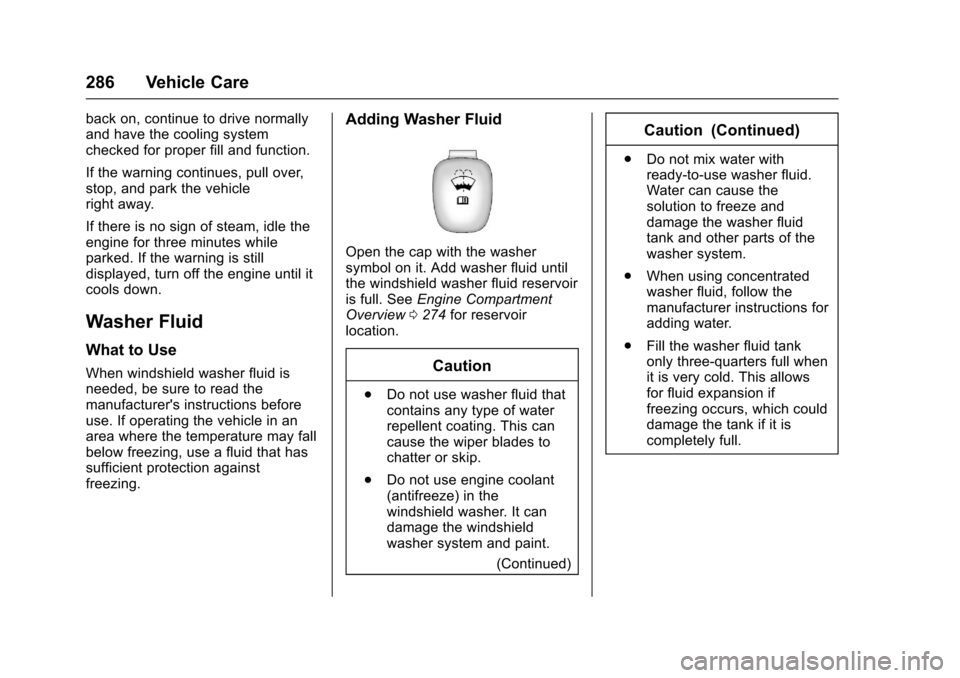
Open the cap with the washersymbol on it. Add washer fluid untilthe windshield washer fluid reservoiris full. SeeEngine CompartmentOverview0274for reservoirlocation.
Caution
.Do not use washer fluid thatcontains any type of waterrepellent coating. This cancause the wiper blades tochatter or skip.
.Do not use engine coolant(antifreeze) in thewindshield washer. It candamage the windshieldwasher system and paint.
(Continued)
Caution (Continued)
.Do not mix water withready-to-use washer fluid.Water can cause thesolution to freeze anddamage the washer fluidtank and other parts of thewasher system.
.When using concentratedwasher fluid, follow themanufacturer instructions foradding water.
.Fill the washer fluid tankonly three-quarters full whenit is very cold. This allowsfor fluid expansion iffreezing occurs, which coulddamage the tank if it iscompletely full.
Page 288 of 400
Chevrolet SS Sedan Owner Manual (GMNA-Localizing-U.S.-10122752) -2017 - crc - 8/31/16
Vehicle Care 287
Brakes
Disc brake pads have built-in wearindicators that make a high-pitchedwarning sound when the brake padsare worn and new pads are needed.The sound can come and go or canbe heard all the time when thevehicle is moving, except whenapplying the brake pedal firmly.
{Warning
The brake wear warning sound
means that soon the brakes will
not work well. That could lead to
acrash.Whenthebrakewear
warning sound is heard, have the
vehicle serviced.
Caution
Continuing to drive with worn-out
brake pads could result in costly
brake repair.
Some driving conditions or climatescan cause a brake squeal when thebrakes are first applied or lightlyapplied. This does not meansomething is wrong with the brakes.
Properly torqued wheel nuts arenecessary to help prevent brakepulsation. When tires are rotated,inspect brake pads for wear andevenly tighten wheel nuts in theproper sequence to torquespecifications. SeeCapacities andSpecifications0362.
Brake pads should be replaced ascomplete sets.
Brake Pedal Travel
See your dealer if the brake pedaldoes not return to normal height,or if there is a rapid increase inpedal travel. This could be a signthat brake service may be required.
Replacing Brake System Parts
Always replace brake system partswith new, approved replacementparts. If this is not done, the brakesmay not work properly. The brakingperformance expected can changein many other ways if the wrong
replacement brake parts areinstalled or if parts are improperlyinstalled.
Brake Fluid
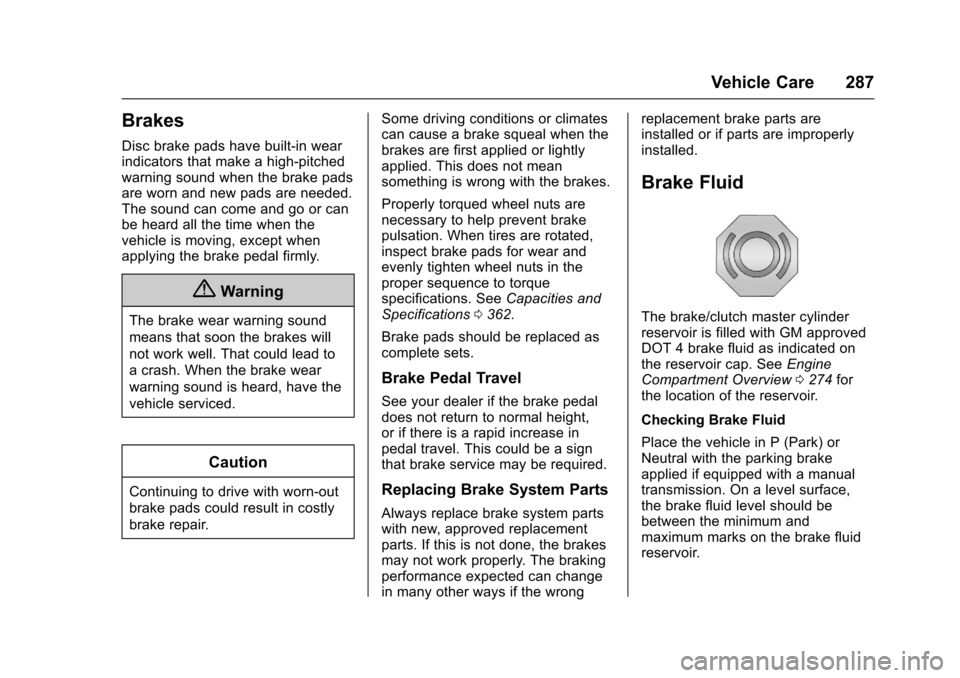
The brake/clutch master cylinderreservoir is filled with GM approvedDOT 4 brake fluid as indicated onthe reservoir cap. SeeEngineCompartment Overview0274forthe location of the reservoir.
Checking Brake Fluid
Place the vehicle in P (Park) orNeutral with the parking brakeapplied if equipped with a manualtransmission. On a level surface,the brake fluid level should bebetween the minimum andmaximum marks on the brake fluidreservoir.