belt CHEVROLET SS 2017 1.G Service Manual
[x] Cancel search | Manufacturer: CHEVROLET, Model Year: 2017, Model line: SS, Model: CHEVROLET SS 2017 1.GPages: 400, PDF Size: 7.31 MB
Page 272 of 400
Chevrolet SS Sedan Owner Manual (GMNA-Localizing-U.S.-10122752) -2017 - crc - 8/31/16
Vehicle Care 271
Tire Sealant andCompressor Kit . . . . . . . . . . . . . 323Storing the Tire Sealant andCompressor Kit . . . . . . . . . . . . . 329Tire Changing . . . . . . . . . . . . . . . . 329Full-Size Spare Tire . . . . . . . . . . 334
Jump Starting
Jump Starting - NorthAmerica . . . . . . . . . . . . . . . . . . . . . 335
Towing the Vehicle
To w i n g t h e V e h i c l e . . . . . . . . . . . 3 3 7Recreational VehicleTo w i n g . . . . . . . . . . . . . . . . . . . . . . 3 3 8
Appearance Care
Exterior Care . . . . . . . . . . . . . . . . . 338Interior Care . . . . . . . . . . . . . . . . . . 343Floor Mats . . . . . . . . . . . . . . . . . . . . 346
General Information
For service and parts needs, visityour dealer. You will receivegenuine GM parts and GM-trainedand supported service people.
Genuine GM parts have one ofthese marks:
California Proposition
65 Warning
WARNING:Most motor vehicles,including this one, as well as manyof its service parts and fluids,contain and/or emit chemicalsknown to the State of California to
cause cancer and birth defects orother reproductive harm. Engineexhaust, many parts and systems,many fluids, and some componentwear by-products contain and/oremit these chemicals.
SeeBattery - North America0288andJump Starting - North America0335.
California Perchlorate
Materials Requirements
Certain types of automotiveapplications, such as airbaginitiators, safety belt pretensioners,and lithium batteries contained inRemote Keyless Entry transmitters,may contain perchlorate materials.Special handling may be necessary.For additional information, seewww.dtsc.ca.gov/hazardouswaste/perchlorate.
Page 285 of 400
Chevrolet SS Sedan Owner Manual (GMNA-Localizing-U.S.-10122752) -2017 - crc - 8/31/16
284 Vehicle Care
If no coolant is visible in the enginecoolant recovery reservoir, addcoolant as follows:
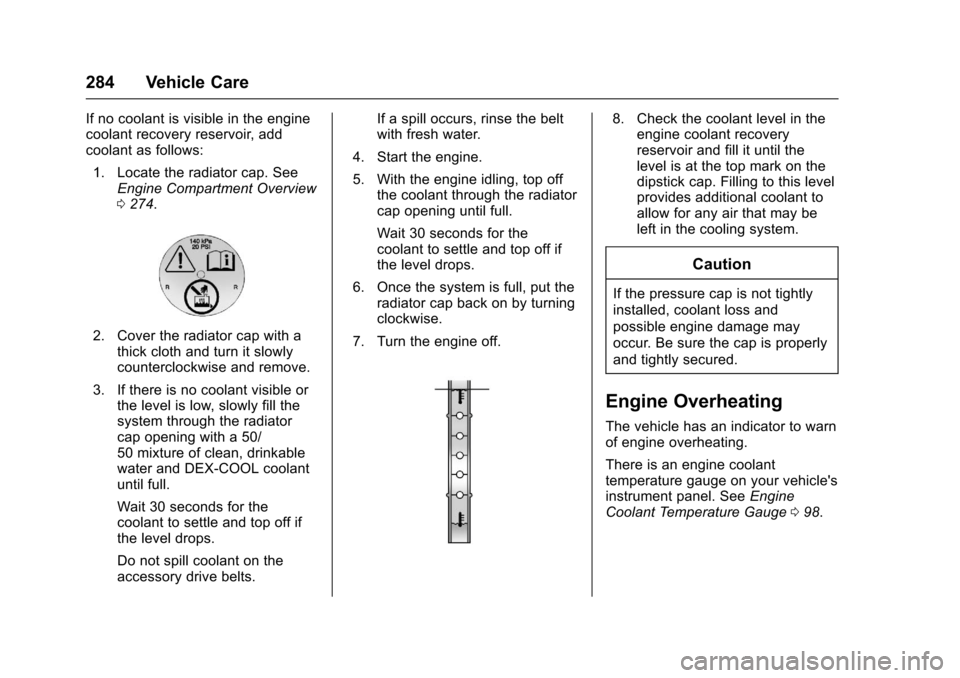
1. Locate the radiator cap. SeeEngine Compartment Overview0274.
2. Cover the radiator cap with athick cloth and turn it slowlycounterclockwise and remove.
3. If there is no coolant visible orthe level is low, slowly fill thesystem through the radiatorcap opening with a 50/50 mixture of clean, drinkablewater and DEX-COOL coolantuntil full.
Wait 30 seconds for thecoolant to settle and top off ifthe level drops.
Do not spill coolant on theaccessory drive belts.
If a spill occurs, rinse the beltwith fresh water.
4. Start the engine.
5. With the engine idling, top offthe coolant through the radiatorcap opening until full.
Wait 30 seconds for thecoolant to settle and top off ifthe level drops.
6. Once the system is full, put theradiator cap back on by turningclockwise.
7. Turn the engine off.
8. Check the coolant level in theengine coolant recoveryreservoir and fill it until thelevel is at the top mark on thedipstick cap. Filling to this levelprovides additional coolant toallow for any air that may beleft in the cooling system.
Caution
If the pressure cap is not tightly
installed, coolant loss and
possible engine damage may
occur. Be sure the cap is properly
and tightly secured.
Engine Overheating
The vehicle has an indicator to warnof engine overheating.
There is an engine coolanttemperature gauge on your vehicle'sinstrument panel. SeeEngineCoolant Temperature Gauge098.
Page 307 of 400
Chevrolet SS Sedan Owner Manual (GMNA-Localizing-U.S.-10122752) -2017 - crc - 8/31/16
306 Vehicle Care
tire size, and date the tire was
manufactured. The TIN is
molded onto both sides of the
tire, although only one side may
have the date of manufacture.
(5) Tire Ply Material:The type
of cord and number of plies in
the sidewall and under the tread.
(6) Uniform Tire Quality
Grading (UTQG):Tire
manufacturers are required to
grade tires based on three
performance factors: treadwear,
traction, and temperature
resistance. For more information
seeUniform Tire Quality
Grading0319.
(7) Maximum Cold Inflation
Load Limit:Maximum load that
can be carried and the
maximum pressure needed to
support that load.
Tire Designations
Tire Size
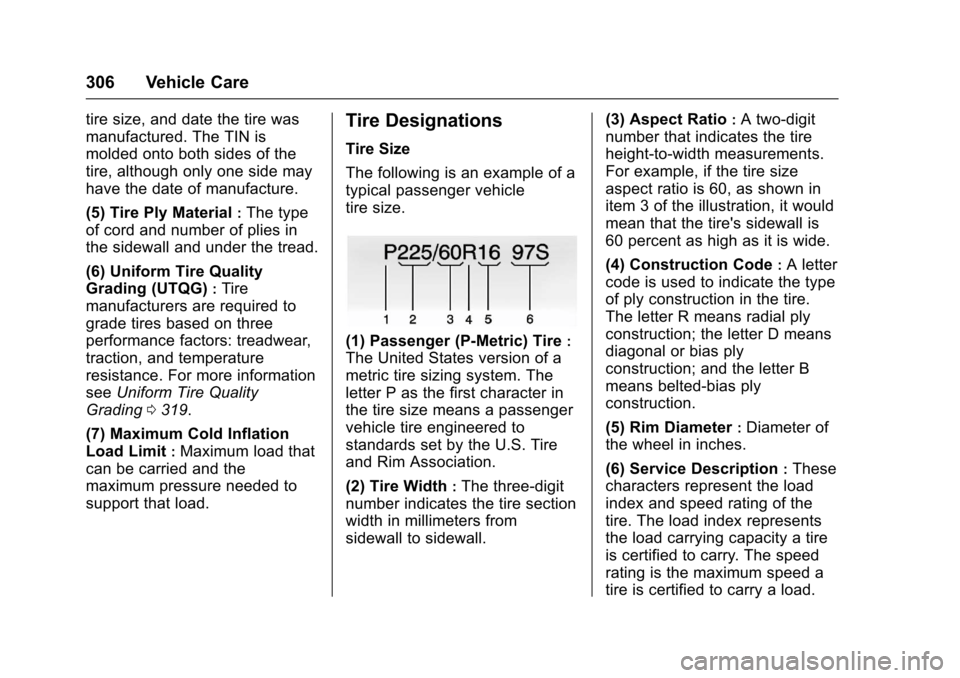
The following is an example of a
typical passenger vehicle
tire size.
(1) Passenger (P-Metric) Tire:
The United States version of a
metric tire sizing system. The
letter P as the first character in
the tire size means a passenger
vehicle tire engineered to
standards set by the U.S. Tire
and Rim Association.
(2) Tire Width:The three-digit
number indicates the tire section
width in millimeters from
sidewall to sidewall.
(3) Aspect Ratio:Atwo-digit
number that indicates the tire
height-to-width measurements.
For example, if the tire size
aspect ratio is 60, as shown in
item 3 of the illustration, it would
mean that the tire's sidewall is
60 percent as high as it is wide.
(4) Construction Code:Aletter
code is used to indicate the type
of ply construction in the tire.
The letter R means radial ply
construction; the letter D means
diagonal or bias ply
construction; and the letter B
means belted-bias ply
construction.
(5) Rim Diameter:Diameter of
the wheel in inches.
(6) Service Description:These
characters represent the load
index and speed rating of the
tire. The load index represents
the load carrying capacity a tire
is certified to carry. The speed
rating is the maximum speed a
tire is certified to carry a load.
Page 308 of 400
Chevrolet SS Sedan Owner Manual (GMNA-Localizing-U.S.-10122752) -2017 - crc - 8/31/16
Vehicle Care 307
Tire Terminology and
Definitions
Air Pressure:The amount of
air inside the tire pressing
outward on each square inch of
the tire. Air pressure is
expressed in kPa (kilopascal)
or psi (pounds per square inch).
Accessory Weight:The
combined weight of optional
accessories. Some examples of
optional accessories are
automatic transmission, power
windows, power seats, and air
conditioning.
Aspect Ratio:The relationship
of a tire's height to its width.
Belt:Arubbercoatedlayerof
cords between the plies and the
tread. Cords may be made from
steel or other reinforcing
materials.
Bead:The tire bead contains
steel wires wrapped by steel
cords that hold the tire onto
the rim.
Bias Ply Tire:Apneumatictire
in which the plies are laid at
alternate angles less than
90 degrees to the centerline of
the tread.
Cold Tire Pressure:The
amount of air pressure in a tire,
measured in kPa (kilopascal)
or psi (pounds per square inch)
before a tire has built up heat
from driving. SeeTire Pressure
0309.
Curb Weight:The weight of a
motor vehicle with standard and
optional equipment including the
maximum capacity of fuel, oil,
and coolant, but without
passengers and cargo.
DOT Markings:Acodemolded
into the sidewall of a tire
signifying that the tire is in
compliance with the U.S.
Department of Transportation
(DOT) Motor Vehicle Safety
Standards. The DOT code
includes the Tire Identification
Number (TIN), an alphanumeric
designator which can also
identify the tire manufacturer,
production plant, brand, and
date of production.
GVWR:Gross Vehicle Weight
Rating. SeeVehicle Load Limits
0226.
GAWR FRT:Gross Axle Weight
Rating for the front axle. See
Vehicle Load Limits0226.
GAWR RR:Gross Axle Weight
Rating for the rear axle. See
Vehicle Load Limits0226.
Intended Outboard Sidewall:
The side of an asymmetrical tire
that must always face outward
when mounted on a vehicle.
Kilopascal (kPa):The metric
unit for air pressure.
Page 347 of 400
Chevrolet SS Sedan Owner Manual (GMNA-Localizing-U.S.-10122752) -2017 - crc - 8/31/16
346 Vehicle Care
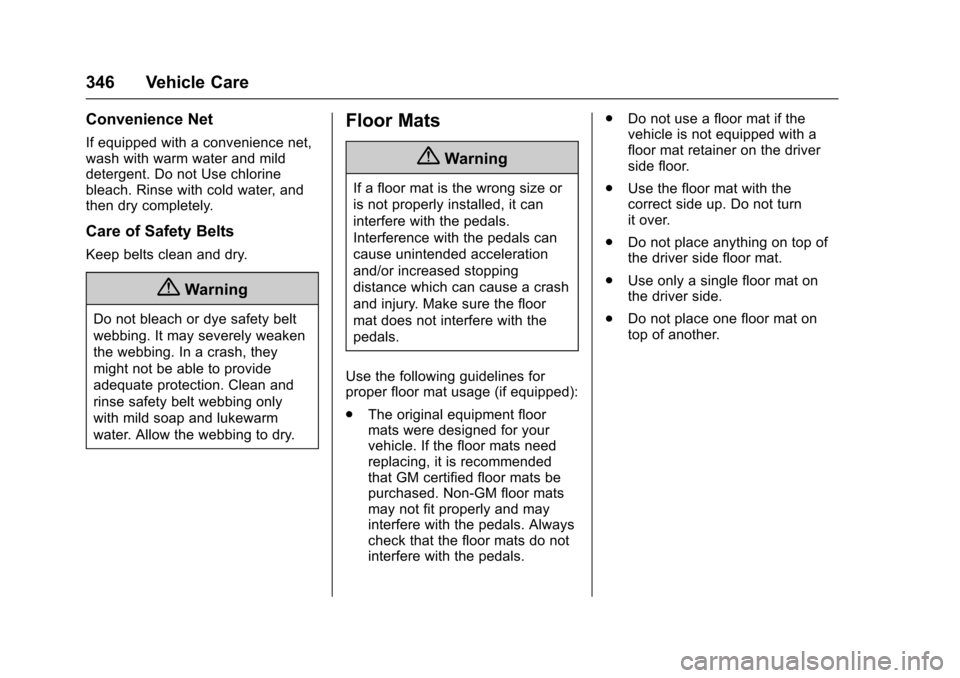
Convenience Net
If equipped with a convenience net,wash with warm water and milddetergent. Do not Use chlorinebleach. Rinse with cold water, andthen dry completely.
Care of Safety Belts
Keep belts clean and dry.
{Warning
Do not bleach or dye safety belt
webbing. It may severely weaken
the webbing. In a crash, they
might not be able to provide
adequate protection. Clean and
rinse safety belt webbing only
with mild soap and lukewarm
water. Allow the webbing to dry.
Floor Mats
{Warning
If a floor mat is the wrong size or
is not properly installed, it can
interfere with the pedals.
Interference with the pedals can
cause unintended acceleration
and/or increased stopping
distance which can cause a crash
and injury. Make sure the floor
mat does not interfere with the
pedals.
Use the following guidelines forproper floor mat usage (if equipped):
.The original equipment floormats were designed for yourvehicle. If the floor mats needreplacing, it is recommendedthat GM certified floor mats bepurchased. Non-GM floor matsmay not fit properly and mayinterfere with the pedals. Alwayscheck that the floor mats do notinterfere with the pedals.
.Do not use a floor mat if thevehicle is not equipped with afloor mat retainer on the driverside floor.
.Use the floor mat with thecorrect side up. Do not turnit over.
.Do not place anything on top ofthe driver side floor mat.
.Use only a single floor mat onthe driver side.
.Do not place one floor mat ontop of another.
Page 353 of 400
Chevrolet SS Sedan Owner Manual (GMNA-Localizing-U.S.-10122752) -2017 - crc - 8/31/16
352 Service and Maintenance
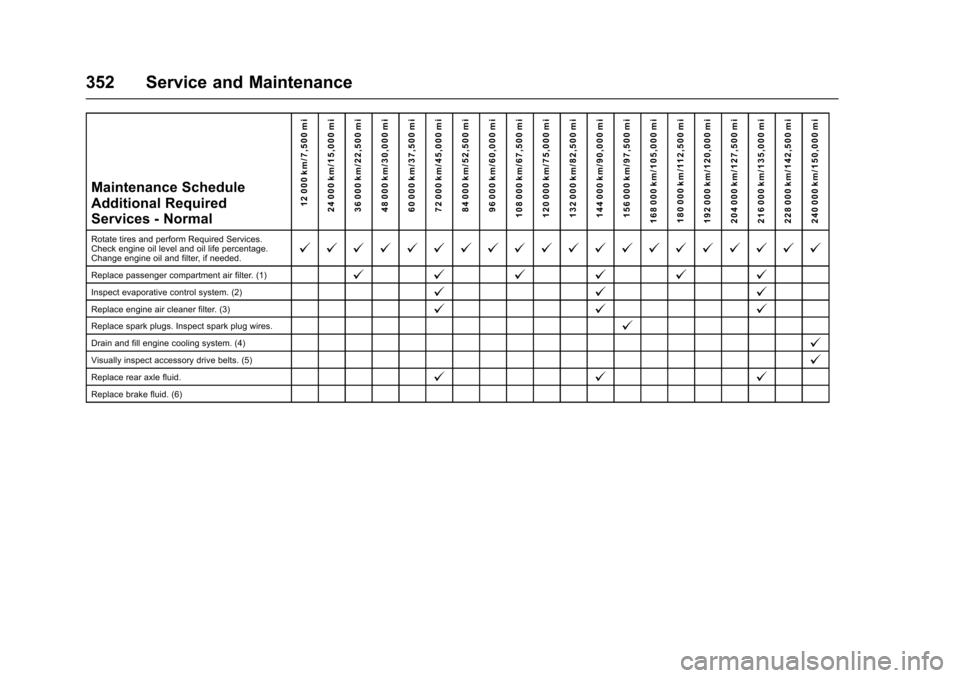
Maintenance ScheduleAdditional RequiredServices - Normal
12 000 km/7,500 mi24 000 km/15,000 mi36 000 km/22,500 mi48 000 km/30,000 mi60 000 km/37,500 mi72 000 km/45,000 mi84 000 km/52,500 mi96 000 km/60,000 mi108 000 km/67,500 mi120 000 km/75,000 mi132 000 km/82,500 mi144 000 km/90,000 mi156 000 km/97,500 mi168 000 km/105,000 mi180 000 km/112,500 mi192 000 km/120,000 mi204 000 km/127,500 mi216 000 km/135,000 mi228 000 km/142,500 mi240 000 km/150,000 mi
Rotate tires and perform Required Services.Check engine oil level and oil life percentage.Change engine oil and filter, if needed.@@@@@@@@@@@@@@@@@@@@
Replace passenger compartment air filter. (1)@@@@@@
Inspect evaporative control system. (2)@@@
Replace engine air cleaner filter. (3)@@@
Replace spark plugs. Inspect spark plug wires.@
Drain and fill engine cooling system. (4)@
Visually inspect accessory drive belts. (5)@
Replace rear axle fluid.@@@
Replace brake fluid. (6)
Page 355 of 400
Chevrolet SS Sedan Owner Manual (GMNA-Localizing-U.S.-10122752) -2017 - crc - 8/31/16
354 Service and Maintenance
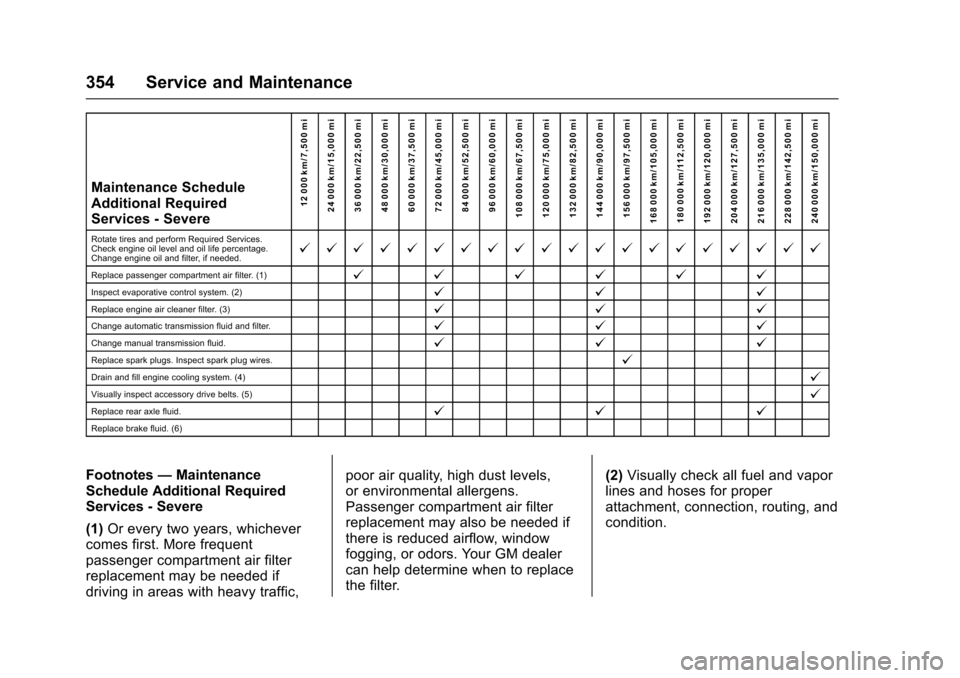
Maintenance ScheduleAdditional RequiredServices - Severe
12 000 km/7,500 mi24 000 km/15,000 mi36 000 km/22,500 mi48 000 km/30,000 mi60 000 km/37,500 mi72 000 km/45,000 mi84 000 km/52,500 mi96 000 km/60,000 mi108 000 km/67,500 mi120 000 km/75,000 mi132 000 km/82,500 mi144 000 km/90,000 mi156 000 km/97,500 mi168 000 km/105,000 mi180 000 km/112,500 mi192 000 km/120,000 mi204 000 km/127,500 mi216 000 km/135,000 mi228 000 km/142,500 mi240 000 km/150,000 mi
Rotate tires and perform Required Services.Check engine oil level and oil life percentage.Change engine oil and filter, if needed.@@@@@@@@@@@@@@@@@@@@
Replace passenger compartment air filter. (1)@@@@@@
Inspect evaporative control system. (2)@@@
Replace engine air cleaner filter. (3)@@@
Change automatic transmission fluid and filter.@@@
Change manual transmission fluid.@@@
Replace spark plugs. Inspect spark plug wires.@
Drain and fill engine cooling system. (4)@
Visually inspect accessory drive belts. (5)@
Replace rear axle fluid.@@@
Replace brake fluid. (6)
Footnotes—MaintenanceSchedule Additional RequiredServices - Severe
(1)Or every two years, whichevercomes first. More frequentpassenger compartment air filterreplacement may be needed ifdriving in areas with heavy traffic,
poor air quality, high dust levels,or environmental allergens.Passenger compartment air filterreplacement may also be needed ifthere is reduced airflow, windowfogging, or odors. Your GM dealercan help determine when to replacethe filter.
(2)Visually check all fuel and vaporlines and hoses for properattachment, connection, routing, andcondition.
Page 357 of 400
Chevrolet SS Sedan Owner Manual (GMNA-Localizing-U.S.-10122752) -2017 - crc - 8/31/16
356 Service and Maintenance
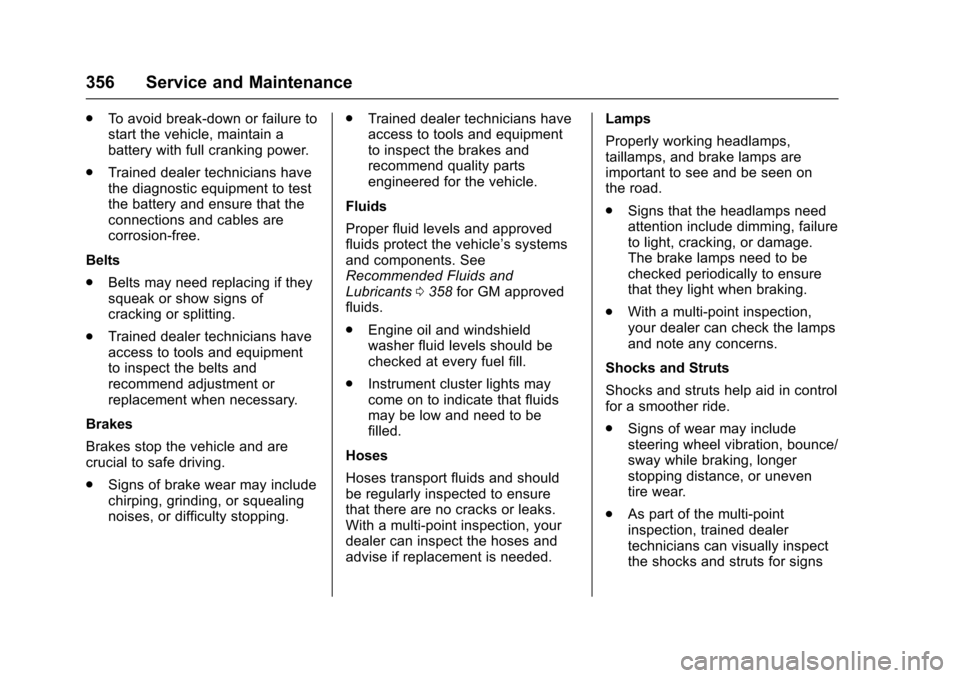
.To a v o i d b r e a k - d o w n o r f a i l u r e t ostart the vehicle, maintain abattery with full cranking power.
.Trained dealer technicians havethe diagnostic equipment to testthe battery and ensure that theconnections and cables arecorrosion-free.
Belts
.Belts may need replacing if theysqueak or show signs ofcracking or splitting.
.Trained dealer technicians haveaccess to tools and equipmentto inspect the belts andrecommend adjustment orreplacement when necessary.
Brakes
Brakes stop the vehicle and arecrucial to safe driving.
.Signs of brake wear may includechirping, grinding, or squealingnoises, or difficulty stopping.
.Trained dealer technicians haveaccess to tools and equipmentto inspect the brakes andrecommend quality partsengineered for the vehicle.
Fluids
Proper fluid levels and approvedfluids protect the vehicle’ssystemsand components. SeeRecommended Fluids andLubricants0358for GM approvedfluids.
.Engine oil and windshieldwasher fluid levels should bechecked at every fuel fill.
.Instrument cluster lights maycome on to indicate that fluidsmay be low and need to befilled.
Hoses
Hoses transport fluids and shouldbe regularly inspected to ensurethat there are no cracks or leaks.With a multi-point inspection, yourdealer can inspect the hoses andadvise if replacement is needed.
Lamps
Properly working headlamps,taillamps, and brake lamps areimportant to see and be seen onthe road.
.Signs that the headlamps needattention include dimming, failureto light, cracking, or damage.The brake lamps need to bechecked periodically to ensurethat they light when braking.
.With a multi-point inspection,your dealer can check the lampsand note any concerns.
Shocks and Struts
Shocks and struts help aid in controlfor a smoother ride.
.Signs of wear may includesteering wheel vibration, bounce/sway while braking, longerstopping distance, or uneventire wear.
.As part of the multi-pointinspection, trained dealertechnicians can visually inspectthe shocks and struts for signs
Page 362 of 400
Chevrolet SS Sedan Owner Manual (GMNA-Localizing-U.S.-10122752) -2017 - crc - 8/31/16
Technical Data 361
Technical Data
Vehicle Identification
Vehicle IdentificationNumber (VIN) . . . . . . . . . . . . . . . 361Service Parts IdentificationLabel . . . . . . . . . . . . . . . . . . . . . . . . 361
Vehicle Data
Capacities andSpecifications . . . . . . . . . . . . . . . 362Engine Drive Belt Routing . . . . 363
Vehicle Identification
Vehicle Identification
Number (VIN)
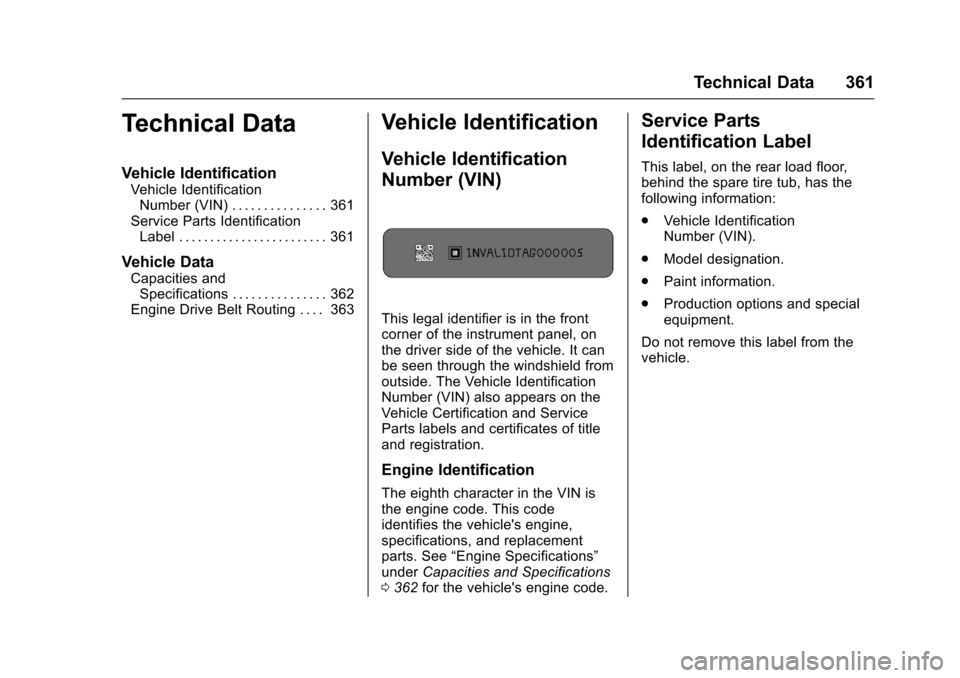
This legal identifier is in the frontcorner of the instrument panel, onthe driver side of the vehicle. It canbe seen through the windshield fromoutside. The Vehicle IdentificationNumber (VIN) also appears on theVehicle Certification and ServiceParts labels and certificates of titleand registration.
Engine Identification
The eighth character in the VIN isthe engine code. This codeidentifies the vehicle's engine,specifications, and replacementparts. See“Engine Specifications”underCapacities and Specifications0362for the vehicle's engine code.
Service Parts
Identification Label
This label, on the rear load floor,behind the spare tire tub, has thefollowing information:
.Vehicle IdentificationNumber (VIN).
.Model designation.
.Paint information.
.Production options and specialequipment.
Do not remove this label from thevehicle.
Page 364 of 400
Chevrolet SS Sedan Owner Manual (GMNA-Localizing-U.S.-10122752) -2017 - crc - 8/31/16
Technical Data 363
Engine Specifications
EngineVIN CodeTr a n s m i s s i o nSpark Plug Gap
6.2L V8 (LS3)WAutomaticManual0.95–1.10 mm (0.037–0.043 in)
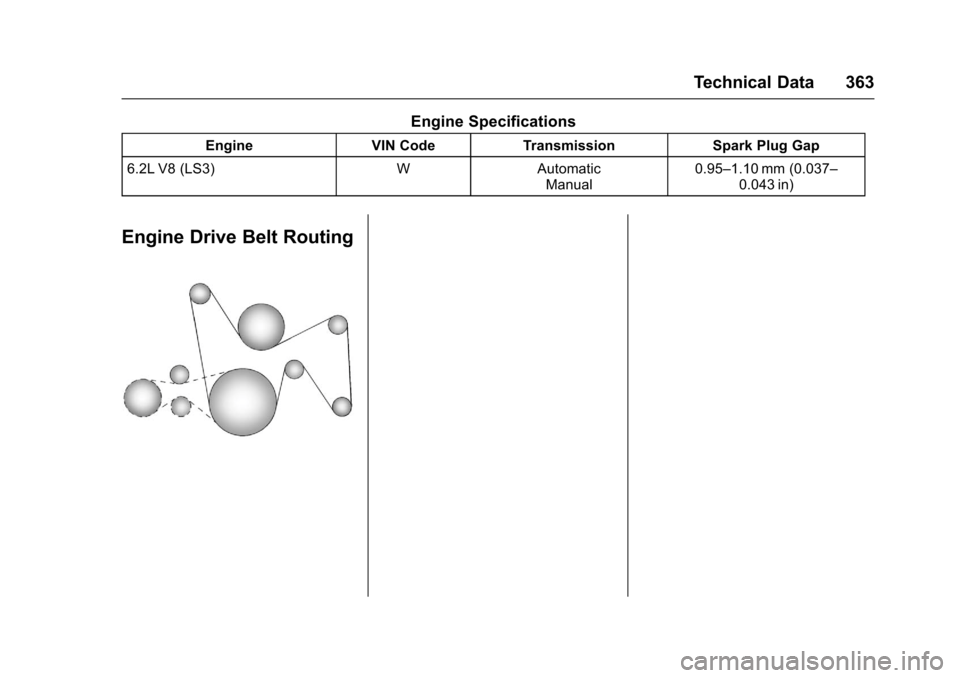
Engine Drive Belt Routing