warning light CHEVROLET SS 2017 1.G Workshop Manual
[x] Cancel search | Manufacturer: CHEVROLET, Model Year: 2017, Model line: SS, Model: CHEVROLET SS 2017 1.GPages: 400, PDF Size: 7.31 MB
Page 313 of 400
Chevrolet SS Sedan Owner Manual (GMNA-Localizing-U.S.-10122752) -2017 - crc - 8/31/16
312 Vehicle Care
of reasons, including the installationof replacement or alternate tires orwheels on the vehicle that preventthe TPMS from functioning properly.Always check the TPMS malfunctiontelltale after replacing one or moretires or wheels on your vehicle toensure that the replacement oralternate tires and wheels allow theTPMS to continue to functionproperly.
SeeTire Pressure MonitorOperation0312.
SeeRadio Frequency Statement0374.
Tire Pressure Monitor
Operation
This vehicle may have a TirePressure Monitor System (TPMS).The TPMS is designed to warn thedriver when a low tire pressurecondition exists. TPMS sensors aremounted onto each tire and wheelassembly, including the spare tireand wheel assembly. The TPMSsensors monitor the air pressure in
the tires and transmit the tirepressure readings to a receiverlocated in the vehicle.
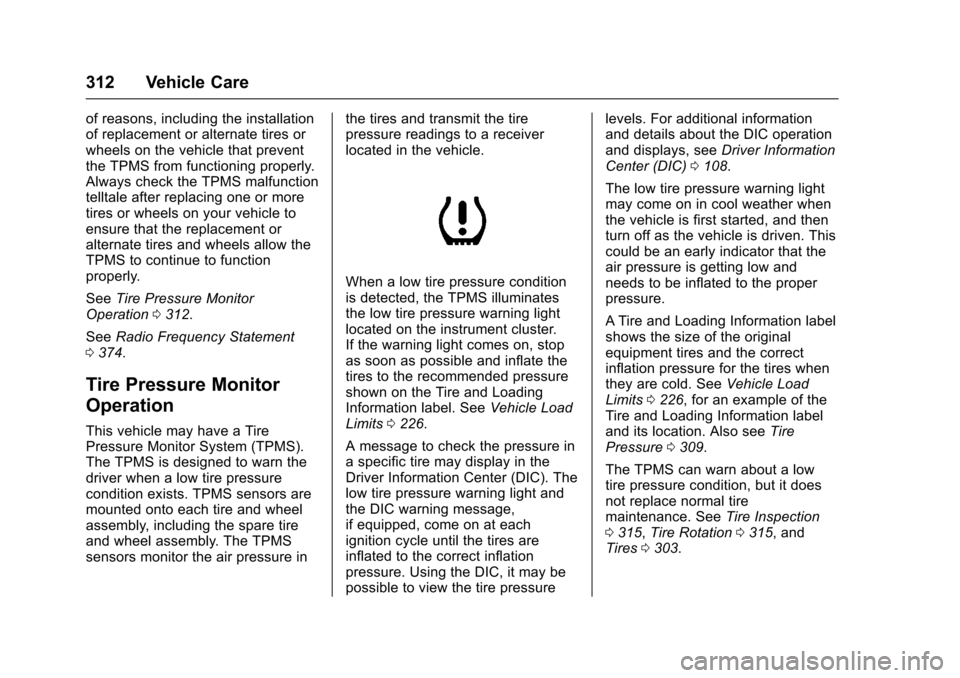
When a low tire pressure conditionis detected, the TPMS illuminatesthe low tire pressure warning lightlocated on the instrument cluster.If the warning light comes on, stopas soon as possible and inflate thetires to the recommended pressureshown on the Tire and LoadingInformation label. SeeVehicle LoadLimits0226.
AmessagetocheckthepressureinaspecifictiremaydisplayintheDriver Information Center (DIC). Thelow tire pressure warning light andthe DIC warning message,if equipped, come on at eachignition cycle until the tires areinflated to the correct inflationpressure. Using the DIC, it may bepossible to view the tire pressure
levels. For additional informationand details about the DIC operationand displays, seeDriver InformationCenter (DIC)0108.
The low tire pressure warning lightmay come on in cool weather whenthe vehicle is first started, and thenturn off as the vehicle is driven. Thiscould be an early indicator that theair pressure is getting low andneeds to be inflated to the properpressure.
ATire and Loading Information labelshows the size of the originalequipment tires and the correctinflation pressure for the tires whenthey are cold. SeeVehicle LoadLimits0226,foranexampleoftheTire and Loading Information labeland its location. Also seeTirePressure0309.
The TPMS can warn about a lowtire pressure condition, but it doesnot replace normal tiremaintenance. SeeTire Inspection0315,Tire Rotation0315,andTires0303.
Page 314 of 400
Chevrolet SS Sedan Owner Manual (GMNA-Localizing-U.S.-10122752) -2017 - crc - 8/31/16
Vehicle Care 313
Caution
Tire sealant materials are not all
the same. A non-approved tire
sealant could damage the TPMS
sensors. TPMS sensor damage
caused by using an incorrect tire
sealant is not covered by the
vehicle warranty. Always use only
the GM approved tire sealant
available through your dealer or
included in the vehicle.
Factory-installed Tire Inflator Kitsuse a GM approved liquid tiresealant. Using non-approved tiresealants could damage the TPMSsensors. SeeTire Sealant andCompressor Kit0323forinformation regarding the inflator kitmaterials and instructions.
TPMS Malfunction Light and
Message
The TPMS will not function properlyif one or more of the TPMS sensorsare missing or inoperable. When thesystem detects a malfunction, thelow tire pressure warning light,
defined above, flashes for aboutone minute and then stays on forthe remainder of the ignition cycle.ADICwarningmessagemayalsodisplay. The malfunction light andDIC warning message, if equipped,come on at each ignition cycle untilthe problem is corrected. Some ofthe conditions that can cause theseto come on are:
.One of the road tires has beenreplaced with the spare tire. Thespare tire does not have aTPMS sensor. The malfunctionlight and the DIC message,if equipped, should go off afterthe road tire is replaced and thesensor matching process isperformed successfully. See"TPMS Sensor MatchingProcess" later in this section.
.The TPMS sensor matchingprocess was not done or notcompleted successfully afterrotating the tires or exchanging aroad tire with the spare tire. Themalfunction light and the DICmessage, if equipped, should gooff after successfully completing
the sensor matching process.See "TPMS Sensor MatchingProcess" later in this section.
.One or more TPMS sensors aremissing or damaged. Themalfunction light and the DICmessage, if equipped, should gooff when the TPMS sensors areinstalled and the sensormatching process is performedsuccessfully. See your dealer forservice.
.Replacement tires or wheels donot match the original equipmenttires or wheels. Tires and wheelsother than those recommendedcould prevent the TPMS fromfunctioning properly. SeeBuyingNew Tires0317.
.Operating electronic devices orbeing near facilities using radiowave frequencies similar to theTPMS could cause the TPMSsensors to malfunction.
If the TPMS is not functioningproperly, it cannot detect or signal alow tire condition. See your dealer
Page 317 of 400
Chevrolet SS Sedan Owner Manual (GMNA-Localizing-U.S.-10122752) -2017 - crc - 8/31/16
316 Vehicle Care
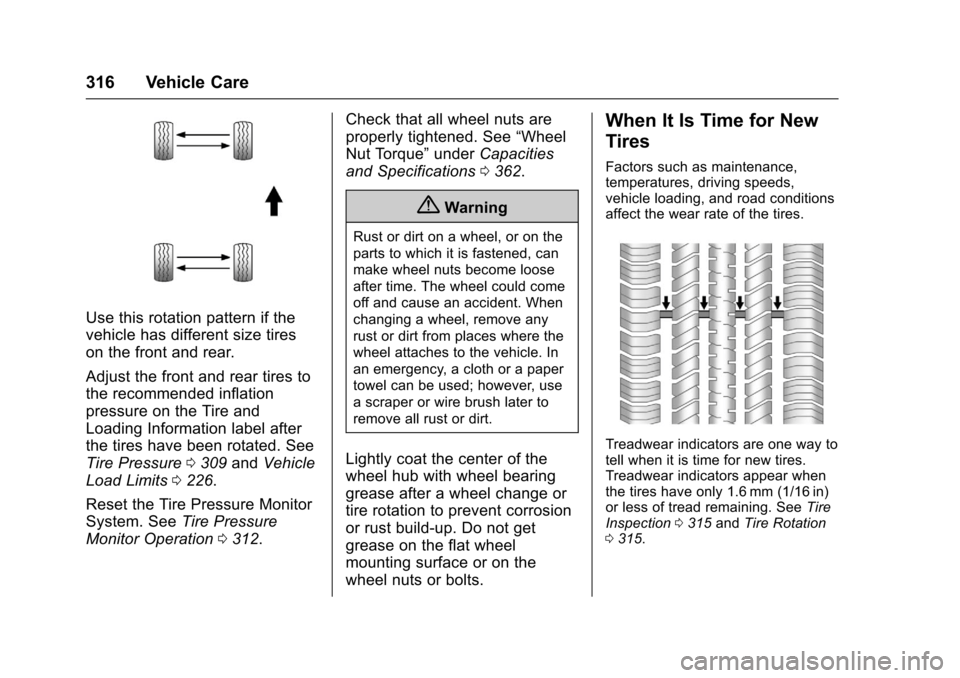
Use this rotation pattern if the
vehicle has different size tires
on the front and rear.
Adjust the front and rear tires to
the recommended inflation
pressure on the Tire and
Loading Information label after
the tires have been rotated. See
Tire Pressure0309andVehicle
Load Limits0226.
Reset the Tire Pressure Monitor
System. SeeTire Pressure
Monitor Operation0312.
Check that all wheel nuts are
properly tightened. See“Wheel
Nut Torque”underCapacities
and Specifications0362.
{Warning
Rust or dirt on a wheel, or on the
parts to which it is fastened, can
make wheel nuts become loose
after time. The wheel could come
off and cause an accident. When
changing a wheel, remove any
rust or dirt from places where the
wheel attaches to the vehicle. In
an emergency, a cloth or a paper
towel can be used; however, use
ascraperorwirebrushlaterto
remove all rust or dirt.
Lightly coat the center of the
wheel hub with wheel bearing
grease after a wheel change or
tire rotation to prevent corrosion
or rust build-up. Do not get
grease on the flat wheel
mounting surface or on the
wheel nuts or bolts.
When It Is Time for New
Tires
Factors such as maintenance,temperatures, driving speeds,vehicle loading, and road conditionsaffect the wear rate of the tires.
Treadwear indicators are one way totell when it is time for new tires.Treadwear indicators appear whenthe tires have only 1.6 mm (1/16 in)or less of tread remaining. SeeTireInspection0315andTire Rotation0315.
Page 320 of 400
Chevrolet SS Sedan Owner Manual (GMNA-Localizing-U.S.-10122752) -2017 - crc - 8/31/16
Vehicle Care 319
control, electronic stability control,or All-Wheel Drive, the performanceof these systems can also beaffected.
{Warning
If different sized wheels are used,
there may not be an acceptable
level of performance and safety if
tires not recommended for those
wheels are selected. This
increases the chance of a crash
and serious injury. Only use GM
specific wheel and tire systems
developed for the vehicle, and
have them properly installed by a
GM certified technician.
SeeBuying New Tires0317andAccessories and Modifications0272.
Uniform Tire Quality
Grading
The following information relates
to the system developed by the
United States National Highway
Traffic Safety Administration
(NHTSA), which grades tires by
treadwear, traction, and
temperature performance. This
applies only to vehicles sold in
the United States. The grades
are molded on the sidewalls of
most passenger car tires. The
Uniform Tire Quality Grading
(UTQG) system does not apply
to deep tread, winter tires,
compact spare tires, tires with
nominal rim diameters of
10 to 12 inches (25 to 30 cm),
or to some limited-production
tires.
While the tires available on
General Motors passenger cars
and light trucks may vary with
respect to these grades, they
must also conform to federal
safety requirements and
additional General Motors Tire
Performance Criteria (TPC)
standards.
Quality grades can be found
where applicable on the tire
sidewall between tread shoulder
and maximum section width. For
example:
Treadwear 200 Traction AATemperature A
All Passenger Car Tires Must
Conform to Federal Safety
Requirements In Addition To
These Grades.
Treadwear
The treadwear grade is a
comparative rating based on the
wear rate of the tire when tested
under controlled conditions on a
specified government test
course. For example, a tire
graded 150 would wear one and
one-half (1Ω) times as well on
the government course as a tire
graded 100. The relative
performance of tires depends
upon the actual conditions of
their use, however, and may
depart significantly from the
Page 321 of 400
Chevrolet SS Sedan Owner Manual (GMNA-Localizing-U.S.-10122752) -2017 - crc - 8/31/16
320 Vehicle Care
norm due to variations in driving
habits, service practices and
differences in road
characteristics and climate.
Traction
The traction grades, from
highest to lowest, are AA, A, B,
and C. Those grades represent
the tire's ability to stop on wet
pavement as measured under
controlled conditions on
specified government test
surfaces of asphalt and
concrete. A tire marked C may
have poor traction performance.
Warning: The traction grade
assigned to this tire is based on
straight-ahead braking traction
tests, and does not include
acceleration, cornering,
hydroplaning, or peak traction
characteristics.
Temperature
The temperature grades are A
(the highest), B, and C,
representing the tire's resistance
to the generation of heat and its
ability to dissipate heat when
tested under controlled
conditions on a specified indoor
laboratory test wheel. Sustained
high temperature can cause the
material of the tire to degenerate
and reduce tire life, and
excessive temperature can lead
to sudden tire failure. The grade
Ccorrespondstoalevelof
performance which all
passenger car tires must meet
under the Federal Motor Safety
Standard No. 109. Grades B and
Arepresenthigherlevelsof
performance on the laboratory
test wheel than the minimum
required by law. Warning: The
temperature grade for this tire is
established for a tire that is
properly inflated and not
overloaded. Excessive speed,
underinflation, or excessive
loading, either separately or in
combination, can cause heat
buildup and possible tire failure.
Wheel Alignment and Tire
Balance
The tires and wheels were alignedand balanced at the factory toprovide the longest tire life and bestoverall performance. Adjustments towheel alignment and tire balancingare not necessary on a regularbasis. Consider an alignment checkif there is unusual tire wear or thevehicle is significantly pulling to oneside or the other. Some slight pull tothe left or right, depending on thecrown of the road and/or other roadsurface variations such as troughsor ruts, is normal. If the vehicle isvibrating when driving on a smoothroad, the tires and wheels may needto be rebalanced. See your dealerfor proper diagnosis.
Wheel Replacement
Replace any wheel that is bent,cracked, or badly rusted orcorroded. If wheel nuts keep comingloose, the wheel, wheel bolts, andwheel nuts should be replaced.If the wheel leaks air, replace it.
Page 326 of 400
Chevrolet SS Sedan Owner Manual (GMNA-Localizing-U.S.-10122752) -2017 - crc - 8/31/16
Vehicle Care 325
If a tire goes flat, avoid further tireand wheel damage by driving slowlyto a level place. Turn on the hazardwarning flashers. SeeHazardWarning Flashers0127.
SeeIf a Tire Goes Flat0322forother important safety warnings.
Do not remove any objects thathave penetrated the tire.
1. Remove the tire sealant andcompressor kit from its storagelocation. SeeStoring the TireSealant and Compressor Kit0329.
2. Remove the sealant/airhose (5) from the side of thecompressor.
3. Remove the power plug (6).
4. Place the kit on the ground.
Make sure the tire valve stemis positioned close to theground so the hose willreach it.
5. Remove the valve stem capfrom the flat tire by turning itcounterclockwise.
6. Attach the sealant/air hose (5)onto the tire valve. Turn itclockwise until it is tight.
7. Switch the on/off switch (1) tothe O position.
8. Plug the power plug (6) into thepower outlet in the vehicle.Unplug all items from otheraccessory power outlets. SeePower Outlets094.
If the vehicle has an accessorypower outlet, do not use thecigarette lighter.
If the vehicle only has acigarette lighter, use thecigarette lighter.
Do not pinch the power plugcord in the door or window.
9. Start the vehicle. The vehiclemust be running while usingthe air compressor.
10. Switch the on/off switch (1) tothe I position.
The compressor will injectsealant and air into the tire.
Sealant may leak from thepuncture hole until the vehicleis driven and the hole hassealed.
The pressure gauge (2) willinitially show a high pressurewhile the compressor pushesthe sealant into the tire. Oncethe sealant is completelydispersed into the tire, thepressure will quickly drop andstart to rise again as the tireinflates with air only.
11 . I n f l a t e t h e t i r e t o t h erecommended inflationpressure using the pressuregauge (2). The recommendedinflation pressure can be foundon the Tire and LoadingInformation label. SeeTirePressure0309.
The pressure gauge (2) mayread higher than the actual tirepressure while the compressoris on. Turn the compressor offto get an accurate pressurereading. The compressor maybe turned on/off until thecorrect pressure is reached.
Page 337 of 400
Chevrolet SS Sedan Owner Manual (GMNA-Localizing-U.S.-10122752) -2017 - crc - 8/31/16
336 Vehicle Care
The jump start positive (1) andnegative (2) posts are in the enginecompartment on the driver side ofthe vehicle.
These posts are used instead of adirect connection to the battery.
The positive jump start connectionis covered by a red cap. Remove toexpose the terminal.
1. Check the other vehicle.It must have a 12-volt batterywith a negative ground system.
Caution
If the other vehicle does not have
a12-voltsystemwithanegative
ground, both vehicles can be
damaged. Only use a vehicle that
has a 12-volt system with a
negative ground for jump starting.
2. Position the two vehicles sothat they are not touching.
3. Set the parking brake firmlyand put the shift lever inP(Park)withanautomatictransmission. SeeShifting IntoPark (Automatic Transmission)0232.Vehicleswithamanualtransmission should be inNeutral. SeeParking0234.
Caution
If any accessories are left on or
plugged in during the jump
starting procedure, they could be
damaged. The repairs would not
be covered by the vehicle
warranty. Whenever possible, turn
off or unplug all accessories on
either vehicle when jump starting.
4. Turn the ignition to LOCK/OFFand switch off all lights andaccessories in both vehicles,except the hazard warningflashers if needed.
{Warning
An electric fan can start up even
when the engine is not running
and can injure you. Keep hands,
clothing, and tools away from any
underhood electric fan.
{Warning
Using a match near a battery can
cause battery gas to explode.
People have been hurt doing this,
and some have been blinded.
Use a flashlight if you need more
light.
Battery fluid contains acid that
can burn you. Do not get it on
you. If you accidentally get it in
your eyes or on your skin, flush
the place with water and get
medical help immediately.
Page 389 of 400

Chevrolet SS Sedan Owner Manual (GMNA-Localizing-U.S.-10122752) -2017 - crc - 9/1/16
388 Index
IndexA
Accessories and
Modifications . . . . . . . . . . . . . . . . . . 272
Accessory Power . . . . . . . . . . . . . . . 232
Add-On Electrical Equipment . . . 268
Additional Information
OnStar®...................... 383
Additional Maintenance
and Care . . . . . . . . . . . . . . . . . . . . . . 355
Adjustments
Lumbar, Front Seats . . . . . . . . . . . . 46
Agreements
Trademarks and License . . . . . 205
Air Cleaner/Filter, Engine . . . . . . . 279
Air Conditioning . . . . . . . . . . . . . . . . 210
Air Filter, Passenger
Compartment . . . . . . . . . . . . . . . . . 215
Air Vents . . . . . . . . . . . . . . . . . . . . . . . 214
Airbag System
Check . . . . . . . . . . . . . . . . . . . . . . . . . . 68
How Does an Airbag
Restrain? . . . . . . . . . . . . . . . . . . . . . 61
Passenger Sensing System . . . . 63
What Makes an Airbag
Inflate? . . . . . . . . . . . . . . . . . . . . . . . . 61
What Will You See after an
Airbag Inflates? . . . . . . . . . . . . . . . 62
Airbag System (cont'd)
When Should an Airbag
Inflate? . . . . . . . . . . . . . . . . . . . . . . . . 60
Where Are the Airbags? . . . . . . . . 59
Airbags
Adding Equipment to the
Vehicle . . . . . . . . . . . . . . . . . . . . . . . . 68
Passenger Status Indicator . . . . . 99
Readiness Light . . . . . . . . . . . . . . . . 99
Servicing Airbag-Equipped
Vehicles . . . . . . . . . . . . . . . . . . . . . . . 67
System Check . . . . . . . . . . . . . . . . . . 57
Alarm
Vehicle Security . . . . . . . . . . . . . . . . 36
Alert
Side Blind Zone (SBZA) . . . . . . 261
AM-FM Radio . . . . . . . . . . . . . . . . . . . 139
Antenna
Backglass . . . . . . . . . . . . . . . . . . . . 147
Multi-band . . . . . . . . . . . . . . . . . . . . 148
Antilock Brake System (ABS) . . . 241
Warning Light . . . . . . . . . . . . . . . . . 104
Appearance Care
Exterior . . . . . . . . . . . . . . . . . . . . . . . 338
Interior . . . . . . . . . . . . . . . . . . . . . . . . 343
Assistance Program,
Roadside . . . . . . . . . . . . . . . . . . . . . . 368
Page 390 of 400

Chevrolet SS Sedan Owner Manual (GMNA-Localizing-U.S.-10122752) -2017 - crc - 9/1/16
Index 389
Assistance Systems for
Driving . . . . . . . . . . . . . . . . . . . . . . . . 259
Assistance Systems for
Parking and Backing . . . . . . . . . . 254
Audio
Bluetooth . . . . . . . . . . . . . . . . . . . . . 163
Automatic
Dimming Mirrors . . . . . . . . . . . . . . . . 39
Door Locks . . . . . . . . . . . . . . . . . . . . . 33
Headlamp System . . . . . . . . . . . . 127
Transmission . . . . . . . . . . . . . . . . . 236
Transmission Fluid . . . . . . . . . . . 278
Automatic Transmission
Manual Mode . . . . . . . . . . . . . . . . . 238
Shift Lock Control Function
Check . . . . . . . . . . . . . . . . . . . . . . . 290
Axle, Rear . . . . . . . . . . . . . . . . . . . . . . 289
B
Backglass Antenna . . . . . . . . . . . . . 147
Battery
Power Protection . . . . . . . . . . . . . 130
Voltage and Charging
Messages . . . . . . . . . . . . . . . . . . . .113
Battery - North America . . . . 288, 335
Blade Replacement, Wiper . . . . . 291
Bluetooth . . . . . . . . . . . . . . . . . . . . . . . 195
Bluetooth Audio . . . . . . . . . . . . . . . . 163
Brake
Parking, Electric . . . . . . . . . . . . . . 242
System Warning Light . . . . . . . . 102
Brakes . . . . . . . . . . . . . . . . . . . . . . . . . . 287
Antilock . . . . . . . . . . . . . . . . . . . . . . . 241
Assist . . . . . . . . . . . . . . . . . . . . . . . . . 244
Fluid . . . . . . . . . . . . . . . . . . . . . . . . . . 287
System Messages . . . . . . . . . . . . .113
Braking . . . . . . . . . . . . . . . . . . . . . . . . . 218
Break-In, New Vehicle . . . . . . . . . . 229
Bulb Replacement . . . . . . . . . . . . . . 294
Headlamp Aiming . . . . . . . . . . . . . 292
Headlamps . . . . . . . . . . . . . . . . . . . 293
High Intensity Discharge
(HID) Lighting . . . . . . . . . . . . . . . 293
License Plate Lamps . . . . . . . . . 293
Buying New Tires . . . . . . . . . . . . . . . 317
C
California
Fuel Requirements . . . . . . . . . . . 265
Perchlorate Materials
Requirements . . . . . . . . . . . . . . . 271
California
Proposition
65 Warning . . . . . . . . . .271, 288, 335
Capacities and
Specifications . . . . . . . . . . . . . . . . . 362
Carbon Monoxide
Engine Exhaust . . . . . . . . . . . . . . . 235
Trunk . . . . . . . . . . . . . . . . . . . . . . . . . . . 35
Winter Driving . . . . . . . . . . . . . . . . 224
Caution, Danger, and Warning . . . . 2
Center Console Storage . . . . . . . . . 87
Chains, Tire . . . . . . . . . . . . . . . . . . . . 321
Charging System Light . . . . . . . . . 100
Check
Malfunction Indicator
Engine Light . . . . . . . . . . . . . . . . 100
Child Restraints
Infants and Young Children . . . . . 71
Lower Anchors and Tethers
for Children . . . . . . . . . . . . . . . . . . . 76
Older Children . . . . . . . . . . . . . . . . . . 69
Securing . . . . . . . . . . . . . . . . . . . . 81, 83
Systems . . . . . . . . . . . . . . . . . . . . . . . . 73
Cleaning
Exterior Care . . . . . . . . . . . . . . . . . 338
Interior Care . . . . . . . . . . . . . . . . . . 343
Climate Control Systems
Dual Automatic . . . . . . . . . . . . . . . 210
Clock . . . . . . . . . . . . . . . . . . . . . . . . . . . . 93
Cluster, Instrument . . . . . . . . . . . . . . 96
Clutch, Hydraulic . . . . . . . . . . . . . . . 279
Collision Damage Repair . . . . . . . 371
Page 391 of 400

Chevrolet SS Sedan Owner Manual (GMNA-Localizing-U.S.-10122752) -2017 - crc - 9/1/16
390 Index
Compartments
Storage . . . . . . . . . . . . . . . . . . . . . . . . . 87
Compressor Kit, Tire Sealant . . . 323
Configure Menu . . . . . . . . . . . . . . . . 181
Connections
OnStar®...................... 380
Control
Traction and Electronic
Stability . . . . . . . . . . . . . . . . . . . . . 245
Control of a Vehicle . . . . . . . . . . . . . 218
Controls
Steering Wheel . . . . . . . . . . . . . . . 134
Convenience Net . . . . . . . . . . . . . . . . 88
Convex Mirrors . . . . . . . . . . . . . . . . . . 38
Coolant
Engine . . . . . . . . . . . . . . . . . . . . . . . . 281
Engine Temperature Gauge . . . . 98
Cooling . . . . . . . . . . . . . . . . . . . . . . . . . 210
Cooling System . . . . . . . . . . . . . . . . . 280
Engine Messages . . . . . . . . . . . . .114
Courtesy Transportation
Program . . . . . . . . . . . . . . . . . . . . . . . 370
Coverage Explanations . . . . . . . . . 188
Cruise Control . . . . . . . . . . . . . . . . . . 251
Light . . . . . . . . . . . . . . . . . . . . . . . . . . 107
Messages . . . . . . . . . . . . . . . . . . . . .114
Cupholders . . . . . . . . . . . . . . . . . . . . . . 87
Customer Assistance . . . . . . . . . . . 367
Customer Assistance (cont'd)
Offices . . . . . . . . . . . . . . . . . . . . . . . . 366
Te x t Te l e p h o n e ( T T Y )
Users . . . . . . . . . . . . . . . . . . . . . . . 367
Customer Information
Service Publications
Ordering Information . . . . . . . . 373
Customer Satisfaction
Procedure . . . . . . . . . . . . . . . . . . . . . 364
D
Damage Repair, Collision . . . . . . . 371
Danger, Warning, and Caution . . . . 2
Data Collection
Infotainment System . . . . . . . . . . 377
OnStar . . . . . . . . . . . . . . . . . . . . . . . 376
Data Recorders, Event . . . . . . . . . 376
Database Coverage
Explanations . . . . . . . . . . . . . . . . . . 188
Daytime Running
Lamps (DRL) . . . . . . . . . . . . . . . . . . 127
Defensive Driving . . . . . . . . . . . . . . . 217
Delayed Locking . . . . . . . . . . . . . . . . . 33
Destination . . . . . . . . . . . . . . . . . . . . . 171
Destination Download
OnStar®...................... 180
Devices
USB . . . . . . . . . . . . . . . . . . . . . . . . . . 158
Diagnostics
OnStar®...................... 382
Distracted Driving . . . . . . . . . . . . . . . 217
Dome Lamps . . . . . . . . . . . . . . . . . . . 129
Door
Ajar Light . . . . . . . . . . . . . . . . . . . . . 108
Ajar Messages . . . . . . . . . . . . . . . .114
Delayed Locking . . . . . . . . . . . . . . . . 33
Locks . . . . . . . . . . . . . . . . . . . . . . . . . . . 32
Power Locks . . . . . . . . . . . . . . . . . . . . 33
Rear Seat Pass-Through . . . . . . . 51
Drive Belt Routing, Engine . . . . . . 363
Driver Assistance Systems . . . . . 253
Driver Information
Center (DIC) . . . . . . . . . . . . . . . . . . 108
Driver Mode Control . . . . . . . . . . . . 247
Driver Mode Control Light . . . . . . 105
Driving
Assistance Systems . . . . . . . . . . 259
Defensive . . . . . . . . . . . . . . . . . . . . . 217
Drunk . . . . . . . . . . . . . . . . . . . . . . . . . 218
For Better Fuel Economy . . . . . . . 22
Hill and Mountain Roads . . . . . . 223
If the Vehicle is Stuck . . . . . . . . . 225
Loss of Control . . . . . . . . . . . . . . . 219
Off-Road Recovery . . . . . . . . . . . 219
Track Events and
Competitive . . . . . . . . . . . . . . . . . 220