engine oil CHEVROLET SSR 2003 1.G User Guide
[x] Cancel search | Manufacturer: CHEVROLET, Model Year: 2003, Model line: SSR, Model: CHEVROLET SSR 2003 1.GPages: 374, PDF Size: 2.55 MB
Page 233 of 374
Backing Up
Hold the bottom of the steering wheel with one hand.
Then, to move the trailer to the left, just move that hand
to the left. To move the trailer to the right, move your
hand to the right. Always back up slowly and, if possible,
have someone guide you.
Making Turns
Notice:Making very sharp turns while trailering
could cause the trailer to come in contact with the
vehicle. Your vehicle could be damaged. Avoid
making very sharp turns while trailering.
When you’re turning with a trailer, make wider turns
than normal. Do this so your trailer won’t strike
soft shoulders, curbs, road signs, trees or other objects.
Avoid jerky or sudden maneuvers. Signal well in
advance.
Turn Signals When Towing a Trailer
When you tow a trailer, your vehicle has to have extra
wiring and a heavy-duty turn signal asher (included
in the optional trailering package).
The arrows on your instrument panel will ash whenever
you signal a turn or lane change. Properly hooked up,
the trailer lamps will also ash, telling other drivers
you’re about to turn, change lanes or stop.When towing a trailer, the arrows on your instrument
panel will ash for turns even if the bulbs on the trailer
are burned out. Thus, you may think drivers behind
you are seeing your signal when they are not. It’s
important to check occasionally to be sure the trailer
bulbs are still working.
Driving On Grades
Reduce speed and shift to a lower gear before you start
down a long or steep downgrade. If you don’t shift
down, you might have to use your brakes so much that
they would get hot and no longer work well.
Under normal conditions, use DRIVE (D) to tow a trailer.
You may want to shift the transmission to THIRD (3)
or, if necessary, a lower gear if the transmission shifts
too often under heavy loads or hilly conditions.
When towing at high altitude on steep uphill grades,
consider the following: Engine coolant will boil at a lower
temperature than at normal altitudes. If you turn your
engine off immediately after towing at high altitude
on steep uphill grades, your vehicle may show signs
similar to engine overheating. To avoid this, let the
engine run while parked (preferably on level ground)
with the transmission in PARK (P) for a few minutes
before turning the engine off. If you do get the overheat
warning, seeEngine Overheating on page 5-27.
4-47
Page 235 of 374
Maintenance When Trailer Towing
Your vehicle will need service more often when you’re
pulling a trailer. SeeScheduled Maintenance on
page 6-5for more information. Things that are especially
important in trailer operation are automatic transmission
uid (don’t overll), engine oil, axle lubricant, belt,
cooling system and brake system. Each of these is
covered in this manual. If you’re trailering, it’s a
good idea to review these sections before you start
your trip.
Check periodically to see that all hitch nuts and bolts
are tight.
Trailer Wiring Harness
The trailer wiring is a four-wire harness assembly. The
wires are blunted and taped to the wiring harness.
The harness and wiring are stored under the vehicle on
the driver’s side. The harness has no connector and
should be wired by a qualied electrical technician. The
technician can use the following color code chart
when connecting the wiring harness to your trailer.
Black: Ground wire.
Yellow: Left turn lamps.
Dark Green: Right turn lamps.
Brown: Parking lamps.
Securely attach the harness to the trailer, then tape or
strap it to your vehicle’s frame rail. Be sure you
leave it loose enough so the wiring doesn’t bend or
break, but not so loose that it drags on the ground. Store
the harness in its original place. Wrap the harness
together and tie it neatly so it won’t be damaged.
4-49
Page 237 of 374
Service............................................................5-3
Doing Your Own Service Work.........................5-4
Adding Equipment to the Outside
of Your Vehicle...........................................5-5
Fuel................................................................5-5
Gasoline Octane............................................5-5
Gasoline Specications....................................5-6
California Fuel...............................................5-6
Additives.......................................................5-7
Fuels in Foreign Countries...............................5-7
Filling the Tank..............................................5-8
Filling a Portable Fuel Container.....................5-10
Checking Things Under the Hood....................5-10
Hood Release..............................................5-11
Engine Compartment Overview.......................5-12
Engine Oil...................................................5-14
Engine Cover...............................................5-19
Engine Air Cleaner/Filter................................5-20
Automatic Transmission Fluid.........................5-21
Engine Coolant.............................................5-24
Coolant Surge Tank Pressure Cap..................5-26
Engine Overheating.......................................5-27
Cooling System............................................5-28
Power Steering Fluid.....................................5-31
Windshield Washer Fluid................................5-32Brakes........................................................5-33
Battery........................................................5-36
Jump Starting...............................................5-36
Rear Axle.......................................................5-42
Headlamp Aiming...........................................5-42
Bulb Replacement..........................................5-43
Halogen Bulbs..............................................5-43
Headlamps..................................................5-43
Front Turn Signal, Sidemarker and
Parking Lamps..........................................5-44
Taillamps.....................................................5-46
Back-Up Lamps............................................5-47
Replacement Bulbs.......................................5-48
Windshield Wiper Blade Replacement..............5-48
Tires..............................................................5-51
Ination - Tire Pressure.................................5-56
Tire Inspection and Rotation...........................5-57
When It Is Time for New Tires.......................5-58
Buying New Tires.........................................5-59
Uniform Tire Quality Grading..........................5-60
Wheel Alignment and Tire Balance..................5-61
Wheel Replacement......................................5-62
Tire Chains..................................................5-64
If a Tire Goes Flat........................................5-65
Tire Inator Kit.............................................5-66
Section 5 Service and Appearance Care
5-1
Page 243 of 374
Additives
To provide cleaner air, all gasolines in the United
States are now required to contain additives that will
help prevent engine and fuel system deposits from
forming, allowing your emission control system to
work properly. You should not have to add anything to
your fuel. Gasolines containing oxygenates, such as
ethers and ethanol, and reformulated gasolines may
be available in your area to contribute to clean air.
General Motors recommends that you use these
gasolines, particularly if they comply with the
specications described earlier.
Notice:Your vehicle was not designed for fuel
that contains methanol. Do not use fuel containing
methanol. It can corrode metal parts in your fuel
system and also damage the plastic and rubber
parts. That damage would not be covered under
your warranty.
Some gasolines that are not reformulated for low
emissions may contain an octane-enhancing additive
called methylcyclopentadienyl manganese tricarbonyl
(MMT); ask the attendant where you buy gasoline
whether the fuel contains MMT. General Motors
does not recommend the use of such gasolines.Fuels containing MMT can reduce the life of spark plugs
and the performance of the emission control system
may be affected. The malfunction indicator lamp
may turn on. If this occurs, return to your authorized
GM dealer for service.
Fuels in Foreign Countries
If you plan on driving in another country outside the
United States or Canada, the proper fuel may be hard
to nd. Never use leaded gasoline or any other fuel
not recommended in the previous text on fuel. Costly
repairs caused by use of improper fuel would not
be covered by your warranty.
To check the fuel availability, ask an auto club, or
contact a major oil company that does business in
the country where you will be driving.
5-7
Page 246 of 374
Filling a Portable Fuel Container
{CAUTION:
Never ll a portable fuel container while it is in
your vehicle. Static electricity discharge from
the container can ignite the gasoline vapor.
You can be badly burned and your vehicle
damaged if this occurs. To help avoid injury
to you and others:
Dispense gasoline only into approved
containers.
Do not ll a container while it is inside a
vehicle, in a vehicle’s trunk, pickup bed,
or on any surface other than the ground.
Bring the ll nozzle in contact with the
inside of the ll opening before operating
the nozzle. Contact should be maintained
until the lling is complete.
Do not smoke while pumping gasoline.
Checking Things Under
the Hood
{CAUTION:
Things that burn can get on hot engine parts
and start a re. These include liquids like fuel,
oil, coolant, brake uid, windshield washer
and other uids, and plastic or rubber. You or
others could be burned. Be careful not to drop
or spill things that will burn onto a hot engine.
5-10
Page 249 of 374
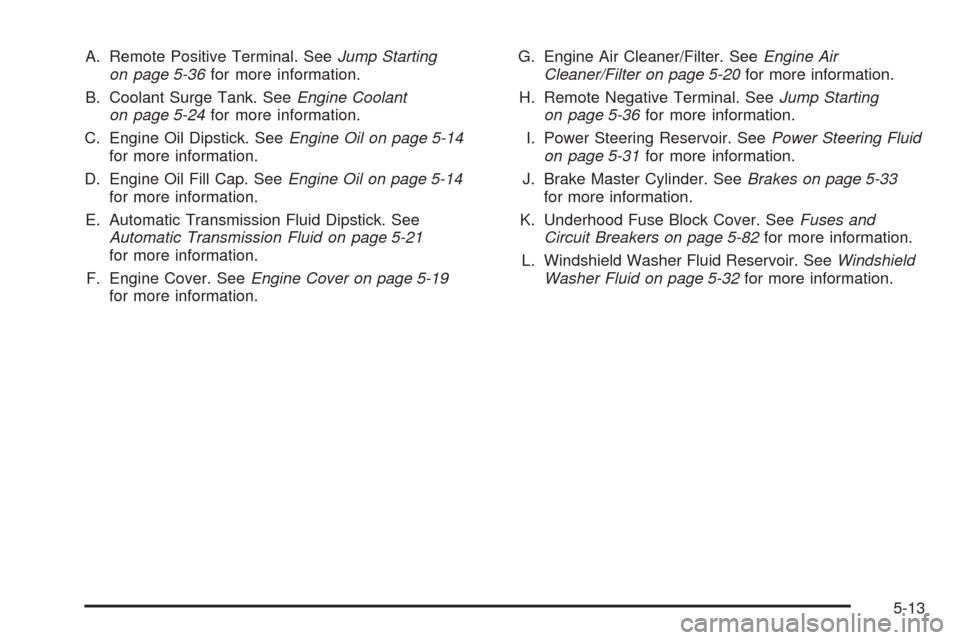
A. Remote Positive Terminal. SeeJump Starting
on page 5-36for more information.
B. Coolant Surge Tank. SeeEngine Coolant
on page 5-24for more information.
C. Engine Oil Dipstick. SeeEngine Oil on page 5-14
for more information.
D. Engine Oil Fill Cap. SeeEngine Oil on page 5-14
for more information.
E. Automatic Transmission Fluid Dipstick. See
Automatic Transmission Fluid on page 5-21
for more information.
F. Engine Cover. SeeEngine Cover on page 5-19
for more information.G. Engine Air Cleaner/Filter. SeeEngine Air
Cleaner/Filter on page 5-20for more information.
H. Remote Negative Terminal. SeeJump Starting
on page 5-36for more information.
I. Power Steering Reservoir. SeePower Steering Fluid
on page 5-31for more information.
J. Brake Master Cylinder. SeeBrakes on page 5-33
for more information.
K. Underhood Fuse Block Cover. SeeFuses and
Circuit Breakers on page 5-82for more information.
L. Windshield Washer Fluid Reservoir. SeeWindshield
Washer Fluid on page 5-32for more information.
5-13
Page 250 of 374
Engine Oil
Checking Engine Oil
It’s a good idea to check your engine oil every time you
get fuel. In order to get an accurate reading, the oil
must be warm and the vehicle must be on level ground.
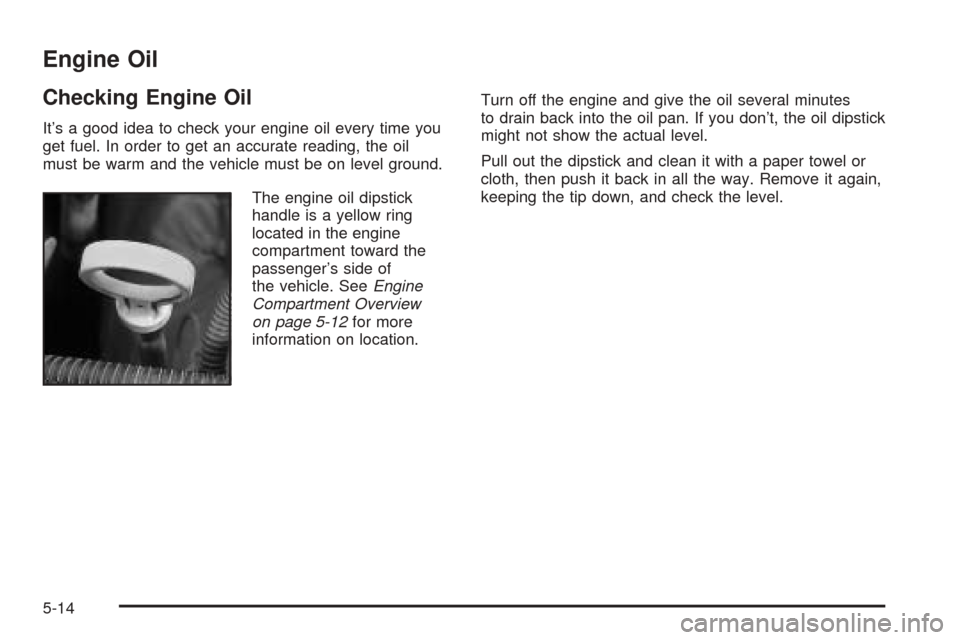
The engine oil dipstick
handle is a yellow ring
located in the engine
compartment toward the
passenger’s side of
the vehicle. SeeEngine
Compartment Overview
on page 5-12for more
information on location.Turn off the engine and give the oil several minutes
to drain back into the oil pan. If you don’t, the oil dipstick
might not show the actual level.
Pull out the dipstick and clean it with a paper towel or
cloth, then push it back in all the way. Remove it again,
keeping the tip down, and check the level.
5-14
Page 251 of 374
When to Add Engine Oil
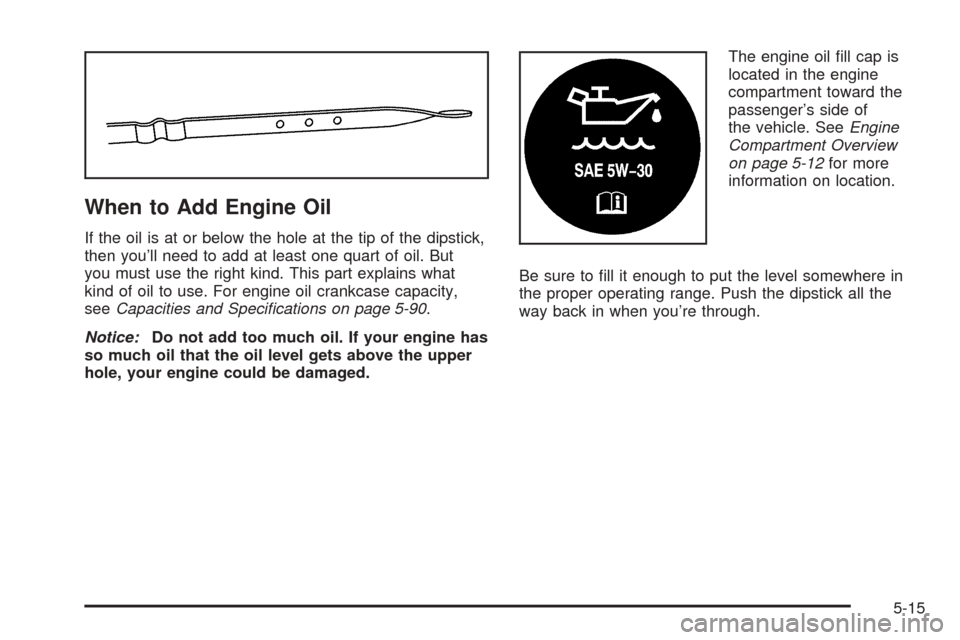
If the oil is at or below the hole at the tip of the dipstick,
then you’ll need to add at least one quart of oil. But
you must use the right kind. This part explains what
kind of oil to use. For engine oil crankcase capacity,
seeCapacities and Specications on page 5-90.
Notice:Do not add too much oil. If your engine has
so much oil that the oil level gets above the upper
hole, your engine could be damaged.The engine oil ll cap is
located in the engine
compartment toward the
passenger’s side of
the vehicle. SeeEngine
Compartment Overview
on page 5-12for more
information on location.
Be sure to ll it enough to put the level somewhere in
the proper operating range. Push the dipstick all the
way back in when you’re through.
5-15
Page 252 of 374
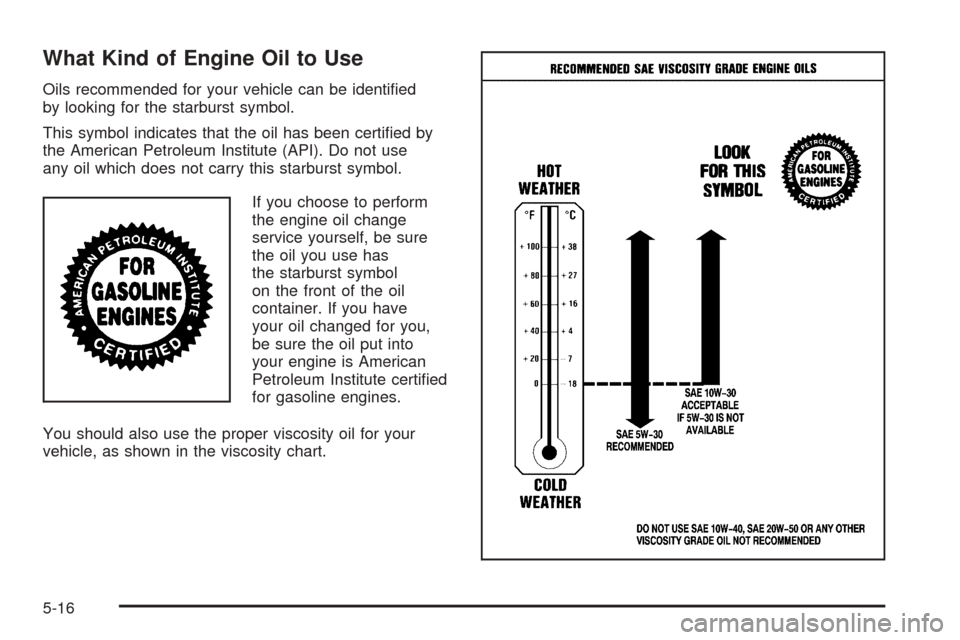
What Kind of Engine Oil to Use
Oils recommended for your vehicle can be identied
by looking for the starburst symbol.
This symbol indicates that the oil has been certied by
the American Petroleum Institute (API). Do not use
any oil which does not carry this starburst symbol.
If you choose to perform
the engine oil change
service yourself, be sure
the oil you use has
the starburst symbol
on the front of the oil
container. If you have
your oil changed for you,
be sure the oil put into
your engine is American
Petroleum Institute certied
for gasoline engines.
You should also use the proper viscosity oil for your
vehicle, as shown in the viscosity chart.
5-16
Page 253 of 374
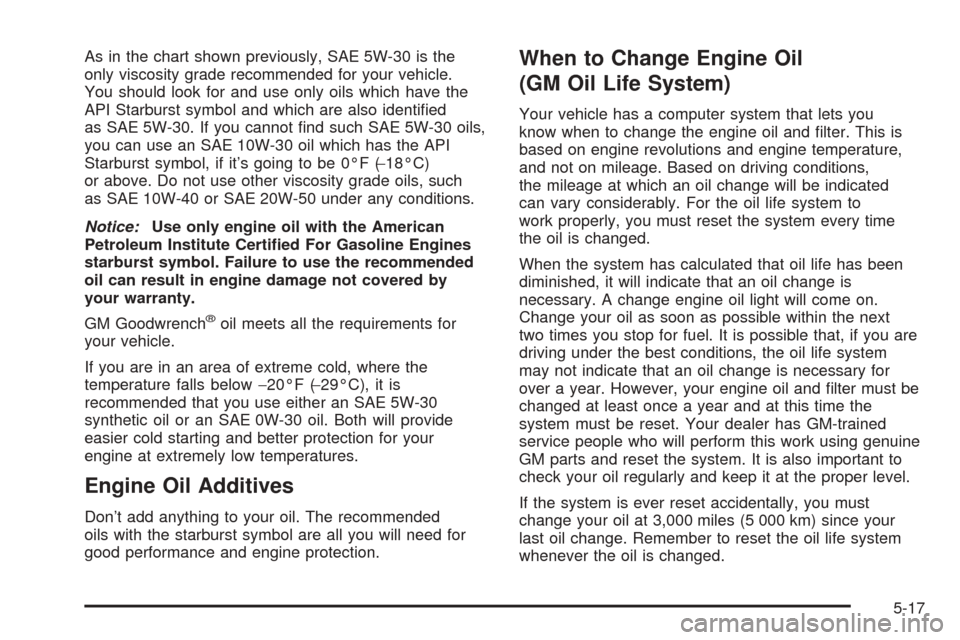
As in the chart shown previously, SAE 5W-30 is the
only viscosity grade recommended for your vehicle.
You should look for and use only oils which have the
API Starburst symbol and which are also identied
as SAE 5W-30. If you cannot nd such SAE 5W-30 oils,
you can use an SAE 10W-30 oil which has the API
Starburst symbol, if it’s going to be 0°F (−18°C)
or above. Do not use other viscosity grade oils, such
as SAE 10W-40 or SAE 20W-50 under any conditions.
Notice:Use only engine oil with the American
Petroleum Institute Certied For Gasoline Engines
starburst symbol. Failure to use the recommended
oil can result in engine damage not covered by
your warranty.
GM Goodwrench
®oil meets all the requirements for
your vehicle.
If you are in an area of extreme cold, where the
temperature falls below−20°F (−29°C), it is
recommended that you use either an SAE 5W-30
synthetic oil or an SAE 0W-30 oil. Both will provide
easier cold starting and better protection for your
engine at extremely low temperatures.
Engine Oil Additives
Don’t add anything to your oil. The recommended
oils with the starburst symbol are all you will need for
good performance and engine protection.
When to Change Engine Oil
(GM Oil Life System)
Your vehicle has a computer system that lets you
know when to change the engine oil and lter. This is
based on engine revolutions and engine temperature,
and not on mileage. Based on driving conditions,
the mileage at which an oil change will be indicated
can vary considerably. For the oil life system to
work properly, you must reset the system every time
the oil is changed.
When the system has calculated that oil life has been
diminished, it will indicate that an oil change is
necessary. A change engine oil light will come on.
Change your oil as soon as possible within the next
two times you stop for fuel. It is possible that, if you are
driving under the best conditions, the oil life system
may not indicate that an oil change is necessary for
over a year. However, your engine oil and lter must be
changed at least once a year and at this time the
system must be reset. Your dealer has GM-trained
service people who will perform this work using genuine
GM parts and reset the system. It is also important to
check your oil regularly and keep it at the proper level.
If the system is ever reset accidentally, you must
change your oil at 3,000 miles (5 000 km) since your
last oil change. Remember to reset the oil life system
whenever the oil is changed.
5-17