window CHEVROLET SSR 2006 1.G User Guide
[x] Cancel search | Manufacturer: CHEVROLET, Model Year: 2006, Model line: SSR, Model: CHEVROLET SSR 2006 1.GPages: 390, PDF Size: 2.44 MB
Page 86 of 390

Engine Exhaust
{CAUTION:
Engine exhaust can kill. It contains the gas
carbon monoxide (CO), which you cannot
see or smell. It can cause unconsciousness
and death.
You might have exhaust coming in if:
Your exhaust system sounds strange
or different.
Your vehicle gets rusty underneath.
Your vehicle was damaged in a collision.
Your vehicle was damaged when driving
over high points on the road or over
road debris.
Repairs were not done correctly.
Your vehicle or exhaust system had been
modied improperly.
If you ever suspect exhaust is coming into
your vehicle:
Drive it only with all the windows down to
blow out any CO; and
Have your vehicle xed immediately.
Running the Engine While Parked
It is better not to park with the engine running. But if you
ever have to, here are some things to know.
{CAUTION:
Idling the engine with the climate control
system off could allow dangerous exhaust into
your vehicle. See the earlier caution under
Engine Exhaust on page 2-26.
Also, idling in a closed-in place can let
deadly carbon monoxide (CO) into your
vehicle even if the climate control fan is at
the highest setting. One place this can happen
is a garage. Exhaust — with CO — can come
in easily. NEVER park in a garage with the
engine running.
Another closed-in place can be a blizzard. See
Winter Driving on page 4-24.
2-26
Page 89 of 390

Both mirrors heat to clear them of ice, snow and
condensation when the rear window defogger is turned
on. See “Rear Window Defogger” underClimate
Control System on page 3-21for more information.
The mirrors can be manually folded inward to prevent
damage when going through an automatic car wash
or confined space. Push each mirror toward the vehicle.
To return the mirror to its original position, push
outward. Be sure to return the mirrors to their original
unfolded position before driving.
Outside Convex Mirror
A convex mirror’s surface is curved so more can be
seen from the driver’s seat.
{CAUTION:
A convex mirror can make things (like other
vehicles) look farther away than they really are.
If you cut too sharply into the right lane, you
could hit a vehicle on your right. Check your
inside mirror or glance over your shoulder
before changing lanes.
Outside Automatic Dimming
Heated Mirror
If the vehicle has this feature, the driver’s side
outside rearview mirror will adjust for the glare of
headlamps from behind by pushing the on and off
settings on the mirror.
Both outside mirrors are also heated when the rear
window defogger is turned on. See “Rear Window
Defogger” underClimate Control System on page 3-21.
The mirrors can be manually folded inward to prevent
damage when going through an automatic car wash. To
fold, push the mirror toward the vehicle. To return the
mirror to its original position, push outward. Be sure
to return the mirrors to their original unfolded position
before driving.
2-29
Page 107 of 390
Lowering the Convertible Top
Notice:If you operate the convertible top switch
continuously while the ignition is in ACCESSORY,
the battery will drain and you might not be able
to start your vehicle. Do not use the convertible top
switch for extended periods of time when the
ignition is in ACCESSORY.
The ignition must be in RUN or ACCESSORY, your foot
must be on the brake, and the vehicle must be
stopped in order to lower the convertible top.
a(Top Open):Press and hold this symbol on
the convertible top switch located on the center console
switchbank to open the convertible top. The windows
will lower automatically when the top begins to
lower. Two chimes will sound when the convertible top
is fully opened.
A “Roof Cycle Timeout” message will display on the
Driver Information Center (DIC) and the convertible top
will stop moving when the programmed time limit is
exceeded for the lowered position. See “Roof Cycle
Timeout” underDIC Warnings and Messages on
page 3-45.
If the convertible top cannot be lowered using the
convertible top switch, the fuse may need to be
replaced. SeeFuses and Circuit Breakers on page 5-86
for more information.If the convertible top still does not operate, contact
your GM dealer.
Notice:Leaving the convertible top down and
exposing the interior of your vehicle to outdoor
conditions may cause damage. Always close
the convertible top if leaving your vehicle outdoors.
Roof Tonneau
Notice:Opening the cargo cover manually when
the convertible top is not in the full-open or
full-closed position could damage the tonneau
cover and the convertible top. Always make sure
the convertible top is in the full-closed or
full-opened position before manually opening the
cargo cover.
The vehicle has a roof tonneau that is raised or lowered
along with the convertible top using the convertible
top switch.
If roof tonneau does not raise or lower when using the
convertible top switch, verify that the cargo cover is
closed. The roof tonneau will not raise or lower if the
cargo cover is open. SeeCargo Cover on page 2-35and
for more information. There will also be a message
displayed on the on the Driver Information Center (DIC).
SeeDIC Warnings and Messages on page 3-45for more
information on possible DIC messages and how to clear
them from the display.
2-47
Page 123 of 390
Windshield Wipers
N(Windshield Wipers):To use the windshield
wipers, turn the band with the wiper symbol on it.
8(Mist):For a single wiping cycle, turn the band to
mist. Hold it there until the wipers start. Then let go. The
wipers will stop after one wipe. If you want more
wipes, hold the band on mist longer.
Delayed Wipers:You can set the wiper speed for a
long or short delay between wipes. This can be
very useful in light rain or snow. Turn the band to
one of the dashed marks on the lever to choose the
delay time. The closer to the top of the lever, the shorter
the delay.
6(Low Speed):For steady wiping at low speed,
turn the band away from you to the first solid band past
the delay settings.
1(High Speed):For high-speed wiping, turn the
band further, to the second solid band past the
delay settings.
9(Off):Turn the band to this symbol to turn off your
windshield wipers.
Windshield Washer
{CAUTION:
In freezing weather, do not use your washer
until the windshield is warmed. Otherwise the
washer uid can form ice on the windshield,
blocking your vision.
LQ(Windshield Washer):To spray washer fluid on
the windshield, press the paddle. The wipers will clear
the window and then either stop or return to your
preset speed.
3-9
Page 133 of 390
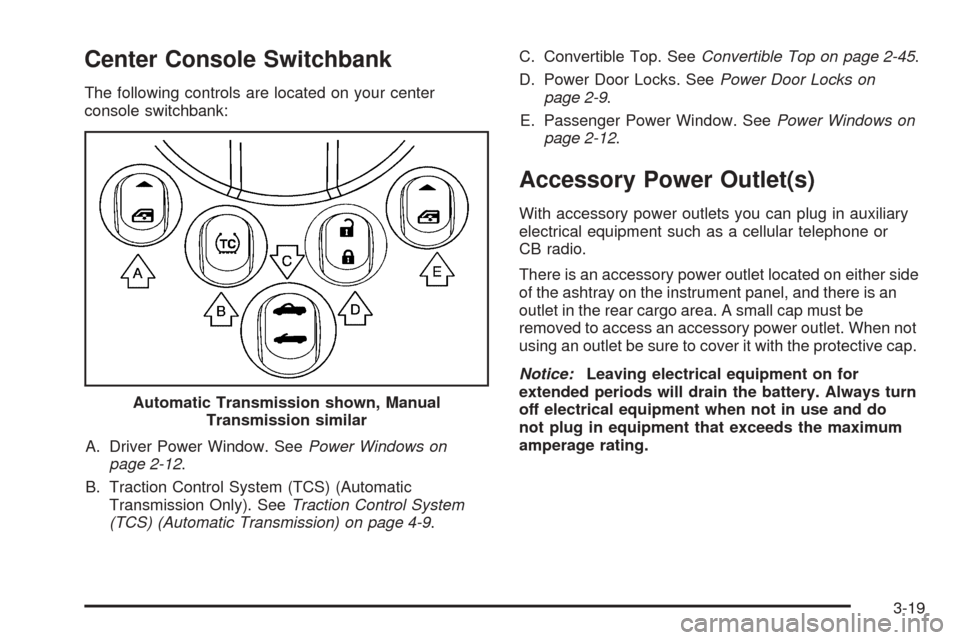
Center Console Switchbank
The following controls are located on your center
console switchbank:
A. Driver Power Window. SeePower Windows on
page 2-12.
B. Traction Control System (TCS) (Automatic
Transmission Only). SeeTraction Control System
(TCS) (Automatic Transmission) on page 4-9.C. Convertible Top. SeeConvertible Top on page 2-45.
D. Power Door Locks. SeePower Door Locks on
page 2-9.
E. Passenger Power Window. SeePower Windows on
page 2-12.
Accessory Power Outlet(s)
With accessory power outlets you can plug in auxiliary
electrical equipment such as a cellular telephone or
CB radio.
There is an accessory power outlet located on either side
of the ashtray on the instrument panel, and there is an
outlet in the rear cargo area. A small cap must be
removed to access an accessory power outlet. When not
using an outlet be sure to cover it with the protective cap.
Notice:Leaving electrical equipment on for
extended periods will drain the battery. Always turn
off electrical equipment when not in use and do
not plug in equipment that exceeds the maximum
amperage rating. Automatic Transmission shown, Manual
Transmission similar
3-19
Page 136 of 390
Fan Knob
The center knob on the control panel is used to control
the fan speed. Turn the knob clockwise or
counterclockwise to increase or decrease the fan speed.
?(Recirculation):This mode keeps outside air
from coming in the vehicle. It can be used to prevent
outside air and odors from entering your vehicle or help
heat or cool the air inside your vehicle more quickly.
Press this button on the fan knob to turn the recirculation
mode on or off. An indicator light on the button will
come on to let you know the recirculation mode
is activated.
Recirculation is only available in the bi-level and vent
modes. If you push the recirculation button while
the system is in any other mode, the light on the button
will flash to indicate that recirculation is not available.
Mode Knob
The right knob on the control panel is used to direct the
airflow inside your vehicle. Turn the knob to select
one of the following modes:
H(Vent):Select this mode to direct air to the
instrument panel outlets.
)(Bi-Level):Select this mode to direct approximately
half of the air to the instrument panel outlets, and the
remaining air to the floor outlets and the defroster
and side window outlets. Cooler air is directed to the
upper outlets and warmer air to the floor outlets.
6(Floor):Select this mode to direct air to the floor
outlets. Recirculation does not work in this mode.
Defogging and Defrosting
Fog on the inside of windows is a result of high humidity
(moisture) condensing on the cool window glass. This
can be minimized if the climate control system is
used properly. There are two modes to clear fog or frost
from your windshield and side windows. Use the
defog mode to clear the windows of fog or moisture and
warm the passengers. Use the defrost mode to
remove fog or frost from the windshield more quickly.
For best results, clear all snow and ice from the
windshield before defrosting.
W(Floor/Defog):This mode directs half of the air to
the windshield and the other half to the floor outlets.
When you select this mode, the system runs the
air-conditioning compressor unless the outside
temperature is at or below freezing. Recirculation
is not available in this mode.
3-22
Page 137 of 390
0(Defrost):This mode directs most of the air to the
windshield. When you select this mode, the system
runs the air-conditioning compressor unless the outside
temperature is at or below freezing. Recirculation is
not available in this mode.
1(Maximum Defrost):This mode directs most of
the air to the windshield. The rear window defogger and
heated outside mirrors will turn on, and the fan speed
will be at the highest setting (5). The temperature will be
at the hottest setting also. Recirculation is not available
in this mode.
If this mode was selected when you turn your vehicle
off, the warmest temperature and highest fan speed will
be restored when the vehicle is started, regardless of
the temperature and fan setting.
Do not drive the vehicle until all the windows are clear.
Rear Window Defogger
The rear window defogger uses a warming grid to
remove fog from the rear window.
The rear window defogger will only work when the
ignition is on.
=(Rear):Press this button on the mode knob to turn
the rear window defogger on or off. An indicator light
on the button will come on to let you know that the rear
window defogger is activated.
When the rear defogger button is pressed, the outside
heated mirrors will warm to help clear any fog or
frost from the surface of the mirrors.
Notice:Do not use a razor blade or sharp object to
clear the inside rear window. Do not adhere
anything to the defogger grid lines in the rear glass.
These actions may damage the rear defogger.
Repairs would not be covered by your warranty.
Outlet Adjustment
Use the levers located in the center of each outlet to
change the direction of the airflow.
Operation Tips
•
Clear away any ice, snow or leaves from the air
inlets at the base of the windshield that may
block the flow of air into your vehicle.
•Use of non-GM approved hood deflectors may
adversely affect the performance of the system.
•Keep the path under the front seats clear of
objects to help circulate the air inside of your
vehicle more effectively.
3-23
Page 221 of 390

Before Leaving on a Long Trip
Make sure you are ready. Try to be well rested. If you
must start when you are not fresh — such as after
a day’s work — do not plan to make too many miles that
first part of the journey. Wear comfortable clothing
and shoes you can easily drive in.
Is your vehicle ready for a long trip? If you keep it
serviced and maintained, it is ready to go. If it needs
service, have it done before starting out. Of course, you
will find experienced and able service experts in GM
dealerships all across North America. They will be ready
and willing to help if you need it.
Here are some things you can check before a trip:
•Windshield Washer Fluid:Is the reservoir full? Are
all windows clean inside and outside?
•Wiper Blades:Are they in good shape?
•Fuel, Engine Oil, Other Fluids:Have you checked
all levels?
•Lamps:Are they all working? Are the lenses clean?
•Tires:They are vitally important to a safe,
trouble-free trip. Is the tread good enough for
long-distance driving? Are the tires all inflated to the
recommended pressure?
•Weather Forecasts:What is the weather outlook
along your route? Should you delay your trip a
short time to avoid a major storm system?
•Maps:Do you have up-to-date maps?
Highway Hypnosis
Is there actually such a condition as highway hypnosis?
Or is it just plain falling asleep at the wheel? Call it
highway hypnosis, lack of awareness, or whatever.
There is something about an easy stretch of road with
the same scenery, along with the hum of the tires on the
road, the drone of the engine, and the rush of the
wind against the vehicle that can make you sleepy. Do
not let it happen to you! If it does, your vehicle can
leave the road in less than a second, and you could
crash and be injured.
What can you do about highway hypnosis? First, be
aware that it can happen.
Then here are some tips:
•Make sure your vehicle is well ventilated, with a
comfortably cool interior.
•Keep your eyes moving. Scan the road ahead and
to the sides. Check your mirrors and your
instruments frequently.
•If you get sleepy, pull off the road into a rest,
service, or parking area and take a nap, get some
exercise, or both. For safety, treat drowsiness
on the highway as an emergency.
4-21
Page 227 of 390

{CAUTION:
Snow can trap exhaust gases under your
vehicle. This can cause deadly CO (carbon
monoxide) gas to get inside. CO could
overcome you and kill you. You cannot see it
or smell it, so you might not know it is in your
vehicle. Clear away snow from around the
base of your vehicle, especially any that is
blocking your exhaust pipe. And check around
again from time to time to be sure snow does
not collect there.
Open a window just a little on the side of the
vehicle that is away from the wind. This will
help keep CO out.Run your engine only as long as you must. This
saves fuel. When you run the engine, make it go a
little faster than just idle. That is, push the accelerator
slightly. This uses less fuel for the heat that you get
and it keeps the battery charged. You will need a
well-charged battery to restart the vehicle, and possibly
for signaling later on with your headlamps. Let the
heater run for a while.
Then, shut the engine off and close the window
almost all the way to preserve the heat. Start the
engine again and repeat this only when you feel
really uncomfortable from the cold. But do it as little as
possible. Preserve the fuel as long as you can. To
help keep warm, you can get out of the vehicle and do
some fairly vigorous exercises every half hour or so
until help comes.
4-27
Page 250 of 390

Different Size Tires and Wheels......................5-62
Uniform Tire Quality Grading..........................5-62
Wheel Alignment and Tire Balance..................5-63
Wheel Replacement......................................5-64
Tire Chains..................................................5-66
If a Tire Goes Flat........................................5-67
Tire Inflator Kit.............................................5-68
Appearance Care............................................5-76
Cleaning the Inside of Your Vehicle.................5-76
Fabric/Carpet...............................................5-78
Leather.......................................................5-78
Instrument Panel, Vinyl, and Other
Plastic Surfaces........................................5-79
Care of Safety Belts......................................5-79
Weatherstrips...............................................5-79
Washing Your Vehicle...................................5-80
Cleaning Exterior Lamps/Lenses.....................5-80
Finish Care..................................................5-80
Windshield and Wiper Blades.........................5-81
Aluminum or Chrome-Plated Wheels................5-82Tires...........................................................5-82
Sheet Metal Damage.....................................5-83
Finish Damage.............................................5-83
Underbody Maintenance................................5-83
Chemical Paint Spotting.................................5-83
Vehicle Care/Appearance Materials..................5-84
Vehicle Identication......................................5-85
Vehicle Identification Number (VIN).................5-85
Service Parts Identification Label.....................5-85
Electrical System............................................5-86
Add-On Electrical Equipment..........................5-86
Headlamps..................................................5-86
Windshield Wiper Fuses................................5-86
Power Windows and Other Power Options.......5-86
Fuses and Circuit Breakers............................5-86
Floor Console Fuse Block..............................5-87
Engine Compartment Fuse Block....................5-90
Relay Center................................................5-92
Capacities and Specications..........................5-95
Section 5 Service and Appearance Care
5-2