tow CHEVROLET SUBURBAN 1993 Workshop Manual
[x] Cancel search | Manufacturer: CHEVROLET, Model Year: 1993, Model line: SUBURBAN, Model: CHEVROLET SUBURBAN 1993Pages: 386, PDF Size: 21.06 MB
Page 323 of 386

Service & Appearance Care
Cleaning the Inside of Your Vehjcle
Use a vacuum cleaner often to get rid of dust and loose dirt\
. Wipe vinyl with
a clean, damp cloth.
Your GM dealer has
two GM cleaners-a solvent-type spot lifter and a foam-type
powdered cleaner. They will clean normal spots and stains very \
well.
Here are some cleaning tips:
Always read the instructions on the cleaner label.
Clean up stains as soon as you can-before they set.
Use a clean cloth or sponge, and change to a clean area often. A soft
brush may be used
if stains are stubborn.
Use solvent-type cleaners in a well ventilated area only. If you use them,
don’t saturate the stained area.
If a ring forms after spot cleaning, clean the entire area immedi\
ately or it
will set.
Using Foam-Type CIeaner on Fabric
Vacuum and brush the area to remove any loose dirt.
Always clean a whole trim panel or section. Mask surrounding trim along
stitch or welt lines.
Mix Multi-Purpose Powdered Cleaner following the directions on t\
he
Use suds only and apply with a clean sponge.
container label.
Don’t saturate the material.
Don’t rub
it roughly.
As soon as you’ve cleaned the section, use a sponge to remove the
suds.
Rinse the section with a clean, wet sponge.
Wipe off what’s left with a slightly damp paper towel or cloth.
Then dry it immediately with an air hose, a hair dryer or a heat lamp.
NOTICE I
Be careful with a hair dryer or heat lamp. You could scorch the fabric
Wipe with a clean cloth.
6-58
ProCarManuals.com
Page 324 of 386
Using Solvent-Type CIeaner on Fabric
First, see if you have to use solvent-type cleaner at all. Some spots and
stains will clean
off better with just water and mild soap.
If you need to use it, then:
Gently scrape excess soil from the trim material with a clean, dull knife
or scraper. Use very little cleaner, light pressure and clean cloths
(preferably cheesecloth). Cleaning should start at the outside \
of the stain,
“feathering” toward the center. Keep changing
to a clean section of the
cloth
.
When you clean a stain from fabric, immediately dry the area with an air
hose, hair dryer, or heat lamp
to help prevent a cleaning ring. (See
previous NOTICE.)
Fabric Profection
Your vehicle has upholstery that has been treated with ScotchgardTM \
Fabric
Protector, a
3M product. ScotchgardTM protects fabrics by repelling oil and
water, which are the carriers
of most stains. Even with this protection, you
still need
to clean your upholstery often to keep it looking new.
Further information on cleaning is available by calling
1-800-433-3296 (in
Minnesota,
1-800-642-61 67).
Special Cleaning Problems
Greasy or Oily Stains: Like grease, oil, butter, margarine, shoe polish, coffee
with cream, chewing gum, cosmetic creams, vegetable oils, wax c\
rayon, tar
and asp ha1
t .
Carefully scrape off excess stain.
Then follow the solvent-type instructions above.
Shoe polish, wax crayon, tar and asphalt will stain if left on a vehicle
seat fabric. They should be removed as soon as possible. Be c\
areful, because the cleaner will dissolve them and may cause them
to bleed.
Non-Greasy Stains: Like catsup, coffee (black), egg, fruit, fruit juice, milk,
soft drinks, wine, vomit, urine and blood.
Carefully scrape off excess stain, then sponge the place with cool water.
If a stain remains, follow the foam-type instructions above.
If an odor lingers after cleaning vomit or urine, treat the area with a
watedbaking soda solution:
1 teaspoon (5 ml) of baking soda to 1 cup
(250 ml) of lukewarm water.
Finally, if needed, clean lightly with solvent-type cleaner.
6-59
ProCarManuals.com
Page 326 of 386
Cleaning the Outside of the Windshield and Wiper Blades
If the windshield is not clear after using the windshield washer, or if the wiper
blade chatters when running, wax or other material may be on the blade or
windshield,
Clean the outside windshield with
GM Windshield Cleaner, Bon-Ami Powder@
(GM Part No. 1050011). The windshield is clean if beads do not form when
you rinse it with water.
Clean the blade by wiping vigorously with a cloth soaked in full strength
washer solvent. Then rinse the blade with water.
Wiper blades should be checked on a regular basis and replaced\
when worn.
Cleaning the Outside of Your Vehicle
The paint finish on your vehicle provides beauty, depth of color, gloss
retention and durability.
Washing Your Vehicle
The best way to preserve your vehicle’s finish is to keep it clean by washing
it often with lukewarm or cold water.
Don’t wash your vehicle in the direct rays
of the sun, Don’t use strong soaps
or chemical detergents. Use liquid hand, dish or car washing (non-detergent)
soaps. Don’t use cleaning agents that contain acid
or abrasives. All cleaning
agents should be flushed promptly and not allowed to dry on t\
he surface, or
they could stain. Dry the finish with a soft, clean chamois or a
100% cotton
towel to avoid surface scratches and water spotting.
High pressure vehicle washes may cause water to enter your vehicle.
Finish Care
Occasional waxing or mild polishing of your vehicle may be necessary to
remove residue from the paint finish. You can get GM approved cleaning
products from your dealer. (See “Appearance Care and Materia\
ls” in the
Index.)
Your vehicle has a “basecoatlclearcoat” paint finish. The clearcoat gives more
depth and
gloss to the colored basecoat.
Machine compounding
or aggressive polishing on a basecoatlctearcoat I f
paint finish may dull the finish or leave swirl marks.
6-6 1
ProCarManuals.com
Page 342 of 386
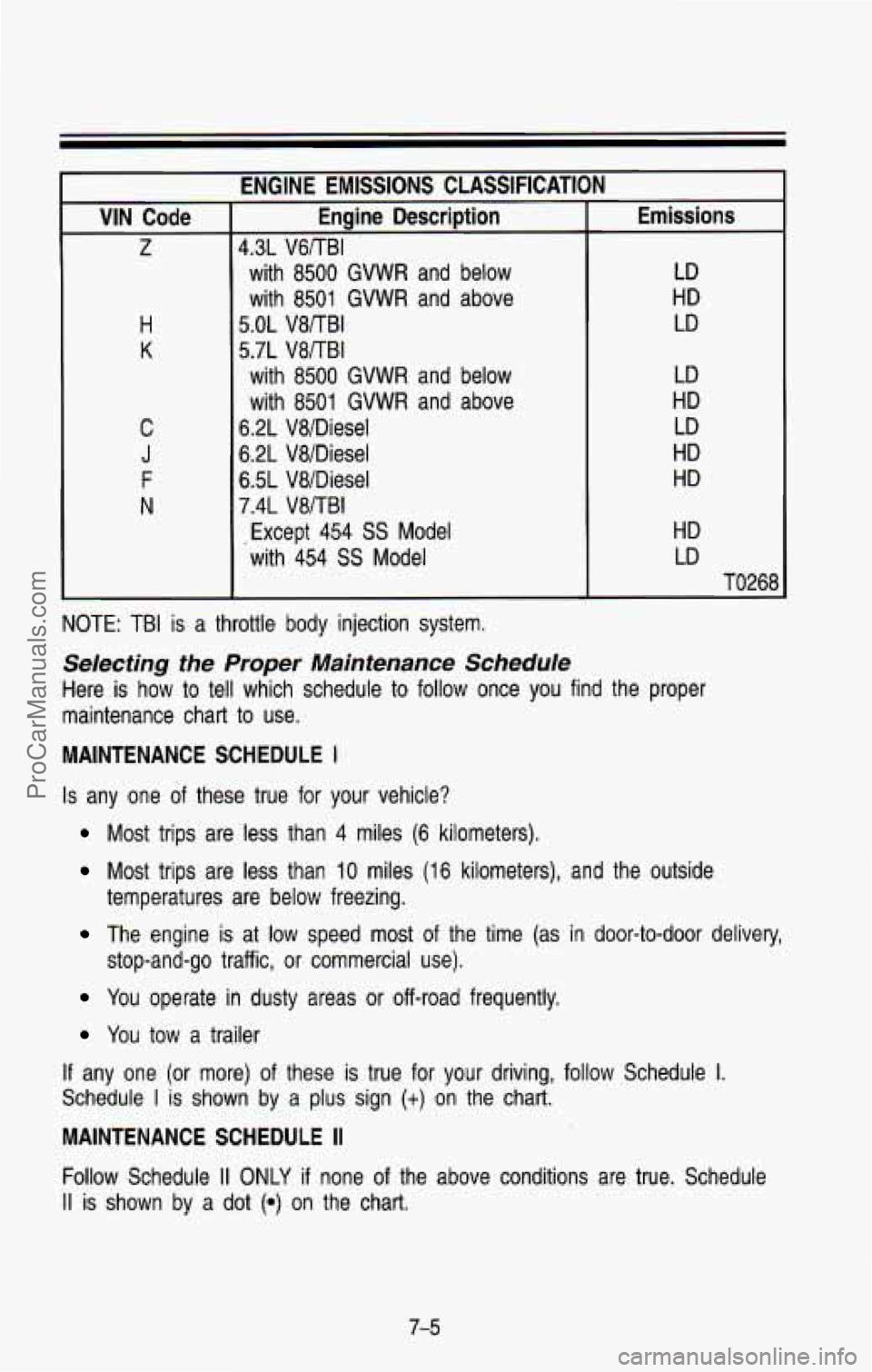
r ENGINE EMISSIONS CLASSIFICATION I
VIN Code
Z
H
K
C
J
F
N
Enaine Description
4.3L V6TTBI
with 8500 GVWR and below
with 8501 GVWR and above
5.0L V8TTBI
5.7L V8TTBI
with 8500 GWR and below
with 8501 GVWR and above
6.2L V8IDiesel
6.2L V8IDiesel
6.5L V8IDiesel
7.4L V8/TBI
.Except 454
SS Model
with 454
SS Model
L
Emissions I
LD
HD LD
LD
HD
LD
HD HD
HD LD TO268
NOTE: TBI is a throttle body injection system.
Selecting the Proper Maintenance Schedule
Here is how to tell which schedule to follow once you find the proper
maintenance chart
to use.
MAINTENANCE SCHEDULE I
Is any one of these true for your vehicle?
Most trips are less than 4 miles (6 kilometers).
Most trips are less than 10 miles (16 kilometers), and the outside
The engine is at low speed most of the time (as in door-to-door delivery,
temperatures
are below freezing.
stop-and-go traffic, or commercial use).
You operate in dusty areas or off-road frequently.
You tow a trailer
If any one (or more) of these is true for your driving, follow Schedule I.
Schedule 1 is shown by a plus sign (t) on the chart.
MAINTENANCE SCHEDULE II
Follow Schedule II ONLY if none of the above conditions are true. Schedule
II is shown by a dot (.) on the chart.
7-5
ProCarManuals.com
Page 358 of 386

23. EXHAUST PRESSURE EGULATOR VALVE INSPECTION* -Check that
the valve works properly. Correct any binding. Inspect hoses fo\
r cracks,
chafing or decay. Replace parts
as needed.
24. TIRE AND WHEEL ROTATION AND INSPECTION -For proper wear
and maximum tire life, rotate tires
at the first 6,000 miles (10 000
kilometers) for Schedule I (t) or 7,500 miles (12 500 kilometers) for
Schedule
II (.) and then every 15,000 miles (25 000 kilometers)
thereafter.
Follow the instructions and patterns shown in Section 6.
Check tires for uneven wear or damage. If irregular or premature wear is
apparent, check wheel alignment.
Also, check for damaged wheels. See
“Tires” in the Index for more information.
For dual wheels, whenever the vehicle, wheels, or fasteners are new\
,
have the wheel fastener torque set at the first 100,
1,000 and 6,000
miles
(160, 1600 and 10 000 km).
For
3500 H.D. Models, block the tires opposite those being removed to
keep the vehicle from rolling.
25.
DRIVE AXLE SERVICE -Check readfront axle fluid level and add as
needed. Check constant velocity joints and axle seals for leaki\
ng.
Locking differential-Drain fluid at first oil change and refill. Check
fluid level and add as needed at subsequent oil changes. In dusty
areas, or trailer towing applications drain fluid at every
15,000 miles
(24 135 kilometers) and refill$
every oil change. In dusty areas,
or trailer towing applications, drain
fluid every 15,000 miles
(24 135 kilometers) and refi1l.t
Standard differential -Check fluid level and add as needed at
More frequent lubrication may be required on heavy-duty or off-road
use.
26. BRAKE SYSTEM INSPECTION -When the engine oil is changed,
inspect the lines
and hoses for proper hookup, binding, leaks, cracks,
chafing, etc. Check the parking brake adjustment, and the fluid level in
the master cylinder.
A low fluid level can indicate worn disc brake pads
which may need to be serviced$
*An Emission Control Service
tA fluid loss in these systems may indicate a problem. Have them
inspected and repaired
at once.
7-2 1
ProCarManuals.com
Page 372 of 386
 or write to:
NHTSA,
U.S. Department of Transpo")
To contact NHTSA, you may either call the Auto Safety Hotline tol\
l-free at
1-800-424-9393
(or 366-0123 in the Washington, DC area) or write to:
NHTSA,
U.S. Department of Transportation, Washington, D.C. 20590. You can
also obtain other information about motor vehicle safety from t\
he Hotline.
Reporting Safety Defects to the
Canadian Government
If you live in Canada, and you believe that your vehicle has \
a safety defect,
you should immediately notify Transport Canada, in addition to notifying
General Motors of Canada Limited. You may write to: Transport Canada at
Box 8880, Ottawa, Ontario K1G 3J2.
Reporting Safety Defects to General
Motors
In addition to notifying NHTSA (or Transport Canada) in a situation like this,
we certainly hope you’ll notify
us. Please call us at 1-800-222-1 020, or write:
Chevrolet Motor Division, Customer Assistance Center,
Post Office Box 7047,
Troy, Michigan 48007-7047. In Canada, please call us at 1-800-263-3777
(English)
or 1-800-263-7854 (French). Or, write: General Motors of Canada
Limited, Customer Assistance Center, 1908 Colonel Sam Drive, Osh\
awa,
Ontario L1H 8P7.
Chevmlet/Geo Roadside Assistance
To enhance Chevrolet’s strong commitment to customer satisfaction,\
Chevrolet
is excited to announce the establishment
of the ChevroletlGeo Roadside
Assistance Center. As the owner of a 1993 ChevroleVGeo, members\
hip in
Roadside Assistance is free.
Roadside Assistance is available
24 hours a day, 365 days a year, by calling
1-800-CHEV
USA (1 -800-243-8872). This toll-free number will provide you
over-the-phone roadside assistance with minor mechanical problems.\
If your
problem cannot be resolved over the phone, our advisors have a\
ccess to a
nationwide network of deater recommended service providers. The \
following
services are available:
Towing
Locksmith
Tire repair
Glass replacement
Rental car or taxi
Additional services as necessary
ProCarManuals.com
Page 380 of 386
M
Maintenance Other Items
............................... 6-34
Periodic Inspections
................. 7-24
Record
............................... 7.3. 7-27
Scheduled Maintenance
.. 7.4. 7-1 8
Underbody
................................ 6-62
When Towing a Trailer
............. 4-63
Master Cylinder (See “Brakes”)
Mirrors
........................................... 2-51
Convex Outside
........................ 2-52
Electric Outside
........................ 2-52
Inside
.......................................... 2-51
Model Reference
............................... III
Multifunction Lever ...................... 2-36
...
Turn SignalLane
Change Indicator
........... 2-37, 2-75
0
Odometer ....................................... 2-66
Off-Road Driving (See “Driving”)
Off-Road Recovery
..................... 4-20
Oil ..................................................... 6-9
Additives
................................... 6-1 5
Disposal of Used ...................... 6-1 6
Pressure Gage
.......................... 2-78
To Check
................................... 6-1 0
What Kind to Use .................... 6-12
When
to Add ............................ 6-10
When
to Change ...................... 6-1 5
Owner Checks and Services ...... 7-22
Parking On Hills
...................................... 4.49
Over Things That Burn
............ 2-27
Torque Lock (Automatic
Transmission)
............. 2.24. 4-52
Your Vehicle (Manual Transmission)
........................ 2-26
Parking Brake
............................... 2-23
Passing
Other Vehicles .... 4.21. 4-61
Pavement Markings
........................ 4-8
Periodic Maintenance
Power Inspections
................................ 7-24
Door Locks
.................................. 2-7
Steering
..................................... 4-18
Steering Fluid
........................... 6-29
Winches
..................................... 4-64
Product Service Publications
....... 8-6
R
Radiator Pressure Cap ................ 6-28
Radio (See “Audio Systems”)
Rear Window Defogger
.............. 3-11
Recommended Fluids And Lubricants
......................... 7-25
Recovery Hooks
........................... 5-32
Replacement Parts
...................... 6-68
Reporting Safety Defects
............. 8-4
Road Signs
..................................... 4-2
Roadside Assistance
..................... 8-5
Rocking Your Vehicle
.................. 5-32
S
Safety Belts .................................. 1-13
Center Passenger
........... 1-27, 1-29
Cleaning
..................................... 6-60
Checking Restraint System
.... 1-47
Child Restraints
........................ 1-36
Children
...................................... 1-34
Driver Position
.......................... 1-20
Extender
.................................... 1-46
Lap Shoulder
............................ 1-21
Larger Children
......................... 1-44
Proper Wear
............................. 1-20
Questions and Answers
.......... 1-18
Rear Seat
.................................. 1-30
Replacing After a Crash
......... 1-47
Right Front Passenger
............ 1-27
Small Children and Babies
..... 1-34
Use During Pregnancy
............ 1-26
Why They Work ....................... 1-15
Adults
......................................... 1-20
Reminder Light
......................... 1-19
9-5
ProCarManuals.com
Page 381 of 386
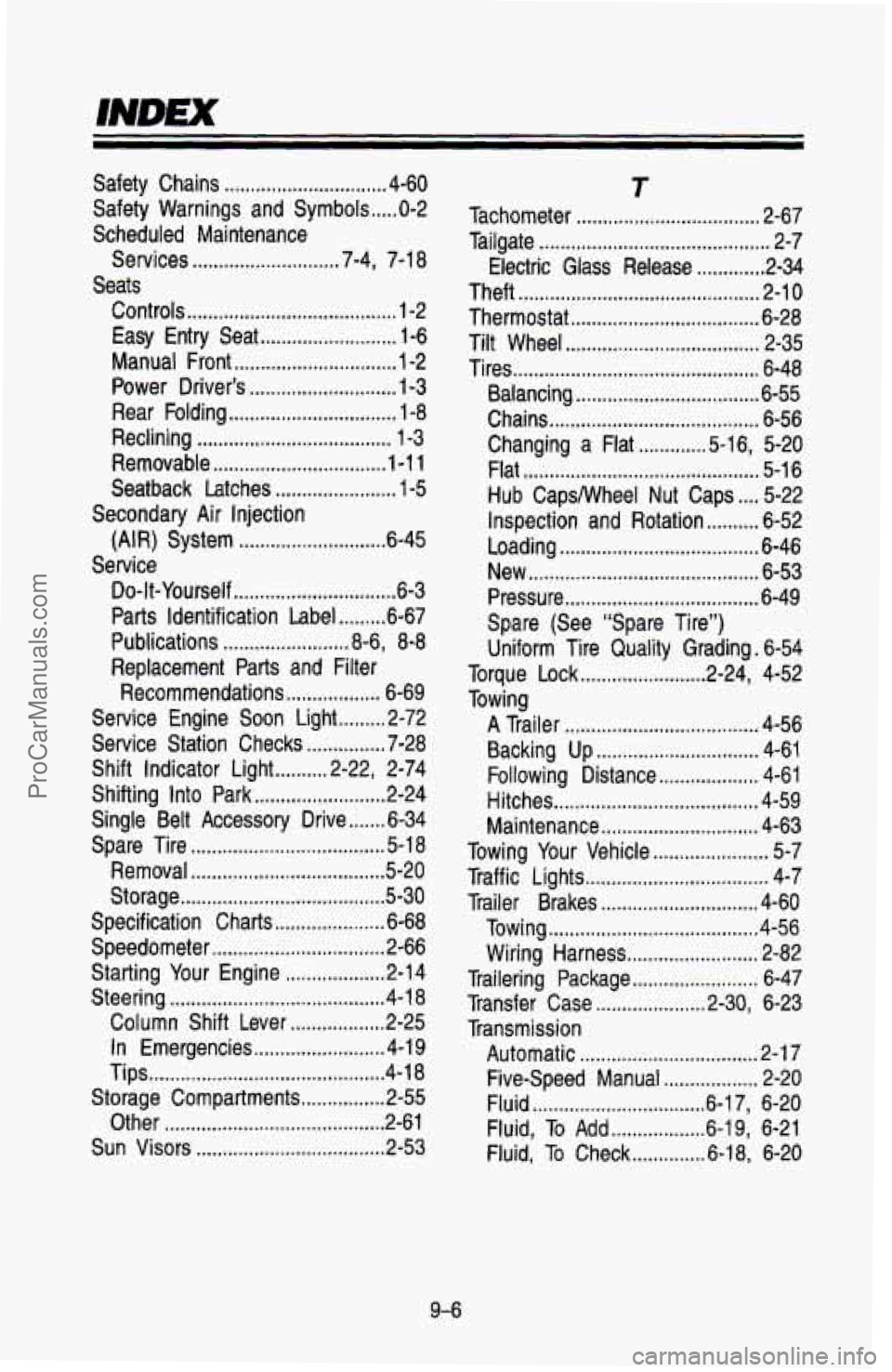
Safety Chains ............................... 4-60
Scheduled Maintenance
Seats Safety Warnings and Symbols
..... 0-2
Services
............................ 7-4, 7-1 8
Controls
........................................ 1-2
Easy Entry Seat
.......................... 1 -6
Manual Front
............................... 1 -2
Power Driver‘s
............................ 1-3
Rear Folding
................................ 1-8
Reclining
..................................... 1-3
Removable
................................. 1-1 1
Seatback Latches
....................... 1-5
(AIR) System
............................ 6-45
Do-It-Yourself
............................... 6-3
Parts Identification Label
......... 6-67
Publications
........................ 8-6, 8-8
Replacement Parts and Filter Recommendations
.................. 6-69
Service Engine
Soon Light ......... 2-72
Service Station Checks
............... 7-28
Shift Indicator Light
.......... 2-22, 2-74
Shifting Into Park
......................... 2-24
Single Belt Accessory Drive
....... 6-34
Spare Tire
..................................... 5-1 8
Removal ..................................... 5-20
Storage ....................................... 5-30
Specification Charts ..................... 6-68
Speedometer
................................. 2-66
Starting Your Engine
................... 2-1 4
Column Shift Lever
.................. 2-25
In Emergencies
......................... 4-1 9
Tips ............................................. 4-1 8
Storage Compartments ................ 2-55
Other
.......................................... 2-6 1
Sun Visors .................................... 2-53
Secondary
Air Injection
Service
Steering
......................................... 4-18
T
Tachometer ................................... 2-67
Tailgate
............................................ 2-7
Electric Glass Release ............. 2-34
Theft
.............................................. 2-10
Thermostat
.................................... 6-28
Tilt Wheel
..................................... 2-35
Tires
............................................... 6-48
Balancing
................................... 6-55
Chains
........................................ 6-56
Changing a Flat
............. 5-16, 5-20
Flat
............................................. 5-16
Hub CapsNVheel Nut Caps
.... 5-22
Inspection and Rotation
.......... 6-52
Loading
...................................... 6-46
New ............................................
Pressure ..................................... 6-49
Spare (See “Spare Tire”)
Uniform Tire Quality Grading
. 6-54
Torque Lock
........................ 2-24, 4-52
Towing
A Trailer ..................................... 4-56
Backing Up
............................... 4-61
Following Distance
................... 4-61
Hitches
....................................... 4-59
Maintenance
.............................. 4-63
Towing Your Vehicle
...................... 5-7
Traffic Lights
................................... 4-7
Trailer Brakes
.............................. 4-60
Towing
........................................ 4-56
Wiring Harness
......................... 2-82
Trailering Package
........................ 6-47
Transfer Case
..................... 2-30, 6-23
Transmission Automatic
.................................. 2-17
Five-Speed Manual
.................. 2-20
Fluid ................................. 6-1 7, 6-20
Fluid, To Add
.................. 6-1 9. 6-21
Fluid.
To Check .............. 6-18. 6-20
6-53
9-6
ProCarManuals.com