tow CHEVROLET SUBURBAN 1993 Service Manual
[x] Cancel search | Manufacturer: CHEVROLET, Model Year: 1993, Model line: SUBURBAN, Model: CHEVROLET SUBURBAN 1993Pages: 386, PDF Size: 21.06 MB
Page 240 of 386
If No Steam Is Coming From Your C gine:
If you get the overheat warning but see or hear no steam, the problem may
not be too serious. Sometimes the engine can get a little too hot when you:
Climb a long hill on a hot day.
Stop after high speed driving.
Idle for long periods in traffic.
Tow a trailer.
If you get the overheat warning with no sign of steam, try this for a minute
or so:
1. If you have an air conditioner, turn it off.
2. Turn on your heater to full hot at the highest fan speed and open the
3. If you’re in a traffic jam, shift to N (Neutral).
window
as necessary.
If you no longer have the overheat warning, you can drive. Just to be safe,
drive slower for about ten minutes.
If the warning doesn’t come back on, you
can drive normally.
If the warning continues, pull over, stop, and park your vehicle right away.
If there’s still no sign of steam, push the accelerator until the engine speed is
about twice as fast as normal idle speed. Bring the engine speed back to
normal idle speed after two or three minutes.
Now see if the warning stops.
But then,
if you still have the warning, TURN OFF THE ENGINE AND GET
EVERYONE
OUT OF THE VEHICLE until it cools down.
You may decide not
to lift the hood but to get service help right away.
5-9
ProCarManuals.com
Page 247 of 386

Engine Fan Noise
This vehicle has a clutched engine cooling fan. When the clutc\
h is engaged,
the fan spins faster
to provide more air to cool the engine. In most every day
driving conditions the clutch is not engaged. This improves fuel economy and
reduces fan noise. Under heavy vehicle loading, trailer towing \
and/or high
outside temperatures, the fan speed increases when the clutch e\
ngages.
So
you may hear an increase in fan noise. This is normal and sh\
ould not be
mistaken
as the transmission slipping or making extra shifts. It is merely the
cooling system functioning properly. The fan
will slow down when additional
cooling is not required and the clutch disengages.
You may also hear this fan noise when you start the engine. \
It will go away
as the fan clutch disengages.
If a Tire Goes Fiat
It’s unusual for a tire to “blow out” while you’re driving,\
especially if you
maintain your tires properly.
If air goes out of a tire, it’s much more likely to
leak out slowly. But if you should ever have a “blowout,” here are a few tips
about what
to expect and what to do:
If a front tire fails, the flat tire will create a drag that pulls the vehicle toward
that side. Take your foot
off the accelerator pedal and grip the steering wheel
firmly. Steer to maintain lane position, then gently brake
to a stop well out of
the traffic lane.
A rear blowout, particularly on a curve, acts much like a skid and may
require the same correction you’d use in a skid. In any rear blowout, remove
your foot from the accelerator pedal. Get the vehicle under co\
ntrol by steering
the way you want the vehicle
to go. It may be very bumpy and noisy, but
you can still steer. Gently brake to a stop, well off the road if possible.
If your tire goes flat, the next part shows how to use your jacking equipment
to change a flat tire safely.
Changing a Flat Tire
If a tire goes flat, avoid further tire and wheel damage by driving slowly to a
level place. Turn
on your hazard warning flashers.
5-1 6
ProCarManuals.com
Page 257 of 386
1 CAUTION
* Rust or dirt on the wheel, or on the parts to which it is fastened, ’
h can make the wheel nuts become loose after a time. The wheel
I could corne off and cause an accident. When you change a wheel,
remove any rust or dirt fmm the places where the wheel attaches to
the vehicle. In an emergency, you can use a cloth or a paper towel
to do this; but be sure to use a scraper ~r wire brush later, if you
need to, to get all the rust or dirt off.
Remove any rust or dirt from the wheel bolts, mounting surfaces or spare
wheel. Place the spare on the wheel mounting
surface.
CAUTION
Never use oil or grease on studs or nuts. If you do, the nuts might
come loose. Your wheel could fall
off, causing a serious accident.
I
K2127
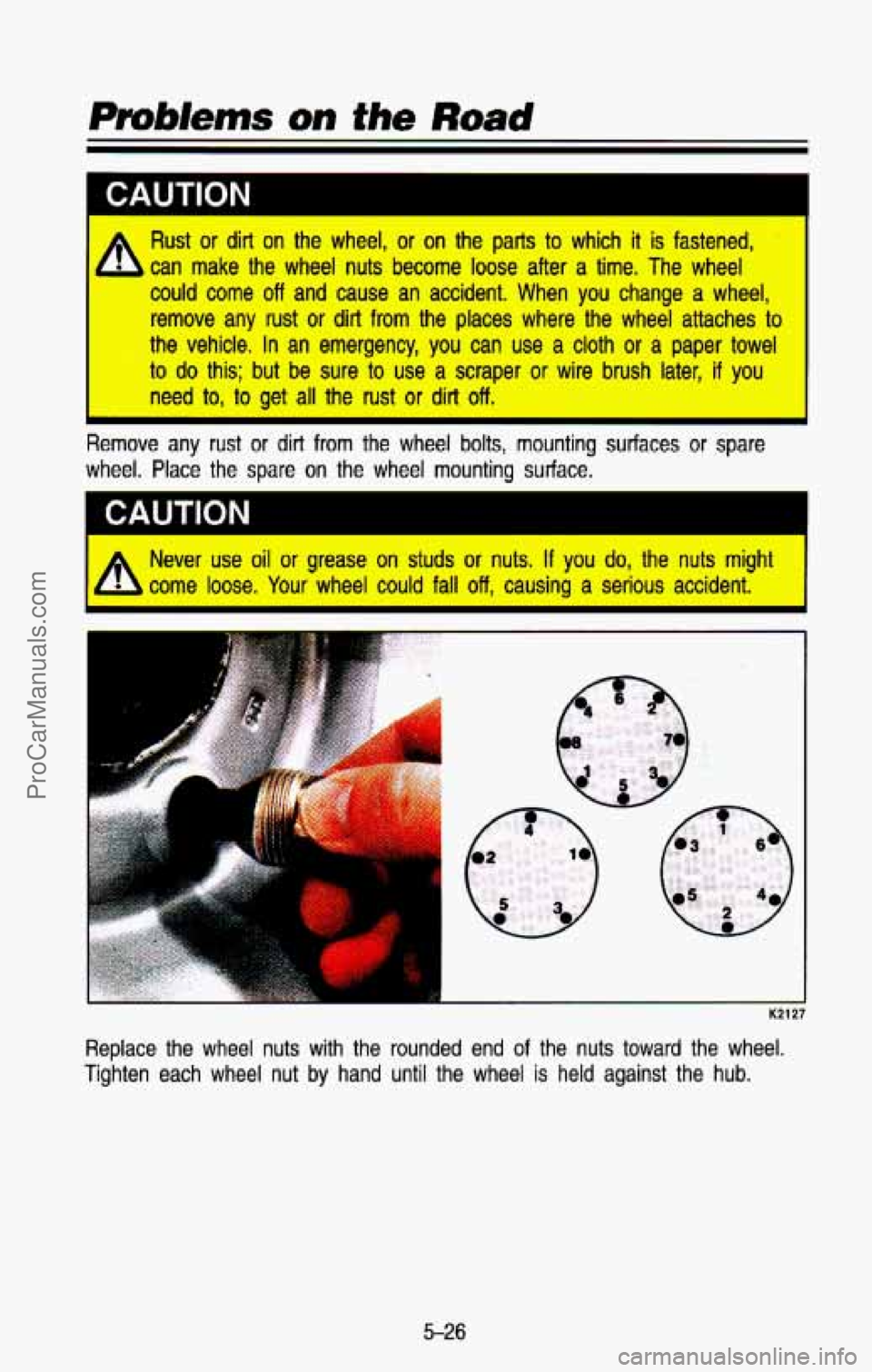
Replace the wheel nuts with the rounded end of the nuts toward the wheel.
Tighten each wheel
nut by hand until the wheel is held against the hub.
5-26
ProCarManuals.com
Page 263 of 386
Pmb/ems on the Road
Spinning your wheels can destroy parts of your vehicle as well as the
Rocking your vehicle to get it out:
First, turn your steering wheel left and right. That will clear the area around
your front wheels. Then shift back and forth between R and a forward gear
(or with a manual transmission, between First or Second gear and Reverse),
spinning the wheels as little as possible. Release the accelerator pedal while
you shift, and press lightly on the accelerator pedal when the transmission is
in gear. If that doesn’t get you out after a few tries, you may need to be
towed out. Or, you can use your recovery hooks, if your vehicle has them. If
you do need to be towed out, see “Towing Your Vehicle” in the Index.
Using the Recovery Hooks
m
K2456
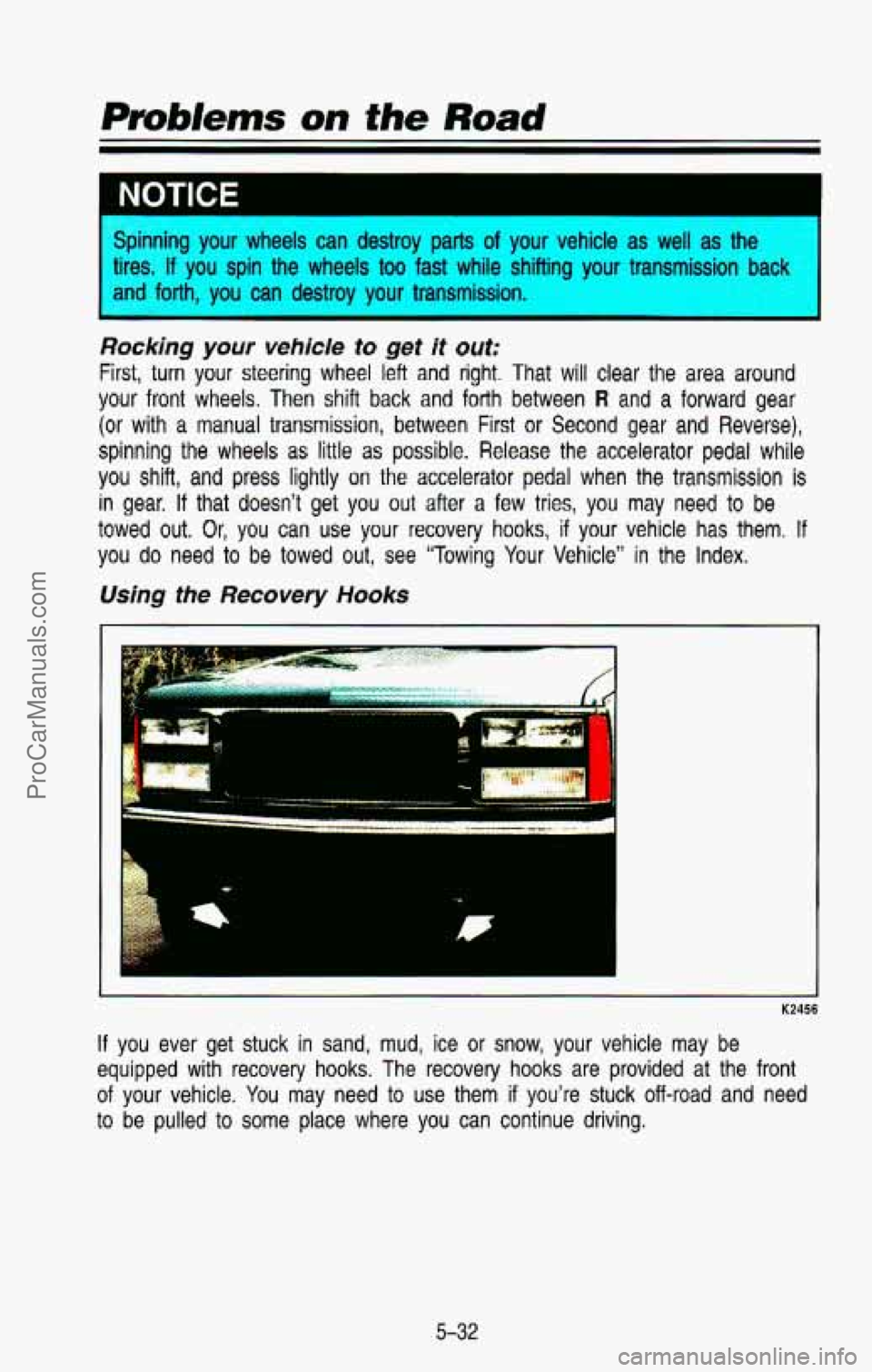
If you ever get stuck in sand, mud, ice or snow, your vehicle may be
equipped with recovery hooks. The recovery hooks are provided a\
t the front
of your vehicle. You may need to use them if you’re stuck off-road and need
to be pulled to some place where you can continue driving.
5-32
ProCarManuals.com
Page 264 of 386
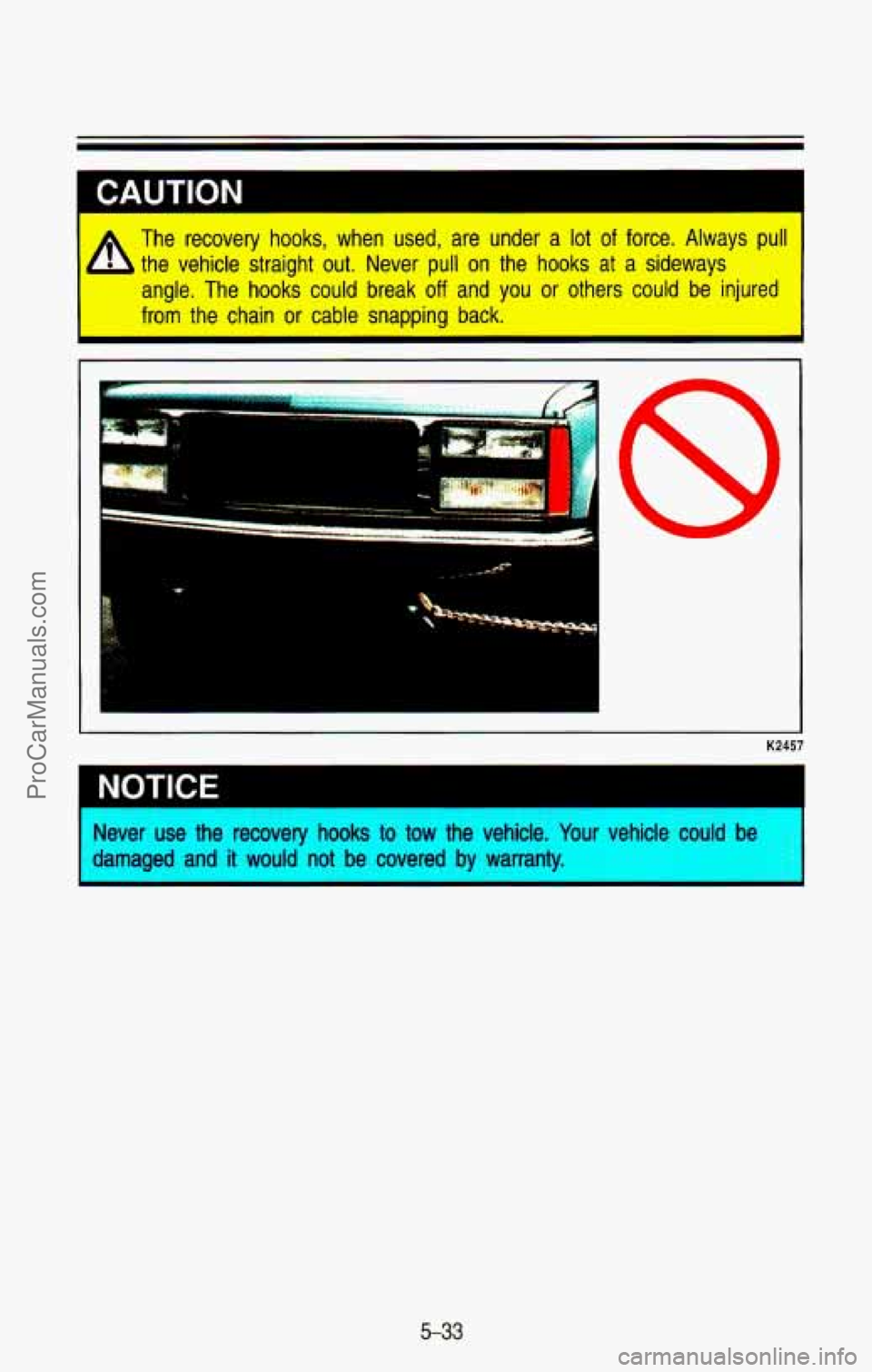
The recovery hooks, when used, are under a lot of force. Always pull
the vehicle straight out. Never pull
on the hooks at a sideways
angle. The hooks could break
off and you or others could be i * Irec'
from the chain or cable snapping back.
b
J
7
d
K2457
I NOTICE
I
Never use the recovery hooks to tow the vehicle. Your vehicle could be
damaged and it would not be covered by warranty.
I
5-33
ProCarManuals.com
Page 275 of 386
I
K2613
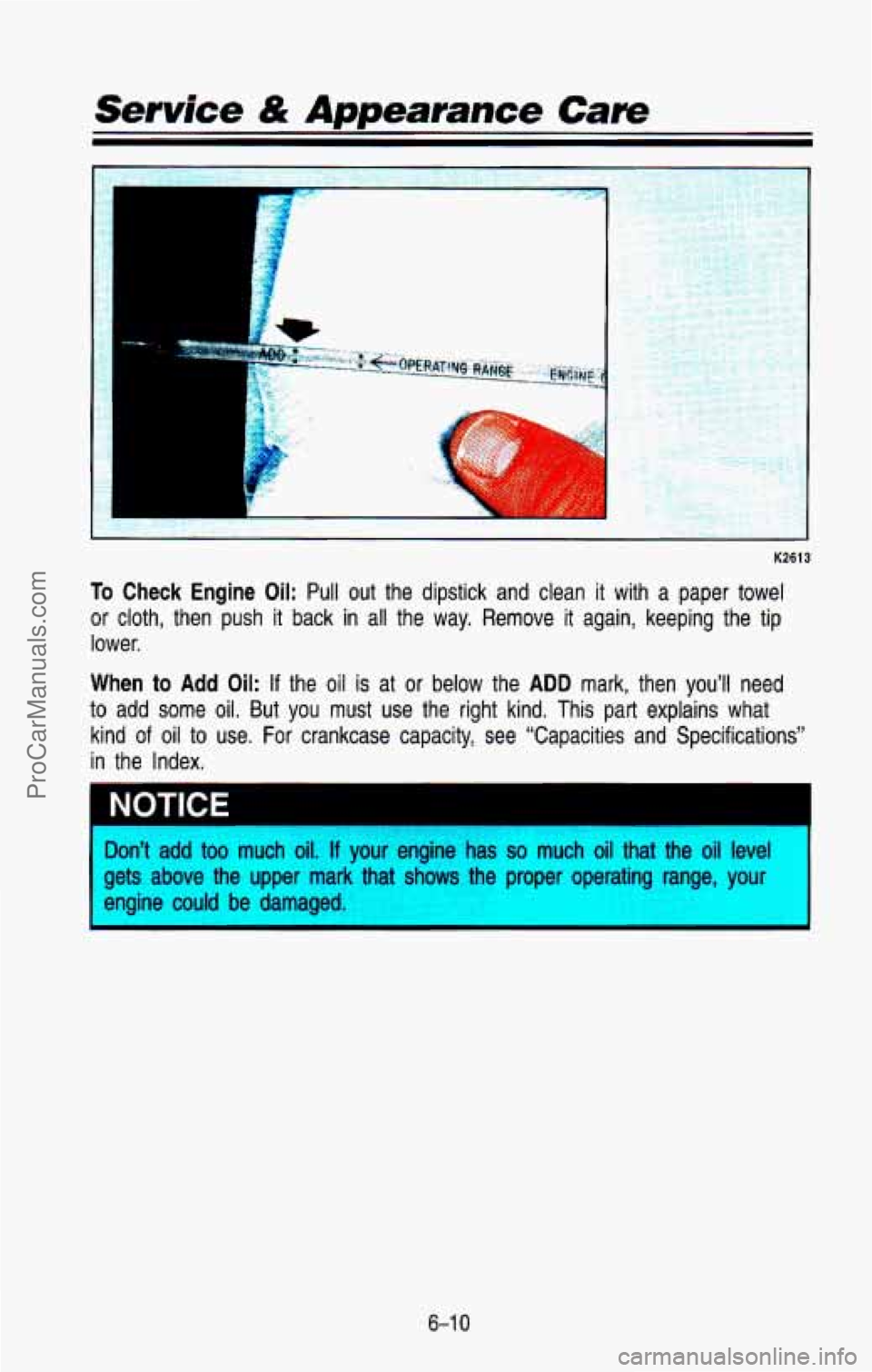
To Check Engine Oil: Pull out the dipstick and clean it with a paper towel
or cloth, then push
it back in all the way. Remove it again, keeping the tip
lower.
When to Add Oil: If the oil is at or below the ADD mark, then you’ll need
to add some oil. But you must use the right kind. This part exp\
lains what
kind
of oil to use. For crankcase capacity, see “Capacities and Specification\
s”
in the Index.
I Don’t add too much oil. If your engine has so much oil that the oil level
gets above the upper mark that
shows the proper operating range, your
engine could be damaged.
I
6-1 0
ProCarManuals.com
Page 280 of 386
These numbers on an oil container show its viscosity, or thickness.
Do not use other viscosity oils such as SAE 1OW-40 or SAE 2OW-50.
Energy Conserving II
Oils with these words on the container will help you save fuel.
This doughnut-shaped logo (symbol) is used on most oil contai\
ners to help
you select the correct oil,
You should look for this on the
oil container, and use only those oils that
display the logo.
GM Goodwrench@ oil (in Canada, GM Engine Oil) meets all the requirements
for your vehicle.
Engine Oil Addifives:
Don't add anything to your oil. Your GM dealer is ready to advise if you think
something should be added.
When to Change Engine Oil:
See if any one of these is true for you;
Most trips are less than 4 miles (6 km).
It's below freezing outside and most trips are less than 10 miles (16 km).
The engine is at low speed most of the time (as in door to door
You tow a trailer often.
Most trips are through dusty places.
The vehicle is frequently operated off-road. delivery, or in stop-and-go
traffic),
If any one of these is true for your vehicle, then you need to change your oil
and filter every 3,000 miles (5000 km) or 3 months-whichever comes first.
Vehicles with Light Duty Emissions (8500 GVWR or less).
If none of them is true, change the oil every 7,500 miles (1 2 500 km) or 12
months-whichever comes first. Change the filter at the first oil change and at
every other oil change after that.
Vehicles with Heavy Duty Emissions (8501 GVWR or more).
If none of them is true, change the oil every 6,000 miles (1 0 000 km) or 12
months-whichever comes first. Change the filter at the first oil change and at
every other oil change after that if mileage determines when you change your
6-1 5
ProCarManuals.com
Page 283 of 386
.
To check the transmission fluid")
Service & Appearance Care
To get the right reading, the fluid must be at normal operating \
temperature,
which is 180°F
to 200°F (82°C to 93°C).
To check the transmission fluid hot: Get the vehicle warmed up by driving
about
15 miles (24 km) when outside temperatures are above 50°F (10°C). If
it's colder than 50°F (lO°C), drive the vehicle in 0 (3rd gear) until the engine
temperature gage moves and then remains steady for ten minutes.\
Then
follow the
hot check procedures.
To check transmission fluid cold: A cold check is made after the vehicle
has been sitting for eight hours or more with the engine
off and is used only
as a reference. Let the engine run at idle for
five minutes if outside
temperatures are 50°F (IO'C) or more. If it's colder than 50°F (1 O'C), you
may have
to idle the engine longer. A hot check must follow when fluid is
added during a cold check.
To check the fluid hot or cold:
Park your vehicle on a level place.
Place the shift lever in P (Park) with the parking brake applied.
With your foot on the brake pedal, move the shift lever throu\
gh each
gear range, pausing for about three seconds
in each range. Then,
position the shift lever in
P (Park).
Let the engine run at idle for three minutes or more.
Then, without shutting off the engine, follow these steps:
1. Flip the handle up and then pull out the dipstick and wipe it with a
clean raa or DaDer towel.
PO229
2. Push it back in all the way, wait three seconds and then pull it back out
again.
6-1
8
ProCarManuals.com
Page 312 of 386
Your warranty does not r-rer parts or co ~~ ronents that fail because -
If you put things inside your vehicle-like suitmes, LWWIY, pac;Kages, or
anything else-they will go as fast as the vehicle goes. If you have to stop
or turn quickly, or if there is a crash, they’ll keep going.
I
Things you put inside your vehicle can strike and injure people in a
, sudden stop or turn, or in a crash.
9 Put things in the cargo area of your vehicle. Try to spread the
Never stack heavier things, like suitcases, inside the vehicle so
weight evenly.
that some
of them are above the tops of the seats.
When you carry something inside the vehicle, secure it
whenever you can. I
I Don’t have a seat folded down unless you need to. I
Trailering Package
GROSS COMBINATION WEIGHT RATING
(GCWR)
PO340
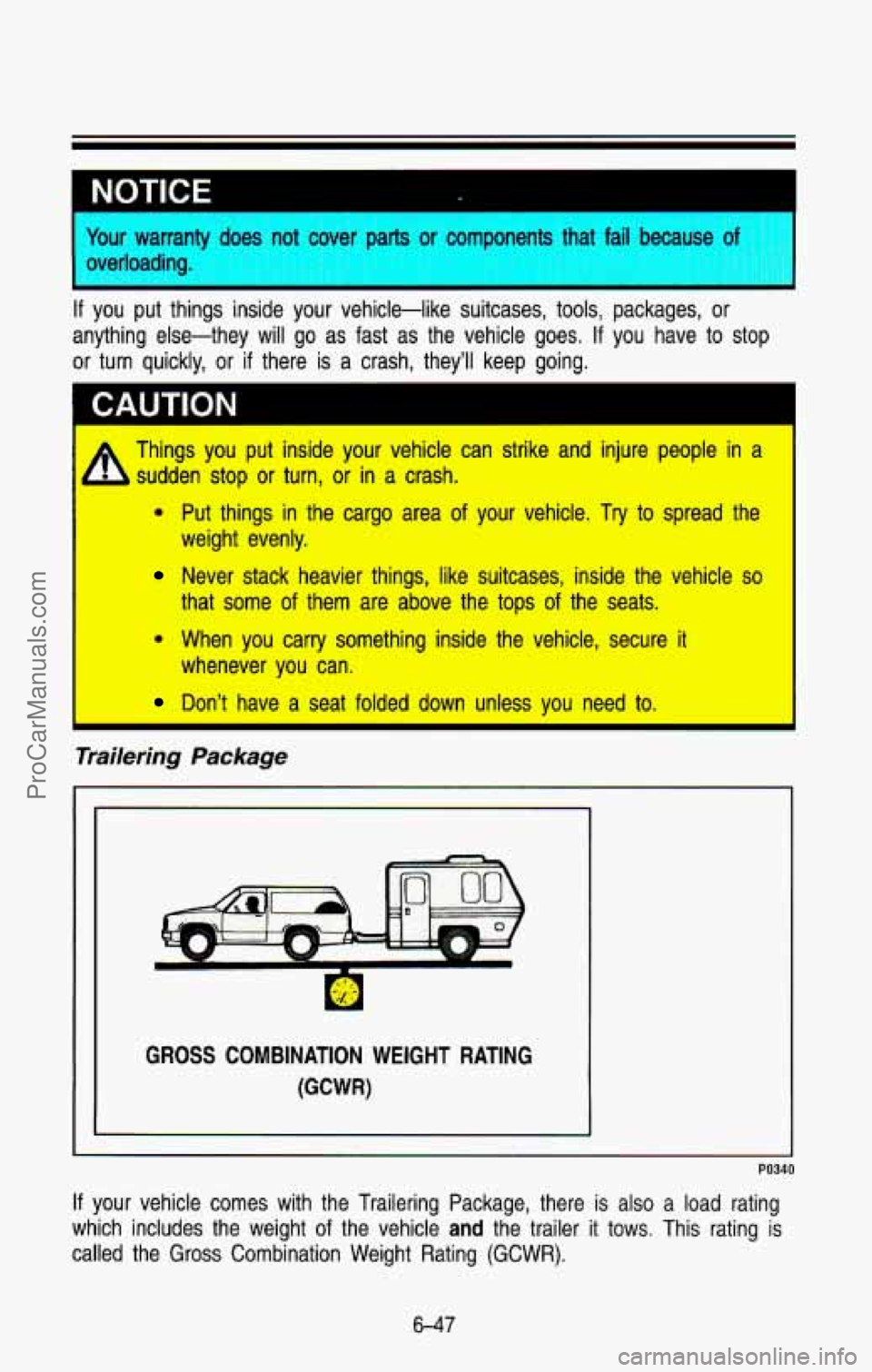
If your vehicle comes with the Trailering Package, there is al\
so a load rating
which includes the weight of the vehicle
and the trailer it tows. This rating is
called the
Gross Combination Weight Rating (GCWR).
6-47
ProCarManuals.com
Page 317 of 386
Service & Appearance Care
Tire lnspecfion and Rotation
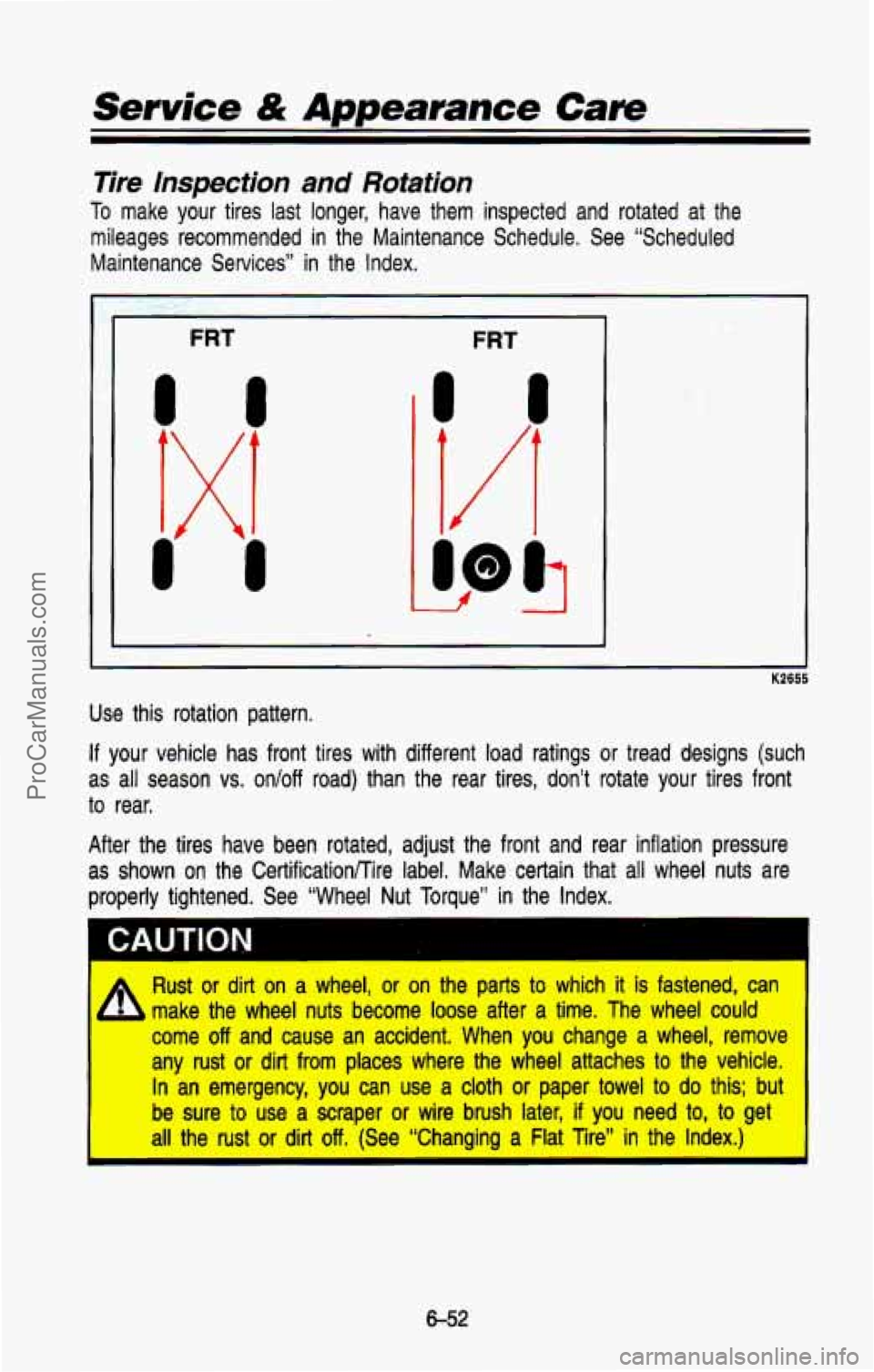
To make your tires last longer, have them inspected and rotated at the
mileages recommended in the Maintenance Schedule. See “Scheduled
Maintenance Services” in the Index.
FRT FRT
L
I I
K2655
Use this rotation pattern,
If your vehicle has front tires with different load ratings or tr\
ead designs (such
as all season vs. on/off road) than the rear tires, don’t rotate \
your tires front
to rear,
After the tires have been rotated, adjust the front and rear \
inflation pressure
as shown on the CertificationRire label. Make certain that all \
wheel nuts are
properly tightened.
See “Wheel Nut Torque” in the Index.
1 CAUTION
Rust or dirt on a wheel, or on the parts to which it is fastened, can
make the wheel nuts become loose after a time. The wheel could
come
off and cause an accident. When you change a wheel, remove
any rust or dirt from places where the wheel attaches
to the vehicle.
In an emergency, you can use a cloth or paper towel to
do this; but
be sure to use a scraper or wire brush later, if you need to, to get
I
I all the rust or dirt off. (See ‘Changing a Flat Tire” in the Index.) I
&52
ProCarManuals.com