engine CHEVROLET SUBURBAN 1993 Repair Manual
[x] Cancel search | Manufacturer: CHEVROLET, Model Year: 1993, Model line: SUBURBAN, Model: CHEVROLET SUBURBAN 1993Pages: 386, PDF Size: 21.06 MB
Page 269 of 386
If you try to do your own service work without knowing enough about it,
your vehicle could be damaged.
I
Maintenance Schedule
Section 7 of this manual, “Scheduled Maintenance Services”, explains \
the
maintenance your new vehicle needs, and when
it should be done. It also
has a
form that you can use to record the maintenance work done on your
vehicle. Be sure to read this information.
Fuel
I K228
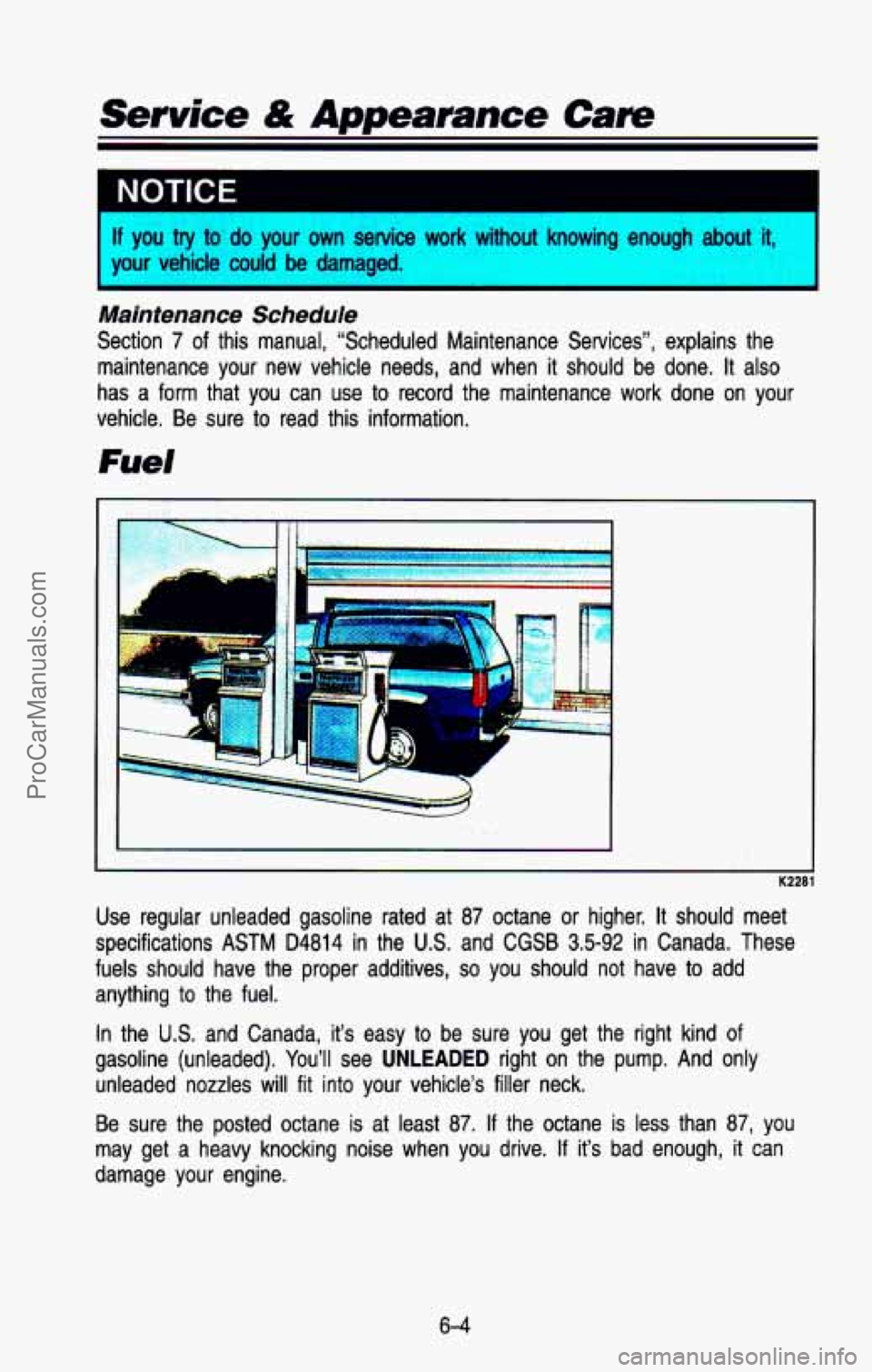
Use regular unleaded gasoline rated at 87 octane or higher. It should meet
specifications
ASTM D4814 in the U.S. and CGSB 3.5-92 in Canada. These
fuels should have the proper additives,
so you should not have to add
anything
to the fuel.
In the
US. and Canada, it’s easy to be sure you get the right kind of
gasoline (unleaded). You’ll see UNLEADED right on the pump. And only
unleaded nozzles will
fit into your vehicle’s filler neck.
Be sure the posted octane is at least
87. If the octane is less than 87, you
may get a heavy knocking noise when you drive. If it’s bad enough, it can
damage your engine.
6-4
ProCarManuals.com
Page 270 of 386
If you’re using fuel rated at 87 octane or higher and you still hear heavy
knocking, your engine needs service. But don’t worry
if you hear a little
pinging noise when you’re accelerating
or driving up a hill. That’s normal and
you don’t have to buy
a higher octane fuel to get rid of pinging. It’s the
heavy, constant knock that means you have
a problem.
What about gasoline with blending materials that contain oxygen,\
such as MTBE
or alcohol?
MTBE is “methyl tertiary-butyl ether.” Fuel that is no more th\
an 15% MTBE is
fine for your vehicle.
Ethanol is ethyl or grain alcohol. Properly-blended fuel that is no more than
10% ethanol is fine for your vehicle.
Methanol is methyl or wood alcohol,
NOTICE
Fuel that is more than 5% methanol is bad for your vehicfe. Don’t use ‘A
It can corrode metal parts in your fuel system and also damage plastic
and rubber
parts. That damage wouldn’t be covered under your warri ’y.
And even at 5% or less, there must be “cosolvents” and corrosion
eventers
in this fuel to help avoid these problems.
Gasolines for Cleaner Air
Your use of gasoline with detergent additives will help prevent depo\
sits from
forming in your engine and fuel system. That helps keep your engine in t\
une
and your emission control system working properly. It’s good \
for your vehicle,
and you’ll be doing your part for cleaner air.
Many gasolines are now blended with materials that called oxyge\
nates.
General Motors recommends that you use gasolines with these ble\
nding
materials, such as MTBE and ethanol. By doing
so, you can help clean the
air, especially in those parts of the country that have higher carbon monoxide
levels.
In addition, some gasoline suppliers are now producing reformulated \
gasolines. These gasolines are specially designed
to reduce vehicle
emissions. General Motors recommends that you use reformulated g\
asoline.
By doing
so, you can help clean the air, especially in those parts of the
country that have high
ozone levels.
You should ask your service station operators if their gasolines co\
ntain
detergents and oxygenates, and if they have been reformulated to reduce
vehicle emissions.
6-5
ProCarManuals.com
Page 271 of 386
Service & Appearance Care
Fuels in Foreign Countries
If you plan on driving in another country outside the US. or Canada,
unleaded fuel may be hard
to find. Do not use leaded gasoline. If you use
even one tank full, your emission controls won’t work well \
or at all. With
continuous use, spark plugs can get fouled, the exhaust system \
can corrode,
and your engine
oil can deteriorate quickly. Your vehicle’s three-way catalytic
converter and oxygen sensor will be damaged.
All of that means costly
repairs that wouldn’t
be covered by your warranty.
To check on fuel availability, ask an auto club, or contact a major oil
company
that does business in the country where you’ll be driving.
You can also write us at the following address for advice. Just tell us where
you’re
going and give your Vehicle Identification Number (VIN).
General Motors of Canada Ltd.
International Export Sales
Post Office Box 828
Oshawa, Ontario L1H 7N1, Canada
Fi/ling Your Tank
I PO444
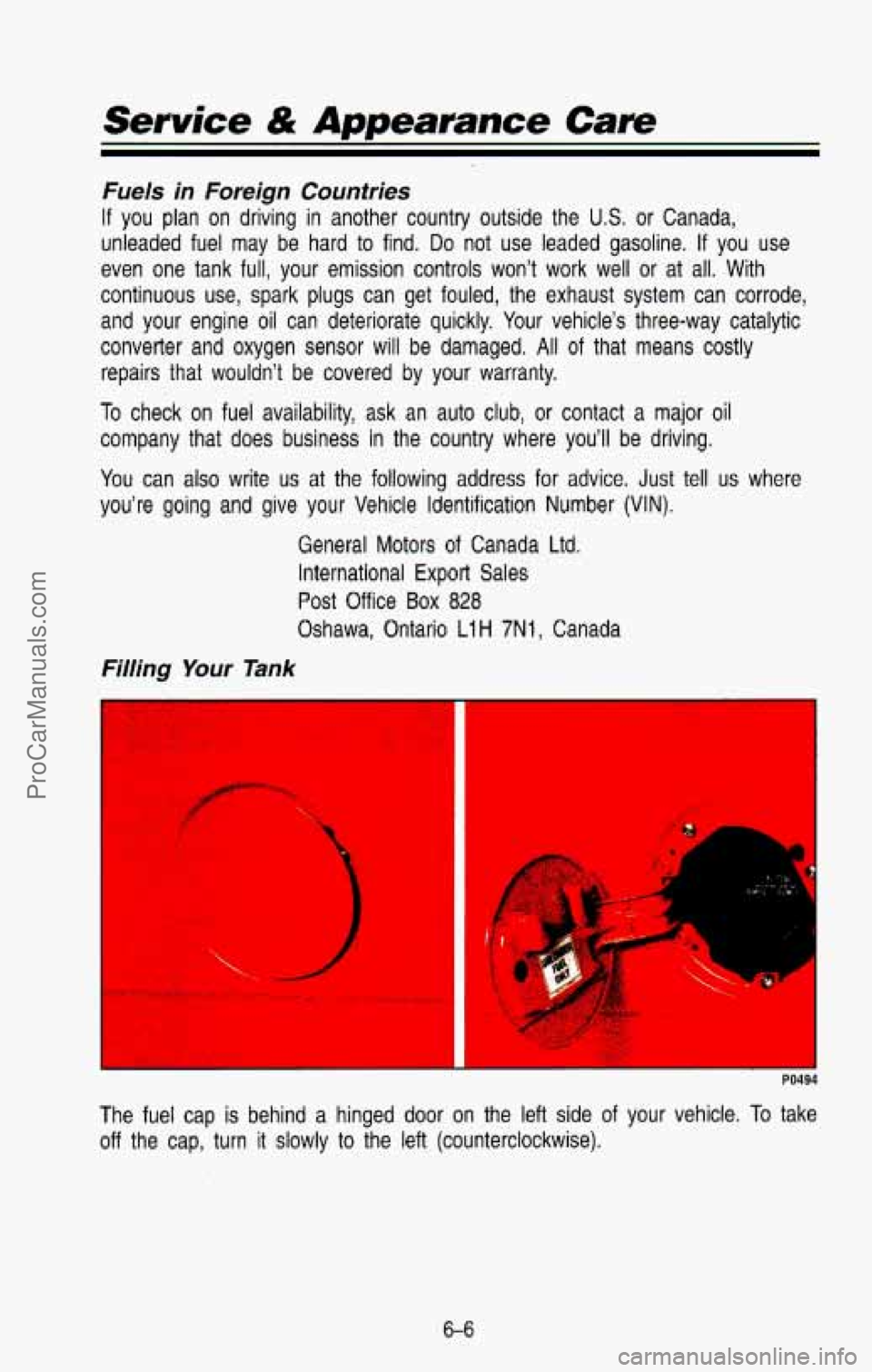
The fuel cap is behind a hinged door on the left side of your vehicle. To take
off the cap, turn it slowly to the left (counterclockwise).
6-6
ProCarManuals.com
Page 273 of 386
Service & Appearance Care
Checking Things Under the Hood
a&
.. .. .
~
Hood Release
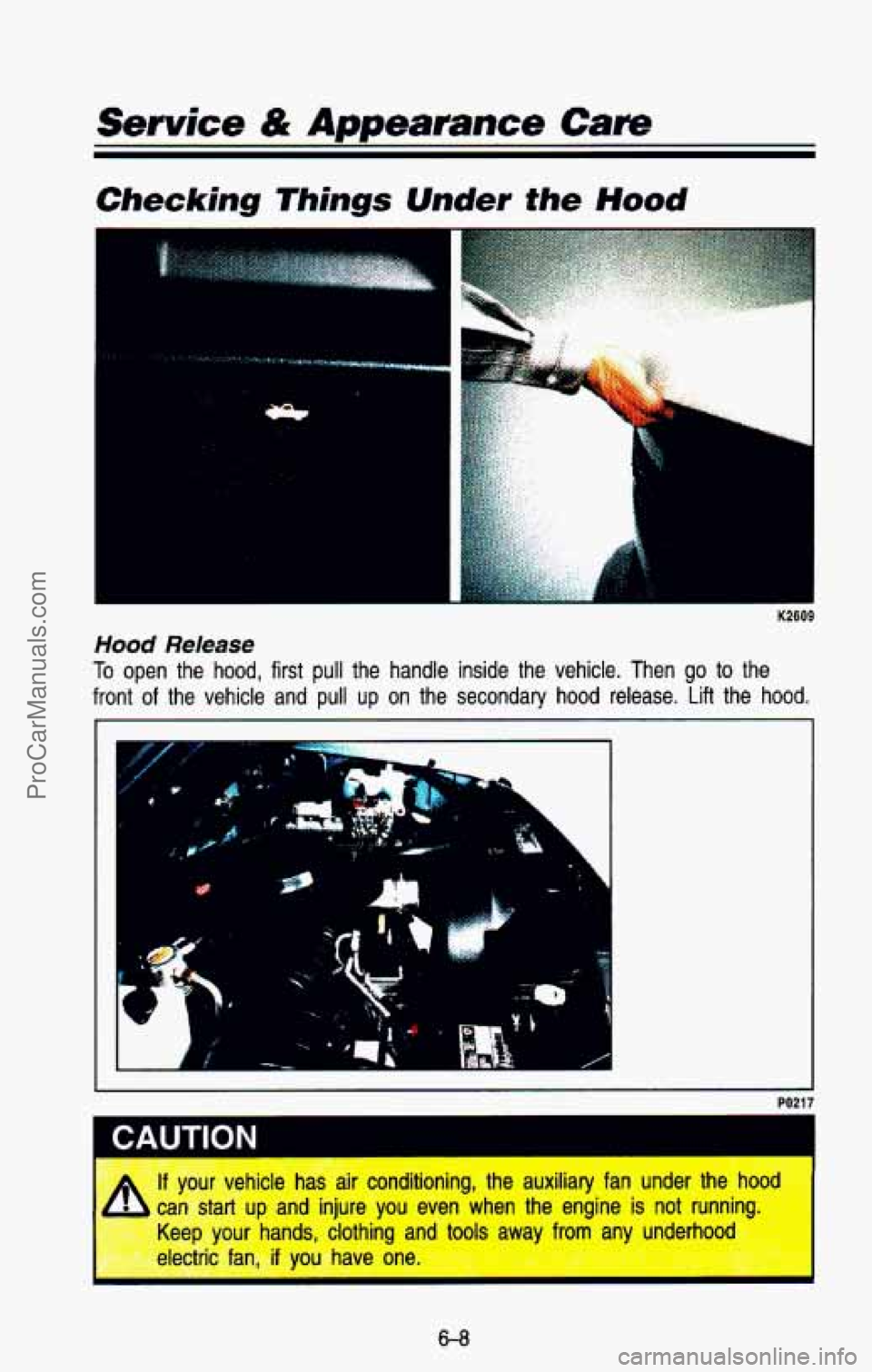
To open the hood, first pull the handle inside the vehicle. Then go to the
front of the vehicle and pull
up on the secondary hood release. Lift the hood.
PO21 7
.. .
CAUTION
A
If your vehicle h;- air conditioning, the auxiliary fan under the hood
,can
start up and injure you even when the engine is not runninc
*y,?*& 8gKeep your hands, clothing and tools awav from anv underhoo
Wk%selectric fan,
you have one
6-8
ProCarManuals.com
Page 274 of 386
~AUTION
- Things that burn can get on hot engine parts and start a fire. These
include liquids like gasoline,
oil, coolant, brake fluid, windshield
washer and other fluids, and plastic or rubber.
You or others could
be burned. Be careful not to drop or spill things that will burn onto a
Before closing the hood, be sure
all the filler caps are on properly. Then just
pull the
hood down and close it firmly.
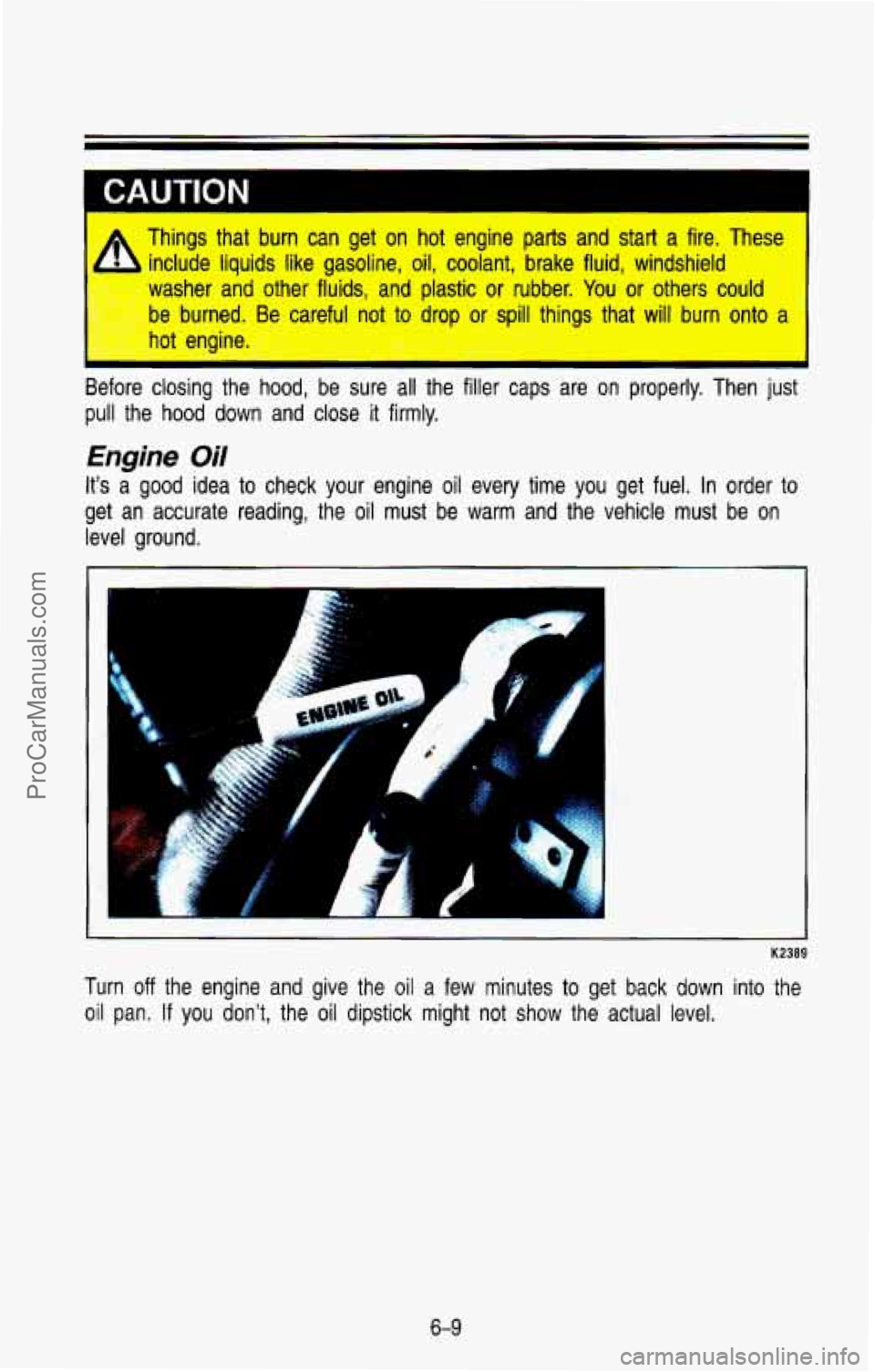
Engine Oil
It's a good idea to check your engine oil every time you get fuel. In order to
get an accurate reading, the
oil must be warm and the vehicle must be on
level ground.
Turn
off the engine and give the oil a few minutes to get back down into the
oil pan. If you don't, the oil dipstick might not show the actual level.
6-9
ProCarManuals.com
Page 275 of 386
I
K2613
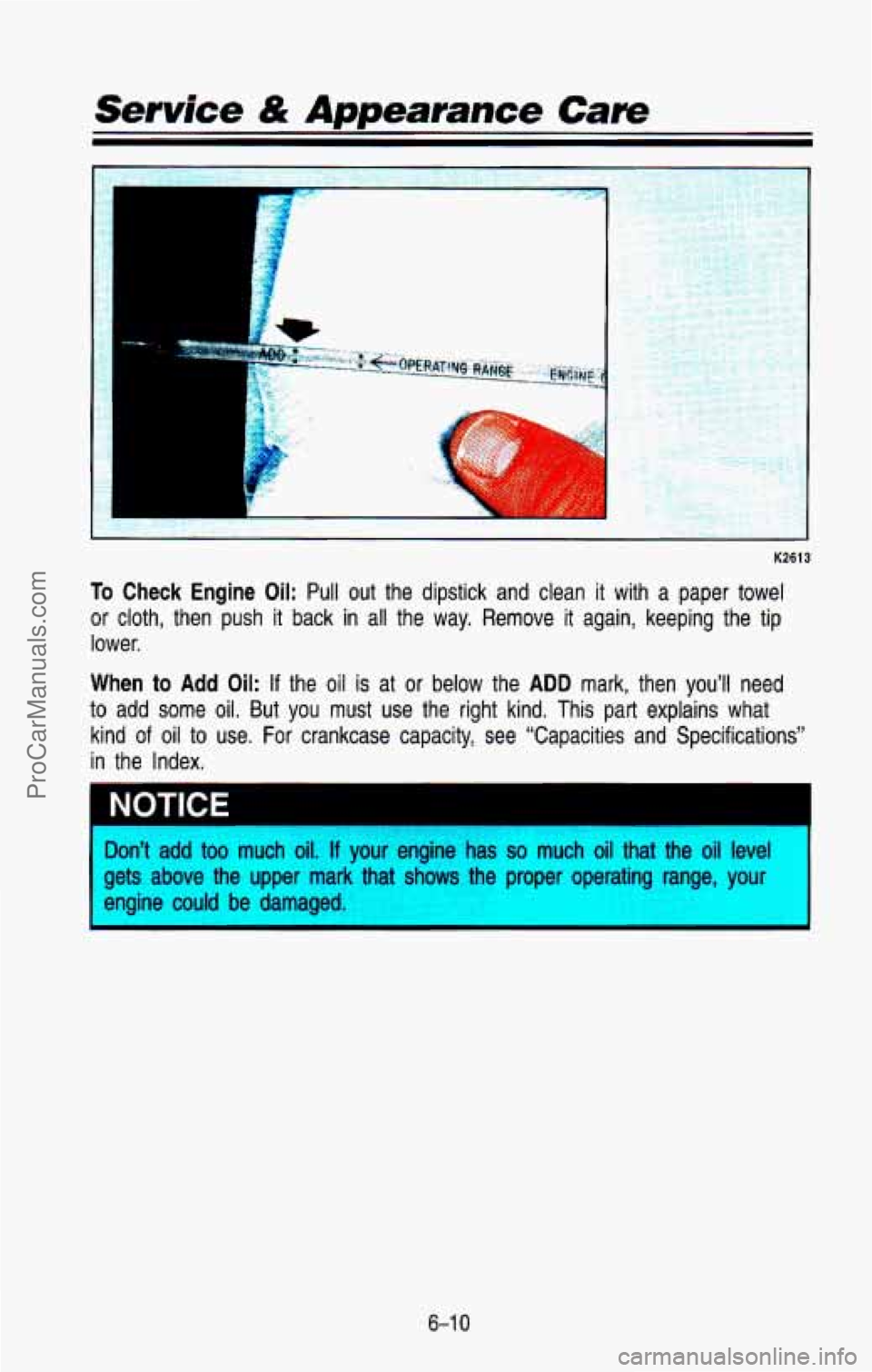
To Check Engine Oil: Pull out the dipstick and clean it with a paper towel
or cloth, then push
it back in all the way. Remove it again, keeping the tip
lower.
When to Add Oil: If the oil is at or below the ADD mark, then you’ll need
to add some oil. But you must use the right kind. This part exp\
lains what
kind
of oil to use. For crankcase capacity, see “Capacities and Specification\
s”
in the Index.
I Don’t add too much oil. If your engine has so much oil that the oil level
gets above the upper mark that
shows the proper operating range, your
engine could be damaged.
I
6-1 0
ProCarManuals.com
Page 280 of 386
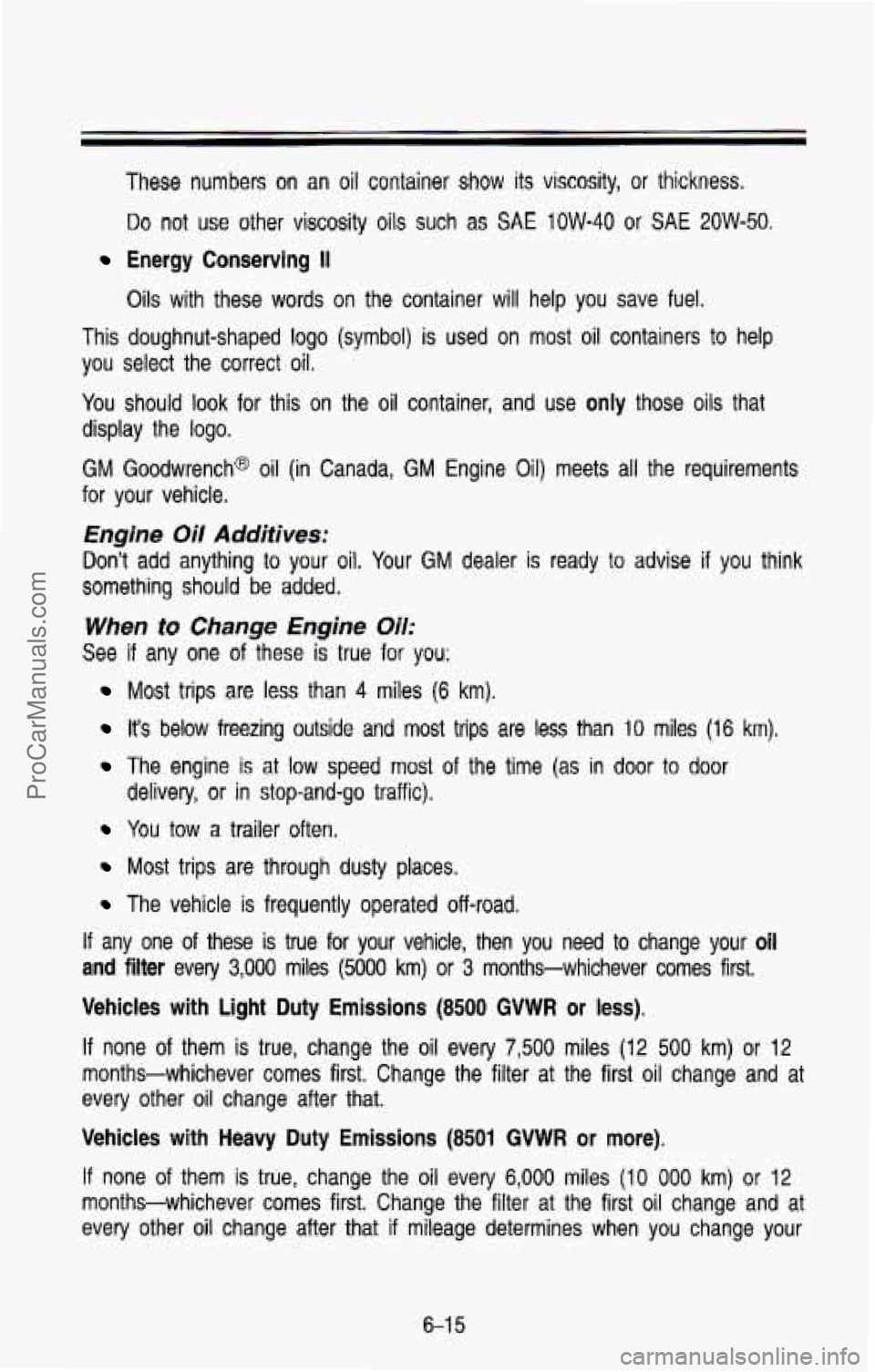
These numbers on an oil container show its viscosity, or thickness.
Do not use other viscosity oils such as SAE 1OW-40 or SAE 2OW-50.
Energy Conserving II
Oils with these words on the container will help you save fuel.
This doughnut-shaped logo (symbol) is used on most oil contai\
ners to help
you select the correct oil,
You should look for this on the
oil container, and use only those oils that
display the logo.
GM Goodwrench@ oil (in Canada, GM Engine Oil) meets all the requirements
for your vehicle.
Engine Oil Addifives:
Don't add anything to your oil. Your GM dealer is ready to advise if you think
something should be added.
When to Change Engine Oil:
See if any one of these is true for you;
Most trips are less than 4 miles (6 km).
It's below freezing outside and most trips are less than 10 miles (16 km).
The engine is at low speed most of the time (as in door to door
You tow a trailer often.
Most trips are through dusty places.
The vehicle is frequently operated off-road. delivery, or in stop-and-go
traffic),
If any one of these is true for your vehicle, then you need to change your oil
and filter every 3,000 miles (5000 km) or 3 months-whichever comes first.
Vehicles with Light Duty Emissions (8500 GVWR or less).
If none of them is true, change the oil every 7,500 miles (1 2 500 km) or 12
months-whichever comes first. Change the filter at the first oil change and at
every other oil change after that.
Vehicles with Heavy Duty Emissions (8501 GVWR or more).
If none of them is true, change the oil every 6,000 miles (1 0 000 km) or 12
months-whichever comes first. Change the filter at the first oil change and at
every other oil change after that if mileage determines when you change your
6-1 5
ProCarManuals.com
Page 281 of 386

Service & Appearance Care
oil. If time determines when you change your oil, change the filter ea\
ch time
you change your oil.
Engine Block Heater:
An engine block heater can be a big help if you have to park outside in very
cold weather,
0°F (-18°C) or colder. If your vehicle has this option, see
“Engine Block Heater” in the Index.
What to Do with Used Oil:
Used engine oil contains things that have caused skin cancer in
laboratory animals. Don’t let
used oil stay on your skin for very long.
Clean
your skin and nails with soap and water, or a good hand ,,:: :‘:-;
cleaner. Wash or properly throw away clothing or rags containing-:’-:;$ ~
used engine oil.
. ,A:<< --.
L. .. . .. ,-. f .- , L ., -J ’,: ._ - -
..:.: ;,i, j I -.. : j ,!
Used oil can be a real threat to the environment. If YOU change your own oil,
be sure to drain all free-flowing oil from the filter before disposal. Don’t ever
dispose of oil by putting it in the trash, pouring it on the ground, into sewers,
or into streams or bodies of water. Instead, recycle it by taking it to a place
that collects used oil. If you have a problem properly disposing of your used
oil, ask your dealer, a service station or a local recycling center for help.
Air Cleaner
c
PO21 6
Refer to the Maintenance Schedule to determine when to replace the air
cleaner filter and crankcase ventilation filter. See “Schedule\
d Maintenance Services” in the Index.
6-1 6
ProCarManuals.com
Page 282 of 386
I CAUTION
I 10 Operating the engine with the air cleaner off can cause you or others
to be burned. The air cleaner not only cleans the air, it
stops flame
if the engine backfires.
If it isn’t there, and the engine backfires, y(--
could be burned. Don’t drive with it
off, and be cr-ful working on
the engine with the air cleaner
off.
~
NOTICE I
If the air cleaner is off, a backfire can cause a damaging engine fire. And,
dirt
can easily get into your engine, which will damage it. Always have the
air cleaner
in place when you’re driving.
Ib remove the air cleaner filter on a gas engine, turn the wing nuts
counterclockwise. Remove the cover and change the filter.
-
Automatic Transmission Fluid
When to Check and Change:
A good time to check your automatic transmission fluid level is when the
engine
oil is changed. Refer to the Maintenance Schedule to determine when
to change your fluid. See “Scheduled Maintenance Services” in \
the Index.
How to Check:
Because this operation can be a little difficult, you may choose to have this
done at a General Motors dealership Sewice Department.
If you do it yourself, be sure to follow all the instructions here, or you could
get
a false reading on the dipstick.
NOTICE I
I
Too much or too little fluid can damage your transmission. Too much can
mean that some of the fluid could come out and fail
on hot engine parts,
I
starting a fire. Be sure to get an accurate reading if you check-your
transmission fluid.
Wait at least
30 minutes before checking the transmission fluid level if you
have been driving:
When outside temperatures are above 90°F (32°C).
At high speed for quite a while.
In heavy traffic-especially in hot weather.
While pulling a trailer.
6-1 7
ProCarManuals.com
Page 283 of 386
.
To check the transmission fluid")
Service & Appearance Care
To get the right reading, the fluid must be at normal operating \
temperature,
which is 180°F
to 200°F (82°C to 93°C).
To check the transmission fluid hot: Get the vehicle warmed up by driving
about
15 miles (24 km) when outside temperatures are above 50°F (10°C). If
it's colder than 50°F (lO°C), drive the vehicle in 0 (3rd gear) until the engine
temperature gage moves and then remains steady for ten minutes.\
Then
follow the
hot check procedures.
To check transmission fluid cold: A cold check is made after the vehicle
has been sitting for eight hours or more with the engine
off and is used only
as a reference. Let the engine run at idle for
five minutes if outside
temperatures are 50°F (IO'C) or more. If it's colder than 50°F (1 O'C), you
may have
to idle the engine longer. A hot check must follow when fluid is
added during a cold check.
To check the fluid hot or cold:
Park your vehicle on a level place.
Place the shift lever in P (Park) with the parking brake applied.
With your foot on the brake pedal, move the shift lever throu\
gh each
gear range, pausing for about three seconds
in each range. Then,
position the shift lever in
P (Park).
Let the engine run at idle for three minutes or more.
Then, without shutting off the engine, follow these steps:
1. Flip the handle up and then pull out the dipstick and wipe it with a
clean raa or DaDer towel.
PO229
2. Push it back in all the way, wait three seconds and then pull it back out
again.
6-1
8
ProCarManuals.com